gas type TOYOTA TACOMA 2011 Owners Manual (in English)
[x] Cancel search | Manufacturer: TOYOTA, Model Year: 2011, Model line: TACOMA, Model: TOYOTA TACOMA 2011Pages: 548, PDF Size: 9.84 MB
Page 73 of 548
73
1
1-4. Opening and closing the windows
Before driving
Back window (vehicles with sliding type)
■Closing the back window
Make sure that the back window is securely closed after closing it.
CAUTION
■While driving
Keep the back window closed.
This not only keeps personal belongings from being thrown out, but also pre-
vents exhaust gases from entering the vehicle.
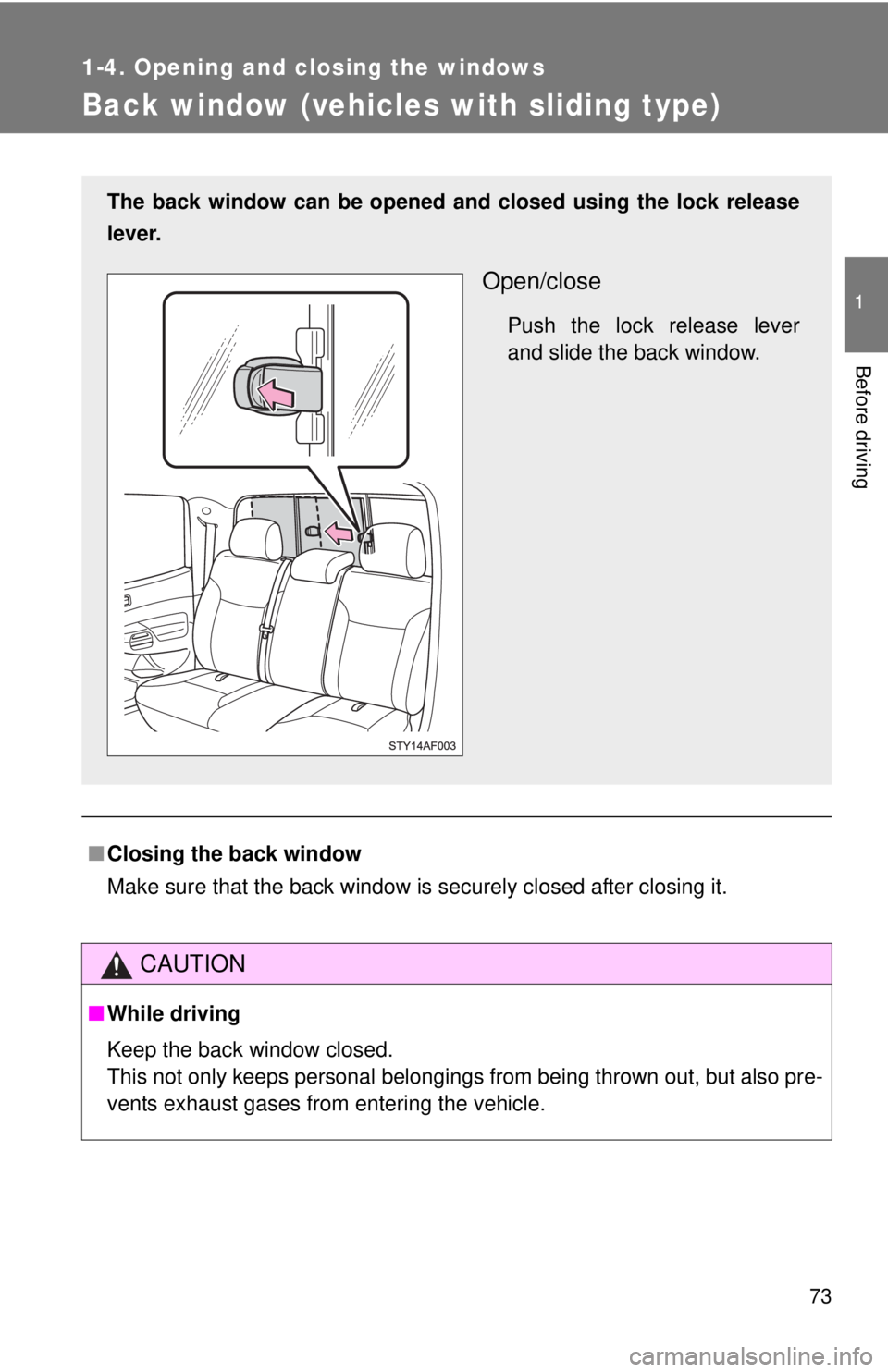
The back window can be opened and closed using the lock release
lever.
Open/close
Push the lock release lever
and slide the back window.
Page 75 of 548
75
1-5. Refueling
1
Before driving
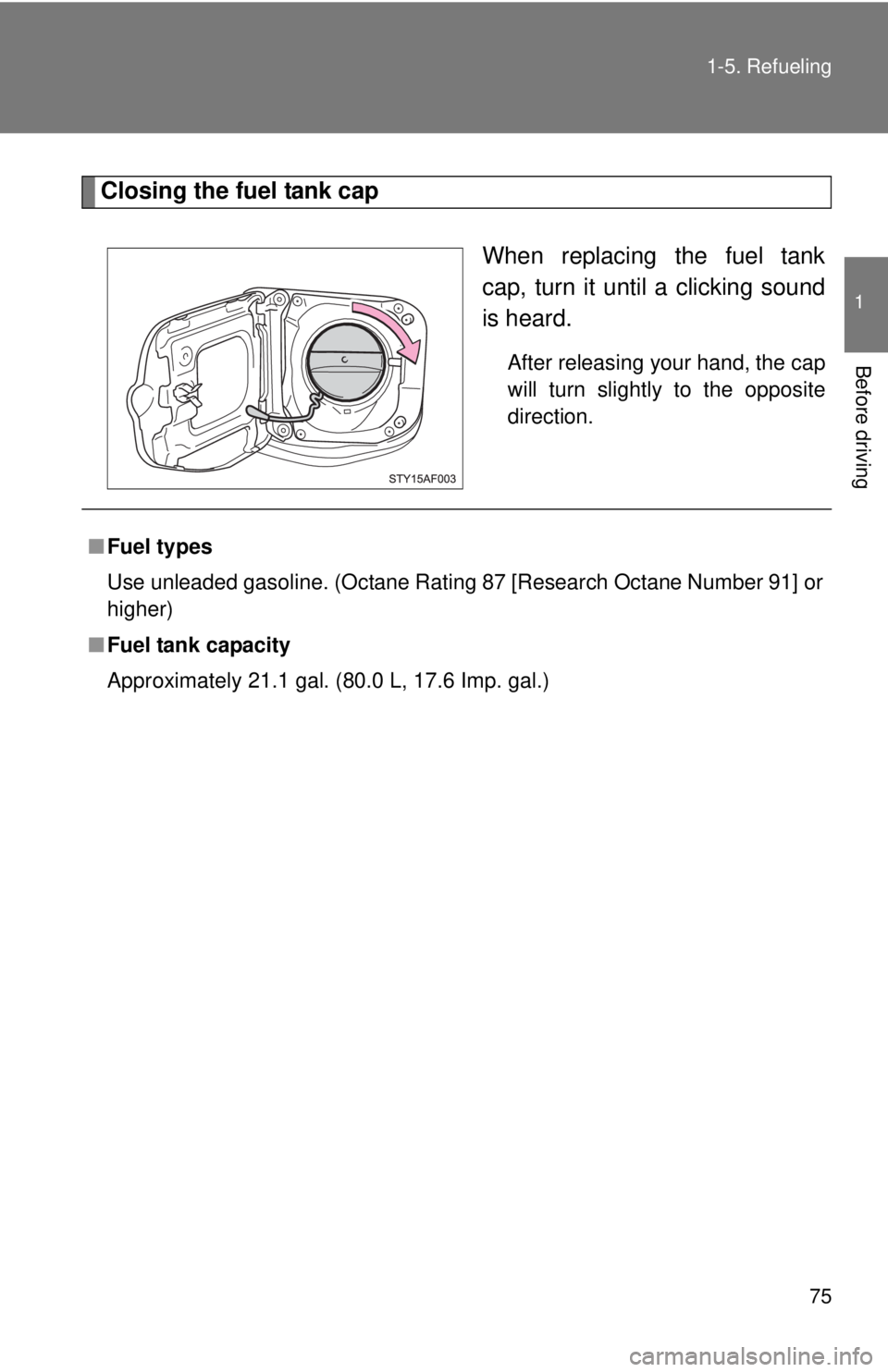
Closing the fuel tank cap
When replacing the fuel tank
cap, turn it until a clicking sound
is heard.
After releasing your hand, the cap
will turn slightly to the opposite
direction.
■Fuel types
Use unleaded gasoline. (Octane Rating 87 [Research Octane Number 91] or
higher)
■ Fuel tank capacity
Approximately 21.1 gal. (80.0 L, 17.6 Imp. gal.)
Page 85 of 548
85
1-7. Safety information
1
Before driving
In certain types of severe frontal or side impacts, the SRS airbag sys-
tem triggers the airbag inflators. A
chemical reaction in the inflators
quickly fills the airbags with non-toxic gas to help rest rain the motion
of the occupants.
■ SRS warning light
This warning light system monitors the airbag sensor assembly, front airbag
sensors, side and curtain shield airbag sensor assemblies, curtain shield air-
bag sensor assemblies (Access Cab and Double cab models), driver’s seat
position sensor, driver’s seat belt buckle switch, front passenger occupant
classification system, AIR BAG ON and AIR BAG OFF indicator lights, front
passenger’s seat position sensor (Bench type seat), front passenger’s seat
belt buckle switch, passenger airbag off switch (Access Cab models), front
seat belt pretensioner assemblies, belt tension sensor (Bench type seat),
RSCA OFF indicator light, inflators, interconnecting wiring and power
sources. ( P. 442)
■ If the SRS airbags deploy (inflate)
●Bruising and slight abrasions may result from contact with a deploying
(inflating) SRS airbag.
● A loud noise and white powder will be emitted.
● Parts of the airbag module (steering wheel hub, airbag cover and inflator)
as well as the front seats, and parts of the front and rear pillars and roof
side rail, may be hot for several minutes. The airbag itself may also be
hot.
● The front windshield may crack.
■ Operating conditions (front airbags)
●The SRS front airbag will deploy in the event of an impact that exceeds
the set threshold level (the level of force corresponding to an approxi-
mately 12-18 mph [20-30 km/h] frontal collision with a fixed wall that does
not move or deform).
However, this threshold velocity will be considerably higher if the vehicle
strikes an object, such as a parked vehicle or sign pole, which can move or
deform on impact, or if the vehicle is involved in an underride collision (e.g.
a collision in which the front of the vehicle “underrides”, or goes under, the
bed of a truck, etc.).
Page 141 of 548
141
2-1. Driving procedures
2
When driving
CAUTION
■
Exhaust gases
●Toyota does not recommend occupying the rear cargo area when it is fitted
with a slide-in camper, camper shell or other type cover while the engine is
running. This caution applies to both driving and stopped or parked situa-
tions with the engine running. Particular care should be taken to prevent
exhaust gases from entering camper bodies, trailers or other enclosures
on or around your vehicle. If exhaust fumes are detected, open all win-
dows and thoroughly ventilate the area.
■ When taking a nap in the vehicle
Always turn the engine off. Otherwise, you may accidentally move the shift
lever or depress the accelerator pedal, which could cause an accident or fire
due to engine overheating. Additionally, if the vehicle is parked in a poorly
ventilated area, exhaust gases may collect and enter the vehicle, leadin\
g to
death or a serious health hazard.
■ When braking the vehicle
●When the brakes are wet, drive more cautiously.
Braking distance increases when the brakes are wet, and may cause one
side of the vehicle to brake differently than the other side. Also the parking
brake may not securely hold the vehicle.
● If the power brake assist function does not operate, do not follow other
vehicles closely and avoid downhills or sharp turns that require braking.
In this case, braking is still possible, but it will require more force on the
pedal than usual. Braking distance may also increase.
● Do not pump the brake pedal if the engine stalls.
Each push on the brake pedal uses up the reserve for the power-assisted
brakes.
● The brake system consists of 2 individual hydraulic systems: If one of the
systems fails, the other will still operate. In this case, the brake pedal
should be depressed more firmly than usual and braking distance
becomes longer.
Do not drive your vehicle with only a single brake system. Have your
brakes fixed immediately.
Page 491 of 548
491
6-1. Specifications
6
Vehicle specifications
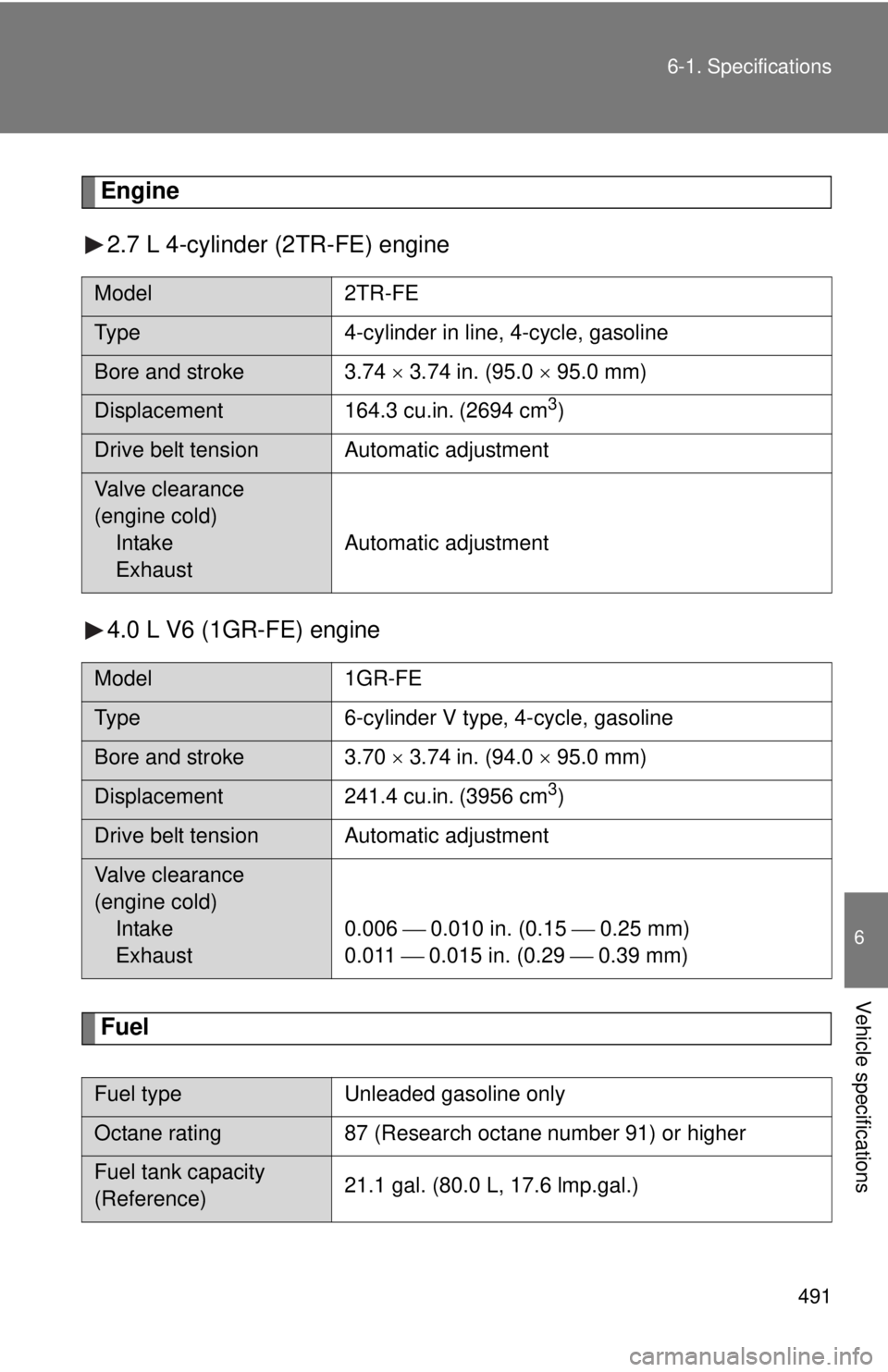
Engine
2.7 L 4-cylinder (2TR-FE) engine
4.0 L V6 (1GR-FE) engine
Fuel
Model 2TR-FE
Type 4-cylinder in line, 4-cycle, gasoline
Bore and stroke 3.74 3.74 in. (95.0 95.0 mm)
Displacement 164.3 cu.in. (2694 cm3)
Drive belt tension Automatic adjustment
Valve clearance
(engine cold)
Intake
Exhaust Automatic adjustment
Model
1GR-FE
Type 6-cylinder V type, 4-cycle, gasoline
Bore and stroke 3.70 3.74 in. (94.0 95.0 mm)
Displacement 241.4 cu.in. (3956 cm3)
Drive belt tension Automatic adjustment
Valve clearance
(engine cold)
Intake
Exhaust 0.006 0.010 in. (0.15 0.25 mm)
0.011 0.015 in. (0.29
0.39 mm)
Fuel type Unleaded gasoline only
Octane rating87 (Research octane number 91) or higher
Fuel tank capacity
(Reference) 21.1 gal. (80.0 L, 17.6 lmp.gal.)
Page 505 of 548
505
6-1. Specifications
6
Vehicle specifications
■
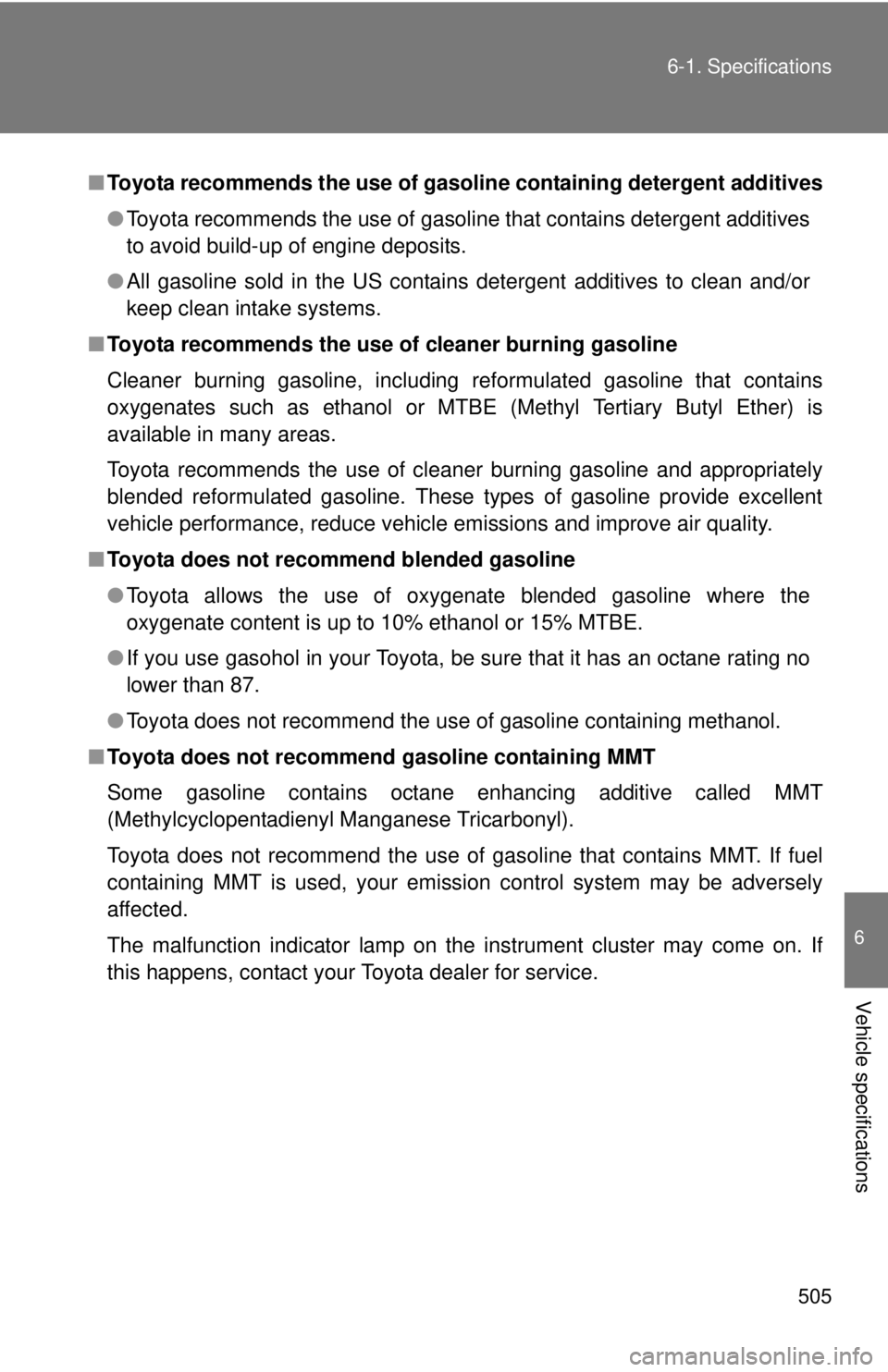
Toyota recommends the use of gaso line containing detergent additives
● Toyota recommends the use of gasoline that contains detergent additives
to avoid build-up of engine deposits.
● All gasoline sold in the US contains detergent additives to clean and/or
keep clean intake systems.
■ Toyota recommends the use of cleaner burning gasoline
Cleaner burning gasoline, including reformulated gasoline that contains
oxygenates such as ethanol or MTBE (Methyl Tertiary Butyl Ether) is
available in many areas.
Toyota recommends the use of cleaner burning gasoline and appropriately
blended reformulated gasoline. These types of gasoline provide excellent
vehicle performance, reduce vehicle emissions and improve air quality.
■ Toyota does not recommend blended gasoline
●Toyota allows the use of oxygenate blended gasoline where the
oxygenate content is up to 10% ethanol or 15% MTBE.
● If you use gasohol in your Toyota, be sure that it has an octane rating no
lower than 87.
● Toyota does not recommend the use of gasoline containing methanol.
■ Toyota does not recommend gasoline containing MMT
Some gasoline contains octane enhancing additive called MMT
(Methylcyclopentadienyl Manganese Tricarbonyl).
Toyota does not recommend the use of gasoline that contains MMT. If fuel
containing MMT is used, your emission control system may be adversely
affected.
The malfunction indicator lamp on the instrument cluster may come on. If
this happens, contact your Toyota dealer for service.
Page 506 of 548

506 6-1. Specifications
NOTICE
■Notice on fuel quality
●Do not use improper fuels.
If improper fuels are used the engine will be damaged.
● Do not use leaded gasoline.
Leaded gasoline can cause damage to your vehicle’s three-way catalytic
converters causing the emission control system to malfunction.
● Do not use gasohol other than that stated here.
Other gasohol may cause fuel system damage or vehicle performance
problems.
● Using unleaded gasoline with an octane number or rating lower than the
level previously stated will cause persistent heavy knocking.
At worst, this will lead to engine damage.
■ Fuel-related poor driveability
If after using a different type of fuel, poor driveability is encountered (poor
hot starting, vaporization, engine knocking, etc.), discontinue the use of that
type of fuel.
■ When refueling with gasohol
Take care not to spill gasohol.
It can damage your vehicle’s paint.
Page 537 of 548
537
Alphabetical index
Engine coolan
t temperature
gauge ..................................... 157
Engine immobilizer system ...... 78
Engine oil Capacity ............................... 492
Checking .............................. 374
Preparing and checking before winter ................................. 209
Warning light ................ 442, 444
Engine oil maintenance data ........................................ 377
Engine switch .......................... 144
Event data recorder ................ 439
Floor mat .................................. 332
Fluid Brake .................................... 380
Washer ................................. 386
Fog lights
Replacing light bulbs ............ 421
Switch ................................... 166
Wattage ................................ 503
Four-wheel drive system Front-wheel drive control switch ................................. 177
Front fog lights Replacing light bulbs ............ 421
Switch ................................... 166
Wattage ................................ 503
Front passenger occupant classification system.............. 99
Front passenger's seat belt reminder light ........................ 444
Front passenger’s seat belt
warning buzzer...................... 444
Front seats Adjustment ............................. 45
Front side marker lights Replacing light bulbs ............ 422
Switch ................................... 164
Wattage ................................ 503 Front turn signal lights
Lever .....................................153
Replacing light bulbs .............423
Switch....................................153
Wattage .................................503
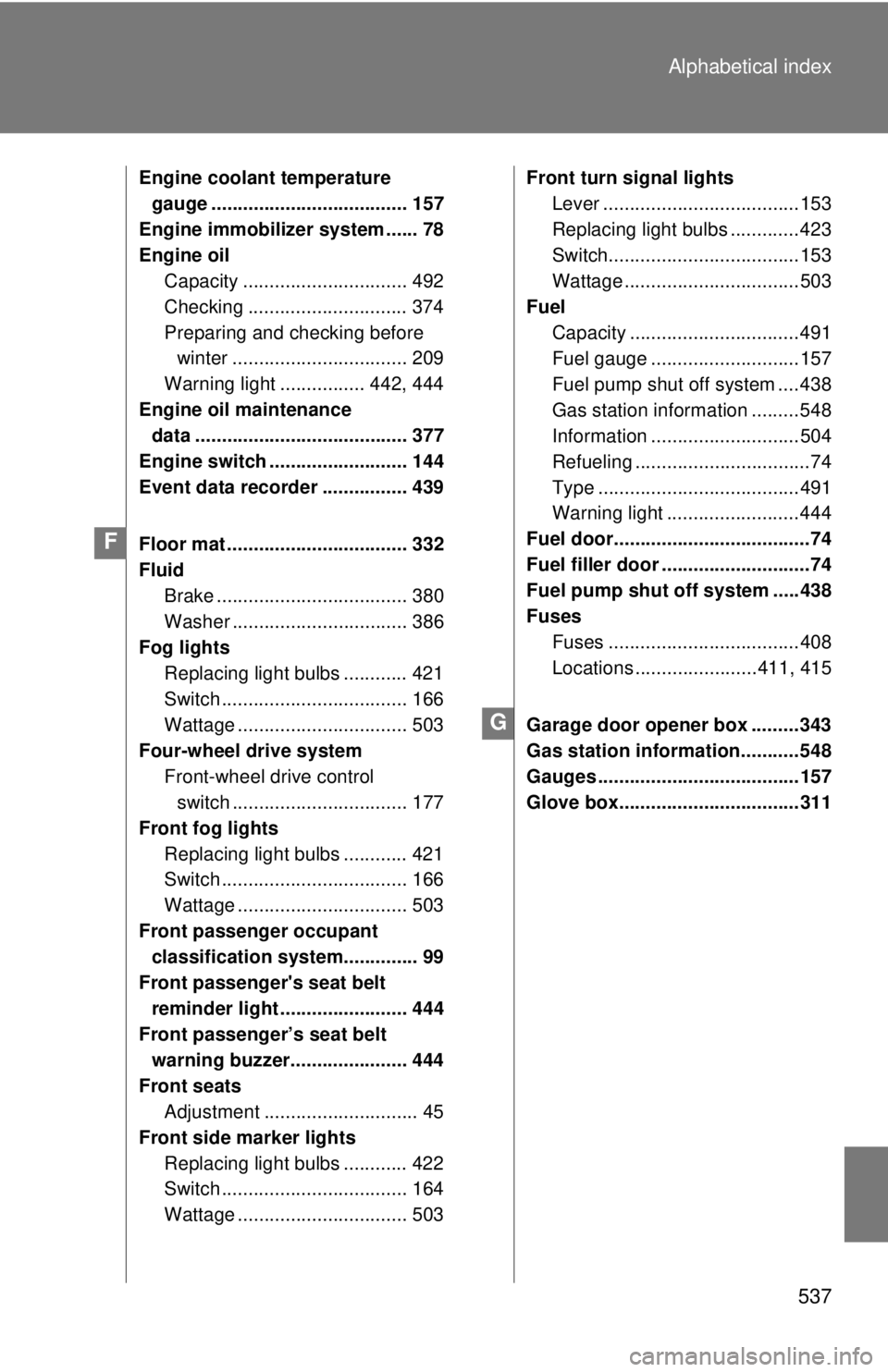
Fuel Capacity ................................491
Fuel gauge ............................157
Fuel pump shut off system ....438
Gas station information .........548
Information ............................504
Refueling .................................74
Type ......................................491
Warning light .........................444
Fuel door.....................................74
Fuel filler door ............................74
Fuel pump shut off system .....438
Fuses Fuses ....................................408
Locations .......................411, 415
Garage door opener box .........343
Gas station information...........548
Gauges ......................................157
Glove box..................................311
F
G
Page 548 of 548
548
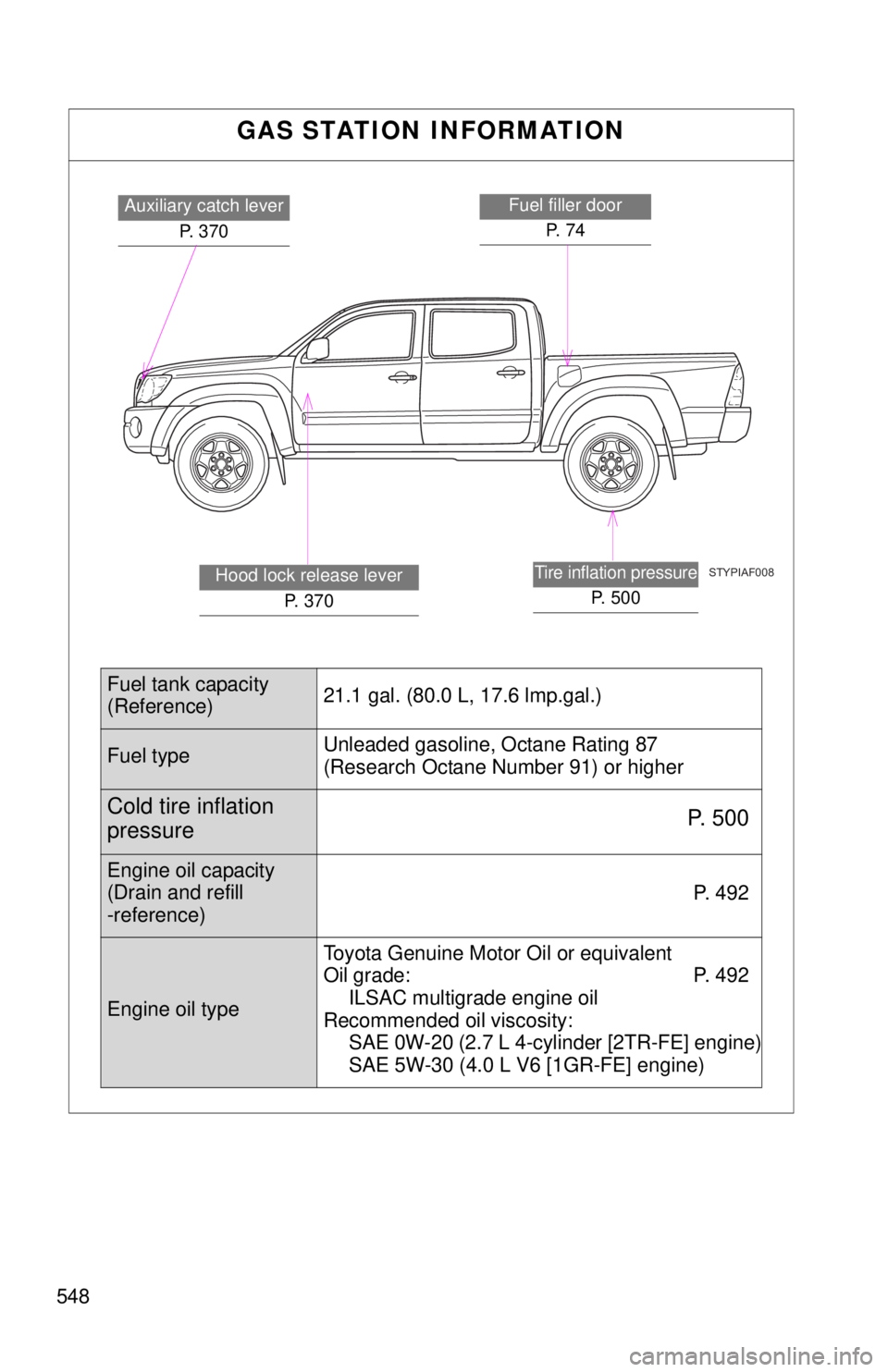
GAS STATION INFORMATION
STYPIAF008
Auxiliary catch leverP. 370Fuel filler doorP. 7 4
Tire inflation pressure
P. 500
Hood lock release lever P. 3 7 0
Fuel tank capacity
(Reference) 21.1 gal. (80.0 L, 17.6 lmp.gal.)
Fuel typeUnleaded gasoline, Octane Rating 87
(Research Octane Number 91) or higher
Cold tire inflation
pressure
P. 5 0 0
Engine oil capacity
(Drain and refill
-reference) P. 4 9 2
Engine oil typeToyota Genuine Motor Oil or equivalent
Oil grade:
P. 492
ILSAC multigrade engine oil
Recommended oil viscosity: SAE 0W-20 (2.7 L 4-cylinder [2TR-FE] engine)
SAE 5W-30 (4.0 L V6 [1GR-FE] engine)