width TOYOTA TACOMA 2014 Owners Manual (in English)
[x] Cancel search | Manufacturer: TOYOTA, Model Year: 2014, Model line: TACOMA, Model: TOYOTA TACOMA 2014Pages: 601, PDF Size: 11.67 MB
Page 177 of 601
177
2-4. Using other
driving systems
2
When driving
Using the rear view monitor system
■ Screen description
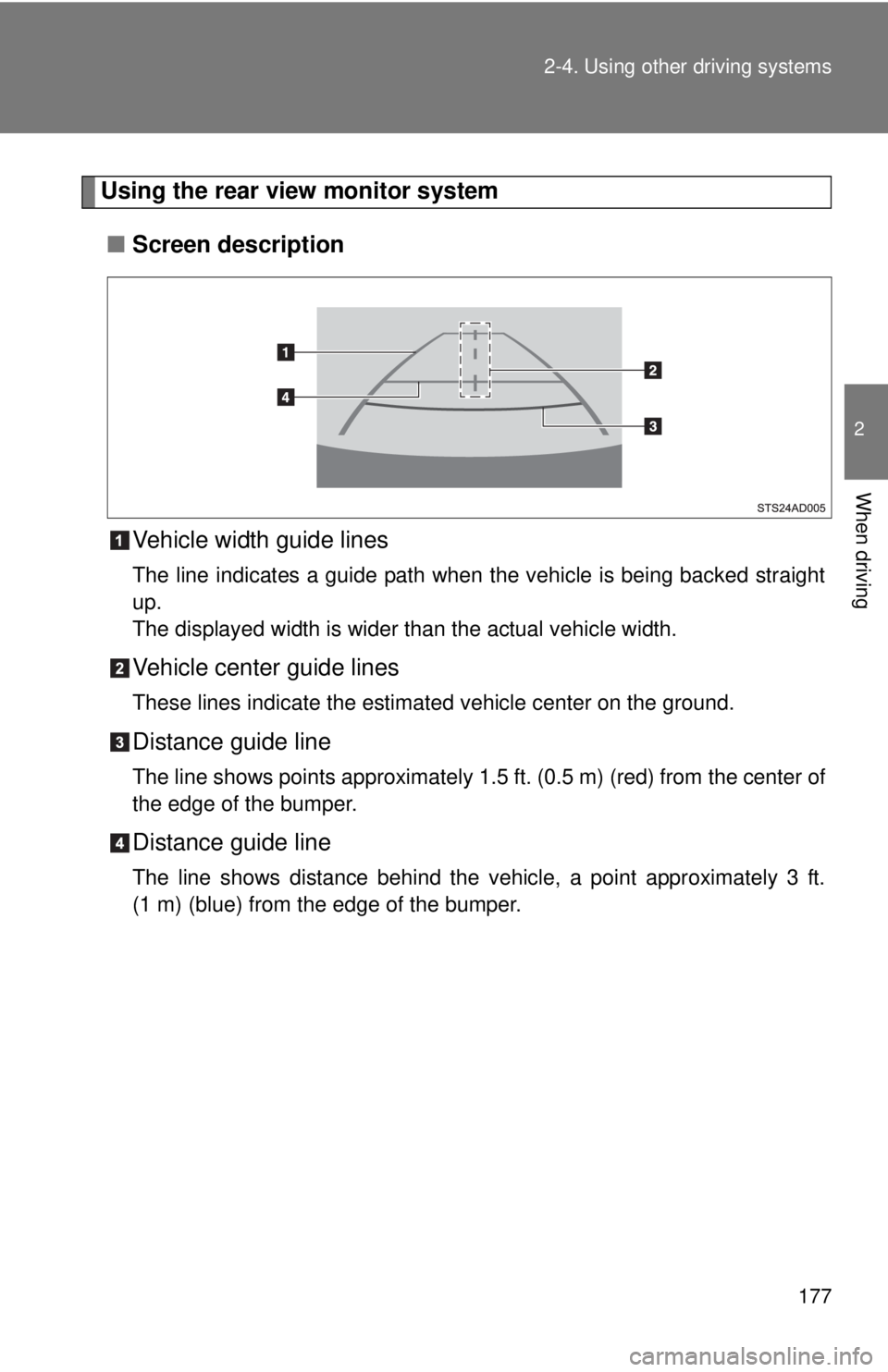
Vehicle width guide lines
The line indicates a guide path when the vehicle is being backed straight
up.
The displayed width is wider than the actual vehicle width.
Vehicle center guide lines
These lines indicate the estimated vehicle center on the ground.
Distance guide line
The line shows points approximately 1.5 ft . (0.5 m) (red) from the center of
the edge of the bumper.
Distance guide line
The line shows distance behind the vehicle, a point approximately 3 ft.
(1 m) (blue) from the edge of the bumper.
Page 180 of 601
180 2-4. Using other driving systems
■Differences between the screen and the actual road
The distance guide lines and the v ehicle width guide lines may not
actually be parallel with the divi ding lines of the parking space,
even when they appear to be so. Be sure to check visually.
The distances between the vehicl e width guide lines and the left
and right dividing lines of the parking space may not be equal,
even when they appear to be so. Be sure to check visually.
The distance guide lines give a distance guide for flat road sur-
faces. In any of the following situations, there is a margin of error
between the fixed guide lines on the screen and the actual dis-
tance/course on the road.
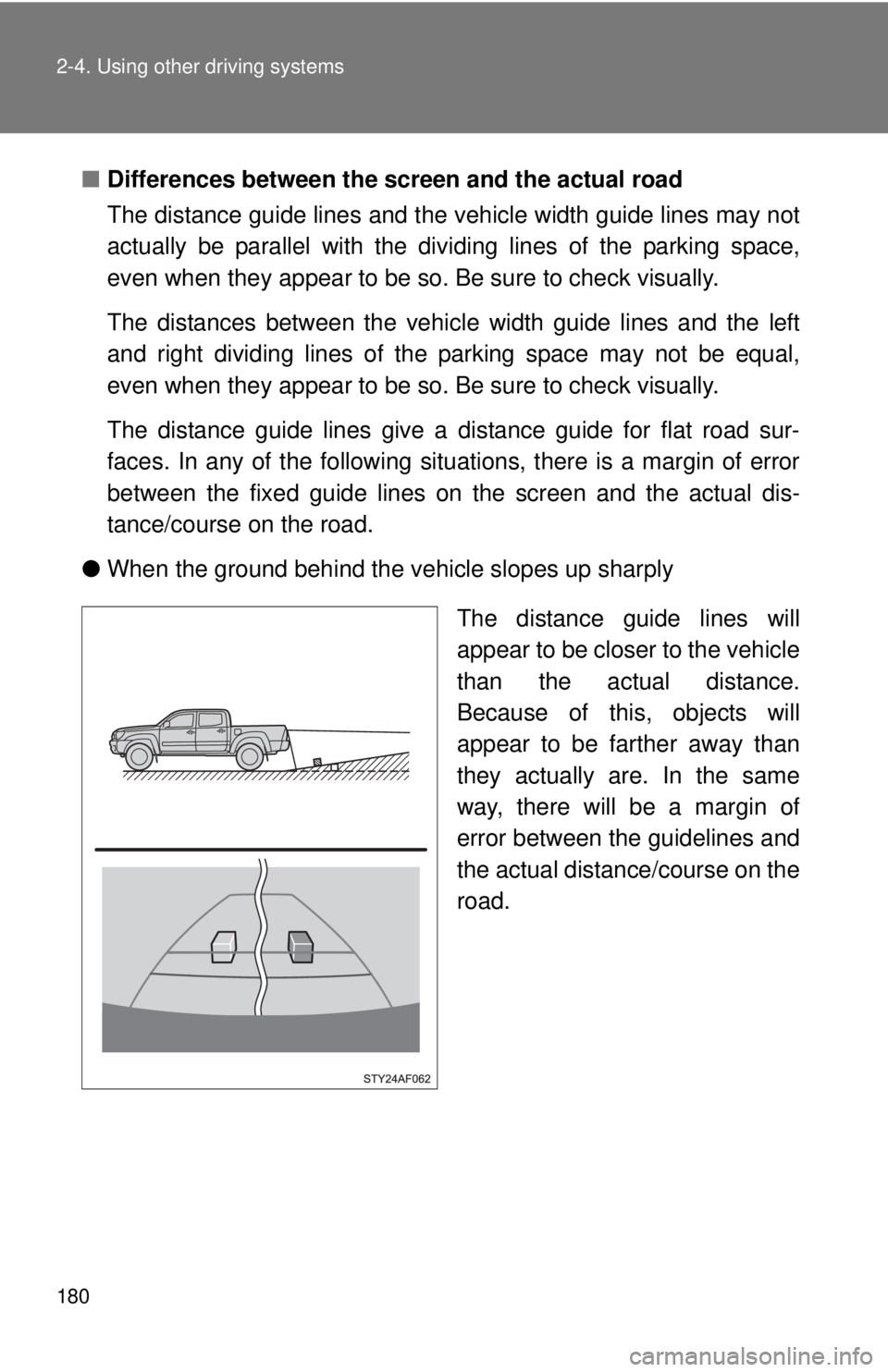
● When the ground behind the vehicle slopes up sharply
The distance guide lines will
appear to be closer to the vehicle
than the actual distance.
Because of this, objects will
appear to be farther away than
they actually are. In the same
way, there will be a margin of
error between the guidelines and
the actual distance/course on the
road.
Page 182 of 601
182 2-4. Using other driving systems
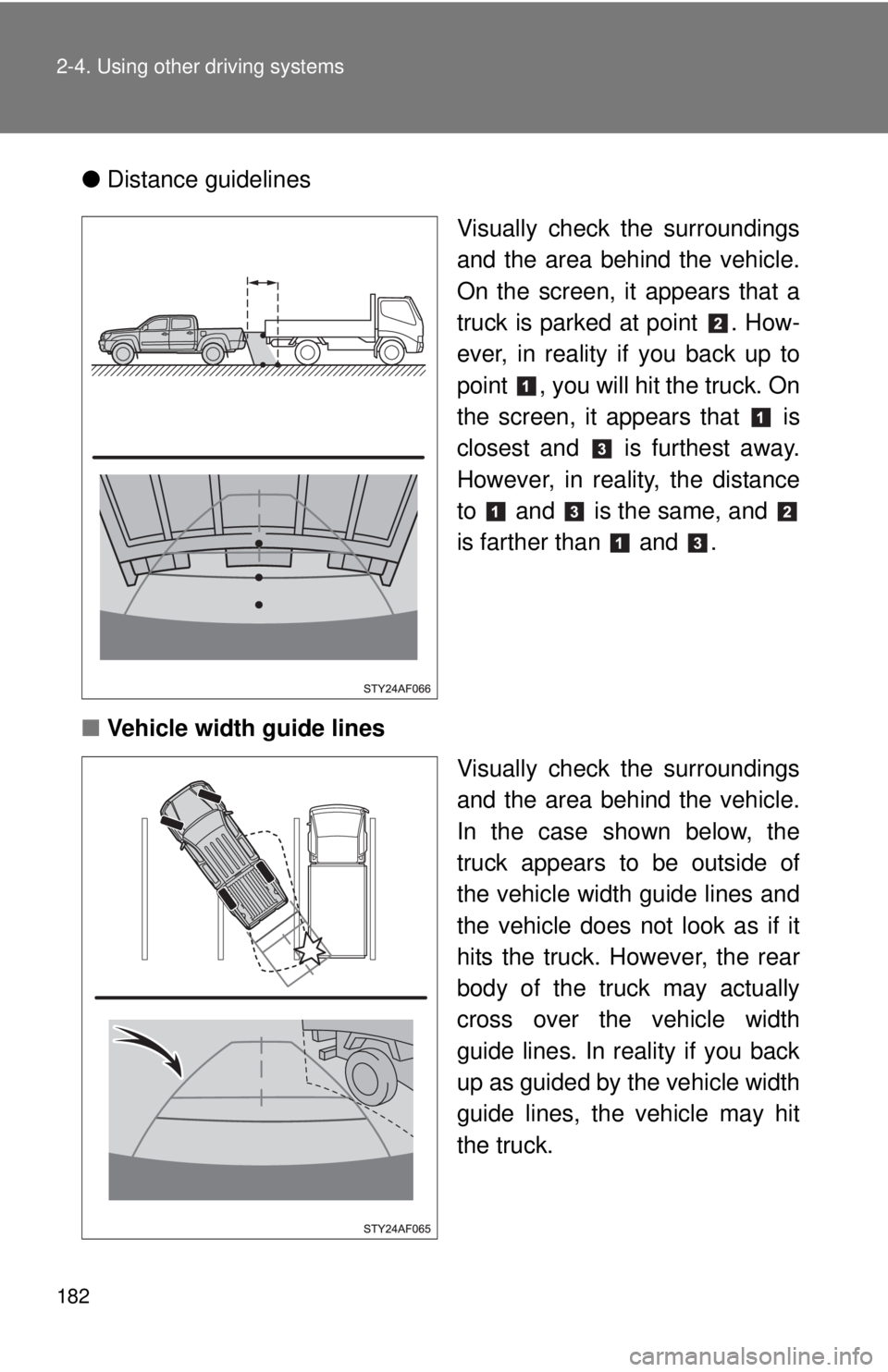
●Distance guidelines
Visually check the surroundings
and the area behind the vehicle.
On the screen, it appears that a
truck is parked at point . How-
ever, in reality if you back up to
point , you will hit the truck. On
the screen, it appears that is
closest and is furthest away.
However, in reality, the distance
to and is the same, and
is farther than and .
■ Vehicle width guide lines
Visually check the surroundings
and the area behind the vehicle.
In the case shown below, the
truck appears to be outside of
the vehicle width guide lines and
the vehicle does not look as if it
hits the truck. However, the rear
body of the truck may actually
cross over the vehicle width
guide lines. In reality if you back
up as guided by the vehicle width
guide lines, the vehicle may hit
the truck.
Page 444 of 601
444
4-3. Do-it-yourself maintenance
Wheels
If a wheel is bent, cracked or heavily corroded, it should be
replaced.
Otherwise, the tire may separate from the wheel or cause loss of
handling control.
■Wheel selection
When replacing wheels, care should be taken to ensure that
they are equivalent to those removed in load capacity, diameter,
rim width, and inset
*.
Replacement wheels are available at your Toyota dealer.
*: Conventionally referred to as “offset”.
Toyota does not recommend using:
● Wheels of different sizes or types
● Used wheels
● Bent wheels that have been straightened
■ Wheel precautions
●Use only Toyota wheel nuts and wrench designed for use with
your aluminum wheels.
● When rotating, repairing or changing your tires, check that the
wheel nuts are still tight after driving 100 miles (160 km).
● Be careful not to damage the aluminum wheels when using
tire chains.
● Use only Toyota genuine balance weights or equivalent and a
plastic or rubber hammer when balancing your wheels.
Page 527 of 601
526
6-1. Specifications
Maintenance data (fuel, oil level, etc.)
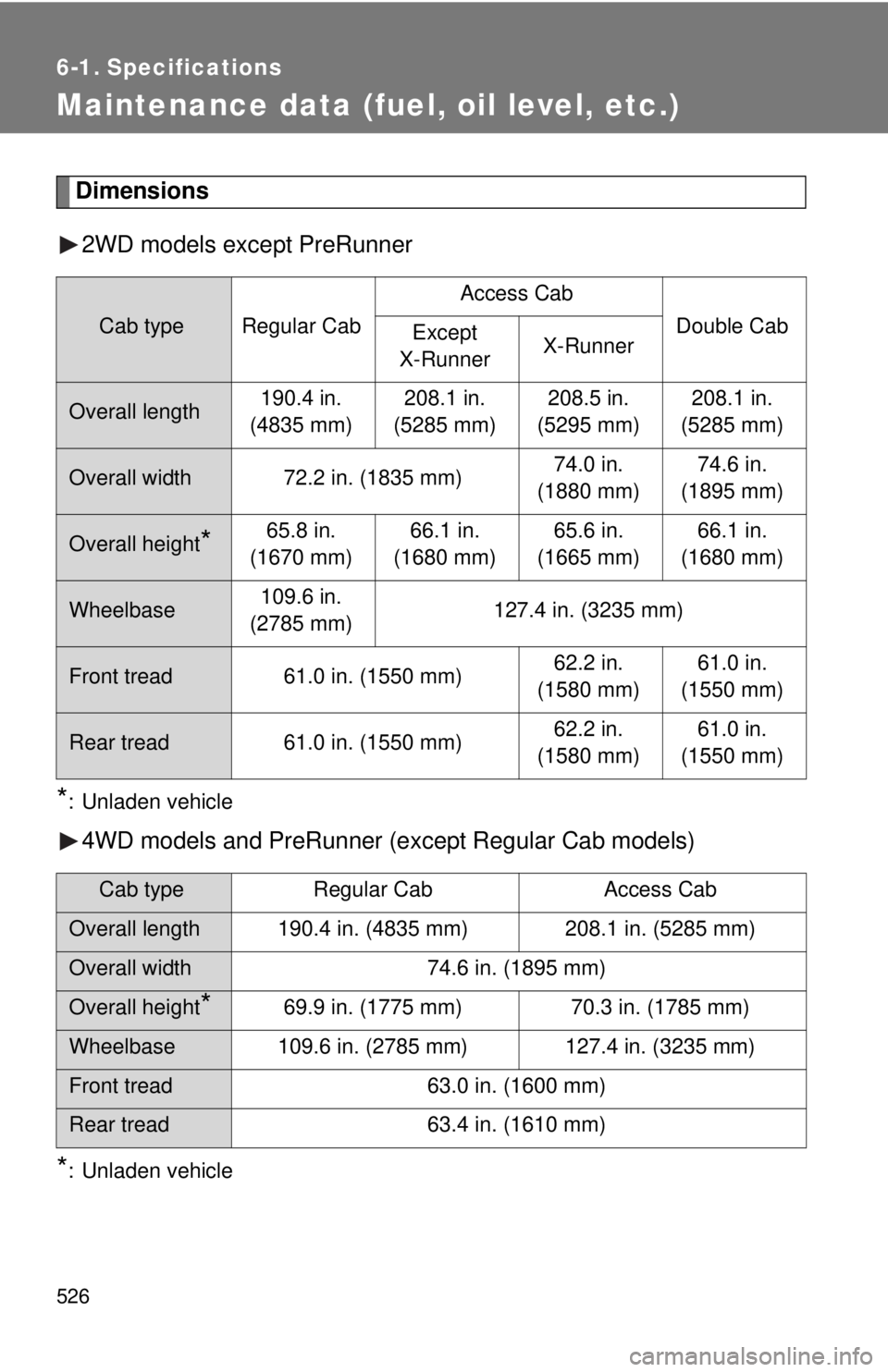
Dimensions2WD models except PreRunner
*: Unladen vehicle
4WD models and PreRunner (except Regular Cab models)
*: Unladen vehicle
Cab typeRegular Cab
Access Cab
Double CabExcept
X-RunnerX-Runner
Overall length 190.4 in.
(4835 mm) 208.1 in.
(5285 mm) 208.5 in.
(5295 mm) 208.1 in.
(5285 mm)
Overall width 72.2 in. (1835 mm) 74.0 in.
(1880 mm) 74.6 in.
(1895 mm)
Overall height*65.8 in.
(1670 mm) 66.1 in.
(1680 mm) 65.6 in.
(1665 mm) 66.1 in.
(1680 mm)
Wheelbase 109.6 in.
(2785 mm) 127.4 in. (3235 mm)
Front tread
61.0 in. (1550 mm) 62.2 in.
(1580 mm) 61.0 in.
(1550 mm)
Rear tread 61.0 in. (1550 mm) 62.2 in.
(1580 mm) 61.0 in.
(1550 mm)
Cab typeRegular CabAccess Cab
Overall length 190.4 in. (4835 mm) 208.1 in. (5285 mm)
Overall width 74.6 in. (1895 mm)
Overall height*69.9 in. (1775 mm)70.3 in. (1785 mm)
Wheelbase 109.6 in. (2785 mm) 127.4 in. (3235 mm)
Front tread 63.0 in. (1600 mm)
Rear tread63.4 in. (1610 mm)
Page 528 of 601
527
6-1. Specifications
6
Vehicle specifications
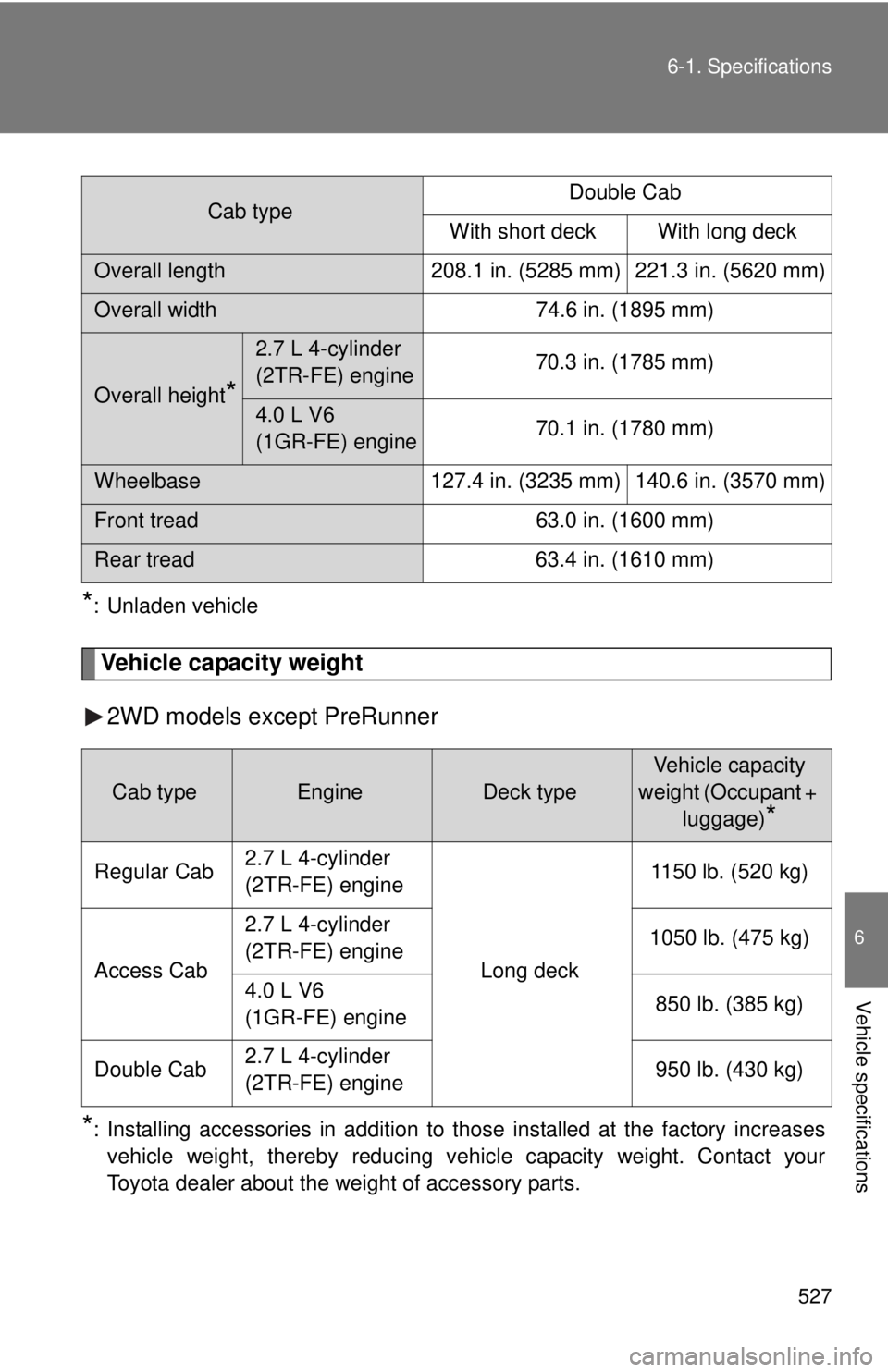
*: Unladen vehicle
Vehicle capacity weight
2WD models except PreRunner
*: Installing accessories in addition to those installed at the factory increases vehicle weight, thereby reducing vehicle capacity weight. Contact your
Toyota dealer about the weight of accessory parts.
Cab typeDouble Cab
With short deckWith long deck
Overall length 208.1 in. (5285 mm) 221.3 in. (5620 mm)
Overall width 74.6 in. (1895 mm)
Overall height*
2.7 L 4-cylinder
(2TR-FE) engine70.3 in. (1785 mm)
4.0 L V6
(1GR-FE) engine70.1 in. (1780 mm)
Wheelbase
127.4 in. (3235 mm) 140.6 in. (3570 mm)
Front tread 63.0 in. (1600 mm)
Rear tread63.4 in. (1610 mm)
Cab typeEngineDeck type
Vehicle capacity
weight (Occupant + luggage)
*
Regular Cab2.7 L 4-cylinder
(2TR-FE) engine
Long deck
1150 lb. (520 kg)
Access Cab
2.7 L 4-cylinder
(2TR-FE) engine1050 lb. (475 kg)
4.0 L V6
(1GR-FE) engine850 lb. (385 kg)
Double Cab
2.7 L 4-cylinder
(2TR-FE) engine950 lb. (430 kg)
Page 553 of 601
552 6-1. Specifications
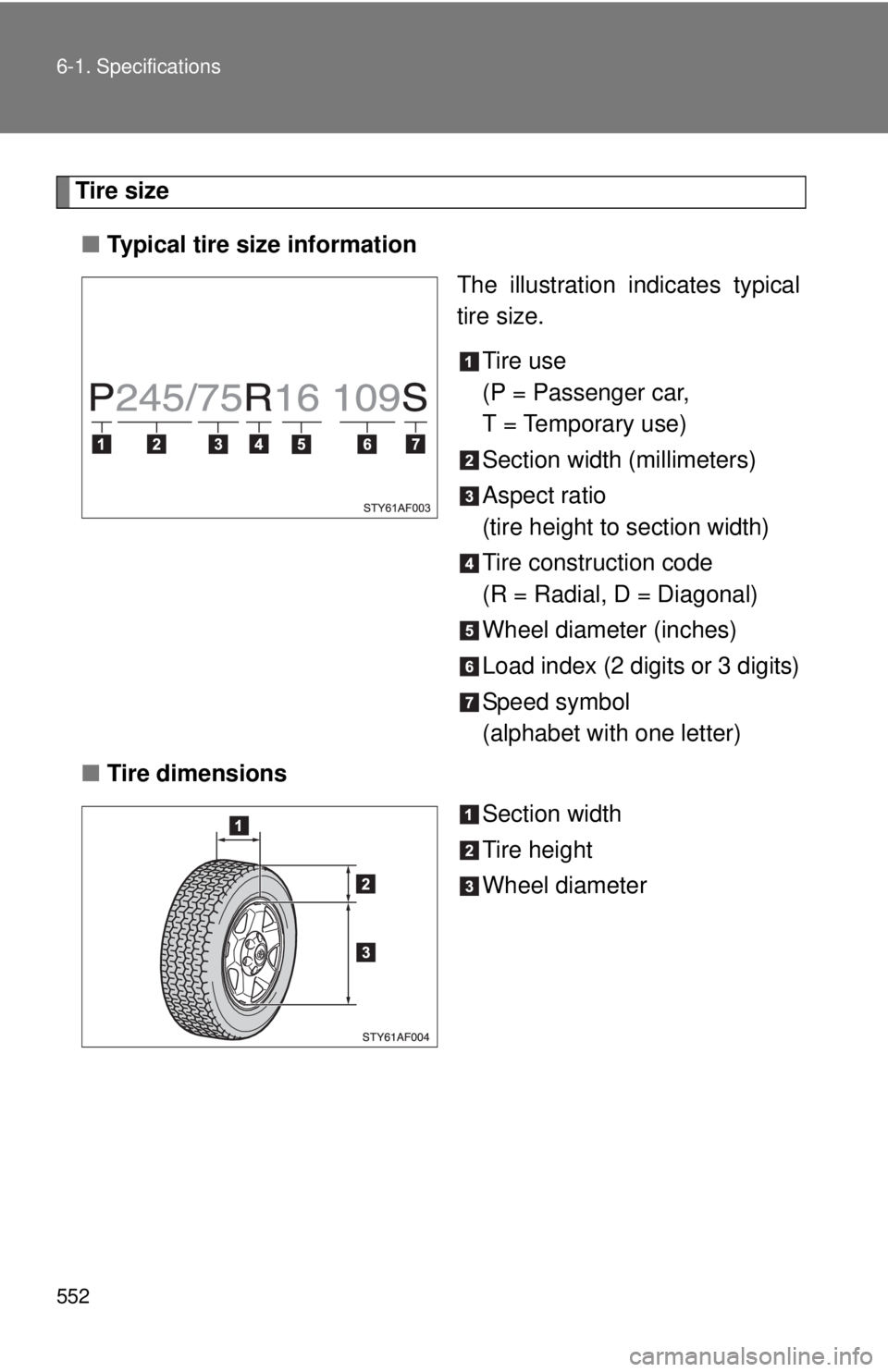
Tire size■ Typical tire size information
The illustration indicates typical
tire size.
Tire use
(P = Passenger car,
T = Temporary use)
Section width (millimeters)
Aspect ratio
(tire height to section width)
Tire construction code
(R = Radial, D = Diagonal)
Wheel diameter (inches)
Load index (2 digits or 3 digits)
Speed symbol
(alphabet with one letter)
■ Tire dimensions
Section width
Tire height
Wheel diameter
Page 554 of 601
553
6-1. Specifications
6
Vehicle specifications
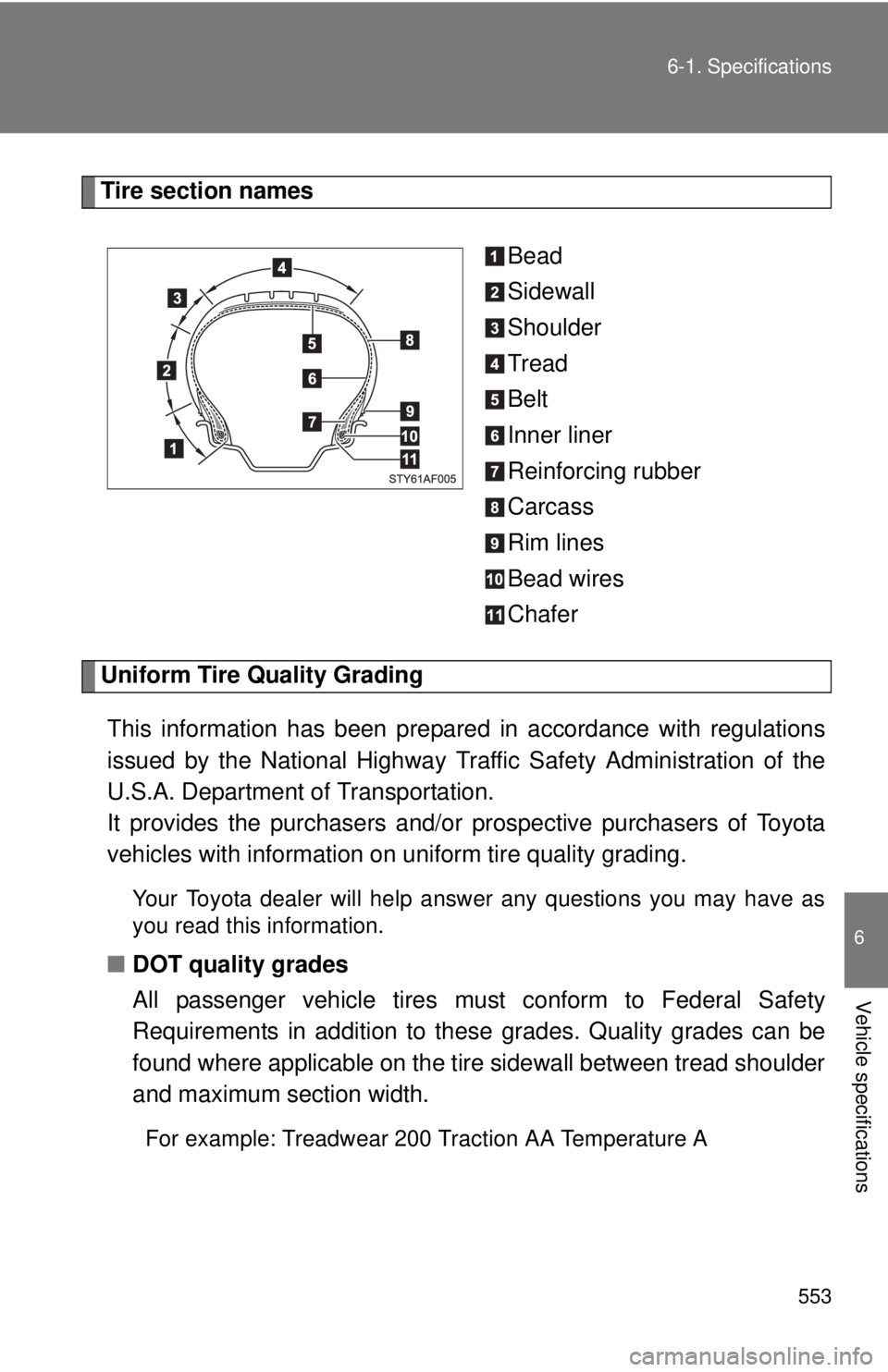
Tire section names
Bead
Sidewall
Shoulder
Tread
Belt
Inner liner
Reinforcing rubber
Carcass
Rim lines
Bead wires
Chafer
Uniform Tire Quality GradingThis information has been prepared in accordance with regulations
issued by the National Highway Tr affic Safety Administration of the
U.S.A. Department of Transportation.
It provides the purchasers and/or prospective purchasers of Toyota
vehicles with information on uniform tire quality grading.
Your Toyota dealer will help answ er any questions you may have as
you read this information.
■ DOT quality grades
All passenger vehicle tires mu st conform to Federal Safety
Requirements in addition to these grades. Quality grades can be
found where applicable on the tire sidewall between tread shoulder
and maximum section width.
For example: Treadwear 200 Traction AA Temperature A
Page 557 of 601
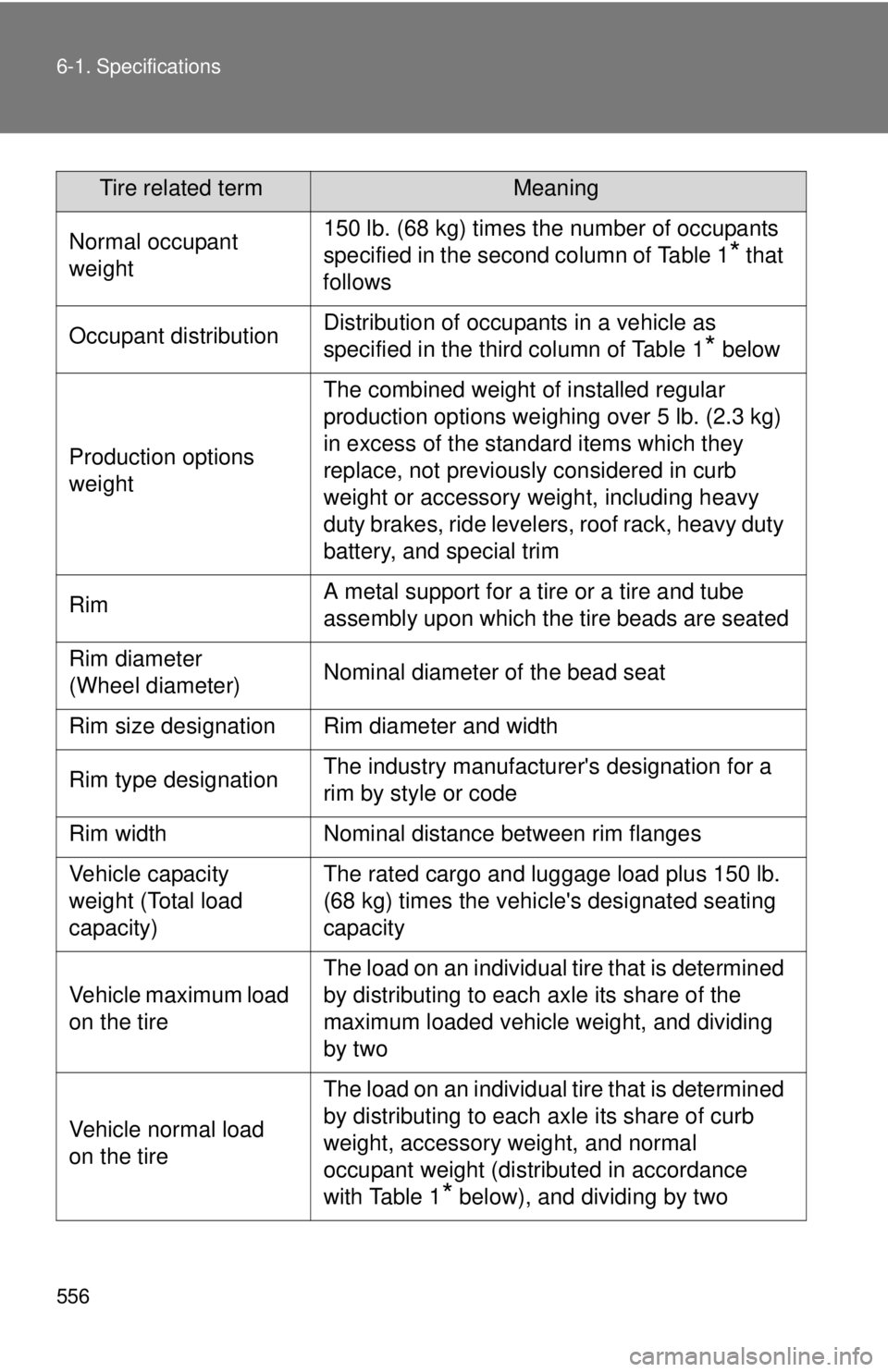
556 6-1. Specifications
Normal occupant
weight150 lb. (68 kg) times the number of occupants
specified in the second column of Table 1
* that
follows
Occupant distributionDistribution of occupants in a vehicle as
specified in the third column of Table 1
* below
Production options
weight
The combined weight of installed regular
production options weighing over 5 lb. (2.3 kg)
in excess of the standard items which they
replace, not previously considered in curb
weight or accessory weight, including heavy
duty brakes, ride levelers, roof rack, heavy duty
battery, and special trim
RimA metal support for a tire or a tire and tube
assembly upon which the tire beads are seated
Rim diameter
(Wheel diameter)Nominal diameter of the bead seat
Rim size designationRim diameter and width
Rim type designationThe industry manufacturer's designation for a
rim by style or code
Rim widthNominal distance between rim flanges
Vehicle capacity
weight (Total load
capacity)The rated cargo and luggage load plus 150 lb.
(68 kg) times the vehicl e's designated seating
capacity
Vehicle maximum load
on the tire
The load on an individual tire that is determined
by distributing to each axle its share of the
maximum loaded vehicle weight, and dividing
by two
Vehicle normal load
on the tire
The load on an individual tire that is determined
by distributing to each axle its share of curb
weight, accessory weight, and normal
occupant weight (distr ibuted in accordance
with Table 1
* below), and dividing by two
Tire related termMeaning
Page 559 of 601
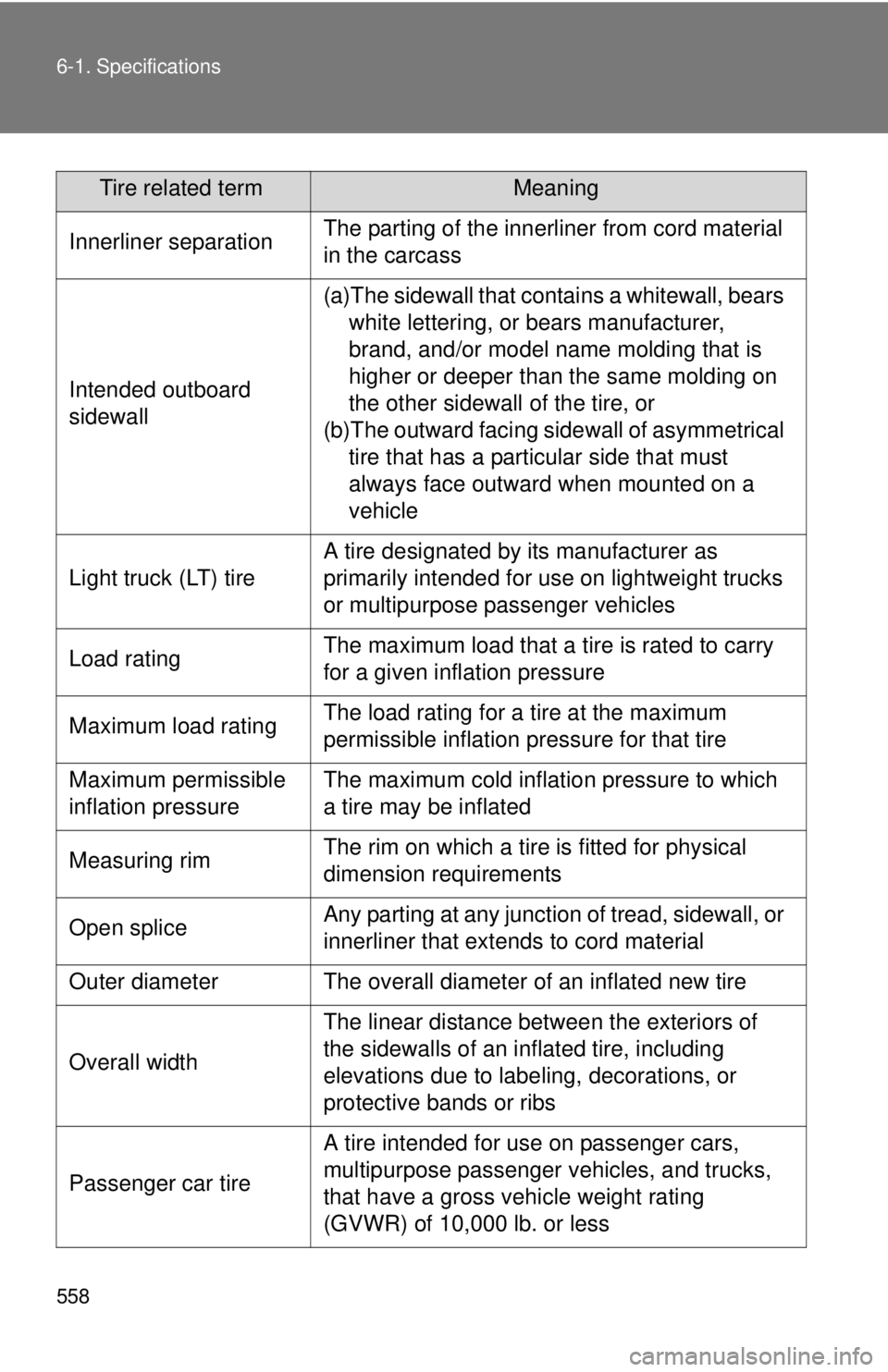
558 6-1. Specifications
Innerliner separationThe parting of the innerliner from cord material
in the carcass
Intended outboard
sidewall
(a)The sidewall that contains a whitewall, bears white lettering, or bears manufacturer,
brand, and/or model name molding that is
higher or deeper than the same molding on
the other sidewall of the tire, or
(b)The outward facing sidewall of asymmetrical tire that has a particular side that must
always face outward when mounted on a
vehicle
Light truck (LT) tire
A tire designated by its manufacturer as
primarily intended for use on lightweight trucks
or multipurpose passenger vehicles
Load ratingThe maximum load that a tire is rated to carry
for a given inflation pressure
Maximum load ratingThe load rating for a tire at the maximum
permissible inflation pressure for that tire
Maximum permissible
inflation pressureThe maximum cold inflation pressure to which
a tire may be inflated
Measuring rimThe rim on which a tire is fitted for physical
dimension requirements
Open spliceAny parting at any junction of tread, sidewall, or
innerliner that extends to cord material
Outer diameterThe overall diameter of an inflated new tire
Overall width
The linear distance between the exteriors of
the sidewalls of an inflated tire, including
elevations due to labeling, decorations, or
protective bands or ribs
Passenger car tire
A tire intended for use on passenger cars,
multipurpose passenger vehicles, and trucks,
that have a gross vehicle weight rating
(GVWR) of 10,000 lb. or less
Tire related termMeaning