trailer TOYOTA TACOMA 2015 Owners Manual (in English)
[x] Cancel search | Manufacturer: TOYOTA, Model Year: 2015, Model line: TACOMA, Model: TOYOTA TACOMA 2015Pages: 590, PDF Size: 10.76 MB
Page 3 of 590

1
2
3
4
5
6
7
3
2-3. Operating the lights and wipers
Headlight switch .................. 152
Fog light switch ................... 155
Windshield wipers and washer .............................. 156
2-4. Using other driving systems Cruise control ...................... 162
Rear view monitor system... 166
Four-wheel drive system ..... 177
Active traction control system .............................. 181
AUTO LSD system.............. 183
Rear differential lock system .............................. 185
Downhill Assist Control system .............................. 188
Clutch start cancel switch ... 190
Driving assist systems ........ 191
2-5. Driving information Off-road precautions (4WD models and PreRunner).... 197
Cargo and luggage ............. 202
Vehicle load limits ............... 207
Winter driving tips ............... 209
Trailer towing ...................... 213
Dinghy towing ..................... 233 3-1. Using the air conditioning
system and defogger
Air conditioning system ...... 236
3-2. Using the multimedia system Multimedia system types .... 243
Entune Audio ...................... 245
USB port/AUX port ............. 249
Setup menu ........................ 250
Basic audio operations ....... 256
Using the radio ................... 261
Playing an audio CD and MP3/WMA/AAC discs ...... 263
Listening to an iPod ............ 270
Listening to a USB memory device ................. 276
Using the AUX port............. 281
Connecting Bluetooth
®....... 282
Listening to Bluetooth®
audio ................................ 304
Using a Bluetooth
®
phone ............................... 305
Operating the sub woofer (on some Access Cab
models) ............................ 334
Detachable pole antenna ... 335
3Interior and exterior
features
Page 119 of 590
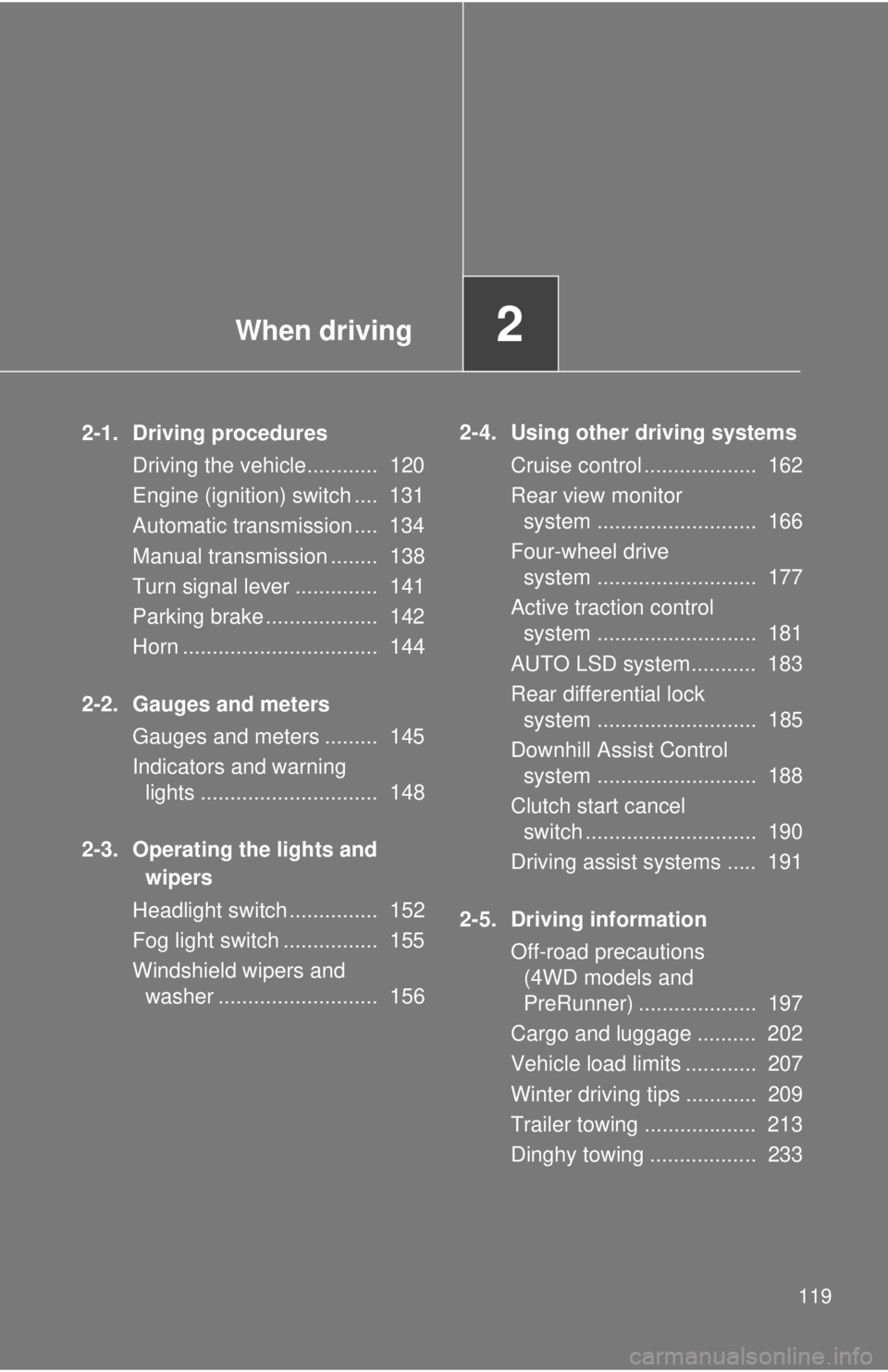
When driving2
119
2-1. Driving proceduresDriving the vehicle............ 120
Engine (ignition) switch .... 131
Automatic transmission .... 134
Manual transmission ........ 138
Turn signal lever .............. 141
Parking brake ................... 142
Horn ................................. 144
2-2. Gauges and meters Gauges and meters ......... 145
Indicators and warning lights .............................. 148
2-3. Operating the lights and wipers
Headlight switch ............... 152
Fog light switch ................ 155
Windshield wipers and washer ........................... 156 2-4. Using other driving systems
Cruise control ................... 162
Rear view monitor system ........................... 166
Four-wheel drive system ........................... 177
Active traction control system ........................... 181
AUTO LSD system........... 183
Rear differential lock system ........................... 185
Downhill Assist Control system ........................... 188
Clutch start cancel switch ............................. 190
Driving assist systems ..... 191
2-5. Driving information Off-road precautions (4WD models and
PreRunner) .................... 197
Cargo and luggage .......... 202
Vehicle load limits ............ 207
Winter driving tips ............ 209
Trailer towing ................... 213
Dinghy towing .................. 233
Page 122 of 590

122 2-1. Driving procedures
Manual transmissionWith the parking brake firmly set and the clutch pedal fully
depressed, shift the shift lever to 1.
Lightly depress the accelerator pedal at the same time as
gradually releasing the clutch pedal.
Release the parking brake.
■Driving in the rain
●Drive carefully when it is raining, because visibility will be reduced, the
windows may become fogged-up, and the road will be slippery.
● Drive carefully when it starts to rain, because the road surface will be
especially slippery.
● Refrain from high speeds when driving on an expressway in the rain,
because there may be a layer of water between the tires and the road
surface, preventing the steering and brakes from operating properly.
■ Engine speed while driving (vehicl es with an automatic transmission)
In the following conditions, the engine speed may become high while driving.
This is due to automatic up-shifting control or down-shifting implementation
to meet driving conditions. It does not indicate sudden acceleration.
● The vehicle is judged to be driving uphill or downhill
● When the accelerator pedal is released
■ Breaking in your new Toyota
To extend the life of the vehicle, the following precautions are recommended
to observe:
●For the first 200 miles (300 km):
Avoid sudden stops.
● For the first 500 miles (800 km):
Do not tow a trailer.
● For the first 1000 miles (1600 km):
• Do not drive at extremely high speeds.
• Avoid sudden acceleration.
• Do not drive continuously in the low gears.
• Do not drive slowly with the manual transmission in a high gear.
• Do not drive at a constant speed for extended periods.
Page 127 of 590

127
2-1. Driving procedures
2
When driving
CAUTION
■
When the vehicle is parked
●Always apply the parking brake, shift the shift lever to P (automatic trans-
mission only), stop the engine and lock the vehicle.
Do not leave the vehicle unattended while the engine is running.
● Do not touch the exhaust pipe while the engine is running or immediately
after turning the engine off.
Doing so may cause burns.
● Do not leave the engine running in an area with snow build-up, or where it
is snowing. If snowbanks build up around the vehicle while the engine is
running, exhaust gases may collect and enter the vehicle. This may lead
to death or a serious health hazard.
■ Exhaust gases
Exhaust gases include harmful carbon monoxide (CO) that is colorless and
odorless. Inhaling exhaust gases may lead to death or a serious health haz-
ard.
●If the vehicle is in a poorly ventilated area, stop the engine. In a closed
area, such as a garage, exhaust gases may collect and enter the vehicle.
This may lead to death or a serious health hazard.
● The exhaust should be checked occasionally. If there is a hole or crack
caused by corrosion, damage to a joint or abnormal exhaust noise, be
sure to have the vehicle inspected and repaired by your Toyota dealer.
Failure to do so may allow exhaust gases to enter the vehicle, resulting in
death or a serious health hazard.
● Toyota does not recommend occupying the rear cargo area when it is fitted
with a slide-in camper, camper shell or other type cover while the engine is
running. This caution applies to both driving and stopped or parked situa-
tions with the engine running. Particular care should be taken to prevent
exhaust gases from entering camper bodies, trailers or other enclosures
on or around your vehicle. If exhaust fumes are detected, open all win-
dows and thoroughly ventilate the area.
Page 165 of 590

165
2-4. Using other
driving systems
2
When driving
CAUTION
■To avoid operating the cruise control by mistake
Switch the cruise control off using the ON-OFF button when not in use.
■ Situations unsuitable for cruise control
Do not use cruise control in any of the following situations.
Doing so may result in loss of control and could cause an accident resulting
in death or serious injury.
●In heavy traffic
● On roads with sharp bends
● On winding roads
● On slippery roads, such as those covered with rain, ice or snow
● On steep hills
Vehicle speed may exceed the set speed when driving down a steep hill.
● When your vehicle is towing a trailer or during emergency towing
Page 191 of 590
191
2-4. Using other driving systems
2
When driving
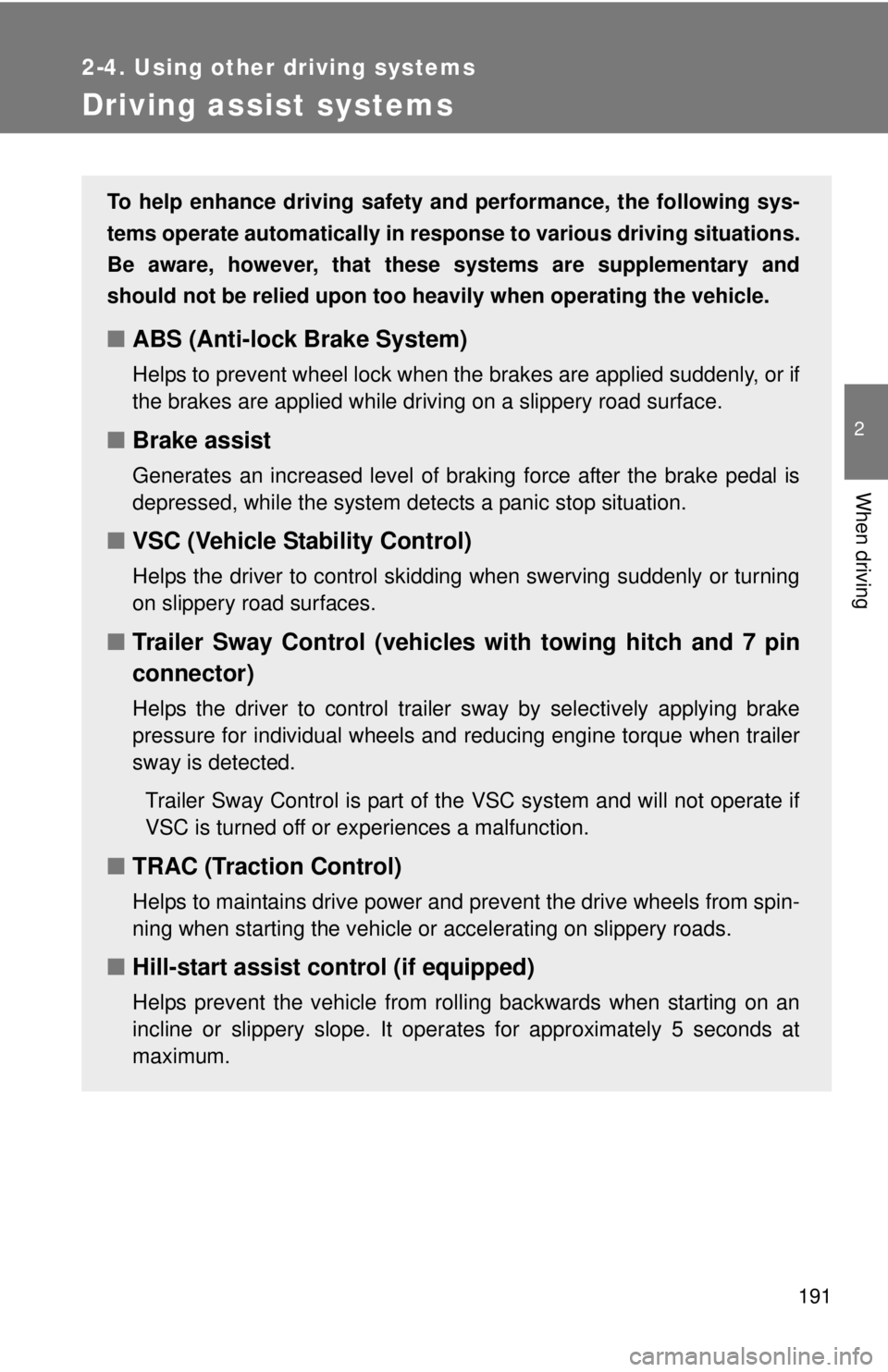
Driving assist systems
To help enhance driving safety and performance, the following sys-
tems operate automatically in res ponse to various driving situations.
Be aware, however, that these systems are supplementary and
should not be relied upon too heavi ly when operating the vehicle.
■ABS (Anti-lock Brake System)
Helps to prevent wheel lock when the brakes are applied suddenly, or if
the brakes are applied while driving on a slippery road surface.
■Brake assist
Generates an increased level of braking force after the brake pedal is
depressed, while the system detects a panic stop situation.
■VSC (Vehicle Stability Control)
Helps the driver to control skidding when swerving suddenly or turning
on slippery road surfaces.
■Trailer Sway Control (vehicl es with towing hitch and 7 pin
connector)
Helps the driver to control trailer sway by selectively applying brake
pressure for individual wheels and reducing engine torque when trailer
sway is detected.
Trailer Sway Control is part of the VSC system and will not operate if
VSC is turned off or experiences a malfunction.
■ TRAC (Traction Control)
Helps to maintains drive power and prevent the drive wheels from spin-
ning when starting the vehicle or accelerating on slippery roads.
■Hill-start assist control (if equipped)
Helps prevent the vehicle from rolling backwards when starting on an
incline or slippery slope. It operates for approximately 5 seconds at
maximum.
Page 192 of 590
192 2-4. Using other driving systems
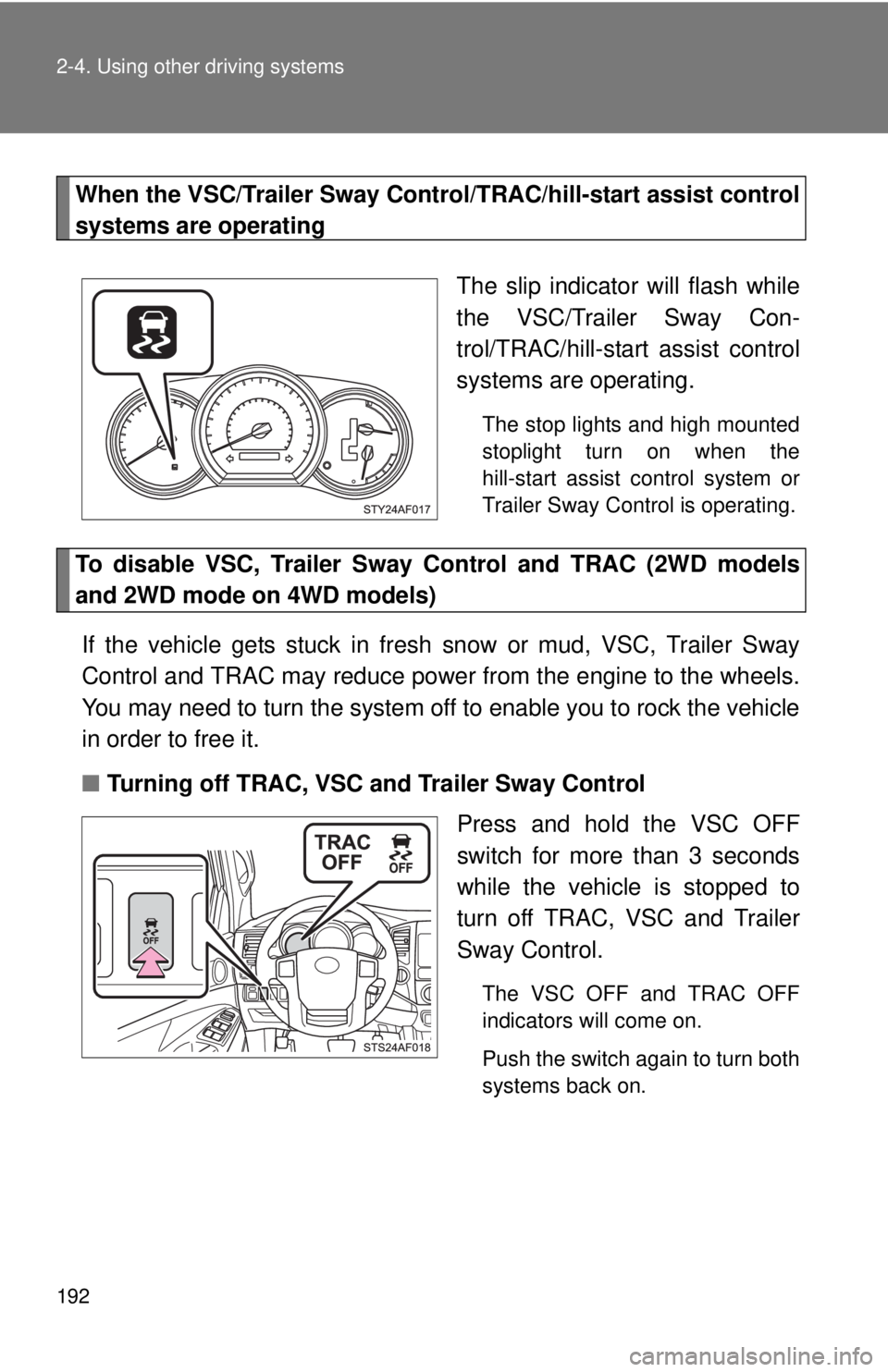
When the VSC/Trailer Sway Control/TRAC/hill-start assist control
systems are operatingThe slip indicator will flash while
the VSC/Trailer Sway Con-
trol/TRAC/hill-start assist control
systems are operating.
The stop lights and high mounted
stoplight turn on when the
hill-start assist control system or
Trailer Sway Control is operating.
To disable VSC, Trailer Sway Control and TRAC (2WD models
and 2WD mode on 4WD models)
If the vehicle gets stuck in fresh snow or mud, VSC, Trailer Sway
Control and TRAC may reduce power from the engine to the wheels.
You may need to turn the system off to enable you to rock the vehicle
in order to free it.
■ Turning off TRAC, VSC and Trailer Sway Control
Press and hold the VSC OFF
switch for more than 3 seconds
while the vehicle is stopped to
turn off TRAC, VSC and Trailer
Sway Control.
The VSC OFF and TRAC OFF
indicators will come on.
Push the switch again to turn both
systems back on.
Page 193 of 590
193
2-4. Using other
driving systems
2
When driving
To disable VSC, Trailer Sway C ontrol and/or TRAC (4WD mode
on 4WD models)
If the vehicle gets stuck in fresh snow or mud, VSC, Trailer Sway
Control and TRAC may reduce power from the engine to the wheels.
You may need to turn the system off to enable you to rock the vehicle
in order to free it.
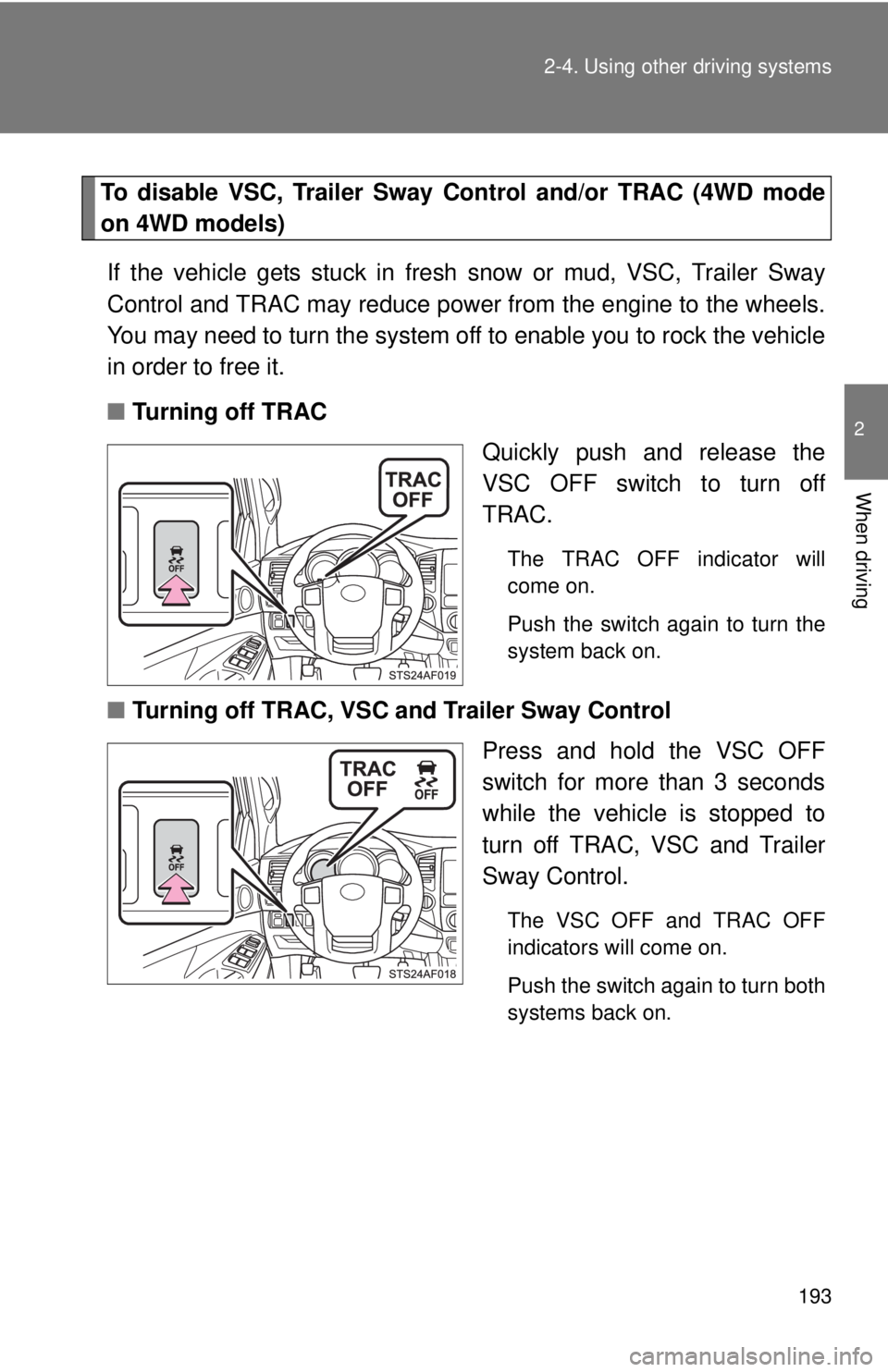
■ Turning off TRAC
Quickly push and release the
VSC OFF switch to turn off
TRAC.
The TRAC OFF indicator will
come on.
Push the switch again to turn the
system back on.
■Turning off TRAC, VSC and Trailer Sway Control
Press and hold the VSC OFF
switch for more than 3 seconds
while the vehicle is stopped to
turn off TRAC, VSC and Trailer
Sway Control.
The VSC OFF and TRAC OFF
indicators will come on.
Push the switch again to turn both
systems back on.
Page 194 of 590

194 2-4. Using other driving systems
■When the TRAC OFF indicator light comes on even if the VSC OFF
switch has not been pressed
TRAC, hill-start assist control, downhill assist control system cannot be oper-
ated. Contact your Toyota dealer.
■ Reactivation of the TRAC, VSC and Trailer Sway Control systems after
turning off the engine
Turning off the engine after turning off the TRAC, VSC and Trailer Sway
Control systems will automatically reactivate them.
■ Automatic TRAC reactivation (AUTO LSD mode)
With AUTO LSD mode, VSC OFF and AUTO LSD indicator lights turn on.
The TRAC system will turn on when the vehicle speed increases.
■ Automatic TRAC, VSC and Trai ler Sway Control reactivation
If the TRAC, VSC and Trailer Sway Control systems are turned off, the sys-
tems will not turn on even when vehicle speed increases.
■ Sounds and vibrations caused by the ABS, TRAC, VSC, Trailer Sway
Control, brake assist and hill-start assist control system
● A sound may be heard from the engine compartment when the engine is
started or just after the vehicle begins to move. This sound does not indi-
cate that a malfunction has occurred in any of these systems.
● Any of the following conditions may occur when the above systems are
operating. None of these indicates that a malfunction has occurred.
• Vibrations may be felt through the vehicle body and steering.
• A motor sound may be heard after the vehicle comes to a stop.
• The brake pedal may pulsate slightly when the ABS is activated.
• The brake pedal may move down slightly after the ABS is activated.
■ Hill-start assist control is op erational when (if equipped)
● The shift lever is in the D, 4, 3, 2 (5-speed automatic transmission), D, 3,
2 (4-speed automatic transmission) or L positions.
● The brake pedal is not depressed.
Page 195 of 590

195
2-4. Using other
driving systems
2
When driving
■Hill-start assist control will not operate when (if equipped)
●The shift lever is in the P, R or N positions.
● The rear differential is locked.
■ If the brake system overheats
TRAC and hill-start control will cease operation and a buzzer will sound to
alert the driver. Stop the vehicle in a safe place. (There is no problem with
continuing normal driving.)
CAUTION
■The ABS does not opera te effectively when
● The limits of tire gripping performance have been exceeded.
● The vehicle hydroplanes while driving at high speed on the wet or slick
road.
■ Stopping distance when the ABS is operating may exceed that of nor-
mal conditions
The ABS is not designed to shorten the vehicle’s stopping distance. Always
maintain a safe distance from the vehicle in front of you, especially in the fol-
lowing situations.
● When driving on dirt, gravel or snow-covered roads
● When driving with tire chains
● When driving over bumps in the road
● When driving over roads with pothol es or roads with uneven roads
■ When VSC and Trailer Sway Control are activated
The slip indicator flashes. Always drive carefully. Reckless driving may
cause an accident. Exercise particular care when the indicator flashes.
■ TRAC may not operate effectively when
Directional control and power may not be achievable while driving on slip-
pery road surfaces, even if TRAC is operating.
Do not drive the vehicle in conditions where stability and power may be lost.
■ If the hill-start assist contro l does not operate effectively
Do not overly rely on the hill-start assist control. The hill start assist control
may not operate effectively on steep inclines and roads covered in ice.