wheel TOYOTA TACOMA 2018 (in English) Owner's Manual
[x] Cancel search | Manufacturer: TOYOTA, Model Year: 2018, Model line: TACOMA, Model: TOYOTA TACOMA 2018Pages: 696, PDF Size: 11.72 MB
Page 145 of 696
1453-4. Adjusting the steering wheel and mirrors
3
Operation of each component
Outside rear view mirrors
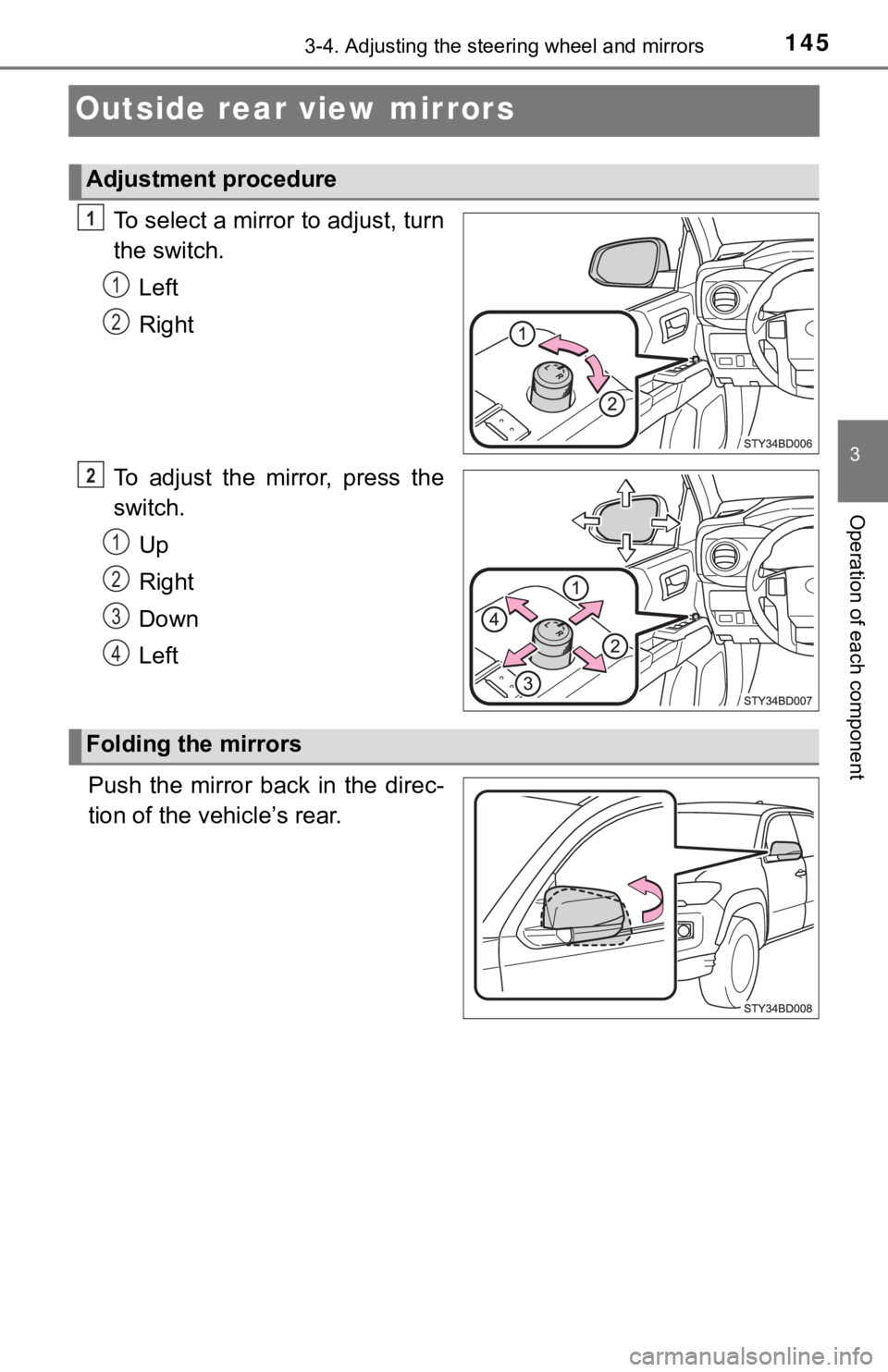
To select a mirror to adjust, turn
the switch.
Left
Right
To adjust the mirror, press the
switch. Up
Right
Down
Left
Push the mirror back in the direc-
tion of the vehicle’s rear.
Adjustment procedure
1
1
2
2
1
2
3
4
Folding the mirrors
Page 146 of 696

1463-4. Adjusting the steering wheel and mirrors
■Mirror angle can be adjusted when
Vehicles without a smart key system
The engine switch is in the “ACC” or “ON” position.
Vehicles with a smart key system
The engine switch is in ACCESSORY or IGNITION ON mode.
■ When the mirrors are fogged up
Turn on the mirror defoggers to defog the mirrors. ( P. 428, 435)
WARNING
■Important points while driving
Observe the following precautions while driving.
Failure to do so may result in loss of control of the vehicle and cause an
accident, resulting in death or serious injury.
● Do not adjust the mirrors while driving.
● Do not drive with the mirrors folded.
● Both the driver and passenger side mirrors must be extended and properly
adjusted before driving.
■ When a mirror is moving
To avoid personal injury and mirror malfunction, be careful not to get your
hand caught by the moving mirror.
■ When the mirror defoggers are operating
Do not touch the rear view mirror surfaces, as they can become very hot
and burn you.
Page 159 of 696

159
4Driving
4-4. RefuelingOpening the fuel tank cap .................................. 224
4-5. Using the driving support systems
Toyota Safety Sense P ..... 228
PCS (Pre-Collision System) .... 235
LDA (Lane Departure Alert) .... 249
Dynamic radar cruise control ............................. 257
Cruise control .................... 271
Intuitive parking assist ....... 275
Rear view monitor system............................. 281
BSM (Blind Spot Monitor) ........ 291
• T he Blind Spot Monitor
function ......................... 293
• The Rear Cross Traffic Alert function ................. 296
Four-wheel drive system ... 299
AUTO LSD system ............ 303 Rear differential lock
system ............................ 305
Active traction control system ............................ 308
Multi-terrain Select ............ 310
Crawl Control .................... 314
Clutch start cancel switch .............................. 318
Driving assist systems ...... 319
4-6. Driving tips Winter driving tips ............. 325
Off-road precautions ......... 329
Page 161 of 696
1614-1. Before driving
4
Driving
Automatic transmission
With the shift lever in D, depress the brake pedal.
Set the parking brake ( P. 210), and shift the shift lever to P
( P. 201).
Vehicles without a smart key sys tem: Turn the engine switch to the
“LOCK” position to stop the engine.
Vehicles with a smart key system : Press the engine switch to stop
the engine.
Lock the door, making sure that you have the key on your person.
If parking on a hill, block the wheels as needed.
Manual transmission
While depressing the clutch pedal, depress the brake pedal.
Set the parking brake. ( P. 2 1 0 )
Shift the shift lever to N. ( P. 207)
If parking on a hill, shift the shift lever to 1 or R needed.
Turn the engine switch to the “LOC K” position to stop the engine.
Lock the door, making sure that you have the key on your person.
If parking on a hill, block the wheels as needed.
Automatic transmission
Make sure that the parking brake is set and shift the shift lev er to D.
Gently depress the accelerator pedal.
Release the parking brake.
Manual transmission
With the parking brake firmly set and the clutch pedal fully
depressed, shift the shift lever to 1.
Lightly depress the accelerato r pedal at the same time as gradu ally
releasing the clutch pedal.
Release the parking brake.
Parking the vehicle
Starting off on a steep uphill
1
2
3
4
1
2
3
4
5
1
2
3
1
2
3
Page 162 of 696

1624-1. Before driving
■When starting off on an uphill (v ehicles with the hill-start assist control
system)
The hill-start assist control will activate. ( P. 320)
■ Driving in the rain
●Drive carefully when it is raining, because visibility will be reduced, the win-
dows may become fogged-up, and the road will be slippery.
● Drive carefully when it starts to rain, because the road surface will be espe-
cially slippery.
● Refrain from high speeds when driving on an expressway in the r ain,
because there may be a layer of water between the tires and the road sur-
face, preventing the steering and brakes from operating properl y.
■ Engine speed while driving (vehic les with an automatic transmission)
In the following conditions, the engine speed may become high w hile driving.
This is due to automatic up-shifting control or down-shifting implementation to
meet driving conditions. It does not indicate sudden acceleration.
● The vehicle is judged to be driving uphill or downhill
● When the accelerator pedal is released
● When the brake pedal is depressed while power mode is selected
■ Restraining the engine out put (Brake Override System)
● When the accelerator and brake pedals are depressed at the same time, the
engine output may be restrained.
● A warning message is displayed on the multi-information display while the
system is operating. ( P. 577)
■ Restraining sudden start (Drive-Start Control: vehicles with an automatic
transmission)
● When the following unusual operation is performed, the engine o utput may
be restrained.
• When the shift lever is shifted from R to D, D to R, N to R, P to D, or P to
R (D includes S) with the accelerator pedal depressed, a warnin g mes-
sage appears on the multi-information display.
• When the accelerator pedal is depressed too much while the veh icle is in
reverse.
● While Drive-Start Control is being activated, your vehicle may have trouble
escaping from the mud or fresh snow. In such case, perform the following
actions to cancel Drive-Start Control so that the vehicle may b ecome able to
escape from the mud or fresh snow.
• Deactivate TRAC ( P. 320)
• When the AUTO LSD system is turned on.
(P. 303)
• 4WD models: The four-wheel drive control switch is in “4L” pos ition.
(P. 299)
Page 164 of 696

1644-1. Before driving
WARNING
Observe the following precautions.
Failure to do so may result in death or serious injury.
■When starting the vehicle (vehic les with an automatic transmission)
Always keep your foot on the brake pedal while stopped with the engine
running. This prevents the vehicle from creeping.
■ When driving the vehicle
● Do not drive if you are unfamiliar with the location of the brake and accel-
erator pedals to avoid depressing the wrong pedal.
• Accidentally depressing the accelerator pedal instead of the b rake
pedal will result in sudden acceleration that may lead to an accident.
• When backing up, you may twist your body around, leading to di fficulty
in operating the pedals. Make sure to operate the pedals proper ly.
• Make sure to keep a correct driving posture even when moving t he
vehicle only slightly. This allows you to depress the brake and accelera-
tor pedals properly.
• Depress the brake pedal using your right foot. Depressing the brake
pedal using your left foot may delay response in an emergency, result-
ing in an accident.
● Do not drive the vehicle over or stop the vehicle near flammable materials.
The exhaust system and exhaust gases can be extremely hot. Thes e hot
parts may cause a fire if there is any flammable material nearb y.
● During normal driving, do not turn off the engine. Turning the engine off
while driving will not cause loss of steering or braking contro l, but the
power assist to these systems will be lost. This will make it m ore difficult to
steer and brake, so you should pull over and stop the vehicle a s soon as it
is safe to do so.
However, in the event of an emergency, such as if it becomes im possible
to stop the vehicle in the normal way: P. 557
● Use engine braking (downshift) to maintain a safe speed when driving
down a steep hill.
Using the brakes continuously may cause the brakes to overheat and lose
effectiveness. ( P. 201, 207)
● Do not adjust the positions of the steering wheel, the seat, or the inside or
outside rear view mirrors while driving.
Doing so may result in a loss of vehicle control.
● Always check that all passengers’ arms, heads or other parts of their body
are not outside the vehicle.
Page 167 of 696

1674-1. Before driving
4
Driving
WARNING
●Do not leave a door or window open if the curved glass is coate d with a
metallized film such as a silver-colored one. Reflected sunligh t may cause
the glass to act as a lens, causing a fire.
● On vehicles with an automatic transmission, always apply the pa rking
brake, shift the shift lever to P, stop the engine and lock the vehicle.
Do not leave the vehicle unattended while the engine is running .
If the vehicle is parked with the shift lever in P but the park ing brake is not
set, the vehicle may start to move, possibly leading to an acci dent.
● Do not touch the exhaust pipes while the engine is running or i mmediately
after turning the engine off.
Doing so may cause burns.
■ When taking a nap in the vehicle
Always turn the engine off. Otherwise, if you accidentally move the shift
lever or depress the accelerator pedal, this could cause an acc ident or fire
due to engine overheating. Additionally, if the vehicle is park ed in a poorly
ventilated area, exhaust gases may collect and enter the vehicl e, leading to
death or a serious health hazard.
■ When braking
● When the brakes are wet, drive more cautiously.
Braking distance increases when the brakes are wet, and this ma y cause
one side of the vehicle to brake differently than the other sid e. Also, the
parking brake may not securely hold the vehicle.
● If the power brake assist function does not operate, do not fol low other
vehicles closely and avoid hills or sharp turns that require br aking.
In this case, braking is still possible, but the brake pedal sh ould be
depressed more firmly than usual. Also, the braking distance wi ll increase.
Have your brakes fixed immediately.
● Do not pump the brake pedal if the engine stalls.
Each push on the brake pedal uses up the reserve for the power-assisted
brakes.
● The brake system consists of 2 individual hydraulic systems; if one of the
systems fails, the other will still operate. In this case, the brake pedal
should be depressed more firmly than usual and the braking dist ance will
increase. Have your brakes fixed immediately.
■ If the vehicle becomes stuck
Do not spin the wheels excessively when any of the tires is up in the air, or
the vehicle is stuck in sand, mud, etc. This may damage the driveline com-
ponents or propel the vehicle forward or backward, causing an a ccident.
Page 168 of 696
1684-1. Before driving
NOTICE
■When driving the vehicle
● Do not depress the accelerator and brake pedals at the same tim e during
driving, as this may restrain the engine output.
Vehicles with an automatic transmission
● Do not use the accelerator pedal or depress the accelerator and brake
pedals at the same time to hold the vehicle on a hill.
Vehicles with a manual transmission
● Do not shift gears unless the clutch pedal is fully depressed. After shifting,
do not release the clutch abruptly. Doing so may damage the clu tch, trans-
mission and gears.
● Do not rest your foot on the clutch pedal while driving.
Doing so may cause clutch trouble.
● Do not use any gear other than the first gear when starting off and moving
forward.
Doing so may damage the clutch.
● Do not use the clutch to hold the vehicle when stopping on an u phill grade.
Doing so may damage the clutch.
● Do not shift the shift lever to R when the vehicle is still moving. Doing so
may damage the clutch, transmission and gears.
■ When parking the vehicle (vehicl es with an automatic transmission)
Always set the parking brake, and shift the shift lever to P. F ailure to do so
may cause the vehicle to move or the vehicle may move suddenly if the
accelerator pedal is accidentally depressed.
■ Avoiding damage to vehicle parts
● Do not turn the steering wheel fully in either direction and ho ld it there for
an extended period of time.
Doing so may damage the power steering pump.
● When driving over bumps in the road, drive as slowly as possibl e to avoid
damaging the wheels, underside of the vehicle, etc.
Page 169 of 696

1694-1. Before driving
4
Driving
NOTICE
■If you get a flat tire while driving
A flat or damaged tire may cause the following situations. Hold the steering
wheel firmly and gradually depress the brake pedal to slow down the vehi-
cle.
● It may be difficult to control your vehicle.
● The vehicle will make abnormal sounds or vibrations.
● The vehicle will lean abnormally.
Information on what to do in case of a flat tire ( P. 594)
■ When encountering flooded roads
Do not drive on a road that has flooded after heavy rain, etc. Doing so may
cause the following serious damage to the vehicle:
● Engine stalling
● Short in electrical components
● Engine damage caused by water immersion
In the event that you drive on a flooded road and the vehicle i s flooded, be
sure to have your Toyota dealer check the following:
● Brake function
● Changes in quantity and quality of oil and fluid used for the engine, trans-
mission, transfer (4WD models) differentials, etc.
● Lubricant condition for the propeller shaft, bearings and suspe nsion joints
(where possible), and the function of all joints, bearings, etc .
Page 179 of 696
1794-1. Before driving
4
Driving
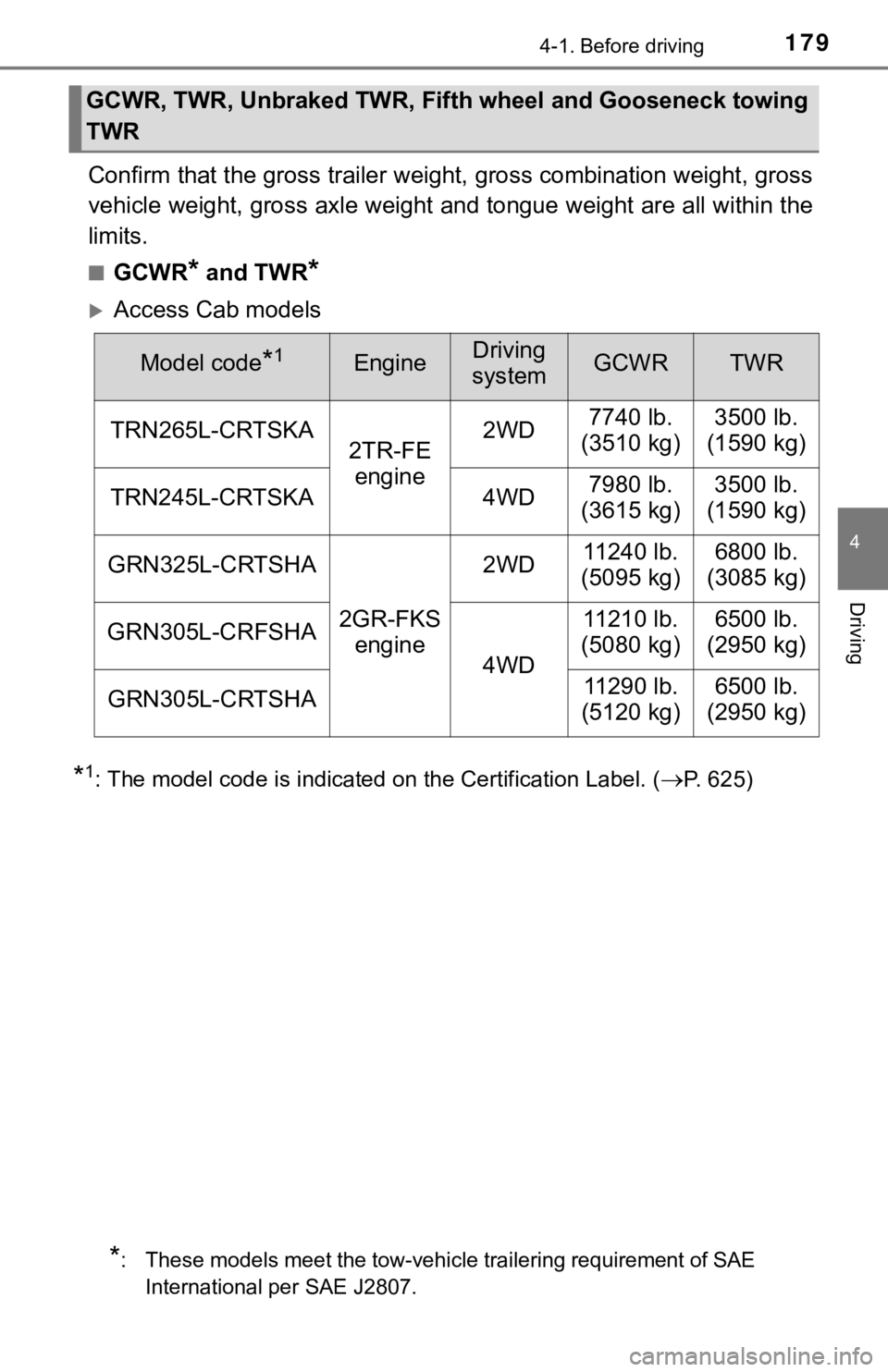
Confirm that the gross trailer weight, gross combination weight, gross
vehicle weight, gross axle weight and tongue weight are all within the
limits.
■GCWR* and TWR*
Access Cab models
*1: The model code is indicated on the Certification Label. (P. 625)
GCWR, TWR, Unbraked TWR, Fifth wheel and Gooseneck towing
TWR
*: These models meet the tow-vehicle trailering requirement of SAE International per SAE J2807.
Model code*1EngineDriving
systemGCWRTWR
TRN265L-CRTSKA 2TR-FE
engine 2WD
7740 lb.
(3510 kg) 3500 lb.
(1590 kg)
TRN245L-CRTSKA 4WD 7980 lb.
(3615 kg) 3500 lb.
(1590 kg)
GRN325L-CRTSHA 2GR-FKS engine 2WD
11240 lb.
(5095 kg) 6800 lb.
(3085 kg)
GRN305L-CRFSHA 4WD11210 lb.
(5080 kg) 6500 lb.
(2950 kg)
GRN305L-CRTSHA 11290 lb.
(5120 kg) 6500 lb.
(2950 kg)