seats TOYOTA TACOMA 2022 User Guide
[x] Cancel search | Manufacturer: TOYOTA, Model Year: 2022, Model line: TACOMA, Model: TOYOTA TACOMA 2022Pages: 616, PDF Size: 12.92 MB
Page 42 of 616
421-1. For safe use
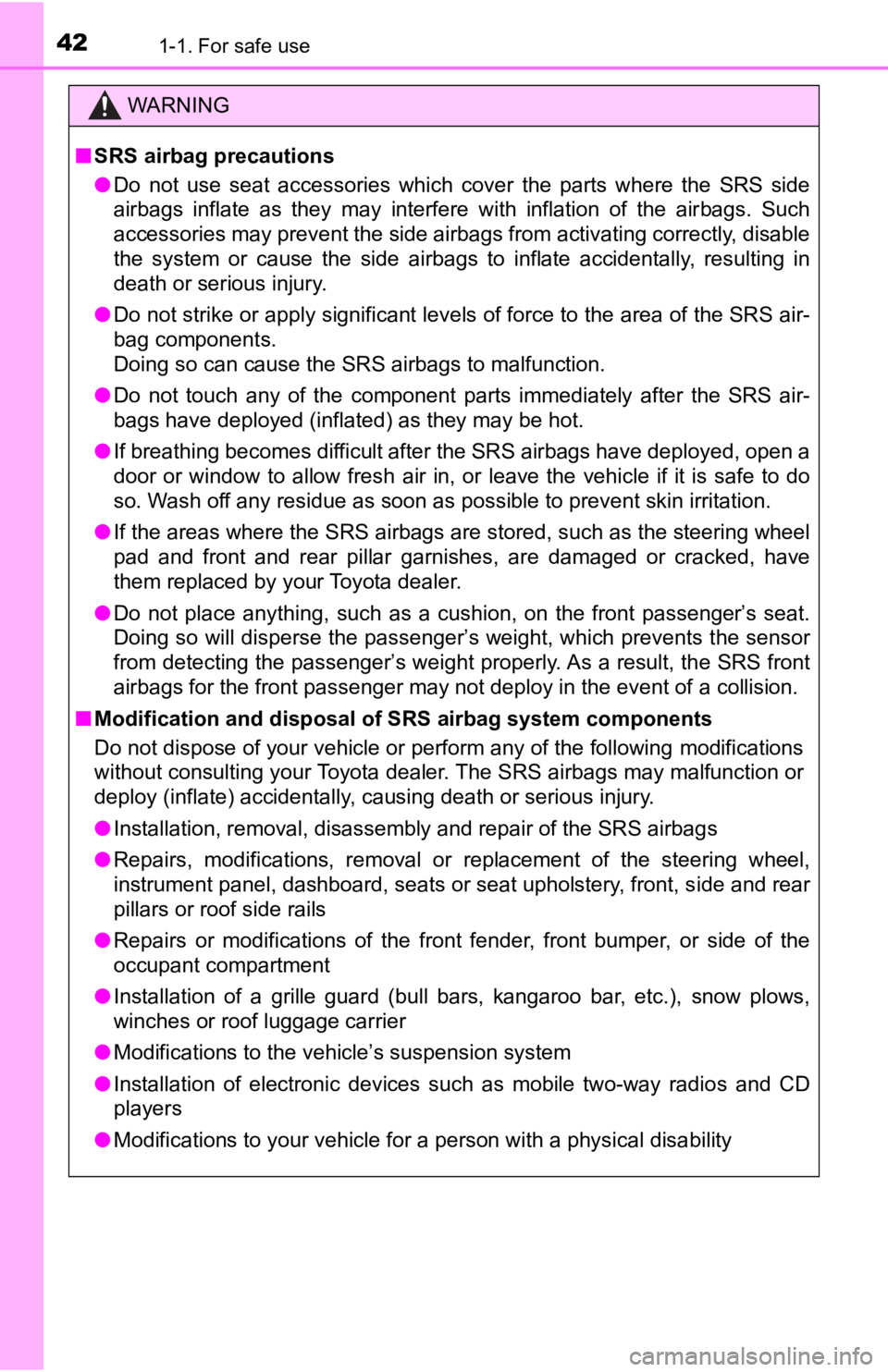
WARNING
■SRS airbag precautions
● Do not use seat accessories which cover the parts where the SRS side
airbags inflate as they may interfere with inflation of the air bags. Such
accessories may prevent the side airbags from activating correctly, disable
the system or cause the side airbags to inflate accidentally, resulting in
death or serious injury.
● Do not strike or apply significant levels of force to the area of the SRS air-
bag components.
Doing so can cause the SRS airbags to malfunction.
● Do not touch any of the component parts immediately after the SRS air-
bags have deployed (inflated) as they may be hot.
● If breathing becomes difficult after the SRS airbags have deployed, open a
door or window to allow fresh air in, or leave the vehicle if i t is safe to do
so. Wash off any residue as soon as possible to prevent skin ir ritation.
● If the areas where the SRS airbags are stored, such as the steering wheel
pad and front and rear pillar garnishes, are damaged or cracked, have
them replaced by your Toyota dealer.
● Do not place anything, such as a cushion, on the front passenger’s seat.
Doing so will disperse the passenger’s weight, which prevents the sensor
from detecting the passenger’s weight properly. As a result, the SRS front
airbags for the front passenger may not deploy in the event of a collision.
■ Modification and disposal of SRS airbag system components
Do not dispose of your vehicle or perform any of the following modifications
without consulting your Toyota dealer. The SRS airbags may malfunction or
deploy (inflate) accidentally, causing death or serious injury.
● Installation, removal, disassembly and repair of the SRS airbags
● Repairs, modifications, removal or replacement of the steering wheel,
instrument panel, dashboard, seats or seat upholstery, front, side and rear
pillars or roof side rails
● Repairs or modifications of the front fender, front bumper, or side of the
occupant compartment
● Installation of a grille guard (bull bars, kangaroo bar, etc.), snow plows,
winches or roof luggage carrier
● Modifications to the vehicle’s suspension system
● Installation of electronic devices such as mobile two-way radio s and CD
players
● Modifications to your vehicle for a person with a physical disability
Page 43 of 616

431-1. For safe use
1
For safety and security
■If the SRS airbags deploy (inflate)
●Slight abrasions, burns, bruising, etc., may be sustained from SRS airbags,
due to the extremely high speed deployment (inflation) by hot g ases.
● A loud noise and white powder will be emitted.
● Parts of the airbag module (steering wheel hub, airbag cover an d inflator) as
well as the front seats, parts of the front and rear pillars, and roof side rails,
may be hot for several minutes. The airbag itself may also be hot.
● The windshield may crack.
● For Safety Connect subscribers, if the SRS airbags deploy or in the event of
a severe rear-end collision, the system is designed to send an emergency
call to the response center, notifying them of the vehicle’s location (without
needing to push the “SOS” button) and an agent will attempt to speak with
the occupants to ascertain the level of emergency and assistanc e required.
If the occupants are unable to communicate, the agent automatic ally treats
the call as an emergency and helps to dispatch the necessary em ergency
services. (→P. 72)
• An SRS airbag is deployed.
• A seat belt pretensioner is activated.
• The vehicle is involved in a severe rear-end collision.
■ SRS airbag deployment condi tions (SRS front airbags)
● The SRS front airbags will deploy in the event of an impact tha t exceeds the
set threshold level (the level of force corresponding to an app roximately
12 - 18 mph [20 - 30 km/h] frontal collision with a fixed wall that does not
move or deform).
However, this threshold velocity will be considerably higher in the following
situations:
• If the vehicle strikes an object, such as a parked vehicle or sign pole, which
can move or deform on impact
• If the vehicle is involved in an underride collision, such as a collision in
which the front of the vehicle “underrides”, or goes under, the bed of a truck
● Depending on the type of collision, it is possible that only th e seat belt pre-
tensioners will activate.
● The SRS front airbags for the front passenger will not activate if there is no
passenger sitting in the front passenger seat. However, the SRS front air-
bags for the front passenger may deploy if luggage is put in the seat, even if
the seat is unoccupied. ( P. 48)
Page 47 of 616

471-1. For safe use
1
For safety and security
●The surface of the seats with the side
airbag is scratched, cracked, or other-
wise damaged.
● The portion of the front pillars, rear pil-
lars or roof side rail garnishes (padding)
containing the curtain shield airbags
inside is scratched, cracked, or other-
wise damaged.
Page 51 of 616

511-1. For safe use
1
For safety and security
*1: The system judges a person of adult size as an adult. When a smaller
adult sits in the front passenger seat, the system may recognize him/her
as a child depending on his/her physique and posture.
*2: In the event the front passenger is wearing a seat belt.
*3: In the event the front passenger does not wear a seat belt.
*4: When a larger child who has outgrown a child restraint system sits in the front passenger seat, the system may recognize him/her as an adult
depending on his/her physique or posture.
*5: Never install a rear-facing child restraint system on the front passengerseat. A forward-facing child restraint system should only be installed on
the front passenger seat when it is unavoidable. ( P. 54)
*6: In case the indicator light is not illuminated, consult this m anual on how
to install the child restraint system properly. ( P. 58)
*7: In the event of a frontal collision or rollover.
*8: In the event of a side collision.
WARNING
■Front passenger occupant classification system precautions
Observe the following precautions regarding the front passenger occupant
classification system.
Failure to do so may cause death or serious injury.
● Wear the seat belt properly.
● Make sure the front passenger’s seat belt plate has not been le ft inserted
into the buckle before someone sits in the front passenger seat.
● Make sure the “AIR BAG OFF” indicator light is not illuminated when using
the seat belt extender for the front passenger seat. If the “AI R BAG OFF”
indicator light is illuminated, disconnect the extender tongue from the seat
belt buckle, and reconnect the seat belt. Reconnect the seat belt extender
after making sure the “AIR BAG ON” indicator light is illuminated. If you
use the seat belt extender while the “AIR BAG OFF” indicator light is illumi-
nated, the SRS airbags for the front passenger will not activate, which
could cause death or serious injury in the event of a collision.
● Do not apply a heavy load to the front passenger seat or equipment (e.g.
seatback pockets).
● Vehicles with rear seats: Do not put weight on the front passenger seat by
putting your hands or feet on the front passenger seat seatback from the
rear passenger seat.
● Vehicles with rear seats: Do not let a rear passenger lift the front passen-
ger seat with their feet or press on the seatback with their le gs.
● Do not put objects under the front passenger seat.
Page 52 of 616

521-1. For safe use
WARNING
■Front passenger occupant classification system precautions
● Do not recline the front passenger seatback so far that it touches a rear
seat or a back wall. This may cause the “AIR BAG OFF” indicator light to
be illuminated, which indicates that the SRS airbags for the front passen-
ger will not activate in the event of a severe accident. If the seatback
touches the rear seat or back wall, return the seatback to a po sition where
it does not touch the rear seat or back wall. Keep the front passenger seat-
back as upright as possible when the vehicle is moving. Reclini ng the
seatback excessively may lessen the effectiveness of the seat belt sys-
tem.
● If an adult sits in the front passenger seat, the “AIR BAG ON” indicator
light is illuminated. If the “AIR BAG OFF” indicator is illumin ated, ask the
passenger to sit up straight, well back in the seat, feet on the floor, and
with the seat belt worn correctly. If the “AIR BAG OFF” indicat or still
remains illuminated, either ask the passenger to move to the re ar seat, or
if that is not possible, move the front passenger seat fully re arward.
● When it is unavoidable to install a forward-facing child restraint system on
the front passenger seat, install the child restraint system on the front pas-
senger seat in the proper order. ( P. 58)
● Do not modify or remove the front seats.
● Do not kick the front passenger seat or subject it to severe im pact. Other-
wise, the SRS warning light may come on to indicate a malfunction of the
front passenger occupant classification system. In this case, contact your
Toyota dealer immediately.
● Vehicles with rear seats: Child restraint systems installed on the rear seat
should not contact the front seatbacks.
● Do not use a seat accessory, such as a cushion and seat cover, that cov-
ers the seat cushion surface.
● Do not attach a commercial seatback table or other heavy item t o the back
of the front passenger seat.
● Do not modify or replace the upholstery of the front seat.
Page 53 of 616

531-1. For safe use
1
For safety and security
Safety information for children
●Vehicles with rear seats: It is recommended that children sit i n the
rear seats to avoid accidental co ntact with the shift lever, wiper
switch, etc.
● Use the rear door child-protector lock (Double Cab models only) or
the window lock switch to avoid children opening the door while
driving or operating the power window accidentally.
● Do not let small children operate equipment which may catch or
pinch body parts, such as the power window, hood, tailgate, sea ts,
etc.
Observe the following precautions when children are in the vehi -
cle.
Use a child restraint system appropriate for the child, until the
child becomes large enough to properly wear the vehicle’s seat
belt.
WARNING
Never leave children unattended in the vehicle, and never allow children to
have or use the key.
Children may be able to start the vehicle or shift the vehicle into neutral.
There is also a danger that children may injure themselves by playing with
the windows, the moon roof or other features of the vehicle. In addition, heat
build-up or extremely cold temperatures inside the vehicle can be fatal to
children.
Page 56 of 616

561-1. For safe use
WARNING
■Child restraint precautions
● For effective protection in automobile accidents and sudden stops, a child
must be properly restrained, using a seat belt or child restrai nt system
depending on the age and size of the child. Holding a child in your arms is
not a substitute for a child restraint system. In an accident, the child can be
crushed against the windshield, or between you and the vehicle’ s interior.
● Vehicles without rear seats: Toyota strongly urges the use of a proper child
restraint system that conforms to the size of the child.
● Vehicles with rear seats: Toyota strongly urges the use of a proper child
restraint system that conforms to the size of the child, instal led on the rear
seat. According to accident statistics, the child is safer when properly
restrained in the rear seat than in the front seat.
● Never install a rear-facing child restraint system on the front passenger
seat even if the “AIR BAG OFF” i ndicator light is illuminated.
In the event of an accident, the force of the rapid inflation of the front pas-
senger airbag can cause death or serious injury to the child if the rear-fac-
ing child restraint system is installed on the front passenger seat.
● Vehicles without rear seats: A forward-facing child restraint s ystem may be
installed on the front passenger seat only when it is unavoidab le. Adjust
the seatback as upright as possible and always move the seat as far back
as possible even if the “AIR BAG OFF” indicator light is illumi nated,
because the front passenger airbag could inflate with considerable speed
and force. Otherwise, the child may be killed or seriously injured.
● Vehicles with rear seats: A forward-facing child restraint syst em may be
installed on the front passenger seat only when it is unavoidable. A child
restraint system that requires a top tether strap should not be used in the
front passenger seat since there is no top tether strap anchor for the front
passenger seat. Adjust the seatback as upright as possible and always
move the seat as far back as possible even if the “AIR BAG OFF” indicator
light is illuminated, because the front passenger airbag could inflate with
considerable speed and force. Otherwise, the child may be kille d or seri-
ously injured.
Page 58 of 616

581-1. For safe use
Installing child restraints
Access Cab models (vehicles with rear seats)
Child restraint LATCH anchors
LATCH anchors are provided for
each of rear seats.
Double Cab models
Child restraint LATCH anchors
LATCH anchors are provided for
the outer rear seats. (Buttons dis-
playing the location of the anchors
are attached to the seats.)
Follow the child restraint system manufacturer’s instructions.
Firmly secure child restraints to the seats using the LATCH
anchors or a seat belt. Attach t he top tether strap when installing
a child restraint.
The lap/shoulder belt can be used if your child restraint syste m
is not compatible with the LATCH (Lower Anchors and Tethers
for Children) system.
Using the LATCH anchors ( P. 61, 62)
Page 59 of 616

591-1. For safe use
1
For safety and security
Seat belts equipped with a child
restraint locking mechanism
(ALR/ELR belts except driver’s
seat belt) (P. 32)
Access Cab models (vehicles without rear seats)
Anchor bracket (for top tether
strap)
Anchor bracket is provided for pas-
senger seat.
Using the seat belts ( P. 6 3 )
Using the top tether strap ( P. 66, 68)
Page 60 of 616

601-1. For safe use
Access Cab models (vehicles with rear seats)
Anchor bracket (for top tether
strap)
Anchor bracket is provided for
each rear seat.
Double Cab models
Anchor bracket (for top tether
strap)
Anchor bracket is provided for
each rear seat.