engine TOYOTA TACOMA 2023 Owners Manual
[x] Cancel search | Manufacturer: TOYOTA, Model Year: 2023, Model line: TACOMA, Model: TOYOTA TACOMA 2023Pages: 616, PDF Size: 12.92 MB
Page 433 of 616
4336-3. Do-it-yourself maintenance
6
Maintenance and care
■How to initialize the tire pressure warning systemVehicles without a smart key system:
Park the vehicle in a safe plac e and turn the engine switch to the
“LOCK” position.
Vehicles with a smart key system:
Park the vehicle in a safe place and turn the engine switch off .
Initialization cannot be performed while the vehicle is moving.
Adjust the tire inflation pressure to the specified cold tire i nflation
pressure level. ( P. 551)
Make sure to adjust the tire pre ssure to the specified cold tire infla-
tion pressure level. The tire pressure warning system will oper ate
based on this pr essure level.
Vehicles without a smart key system:
Turn the engine switch t o the “ON” position.
Vehicles with a smart key system:
Turn the engine switch to IGNITION ON mode.
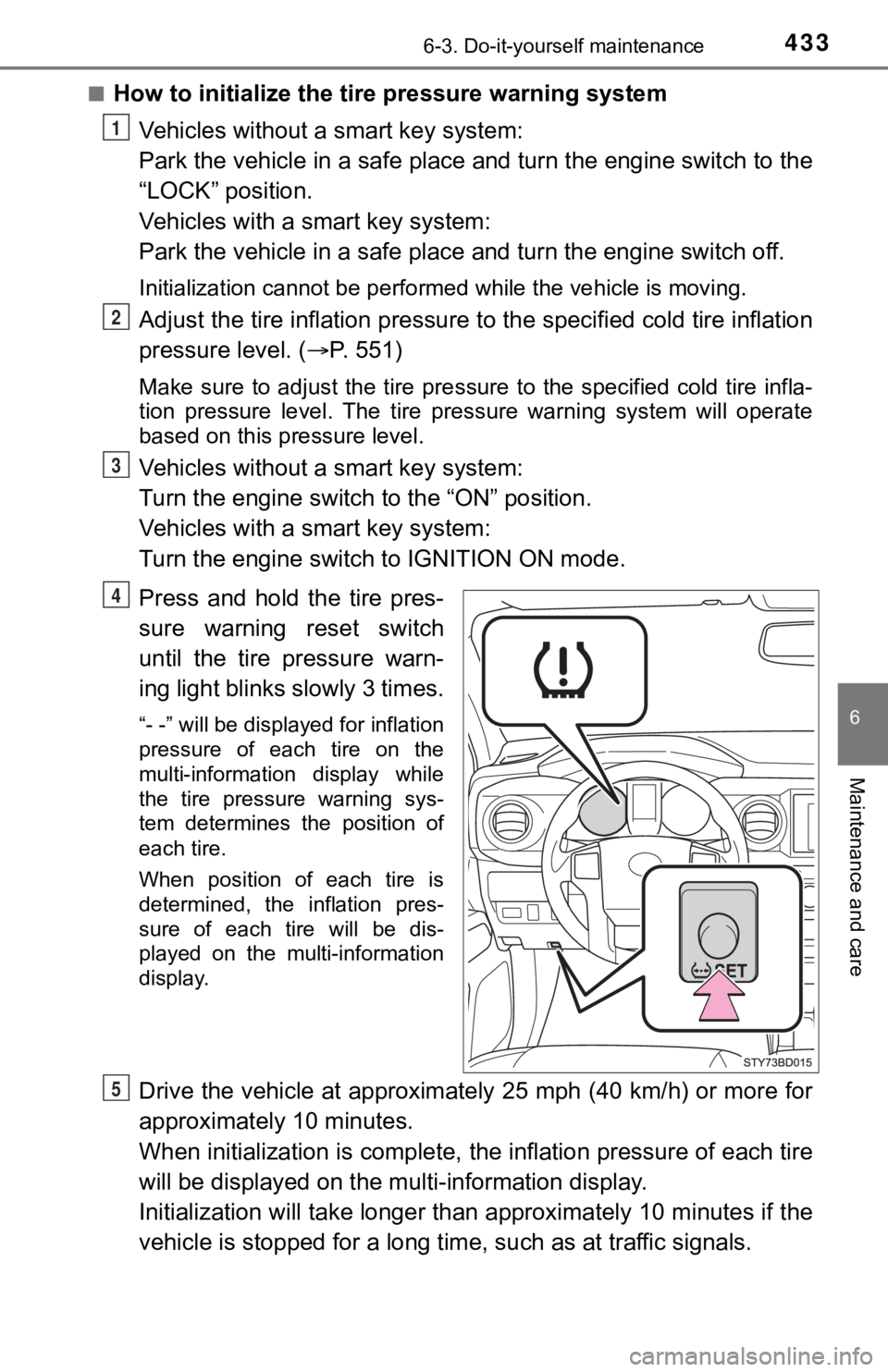
Press and hold the tire pres-
sure warning reset switch
until the tire pressure warn-
ing light blinks slowly 3 times.
“- -” will be displayed for inflation
pressure of each tire on the
multi-information display while
the tire pressure warning sys-
tem determines the position of
each tire.
When position of each tire is
determined, the inflation pres-
sure of each tire will be dis-
played on the multi-information
display.
Drive the vehicle at approximately 25 mph (40 km/h) or more for
approximately 10 minutes.
When initialization is complete, the inflation pressure of each tire
will be displayed on the mu lti-information display.
Initialization will ta ke longer than approxi mately 10 minutes if the
vehicle is stopped for a long time, such as at traffic signals.
1
2
3
4
5
Page 437 of 616

4376-3. Do-it-yourself maintenance
6
Maintenance and care
■The initialization operation (vehicles with the tire pressure warning
system)
●Make sure to carry out initializ ation after adjusting the tire inflation pres-
sure.
Also, make sure the tires are co ld before carrying out initialization or tire
inflation pressure adjustment.
●If you have accidentally turned the engine switch to the “LOCK” position
(vehicles without a smart key system) or off (vehicles with a s mart key
system) during initialization, it is not necessary to press the reset switch
again as initialization will rest art automatically when the engine switch
has been turned to the “ON” posi tion (vehicles without a smart key sys-
tem) or IGNITION ON mode (vehicl es with a smart key system) for the
next time.
●If you accidentally press the reset switch when initialization is not neces-
sary, adjust the tire inflation pressure to the specified level when the
tires are cold, and cond uct initialization again.
■Warning performance of the tire pressure warning system
The warning of the tire pressu re warning system will change in accor-
dance with the conditions under which it was initialized. For t his reason,
the system may give a warning even if the tire pressure does no t reach a
low enough level, or if the pressure is higher than the pressur e that was
adjusted to when the sys tem was initialized.
■When initialization of the tire pressure warning system has fai led (if
equipped)
Initialization may take longer to complete if the vehicle is driven on an
unpaved road. When performing ini tialization, drive on a paved road if
possible. Depending on the driving environment and condition of the tires,
initialization will be completed in approximately 10 minutes. If initialization
is not complete after driving app roximately 10 minutes, continue driving
for a while.
If the inflation pressure of each tire is not displayed after d riving for
approximately 1 hour, perf orm the following procedure.
●Park the vehicle in a safe place for approximately 20 minutes. Then
drive straight (with occasional left and right turns) at approx imately
25mph (40 km/h) or more for ap proximately 10 to 20 minutes.
However, in the following situatio ns, the tire inflation pressure will not be
recorded and the system will not operate properly. Perform initialization
again.
●When operating the tire pressure warning reset switch, the tire pressure
warning light does not blink 3 times.
●After performing initialization, t he tire pressure warning light blinks for
1 minute then stays on while driving.
If the inflation pressure of eac h tire is still not displayed, have the vehicle
inspected by you r Toyota dealer.
Page 448 of 616
4486-3. Do-it-yourself maintenance
Air conditioning filter
Vehicles without a smart key system:
Turn the engine switch to the “LOCK” position.
Vehicles with a smart key system:
Turn the engine switch off.
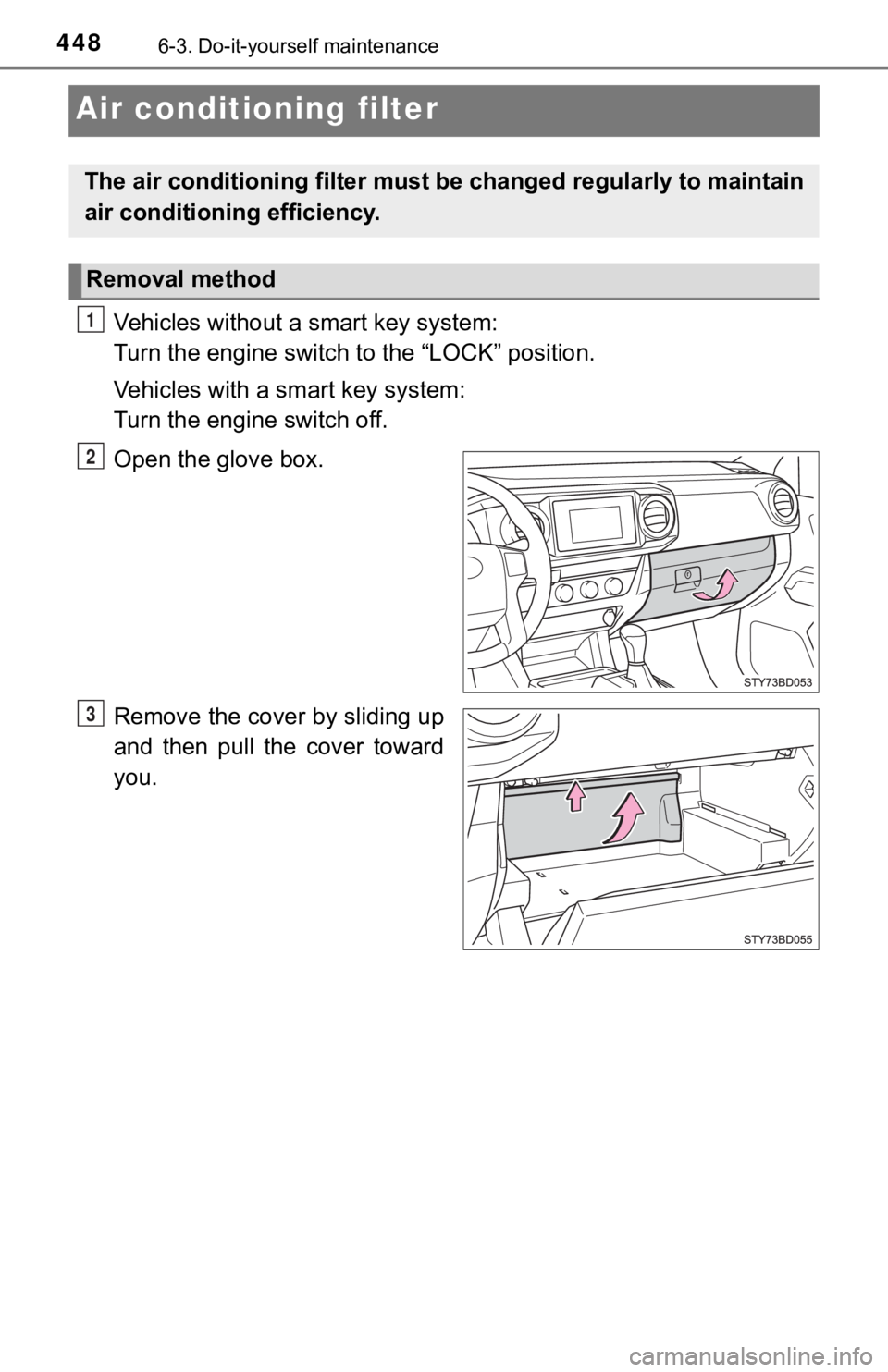
Open the glove box.
Remove the cover by sliding up
and then pull the cover toward
you.
The air conditioning filter must be changed regularly to maintain
air conditioning efficiency.
Removal method
1
2
3
Page 455 of 616
4556-3. Do-it-yourself maintenance
6
Maintenance and care
Checking and replacing fuses
Vehicles without a smart key system:
Turn the engine switch to the “LOCK” position.
Vehicles with a smart key system:
Turn the engine switch off.
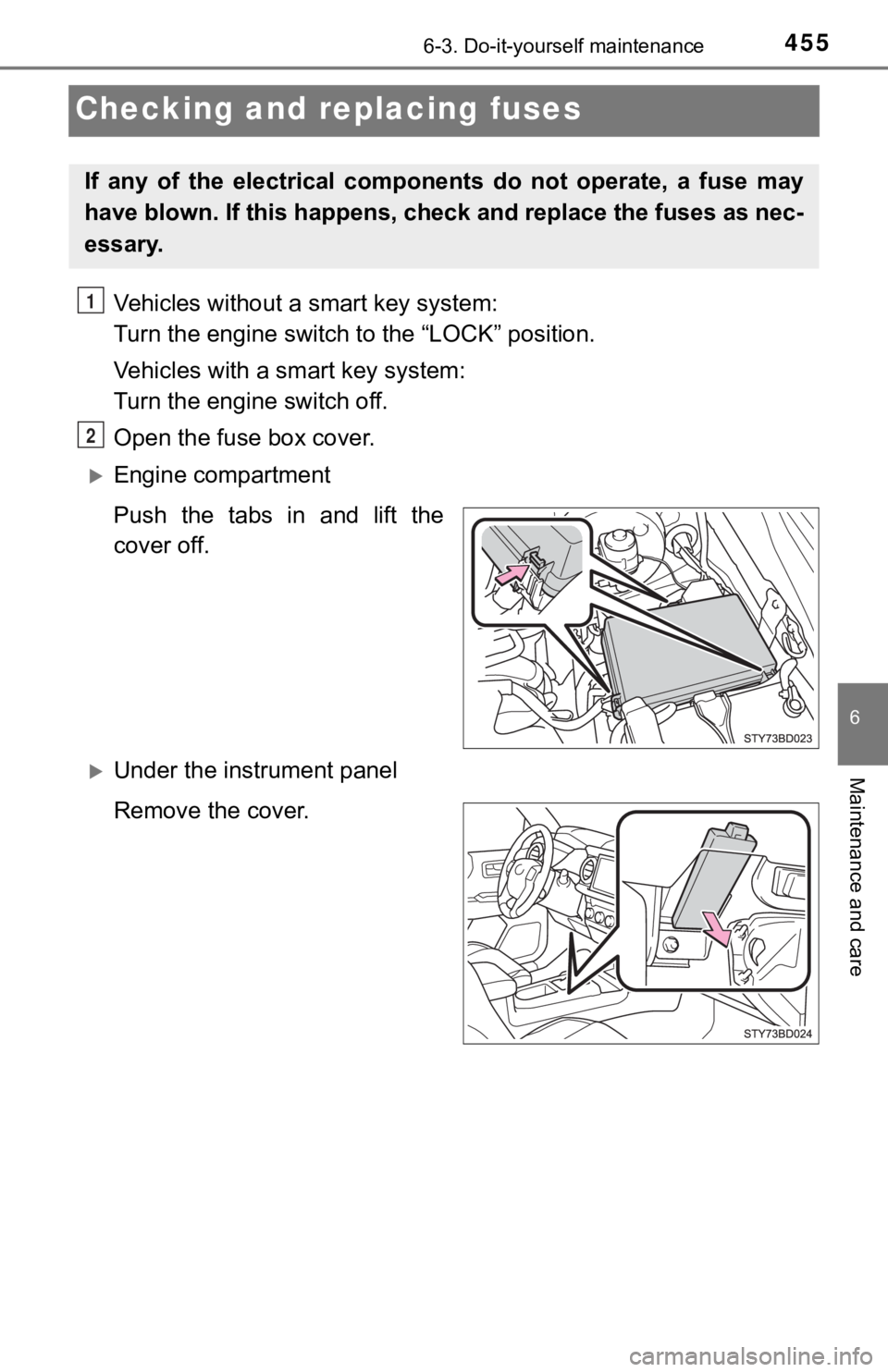
Open the fuse box cover.
Engine compartment
Push the tabs in and lift the
cover off.
Under the instrument panel
Remove the cover.
If any of the electrical components do not operate, a fuse may
have blown. If this happens, check and replace the fuses as nec-
essary.
1
2
Page 471 of 616

471
7When trouble arises
7-1. Essential informationEmergency flashers .......... 472
If your vehicle has to be stopped in
an emergency ................. 473
If the vehicle is submerged or water on
the road is rising.............. 475 7-2. Steps to take in an emergency
If your vehicle needs to be towed ......................... 476
If you think something is wrong ......... 480
Fuel pump shut off system ............................ 481
If a warning light turns on or a warning buzzer
sounds ............................ 482
If a warning message is displayed......................... 489
If you have a flat tire.......... 511
If the engine will not start ................................. 526
If the electronic key does not operate properly
(vehicles with a smart key
system) ........................... 528
If the vehicle battery is discharged ...................... 530
If your vehicle overheats ... 534
If the vehicle becomes stuck ............................... 536
Page 473 of 616
473
7
When trouble arises
7-1. Essential information
If your vehicle has to be stopped in an
emergency
Steadily step on the brake pedal with both feet and firmly depress it.
Do not pump the brake pedal repeatedly as this will increase th e effort
required to slow the vehicle.
Shift the shift lever to N.
If the shift lever is shifted to N
After slowing down, stop the vehi cle in a safe place by the road.
Stop the engine.
If the shift lever cann ot be shifted to N
Keep depressing the brake pedal with both feet to reduce vehicl e
speed as much as possible.
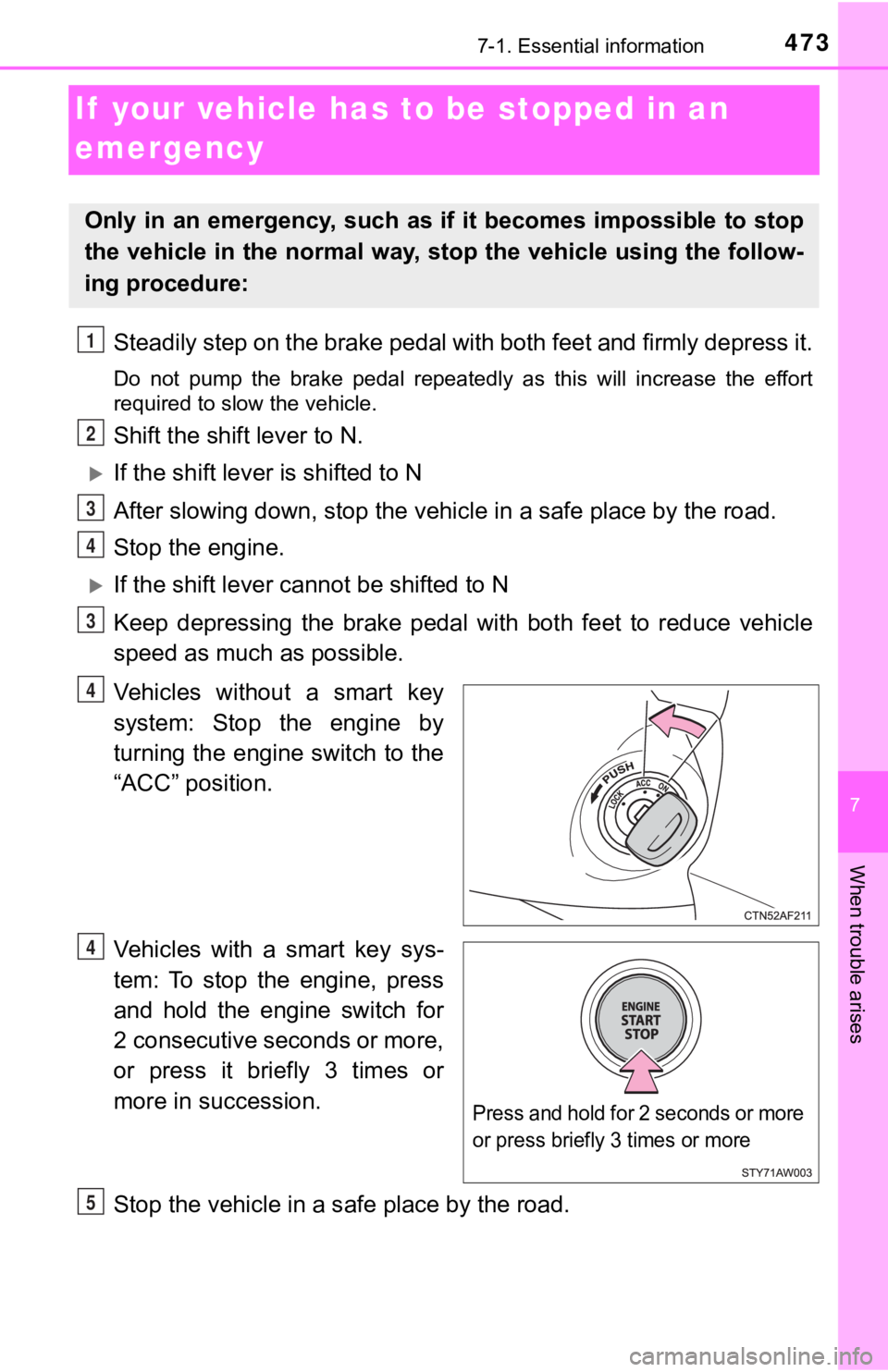
Vehicles without a smart key
system: Stop the engine by
turning the engine switch to the
“ACC” position.
Vehicles with a smart key sys-
tem: To stop the engine, press
and hold the engine switch for
2 consecutive seconds or more,
or press it briefly 3 times or
more in succession.
Stop the vehicle in a s afe place by the road.
Only in an emergency, such as if it becomes impossible to stop
the vehicle in the normal way, st op the vehicle using the follow-
ing procedure:
1
2
3
4
3
4
Press and hold for 2 seconds or more
or press briefly 3 times or more
Q
R
Page 474 of 616

4747-1. Essential information
WARNING
■If the engine has to be turned off while driving
● Power assist for the brakes and steering wheel will be lost, making the
brake pedal harder to depress and the steering wheel heavier to turn.
Decelerate as much as possible before turning off the engine.
● Vehicles without a smart key system:
Never attempt to remove the key, as doing so will lock the stee ring wheel.
Page 475 of 616
475
7
When trouble arises
7-1. Essential information
If the vehicle is submerged or water on the
road is rising
●If the door can be opened, open the door and exit the vehicle.
● If the door can not be opened, open the window using the power
window switch and ens ure an escape route.
● If the window can be opened, exit the vehicle through the windo w.
● If the door and window cannot be opened due to the rising water ,
remain calm, wait until the water level inside the vehicle rises to the
point that the water pressure inside of the vehicle equals the water
pressure outside of the vehicle and then open the door after wa iting
for the rising water to enter the vehicle, and exit the vehicle . When
the outside water level exc eeds half the height of the door, the door
cannot be opened from the inside due to water pressure.
■ Water level exceeds the floor
When the water level exceeds the floor and time has passed, the electrical
equipment will get damaged, the power windows will not operate, the engine
stop, and the vehicle may not be able to get moving.
■ Using an emergency escape hammer
*
Laminated glass is used in the windshield on this vehicle.
Laminated glass cannot be shattered with an emergency hammer
*.
Tempered glass is used in the windows on this vehicle.
*: Contact your Toyota dealer or aftermarket accessory manufacturer for fur-
ther information about an emergency hammer.
This vehicle is not designed to be able to drive on roads that are
deeply flooded with water. Do not drive on roads where the
roads may be submerged or the water may be rising. It is dan-
gerous to remain in the vehicle, if it anticipated that the veh icle
will be flooded or set a drift. Re main calm and follow the follow-
ing.
WARNING
■ Caution while driving
Do not drive on roads where the roads may be submerged or the w ater may
be rising. Otherwise the vehicle may be damaged and cannot move, as well
as become flooded and set a drift, which may lead to death.
Page 477 of 616
4777-2. Steps to take in an emergency
7
When trouble arises
The following may indicate a problem with your transmission. Contact
your Toyota dealer or commercial towing service before towing.
● The engine is running but t he vehicle does not move.
● The vehicle makes an abnormal sound.
WARNING
■While towing
● When towing using cables or chains, avoid sudden starts, etc., which
place excessive stress on the towing eyelets, cables or chains. The towing
eyelets, cables or chains may become damaged, broken debris may hit
people, and cause serious damage.
● Do not turn the engine switch to the “LOCK” position (vehicles without a
smart key system) or off (vehicles with a smart key system).
There is a possibility that the steering wheel is locked and ca nnot be oper-
ated.
NOTICE
■ To prevent damage to the vehicle when towing using a wheel-lift type
truck
● Vehicles without a smart key system:
Do not tow the vehicle from the rear when the engine switch is in the
“LOCK” position or the key is removed.
The steering lock mechanism is not strong enough to hold the front wheels
straight.
● Vehicles with a smart key system:
Do not tow the vehicle from the rear when the engine switch is off.
The steering lock mechanism is not strong enough to hold the front wheels
straight.
● When raising the vehicle, ensure adequate ground clearance for towing at
the opposite end of the raised vehicle. Without adequate clearance, the
vehicle could be damaged while being towed.
■ To prevent damage to the vehicle when towing with a sling-type truck
Do not tow with a sling-type truck, either from the front or re a r.
■ To prevent damage to the vehicle during emergency towing
Do not secure cables or chains to the suspension components.
Situations when it is necessary to contact dealers before towing
Page 478 of 616
4787-2. Steps to take in an emergency
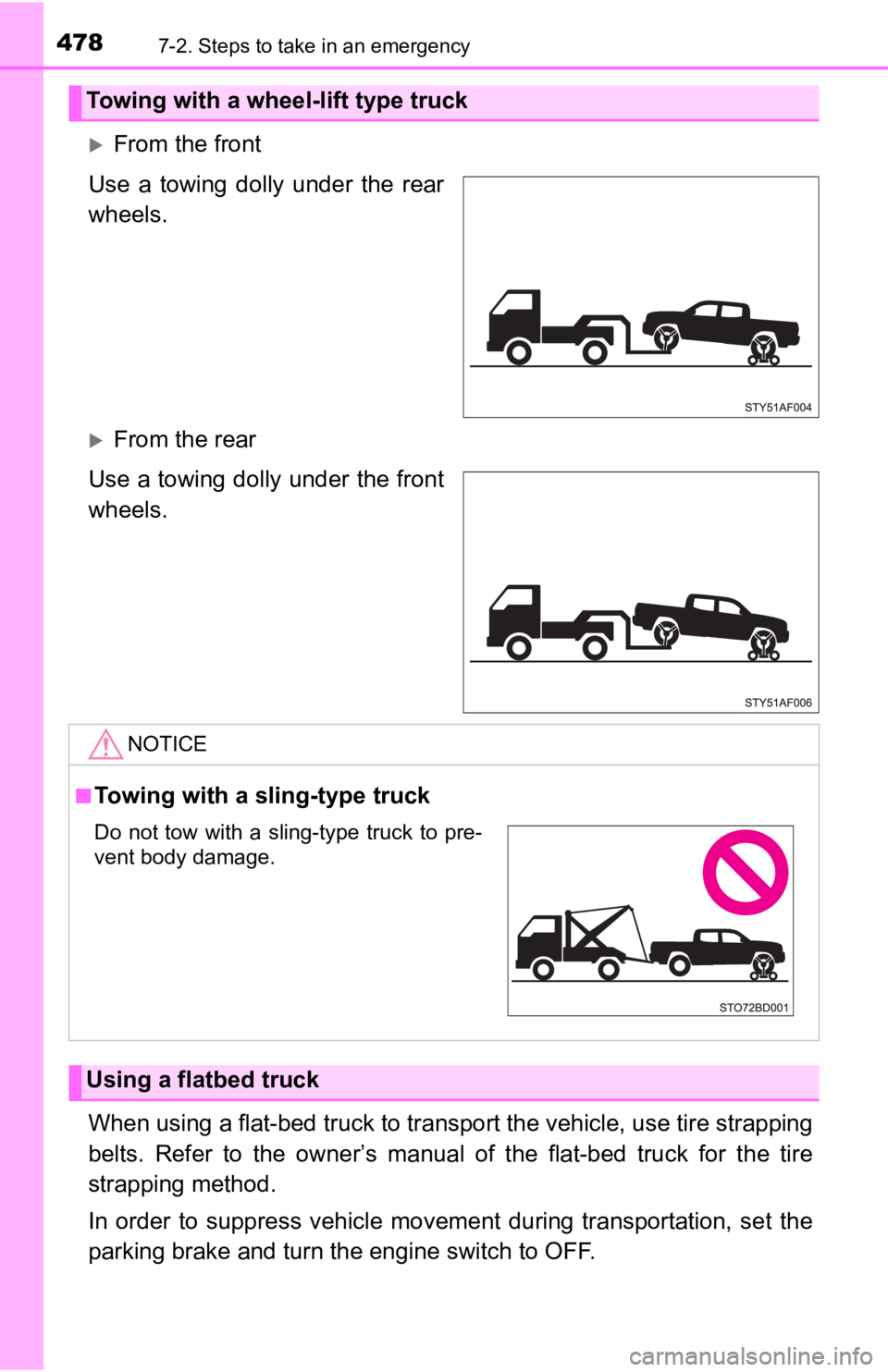
From the front
Use a towing dolly under the rear
wheels.
From the rear
Use a towing dolly under the front
wheels.
When using a flat-bed truck to transport the vehicle, use tire strapping
belts. Refer to the owner’s manual of the flat-bed truck for th e tire
strapping method.
In order to suppress vehicle movement during transportation, se t the
parking brake and turn th e engine switch to OFF.
Towing with a wheel-lift type truck
NOTICE
■Towing with a sling-type truck
Using a flatbed truck
Do not tow with a sling-type truck to pre-
vent body damage.