key battery TOYOTA tC 2011 (in English) User Guide
[x] Cancel search | Manufacturer: TOYOTA, Model Year: 2011, Model line: tC, Model: TOYOTA tC 2011Pages: 473, PDF Size: 10.91 MB
Page 241 of 473
241
3-3. Using the interior lights
3
Interior features
■
Illuminated entry system
Vehicles without a smart key system
The lights automatically turn on/off according to the engine switch position,
whether the doors are locked/unlocked, and whether the doors are open/
closed.
Vehicles with a smart key system
The lights automatically turn on/off according to “ENGINE START STOP”
switch mode, the presence of the electronic key, whether the doors are
locked/unlocked, and whether the doors are open/closed.
■ To prevent battery discharge
If the interior lights remain on when the door is not fully closed and the inte-
rior light switch is in door position, the lights will go off automatically after 20
minutes.
■ Customization that can be configured at Scion dealer
Settings (e.g. The time elapsed before lights turn off) can be changed.
(Customizable features: P. 438)
Page 249 of 473
249
3-5. Other interior features
3
Interior features
Clock
■The clock is displayed when
Vehicles without a smart key system
The engine switch is in the “ACC” or “ON” position.
Vehicles with a smart key system
The “ENGINE START STOP” switch is in ACCESSORY or IGNITION ON
mode.
■ When disconnecting and reco nnecting battery terminals
The time display will automatically be set to 1:00.
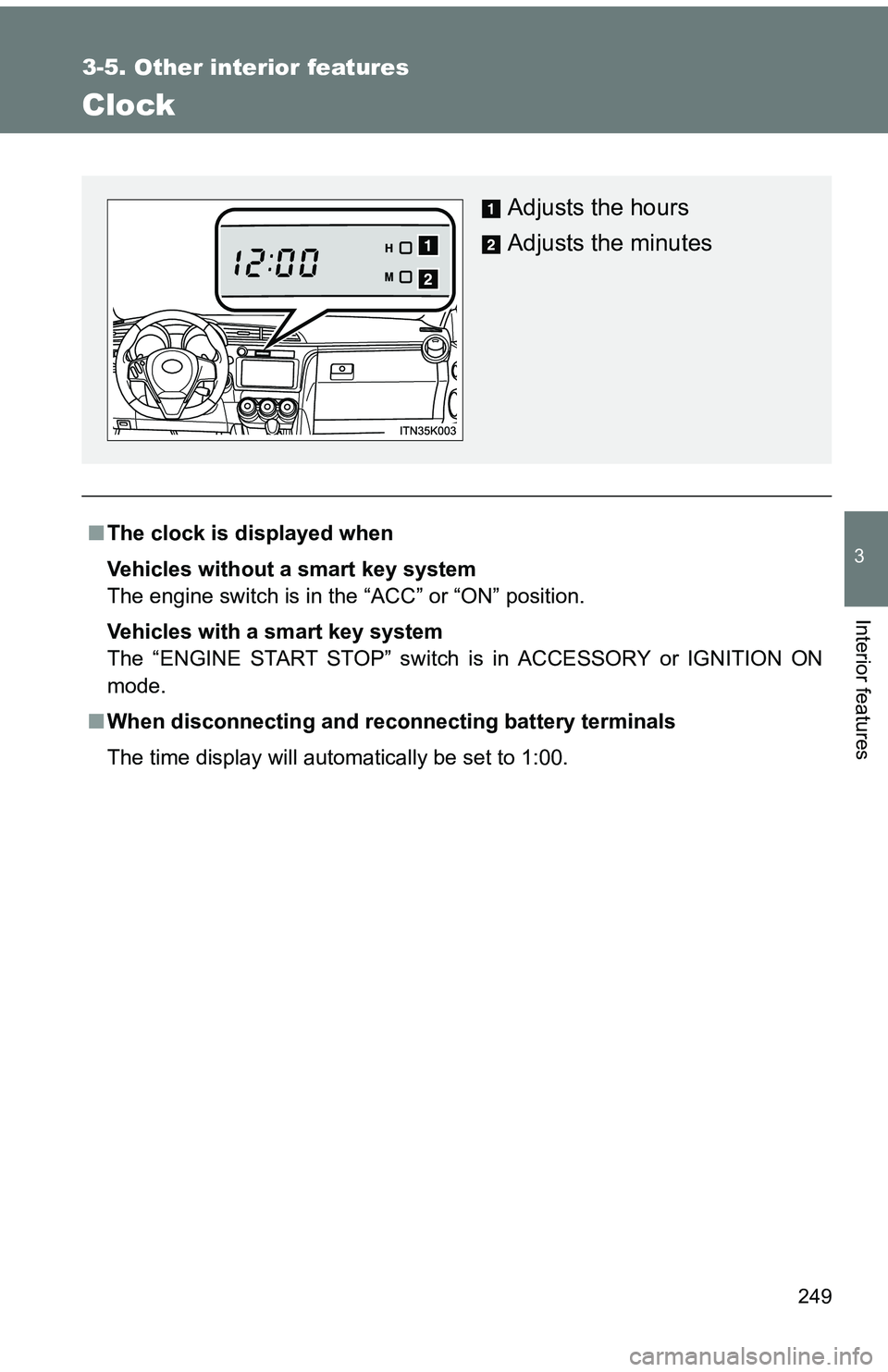
Adjusts the hours
Adjusts the minutes
Page 250 of 473
250
3-5. Other interior features
Power outlet
■The power outlet can be used when
Vehicles without a smart key system
The engine switch is in the “ACC” or “ON” position.
Vehicles with a smart key system
The “ENGINE START STOP” switch is in ACCESSORY or IGNITION ON
mode.
NOTICE
■To avoid damaging the power outlet
Close the power outlet lid when the power outlet is not in use.
Foreign objects or liquids that enter the power outlet may cause a short cir-
cuit.
■ To prevent blown fuse
Do not use an accessory that uses more than 12 V 10 A.
■ To prevent battery discharge
Do not use the power outlet longer than necessary when the engine is not\
running.
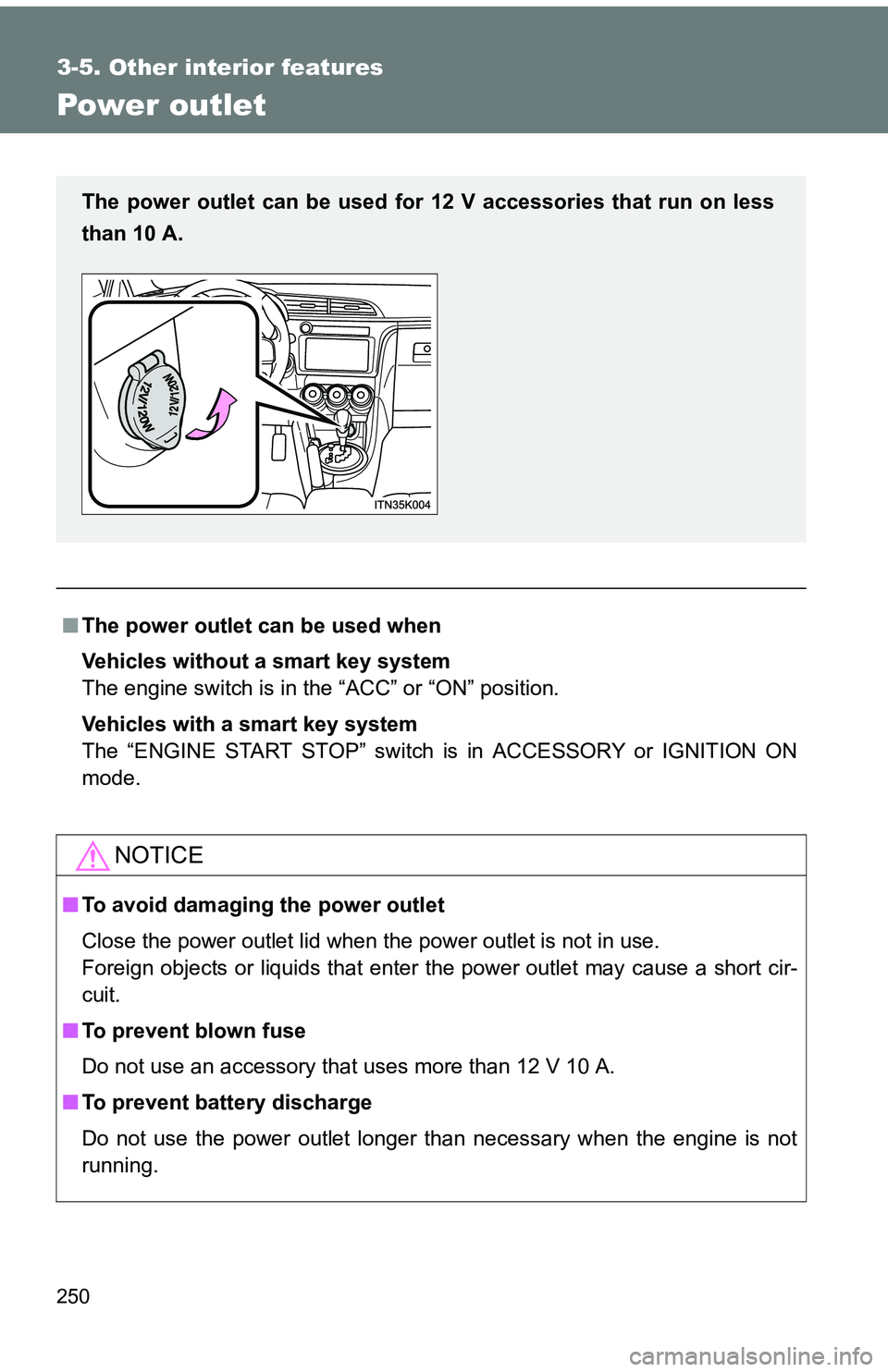
The power outlet can be used for 12 V accessories that run on less
than 10 A.
Page 261 of 473
Maintenance and care4
261
4-1. Maintenance and careCleaning and protecting the vehicle exterior......... 262
Cleaning and protecting the vehicle interior.......... 266 4-2. Maintenance
Maintenance requirements .................. 269
General maintenance....... 271
Emission inspection and maintenance (I/M)
programs........................ 275
4-3. Do-it-yourself maintenance Do-it-yourself service precautions .................... 276
Hood ................................ 281
Positioning a floor jack ..... 283
Engine compartment ........ 285
Tires ................................. 302
Tire inflation pressure ...... 312
Wheels ............................. 316
Wireless remote control/ electronic key battery ..... 318
Checking and replacing fuses .............................. 322
Light bulbs........................ 333
Page 298 of 473
297
4-3. Do-it-yourself maintenance
4
Maintenance and care
■
Before recharging
When recharging, the battery produces hydrogen gas which is flammable
and explosive. Therefore, observe the following before recharging:
●If recharging with the battery installed on the vehicle, be sure to discon-
nect the ground cable.
● Make sure the power switch on the charger is off when connecting and
disconnecting the charger cables to the battery.
■ After recharging/reconnecting the battery (vehicles with a smart key
system)
●Unlocking the doors using the smart key system may not be possible
immediately after reconnecting the battery. If this happens, use the wire-
less remote control or the mechanical key to lock/unlock the doors.
● Start the engine with the “ENGINE START STOP” switch in ACCES-
SORY mode. The engine may not start with the “ENGINE START STOP”
switch turned OFF. However, the engine will operate normally from the
second attempt.
● The “ENGINE START STOP” switch mode is recorded by the vehicle. If
the battery is reconnected, the vehicle will return the “ENGINE START
STOP” switch mode to the status it was in before the battery was discon-
nected. Make sure to turn off the power before disconnecting the battery.
Take extra care when connecting the battery if the “ENGINE START
STOP” switch mode prior to discharge is unknown.
If the system will not start even after multiple attempts, contact your Scion
dealer.
Page 319 of 473
318
4-3. Do-it-yourself maintenance
Wireless remote control/electronic key batter y
Replace the battery with a new one if it is depleted.
■You will need the following items:
●Flathead screwdriver
● Lithium battery CR2016 (vehicles without a smart key sys-
tem), or CR1632 (vehicles with a smart key system)
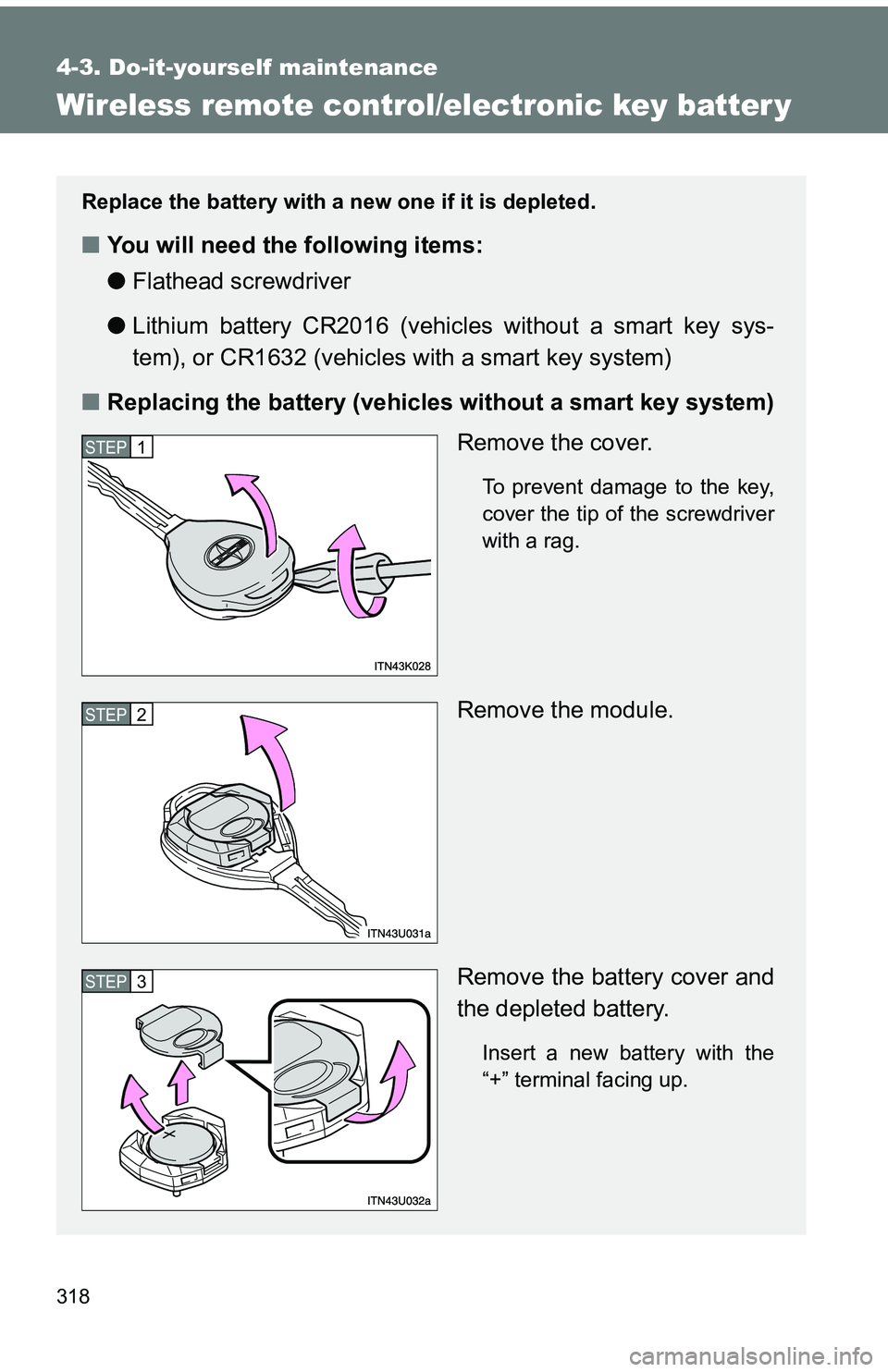
■ Replacing the battery (vehicles without a smart key system)
Remove the cover.
To prevent damage to the key,
cover the tip of the screwdriver
with a rag.
Remove the module.
Remove the battery cover and
the depleted battery.
Insert a new battery with the
“+” terminal facing up.
STEP 1
STEP 2
STEP 3
Page 320 of 473
319
4-3. Do-it-yourself maintenance
4
Maintenance and care
■
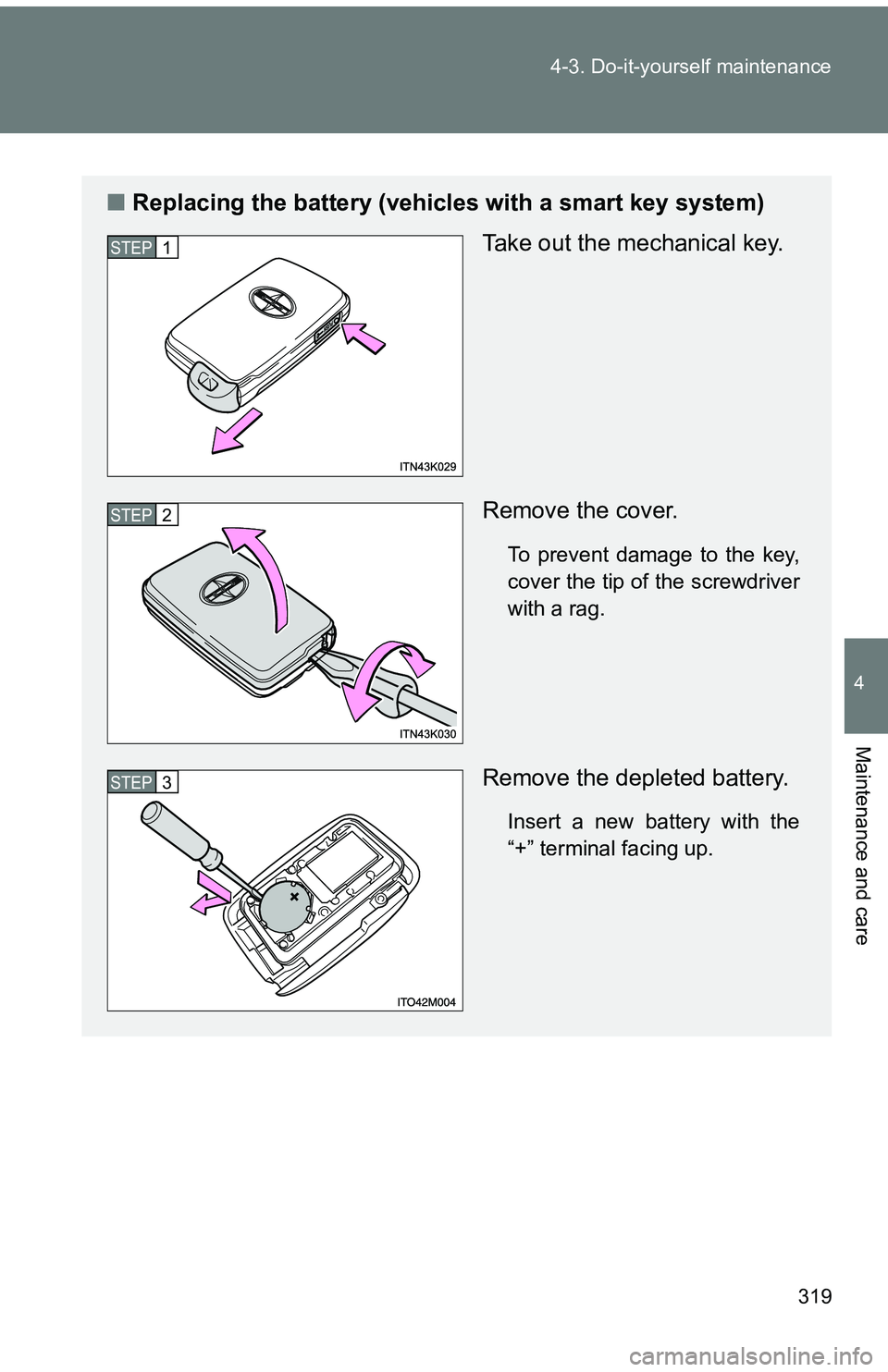
Replacing the battery (vehicles with a smart key system)
Take out the mechanical key.
Remove the cover.
To prevent damage to the key,
cover the tip of the screwdriver
with a rag.
Remove the depleted battery.
Insert a new battery with the
“+” terminal facing up.
STEP 1
STEP 2
STEP 3
Page 321 of 473
320 4-3. Do-it-yourself maintenance
■Use the following types of lithium battery
Vehicles without a smart key system: CR2016
Vehicles with a smart key system: CR1632
●Batteries can be purchased at your Scion dealer, local electrical appli-
ance shops or camera stores.
● Replace only with the same or equivalent type recommended by the
manufacturer.
● Dispose of used batteries according to local laws.
■ If the key battery is depleted
The following symptoms may occur:
●The smart key system (if equipped) and wireless remote control will not
function properly.
● The operational range will be reduced.
CAUTION
■Removed battery and other parts
Keep away from children. These parts are small and if swallowed by a child,
they can cause choking.
Failure to do so could result in death or serious injury.
Page 344 of 473
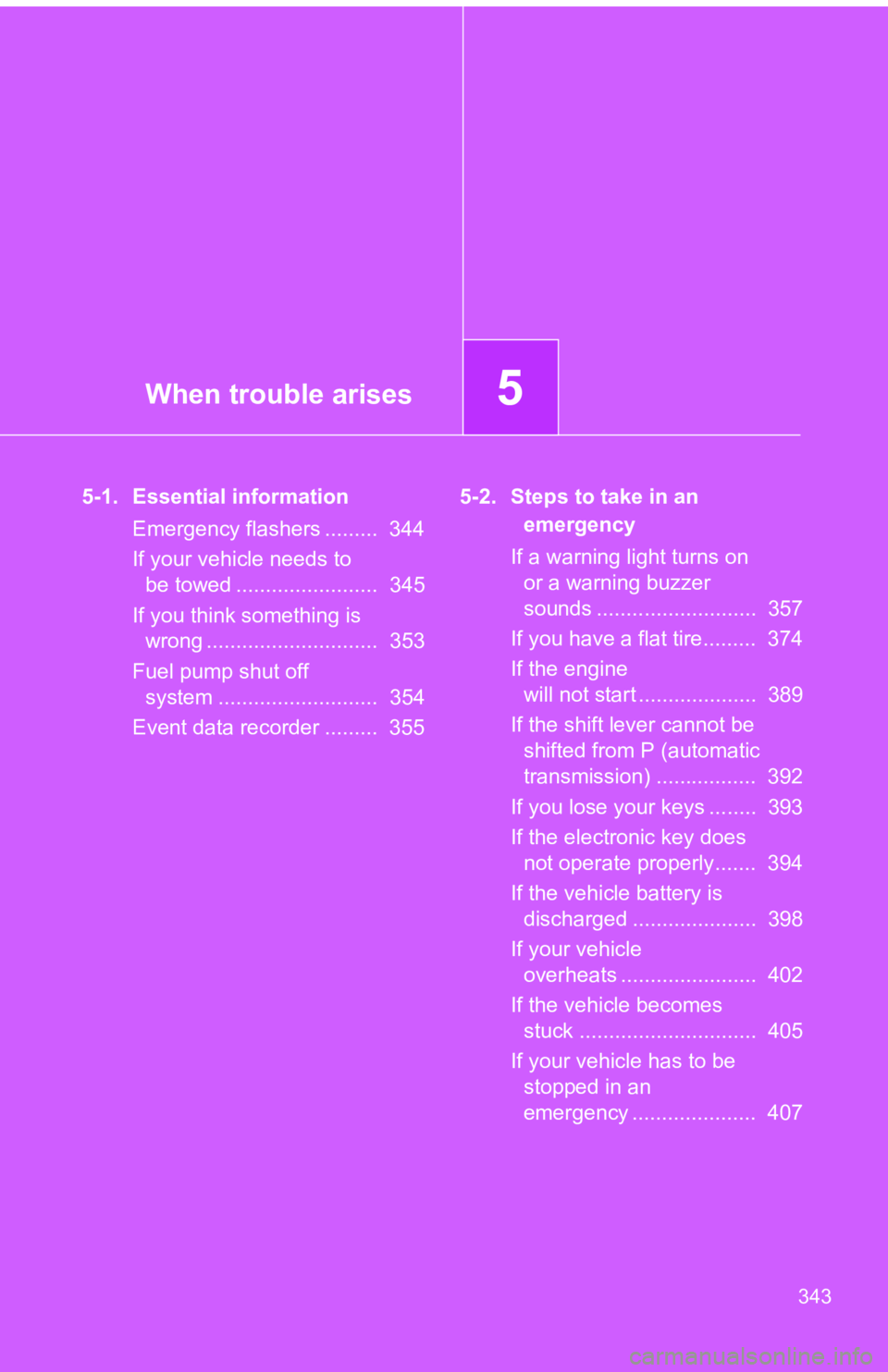
When trouble arises5
343
5-1. Essential informationEmergency flashers ......... 344
If your vehicle needs to be towed ........................ 345
If you think something is wrong ............................. 353
Fuel pump shut off system ........................... 354
Event data recorder ......... 355 5-2. Steps to take in an
emergency
If a warning light turns on or a warning buzzer
sounds ........................... 357
If you have a flat tire......... 374
If the engine will not start .................... 389
If the shift lever cannot be shifted from P (automatic
transmission) ................. 392
If you lose your keys ........ 393
If the electronic key does not operate properly....... 394
If the vehicle battery is discharged ..................... 398
If your vehicle overheats ....................... 402
If the vehicle becomes stuck .............................. 405
If your vehicle has to be stopped in an
emergency ..................... 407
Page 390 of 473
5
When trouble arises
389
5-2. Steps to take in an emergency
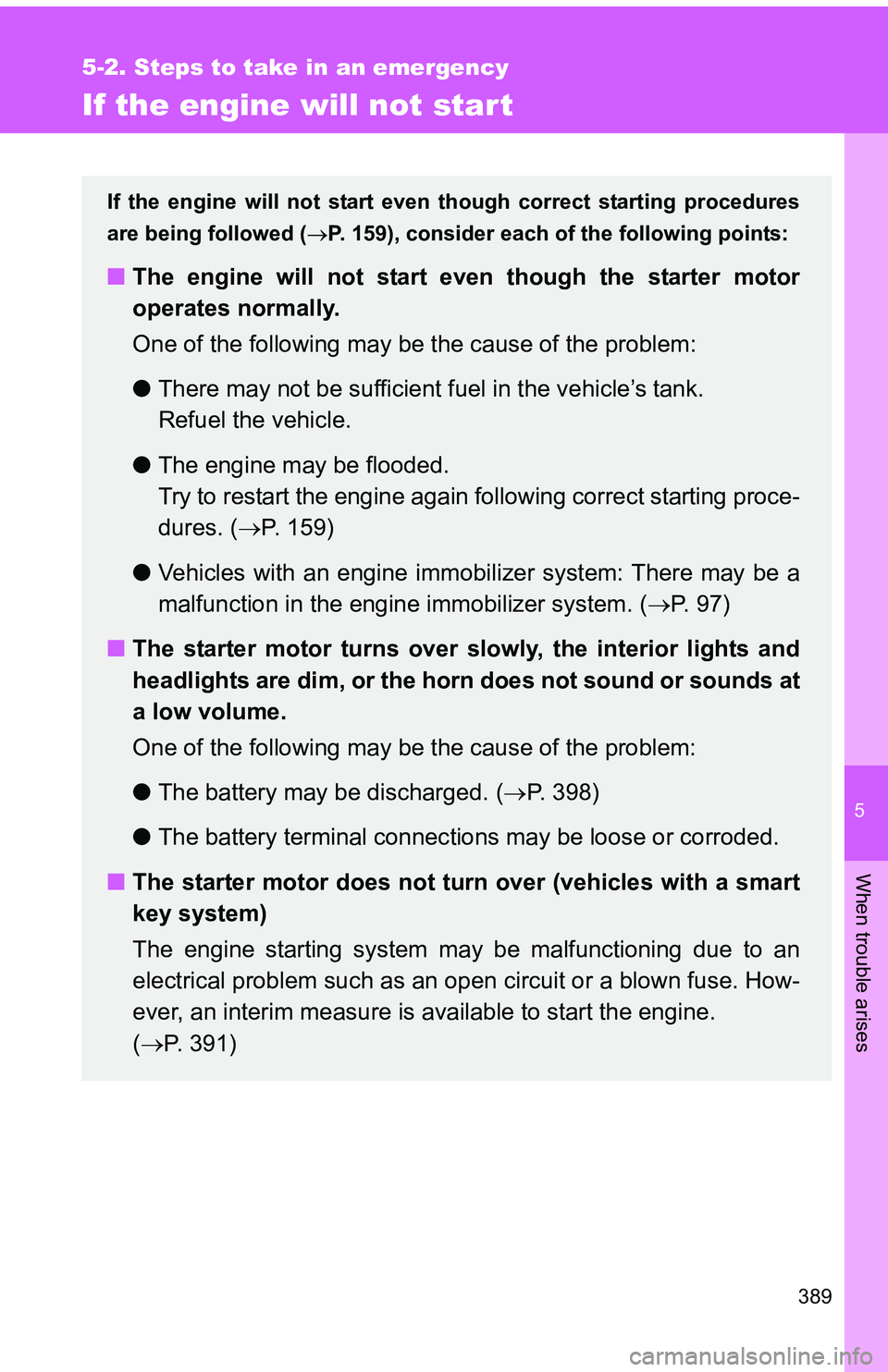
If the engine will not star t
If the engine will not start even though correct starting procedures
are being followed ( P. 159), consider each of the following points:
■The engine will not start even though the starter motor
operates normally.
One of the following may be the cause of the problem:
●There may not be sufficient fuel in the vehicle’s tank.
Refuel the vehicle.
● The engine may be flooded.
Try to restart the engine again following correct starting proce-
dures. ( P. 159)
● Vehicles with an engine immobilizer system: There may be a
malfunction in the engine immobilizer system. (P. 9 7 )
■ The starter motor turns over slowly, the interior lights and
headlights are dim, or the horn does not sound or sounds at
a low volume.
One of the following may be the cause of the problem:
●The battery may be discharged. ( P. 398)
● The battery terminal connec tions may be loose or corroded.
■ The starter motor does not turn over (vehicles with a smart
key system)
The engine starting system may be malfunctioning due to an
electrical problem such as an open circuit or a blown fuse. How-
ever, an interim measure is available to start the engine.
( P. 391)