air condition TOYOTA tC 2015 Owners Manual (in English)
[x] Cancel search | Manufacturer: TOYOTA, Model Year: 2015, Model line: tC, Model: TOYOTA tC 2015Pages: 492, PDF Size: 9.63 MB
Page 1 of 492

TABLE OF CONTENTS
1
tC_OM_OM21057U_(U)
1Before drivingAdjusting and operating features such as door locks,
mirrors, and steering column
2When drivingDriving, stopping and safe-driving information
3Interior
featuresAir conditioning as well as other interior features for a
comfortable driving experience
4Maintenance
and careCleaning and protecting your vehicle, performing do-it-
yourself maintenance, and maintenance information
5When trouble
arisesWhat to do if the vehicle needs to be towed, gets a flat
tire, or is involved in an accident
6Vehicle
specificationsDetailed vehicle information
7For ownersReporting safety defects for U.S. owners, and seat belt
and SRS airbag instructions for Canadian owners
IndexAlphabetical listing of information contained in this
manual
Page 3 of 492

1
2
3
4
5
6
7
3
tC_OM_OM21057U_(U)
2-3. Operating the lights and windshield wipers
Headlight switch .................. 199
Windshield wipers and washer .............................. 204
Rear window wiper and washer .............................. 208
2-4. Using other driving systems Cruise control ...................... 211
Driving assist systems ........ 215
2-5. Driving information Cargo and luggage ............. 220
Vehicle load limits ............... 225
Winter driving tips ............... 226
Trailer towing ...................... 232
Dinghy towing (automatic transmission) .................... 233
Dinghy towing (manual transmission) .................... 234
3-1. Using the air conditioning system and defogger
Air conditioning system ....... 238
Rear window and outside rear view mirror defogger
switch ................................ 245 3-2. Using the audio system
Using the AUX port/USB port........................... 247
Using the steering wheel audio switches.................. 248
Using the microphone ........ 249
3-3. Using the interior lights Interior lights list ................. 250
• Interior lights..................... 251
3-4. Using the storage features List of storage features ....... 253
• Glove box ......................... 254
• Console box ..................... 255
• Auxiliary box ..................... 256
• Cup holders ...................... 256
• Bottle holders ................... 257
3-5. Other interior features Sun visors........................... 258
Vanity mirrors ..................... 259
Clock .................................. 260
Power outlet ....................... 261
Seat heaters ....................... 262
Sunshades ......................... 264
Assist grips ......................... 266
Floor mat ............................ 267
Luggage compartment features ............................ 269
3Interior features
Page 4 of 492

TABLE OF CONTENTSIndex
4
tC_OM_OM21057U_(U)
4-1. Maintenance and careCleaning and protecting the vehicle exterior ........... 274
Cleaning and protecting the vehicle interior ............ 278
4-2. Maintenance Maintenance requirements .................... 281
General maintenance ......... 284
Emission inspection and maintenance (I/M)
programs .......................... 288
4-3. Do-it-yourself maintenance Do-it-yourself service precautions ...................... 289
Hood................................... 294
Positioning a floor jack ....... 296
Engine compartment .......... 298
Tires ................................... 314
Tire inflation pressure......... 325
Wheels ............................... 329
Air conditioning filter ........... 332
Wireless remote control/ electronic key battery ....... 335
Checking and replacing fuses ................. 341
Light bulbs .......................... 352 5-1. Essential information
Emergency flashers ............ 364
If your vehicle needs to be towed ........................... 365
If you think something is wrong ............................ 374
Fuel pump shut off system .............................. 375
5-2. Steps to take in an emergency If a warning light turns on or a warning buzzer
sounds... .......................... 376
If you have a flat tire ........... 394
If the engine will not start .................................. 408
If the shift lever cannot be shifted from P (automatic
transmission) .................... 411
If you lose your keys ........... 412
If the electronic key does not operate properly ......... 413
If the vehicle battery is discharged .................... 417
If your vehicle overheats..... 421
If the vehicle becomes stuck ................................. 424
If your vehicle has to be stopped in an
emergency........................ 426
4Maintenance and care5When trouble arises
Page 14 of 492
14
tC_OM_OM21057U_(U)
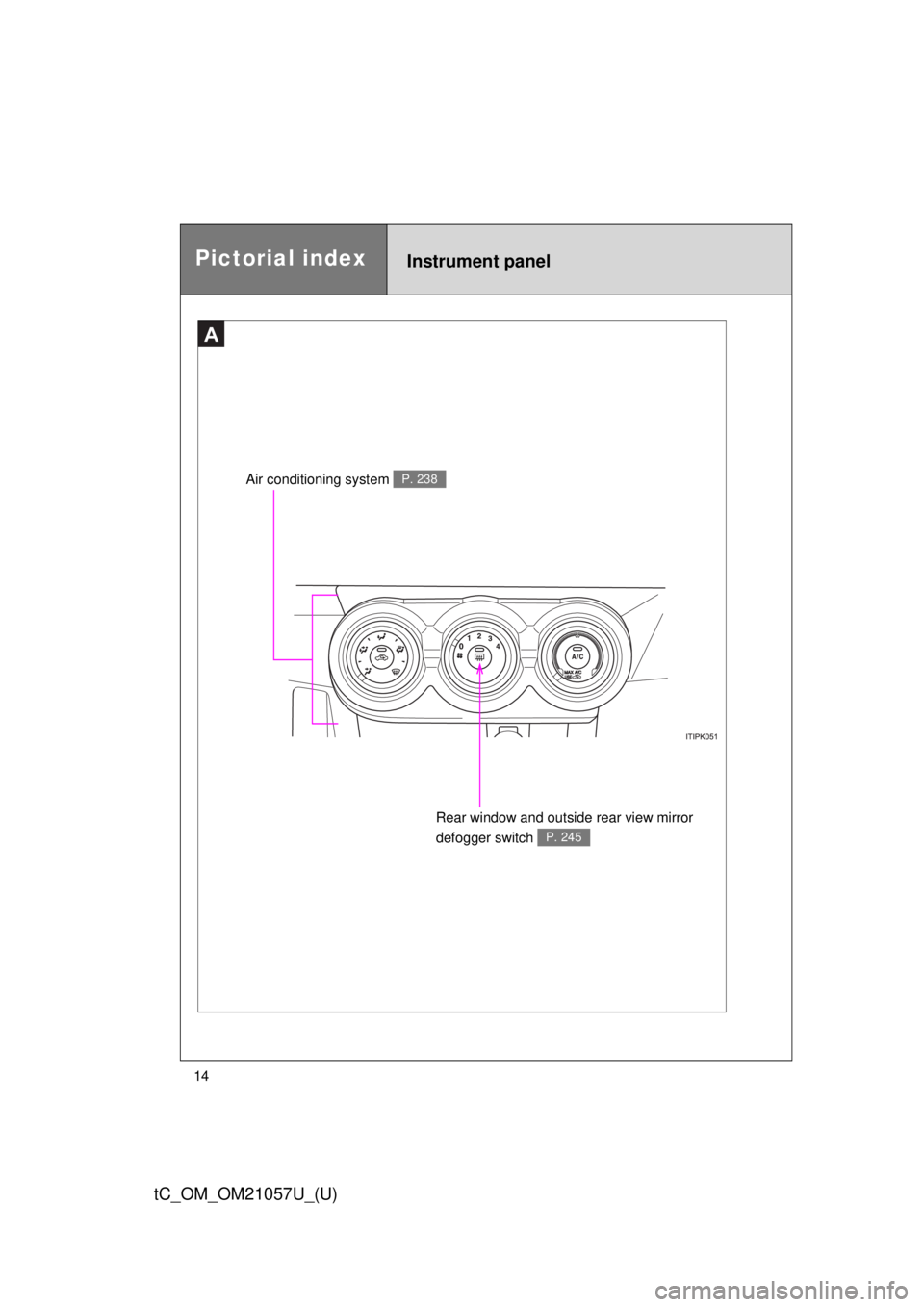
Air conditioning system P. 238
Rear window and outside rear view mirror
defogger switch
P. 245
A
Instrument panelPictorial index
Page 41 of 492

41
1-2. Opening, closing and locking the doors
1
Before driving
tC_OM_OM21057U_(U)
■
Conditions aff ecting operation
The smart key system uses weak radio waves. In the following situations,
the communication between the electronic key and the vehicle may be
affected, preventing the smart key system, wireless remote control and
immobilizer system from operating properly. (Ways of coping: P. 413)
● When the electronic key battery is depleted
● Near a TV tower, electric power plant, gas station, radio station, large dis-
play, airport or other facility that generates strong radio waves or electri-
cal noise
● When carrying a portable radio, ce llular phone, cordless phone or other
wireless communication devices
● When the electronic key is in contact with, or is covered by the following
metallic objects
• Cards to which aluminum foil is attached
• Cigarette boxes that have aluminum foil inside
• Metallic wallets or bags
• Coins
• Hand warmers made of metal
• Media such as CDs and DVDs
● When multiple electronic keys are in the vicinity
● When another wireless key (that emits radio waves) is being used nearby
● When carrying the electronic key together with the following devices that
emit radio waves
• Another vehicle’s electronic key or a wireless key that emits radio
waves
• Personal computers or personal digital assistants (PDAs)
• Digital audio players
• Portable game systems
● If window tint with a metallic content or metallic objects are attached to
the rear window
Page 51 of 492

51
1-2. Opening, closing and locking the doors
1
Before driving
tC_OM_OM21057U_(U)
■
Conditions aff ecting operation
The wireless remote control function may not operate normally in the follow-
ing situations:
Vehicles without a smart key system
● Near a TV tower, radio station, electr ic power plant, airport or other facil-
ity that generates strong radio waves
● When carrying a portable radio, cell ular phone or other wireless commu-
nication devices
● When multiple wireless keys are in the vicinity
● When the wireless key is in contact with, or is covered by, a metallic
object
● When a wireless key (that emits radio waves) is being used nearby
● When the wireless key has been left near an electrical appliance such as
a personal computer
Vehicles with a smart key system
P. 4 1
■ If the wireless remote control does not operate properly (vehicles with
a smart key system)
Locking and unlocking the doors: Use the mechanical key. ( P. 413)
■ Key battery depletion
Vehicles without a smart key system
If the wireless remote control function does not operate, the battery may be
depleted. Replace the battery when necessary. ( P. 335)
Vehicles with a smart key system
P. 4 5
Page 112 of 492

112 1-7. Safety information
tC_OM_OM21057U_(U)
■SRS airbag deployment conditions (SRS front airbags)
●The SRS front airbags will deploy in the event of an impact that exceeds
the set threshold level (the level of force corresponding to an approxi-
mately 12 - 18 mph [20 - 30 km/h] frontal collision with a fixed wall that
does not move or deform).
However, this threshold velocity will be considerably higher in the following
situations:
• If the vehicle strikes an object, such as a parked vehicle or sign pole,
which can move or deform on impact
• If the vehicle is involved in an underride collision, such as a collision in which the front of the vehicle “underrides”, or goes under, the bed of a
truck
● Depending on the type of collision, it is possible that only the seat belt
pretensioners will activate.
● The SRS front airbags for the front passenger will not activate if there is
no passenger sitting in the front passenger seat. However, the SRS front
airbags for the front passenger may deploy if luggage is put in the seat,
even if the seat is unoccupied. ( P. 123)
■ SRS airbag deployment conditions (S RS side and curtain shield air-
bags)
● The SRS side and curtain shield airbags will deploy in the event of an
impact that exceeds the set threshold level (the level of force corre-
sponding to the impact force produced by an approximately 3300 lb.
[1500 kg] vehicle colliding with the vehicle cabin from a direction perpen-
dicular to the vehicle orientation at an approximate speed of 12 - 18 mph
[20 - 30 km/h]).
● The SRS curtain shield airbags may also deploy in the event of a severe
frontal collision.
Page 113 of 492
113
1-7. Safety information
1
Before driving
tC_OM_OM21057U_(U)
■
Conditions under which the SRS airbags may deploy (inflate), other
than a collision
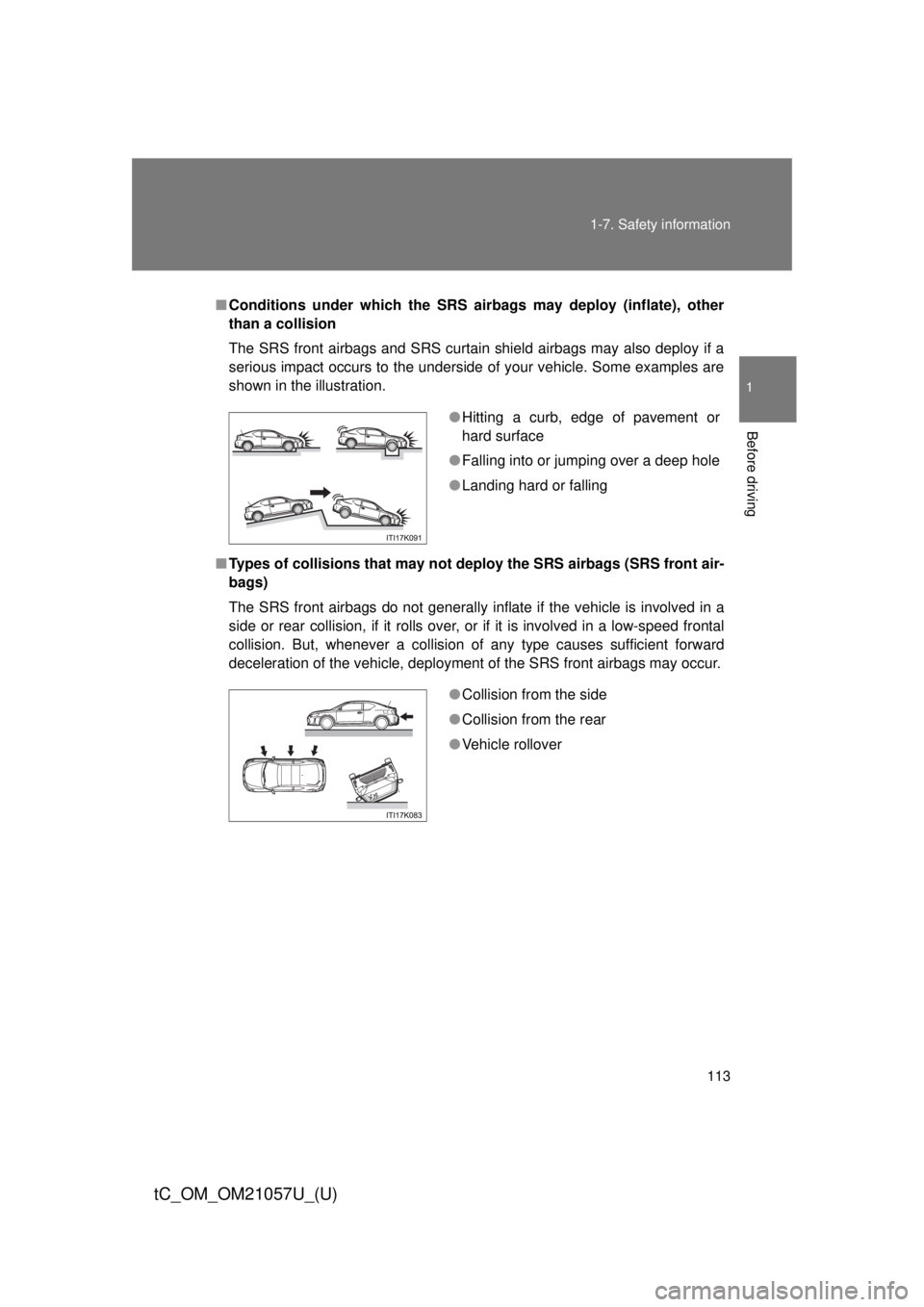
The SRS front airbags and SRS curtain shield airbags may also deploy if a
serious impact occurs to the underside of your vehicle. Some examples are
shown in the illustration.
■ Types of collisions that may not de ploy the SRS airbags (SRS front air-
bags)
The SRS front airbags do not generally inflate if the vehicle is involved in a
side or rear collision, if it rolls over, or if it is involved in a low-speed frontal
collision. But, whenever a collision of any type causes sufficient forward
deceleration of the vehicle, deployment of the SRS front airbags may occur.
● Hitting a curb, edge of pavement or
hard surface
● Falling into or jumping over a deep hole
● Landing hard or falling
●Collision from the side
● Collision from the rear
● Vehicle rollover
Page 123 of 492
123
1
1-7. Safety information
Before driving
tC_OM_OM21057U_(U)
Front passenger occupant classification system
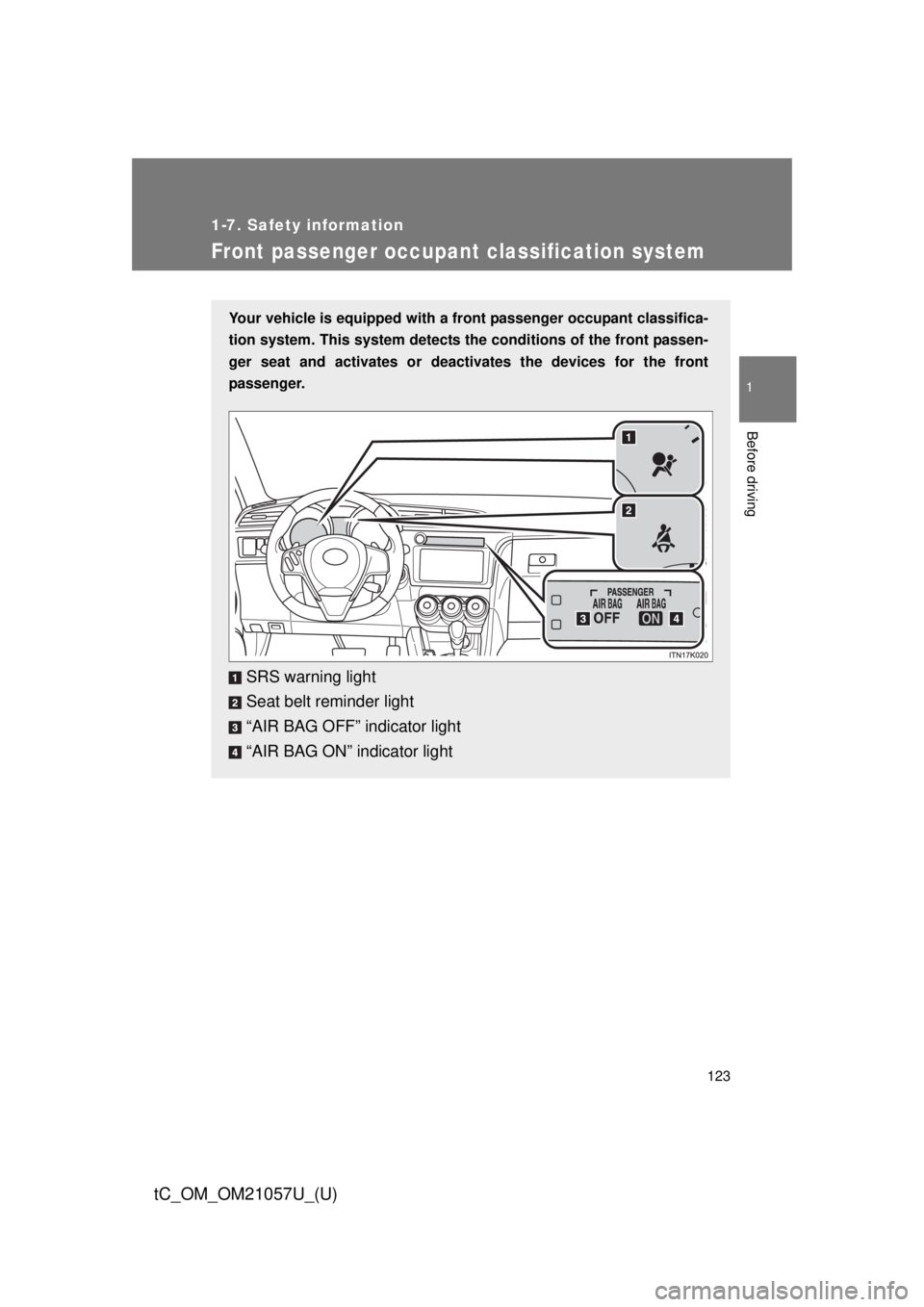
Your vehicle is equipped with a front passenger occupant classifica-
tion system. This system detects the conditions of the front passen-
ger seat and activates or deactiv ates the devices for the front
passenger.
SRS warning light
Seat belt reminder light
“AIR BAG OFF” indicator light
“AIR BAG ON” indicator light
Page 124 of 492

124 1-7. Safety information
tC_OM_OM21057U_(U)
Conditions and operation of the front passenger occupant clas-
sification system■ Adult
*1
■Child*4 or child restraint system*5
Indicator/
warning light “AIR BAG ON” and
“AIR BAG OFF” indicator lights
“AIR BAG ON”
SRS warning light Off
Seat belt reminder light Off
*2 or
flashing
*3
Devices Front passenger airbag
Activated
Side airbag on the front
passenger seat
Curtain shield airbag in the front passenger side
Front passenger knee airbag
Front passenger’s seat belt pretensioner
Indicator/
warning light “AIR BAG ON” and
“AIR BAG OFF” indicator lights
“AIR BAG OFF”
*6
SRS warning light Off
Seat belt reminder light Off
*2 or
flashing
*3
Devices Front passenger airbag Deactivated
Side airbag on the front passenger seat Activated
Curtain shield airbag in the front
passenger side
Front passenger knee airbag Deactivated
Front passenger’s seat belt pretensioner Activated