air condition TOYOTA TERCEL 1997 User Guide
[x] Cancel search | Manufacturer: TOYOTA, Model Year: 1997, Model line: TERCEL, Model: TOYOTA TERCEL 1997Pages: 184, PDF Size: 1.79 MB
Page 107 of 184

105
FUNCTIONS OF ENGINE OIL
Engine oil has the primary functions of lu-
bricating and cooling the inside of the en-
gine,
and plays a major role in maintaining
the engine in proper working order. ENGINE OIL CONSUMPTION
It is normal that an engine should con-
sume some engine oil during normal
engine operation. The causes of oil
consumption in a normal engine are
as follows. Oil is used to lubricate pistons, piston
rings and cylinders. A thin film of oil is left on the cylinder wall when a piston
moves downwards in the cylinder.
High negative pressure generated
when the vehicle is decelerating sucks
some of this oil into the combustion
chamber. This oil as well as some part
of the oil film left on the cylinder wall is
burned by the high temperature com-
bustion gases during the combustionprocess.
Oil is also used to lubricate the stems
of the intake valves. Some of this oil is
sucked into the combustion chamber
together with the intake air and is
burned along with the fuel. High tem-perature exhaust gases also burn the
oil used to lubricate the exhaust valve stems.
The amount of engine oil consumed
depends on the viscosity of the oil, the
quality of the oil and the conditions
the vehicle is driven under. More oil is consumed by high-speed driv-
ing and frequent acceleration and decel- eration.
A new engine consumes more oil, since
its pistons, piston rings and cylinder walls
have not become conditioned.
When judging the amount of oil con-
sumption, note that the oil may be-come diluted and make it difficult to
judge the true level accurately.
As an example, if a vehicle is used for re-
peated short trips, and consumes a nor- mal amount of oil, the dipstick may not
show any drop in the oil level at all, even after 1000 km (600 miles) or more. This is because the oil is gradually becoming
diluted with fuel or moisture, making it ap-
pear that the oil level has not changed. The diluting ingredients evaporate out
when the vehicle is then driven at high
speeds, as on an expressway, making itappear that oil is excessively consumed
after driving as high speeds.
IMPORTANCE OF ENGINE OIL LEVEL CHECK
One of the most important points in proper vehicle maintenance is to keep the engine
oil at the optimum level so that oil function
will
not be impaired. Therefore, it is essen-
tial that the oil level be checked regularly.
Toyota recommends that the oil level bechecked every time you refuel the vehicle.
Failure to check the oil level
regularly could lead to serious
engine trouble due to insufficientoil.
NOTICE
For detailed information on the oil level
check, see Checking the engine oil levelº
in Chapter 7-2.
Facts about engine oil consumption
Page 116 of 184

11 4
Before starting the engine, be sure to fol-
low the instructions in (a) Before crank- ingº.
Normal starting procedure
The multiport fuel injection system/se-
quential multiport fuel injection system in
your engine automatically controls the
proper air-fuel mixture for starting. You can start a cold or hot engine as follows:
1. With your foot off the accelerator ped-
al, crank the engine by turning the key
to STARTº. Release it when the en-
gine starts.
2. After the engine runs for about 10 sec-
onds, you are ready to drive.
If the weather is below freezing, let the en-
gine warm up for a few minutes before driving.
If the engine stalls...
Simply restart it, using the correct proce- dure given in normal starting. If the engine will not start-
See If your vehicle will not startº in Part 4.
Do not crank for more than 30 sec-
onds at a time. This may overheat
the starter and wiring systems.
Do not race a cold engine.
If the engine becomes difficult to
start or stalls frequently, have theengine checked immediately.
NOTICE Always slow down in gusty cross- winds. This will allow you much better control.
Drive slowly onto curbs and, if pos-
sible, at a right angle. Avoid driving onto high, sharp-edged objects and
other road hazards. Failure to do so
can lead to server tire damage result- ing in tire bursts.
When parking on a hill, turn the front
wheels until they touch the curb so that
the vehicle will not roll. Apply the park-
ing brake, and place the transmission in Pº (automatic) or in first or reverse
(manual). If necessary, block thewheels.
Washing your vehicle or driving
through deep water may get the
brakes wet. To see whether they are
wet, check that there is no traffic near
you, and then press the pedal lightly. If
you do not feel a normal braking force,
the brakes are probably wet. To dry
them, drive the vehicle cautiously
while lightly pressing the brake pedal
with the parking brake pulled. If they
still do not work safely, pull to the side
of the road and call a T oyota dealer for
assistance.
(b) Starting the engine
Tips for driving in various conditions
Page 119 of 184
11 7
Getting
more kilometers/mileage from a li-
ter/gallon of fuel is easyÐjust take it easy.
It will help make your vehicle last longer,
too. Here are some specific tips on how to
save money on both fuel and repairs: Keep your tires inflated at the cor- rect pressure. Underinflation causes
tire wear and wastes fuel. See Chapter
7-2 for instructions.
Do not carry unneeded weight in
your vehicle. Excess weight puts a
heavier load on the engine, causing greater fuel consumption.
Avoid lenghty warm-up idling.
Once the engine is running smoothly,
begin driving-but gently. Remember,
however, that on cold winter days this
may take a little longer.
Accelerate slowly and smoothly.
Avoid jackrabbit starts. Get into high
gear as quickly as possible.
Avoid long engine idling. If you have
a long wait and you are not in traffic, it
is better to turn off the engine and start
again later.
Avoid engine lug or overrevving.
Use a gear position suitable for the
road on which you are travelling.
Avoid continuous speeding up and
slowing down. Stop-and-go driving
wastes fuel.
Avoid unnecessary stopping and
braking. Maintain a steady pace. Try
to time the traffic signals so you only
need to stop as little as possible or take
advantage of through streets to avoid
traffic lights. Keep a proper distance
from other vehicles to avoid sudden braking. This will also recduce wear on
your brakes.
Avoid heavy traffic or traffic jams
whenever possible.
Do not rest your foot on the clutch
or brake pedal. This causes needless
wear, overheating and poor fuel econ-
omy.
Maintain a moderate speed onhighways. The faster you drive, the
greater the fuel consumption. By re-
ducing your speed, you will cut down
on fuel consumption.
Keep the front wheels in properalignment. Avoid hitting the curb and
slow down on rough roads. Improper
alignment not only causes faster tire
wear but also puts an extra load on the
engine, which, it turn, wastes fuel.
Keep the bottom of your vehicle
free from mud, etc. This not only
lessens weight but also helps preventcorrosion.
Keep your vehicle tuned-up and in
top shape. A dirty air cleaner, improp-
er valve clearance, dirty plugs, dirty oil
and grease, brakes not adjusted, etc.
all lower engine performance and con-
tribute to poor fuel economy. For lon-
ger life of all parts and lower operating
costs, keep all maintenance work on
schedule, and if you often drive under severe conditions, see that your ve-
hicle receives more frequent mainte-
nance (For schedule maintenance in-
formation, please refer to the separate
Owner 's Manual Supplement/Main-
tenance Scheduleº).
CAUTION
Never turn off the engine to coast
down hills. Your power steering
and brake booster will not function
without the engine running. Also,
the emission control system oper-
ates properly only when the engine
is running.!
How to save fuel and make
your vehicle last longer, too
Page 125 of 184
123
If your engine coolant temperature
gauge indicates overheating, if you
experience a loss of power, or if you
hear a
loud knocking or pinging noise,
the engine has probably overheated.
You should follow this procedure 0
1. Pull safely off the road, stop the ve- hicle and turn on your emergency
flashers. Put the transmission in Pº
(automatic) or neutral (manual) and
apply the parking brake. Turn off the
air conditioning if it is being used.
2. If coolant or steam is boiling out of the radiator or reservoir, stop the engine.
Wait until the steam subsides before
opening the hood. If there is no coolant
boiling over or steam, leave the engine
running and make sure the electric
cooling fan is operating. If it is not, turn
the ignition off.
To help avoid personal injury, keep
the hood closed until there is no steam. Escaping steam or coolant is
a sign of very high pressure. CAUTION
! 3. Visually check to see if the engine
drive belt (water pump belt) is broken or loose. Look for obvious coolant
leaks from the radiator, hoses, and un-
der the vehicle. However, note that
water draining from the air condition-
ing is normal if it has been used.
When the engine is running, keep
hands and clothing away from the
moving fan and engine drive belts. CAUTION
!
4. If the engine drive belt is broken or coolant is leaking, stop the engine im-
mediately. Call a Toyota dealer for as- sistance.
5. If the engine drive belt is O.K. and there are no obvious leaks, check the
coolant reservoir. If it is dry, add cool-
ant to the reservoir while the engine is
running. Fill it about half full.
Do not attempt to remove the
radiator cap when the engine and
radiator are hot. Serious injury
could result from scalding hot fluid
and steam blown out underpressure. CAUTION
!
6. After the engine coolant temperature has cooled to normal, again check the
coolant level in the reservoir. If
necessary, bring it up to half full again.
Serious coolant loss indicates a leak in
the system. You should have it
checked as soon as possible at your
Toyota dealer.
If your vehicle overheats
Page 137 of 184

Part 5Protecting your Toyota from corrosion
135
CORROSION
PREVENTION ANDAPPEARANCE CARE
Protecting your Toyota from corrosion
Washing and waxing your
Toyota
Cleaning the interior
Toyota, through its diligent research, de-
sign and use of the most advanced
technology available, has done its part to
help prevent corrosion and has provided you with the finest quality vehicle
construction. Now, it is up to you. Proper
care of
your Toyota can help ensure long-
term corrosion prevention.
The most common causes of corro-
sion to your vehicle are: The accumulation of road salt, dirt and
moisture in hard-to-reach areas un- der the vehicle.
Chipping of paint, or undercoating
caused by minor accidents or by
stones and gravel.
Care is especially important if you live
in particular areas or operate your ve-
hicle under certain environmentalconditions: Road salt or dust control chemicals will
accelerate corrosion, as will the pres-
ence of salt in the air near the sea-
coast or in areas of industrial pollution.
High humidity accelerates corrosion
especially when temperatures rangejust above the freezing point.
Wetness or dampness to certain parts
of your vehicle for an extended period
of time, may cause corrosion even
though other parts of the vehicle may
be dry.
High temperatures will cause corro-
sion to those components of the ve-
hicle which are prevented from quick-
drying due to lack of proper ventilation.
The above signifies the necessity to keep
your vehicle, particularly the underside,
as clean as possible and to repair any
damage to paint or protective coatings as
soon as possible.
To help prevent corrosion on your To-
yota, follow these guidelines:
Wash your vehicle frequently. It is, of
course, necessary to keep your vehicle
clean by regular washing, but to prevent corrosion, the following points should beobserved: If you drive on salted roads in the win-
ter or if you live near the ocean, you
should hose off the undercarriage atleast once a month to minimize corro- sion.
Page 138 of 184
136
High pressure water or steam is effec-
tive for cleaning the vehicle's under-
side and wheel housings. Pay particu-
lar attention to these areas as it is
difficult to see all the mud and dirt. It
will do more harm than good to simply
wet the mud and debris without remov-
ing them. The lower edge of doors,
rocker panels and frame members
have drain holes which should not be
allowed to clog with dirt as trapped wa-
ter in these areas can cause corrosion.
Wash the underside of the vehicle
thoroughly when winter is over.
See Washing and waxing your Toyotaº
for more tips.
Check the condition of your vehicle's
paint and trim. If you find any chips or
scratches in the paint, touch them up im- mediately to prevent corrosion from start- ing. If the chips or scratches have gone
through the bare metal, have a qualified
body shop make the repair. Check the interior of your vehicle.
Wa-
ter and dirt can accumulate under the floor
mats and could cause corrosion. Occa-
sionally check under the mats to make sure the area is dry. Be particularly careful
when transporting chemicals, cleansers,
fertilizers, salt, etc; these should be trans-
ported in proper containers. If a spill or
leak should occur, immediately clean and dry the area.
Use mud shields on your wheels. If you
drive on salted or gravel roads, mud
shields help protect your vehicle. Full- size shields, which come as near to the
ground as possible, are the best. We rec-
ommend that the fittings and the area
where the shields are installed be treated
to resist corrosion. Your Toyota dealer will
be happy to assist in supplying and instal-
ling the shields if they are recommended for your area.
Do not park your vehicle in a damp, poorly ventilated garage. If you wash
your vehicle in the garage, or if you drive
it in covered with water or snow, your ga- rage may be so damp it will cause corro-
sion. Even if your garage is heated, a wet
vehicle can corrode if the ventilation is
poor. Washing your Toyota by hand
Work in the shade and wait until the ve-
hicle body is not hot to the touch.
CAUTION
When cleaning under floor or chas-
sis, be careful not to injure your hands.!
1. Rinse off loose dirt with a hose. Re- move any mud or road salt from the
underside of the vehicle or in the wheel
wells.
2. Wash with a mild car-wash soap, mixed according to the manufacturer's
instructions. Use a soft cotton mitt and
keep it wet by dipping it frequently into
the wash water. Do not rub hard-let the soap and water remove the dirt.
Plastic bumpers: Wash carefully. Do not
scrub with ab rasive cleaners. The bumper
faces are soft.
Road tar: Remove with turpentine or
cleaners that are marked safe for painted surfaces.
Washing and waxing your
Toyota
Page 140 of 184
138
CAUTION
Do not wash the vehicle floor with
water, or allow water to get into the
floor when cleaning the vehicle inte-
rior or exterior. Water may get into
audio components or other electri-
cal components above or under the
floor carpet (or mat) and cause a
malfunction; and it may cause body corrosion.!
Vinyl interior
The vinyl upholstery may be easily
cleaned with a mild soap or detergent
and water.
First vacuum over the upholstery to re-
move loose dirt. Then, using a sponge or
soft cloth, apply the soap solution to the vi-
nyl. After allowing it to soak in for a few
minutes to loosen the dirt, remove the dirt
and wipe off the soap with a clean damp
cloth. If all the dirt does not come off, re-
peat the procedure. Commercial foam-
ing-type vinyl cleaners are also available
which work well. Follow the manufactur-
er's instructions.Do not use solvent, thinner,
gasoline or window cleaner on the
interior.
NOTICE
Carpets
Use a good foam-type shampoo to
clean the carpets.
Begin by vacuuming thoroughly to re-
move as much dirt as possible. Several
types of foam cleaners are available' some are in aerosol cans and others are
powders or liquids which you mix with wa-
ter to produce a foam. To shampoo the
carpets, use a sponge or brush to apply the foam. Rub in overlapping circles.
Do not apply water ± the best results are obtained by keeping the carpet as dry as possible. Read the shampoo instructions
and follow them closely. Seat belts
The seat belts may be cleaned with
mild soap and water or with lukewarm
water.
Use a cloth or sponge. As you are clean-
ing, check the belts for excessive wear,
fraying, or cuts.
Do not use dye or bleach on the
belts-it may weaken them.
NOTICE
Windows
The windows may be cleaned with any
household window cleaner.
When cleaning the inside of the
windows, be careful not to scratch
or damage the heater wires on therear window.
NOTICE
Air conditioning control panel, car au-
dio, instrument panel, console panel,
and switches Use a soft damp cloth for cleaning.
Soak a clean soft cloth in water or luke-
warm water then lightly wipe off any dirt.
Cleaning the interior
Page 146 of 184

144Automatic transmission Parkº
mech-
anism
Check the lock release button of the se-
lector lever for proper and smooth opera-
tion. On a safe incline, check that your ve-
hicle is held securely with the selectorlever in Pº position and all brakes re- leased.
IN THE ENGINE COMPARTMENT Items listed below should be checked
from time to time, e.g. each time when refueling.
Washer fluid
Make sure there is sufficient fluid in the
tank. See Chapter 7-3 for additional infor-
mation.
Engine coolant level Make sure the coolant level is between
the FULLº and LOWº lines on the see-
through reservoir when the engine is cold.
See Chapter 7-2 for additional informa- tion when the engine is cold. Battery electrolyte level Make sure the electrolyte level of all bat-
tery cells is between upper and lower level
lines on the case. Add only distilled water
when replenishing. See Chapter 7-3 for
additional information. Brake fluid level
Make sure the brake fluid level is correct. See Chapter 7-2 for additional informa-tion.
Engine oil level
Check the l
evel on the dipstick with the en-
gine turned off and the vehicle parked on
a level spot. See Chapter 7-2 for addition-
al information. Power steering fluid level Check the level through the reservoir. The
level should be in the HOTº or COLDº
range depending on the fluid t emperature.
See Chapter 7-2 for additional informa- tion.
Exhaust system
If you notice any change in the sound of
the exhaust or smell exhaust fumes, have the cause located and corrected immedi-
ately. (See engine exhaust cautions in
Part 2.) Be on the alert for changes in perfor-
mance, sounds, and visual tip-offs
that in-
dicate service is needed. Some important
clues are as follows: Engine missing, stumbling, or pinging
Appreciable loss of power
Strange engine noises
A leak under the vehicle (however, wa-
ter dripping from the air conditioning
after use is normal.)
Change in exhaust sound (This may
indicate a dangerous carbon monox-
ide leak. Drive with the windows open
and have the exhaust system checked
immediately.)
Flat-looking tire; excessive tire squeal
when cornering; uneven tire wear
Vehicle pulls to one side when driving straight on a level road
Strange noises related to suspension movement
Loss of brake effectiveness; spongy
feeling brake or clutch pedal; pedal al-
most touches floor; vehicle pulls to one
side when braking
Engine coolant temperature continual-
ly higher than normal
Does your vehicle needrepairing?
Page 153 of 184
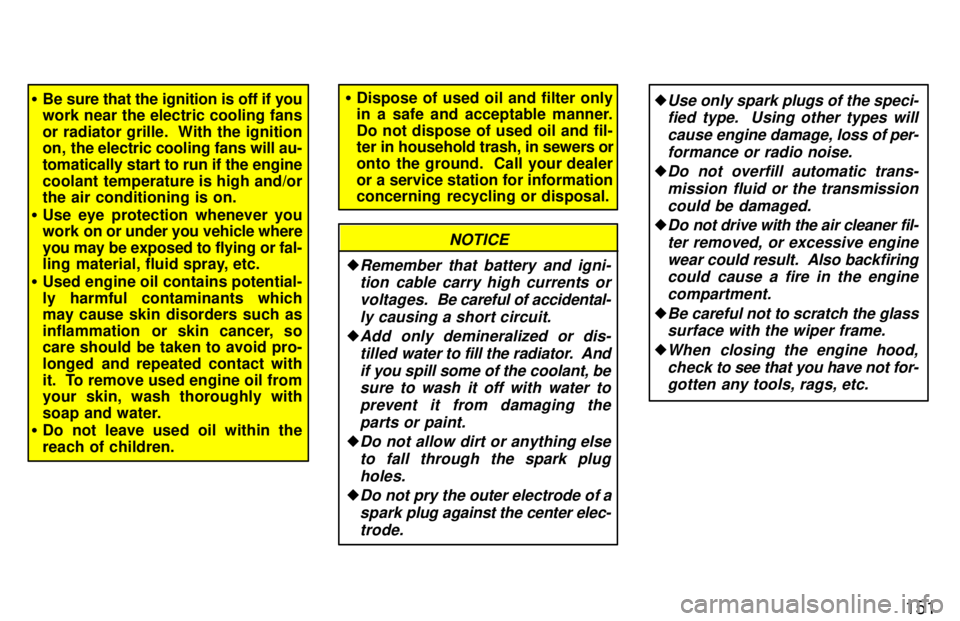
151
Be sure that the ignition is off if you
work near the electric cooling fans or radiator grille. With the ignition
on, the electric cooling fans will au- tomatically start to run if the engine
coolant temperature is high and/or the air conditioning is on.
Use eye protection whenever you
work on or under you vehicle where
you may be exposed to flying or fal-
ling material, fluid spray, etc.
Used engine oil contains potential-
ly harmful contaminants which
may cause skin disorders such as
inflammation or skin cancer, so
care should be taken to avoid pro-
longed and repeated contact with
it. To remove used engine oil from
your skin, wash thoroughly with
soap and water.
Do not leave used oil within thereach of children.Dispose of used oil and filter only
in a safe and acceptable manner.
Do not dispose of used oil and fil-
ter in household trash, in sewers or
onto the ground. Call your dealer
or a service station for information
concerning recycling or disposal.
Remember that battery and igni- tion cable carry high currents or
voltages. Be careful of accidental-
ly causing a short circuit.
Add only demineralized or dis- tilled w ater to fill the radiator. And
if you spill some of the coolant, be sure to wash it off with water to
prevent it from damaging the parts or paint.
Do not allow dirt or anything elseto fall through the spark plug
holes.
Do not pry the outer electrode of aspark plug against the center elec-
trode.
NOTICE
Use only spark plugs of the speci- fied type. Using other types will
cause engine damage, loss of per-
formance or radio noise.
Do not overfill automatic trans- mission fluid or the transmissioncould be damaged.
Do not drive with the air cleaner fil-ter removed, or excessive engine
wear could result. Also backfiringcould cause a fire in the engine
compartment.
Be careful not to scratch the glasssurface with the wiper frame.
When closing the engine hood,
check to see that you have not for-
gotten any tools, rags, etc.
Page 180 of 184

178
Tire size:
Spare tireT115/70D14 T105/70D14
Except spare tire 115 SR13 P185/60R14 82HP175/65R14 81S
Tire pressure, kPa (kgf/cm 2
or bar,
psi): Spare tire
420 (4.2, 60)
Except spare tire
155 SR13Front 240 (2.4, 34) Rear 220 (2.2, 32)
P185/60R14 82H
180 (1.8, 26)
P175/65R14 81S
200 (2.0, 28)
Wheel size:
Spare tire 14 x 4T Except spare tire
115 SR13 13 x 4 1/2J
P185/60R14 82H 14 x 5 1/2J
P175/65R14 81S 14 x 5 1/2J
Wheel nut torque, N Vm (kg Vm, ft Vlbf):
103 (10.5, 76)
Engine compartment (U.S.A.) Fuses (type A)
1. HEAD (LH) 10 A: Left-hand head-
light
2. HEAD (RH) 10 A: Personal Right-
hand headlight
3. AM2 15 A: Ignition system, charging
system, multiport fuel injection system/
sequential multiport fuel injection system,
SRS airbag system, starter system
4. HAZ-HORN 15 A: Horns, turn signal
lights, em ergency flashers, theft deterrent
system
5. EFI 15 A: Multiport fuel injection sys-
tem/sequential multiport fuel injection
system, air conditioning system6. DOME 10 A: Interior lights, open door
warning light, clock, car audio sysem,
anti-lock brake system, theft deterrentsystem
7. OBD-II 7.5 A: On-board diagnosis
system
8. ALT-S 5 A: Charging system
9. DRL 5 A: Daytime running light sys-
tem
10. HEAD (RH-LWR) 10 A: Right-hand
headlight (low beam)
11. HEAD (LH-LWR) 10 A: Left-hand
headlight (low beam)
12. HEAD (RH-UPR) 10 A: Right-hand
headlight (high beam)
Fuses
Tires