air condition TOYOTA TERCEL 1998 Owner's Manual
[x] Cancel search | Manufacturer: TOYOTA, Model Year: 1998, Model line: TERCEL, Model: TOYOTA TERCEL 1998Pages: 194, PDF Size: 2.5 MB
Page 139 of 194
'98 TERCEL (U)137
If your engine coolant temperature
gauge indicates overheating, if you ex-
perience a loss of power, or if you hear
a loud knocking or pinging noise, the
engine has probably overheated. You
should follow this procedure...
1. Pull safely off the road, stop the ve- hicle and turn on your emergency
flashers. Put the transmission in ºPº
(automatic) or neutral (manual) and ap-
ply the parking brake. Turn off the air
conditioning if it is being used.
2. If coolant or steam is boiling out of the radiator or reservoir,stop the engine.
Wait until the steam subsides before
opening the hood. If there is no coolant
boiling over or steam, leave the engine
running and make sure the electric
cooling fan is operating. If it is not,
turn the ignition off.
CAUTION
To help avoid personal injury, keep
the hood closed until there is no
steam. Escaping steam or coolant is
a sign of very high pressure.
3. Visually check to see if the engine drive belt (water pump belt) is broken
or loose. Look for obvious coolant
leaks from the radiator, hoses, and un-
der the vehicle. However, note that wa-
ter draining from the air conditioning is
normal if it has been used.
CAUTION
When the engine is running, keep
hands and clothing away from the
moving fan and engine drive belts.
4. If the engine drive belt is broken orcoolant is leaking, stop the engine im-
mediately. Call a Toyota dealer for as-
sistance.
5. If the engine drive belt is O.K. and there are no obvious leaks, check the
coolant reservoir. If it is dry, add cool-
ant to the reservoir while the engine is
running. Fill it about half full.
CAUTION
Do not attempt to remove the radiator
cap when the engine and radiator are
hot. Serious injury could result from
scalding hot fluid and steam blown
out under pressure.
6. After the engine coolant temperaturehas cooled to normal, again check the
coolant level in the reservoir. If neces-
sary, bring it up to half full again. Seri-
ous coolant loss indicates a leak in the
system. You s hould have it checked as
soon as possible at your Toyota dealer.
If your vehicle overheats
Page 141 of 194
'98 TERCEL (U)139
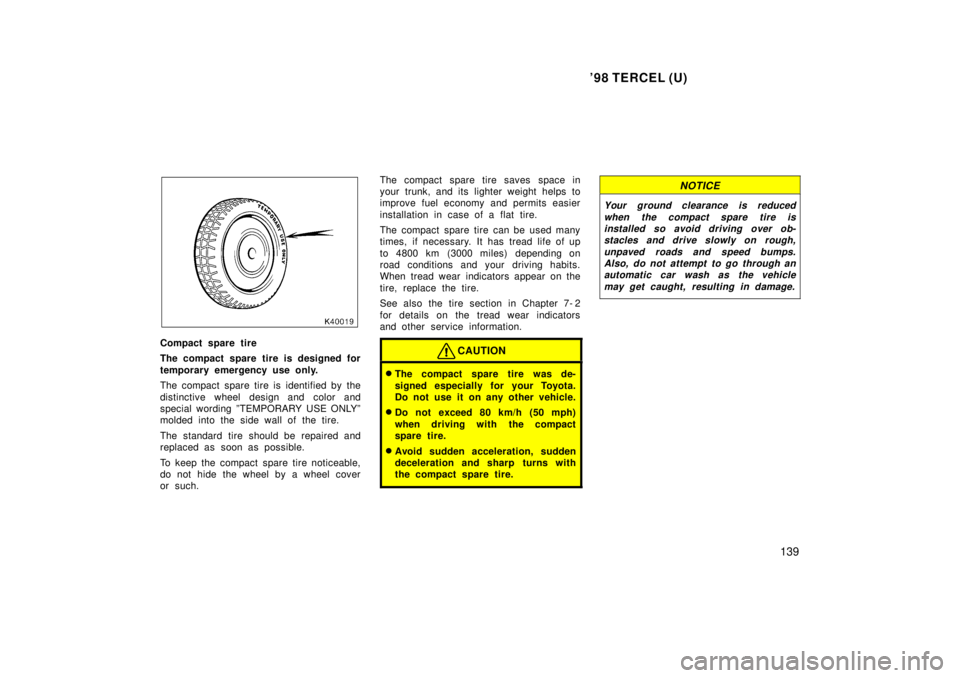
Compact spare tire
The compact spare tire is designed for
temporary emergency use only.
The compact spare tire is identified by the
distinctive wheel design and color and
special wording ºTEMPORARY USE ONLYº
molded into the side wall of the tire.
The standard tire should be repaired and
replaced as soon as possible.
To keep the compact spare tire noticeable,
do not hide the wheel by a wheel cover
or such. The compact spare tire saves space in
your trunk, and its lighter weight helps to
improve fuel economy and permits easier
installation in case of a flat tire.
The compact spare tire can be used many
times, if necessary. It has tread life of up
to 4800 km (3000 miles) depending on
road conditions and your driving habits.
When tread wear indicators appear on the
tire, replace the tire.
See also the tire section in Chapter 7- 2
for details on the tread wear indicators
and other service information.CAUTION
The compact spare tire was de-
signed especially for your Toyota.
Do not use it on any other vehicle.
Do not exceed 80 km/h (50 mph)
when driving with the compact
spare tire.
Avoid sudden acceleration, sudden
deceleration and sharp turns with
the compact spare tire.
NOTICE
Your ground clearance is reduced
when the compact spare tire isinstalled so avoid driving over ob- stacles and drive slowly on rough,
unpaved roads and speed bumps.Also, do not attempt to go through anautomatic car wash as the vehicle
may get caught, resulting in damage.
Page 156 of 194

160
Automatic transmission ºParkº mecha-
nism
Check the lock release button of the se-
lector lever for proper and smooth opera-
tion. On a safe incline, check that your
vehicle is held securely with the selector
lever in ºPº position and all brakes re-
leased.
IN THE ENGINE COMPARTMENT
Items listed below should be checked
from time to time, e.g. each time when
refueling.
Washer fluid
Make sure there is sufficient fluid in the
tank. See Chapter 7- 3 for additional in-
formation.
Engine coolant level
Make sure the coolant level is between
the ºFULLº and ºLOWº lines on the see-
through reservoir when the engine is cold.
See Chapter 7- 2 for additional information
when the engine is cold.
Battery electrolyte level
Make sure the electrolyte level of all bat-
tery cells is between upper and lower lev-
el lines on the case. Add only distilled
water when replenishing. See Chapter 7- 3
for additional information.
Brake fluid level
Make sure the brake fluid level is correct.
See Chapter 7- 2 for additional information.
Engine oil level
Check the level on the dipstick with the
engine turned off and the vehicle parked
on a level spot. See Chapter 7- 2 for addi-
tional information.
Power steering fluid level
Check the level through the reservoir. The
level should be in the ºHOTº or ºCOLDº
range depending on the fluid temperature.
See Chapter 7- 2 for additional information.
Exhaust system
If you notice any change in the sound of
the exhaust or smell exhaust fumes, have
the cause located and corrected immedi-
ately. (See engine exhaust cautions in
Part 2.)
Be on the alert for changes in perfor-
mance, sounds, and visual tip- offs that
indicate service is needed. Some impor-
tant clues are as follows:
Engine missing, stumbling, or pinging
Appreciable loss of power
Strange engine noises
A leak under the vehicle (however, wa-
ter dripping from the air conditioning
after use is normal.)
Change in exhaust sound (This may
indicate a dangerous carbon monoxide
leak. Drive with the windows open and
have the exhaust system checked im-
mediately.)
Flat- looking tire; excessive tire squeal
when cornering; uneven tire wear
Vehicle pulls to one side when driving
straight on a level road
Strange noises related to suspension
movement
Loss of brake effectiveness; spongy
feeling brake or clutch pedal; pedal al-
most touches floor; vehicle pulls to one
side when braking
Engine coolant temperature continually
higher than normal
Does your vehicle need
repairing?
Page 163 of 194
'98 TERCEL (U)167
Be sure that the ignition is off if
you work near the electric cooling
fans or radiator grille. With the
ignition on, the electric cooling fans
will automatically start to run if the
engine coolant temperature is high
and/or the air conditioning is on.
Use eye protection whenever you
work on or under your vehicle
where you may be exposed to flying
or falling material, fluid spray, etc.
Used engine oil contains potentially
harmful contaminants which may
cause skin disorders such as in-
flammation or skin cancer, so care
should be taken to avoid prolonged
and repeated contact with it. To re-
move used engine oil from your
skin, wash thoroughly with soap
and water.
Do not leave used oil within the
reach of children.Dispose of used oil and filter only
in a safe and acceptable manner.
Do not dispose of used oil and fil-
ter in household trash, in sewers or
onto the ground. Call your dealer or
a service station for information
concerning recycling or disposal.
NOTICE
Remember that battery and ignition
cables carry high currents or volt-ages. Be careful of accidentallycausing a short circuit.
Add only demineralized or distilled water to fill the radiator. And if youspill some of the coolant, be sure
to wash it off with water to preventit from damaging the parts or paint.
Do not allow dirt or anything elseto fall through the spark plug holes.
Do not pry the outer electrode of a
spark plug against the center elec-trode.
Use only spark plugs of the speci-
fied type. Using other types willcause engine damage, loss of per-formance or radio noise.
Do not overfill automatic transmis- sion fluid, or the transmissioncould be damaged.
Do not drive with the air cleaner filter removed, or excessive engine
wear could result. Also backfiringcould cause a fire in the engine compartment.
Be careful not to scratch the glasssurface with the wiper frame.
When closing the engine hood,check to see that you have not for-
gotten any tools, rags, etc.
Page 173 of 194
'98 TERCEL (U)177
CAUTION
Do not mix radial, bias belted, or
bias- ply tires on your vehicle. It
can cause dangerous handling char-
acteristics, resulting in loss of con-
trol.
Do not use tires or wheels other
than the manufacturer 's recom-
mended size.
Toyota recommends all four tires, or at
least both of the front or rear tires be
replaced at a time as a set.
See ºIf you have a flat tireº in Part 4 for
tire change procedure.
When a tire is replaced, the wheel
should always be balanced.
An unbalanced wheel may affect vehicle
handling and tire life. Wheels can get out
of balance with regular use and should
therefore be balanced occasionally.
When replacing a tubeless tire, the air
valve should also be replaced with a
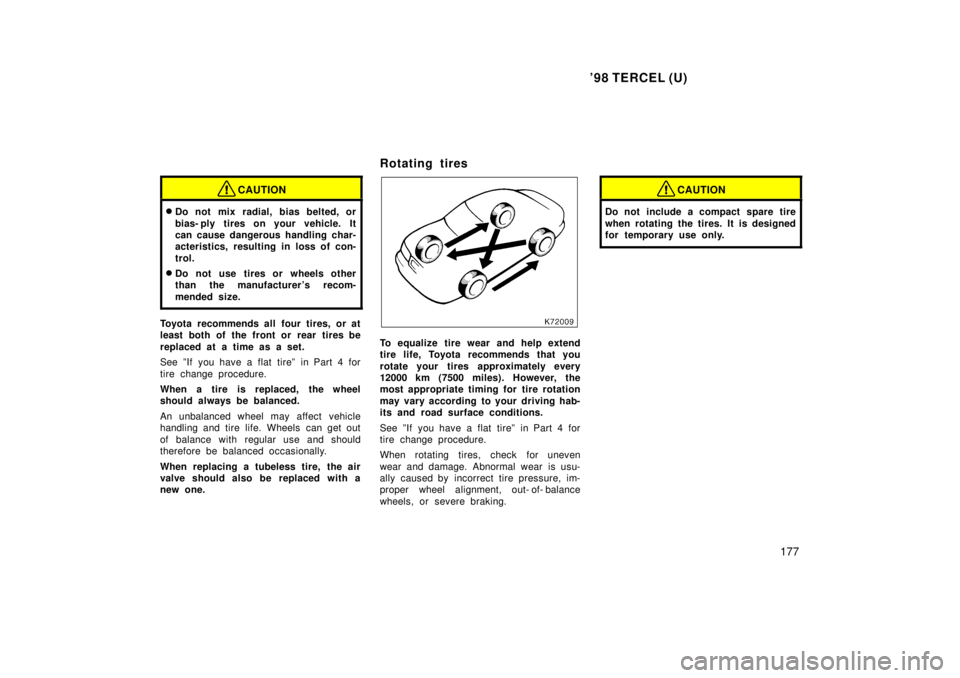
new one. Rotating tires
To equalize tire wear and help extend
tire life, Toyota recommends that you
rotate your tires approximately every
12000 km (7500 miles). However, the
most appropriate timing for tire rotation
may vary according to your driving hab-
its and road surface conditions.
See ºIf you have a flat tireº in Part 4 for
tire change procedure.
When rotating tires, check for uneven
wear and damage. Abnormal wear is usu-
ally caused by incorrect tire pressure, im-
proper wheel alignment, out- of- balance
wheels, or severe braking.
CAUTION
Do not include a compact spare tire
when rotating the tires. It is designed
for temporary use only.
Page 191 of 194

'98 TERCEL (U)195
Engine compartment (Canada only)
13. HEAD (LH- UPR) 10 A: Left- hand
headlight (high beam)
14. STOP 10 A: Stop lights, high mounted
stoplight, anti- lock brake system, shift
lock control system
15. A/C 10 A: Air conditioning system
16. TAIL 15 A: Tail lights, parking lights,
license plate lights, instrument panel
lights, air conditioning system, emer-
gency flashers, air conditioning system,
rear window defogger, car audio sys-
tem, cigarette lighter, clockInstrument panel
17. GAUGE 10 A: Gauge and meters, ser-
vice reminder indicator (except head-
light high beam indicator) and warning
buzzers (except discharge, open door
and SRS warning lights), back- up
lights, rear window defogger, power
windows
18. TURN 7.5 A: Turn signal lights
19. WIPER 20 A: Windshield wipers and
washer
20. ECU- IG 5 A: Anti- lock brake system,
air conditioning system, shift lock con-
trol system, daytime running light sys-
temInstrument panel
21. CIG&RADIO 15 A: Cigarette lighter,
car audio system, clock, theft deterrent
system, shift lock control system, SRS airbag system, seat belt pretensioners
22. IGN 5 A: Charging system, discharge
warning light, multiport fuel injection
system/s equential multiport fuel injec-
tion system, SRS airbag system, seat
belt pretensioners
23. ECU- B 5 A: SRS airbag warning light
Fuses (type B)
24. CDS FAN 30 A: Electric cooling fans
25. RAD FAN 30 A: Electric cooling fans
26. HEATER 40 A: Air conditioning system,
``A/C'' fuses