tail TOYOTA TERCEL 1998 Owners Manual
[x] Cancel search | Manufacturer: TOYOTA, Model Year: 1998, Model line: TERCEL, Model: TOYOTA TERCEL 1998Pages: 194, PDF Size: 2.5 MB
Page 6 of 194

6
Indicator symbols on the instrument panel
Brake system warning light *
Driver 's Seat belt reminder light *
Discharge warning light
*
Malfunction indicator lamp *
Low oil pressure warning light *
Anti-lock brake system warning light *
(type A)
(type B)
Open door warning light *
(type A)
(type B)
SRS airbag warning light*
Overdrive- off indicator light
Headlight high beam indicator light Turn signal indicator lights
The indicators marked with
*
are service reminder indicators.
For details, see ºService reminder indicators and warning buz zerº
in Chapter 1- 5.
Front passenger's seat belt reminder light *
Page 14 of 194
14
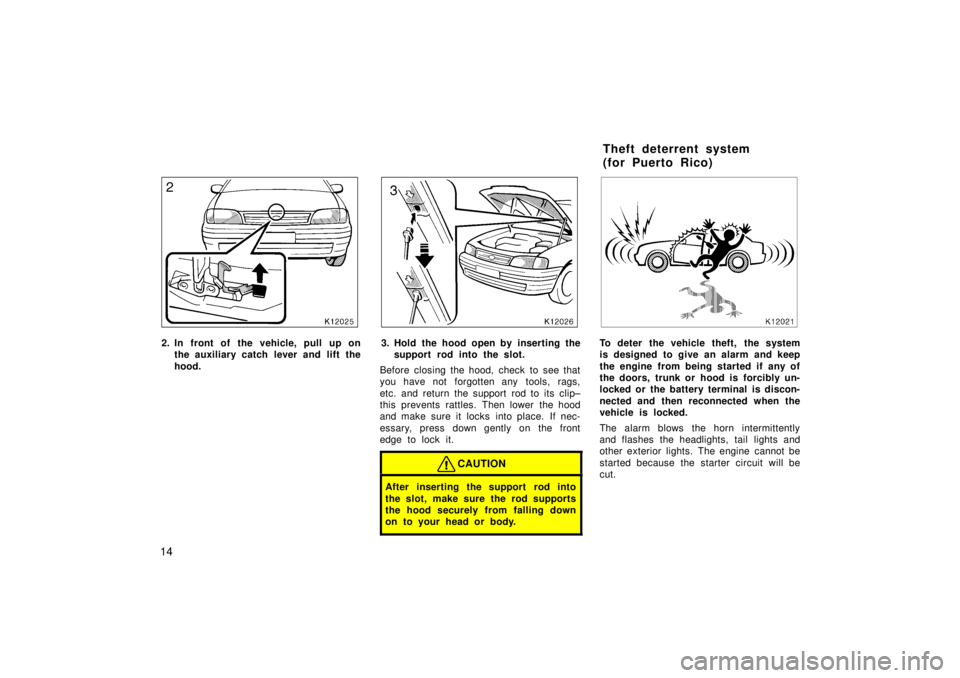
2. In front of the vehicle, pull up onthe auxiliary catch l ever and lift the
hood.3. Hold the hood open by inserting the support rod into the slot.
Before closing the hood, check to see that
you have not forgotten any tools, rags,
etc. and return the support rod to its clip±
this prevents rattles. Then lower the hood
and make sure it locks into place. If nec-
essary, press down gently on the front
edge to lock it.
CAUTION
After inserting the support rod into
the slot, make sure the rod supports
the hood securely from falling down
on to your head or body.
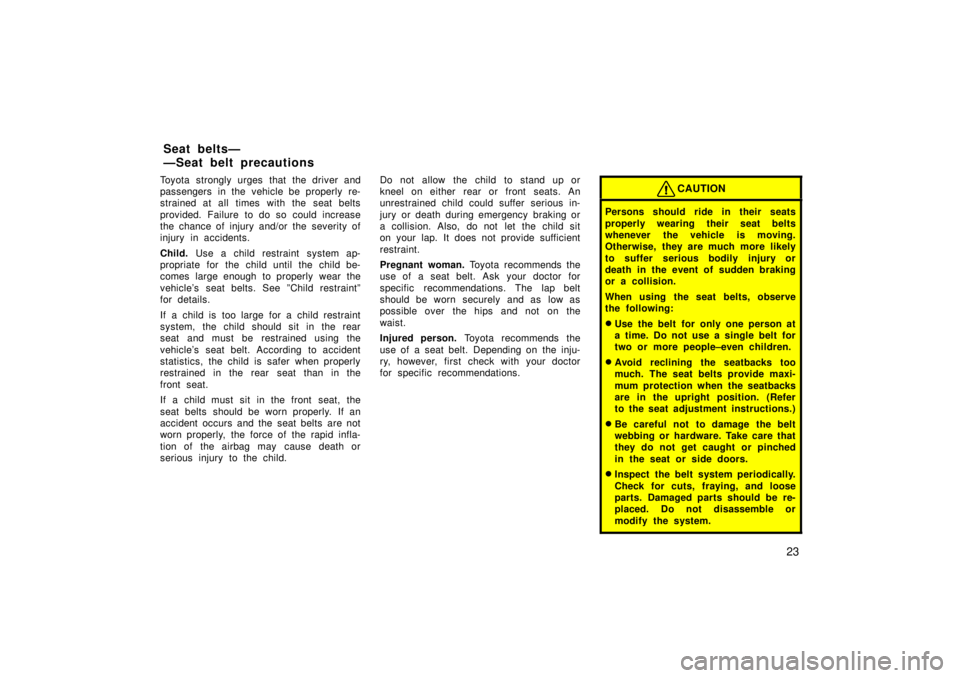
To deter the vehicle theft, the system
is designed to give an alarm and keep
the engine from being started if any of
the doors, trunk or hood is forcibly un-
locked or the battery terminal is discon-
nected and then reconnected when the
vehicle is locked.
The alarm blows the horn intermittently
and flashes the headlights, tail lights and
other exterior lights. The engine cannot be
started because the starter circuit will be
cut. Theft deterrent system
(for Puerto Rico)
Page 23 of 194
23
Toyota strongly urges that the driver and
passengers in the vehicle be properly re-
strained at all times with the seat belts
provided. Failure to do so could increase
the chance of injury and/or the severity of
injury in accidents.
Child.
Use a child restraint system ap-
propriate for the child until the child be-
comes large enough to properly wear the
vehicle's seat belts. See ºChild restraintº
for details.
If a child is too large for a child restraint
system, the child s hould sit in the rear
seat and must be restrained using the
vehicle's seat belt. According to accident
statistics, the child is safer when properly
restrained in the rear seat than in the
front seat.
If a child must sit in the front seat, the
seat belts should be worn properly. If an
accident occurs and the seat belts are not
worn properly, the force of the rapid infla-
tion of the airbag may cause death or
serious injury to the child. Do not allow the child to stand up or
kneel on either rear or front seats. An
unrestrained child could suffer serious in-
jury or death during emergency braking or
a collision. Also, do not let the child sit
on your lap. It does not provide sufficient
restraint.
Pregnant woman.
Toyota recommends the
use of a seat belt. Ask your doctor for
specific recommendations. The lap belt
should be worn securely and as low as
possible over the hips and not on the
waist.
Injured person. Toyota recommends the
use of a seat belt. Depending on the inju-
ry, however, first check with your doctor
for specific recommendations.
CAUTION
Persons should ride in their seats
properly wearing their seat belts
whenever the vehicle is moving.
Otherwise, they are much more likely
to suffer serious bodily injury or
death in the event of sudden braking
or a collision.
When using the seat belts, observe
the following: Use the belt for only one person at
a time. Do not use a single belt for
two or more people±even children.
Avoid reclining the seatbacks too
much. The seat belts provide maxi-
mum protection when the seatbacks
are in the upright position. (Refer
to the seat adjustment instructions.)
Be careful not to damage the belt
webbing or hardware. Take care that
they do not get caught or pinched
in the seat or side doors.
Inspect the belt system periodically.
Check for cuts, fraying, and loose
parts. Damaged parts should be re-
placed. Do not disassemble or
modify the system.
Seat beltsÐ
ÐSeat belt precautions
Page 24 of 194
24
Keep the belts clean and dry. If
they need cleaning, use a mild soap
solution or lukewarm water. Never
use bleach, dye, or abrasive clean-
ersÐthey may severely weaken the
belts. (See Cleaning the interiorº
in Part 5.)
Replace the belt assembly (includ-
ing bolts) if it has been used in a
severe impact. The entire assembly
should be replaced even if damage
is not obvious.
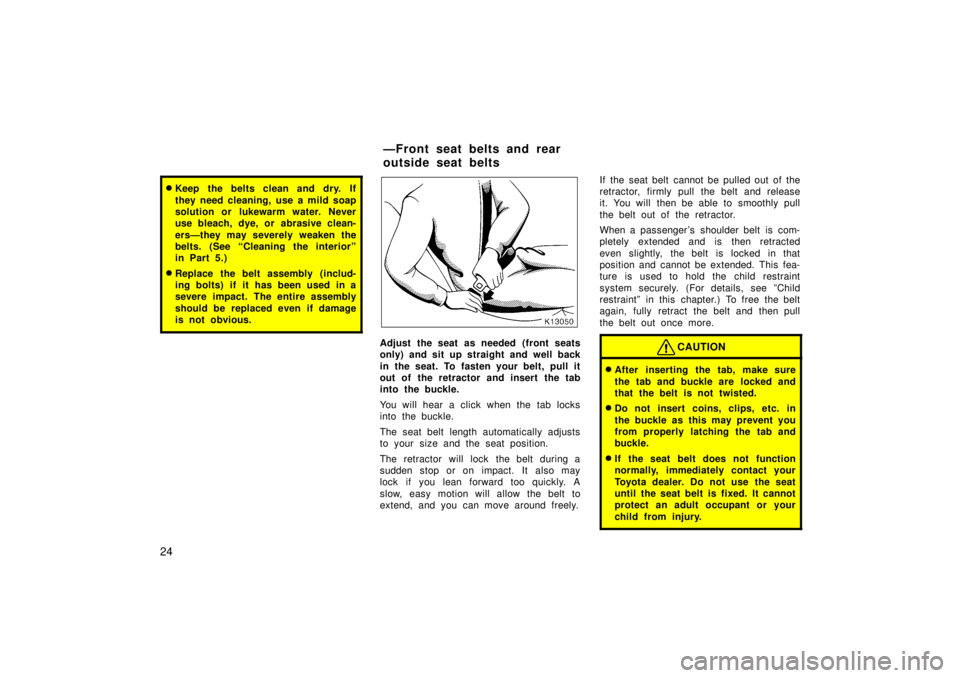
Adjust the seat as needed (front seats
only) and sit up straight and well back
in the seat. To fasten your belt, pull it
out of the retractor and insert the tab
into the buckle.
You will hear a click when the tab locks
into the buckle.
The seat belt length automatically adjusts
to your size and the seat position.
The retractor will lock the belt during a
sudden stop or on impact. It also may
lock if you lean forward too quickly. A
slow, easy motion will allow the belt to
extend, and you can move around freely. If the seat belt cannot be pulled out of the
retractor, firmly pull the belt and release
it. You will then be able to smoothly pull
the belt out of the retractor.
When a passenger 's shoulder belt is com-
pletely extended and is then retracted
even slightly, the belt is locked in that
position and cannot be extended. This fea-
ture is used to hold the child restraint
system securely. (For details, see ºChild
restraintº in this chapter.) To free the belt
again, fully retract the belt and then pull
the belt out once more.CAUTION
After inserting the tab, make sure
the tab and buckle are locked and
that the belt is not twisted.
Do not insert coins, clips, etc. in
the buckle as this may prevent you
from properly latching the tab and
buckle.
If the seat belt does not function
normally, immediately contact your
Toyota dealer. Do not use the seat
until the seat belt is fixed. It cannot
protect an adult occupant or your
child from injury.
ÐFront seat belts and rear
outside seat belts
Page 29 of 194
29
CAUTION
After inserting the tab, make sure
the tab and buckle are locked and
that the seat belt extender is not
twisted.
Do not insert coins, clips, etc. in
the buckle as this may prevent you
from properly latching the tab and
buckle.
If the seat belt does not function
normally, immediately contact your
Toyota dealer. Do not use the seat
until the seat belt is fixed. It cannot
protect an adult occupant or your
child from injury.
ÐFront seat belt pretensioners
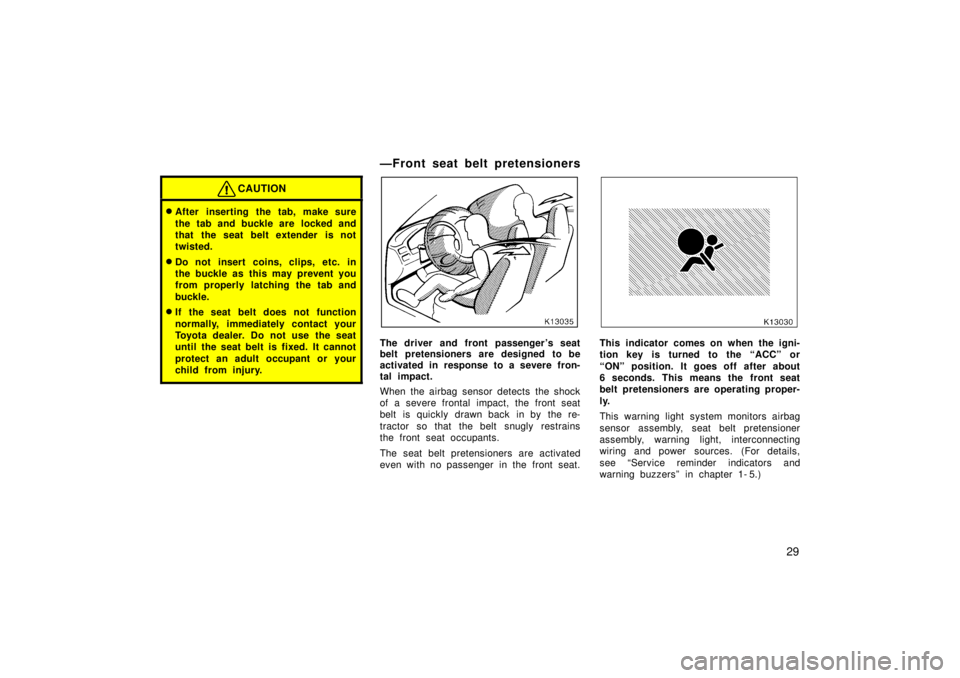
The driver and front passenger 's seat
belt pretensioners are designed to be
activated in response to a severe fron-
tal impact.
When the airbag sensor detects the shock
of a severe frontal impact, the front seat
belt is quickly drawn back in by the re-
tractor so that the belt snugly restrains
the front seat occupants.
The seat belt pretensioners are activated
even with no passenger in the front seat.This indicator comes on when the igni-
tion key is turned to the ACCº or
ONº position. It goes off after about
6 seconds. This means the front seat
belt pretensioners are operating proper-
ly.
This warning light system monitors airbag
sensor assembly, seat belt pretensioner
assembly, warning light, interconnecting
wiring and power sources. (For details,
see Service reminder indicators and
warning buzzersº in chapter 1- 5.)
Page 32 of 194
32
CAUTION
A driver or front passenger too close
to the steering wheel or dashboard
during airbag deployment can be
killed or seriously injured. Toyota
strongly recommends that: The driver sit as far back as pos-
sible from the steering wheel while
still maintaining control of the ve-
hicle.
The front passenger sit as far back
as possible from the dashboard.
All vehicle occupants be properly
restrained using the available seat
belts.
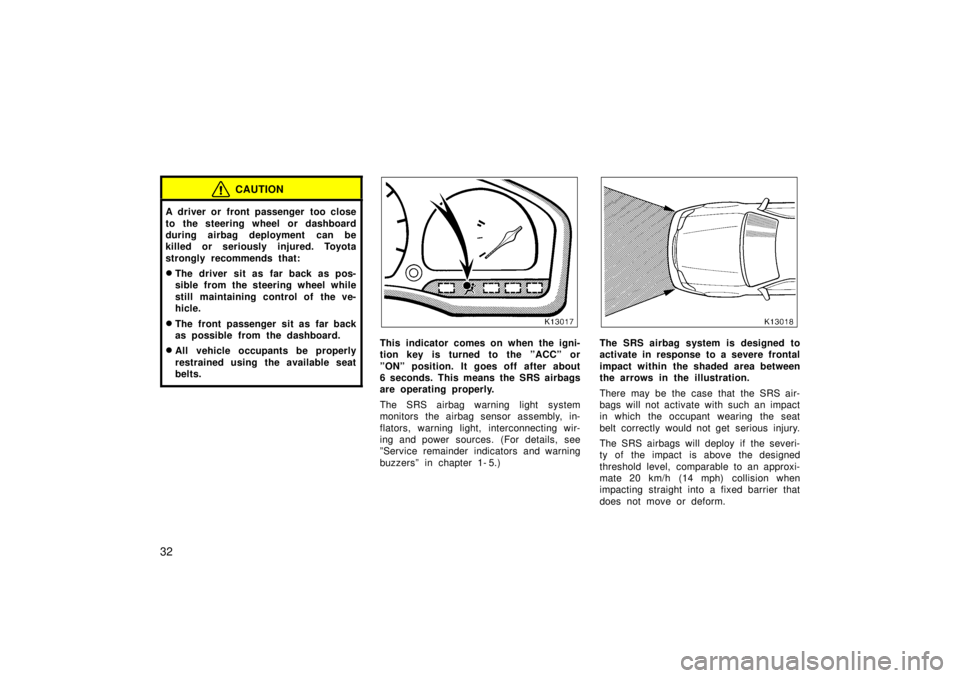
This indicator comes on when the igni-
tion key is turned to the ºACCº or
ºONº position. It goes off after about
6 seconds. This means the SRS airbags
are operating properly.
The SRS airbag warning light system
monitors the airbag sensor assembly, in-
flators, warning light, interconnecting wir-
ing and power sources. (For details, see
ºService remainder indicators and warning
buzzersº in chapter 1- 5.)The SRS airbag system is designed to
activate in response to a severe frontal
impact within the shaded area between
the arrows in the illustration.
There may be the case that the SRS air-
bags will not activate with such an impact
in which the occupant wearing the seat
belt correctly would not get serious injury.
The SRS airbags will deploy if the severi-
ty of the impact is above the designed
threshold level, comparable to an approxi-
mate 20 km/h (14 mph) collision when
impacting straight into a fixed barrier that
does not move or deform.
Page 38 of 194
38
The SRS (Supplemental Restraint Sys-
tem) airbag is designed to provide fur-
ther protection for the driver when add-
ed to the primary protection provided
by the seat belt.
In response to a severe frontal impact,
the SRS airbag works together with the
seat belt to help prevent or reduce injury
by inflating, in order to decrease the likeli-
hood of the driver 's head or chest directly
hitting the steering wheel.
Be sure to wear your seat belt.
CAUTION
A driver too close to the steering
wheel during airbag deployment can
be killed or seriously injured. Toyota
strongly recommends that: The driver sit as far back as pos-
sible from the steering wheel while
still maintaining control of the ve-
hicle.
All vehicle occupants be properly
restrained using the available seat
belts.
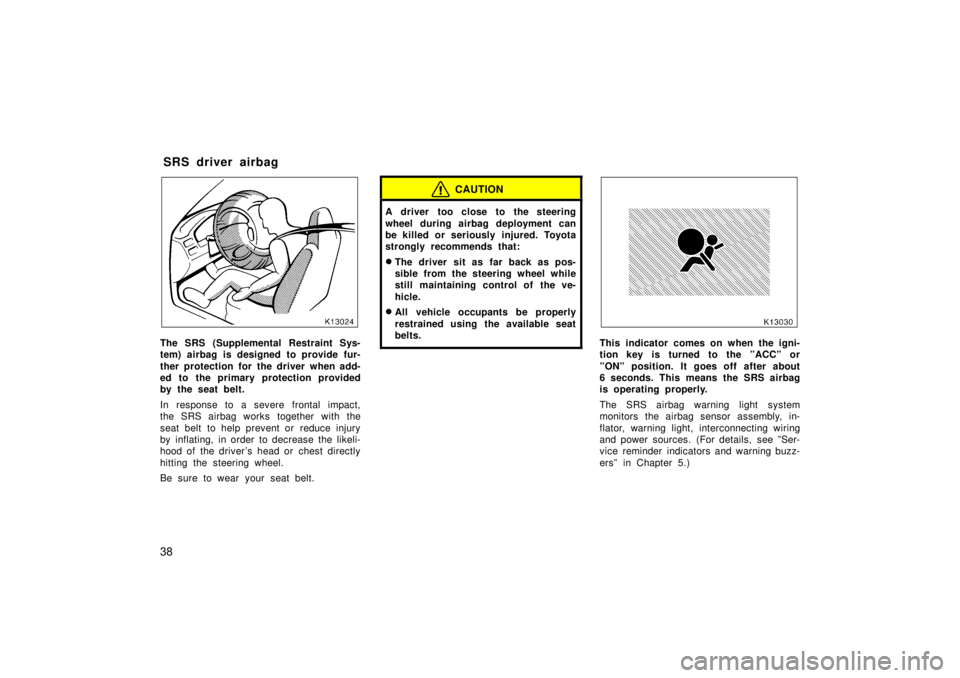
This indicator comes on when the igni-
tion key is turned to the ºACCº or
ºONº position. It goes off after about
6 seconds. This means the SRS airbag
is operating properly.
The SRS airbag warning light system
monitors the airbag sensor assembly, in-
flator, warning light, interconnecting wiring
and power sources. (For details, see ºSer-
vice reminder indicators and warning buzz-
ersº in Chapter 5.)
SRS driver airbag
Page 42 of 194
42
This SRS airbag system has a service
reminder indicator to inform the driver of
operating problems. If either of the follow-
ing conditions occurs, this indicates a mal-
function of the airbag. Contact your Toyota
dealer as soon as possible to service the
vehicle. The light does not come on when the
ignition key is turned to the ºACCº or
ºONº position, or remains on.
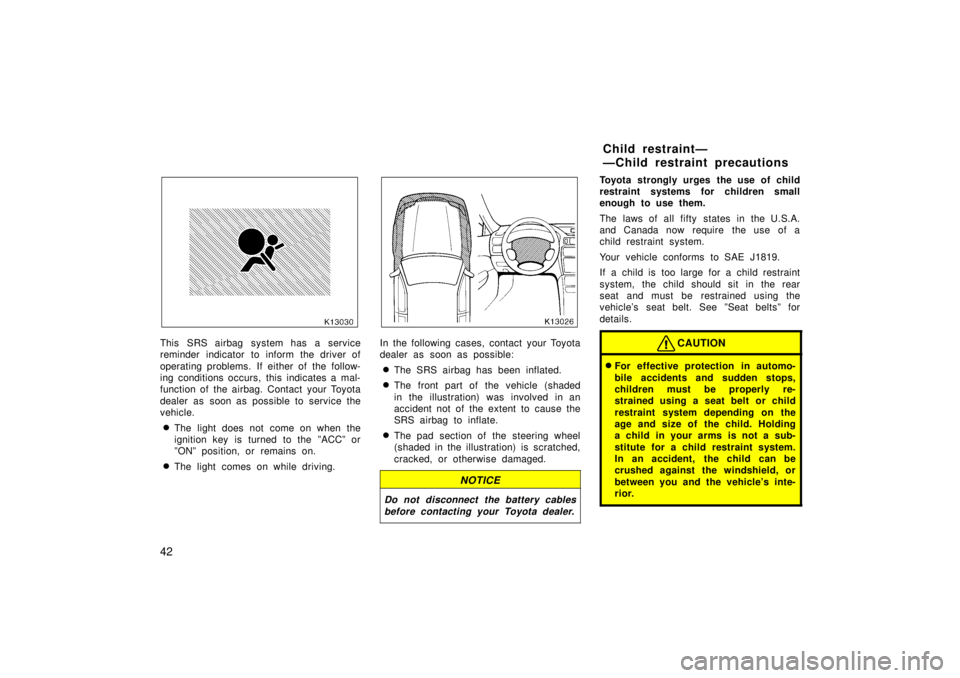
The light comes on while driving.In the following cases, contact your Toyota
dealer as soon as possible:
The SRS airbag has been inflated.
The front part of the vehicle (shaded
in the illustration) was involved in an
accident not of the extent to cause the
SRS airbag to inflate.
The pad section of the steering wheel
(shaded in the illustration) is scratched,
cracked, or otherwise damaged.
NOTICE
Do not disconnect the battery cables
before contacting your Toyota dealer.
Toyota strongly urges the use of child
restraint systems for children small
enough to use them.
The laws of all fifty states in the U.S.A.
and Canada now require the use of a
child restraint system.
Your vehicle conforms to SAE J1819.
If a child is too large for a child restraint
system, the child s hould sit in the rear
seat and must be restrained using the
vehicle's seat belt. See ºSeat beltsº for
details.
CAUTION
For effective protection in automo-
bile accidents and sudden stops,
children must be properly re-
strained using a seat belt or child
restraint system depending on the
age and size of the child. Holding
a child in your arms is not a sub-
stitute for a child restraint system.
In an accident, the child can be
crushed against the windshield, or
between you and the vehicle's inte-
rior.
Child restraintÐ
ÐChild restraint precautions
Page 57 of 194
57
Move seat
fully back
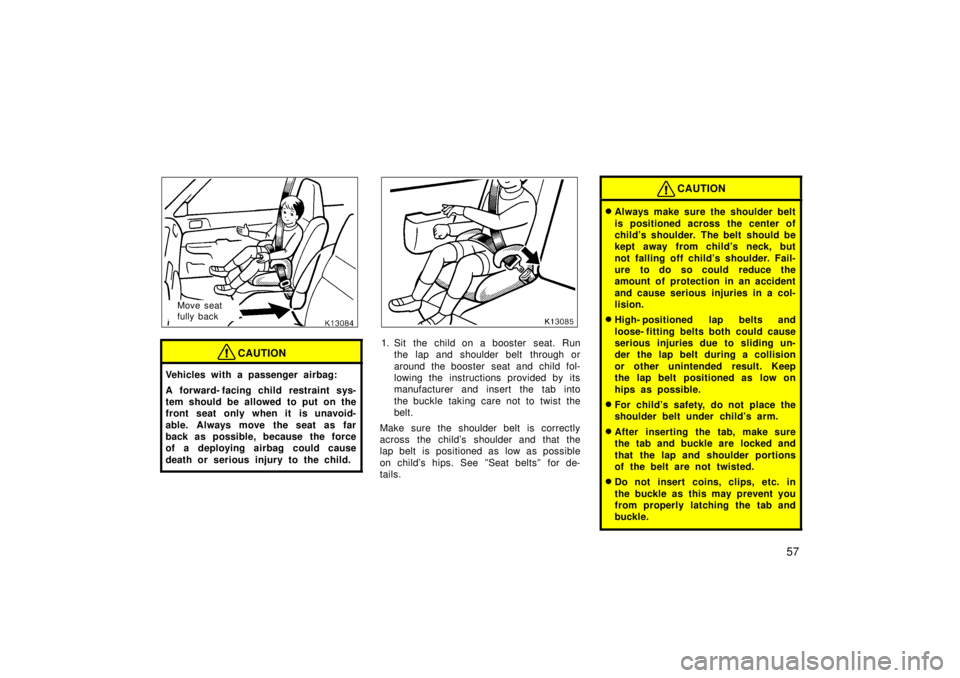
CAUTION
Vehicles with a passenger airbag:
A forward- facing child restraint sys-
tem should be allowed to put on the
front seat only when it is unavoid-
able. Always move the seat as far
back as possible, because the force
of a deploying airbag could cause
death or serious injury to the child.
1. Sit the child on a booster seat. Runthe lap and shoulder belt through or
around the booster seat and child fol-
lowing the instructions provided by its
manufacturer and insert the tab into
the buckle taking care not to twist the
belt.
Make sure the shoulder belt is correctly
across the child's shoulder and that the
lap belt is positioned as low as possible
on child's hips. See ºSeat beltsº for de-
tails.
CAUTION
Always make sure the shoulder belt
is positioned across the center of
child's shoulder. The belt should be
kept away from child's neck, but
not falling off child's s houlder. Fail-
ure to do so could reduce the
amount of protection in an accident
and cause serious injuries in a col-
lision.
High- positioned lap belts and
loose- fitting belts both could cause
serious injuries due to sliding un-
der the lap belt during a collision
or other unintended result. Keep
the lap belt positioned as low on
hips as possible.
For child's safety, do not place the
shoulder belt under child's arm.
After inserting the tab, make sure
the tab and buckle are locked and
that the lap and shoulder portions
of the belt are not twisted.
Do not insert coins, clips, etc. in
the buckle as this may prevent you
from properly latching the tab and
buckle.
Page 63 of 194
63
Part 1
OPERATION OF
INSTRUMENTS
AND CONTROLSÐ
Chapter 1- 4
Lights, Wipers and Defogger
Headlights and turn signals
Emergency flashers
Instrument panel light control
Interior light
Windshield wipers and washer
Rear window defogger
Headlights and turn signals
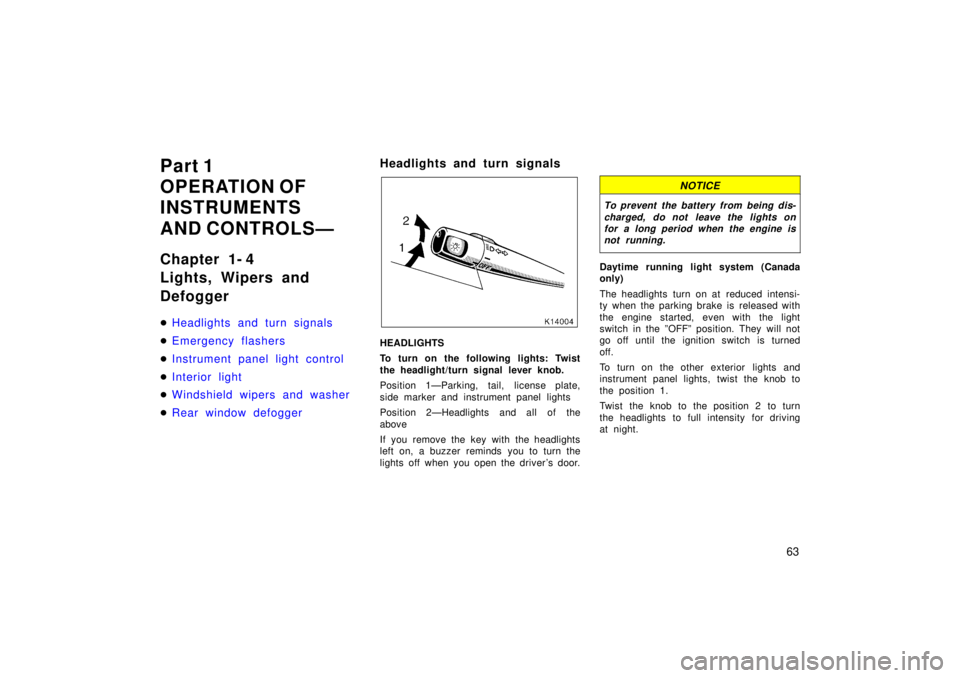
HEADLIGHTS
To turn on the following lights: Twist
the headlight/turn signal lever knob.
Position 1ÐParking, tail, license plate,
side marker and instrument panel lights
Position 2ÐHeadlights and all of the
above
If you remove the key with the headlights
left on, a buzzer reminds you to turn the
lights off when you open the driver 's door.
NOTICE
To prevent the battery from being dis-
charged, do not leave the lights onfor a long period when the engine is not running.
Daytime running light system (Canada
only)
The headlights turn on at reduced intensi-
ty when the parking brake is released with
the engine started, even with the light
switch in the ºOFFº position. They will not
go off until the ignition switch is turned
off.
To turn on the other exterior lights and
instrument panel lights, twist the knob to
the position 1.
Twist the knob to the position 2 to turn
the headlights to full intensity for driving
at night.