fuel TOYOTA TUNDRA 2010 2.G Service Manual
[x] Cancel search | Manufacturer: TOYOTA, Model Year: 2010, Model line: TUNDRA, Model: TOYOTA TUNDRA 2010 2.GPages: 724, PDF Size: 13.74 MB
Page 606 of 724
606 5-2. Steps to take in an emergency
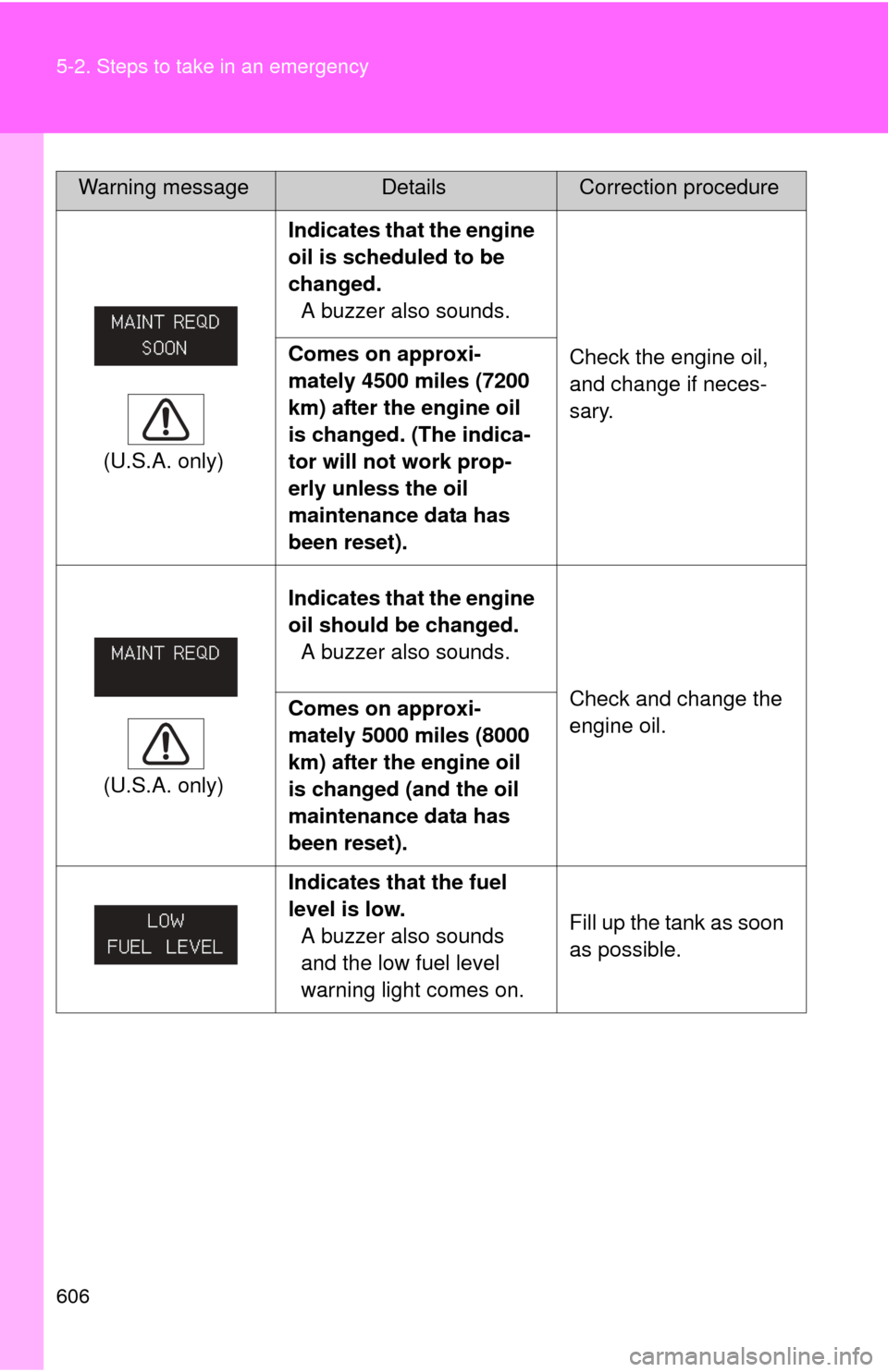
(U.S.A. only)Indicates that the engine
oil is scheduled to be
changed.
A buzzer also sounds.
Check the engine oil,
and change if neces-
sary.
Comes on approxi-
mately 4500 miles (7200
km) after the engine oil
is changed. (The indica-
tor will not work prop-
erly unless the oil
maintenance data has
been reset).
(U.S.A. only) Indicates that the engine
oil should be changed.
A buzzer also sounds.
Check and change the
engine oil.
Comes on approxi-
mately 5000 miles (8000
km) after the engine oil
is changed (and the oil
maintenance data has
been reset).
Indicates that the fuel
level is low.
A buzzer also sounds
and the low fuel level
warning light comes on. Fill up the tank as soon
as possible.
Warning messageDetailsCorrection procedure
Page 625 of 724
5
When trouble arises
625
5-2. Steps to take in an emergency
If the engine will not star t
If the engine still does not start after following the correct starting
procedure ( P. 183) or releasing the steering lock (P. 184), confirm
the following points.
■ The engine will not start even when the starter motor oper-
ates normally.
One of the following may be the cause of the problem.
●There may not be sufficient fuel in the vehicle’s tank.
Refuel the vehicle. (
P. 109)
Flex-fuel vehicles: The type of fuel may be different. When
refueling, add the same type of fuel, if available.
After adding a different type of fuel, the engine may run
roughly and driving performance may be reduced for a while
when the engine is first started. In this case, wait until the
engine runs normally.
● The engine may be flooded.
Try to restart the engine once more following correct starting
procedures.
● There may be a malfunction in the engine immobilizer system.
( P. 1 1 4 )
■ The starter motor turns over slowly, the interior lights and
headlights are dim, or the horn does not sound or sounds at
a low volume.
One of the following may be the cause of the problem.
●The battery may be discharged. ( P. 631)
● The battery terminal connec tions may be loose or corroded.
Page 632 of 724
632 5-2. Steps to take in an emergency
■Starting the engine when the battery is discharged
The engine cannot be started by push-starting.
■ Avoiding a discharged battery
●Turn off the headlights and the audio system while the engine is turned
off.
● Turn off any unnecessary electrical components when the vehicle is run-
ning at a low speed for an extended period, such as in heavy traffic, etc.
■ When the battery is removed or discharged
●The moon roof must be initialized. ( P. 106)
● Flex-fuel vehicles: The information recorded in the computer will be
cleared, which may cause the engine to run roughly and reduce driving
performance for a while when the engine is first started. In this case, wait
until the engine runs normally.
If the vehicle is running on E85, the engine may stall.
In this case, restart the engine, repeatedly if necessary.
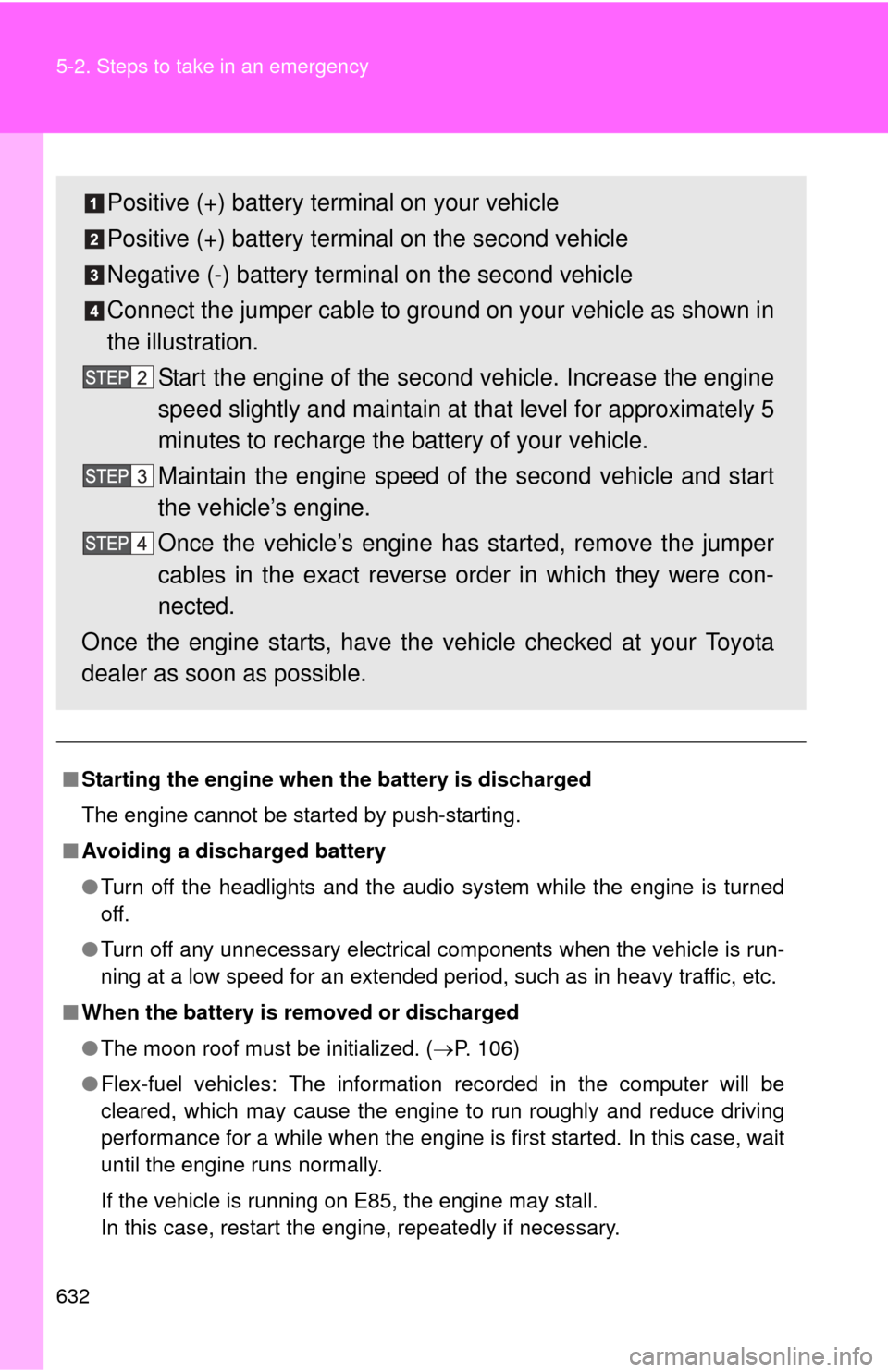
Positive (+) battery terminal on your vehicle
Positive (+) battery terminal on the second vehicle
Negative (-) battery terminal on the second vehicle
Connect the jumper cable to ground on your vehicle as shown in
the illustration.
Start the engine of the second vehicle. Increase the engine
speed slightly and maintain at that level for approximately 5
minutes to recharge the battery of your vehicle.
Maintain the engine speed of the second vehicle and start
the vehicle’s engine.
Once the vehicle’s engine has started, remove the jumper
cables in the exact reverse order in which they were con-
nected.
Once the engine starts, have the vehicle checked at your Toyota
dealer as soon as possible.
Page 639 of 724
Vehicle specifications6
639
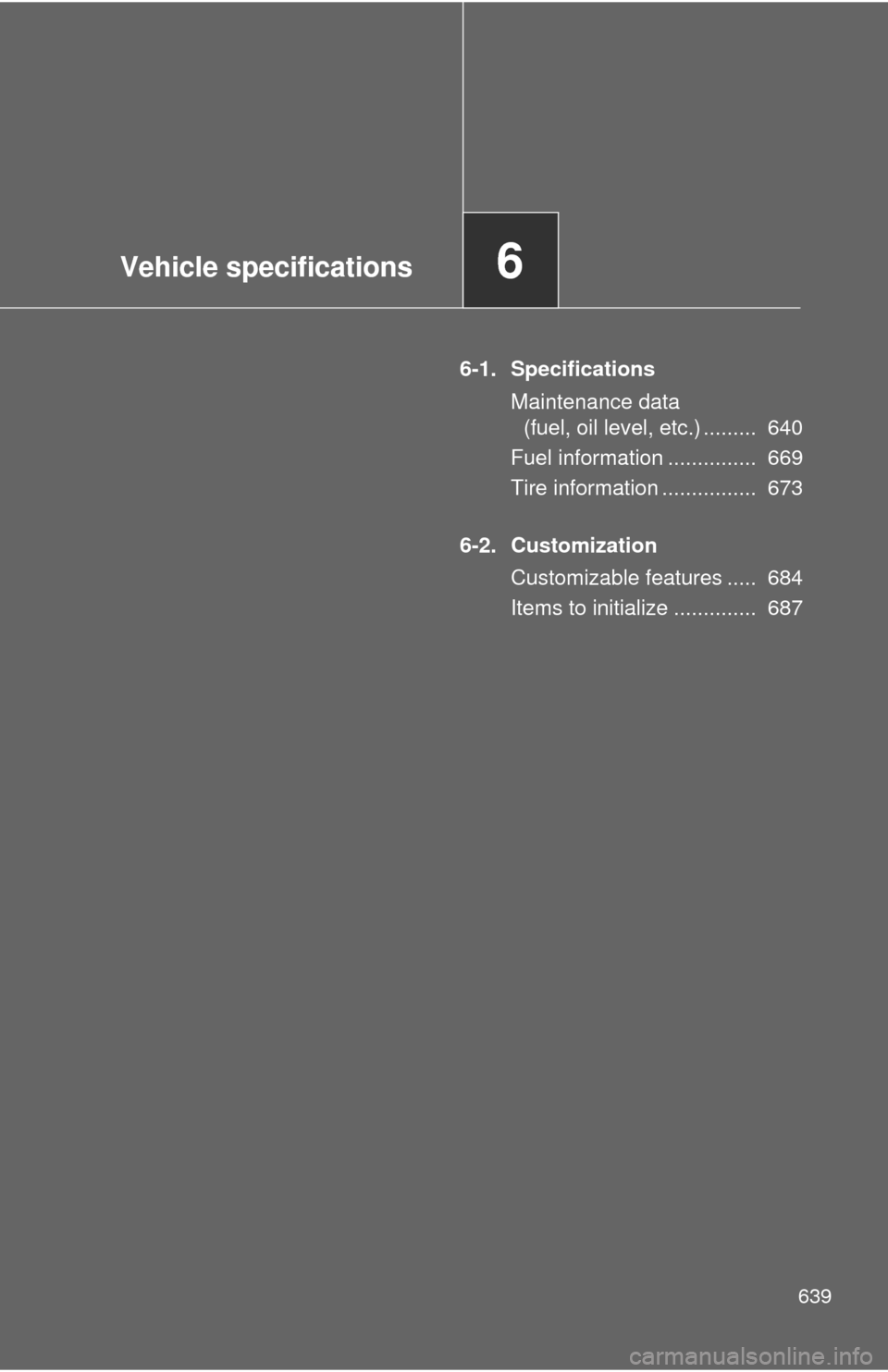
6-1. SpecificationsMaintenance data (fuel, oil level, etc.) ......... 640
Fuel information ............... 669
Tire information ................ 673
6-2. Customization Customizable features ..... 684
Items to initialize .............. 687
Page 640 of 724
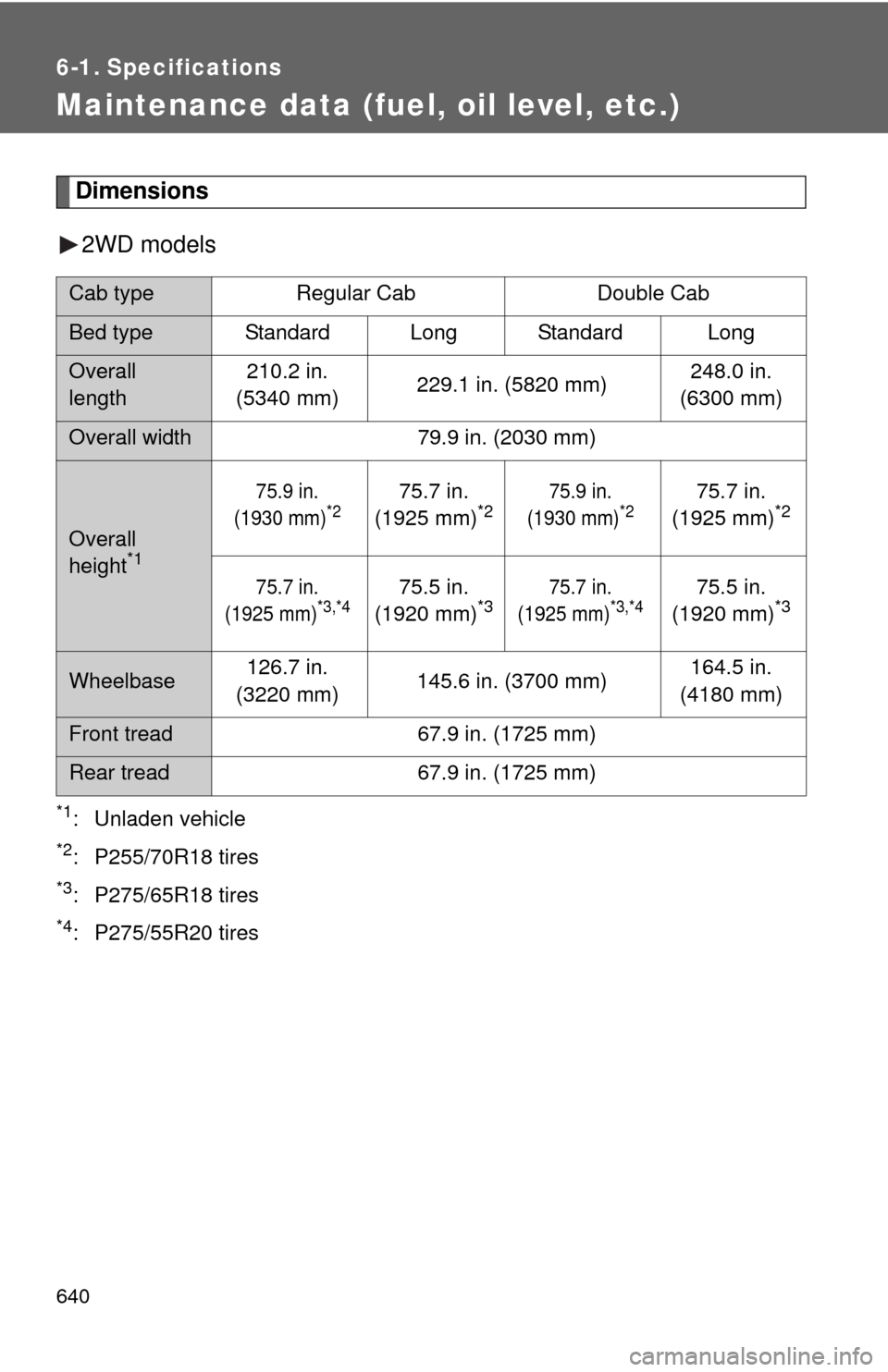
640
6-1. Specifications
Maintenance data (fuel, oil level, etc.)
Dimensions2WD models
*1: Unladen vehicle
*2: P255/70R18 tires
*3: P275/65R18 tires
*4: P275/55R20 tires
Cab type Regular Cab Double Cab
Bed type Standard Long Standard Long
Overall
length210.2 in.
(5340 mm) 229.1 in. (5820 mm) 248.0 in.
(6300 mm)
Overall width 79.9 in. (2030 mm)
Overall
height*1
75.9 in.
(1930 mm)*275.7 in.
(1925 mm)*275.9 in.
(1930 mm)*275.7 in.
(1925 mm)*2
75.7 in.
(1925 mm)*3,*475.5 in.
(1920 mm)*375.7 in.
(1925 mm)*3,*475.5 in.
(1920 mm)*3
Wheelbase 126.7 in.
(3220 mm) 145.6 in. (3700 mm) 164.5 in.
(4180 mm)
Front tread 67.9 in. (1725 mm)
Rear tread67.9 in. (1725 mm)
Page 656 of 724
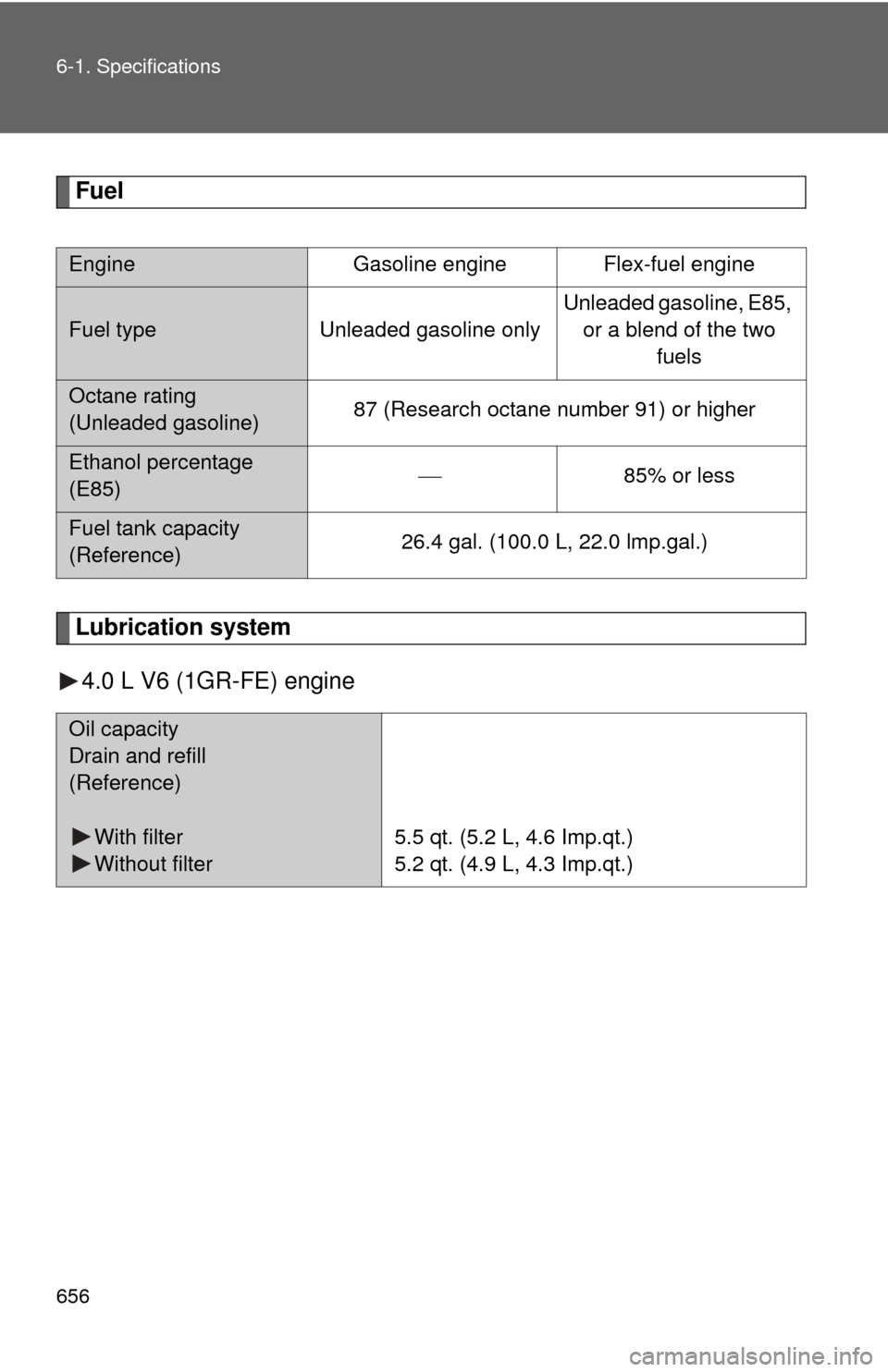
656 6-1. Specifications
Fuel
Lubrication system4.0 L V6 (1GR-FE) engine
Engine Gasoline engine Flex-fuel engine
Fuel typeUnleaded gasoline onlyUnleaded gasoline, E85,
or a blend of the two fuels
Octane rating
(Unleaded gasoline) 87 (Research octane number 91) or higher
Ethanol percentage
(E85)
85% or less
Fuel tank capacity
(Reference) 26.4 gal. (100.0 L, 22.0 lmp.gal.)
Oil capacity
Drain and refill
(Reference)
With filter
Without filter 5.5 qt. (5.2 L, 4.6 Imp.qt.)
5.2 qt. (4.9 L, 4.3 Imp.qt.)
Page 657 of 724
657
6-1. Specifications
6
Vehicle specifications
■
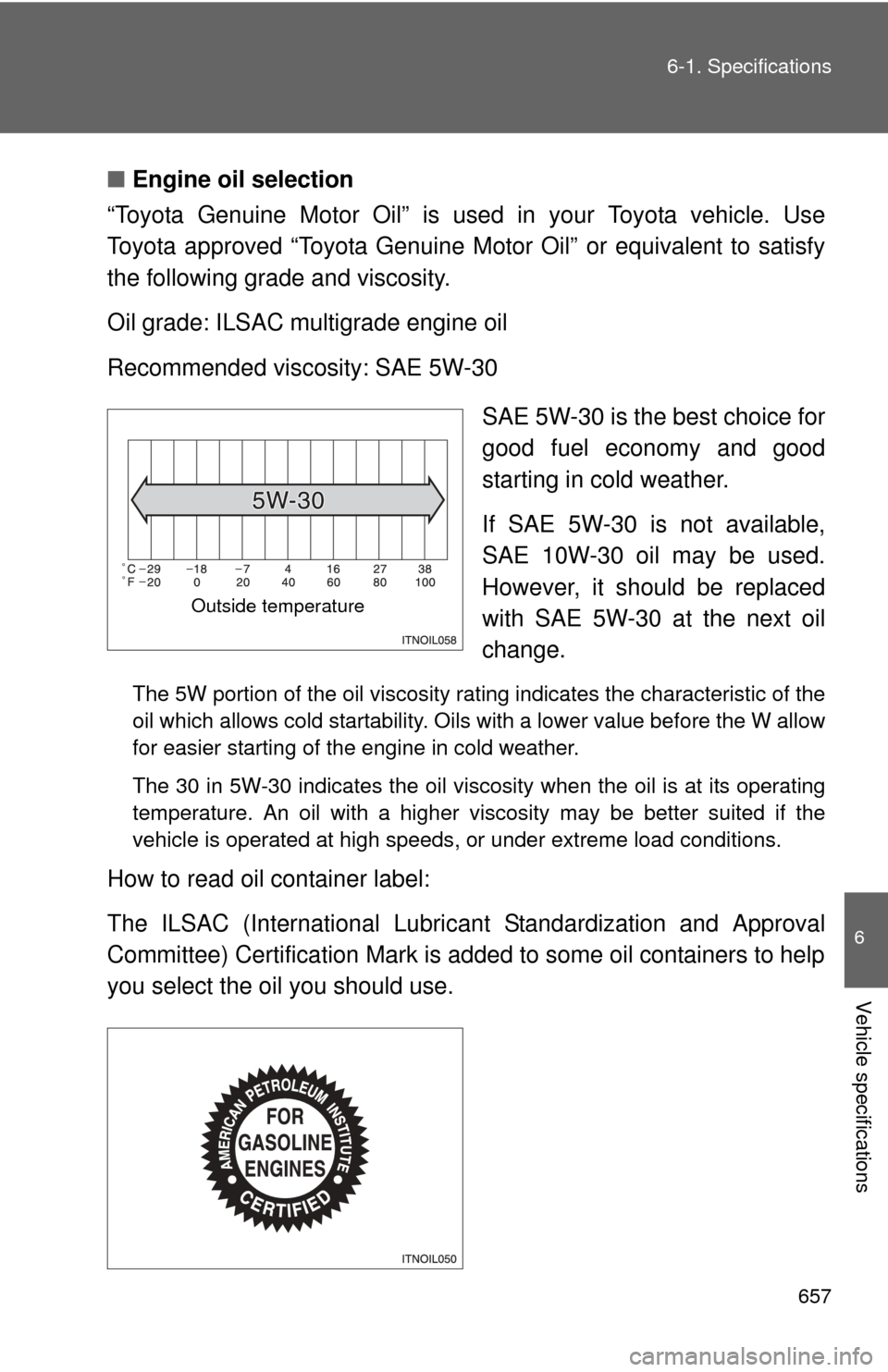
Engine oil selection
“Toyota Genuine Motor Oil” is used in your Toyota vehicle. Use
Toyota approved “Toyota Genuine Motor Oil” or equivalent to satisfy
the following grade and viscosity.
Oil grade: ILSAC multigrade engine oil
Recommended viscosity: SAE 5W-30
SAE 5W-30 is the best choice for
good fuel economy and good
starting in cold weather.
If SAE 5W-30 is not available,
SAE 10W-30 oil may be used.
However, it should be replaced
with SAE 5W-30 at the next oil
change.
The 5W portion of the oil viscosity rating indicates the characteristic of the
oil which allows cold startability. Oils with a lower value before the W allow
for easier starting of the engine in cold weather.
The 30 in 5W-30 indicates the oil viscosity when the oil is at its operating
temperature. An oil with a higher viscosity may be better suited if the
vehicle is operated at high speeds, or under extreme load conditions.
How to read oil container label:
The ILSAC (International Lubricant Standardization and Approval
Committee) Certification Mark is added to some oil containers to help
you select the oil you should use.
Outside temperature
Page 658 of 724
658 6-1. Specifications
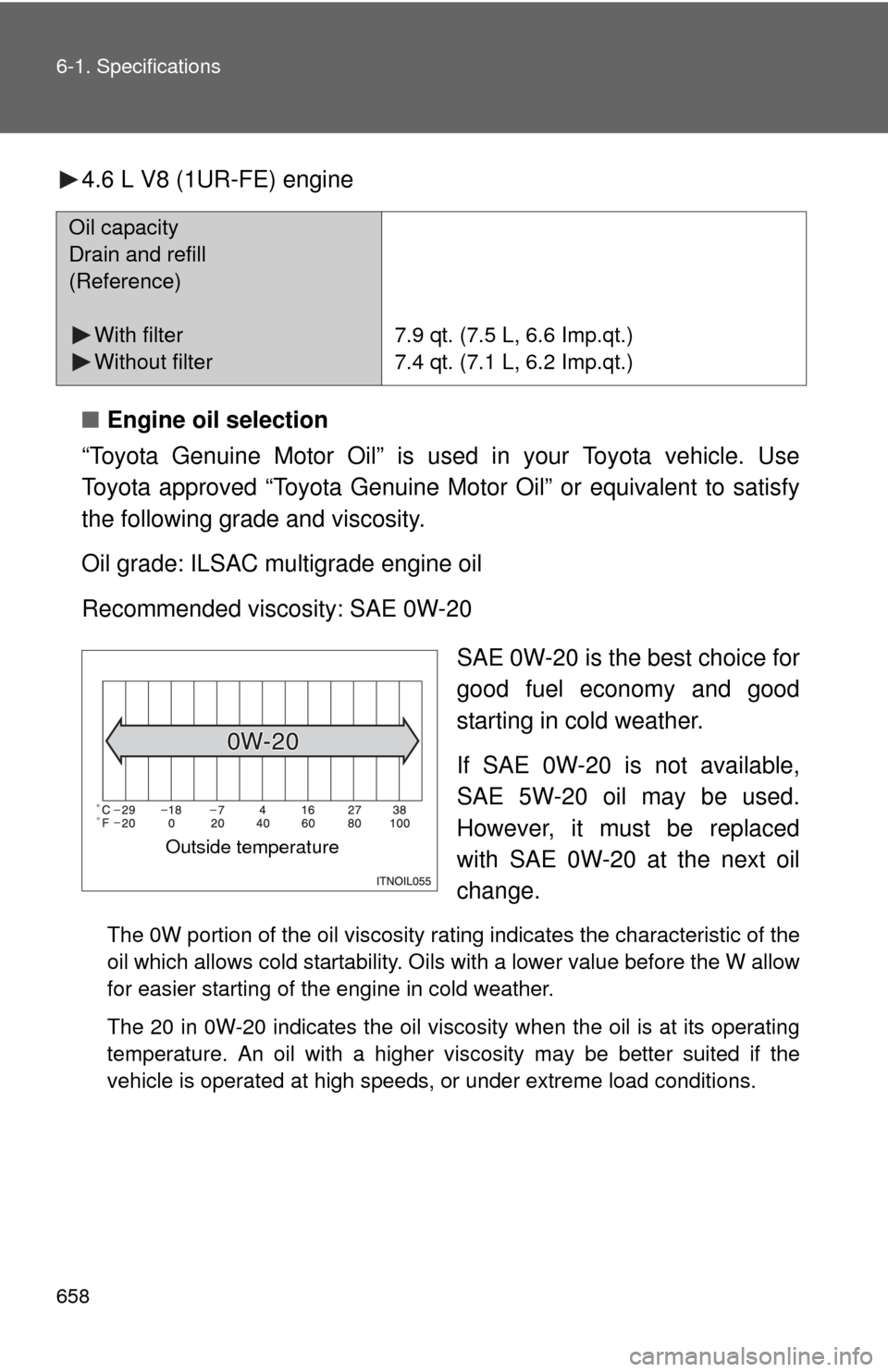
4.6 L V8 (1UR-FE) engine
■Engine oil selection
“Toyota Genuine Motor Oil” is used in your Toyota vehicle. Use
Toyota approved “Toyota Genuine Motor Oil” or equivalent to satisfy
the following grade and viscosity.
Oil grade: ILSAC multigrade engine oil
Recommended viscosity: SAE 0W-20
SAE 0W-20 is the best choice for
good fuel economy and good
starting in cold weather.
If SAE 0W-20 is not available,
SAE 5W-20 oil may be used.
However, it must be replaced
with SAE 0W-20 at the next oil
change.
The 0W portion of the oil viscosity rating indicates the characteristic of the
oil which allows cold startability. Oils with a lower value before the W allow
for easier starting of the engine in cold weather.
The 20 in 0W-20 indicates the oil viscosity when the oil is at its operating
temperature. An oil with a higher viscosity may be better suited if the
vehicle is operated at high speeds, or under extreme load conditions.
Oil capacity
Drain and refill
(Reference)
With filter
Without filter 7.9 qt. (7.5 L, 6.6 Imp.qt.)
7.4 qt. (7.1 L, 6.2 Imp.qt.)
Outside temperature
Page 660 of 724
660 6-1. Specifications
■Engine oil selection
“Toyota Genuine Motor Oil” is used in your Toyota vehicle. Use
Toyota approved “Toyota Genuine Motor Oil” or equivalent to satisfy
the following grade and viscosity.
Oil grade: ILSAC multigrade engine oil
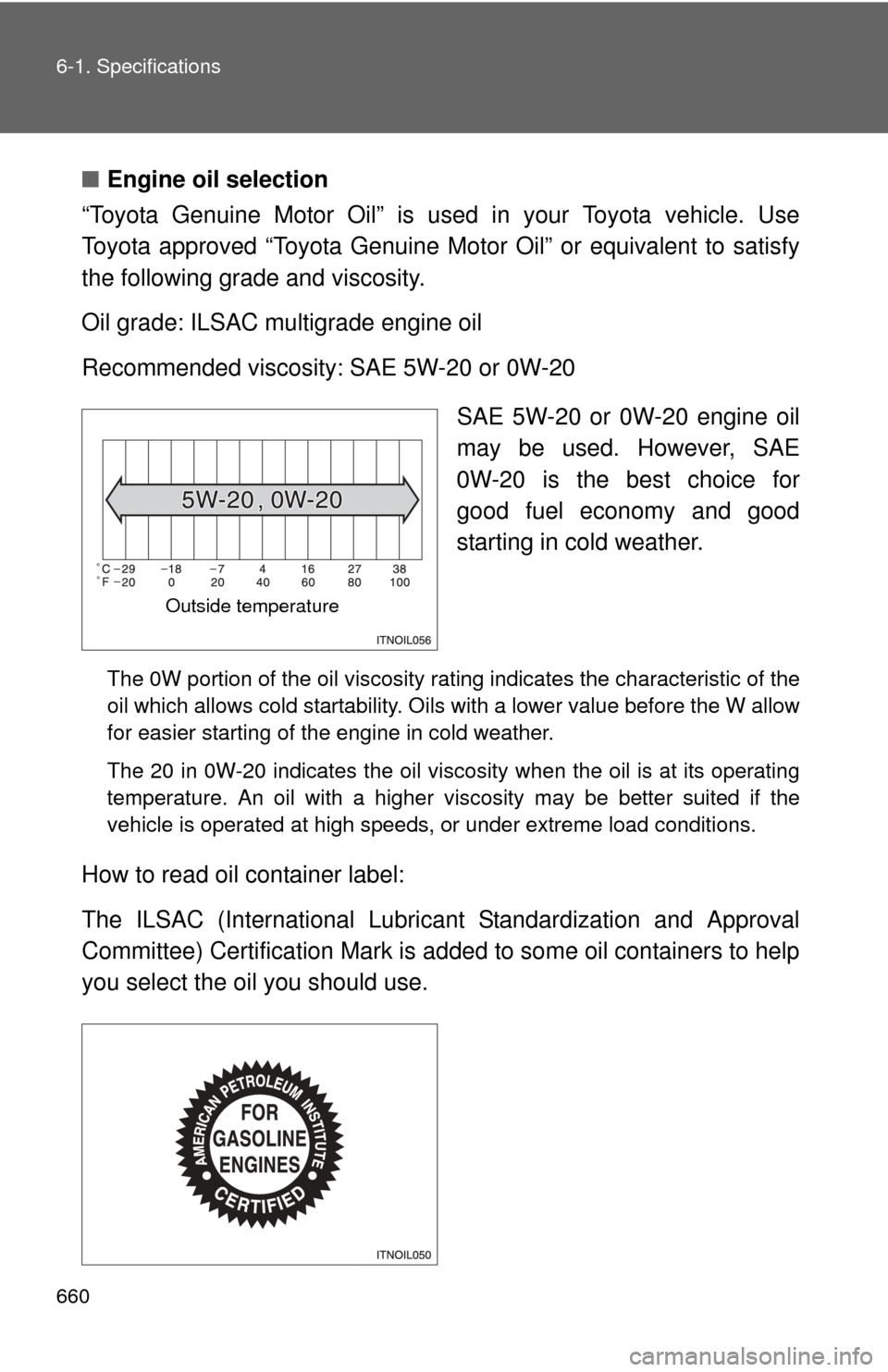
Recommended viscosity: SAE 5W-20 or 0W-20
SAE 5W-20 or 0W-20 engine oil
may be used. However, SAE
0W-20 is the best choice for
good fuel economy and good
starting in cold weather.
The 0W portion of the oil viscosity rating indicates the characteristic of the
oil which allows cold startability. Oils with a lower value before the W allow
for easier starting of the engine in cold weather.
The 20 in 0W-20 indicates the oil viscosity when the oil is at its operating
temperature. An oil with a higher viscosity may be better suited if the
vehicle is operated at high speeds, or under extreme load conditions.
How to read oil container label:
The ILSAC (International Lubricant Standardization and Approval
Committee) Certification Mark is added to some oil containers to help
you select the oil you should use.
Outside temperature
Page 669 of 724
669
6-1. Specifications
6
Vehicle specifications
Fuel infor mation
■Fuel tank opening fo r unleaded gasoline
To help prevent incorrect fueling, your Toyota has a fuel tank opening that
only accommodates the special nozzle on unleaded fuel pumps.
Gasoline engine
Your vehicle must use only unleaded gasoline.
Select octane rating 87 (Research Octane Number 91) or higher. The
use of unleaded fuel with an octane rating lower than 87 may result
in engine knocking. Persistent kno cking can lead to engine damage.
At minimum, the gasoline you use should meet the specifications
of ASTM D4814 in the U.S.A. and CGSB3.5-M93 in Canada.
Flex-fuel engine
Your vehicle must use only unleaded gasoline, E85, or a blend of the
two fuels.
Unleaded gasoline (Octane rating 87 [Research Octane Number 91]
or higher), E85, or a blend of these two fuels is required for optimum
engine performance.
The use of unleaded gasoline with an octane rating lower than 87
may result in engine knocking. Persistent knocking can lead to
engine damage.
The use of fuel with an ethanol concentration in excess of 85% will
have a negative impact on driv ing performance and can cause
damage to the fuel system components.
At minimum, the gasoline you us e should meet the specifications
of ASTM D4814 in the U.S.A. and CGSB3.5-M93 in Canada.
At minimum, the E85 you use should meet the specifications of
ASTM D5798 in the U.S.A.