engine TOYOTA TUNDRA 2010 2.G Manual PDF
[x] Cancel search | Manufacturer: TOYOTA, Model Year: 2010, Model line: TUNDRA, Model: TOYOTA TUNDRA 2010 2.GPages: 724, PDF Size: 13.74 MB
Page 267 of 724
267
2-5. Driving information
2
When driving
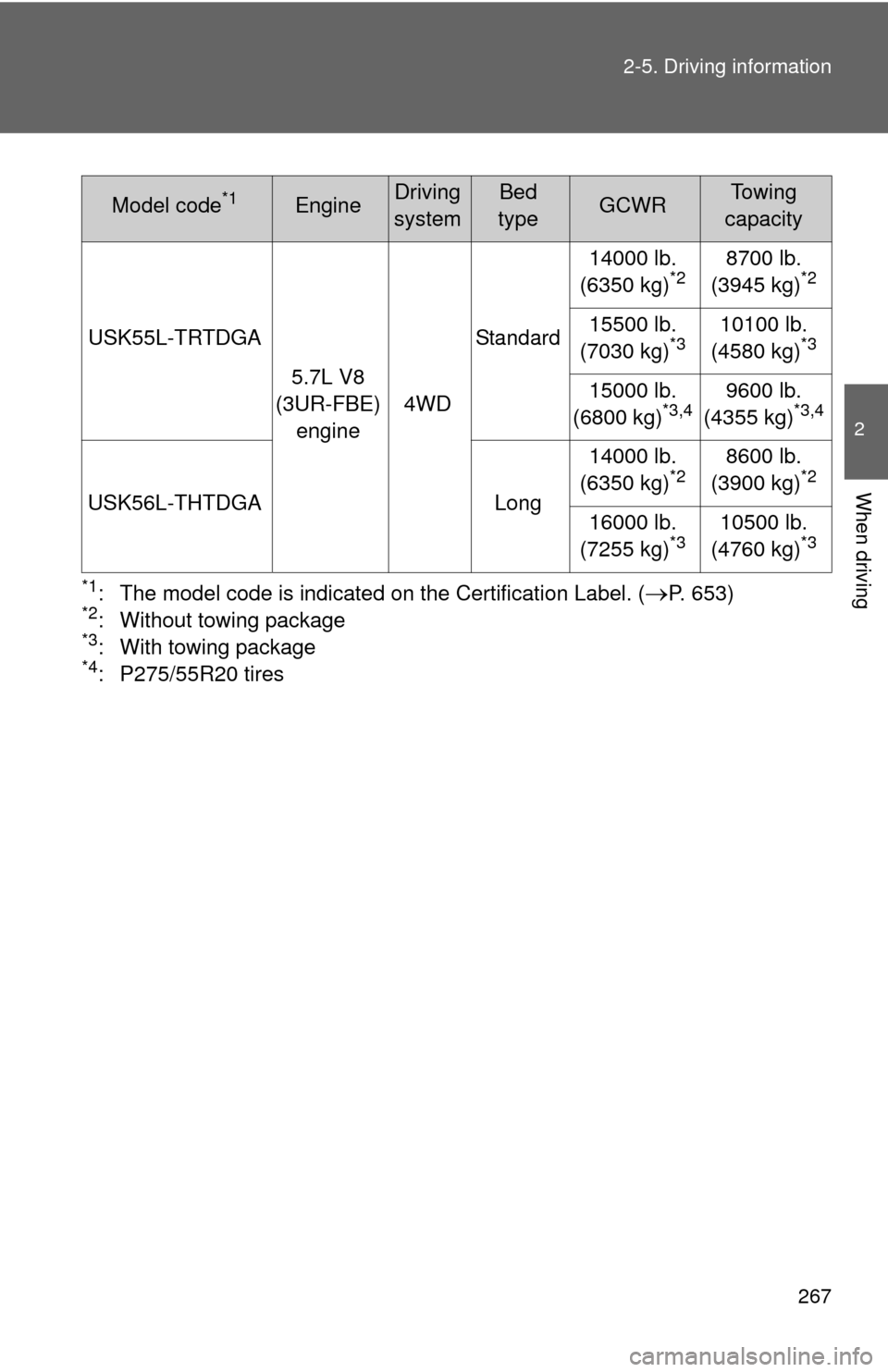
*1: The model code is indicated on the Certification Label. (P. 653)*2: Without towing package*3: With towing package*4: P275/55R20 tires
Model code*1EngineDriving
systemBed
typeGCWRTowing
capacity
USK55L-TRTDGA 5.7L V8
(3UR-FBE) engine 4WDStandard 14000 lb.
(6350 kg)
*28700 lb.
(3945 kg)*2
15500 lb.
(7030 kg)*310100 lb.
(4580 kg)*3
15000 lb.
(6800 kg)*3,49600 lb.
(4355 kg)*3,4
USK56L-THTDGA Long14000 lb.
(6350 kg)
*28600 lb.
(3900 kg)*2
16000 lb.
(7255 kg)*310500 lb.
(4760 kg)*3
Page 268 of 724
268 2-5. Driving information
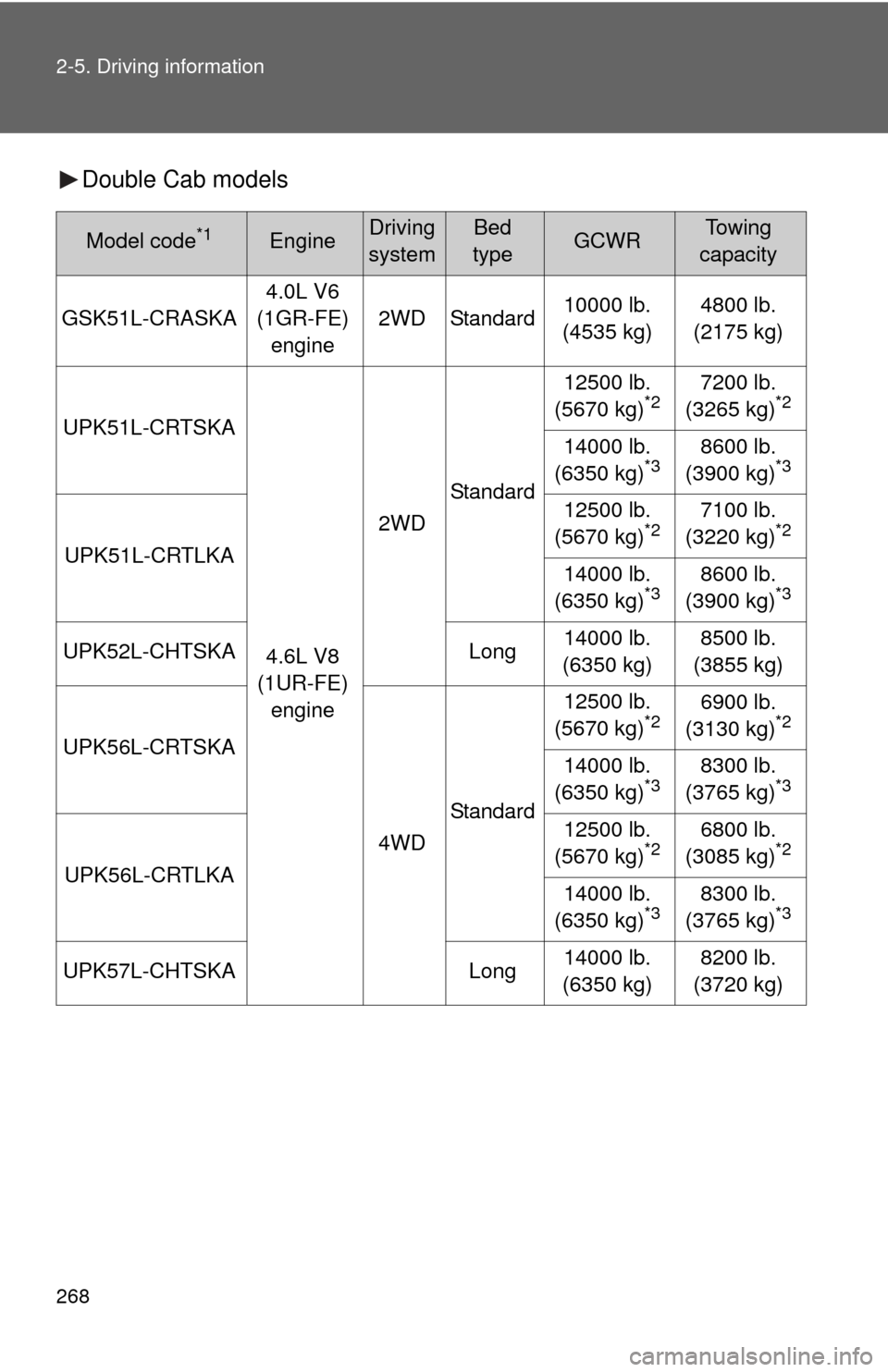
Double Cab models
Model code*1EngineDriving
systemBed
typeGCWRTowing
capacity
GSK51L-CRASKA 4.0L V6
(1GR-FE) engine 2WD Standard
10000 lb.
(4535 kg) 4800 lb.
(2175 kg)
UPK51L-CRTSKA
4.6L V8
(1UR-FE) engine 2WD
Standard 12500 lb.
(5670 kg)
*27200 lb.
(3265 kg)*2
14000 lb.
(6350 kg)*38600 lb.
(3900 kg)*3
UPK51L-CRTLKA 12500 lb.
(5670 kg)
*27100 lb.
(3220 kg)*2
14000 lb.
(6350 kg)*38600 lb.
(3900 kg)*3
UPK52L-CHTSKA Long14000 lb.
(6350 kg) 8500 lb.
(3855 kg)
UPK56L-CRTSKA
4WDStandard 12500 lb.
(5670 kg)
*26900 lb.
(3130 kg)*2
14000 lb.
(6350 kg)*38300 lb.
(3765 kg)*3
UPK56L-CRTLKA 12500 lb.
(5670 kg)
*26800 lb.
(3085 kg)*2
14000 lb.
(6350 kg)*38300 lb.
(3765 kg)*3
UPK57L-CHTSKA Long14000 lb.
(6350 kg) 8200 lb.
(3720 kg)
Page 269 of 724
269
2-5. Driving information
2
When driving
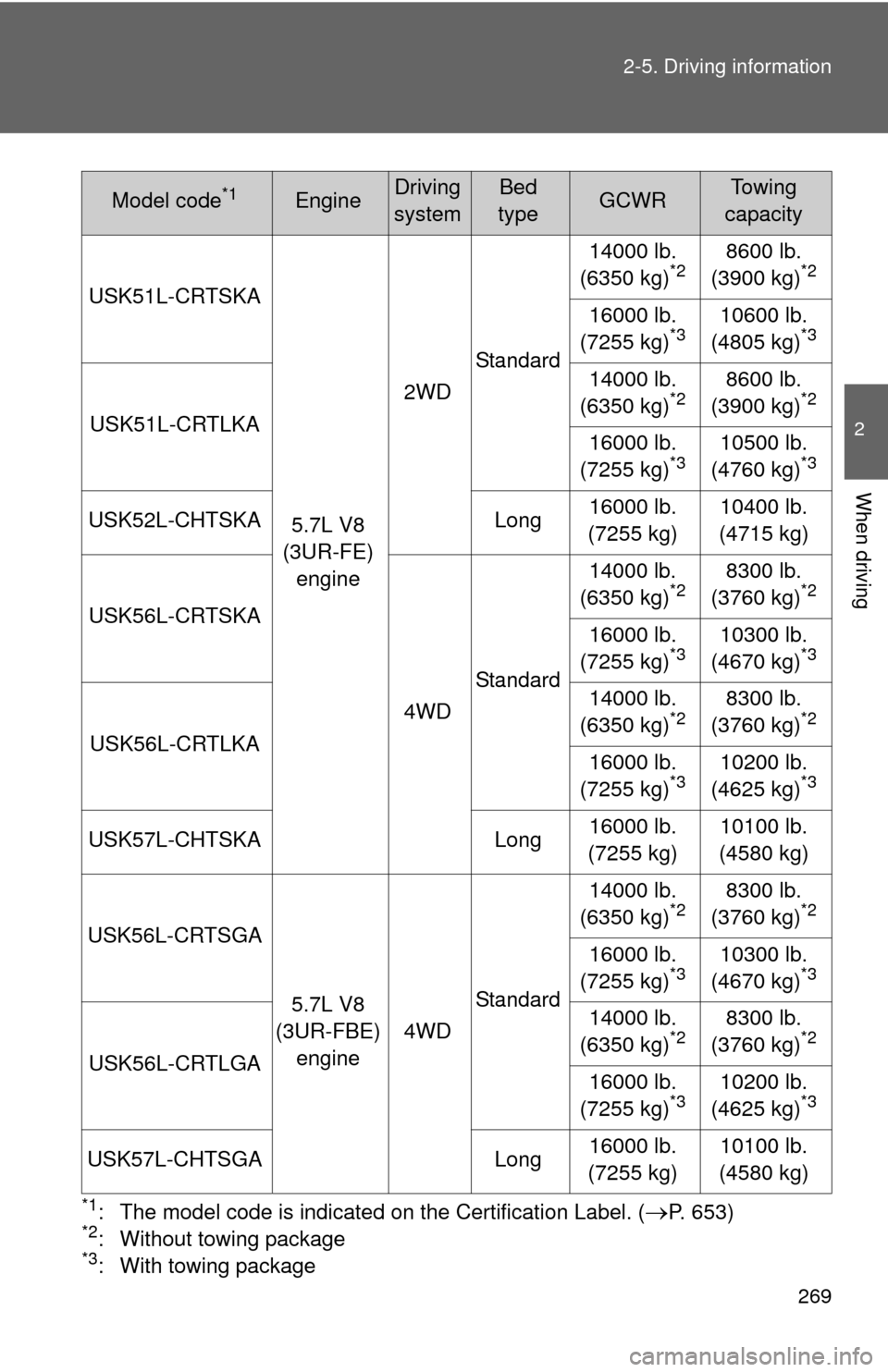
*1: The model code is indicated on the Certification Label. (P. 653)*2: Without towing package*3: With towing package
USK51L-CRTSKA
5.7L V8
(3UR-FE) engine 2WD
Standard 14000 lb.
(6350 kg)
*28600 lb.
(3900 kg)*2
16000 lb.
(7255 kg)*310600 lb.
(4805 kg)*3
USK51L-CRTLKA 14000 lb.
(6350 kg)
*28600 lb.
(3900 kg)*2
16000 lb.
(7255 kg)*310500 lb.
(4760 kg)*3
USK52L-CHTSKA Long16000 lb.
(7255 kg) 10400 lb.
(4715 kg)
USK56L-CRTSKA
4WDStandard 14000 lb.
(6350 kg)
*28300 lb.
(3760 kg)*2
16000 lb.
(7255 kg)*310300 lb.
(4670 kg)*3
USK56L-CRTLKA 14000 lb.
(6350 kg)
*28300 lb.
(3760 kg)*2
16000 lb.
(7255 kg)*310200 lb.
(4625 kg)*3
USK57L-CHTSKA Long16000 lb.
(7255 kg) 10100 lb.
(4580 kg)
USK56L-CRTSGA 5.7L V8
(3UR-FBE) engine 4WDStandard 14000 lb.
(6350 kg)
*28300 lb.
(3760 kg)*2
16000 lb.
(7255 kg)*310300 lb.
(4670 kg)*3
USK56L-CRTLGA 14000 lb.
(6350 kg)
*28300 lb.
(3760 kg)*2
16000 lb.
(7255 kg)*310200 lb.
(4625 kg)*3
USK57L-CHTSGA Long16000 lb.
(7255 kg) 10100 lb.
(4580 kg)
Model code*1EngineDriving
systemBed
typeGCWRTowing
capacity
Page 270 of 724
270 2-5. Driving information
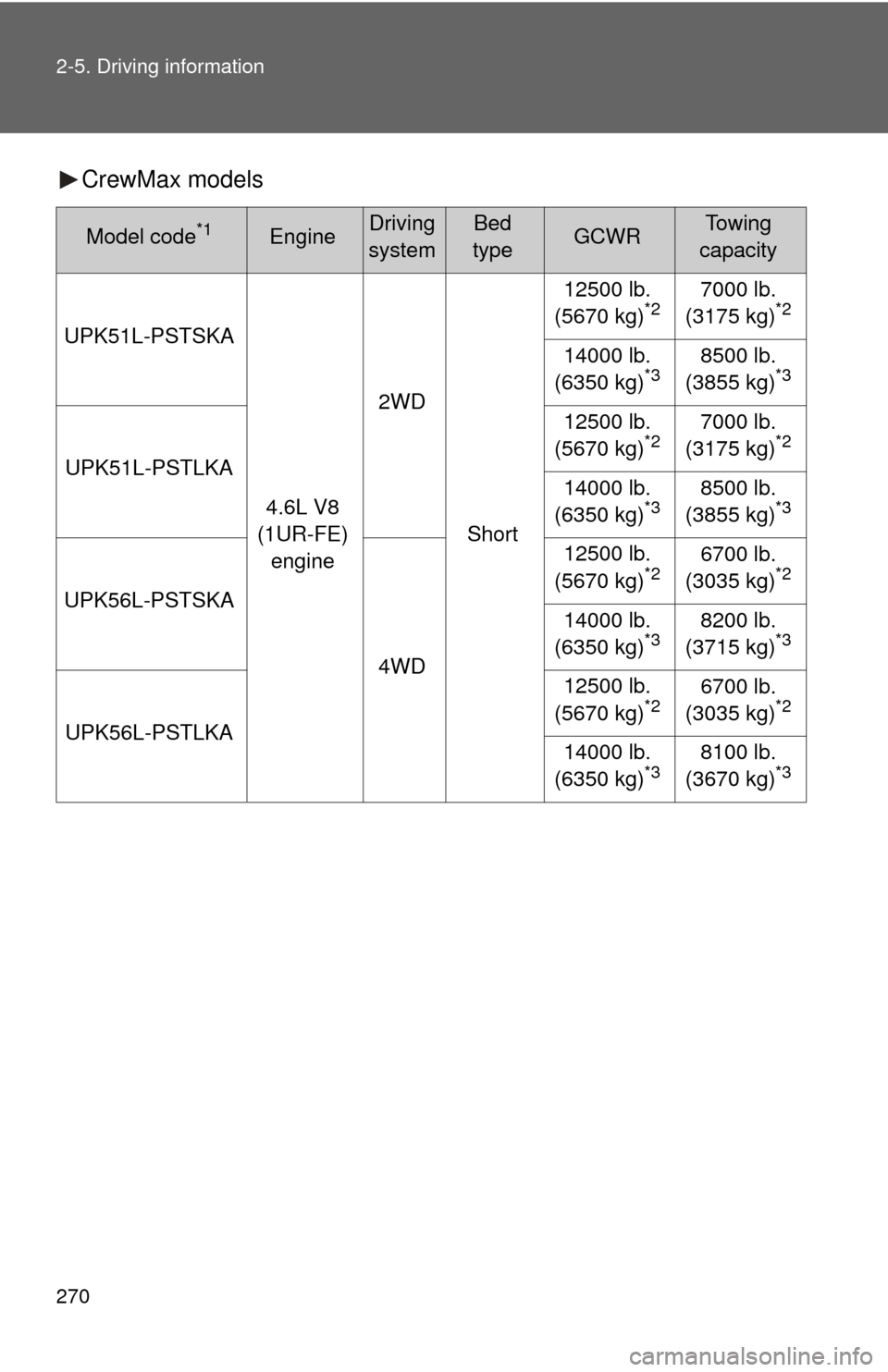
CrewMax models
Model code*1EngineDriving
systemBed
typeGCWRTowing
capacity
UPK51L-PSTSKA
4.6L V8
(1UR-FE) engine 2WD
Short 12500 lb.
(5670 kg)
*27000 lb.
(3175 kg)*2
14000 lb.
(6350 kg)*38500 lb.
(3855 kg)*3
UPK51L-PSTLKA 12500 lb.
(5670 kg)
*27000 lb.
(3175 kg)*2
14000 lb.
(6350 kg)*38500 lb.
(3855 kg)*3
UPK56L-PSTSKA
4WD12500 lb.
(5670 kg)
*26700 lb.
(3035 kg)*2
14000 lb.
(6350 kg)*38200 lb.
(3715 kg)*3
UPK56L-PSTLKA 12500 lb.
(5670 kg)
*26700 lb.
(3035 kg)*2
14000 lb.
(6350 kg)*38100 lb.
(3670 kg)*3
Page 271 of 724
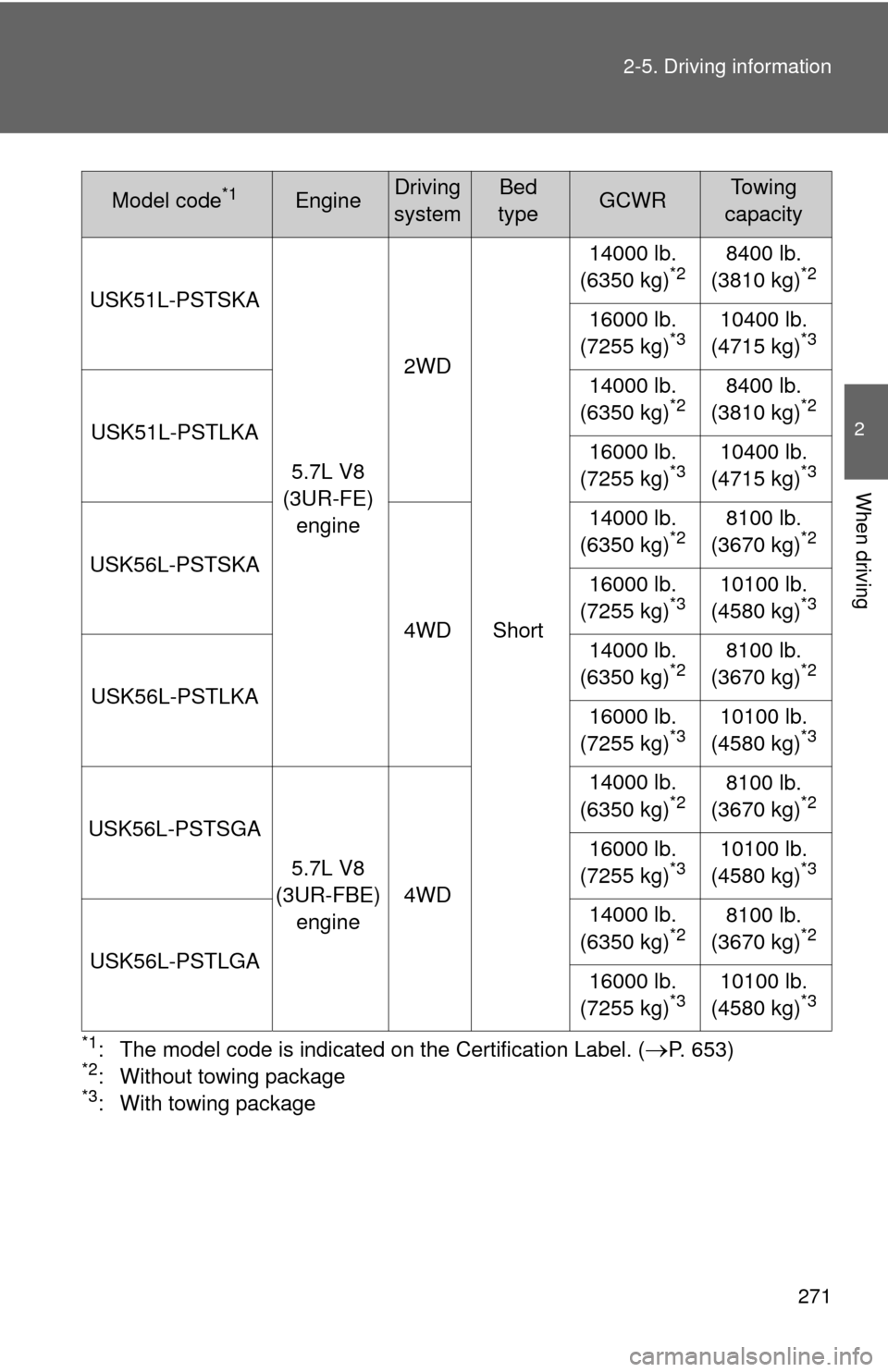
271
2-5. Driving information
2
When driving
*1: The model code is indicated on the Certification Label. (P. 653)*2: Without towing package*3: With towing package
USK51L-PSTSKA
5.7L V8
(3UR-FE) engine 2WD
Short 14000 lb.
(6350 kg)
*28400 lb.
(3810 kg)*2
16000 lb.
(7255 kg)*310400 lb.
(4715 kg)*3
USK51L-PSTLKA 14000 lb.
(6350 kg)
*28400 lb.
(3810 kg)*2
16000 lb.
(7255 kg)*310400 lb.
(4715 kg)*3
USK56L-PSTSKA
4WD14000 lb.
(6350 kg)
*28100 lb.
(3670 kg)*2
16000 lb.
(7255 kg)*310100 lb.
(4580 kg)*3
USK56L-PSTLKA 14000 lb.
(6350 kg)
*28100 lb.
(3670 kg)*2
16000 lb.
(7255 kg)*310100 lb.
(4580 kg)*3
USK56L-PSTSGA
5.7L V8
(3UR-FBE) engine 4WD 14000 lb.
(6350 kg)
*28100 lb.
(3670 kg)*2
16000 lb.
(7255 kg)*310100 lb.
(4580 kg)*3
USK56L-PSTLGA 14000 lb.
(6350 kg)
*28100 lb.
(3670 kg)*2
16000 lb.
(7255 kg)*310100 lb.
(4580 kg)*3
Model code*1EngineDriving
systemBed
typeGCWRTowing
capacity
Page 279 of 724

279
2-5. Driving information
2
When driving
●
Crosswinds and rough roads will adversely affect handling of your
vehicle and trailer, causing sway . Periodically check the rear to
prepare for being passed by large trucks or buses, which may
cause your vehicle and trailer to sway. If swaying occurs, firmly grip
the steering wheel, reduce speed immediately but gradually, and
steer straight ahead. Never increase speed. If you make no
extreme correction with the stee ring or brakes, your vehicle and
trailer will stabilize.
● Take care when passing other vehicles. Passing requires consider-
able distance. After passing a vehicle, do not forget the length of
your trailer, and be sure you hav e plenty of room before changing
lanes.
● In order to maintain engine braking efficiency when driving on a
long steep downgrade, do not use the transmission in D.
Transmission shift range position must be in 5 in the S mode (6-
speed models) or in 4 in the S mode (5-speed models).
● Due to the added load of the trailer, your vehicle’s engine may
overheat on hot days (at temperatures over 85°F [30°C]) when
driving up a long or steep grade. If the engine coolant temperature
gauge indicates overheating, immedi ately turn off the air condition-
ing (if in use), pull your vehicle off the road and stop in a safe spot.
( P. 634)
● Always place wheel blocks under both the vehicle and the trailer
wheels when parking. Apply the parking brake firmly, and put the
transmission in P. Avoid parking on a slope, but if unavoidable, do
so only after performing the following:
Apply the brakes and keep them applied.
Have someone place wheel blocks under both the vehicle and
trailer wheels.
When the wheel blocks are in pl ace, release the brakes slowly
until the blocks absorb the load.
Apply the parking brake firmly.
Page 280 of 724
280 2-5. Driving information
Shift into P and turn off the engine.
● When restarting after parking on a slope:
With the transmission in P, start the engine. Be sure to keep
the brake pedal pressed.
Shift into D or R (if reversing).
Release the parking brake and brake pedal, and slowly pull or
back away from the wheel blocks. Stop and apply the brakes.
Have someone retrieve the blocks.
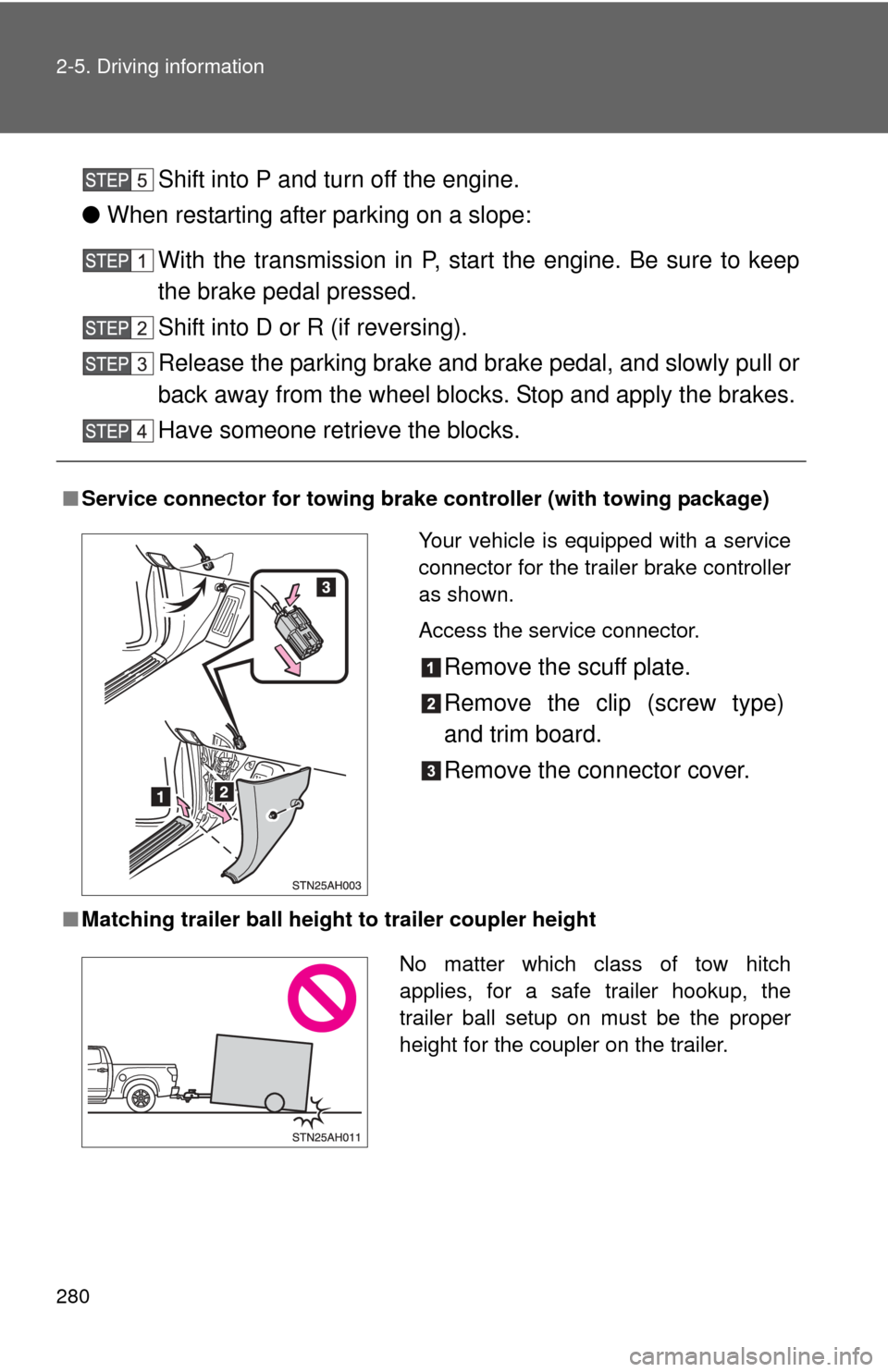
■Service connector for towing br ake controller (with towing package)
■ Matching trailer ball height to trailer coupler height
Your vehicle is equipped with a service
connector for the trailer brake controller
as shown.
Access the service connector.
Remove the scuff plate.
Remove the clip (screw type)
and trim board.
Remove the connector cover.
No matter which class of tow hitch
applies, for a safe trailer hookup, the
trailer ball setup on must be the proper
height for the coupler on the trailer.
Page 281 of 724
281
2-5. Driving information
2
When driving
■
Before towing
Check that the following conditions are met:
●Ensure that your vehicle’s tires are properly inflated. ( P. 666)
● Trailer tires should be inflated according to the trailer manufacturer’s rec-
ommendation.
● All trailer lights work to be legal.
● All lights work each time you connect them.
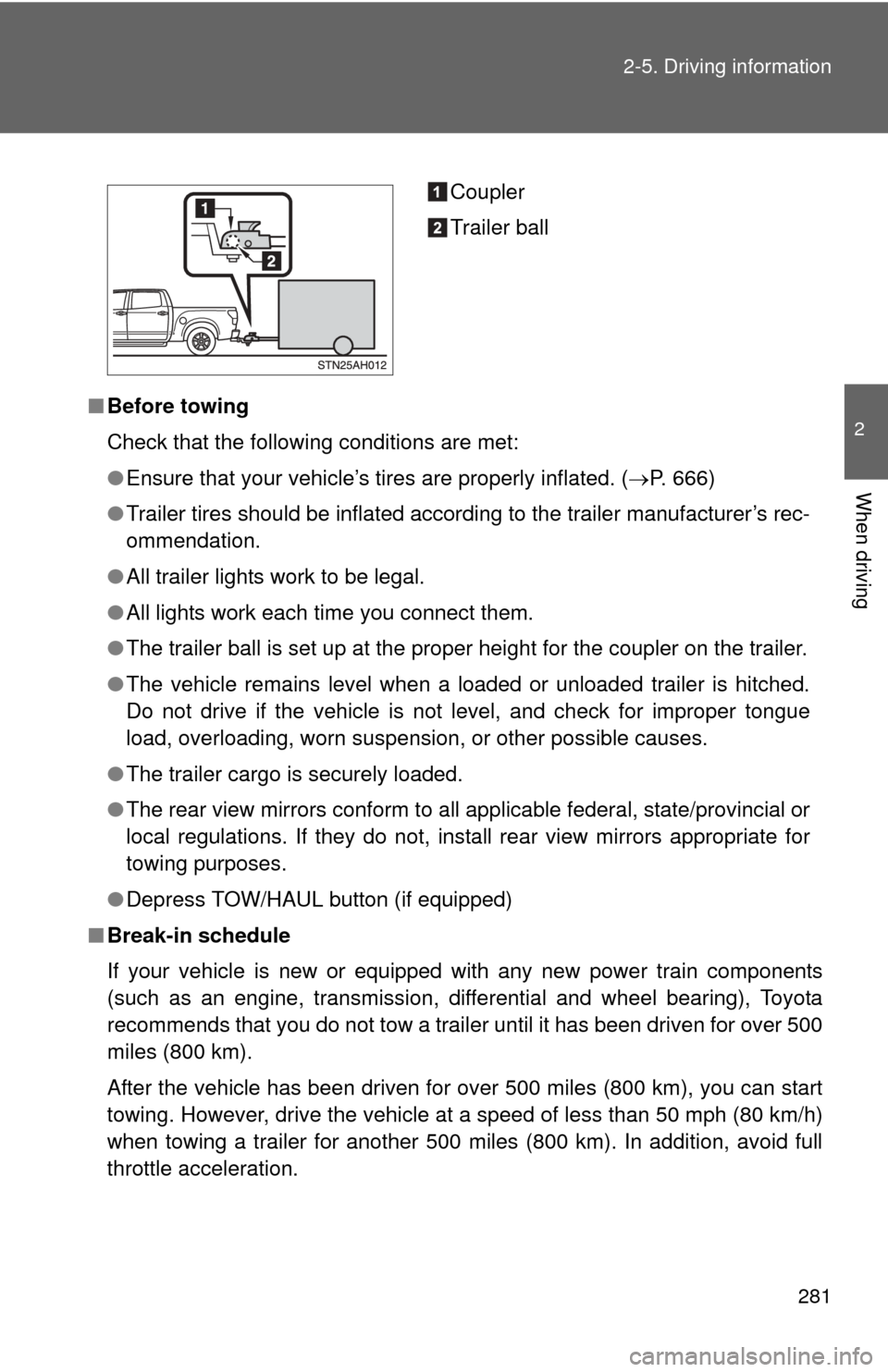
● The trailer ball is set up at the proper height for the coupler on the t\
railer.
● The vehicle remains level when a loaded or unloaded trailer is hitched.
Do not drive if the vehicle is not level, and check for improper tongue
load, overloading, worn suspension, or other possible causes.
● The trailer cargo is securely loaded.
● The rear view mirrors conform to all applicable federal, state/provincial or
local regulations. If they do not, instal l rear view mirrors appropriate for
towing purposes.
● Depress TOW/HAUL button (if equipped)
■ Break-in schedule
If your vehicle is new or equipped with any new power train components
(such as an engine, transmission, differential and wheel bearing), Toyota
recommends that you do not tow a trailer until it has been driven for over 500
miles (800 km).
After the vehicle has been driven for over 500 miles (800 km), you can s\
tart
towing. However, drive the vehicle at a speed of less than 50 mph (80 km/h)
when towing a trailer for another 500 miles (800 km). In addition, avoid full
throttle acceleration.
Coupler
Trailer ball
Page 296 of 724
296 3-1. Using the air conditioning system and defogger
■Air conditioning odors
●During use, various odors from inside and outside the vehicle may enter
into and accumulate in the air conditioning system. This may then cause
odor to be emitted from the vents.
● To reduce potential odors from occurring:
• It is recommended that the air conditioning system be set to outside air
mode prior to turning the vehicle off.
• The start timing of the blower may be delayed for a short period of time immediately after the air conditioning system is started in automatic
mode.
CAUTION
■ To prevent the windshield from fogging up
Do not use during cool air operation in extremely humid weather. The
difference between the temperature of the outside air and that of the wind-
shield can cause the outer surface of the windshield to fog up, blocking your
vision.
NOTICE
■To prevent battery discharge
Do not leave the air conditioning system on longer than necessary when the
engine is stopped.
Page 301 of 724
301
3-1. Using the air conditioning system
and defogger
3
Interior and exterior features
■If the ambient temperature drops while using the recirculated
air mode
The air intake mode automatically changes from recirculated air
mode to outside air mode after a few minutes.
To cancel this function:
Press and hold for longer than 2 seconds.
To reactivate this function:
Turn the engine switch to the LOCK or ACC position.
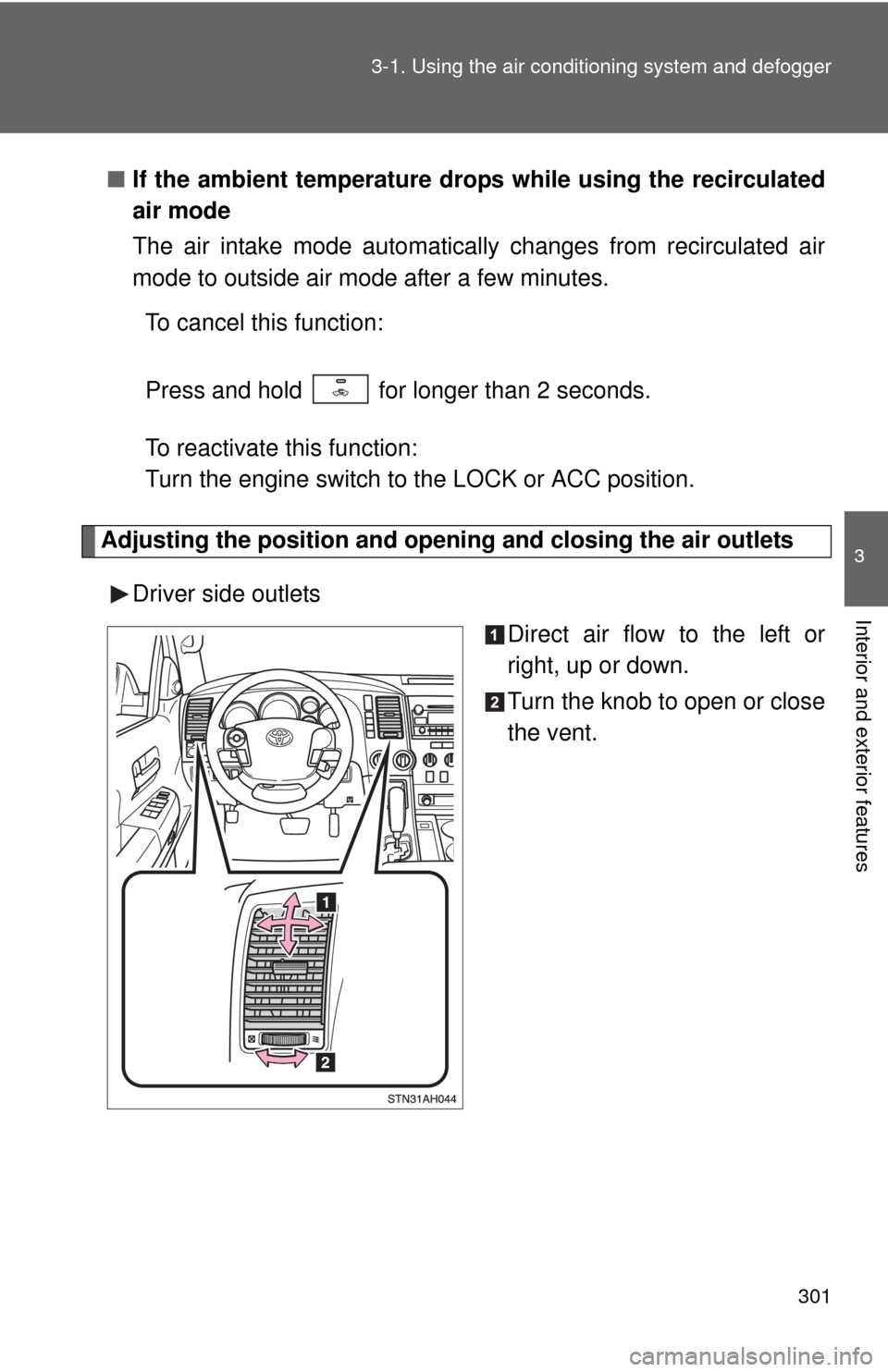
Adjusting the position and openi ng and closing the air outlets
Driver side outlets Direct air flow to the left or
right, up or down.
Turn the knob to open or close
the vent.