flex TOYOTA TUNDRA 2010 2.G Owners Manual
[x] Cancel search | Manufacturer: TOYOTA, Model Year: 2010, Model line: TUNDRA, Model: TOYOTA TUNDRA 2010 2.GPages: 724, PDF Size: 13.74 MB
Page 110 of 724
110 1-5. Refueling
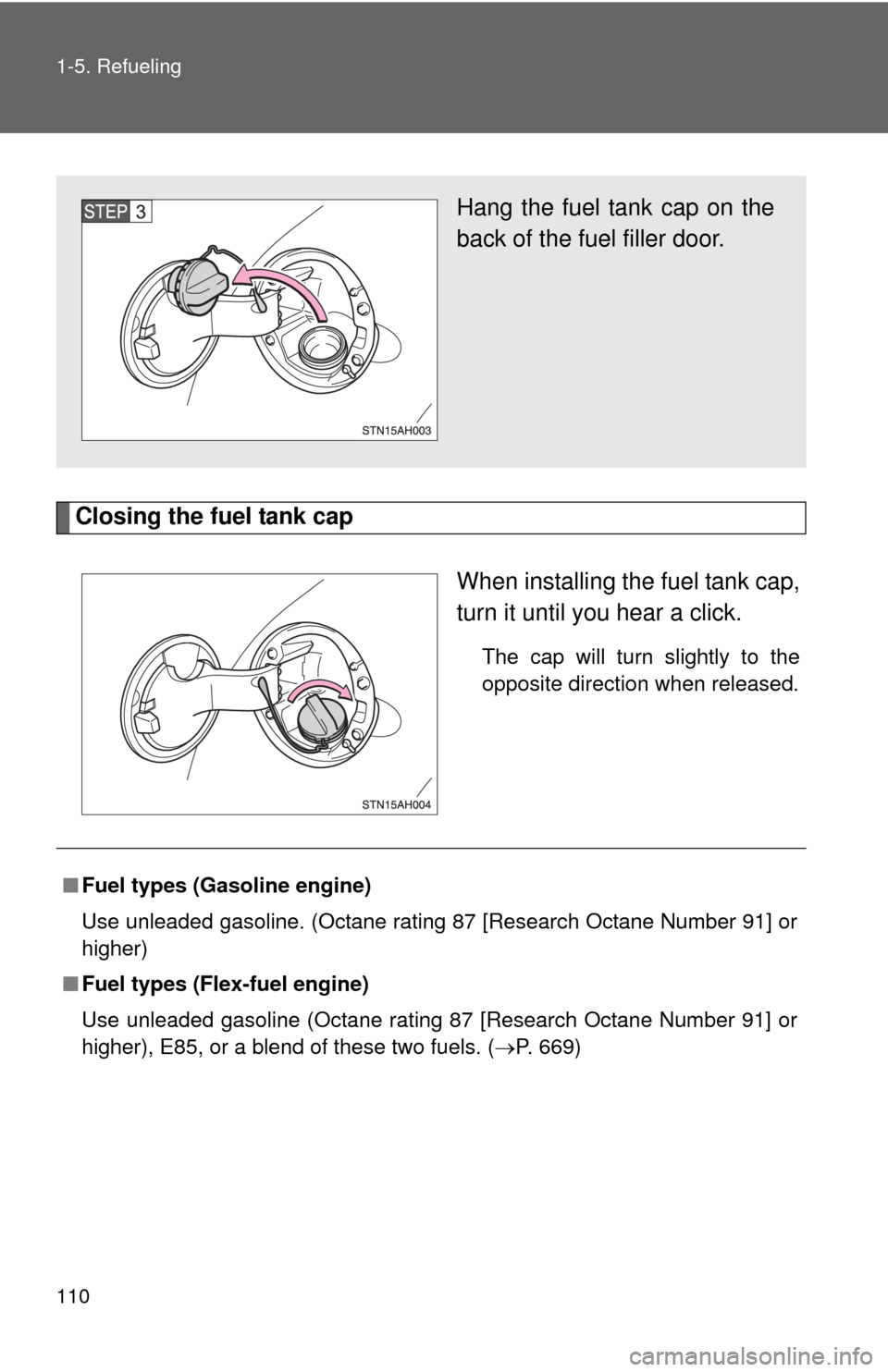
Closing the fuel tank capWhen installing the fuel tank cap,
turn it until you hear a click.
The cap will turn slightly to the
opposite direction when released.
Hang the fuel tank cap on the
back of the fuel filler door.
■Fuel types (Gasoline engine)
Use unleaded gasoline. (Octane rating 87 [Research Octane Number 91] or
higher)
■ Fuel types (Flex-fuel engine)
Use unleaded gasoline (Octane rating 87 [Research Octane Number 91] or
higher), E85, or a blend of these two fuels. ( P. 669)
Page 111 of 724
111
1-5. Refueling
1
Before driving
■
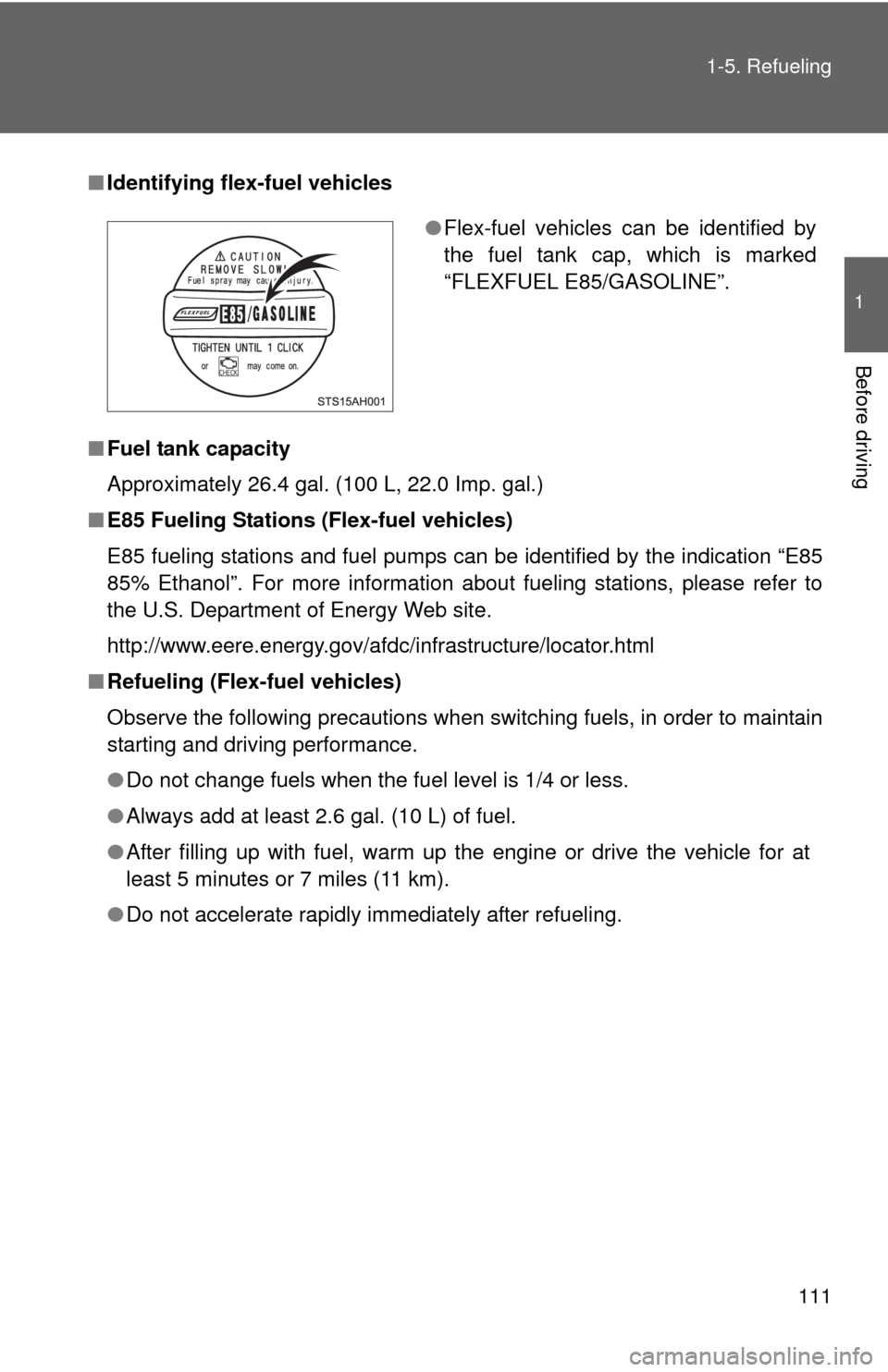
Identifying flex-fuel vehicles
■ Fuel tank capacity
Approximately 26.4 gal. (100 L, 22.0 Imp. gal.)
■ E85 Fueling Stations (Flex-fuel vehicles)
E85 fueling stations and fuel pumps can be identified by the indication “E85
85% Ethanol”. For more information about fueling stations, please refer to
the U.S. Department of Energy Web site.
http://www.eere.energy.gov/afdc/infrastructure/locator.html
■ Refueling (Flex-fuel vehicles)
Observe the following precautions when switching fuels, in order to maintain
starting and driving performance.
●Do not change fuels when the fuel level is 1/4 or less.
● Always add at least 2.6 gal. (10 L) of fuel.
● After filling up with fuel, warm up the engine or drive the vehicle for at
least 5 minutes or 7 miles (11 km).
● Do not accelerate rapidly immediately after refueling.
●Flex-fuel vehicles can be identified by
the fuel tank cap, which is marked
“FLEXFUEL E85/GASOLINE”.
Page 113 of 724

113
1-5. Refueling
1
Before driving
NOTICE
■
Refueling
Do not spill fuel during refueling.
Doing so may damage the vehicle, such as causing the exhaust systems to
operate abnormally or damaging fuel s ystem components or the vehicle’s
painted surface.
■ To prevent damage to the fuel filler door
Do not apply excessive force.
■ E85 fuel
E85 fuel can be used only in flex-fuel vehicles. Do not add E85 fuel to a gas-
oline-engine vehicle.
Filling a gasoline-engine vehicle with E85 will have a negative impact on
starting and driving performance and will cause damage to the fuel system
components.
Page 261 of 724
261
2-5. Driving information
2
When driving
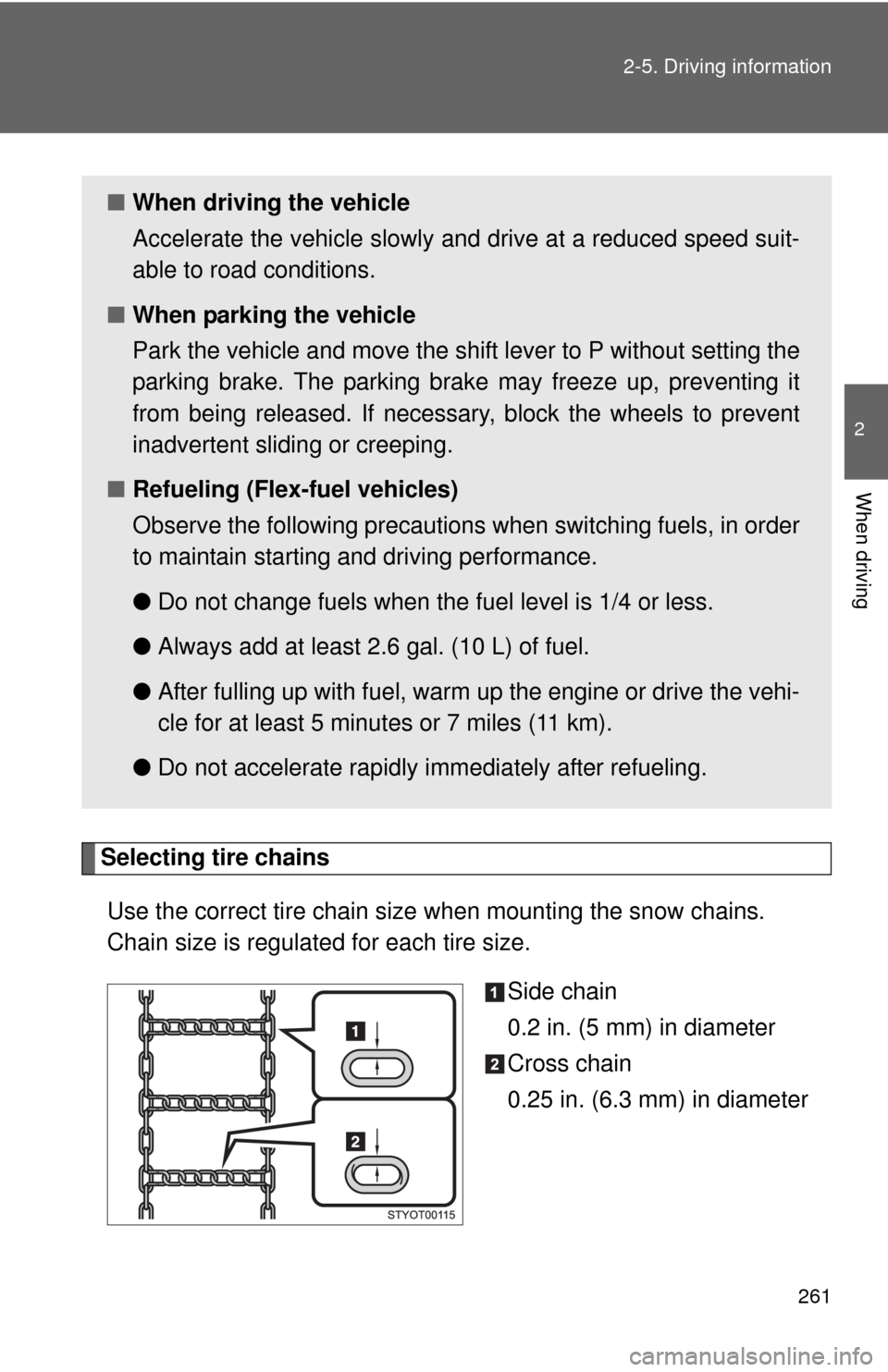
Selecting tire chains
Use the correct tire chain size when mounting the snow chains.
Chain size is regulated for each tire size. Side chain
0.2 in. (5 mm) in diameter
Cross chain
0.25 in. (6.3 mm) in diameter
■When driving the vehicle
Accelerate the vehicle slowly and drive at a reduced speed suit-
able to road conditions.
■ When parking the vehicle
Park the vehicle and move the shift lever to P without setting the
parking brake. The parking brak e may freeze up, preventing it
from being released. If necessary , block the wheels to prevent
inadvertent sliding or creeping.
■ Refueling (Flex-fuel vehicles)
Observe the following precautions when switching fuels, in order
to maintain starting and driving performance.
●Do not change fuels when the fuel level is 1/4 or less.
● Always add at least 2.6 gal. (10 L) of fuel.
● After fulling up with fuel, warm up the engine or drive the vehi-
cle for at least 5 minutes or 7 miles (11 km).
● Do not accelerate rapidly immediately after refueling.
Page 517 of 724
517
4
Maintenance and care
4-2. Maintenance
Maintenance requirements
■Repair and replacement
It is recommended that genuine Toyota parts be used for repair to ensure
performance of each system. If non-Toyota parts are used in replacement or
if a repair shop other than Toyota deal er performs repairs, confirm the war-
ranty coverage.
Flex-fuel vehicles: Flex-fuel vehicles use special parts made exclusively for
flex-fuel vehicles. When servicing or repairing your vehicles, use genuine
Toyota parts made exclusively for your flex-fuel vehicle.
To ensure safe and economical driv ing, day-to-day care and regular
maintenance are essential. It is the owner’s responsibility to perform
regular checks. Toyota recommen ds the following maintenance.
■General maintenance
Should be performed on a daily basis. This can be done by your-
self or by a Toyota dealer.
■ Scheduled maintenance
Should be performed at specified intervals according to the
maintenance schedule.
For details about maintenance items and schedules, refer to the
“Scheduled Maintenance Guide” or “Owner’s Manual Supplement”.
■Do-it-yourself maintenance
You can perform some maintenance procedures yourself.
Please be aware that do-it-yourself maintenance may affect war-
ranty coverage.
The use of Toyota Repair Manuals is recommended.
For details about warranty coverage, see the separate “Owner’s
Warranty Information Booklet”, “Owner’s Manual Supplement”.
Page 625 of 724
5
When trouble arises
625
5-2. Steps to take in an emergency
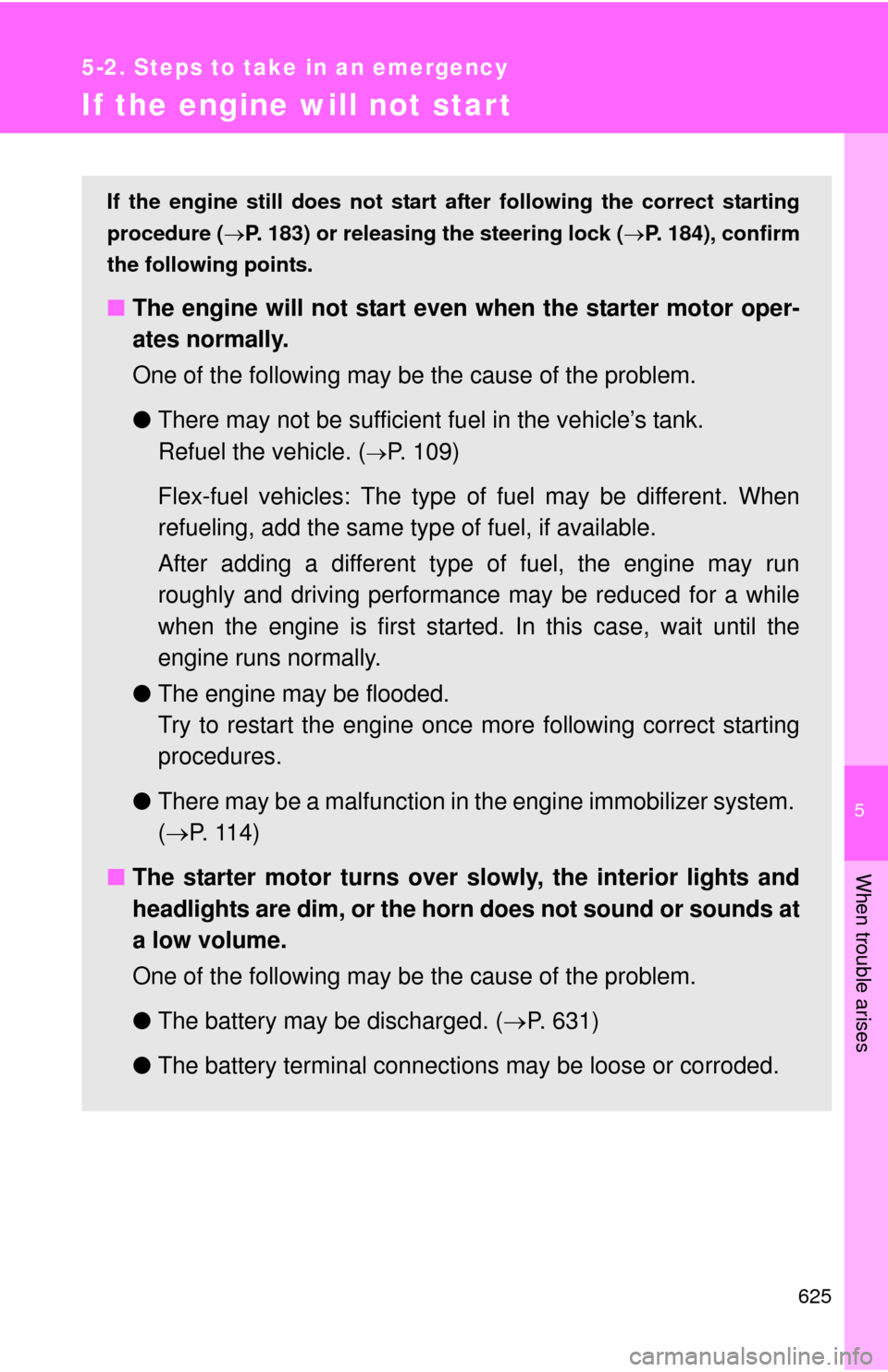
If the engine will not star t
If the engine still does not start after following the correct starting
procedure ( P. 183) or releasing the steering lock (P. 184), confirm
the following points.
■ The engine will not start even when the starter motor oper-
ates normally.
One of the following may be the cause of the problem.
●There may not be sufficient fuel in the vehicle’s tank.
Refuel the vehicle. (
P. 109)
Flex-fuel vehicles: The type of fuel may be different. When
refueling, add the same type of fuel, if available.
After adding a different type of fuel, the engine may run
roughly and driving performance may be reduced for a while
when the engine is first started. In this case, wait until the
engine runs normally.
● The engine may be flooded.
Try to restart the engine once more following correct starting
procedures.
● There may be a malfunction in the engine immobilizer system.
( P. 1 1 4 )
■ The starter motor turns over slowly, the interior lights and
headlights are dim, or the horn does not sound or sounds at
a low volume.
One of the following may be the cause of the problem.
●The battery may be discharged. ( P. 631)
● The battery terminal connec tions may be loose or corroded.
Page 632 of 724
632 5-2. Steps to take in an emergency
■Starting the engine when the battery is discharged
The engine cannot be started by push-starting.
■ Avoiding a discharged battery
●Turn off the headlights and the audio system while the engine is turned
off.
● Turn off any unnecessary electrical components when the vehicle is run-
ning at a low speed for an extended period, such as in heavy traffic, etc.
■ When the battery is removed or discharged
●The moon roof must be initialized. ( P. 106)
● Flex-fuel vehicles: The information recorded in the computer will be
cleared, which may cause the engine to run roughly and reduce driving
performance for a while when the engine is first started. In this case, wait
until the engine runs normally.
If the vehicle is running on E85, the engine may stall.
In this case, restart the engine, repeatedly if necessary.
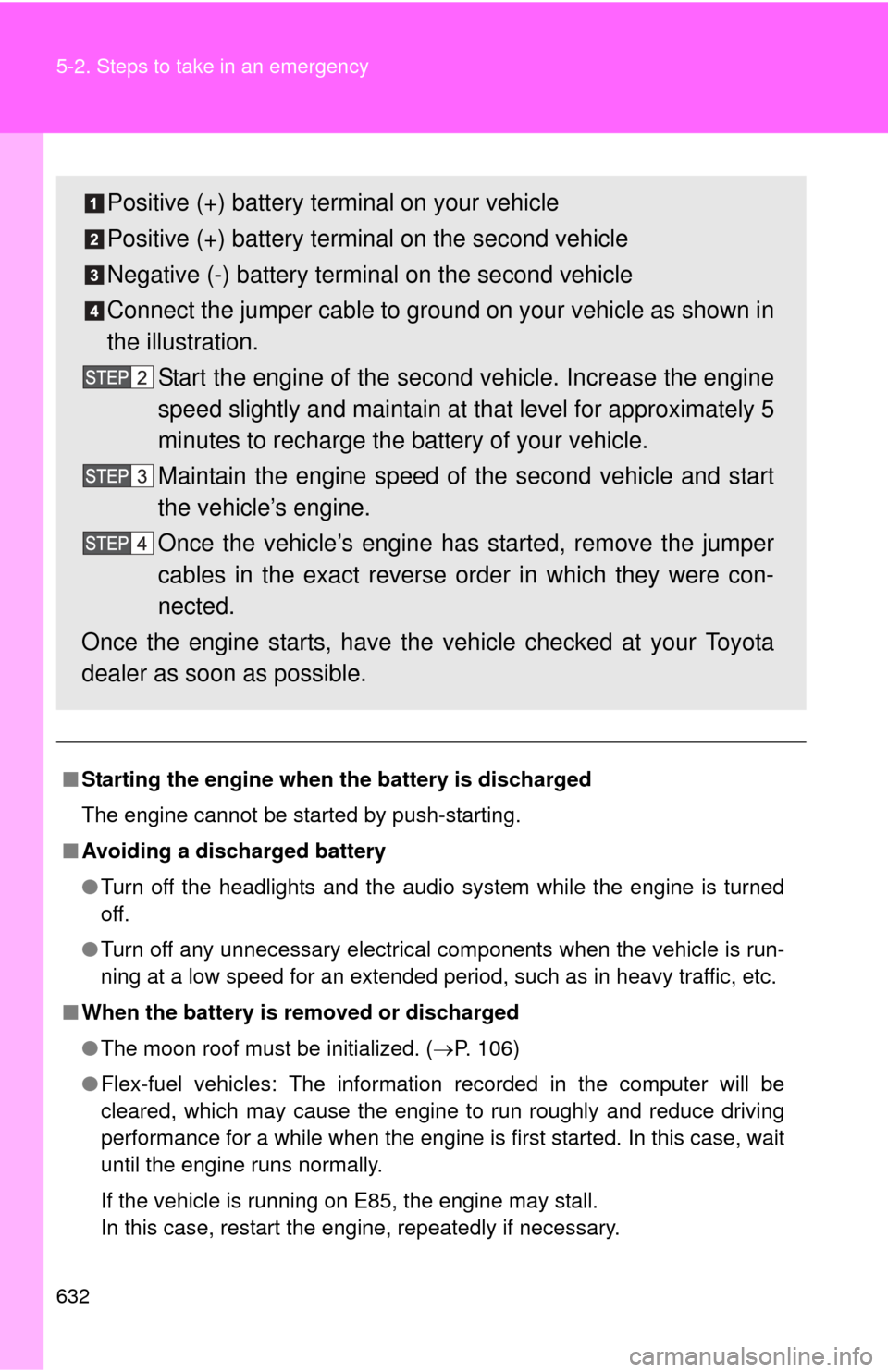
Positive (+) battery terminal on your vehicle
Positive (+) battery terminal on the second vehicle
Negative (-) battery terminal on the second vehicle
Connect the jumper cable to ground on your vehicle as shown in
the illustration.
Start the engine of the second vehicle. Increase the engine
speed slightly and maintain at that level for approximately 5
minutes to recharge the battery of your vehicle.
Maintain the engine speed of the second vehicle and start
the vehicle’s engine.
Once the vehicle’s engine has started, remove the jumper
cables in the exact reverse order in which they were con-
nected.
Once the engine starts, have the vehicle checked at your Toyota
dealer as soon as possible.
Page 656 of 724
656 6-1. Specifications
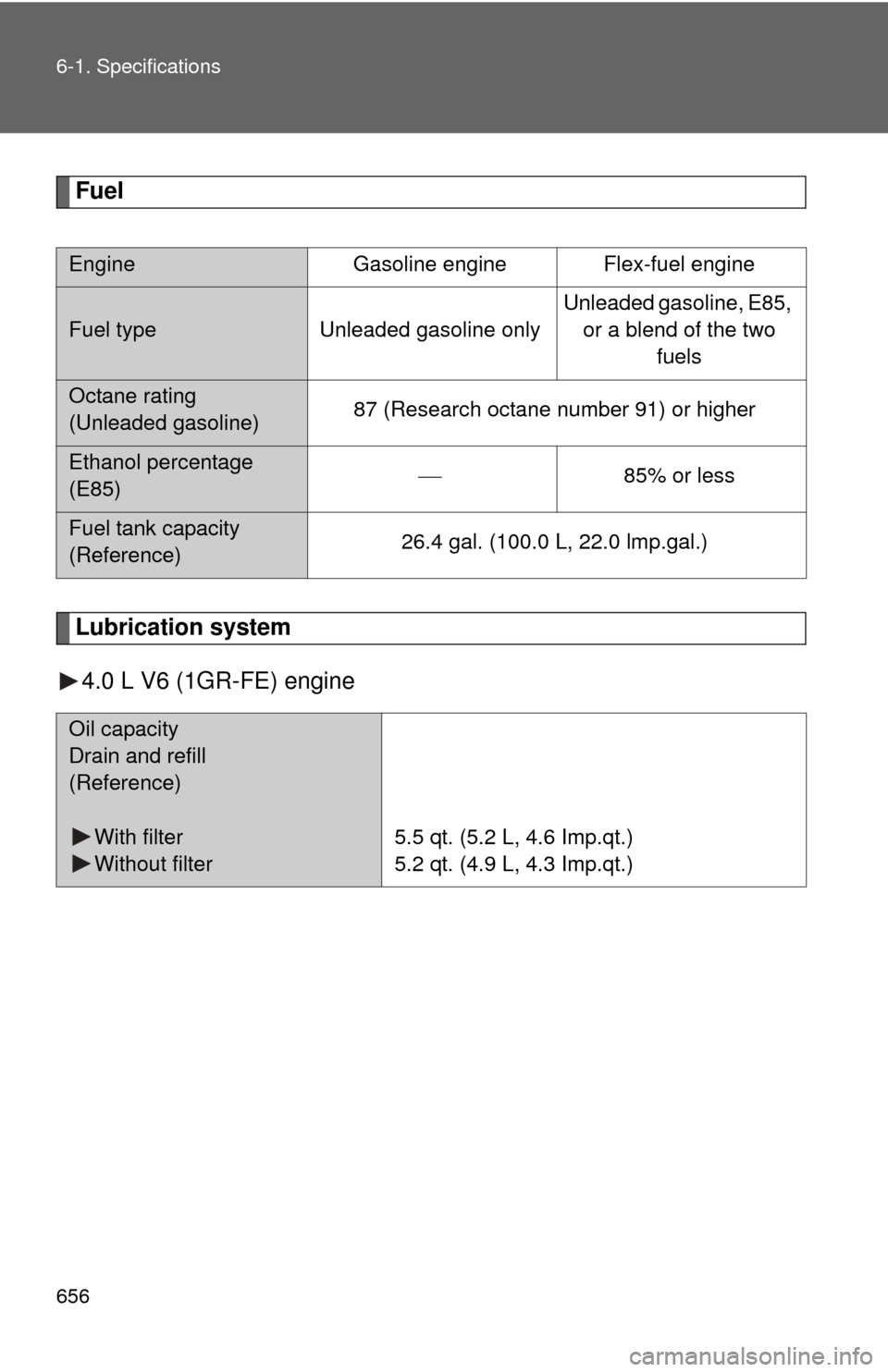
Fuel
Lubrication system4.0 L V6 (1GR-FE) engine
Engine Gasoline engine Flex-fuel engine
Fuel typeUnleaded gasoline onlyUnleaded gasoline, E85,
or a blend of the two fuels
Octane rating
(Unleaded gasoline) 87 (Research octane number 91) or higher
Ethanol percentage
(E85)
85% or less
Fuel tank capacity
(Reference) 26.4 gal. (100.0 L, 22.0 lmp.gal.)
Oil capacity
Drain and refill
(Reference)
With filter
Without filter 5.5 qt. (5.2 L, 4.6 Imp.qt.)
5.2 qt. (4.9 L, 4.3 Imp.qt.)
Page 669 of 724
669
6-1. Specifications
6
Vehicle specifications
Fuel infor mation
■Fuel tank opening fo r unleaded gasoline
To help prevent incorrect fueling, your Toyota has a fuel tank opening that
only accommodates the special nozzle on unleaded fuel pumps.
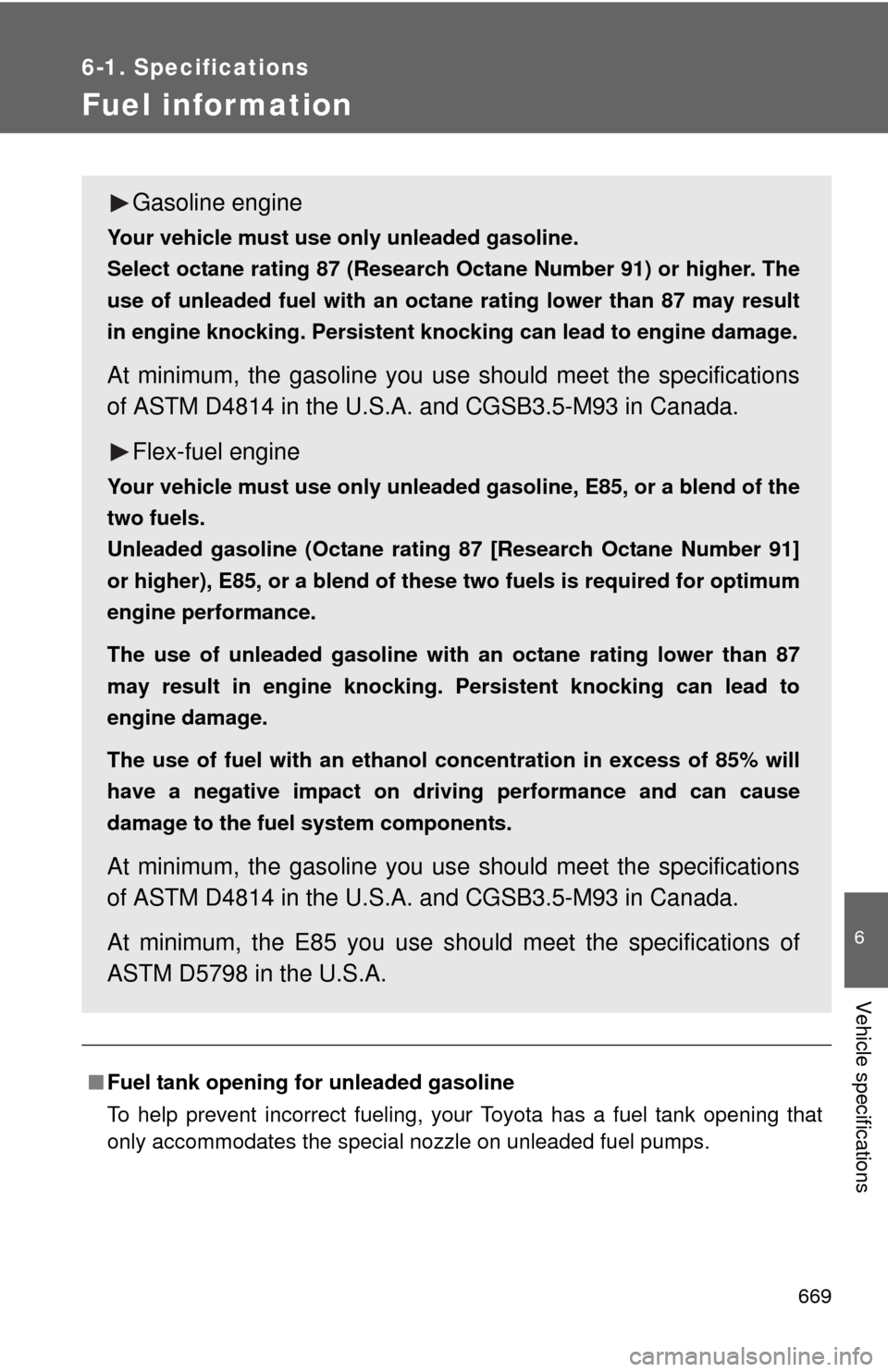
Gasoline engine
Your vehicle must use only unleaded gasoline.
Select octane rating 87 (Research Octane Number 91) or higher. The
use of unleaded fuel with an octane rating lower than 87 may result
in engine knocking. Persistent kno cking can lead to engine damage.
At minimum, the gasoline you use should meet the specifications
of ASTM D4814 in the U.S.A. and CGSB3.5-M93 in Canada.
Flex-fuel engine
Your vehicle must use only unleaded gasoline, E85, or a blend of the
two fuels.
Unleaded gasoline (Octane rating 87 [Research Octane Number 91]
or higher), E85, or a blend of these two fuels is required for optimum
engine performance.
The use of unleaded gasoline with an octane rating lower than 87
may result in engine knocking. Persistent knocking can lead to
engine damage.
The use of fuel with an ethanol concentration in excess of 85% will
have a negative impact on driv ing performance and can cause
damage to the fuel system components.
At minimum, the gasoline you us e should meet the specifications
of ASTM D4814 in the U.S.A. and CGSB3.5-M93 in Canada.
At minimum, the E85 you use should meet the specifications of
ASTM D5798 in the U.S.A.
Page 670 of 724
670 6-1. Specifications
■If your engine knocks
●Consult your Toyota dealer.
● You may occasionally notice light knocking for a short time while
accelerating or driving uphill. This is normal and there is no need for
concern.
■ Fuel quality
In very few cases, driveability problems may be caused by the brand of f\
uel
you are using. If driveability problems persist, try changing the brand of fuel.
If this does not correct the problem, consult your Toyota dealer.
■ Gasoline quality standards
●Automotive manufacturers in the US, Europe and Japan have developed
a specification for fuel quality called World-Wide Fuel Charter (WWFC)
that is expected to be applied worldwide.
● The WWFC consists of four categories that are based on required
emission levels. In the US, category 4 has been adopted.
● The WWFC improves air quality by lowering emissions in vehicle fleets,
and customer satisfaction through better performance.
■ E85 fuel (Flex-fuel vehicles)
●E85 fuel is a blend of 85% ethanol and 15% gasoline. However, E85
does not necessarily contain 85% ethanol. The ethanol content of E85 is
required by ASTM to be between 70% and 85%. For example, in cold
climates the ethanol content of E85 may be reduced during the winter
months to maintain cold weather starting performance.
● E85 has less energy per gallon than gasoline, so you will need to fill your
fuel tank more frequently when using E85.
● The number of fuel stations that sell E85 fuel is limited. For more
information about fueling stations, please refer to the U.S. Department of
Energy Web site.
http://www.eere.energy.gov/afdc/infrastructure/locator.html
■ Toyota recommends the use of gaso line containing detergent additives
● Toyota recommends the use of gasoline that contains detergent additives
to avoid build-up of engine deposits.
● All gasoline sold in the US contains detergent additives to clean and/or
keep clean intake systems.