transmission TOYOTA TUNDRA 2011 2.G Owner's Manual
[x] Cancel search | Manufacturer: TOYOTA, Model Year: 2011, Model line: TUNDRA, Model: TOYOTA TUNDRA 2011 2.GPages: 732, PDF Size: 16.65 MB
Page 591 of 732
5
When trouble arises
591
5-1. Essential information
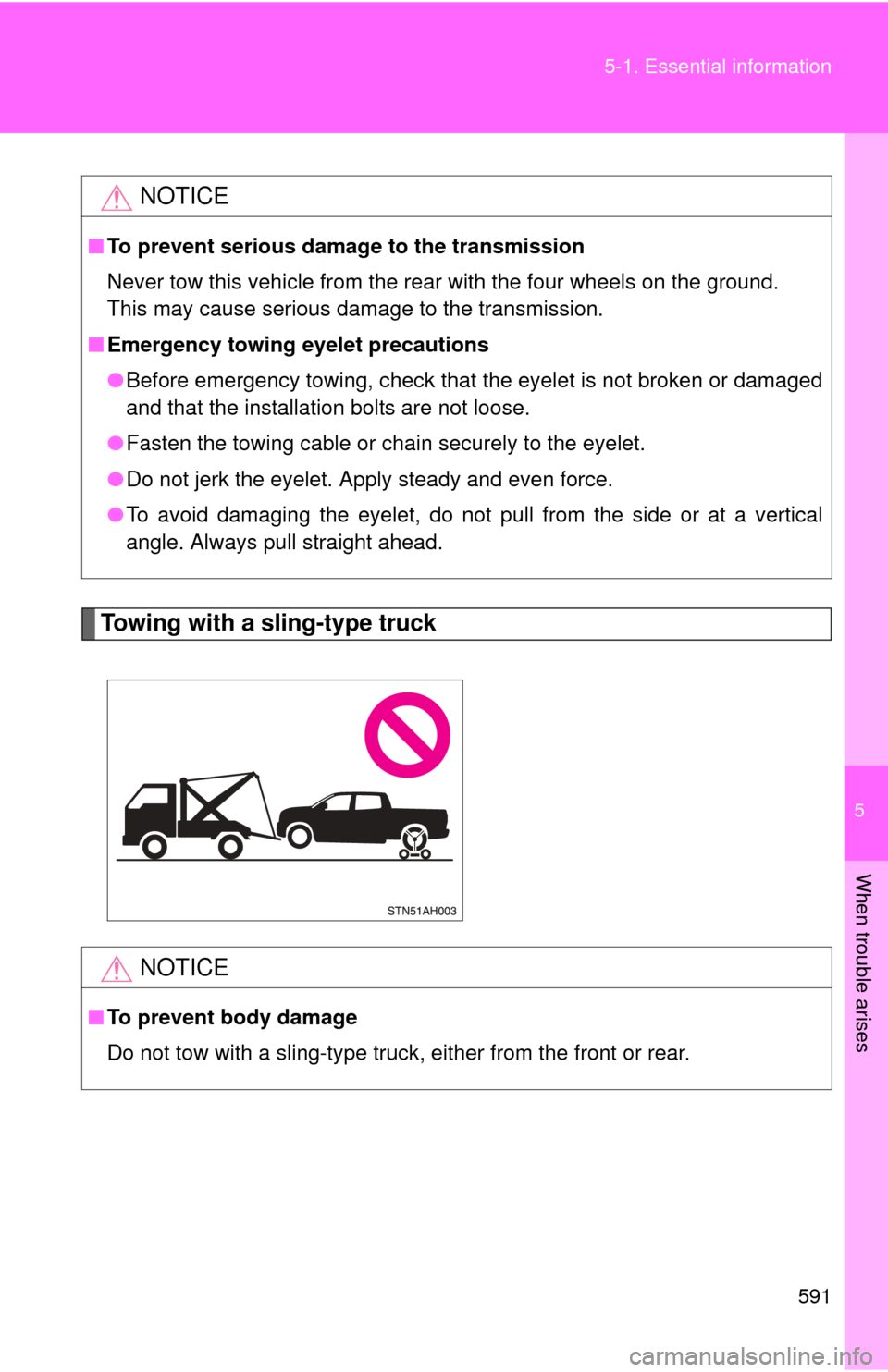
Towing with a sling-type truck
NOTICE
■
To prevent serious damage to the transmission
Never tow this vehicle from the rear with the four wheels on the ground.
This may cause serious damage to the transmission.
■ Emergency towing eyelet precautions
● Before emergency towing, check that the eyelet is not broken or damaged
and that the installation bolts are not loose.
● Fasten the towing cable or chain securely to the eyelet.
● Do not jerk the eyelet. Apply steady and even force.
● To avoid damaging the eyelet, do not pull from the side or at a vertical
angle. Always pull straight ahead.
NOTICE
■To prevent body damage
Do not tow with a sling-type truck, either from the front or rear.
Page 592 of 732
592 5-1. Essential information
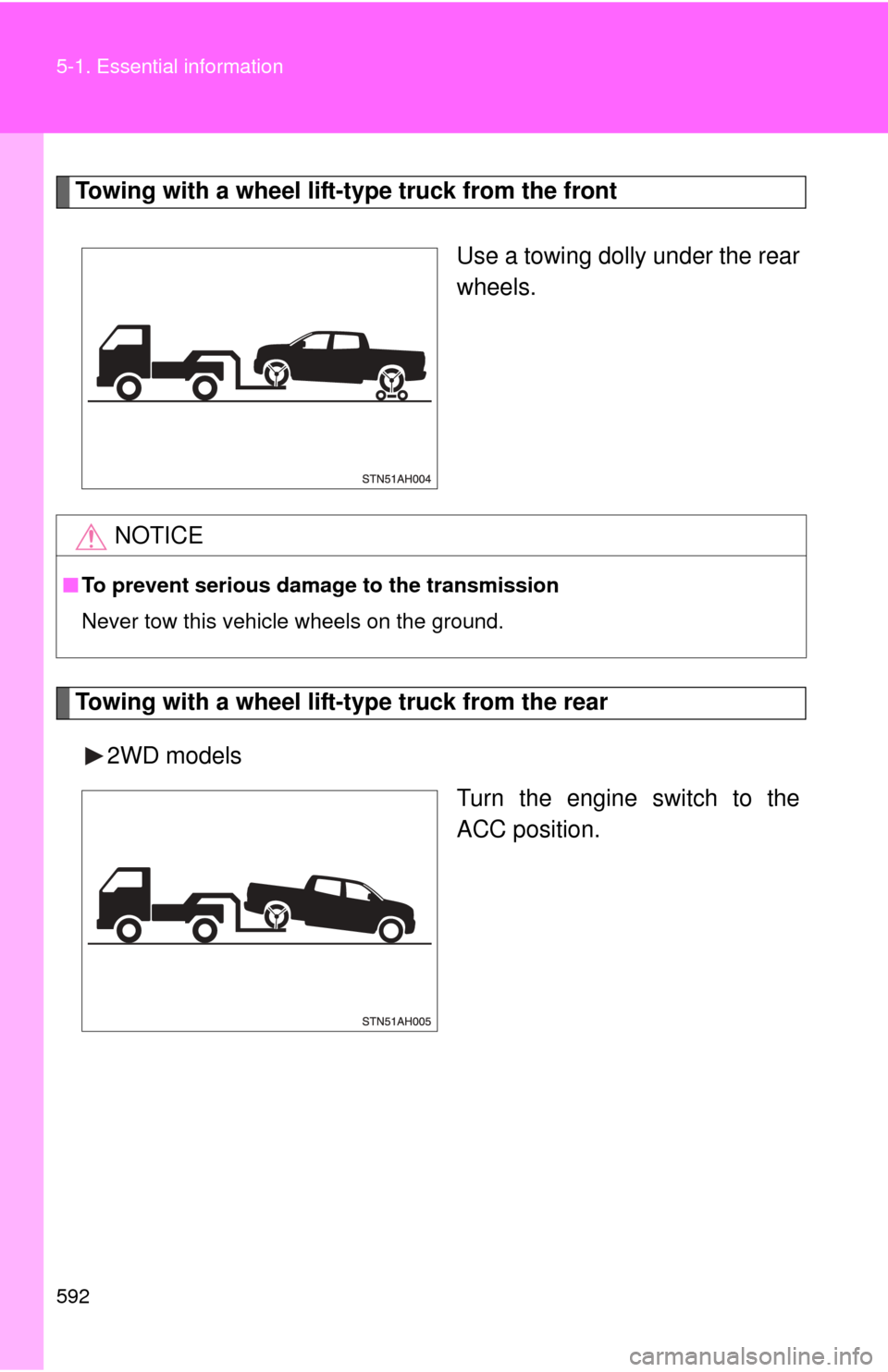
Towing with a wheel lift-type truck from the frontUse a towing dolly under the rear
wheels.
Towing with a wheel lift-type truck from the rear2WD models Turn the engine switch to the
ACC position.
NOTICE
■To prevent serious damage to the transmission
Never tow this vehicle wheels on the ground.
Page 595 of 732
5
When trouble arises
595
5-1. Essential information
If you think something is wrong
If you notice any of the following symptoms, your vehicle probably
needs adjustment or repair. Contact your Toyota dealer as soon as
possible.
■ Visible symptoms
●Fluid leaks under the vehicle
(Water dripping from the air cond itioning after use is normal.)
● Flat-looking tires or uneven tire wear
● Engine coolant temperature g auge needle continually points
higher than normal
● Voltmeter continually points higher or lower than normal
(if equipped)
● Engine oil pressure gauge continually points lower than nor-
mal (if equipped)
● Automatic transmission fluid temperature gauge needle con-
tinually points higher than normal (if equipped)
■ Audible symptoms
●Changes in exhaust sound
● Excessive tire squeal when cornering
● Strange noises related to the suspension system
● Pinging or other noises related to the engine
■ Operational symptoms
●Engine missing, stumbling or running rough
● Appreciable loss of power
● Vehicle pulls heavily to one side when braking
● Vehicle pulls heavily to one side when driving on a level road
● Loss of brake effectiveness, s pongy feeling, pedal almost
touches the floor
Page 597 of 732
5
When trouble arises
597
5-1. Essential information
Event data recorder
In a crash or a near car crash eventThe SRS airbag sensor assembly contains the EDR. In a crash or a
near car crash event, this device may record some or all of the follow-
ing information:
● Engine speed
● Whether the brake pedal was applied or not
● Vehicle speed
● To what extent the accelerator pedal was depressed
● Position of the transmission shift lever
● Whether the driver and front passenger wore seat belts or not
● Driver’s seat position
● SRS airbag deployment data
● SRS airbag system diagnostic data
● Front passenger’s occupant classification
The information above is intended to be used for the purpose of
improving vehicle safety performance. Unlike general data recorders,
the EDR does not record sound data such as conversation between
passengers.
Your vehicle has computers that monitor and control certain aspects
of your vehicle. These computers assi st in driving and maintaining
optimal vehicle performance.
Besides storing data useful for tr oubleshooting, there is an event
data recorder (EDR) that records data in a crash or a near car
crash event.
Page 600 of 732
600 5-2. Steps to take in an emergency
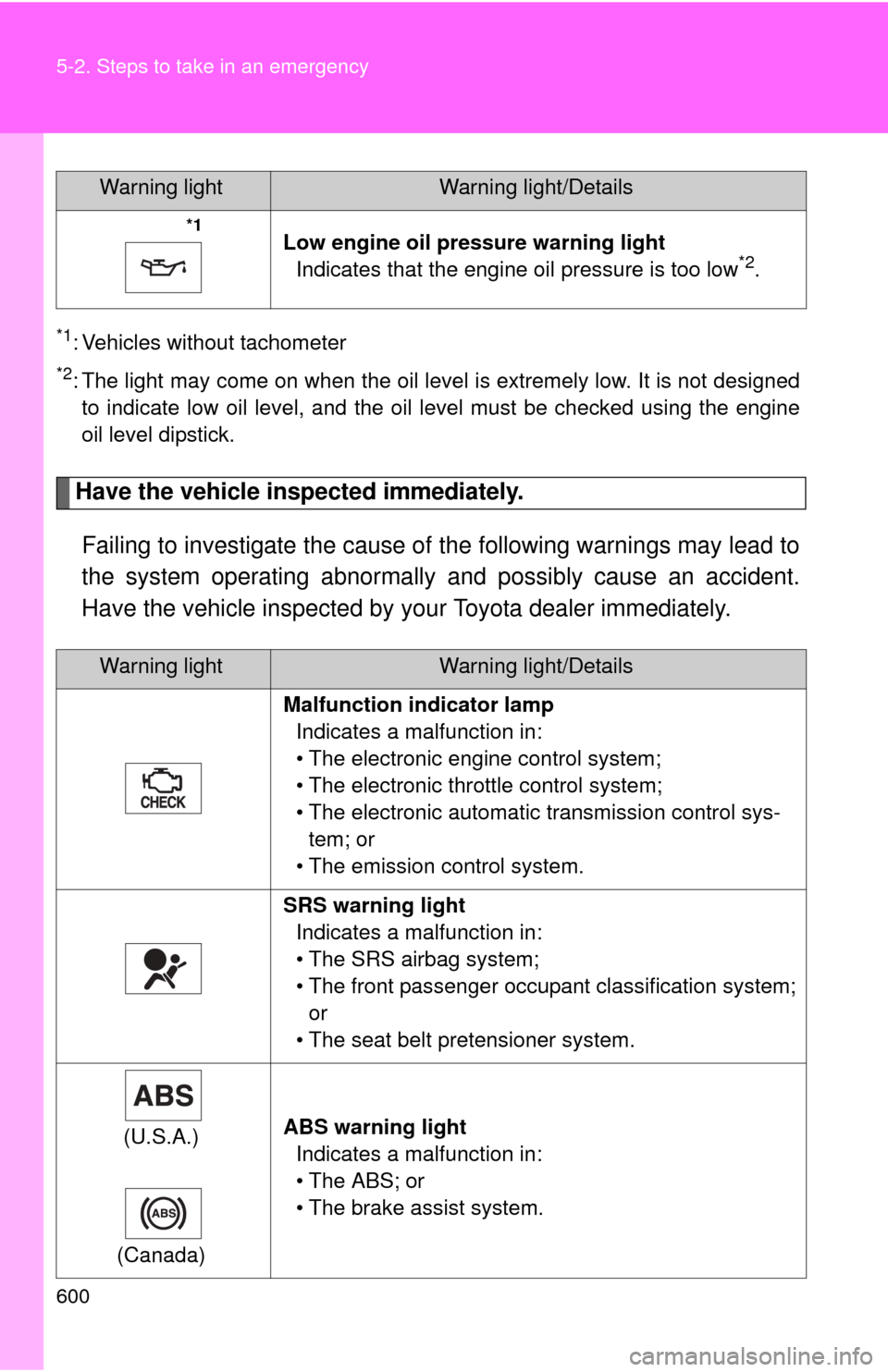
*1: Vehicles without tachometer
*2: The light may come on when the oil level is extremely low. It is not designedto indicate low oil level, and the oil level must be checked using the engine
oil level dipstick.
Have the vehicle inspected immediately.
Failing to investigate the cause of the following warnings may lead to
the system operating abnormally and possibly cause an accident.
Have the vehicle inspected by your Toyota dealer immediately.
Warning lightWarning light/Details
*1Low engine oil pressure warning light
Indicates that the engine oil pressure is too low*2.
Warning lightWarning light/Details
Malfunction indicator lamp Indicates a malfunction in:
• The electronic engine control system;
• The electronic throttle control system;
• The electronic automatic transmission control sys-tem; or
• The emission control system.
SRS warning light Indicates a malfunction in:
• The SRS airbag system;
• The front passenger occupant classification system; or
• The seat belt pretensioner system.
(U.S.A.)
(Canada) ABS warning light
Indicates a malfunction in:
• The ABS; or
• The brake assist system.
Page 601 of 732
5
When trouble arises
601
5-2. Steps to take in an emergency
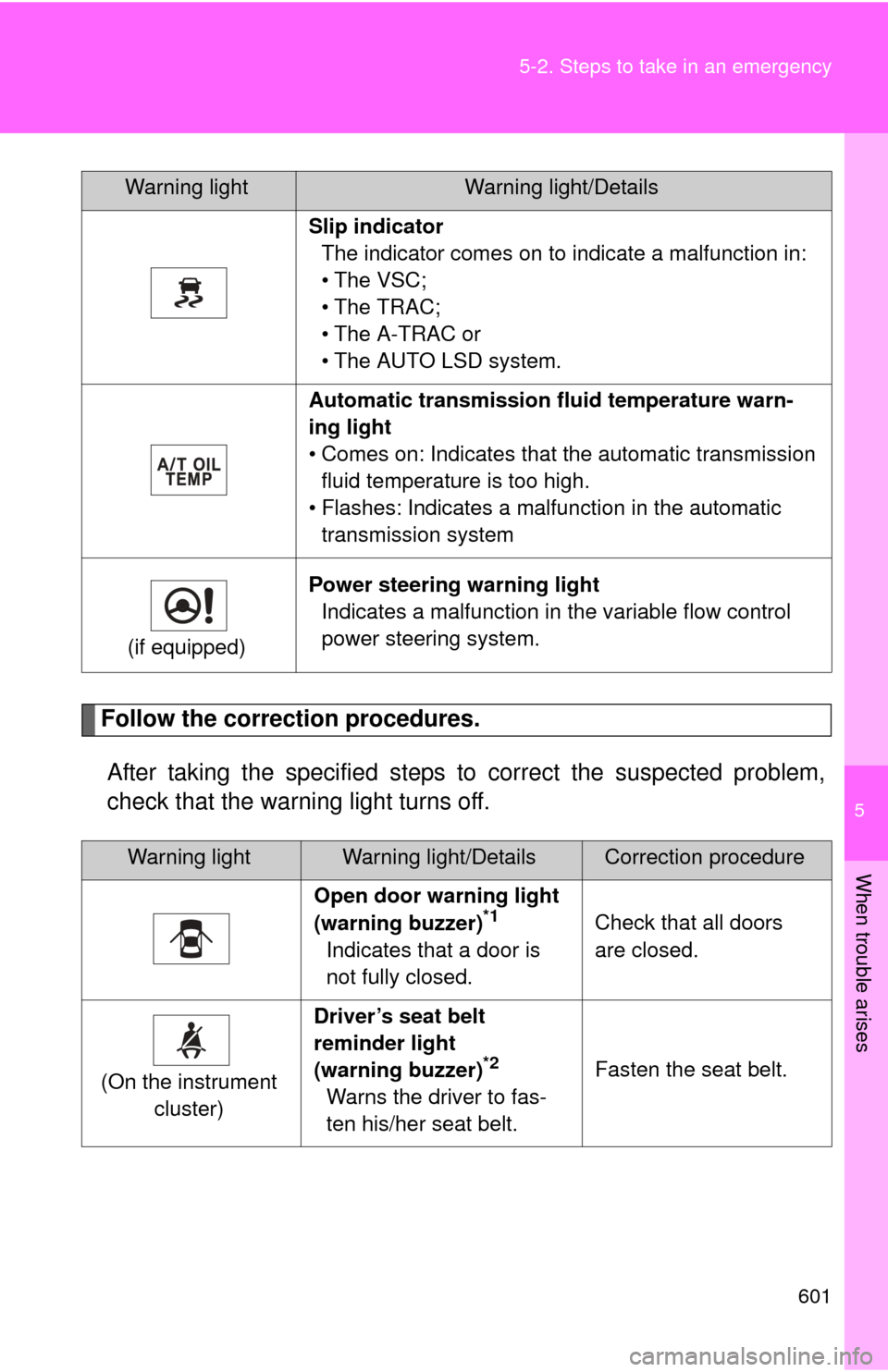
Follow the correction procedures.
After taking the specified steps to correct the suspected problem,
check that the warning light turns off.
Slip indicator The indicator comes on to indicate a malfunction in:
• The VSC;
• The TRAC;
• The A-TRAC or
• The AUTO LSD system.
Automatic transmission fluid temperature warn-
ing light
• Comes on: Indicates that the automatic transmission fluid temperature is too high.
• Flashes: Indicates a malfunction in the automatic transmission system
(if equipped) Power steering warning light
Indicates a malfunction in the variable flow control
power steering system.
Warning lightWarning light/DetailsCorrection procedure
Open door warning light
(warning buzzer)
*1
Indicates that a door is
not fully closed. Check that all doors
are closed.
(On the instrument cluster) Driver’s seat belt
reminder light
(warning buzzer)
*2
Warns the driver to fas-
ten his/her seat belt.
Fasten the seat belt.
Warning lightWarning light/Details
Page 608 of 732
608
5-2. Steps to take in an emergency
If a war ning message is displayed (vehicles with multi-infor mation display)
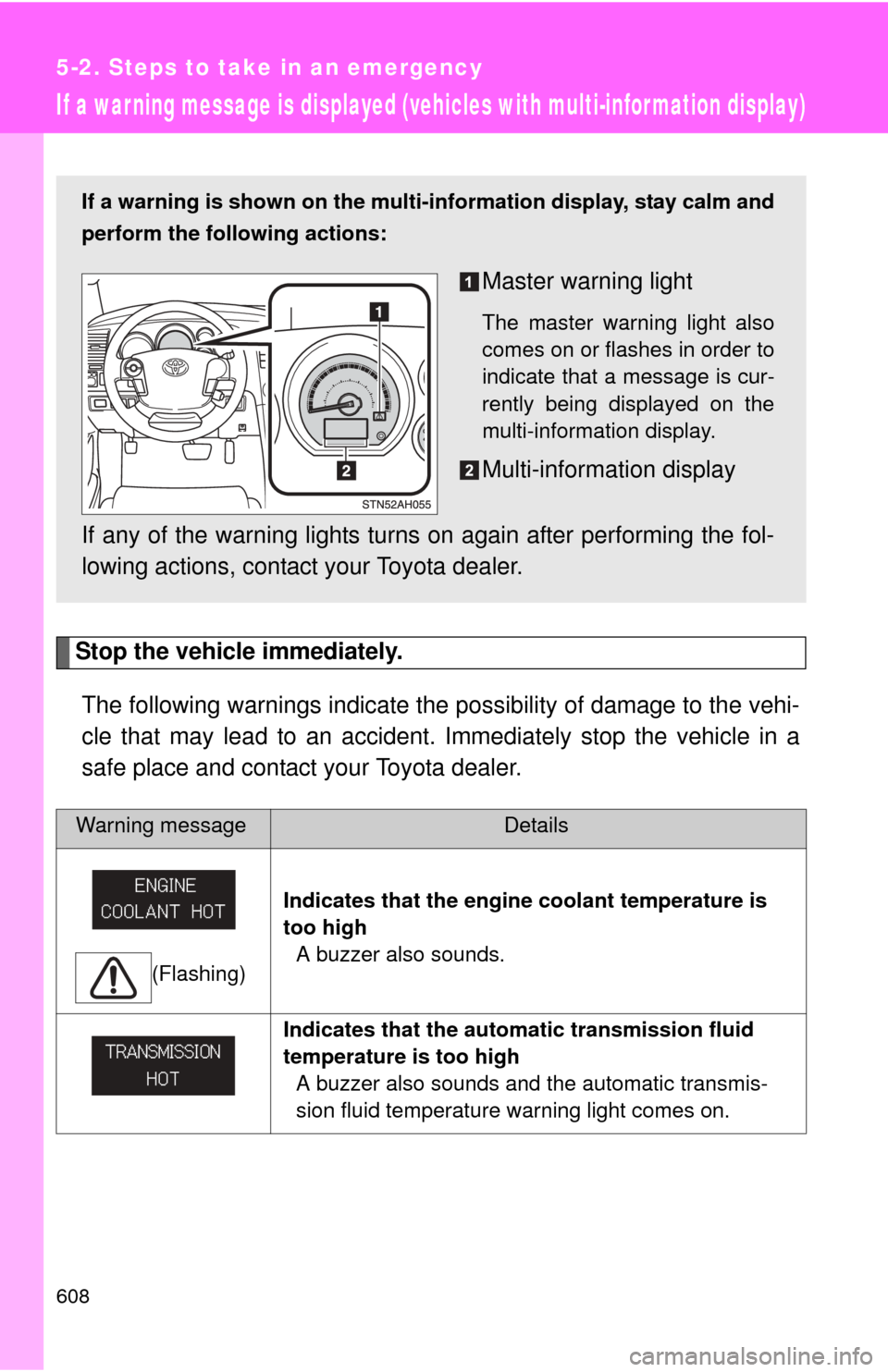
Stop the vehicle immediately.The following warnings indicate the possibility of damage to the vehi-
cle that may lead to an accident. Immediately stop the vehicle in a
safe place and contact your Toyota dealer.
Warning messageDetails
(Flashing) Indicates that the engine coolant temperature is
too high
A buzzer also sounds.
Indicates that the automatic transmission fluid
temperature is too high A buzzer also sounds and the automatic transmis-
sion fluid temperature warning light comes on.
If a warning is shown on the multi- information display, stay calm and
perform the following actions:
Master warning light
The master warning light also
comes on or flashes in order to
indicate that a message is cur-
rently being displayed on the
multi-information display.
Multi-information display
If any of the warning lights turns on again after performing the fol-
lowing actions, contact your Toyota dealer.
Page 640 of 732
640
5-2. Steps to take in an emergency
If the vehicle becomes stuck
CAUTION
■When attempting to free a stuck vehicle
If you choose to rock the vehicle back and forth to free it, make sure the sur-
rounding area is clear, to avoid striki ng other vehicles, objects or persons.
The vehicle may also lunge forward or lunge back suddenly as it becomes
free. Use extreme caution.
■ When shifting the shift lever
Be careful not to shift the shift lever with the accelerator pedal depressed.
This may lead to unexpected rapid acceleration of the vehicle that may
cause an accident and result in death or serious injury.
NOTICE
■To avoid damaging the transmission and other components
●Avoid spinning the wheels and do not rev the engine.
● If the vehicle remains stuck after trying these procedures, the vehicle may
require towing to be freed.
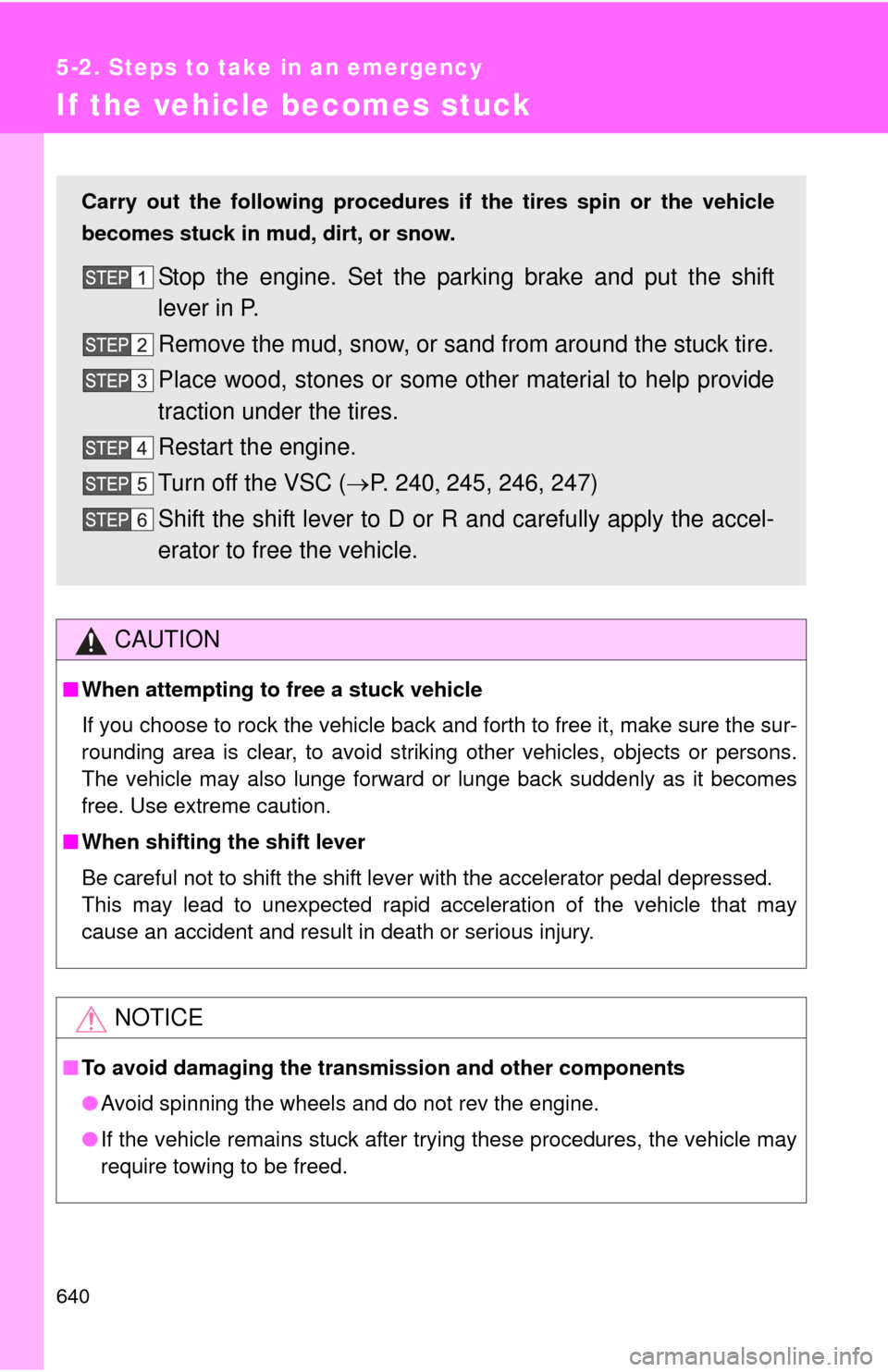
Carry out the following procedures if the tires spin or the vehicle
becomes stuck in mud, dirt, or snow.
Stop the engine. Set the parking brake and put the shift
lever in P.
Remove the mud, snow, or sand from around the stuck tire.
Place wood, stones or some other material to help provide
traction under the tires.
Restart the engine.
Turn off the VSC ( P. 2 4 0 245, 246, 247)
Shift the shift lever to D or R and carefully apply the accel-
erator to free the vehicle.
Page 663 of 732
663
6-1. Specifications
6
Vehicle specifications
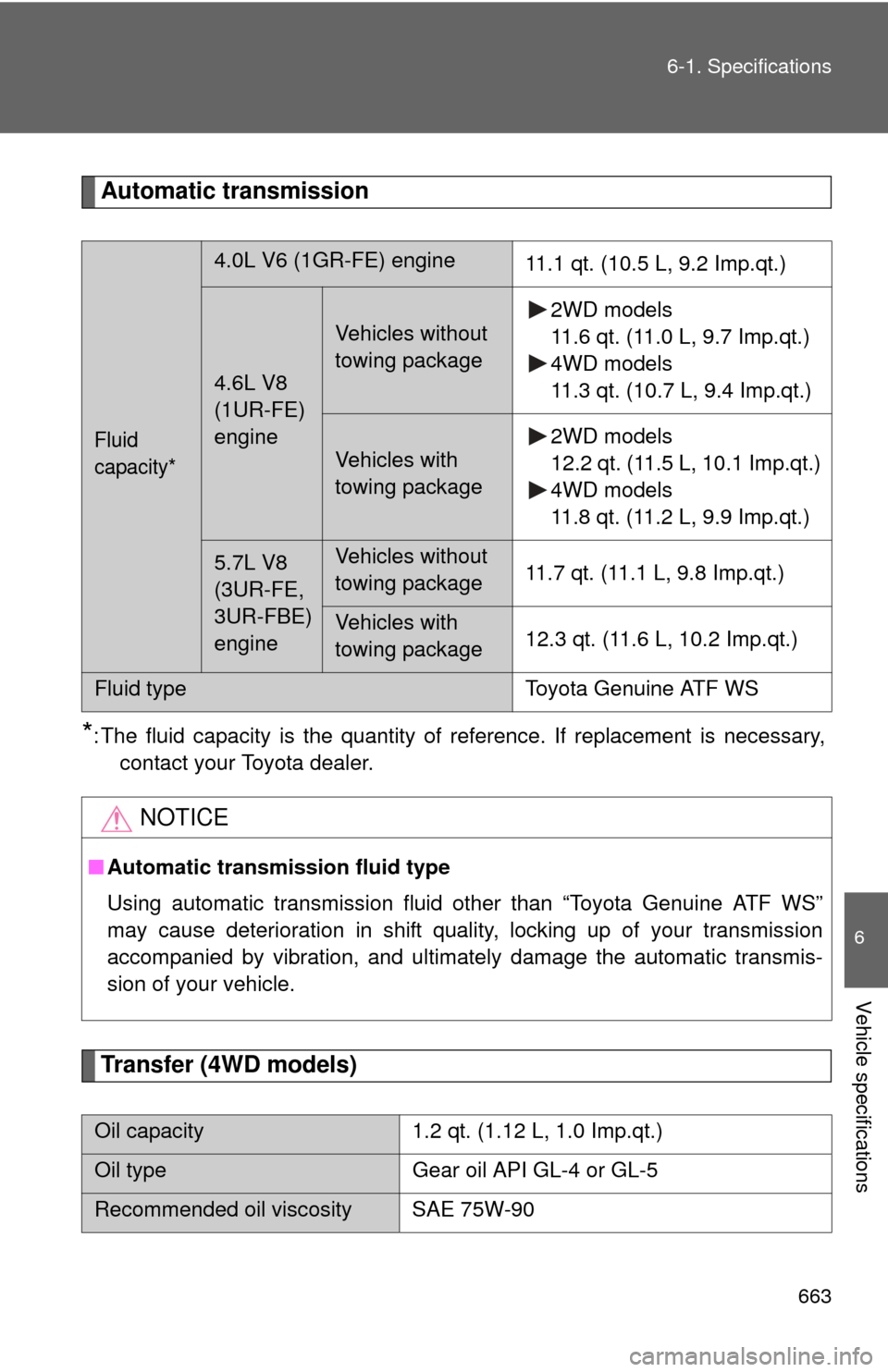
Automatic transmission
*: The fluid capacity is the quantity of reference. If replacement is necessary,
contact your Toyota dealer.
Transfer (4WD models)
Fluid
capacity*
4.0L V6 (1GR-FE) engine 11.1 qt. (10.5 L, 9.2 Imp.qt.)
4.6L V8
(1UR-FE)
engine
Vehicles without
towing package2WD models
11.6 qt. (11.0 L, 9.7 Imp.qt.)
4WD models
11.3 qt. (10.7 L, 9.4 Imp.qt.)
Vehicles with
towing package2WD models
12.2 qt. (11.5 L, 10.1 Imp.qt.)
4WD models
11.8 qt. (11.2 L, 9.9 Imp.qt.)
5.7L V8
(3UR-FE,
3UR-FBE)
engineVehicles without
towing package
11.7 qt. (11.1 L, 9.8 Imp.qt.)
Vehicles with
towing package12.3 qt. (11.6 L, 10.2 Imp.qt.)
Fluid type
Toyota Genuine ATF WS
NOTICE
■Automatic transmission fluid type
Using automatic transmission fluid other than “Toyota Genuine ATF WS”
may cause deterioration in shift quality, locking up of your transmission
accompanied by vibration, and ultimately damage the automatic transmis-
sion of your vehicle.
Oil capacity 1.2 qt. (1.12 L, 1.0 Imp.qt.)
Oil typeGear oil API GL-4 or GL-5
Recommended oil viscosity SAE 75W-90
Page 664 of 732
664 6-1. Specifications
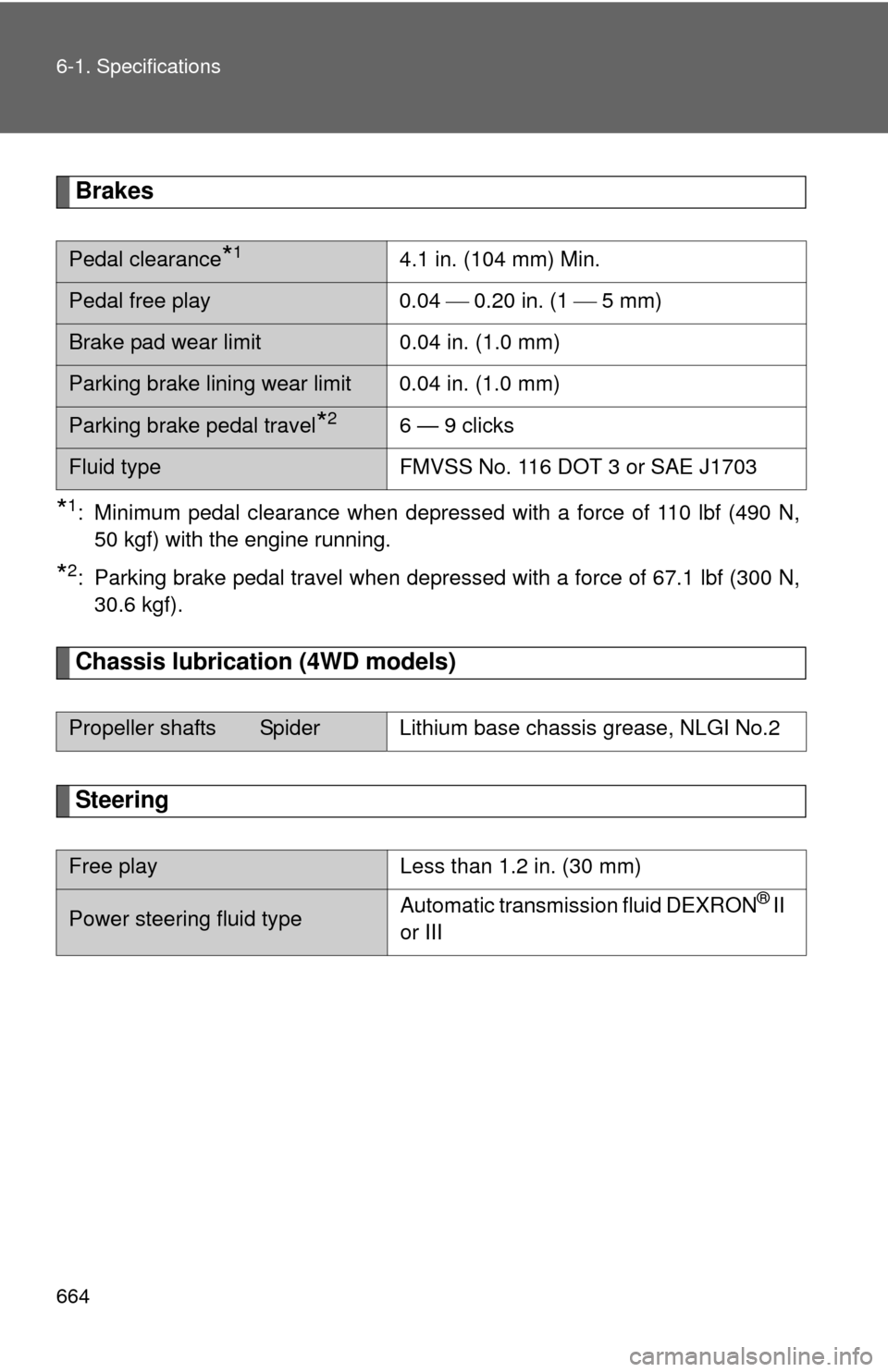
Brakes
*1: Minimum pedal clearance when depressed with a force of 110 lbf (490 N,50 kgf) with the engine running.
*2: Parking brake pedal travel when depressed with a force of 67.1 lbf (300 N,30.6 kgf).
Chassis lubrication (4WD models)
Steering
Pedal clearance*14.1 in. (104 mm) Min.
Pedal free play 0.04 0.20 in. (1 5 mm)
Brake pad wear limit 0.04 in. (1.0 mm)
Parking brake lining wear limit 0.04 in. (1.0 mm)
Parking brake pedal travel*26 — 9 clicks
Fluid type FMVSS No. 116 DOT 3 or SAE J1703
Propeller shafts Spider Lithium base chassis grease, NLGI No.2
Free playLess than 1.2 in. (30 mm)
Power steering fluid type Automatic transmission fluid DEXRON® II
or III