Engine TOYOTA TUNDRA 2012 2.G Owner's Manual
[x] Cancel search | Manufacturer: TOYOTA, Model Year: 2012, Model line: TUNDRA, Model: TOYOTA TUNDRA 2012 2.GPages: 744, PDF Size: 15.3 MB
Page 107 of 744
107
1-4. Opening and closing the windows and moon roof
1
Before driving
■
If the moon roof cannot be closed automatically
Keep the switch depressed.
■ Sunshade
The sunshade can be opened and closed manually. However, the sunshade
will open automatically when the moon roof is opened.
■ Moon roof open reminder function
An alarm will sound when the driver’s door is opened with the moon roof not
fully closed and the engine switch off.
■ When the battery is disconnected
The moon roof must be initialized in order to ensure proper operation.
Push and hold the switch toward the UP (tilt up) side or (sliding
close) side.
After the moon roof will tilt up and down, release the switch.
To ensure the initialization is complete, make sure automatic open-
ing and closing functions work properly.
Page 110 of 744
110
1-5. Refueling
Opening the fuel tank cap
Perform the following steps to open the fuel tank cap.
■Before refueling the vehicle
Turn the engine switch off and ensure that all the doors and win-
dows are closed.
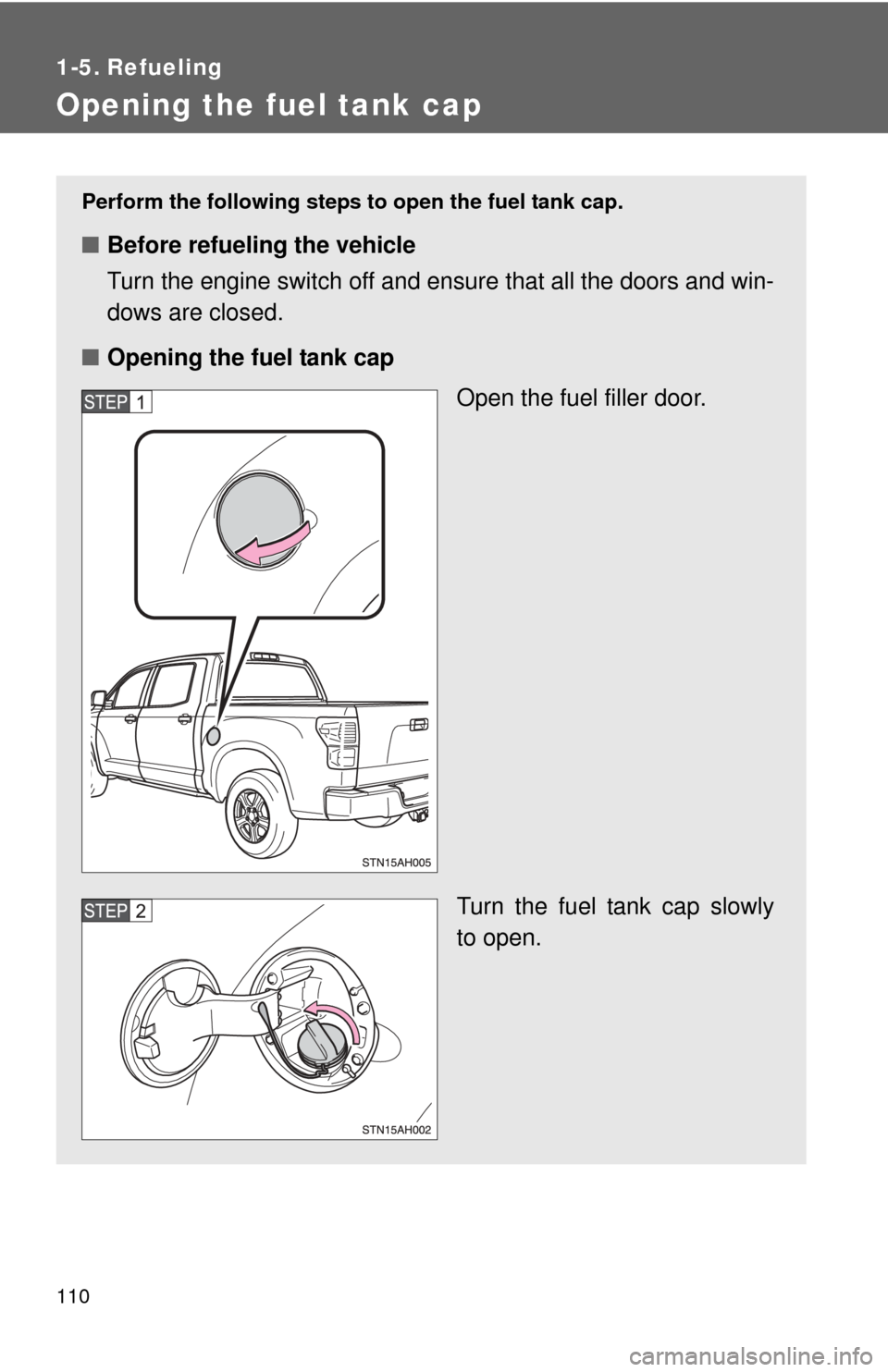
■ Opening the fuel tank cap
Open the fuel filler door.
Turn the fuel tank cap slowly
to open.
Page 111 of 744
111
1-5. Refueling
1
Before driving
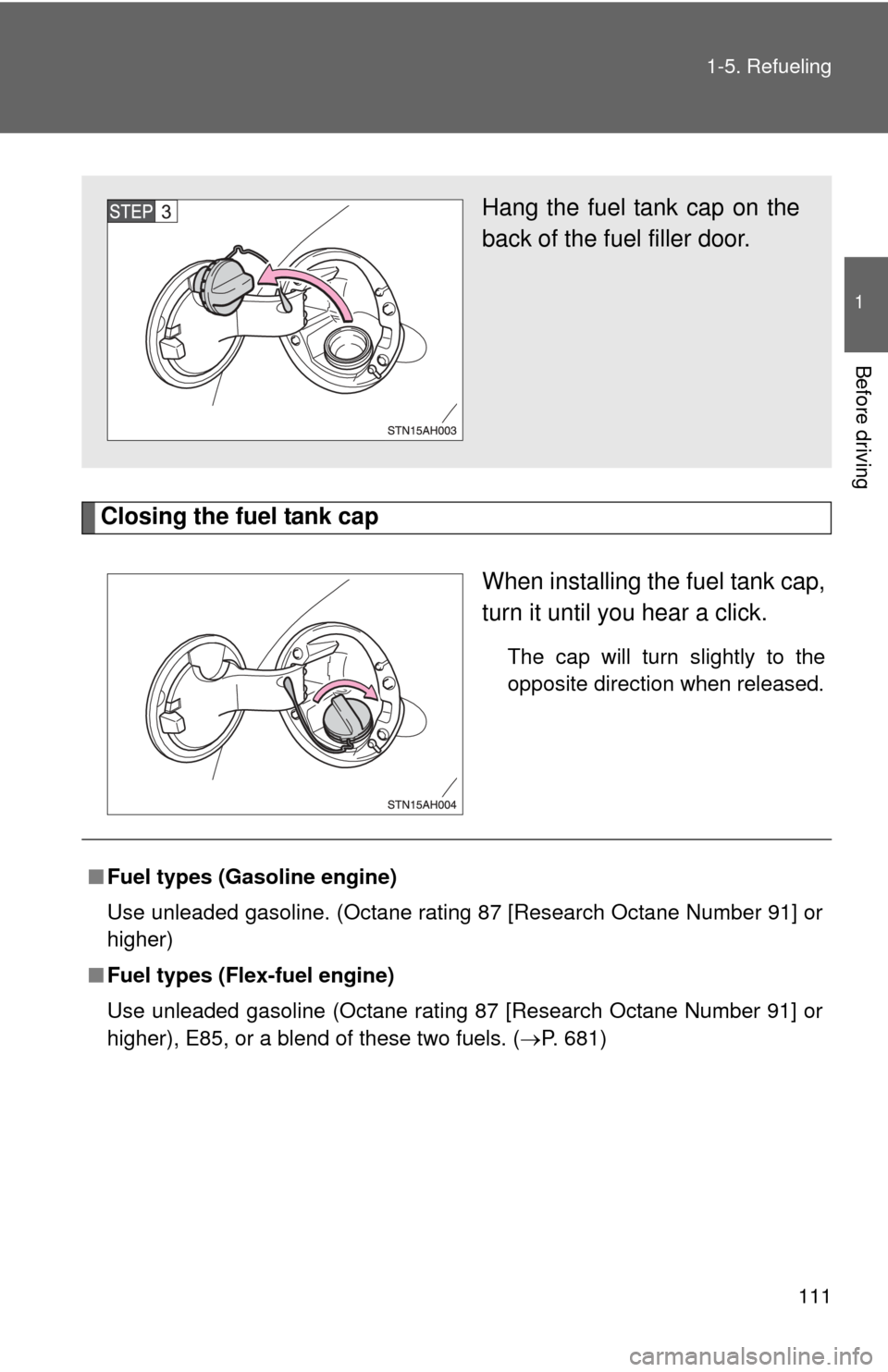
Closing the fuel tank cap
When installing the fuel tank cap,
turn it until you hear a click.
The cap will turn slightly to the
opposite direction when released.
Hang the fuel tank cap on the
back of the fuel filler door.
■Fuel types (Gasoline engine)
Use unleaded gasoline. (Octane rating 87 [Research Octane Number 91] or
higher)
■ Fuel types (Flex-fuel engine)
Use unleaded gasoline (Octane rating 87 [Research Octane Number 91] or
higher), E85, or a blend of these two fuels. ( P. 681)
Page 112 of 744
112 1-5. Refueling
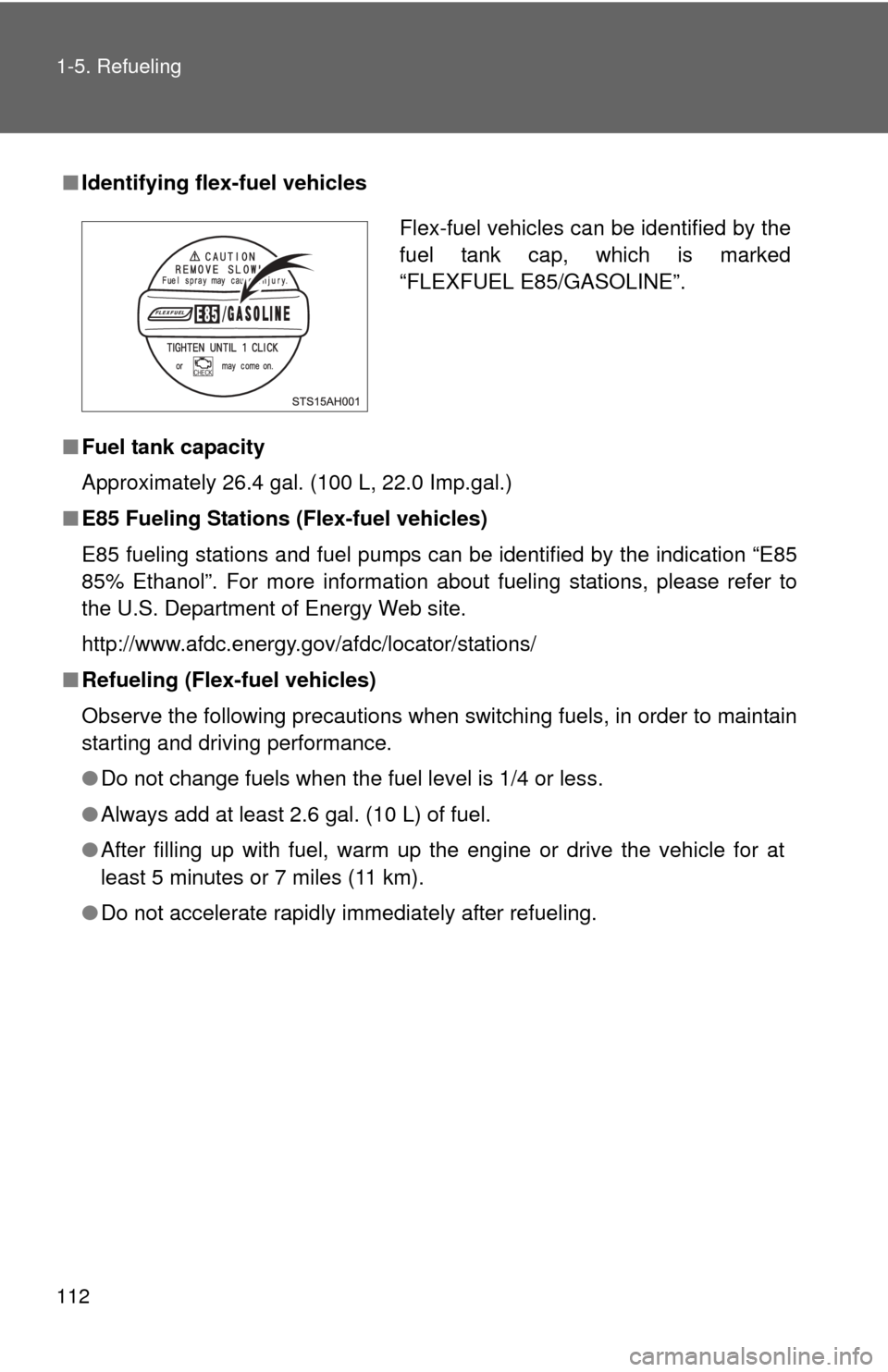
■Identifying flex-fuel vehicles
■ Fuel tank capacity
Approximately 26.4 gal. (100 L, 22.0 Imp.gal.)
■ E85 Fueling Stations (Flex-fuel vehicles)
E85 fueling stations and fuel pumps can be identified by the indication “E85
85% Ethanol”. For more information about fueling stations, please refer to
the U.S. Department of Energy Web site.
http://www.afdc.energy.gov/afdc/locator/stations/
■ Refueling (Flex-fuel vehicles)
Observe the following precautions when switching fuels, in order to maintain
starting and driving performance.
●Do not change fuels when the fuel level is 1/4 or less.
● Always add at least 2.6 gal. (10 L) of fuel.
● After filling up with fuel, warm up the engine or drive the vehicle for at
least 5 minutes or 7 miles (11 km).
● Do not accelerate rapidly immediately after refueling.
Flex-fuel vehicles can be identified by the
fuel tank cap, which is marked
“FLEXFUEL E85/GASOLINE”.
Page 114 of 744

114 1-5. Refueling
NOTICE
■Refueling
Do not spill fuel during refueling.
Doing so may damage the vehicle, such as causing the exhaust systems to
operate abnormally or damaging fuel s ystem components or the vehicle’s
painted surface.
■ To prevent damage to the fuel filler door
Do not apply excessive force.
■ E85 fuel
E85 fuel can be used only in flex-fuel vehicles. Do not add E85 fuel to a gas-
oline-engine vehicle.
Filling a gasoline-engine vehicle with E85 will have a negative impact on
starting and driving performance and will cause damage to the fuel system
components.
Page 115 of 744
115
1
Before driving
1-6. Theft deterrent system
Engine immobilizer system
: If equipped
■System maintenance
The vehicle has a maintenance-free type engine immobilizer system.
■ Conditions that may cause the system to malfunction
● If the key is in contact with a metallic object
● If the key is in close proximity to or touching a key to the security system
(key with a built-in transponder chip) of another vehicle
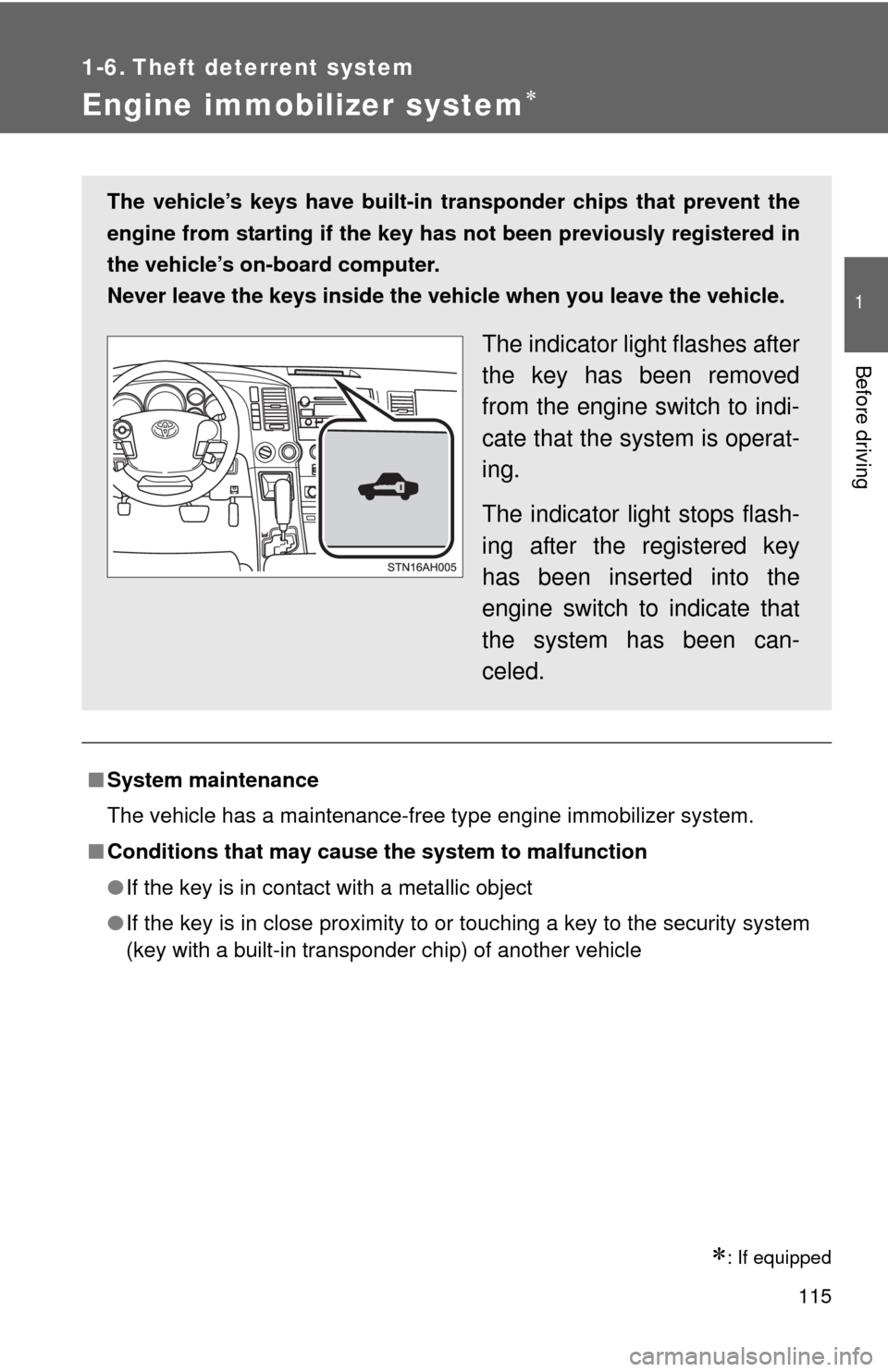
The vehicle’s keys have built-in tr ansponder chips that prevent the
engine from starting if the key has not been previously registered in
the vehicle’s on-board computer.
Never leave the keys inside the vehicle when you leave the vehicle.
The indicator light flashes after
the key has been removed
from the engine switch to indi-
cate that the system is operat-
ing.
The indicator light stops flash-
ing after the registered key
has been inserted into the
engine switch to indicate that
the system has been can-
celed.
Page 117 of 744
117
1
1-6. Theft deterrent system
Before driving
Alarm
: If equipped
The system sounds the alarm and flashes lights when forcible entry
is detected.
■ Triggering of the alarm
The alarm is triggered in the fo llowing situations when the alarm
is set.
● A locked door is unlocked or opened in any way other than
using the wireless remote control door lock function or key.
(The doors will lock again automatically.)
● The hood is opened.
● Vehicles with the glass breakage sensor (if equipped): The
side windows are tapped or broken.
● The battery is reconnected.
■ Setting the alarm system
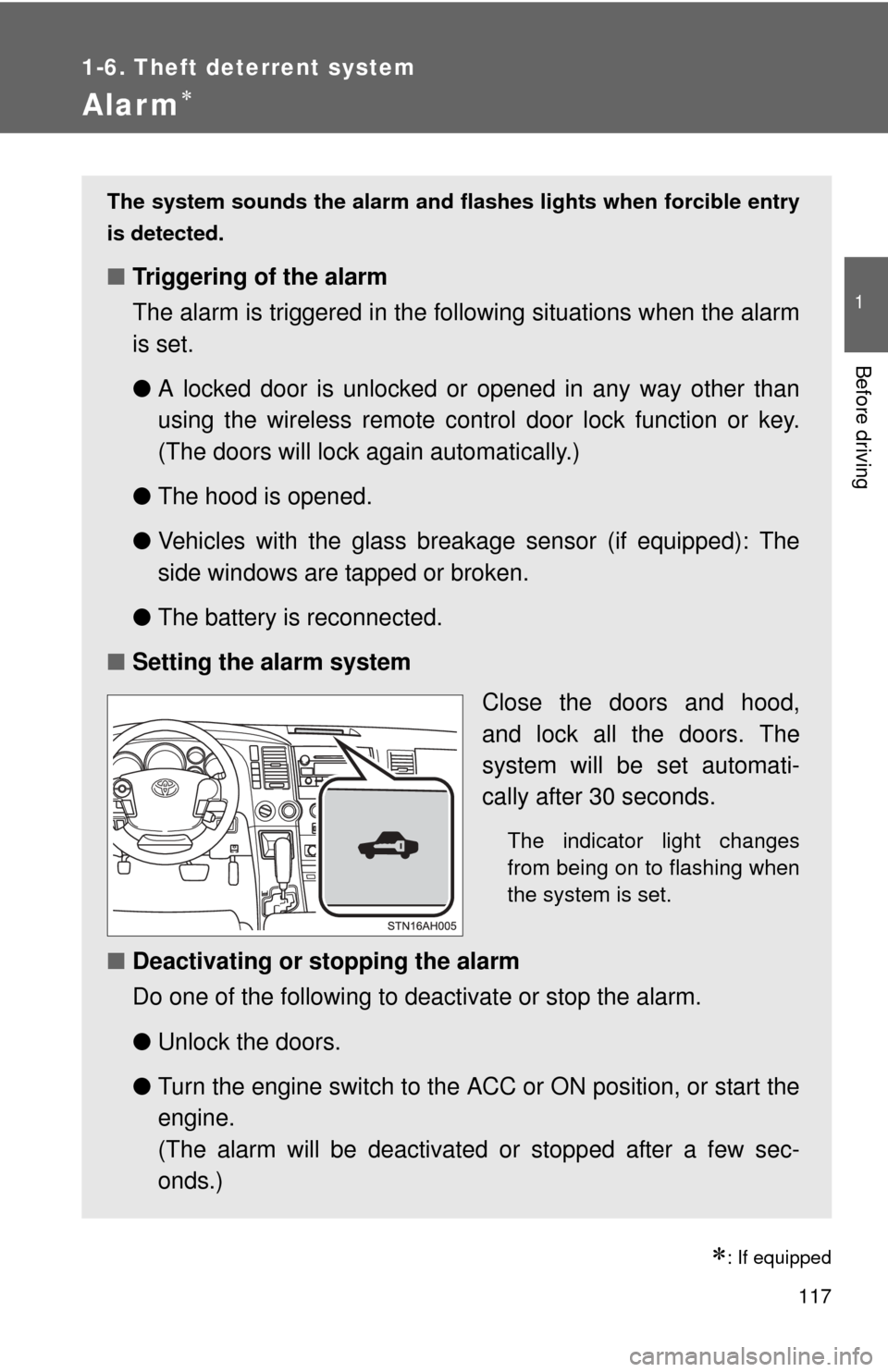
Close the doors and hood,
and lock all the doors. The
system will be set automati-
cally after 30 seconds.
The indicator light changes
from being on to flashing when
the system is set.
■Deactivating or stopping the alarm
Do one of the following to deactivate or stop the alarm.
●Unlock the doors.
● Turn the engine switch to the ACC or ON position, or start the
engine.
(The alarm will be deactivated or stopped after a few sec-
onds.)
Page 134 of 744
134 1-7. Safety information
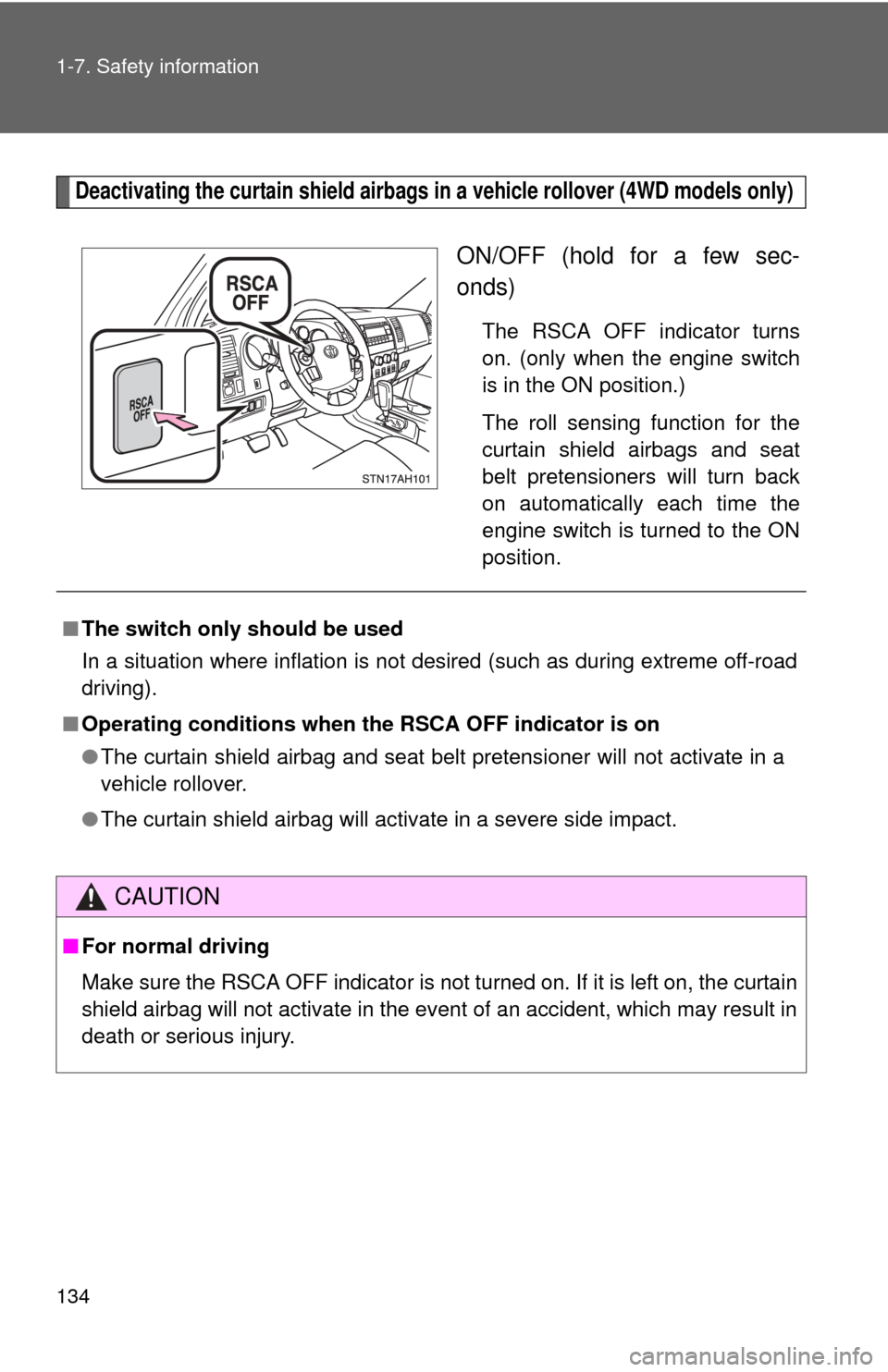
Deactivating the curtain shield airbags in a vehicle rollover (4WD models only)
ON/OFF (hold for a few sec-
onds)
The RSCA OFF indicator turns
on. (only when the engine switch
is in the ON position.)
The roll sensing function for the
curtain shield airbags and seat
belt pretensioners will turn back
on automatically each time the
engine switch is turned to the ON
position.
■The switch only should be used
In a situation where inflation is not desired (such as during extreme off-road
driving).
■ Operating conditions when th e RSCA OFF indicator is on
● The curtain shield airbag and seat belt pretensioner will not activate in a
vehicle rollover.
● The curtain shield airbag will activate in a severe side impact.
CAUTION
■For normal driving
Make sure the RSCA OFF indicator is not turned on. If it is left on, the curtain
shield airbag will not activate in the event of an accident, which may result in
death or serious injury.
Page 167 of 744
When driving2
167
2-1. Driving proceduresDriving the vehicle............ 168
Engine (ignition) switch .... 178
Automatic transmission .... 181
Turn signal lever .............. 186
Parking brake ................... 187
Horn ................................. 188
2-2. Instrument cluster Gauges and meters ......... 189
Indicators and warning lights .............................. 195
Multi-information display............................ 200
Accessory meter .............. 207
2-3. Operating the lights and wipers
Headlight switch ............... 210
Fog light switch ................ 215
Windshield wipers and washer ........................... 217
2-4. Using other driving systems Cruise control ................... 223
Intuitive parking assist...... 227
Rear view monitor system ........................... 234
Four-wheel drive system ........................... 242
AUTO LSD system........... 246
Driving assist systems ..... 249 2-5. Driving information
Off-road precautions ........ 257
Cargo and luggage .......... 262
Vehicle load limits ............ 265
Winter driving tips ............ 267
Trailer towing ................... 271
Dinghy towing .................. 294
Page 168 of 744
168
2-1. Driving procedures
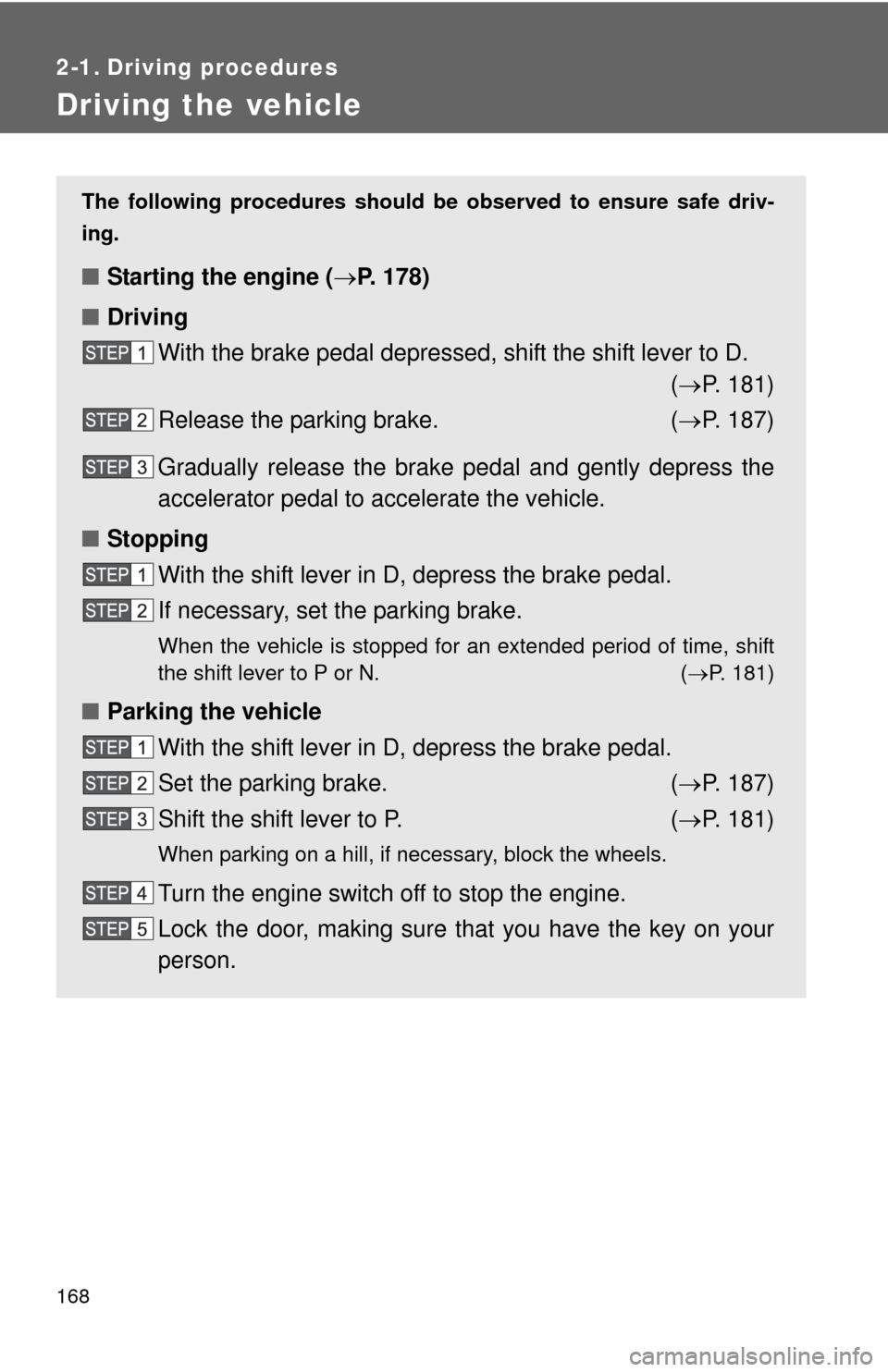
Driving the vehicle
The following procedures should be observed to ensure safe driv-
ing.
■ Starting the engine ( P. 178)
■ Driving
With the brake pedal depressed, shift the shift lever to D. ( P. 181)
Release the parking brake. ( P. 187)
Gradually release the brake pedal and gently depress the
accelerator pedal to accelerate the vehicle.
■ Stopping
With the shift lever in D, depress the brake pedal.
If necessary, set the parking brake.
When the vehicle is stopped for an extended period of time, shift
the shift lever to P or N. ( P. 181)
■Parking the vehicle
With the shift lever in D, depress the brake pedal.
Set the parking brake. ( P. 187)
Shift the shift lever to P. ( P. 181)
When parking on a hill, if necessary, block the wheels.
Turn the engine switch off to stop the engine.
Lock the door, making sure that you have the key on your
person.