ECO mode TOYOTA TUNDRA 2012 2.G Owners Manual
[x] Cancel search | Manufacturer: TOYOTA, Model Year: 2012, Model line: TUNDRA, Model: TOYOTA TUNDRA 2012 2.GPages: 744, PDF Size: 15.3 MB
Page 46 of 744
46
1-2. Opening, closing and locking the doors
Wireless remote control
: If equipped
■Operation signals
A buzzer sounds and the emergency flashers flash to indicate that the doors
have been locked/unlocked. (Locked: Once; Unlocked: Twice)
■ Panic mode
■ Door lock buzzer
If a door is not fully closed, a buzzer sounds for 10 seconds if an attempt to
lock the door is made. Fully close the door to stop the buzzer, and lock the
vehicle once more.
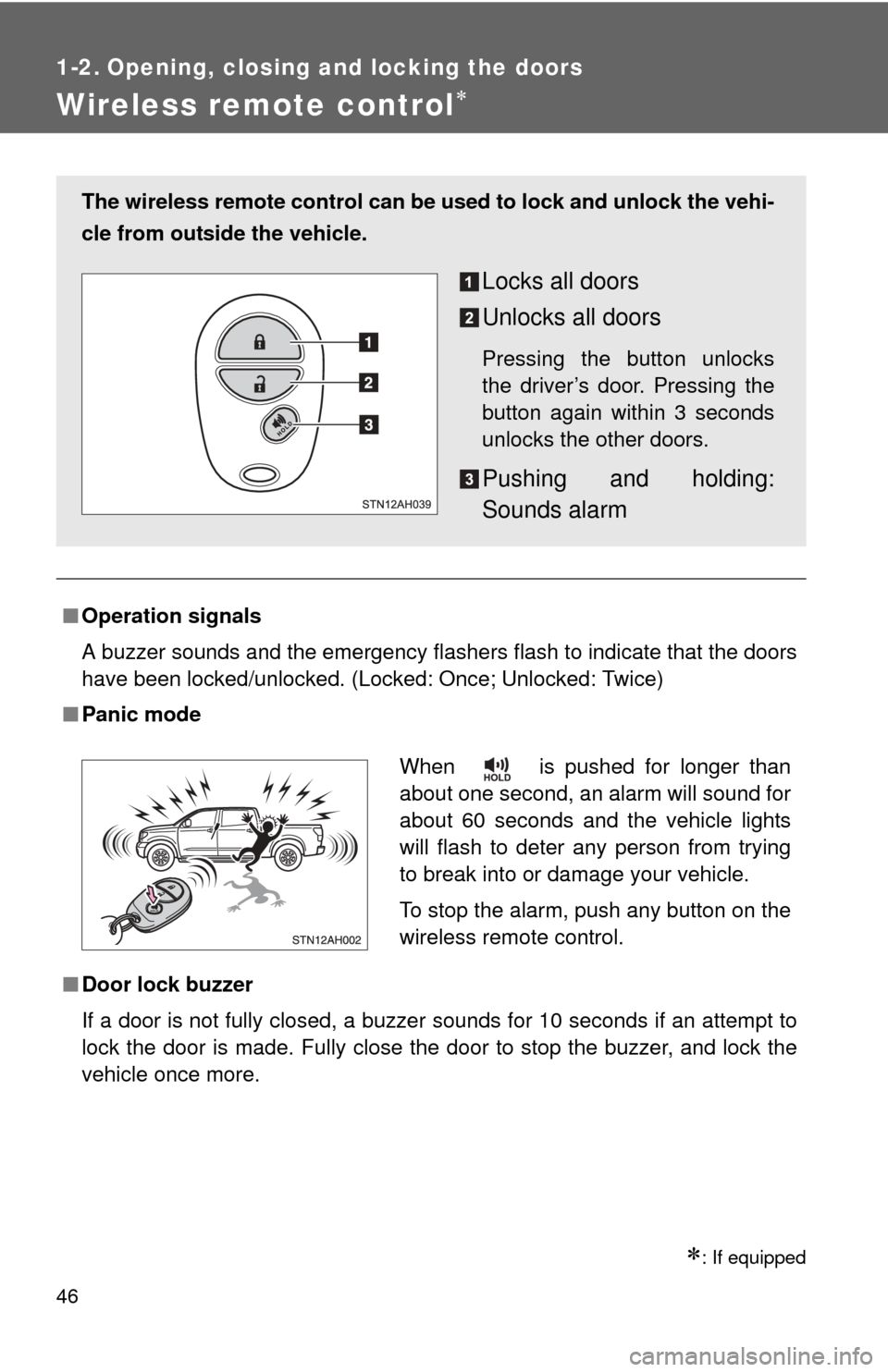
The wireless remote control can be used to lock and unlock the vehi-
cle from outside the vehicle.
Locks all doors
Unlocks all doors
Pressing the button unlocks
the driver’s door. Pressing the
button again within 3 seconds
unlocks the other doors.
Pushing and holding:
Sounds alarm
When is pushed for longer than
about one second, an alarm will sound for
about 60 seconds and the vehicle lights
will flash to deter any person from trying
to break into or damage your vehicle.
To stop the alarm, push any button on the
wireless remote control.
Page 95 of 744
95
1-3. Adjustable components (s
eats, mirrors, steering wheel)
1
Before driving
■Automatic adjustment of the mirror angle (vehicles with driving posi-
tion memory)
A desired mirror face angle can be entered to memory and recalled automat-
ically by the driving position memory. ( P. 7 0 )
■ Auto anti-glare function (if equipped)
When the anti-glare inside rear view mirror is set to automatic mode, the out-
side rear view mirrors wi ll activate in conjunction with the anti-glare inside
rear view mirror to reduce reflected light. ( P. 88)
CAUTION
■When driving the vehicle
Observe the following precautions while driving.
Failing to do so may result in loss of control of the vehicle and cause an acci-
dent, resulting in death or serious injury.
●Do not adjust the mirrors while driving.
● Do not drive with the mirrors folded back.
● Both the driver and passenger side mirrors must be extended and properly
adjusted before driving.
■ When a mirror is moving
To avoid personal injury and mirror malfunction, be careful not to get your
hand caught by the moving mirror.
■ When the mirror defoggers are oper ating (vehicles with outside rear
view mirror defoggers)
Do not touch the rear view mirror surfaces, as they can become very hot and
burn you.
NOTICE
■ If ice should jam the mirror
Do not operate the control or scrape the mirror face. Use a spray de-icer to
free the mirror.
Page 103 of 744
103
1-4. Opening and closing the windows and moon roof
1
Before driving
■
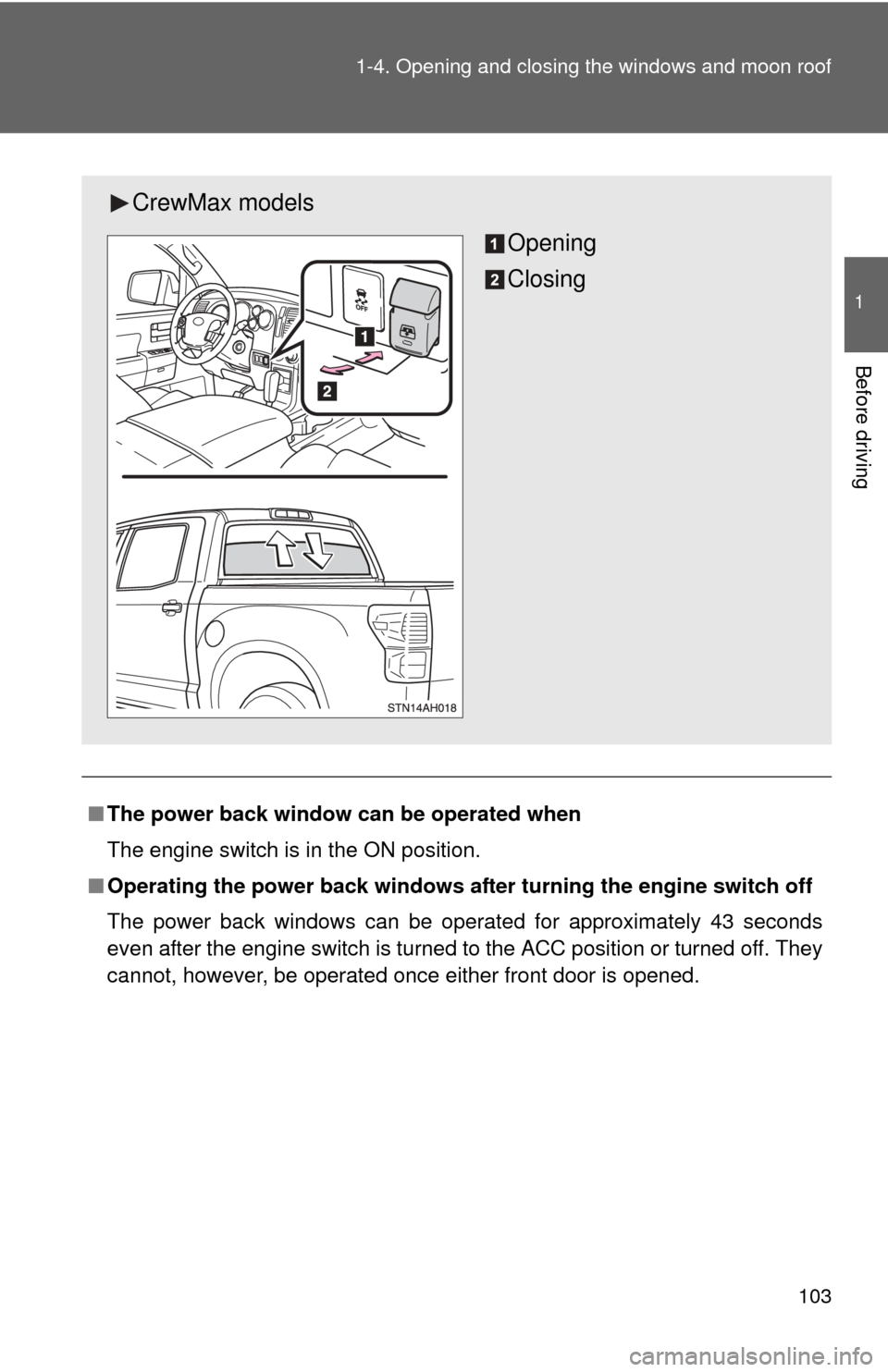
The power back window can be operated when
The engine switch is in the ON position.
■ Operating the power back windows after turning the engine switch off
The power back windows can be operated for approximately 43 seconds
even after the engine switch is turned to the ACC position or turned off. They
cannot, however, be operated once either front door is opened.
CrewMax models
Opening
Closing
Page 118 of 744
118 1-6. Theft deterrent system
■System maintenance
The vehicle has a maintenance-free type alarm system.
■ Items to check before locking the vehicle
To prevent unexpected triggering of the alarm and vehicle theft, make sure
of the following.
●Nobody is in the vehicle.
● The windows and moon roof are closed before the alarm is set.
● No valuables or other personal items are left in the vehicle.
■ Triggering of the alarm
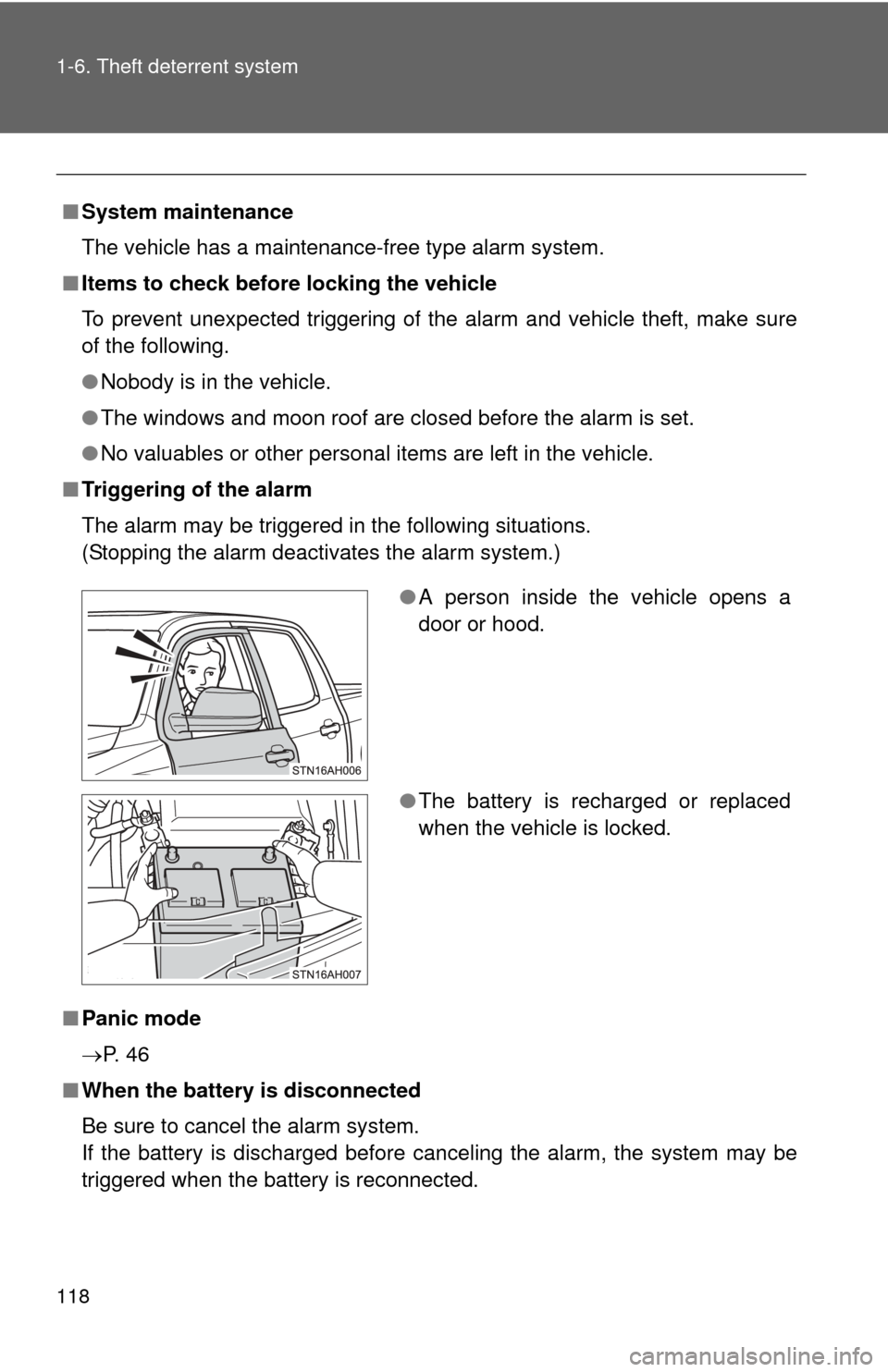
The alarm may be triggered in the following situations.
(Stopping the alarm deactivates the alarm system.)
■ Panic mode
P. 4 6
■ When the battery is disconnected
Be sure to cancel the alarm system.
If the battery is discharged before canceling the alarm, the system may be
triggered when the battery is reconnected.
●A person inside the vehicle opens a
door or hood.
● The battery is recharged or replaced
when the vehicle is locked.
Page 138 of 744
138 1-7. Safety information
*3: When a larger child who has outgrown a child restraint system sitsin the front passenger seat, the system may recognize him/her as
an adult depending on his/her physique or posture.
*
4: Never install a rear-facing child restraint system on the front pas-
senger seat. A forward-facing child restraint system should only be
installed on the front passenger seat when it is unavoidable.
( P. 140)
*
5: In case the indicator is not illu minated, consult this manual for
installing the child restraint system properly. ( P. 144)
CAUTION
■Front passenger occupant cl assification system precautions
Observe the following precautions regarding front passenger occupant clas-
sification system.
Failure to do so may cause death or serious injury.
● Wear the seat belt properly.
● Make sure the front passenger’s seat belt tab has not been left inserted
into the buckle before someone sits in the front passenger seat.
● Make sure the AIR BAG OFF indicator light is not illuminated when using
the seat belt extender for the right front passenger seat. If the AIR BAG
OFF indicator light is illuminated, disconnect the extender tongue from the
seat belt buckle, then reconnect the seat belt. Reconnect the seat belt
extender after making sure the AIR BAG ON indicator light is illuminated. If
you use the seat belt extender while the AIR BAG OFF indicator light is
illuminated, the front passenger airbag, front passenger knee airbag and
side airbag on the right front passenger side airbag may not activate cor-
rectly, which could cause death or serious injury in the event of collision.
● Do not apply a heavy load to the front passenger seat or equipment (e.g.
seatback pocket).
● Do not apply pressure to the right front passenger seat by resting hands or
legs on the seatback.
● Double Cab and CrewMax models: Do not put weight on the front passen-
ger seat by putting your hands or feet on the front passenger seat seat-
back from the rear passenger seat.
Page 143 of 744
143
1-7. Safety information
1
Before driving
CAUTION
■
Child restraint precautions
●Regular Cab models (Bench type seat): Do not install a child restraint sys-
tem on the center seat if it interferes with driving operations such as
changing the shift lever position. In this case, install the child restraint sys-
tem on the right passenger seat.
● Do not use the seat belt extender when installing a child restraint system
on the front or rear passenger seat. If installing a child restraint system
with the seat belt extender connected to the seat belt, the seat belt will not
securely hold the child restraint system, which could cause death or seri-
ous injury to the child or other passengers in the event of a sudden stop,
sudden swerve or an accident.
● Do not allow the child to lean his/her head or any part of his/her body
against the door or the area of the seat , front and rear pillars or roof side
rail from which the side airbags or curtain shield airbags deploy even if the
child is seated in the child restraint system. It is dangerous if the side air-
bags and curtain shield airbags inflate, and the impact could cause death
or serious injury to the child.
● Make sure you have complied with all installation instructions provided by
the child restraint manufacturer and that the system is properly secured. If
it is not secured properly, it may cause death or serious injury to the child
in the event of a sudden stop, sudden swerve or an accident.
■ When children are in the vehicle
Do not allow children to play with the seat belt. If the seat belt becomes
twisted around a child’s neck, it may lead to choking or other serious injuries
that could result in death.
If this occurs and the buckle cannot be unfastened, scissors should be used
to cut the belt.
■ When the child restrain t system is not in use
● Keep the child restraint system properly secured on the seat even if it is
not in use. Do not store the restraint unsecured in the passenger compart-
ment.
● If it is necessary to detach the child restraint system, remove it from the
vehicle. This will prevent it from injuring passengers in the event of a sud-
den stop, sudden swerve or accident.
Page 174 of 744
174 2-1. Driving procedures
CAUTION
■When the vehicle is parked
●If the shift lever is moved before the 4LO indicator turns on/off, the transfer
mode may not be shifted completely. The transfer mode disengages both
the front and rear driveshafts from the powertrain and allows the vehicle to
move regardless of the shift position. (At this time, the indicator blinks and
the buzzer sounds.)
Therefore, the vehicle is free to roll even if the automatic transmission is in
P. You or someone else could be seriously injured. You must complete the
shifting of the transfer mode. ( P. 244)
● Do not touch the exhaust pipe while the engine is running or immediately
after turning the engine off.
Doing so may cause burns.
● Do not leave the engine running in an area with snow build-up, or where it
is snowing. If snowbanks build up around the vehicle while the engine is
running, exhaust gases may collect and enter the vehicle. This may lead
to death or a serious health hazard.
■ Exhaust gases
Exhaust gases include harmful carbon monoxide (CO) that is colorless and
odorless. Inhaling exhaust gases may lead to death or a serious health haz-
ard.
●If the vehicle is in a poorly ventilated area, stop the engine. In a closed
area, such as a garage, exhaust gases may collect and enter the vehicle.
This may lead to death or a serious health hazard.
● The exhaust should be checked occasionally. If there is a hole or crack
caused by corrosion, damage to a joint or abnormal exhaust noise, be
sure to have the vehicle inspected and repaired by your Toyota dealer.
Failure to do so may allow exhaust gases to enter the vehicle, resulting in
death or a serious health hazard.
● Toyota does not recommend occupying the rear cargo area when it is fitted
with a slide-in camper, camper shell or other type cover while the engine is
running. This caution applies to bot h driving and stopped or parked situa-
tions with the engine running. Particular care should be taken to prevent
exhaust gases from entering camper bodies, trailers or other enclosures
on or around your vehicle. If exhaust fumes are detected, open all win-
dows and thoroughly ventilate the area.
Page 198 of 744
198 2-2. Instrument cluster
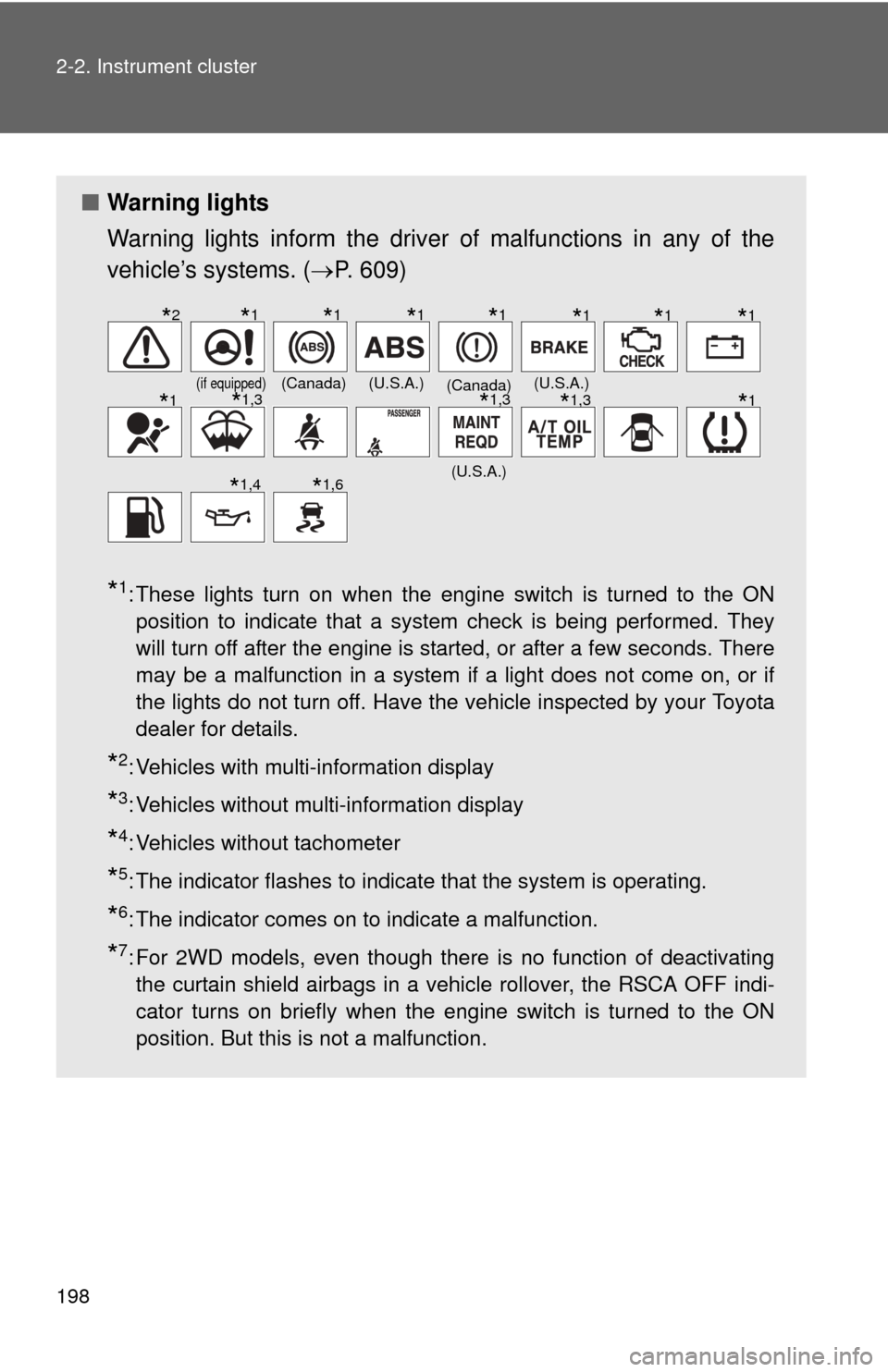
■Warning lights
Warning lights inform the driver of malfunctions in any of the
vehicle’s systems. ( P. 609)
*1: These lights turn on when the engine switch is turned to the ON
position to indicate that a system check is being performed. They
will turn off after the engine is started, or after a few seconds. There
may be a malfunction in a system if a light does not come on, or if
the lights do not turn off. Have the vehicle inspected by your Toyota
dealer for details.
*2: Vehicles with multi-information display
*3: Vehicles without multi-information display
*4: Vehicles without tachometer
*5: The indicator flashes to indicate that the system is operating.
*6: The indicator comes on to indicate a malfunction.
*7: For 2WD models, even though there is no function of deactivatingthe curtain shield airbags in a vehicle rollover, the RSCA OFF indi-
cator turns on briefly when the engine switch is turned to the ON
position. But this is not a malfunction.
(if equipped)(Canada)(U.S.A.)(Canada)(U.S.A.)
(U.S.A.)
*2*1*1*1*1*1*1*1
*1*1,3*1,3*1,3*1
*1,4*1,6
Page 225 of 744
225
2-4. Using other
driving systems
2
When driving
■Cruise control can be set when
●The shift lever is in the D or range 4 or higher of S has been selected.
● Vehicle speed is above approximately 25 mph (40 km/h).
■ Accelerating after setting the vehicle speed
●The vehicle can be accelerated normally. After acceleration, the set
speed resumes.
● Even without cancelling the cruise control, the set speed can be
increased by first accelerating the vehicle to the desired speed and then
pushing the lever down to set the new speed.
■ Automatic cruise control cancelation
Cruise control will stop maintaining the vehicle speed in any of the following
situations.
●Actual vehicle speed falls more than approximately 10 mph (16 km/h)
below the preset vehicle speed.
At this time, the memorized set speed is not retained.
● Actual vehicle speed is below approximately 25 mph (40 km/h).
● VSC is activated.
● The operation cannot be switched for 5 seconds or more after operating
the front-wheel drive control switch. (4WD models)
■ If the cruise control indicator flashes
Press the ON-OFF button once to deactivate the system, and then press the
button again to reactivate the system.
If the cruise control speed cannot be set or if the cruise control cancels
immediately after being activated, there may be a malfunction in the cruise
control system. Have the vehicle inspected by your Toyota dealer.
Page 235 of 744
235
2-4. Using other
driving systems
2
When driving
■The rear view monitor system can be operated when
The shift lever is in R and the engine switch is ON.
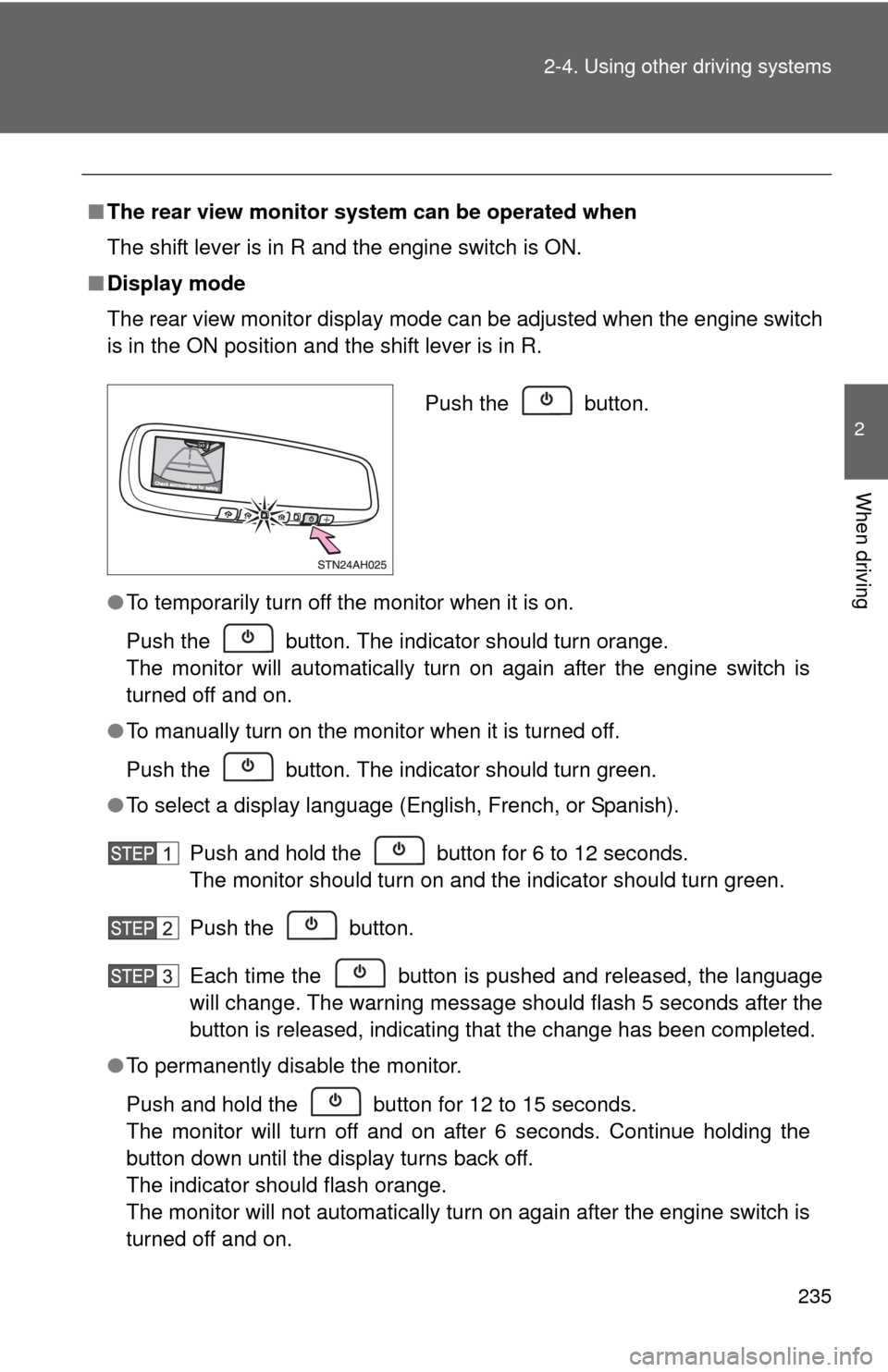
■ Display mode
The rear view monitor display mode can be adjusted when the engine switch
is in the ON position and the shift lever is in R.
●To temporarily turn off the monitor when it is on.
Push the button. The indicator should turn orange.
The monitor will automatically turn on again after the engine switch is
turned off and on.
● To manually turn on the monitor when it is turned off.
Push the button. The indicator should turn green.
● To select a display language (English, French, or Spanish).
Push and hold the button for 6 to 12 seconds.
The monitor should turn on and the indicator should turn green.
Push the button.
Each time the button is pushed and released, the language
will change. The warning message should flash 5 seconds after the
button is released, indicating that the change has been completed.
● To permanently disable the monitor.
Push and hold the button for 12 to 15 seconds.
The monitor will turn off and on after 6 seconds. Continue holding the
button down until the display turns back off.
The indicator should flash orange.
The monitor will not automatically turn on again after the engine switch is
turned off and on.
Push the button.