Keys TOYOTA TUNDRA 2012 2.G Owners Manual
[x] Cancel search | Manufacturer: TOYOTA, Model Year: 2012, Model line: TUNDRA, Model: TOYOTA TUNDRA 2012 2.GPages: 744, PDF Size: 15.3 MB
Page 2 of 744

TABLE OF CONTENTSIndex
2
1-1. Key informationKeys ..................................... 44
1-2. Opening, closing and locking the doors
Wireless remote control ....... 46
Side doors ............................ 49
Tailgate ................................ 54
1-3. Adjustable components (seats, mirrors, steering
wheel)
Front seats ........................... 60
Rear seats (Double Cab and CrewMax models) ....... 65
Driving position memory (driver’s seat) ..................... 70
Head restraints ..................... 73
Seat belts ............................. 77
Steering wheel (manually adjustable type) .................. 85
Steering wheel (power-adjustable type)...... 87
Anti-glare inside rear view mirror .................................. 88
Outside rear view mirrors ..... 91
1-4. Opening and closing the windows and moon roof
Power windows .................... 96
Back window ...................... 101
Power back window ........... 102
Moon roof ........................... 105 1-5. Refueling
Opening the fuel tank cap... 110
1-6. Theft deterrent system Engine immobilizer system .............................. 115
Alarm .................................. 117
1-7. Safety information Correct driving posture ....... 120
SRS airbags ....................... 122
Front passenger occupant classification system ......... 135
Child restraint systems ....... 140
Installing child restraints ..... 144
2-1. Driving procedures Driving the vehicle .............. 168
Engine (ignition) switch....... 178
Automatic transmission ...... 181
Turn signal lever ................. 186
Parking brake ..................... 187
Horn .................................... 188
2-2. Instrument cluster Gauges and meters ............ 189
Indicators and warning lights ................................. 195
Multi-information display ..... 200
Accessory meter ................. 207
1Before driving
2When driving
Page 5 of 744

1
2
3
4
5
6
7
5
4-1. Maintenance and careCleaning and protecting the vehicle exterior............ 526
Cleaning and protecting the vehicle interior............. 529
4-2. Maintenance Maintenance requirements ..................... 532
General maintenance.......... 534
Emission inspection and maintenance (I/M)
programs........................... 537
4-3. Do-it-yourself maintenance Do-it-yourself service precautions ....................... 538
Hood ................................... 542
Engine compartment ........... 543
Tires .................................... 557
Tire inflation pressure ......... 565
Wheels ................................ 569
Air conditioning filter............ 572
Wireless remote control battery ............................... 575
Checking and replacing fuses ................................. 577
Light bulbs........................... 588 5-1. Essential information
Emergency flashers............ 600
If your vehicle needs to be towed........................... 601
If you think something is wrong ............................... 607
Fuel pump shut off system .............................. 608
5-2. Steps to take in an emergency If a warning light turns on or a warning buzzer
sounds... .......................... 609
If a warning message is displayed (vehicles
with multi-information
display) ............................. 619
If you have a flat tire ........... 623
If the engine will not start.... 641
If the shift lever cannot be shifted from P ................... 643
If you lose your keys........... 646
If the vehicle battery is discharged........................ 647
If your vehicle overheats .... 651
If the vehicle becomes stuck ................................. 654
If your vehicle has to be stopped in
an emergency .................. 655
4Maintenance and care5When trouble arises
Page 43 of 744
Before driving1
43
1-1. Key informationKeys ................................... 44
1-2. Opening, closing and locking the doors
Wireless remote control ..... 46
Side doors .......................... 49
Tailgate .............................. 54
1-3. Adjustable components (seats, mirrors,
steering wheel)
Front seats ......................... 60
Rear seats (Double Cab and CrewMax models) ..... 65
Driving position memory (driver’s seat) ................... 70
Head restraints................... 73
Seat belts ........................... 77
Steering wheel (manually adjustable type) ............... 85
Steering wheel (power-adjustable type) ... 87
Anti-glare inside rear view mirror ............................... 88
Outside rear view mirrors ... 91 1-4. Opening and closing
the windows and moon roof
Power windows .................. 96
Back window .................... 101
Power back window ......... 102
Moon roof ......................... 105
1-5. Refueling Opening the fuel tank cap ................................. 110
1-6. Theft deterrent system Engine immobilizer system ........................... 115
Alarm................................ 117
1-7. Safety information Correct driving posture..... 120
SRS airbags ..................... 122
Front passenger occupant classification system ...... 135
Child restraint systems..... 140
Installing child restraints... 144
Page 44 of 744
44
1-1. Key information
Keys
■When required to leave a key to the vehicle with a parking attendant
Lock the glove box as circumstances demand. ( P. 463)
■ Key number plate
Keep the plate in a safe place such as your wallet, not in the vehicle. In the
event that a key is lost, a new key can be made by your Toyota dealer using
the key number plate. ( P. 646)
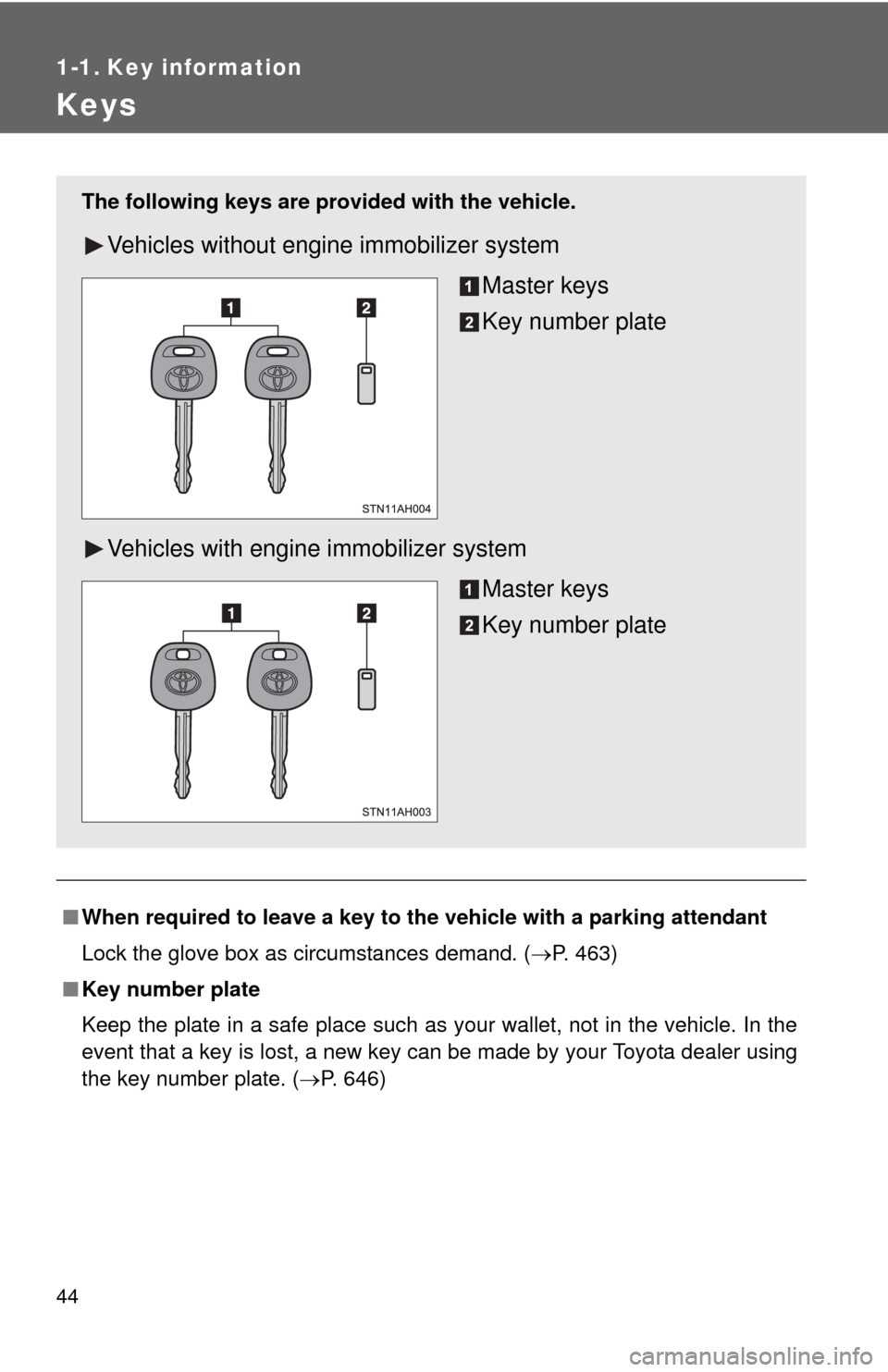
The following keys are provid ed with the vehicle.
Vehicles without engine immobilizer system
Master keys
Key number plate
Vehicles with engine immobilizer system Master keys
Key number plate
Page 45 of 744

45
1-1. Key information
1
Before driving
NOTICE
■
To prevent key damage (vehicles with engine immobilizer system)
● Do not subject the keys to strong shocks, expose them to high tempera-
tures by placing them in direct sunlight, or get them wet.
● Do not expose the keys to electromagnetic materials or attach any mate-
rial that blocks electromagnetic waves to the key surface.
Page 47 of 744

47
1-2. Opening, closing and locking the doors
1
Before driving
■
Wireless remote control battery depletion
The standard battery life is 1 to 2 years. (The battery becomes depleted
even if the wireless remote control is not used.) If the wireless remot\
e control
function does not operate, the battery may be depleted. Replace the battery
when necessary. ( P. 575)
■ If the wireless remote control does not operate
Locking and unlocking the doors: Use the key. ( P. 49)
■ Security feature
If a door is not opened within approximately 60 seconds after the vehicle is
unlocked, the security feature automatically locks the vehicle again.
■ Alarm (if equipped)
Using the wireless remote control to lock the door will set the alarm sy\
stem.
(P. 117)
■ Conditions affecting operation
The wireless remote control function may not operate normally in the follow-
ing situations.
●Near a TV tower, radio station, electr ic power plant, airport or other facil-
ity that generates strong radio waves
● When carrying a portable radio, cell ular phone or other wireless commu-
nication device
● When multiple wireless keys are in the vicinity
● When the wireless key has come into contact with, or is covered by a
metallic object
● When a wireless key (that emits radio waves) is being used nearby
● When the wireless key has been left near an electrical appliance such as
a personal computer
■ When riding in an aircraft
When bringing a wireless remote control onto an aircraft, make sure you do
not press any buttons on the wireless remote control while inside the aircraft
cabin. If you are carrying a wireless remote control in your bag etc, ensure
that the buttons are not likely to be pressed accidentally. Pressing a button
may cause the wireless remote control to emit radio waves that could inter-
fere with the operation of the aircraft.
Page 115 of 744
115
1
Before driving
1-6. Theft deterrent system
Engine immobilizer system
: If equipped
■System maintenance
The vehicle has a maintenance-free type engine immobilizer system.
■ Conditions that may cause the system to malfunction
● If the key is in contact with a metallic object
● If the key is in close proximity to or touching a key to the security system
(key with a built-in transponder chip) of another vehicle
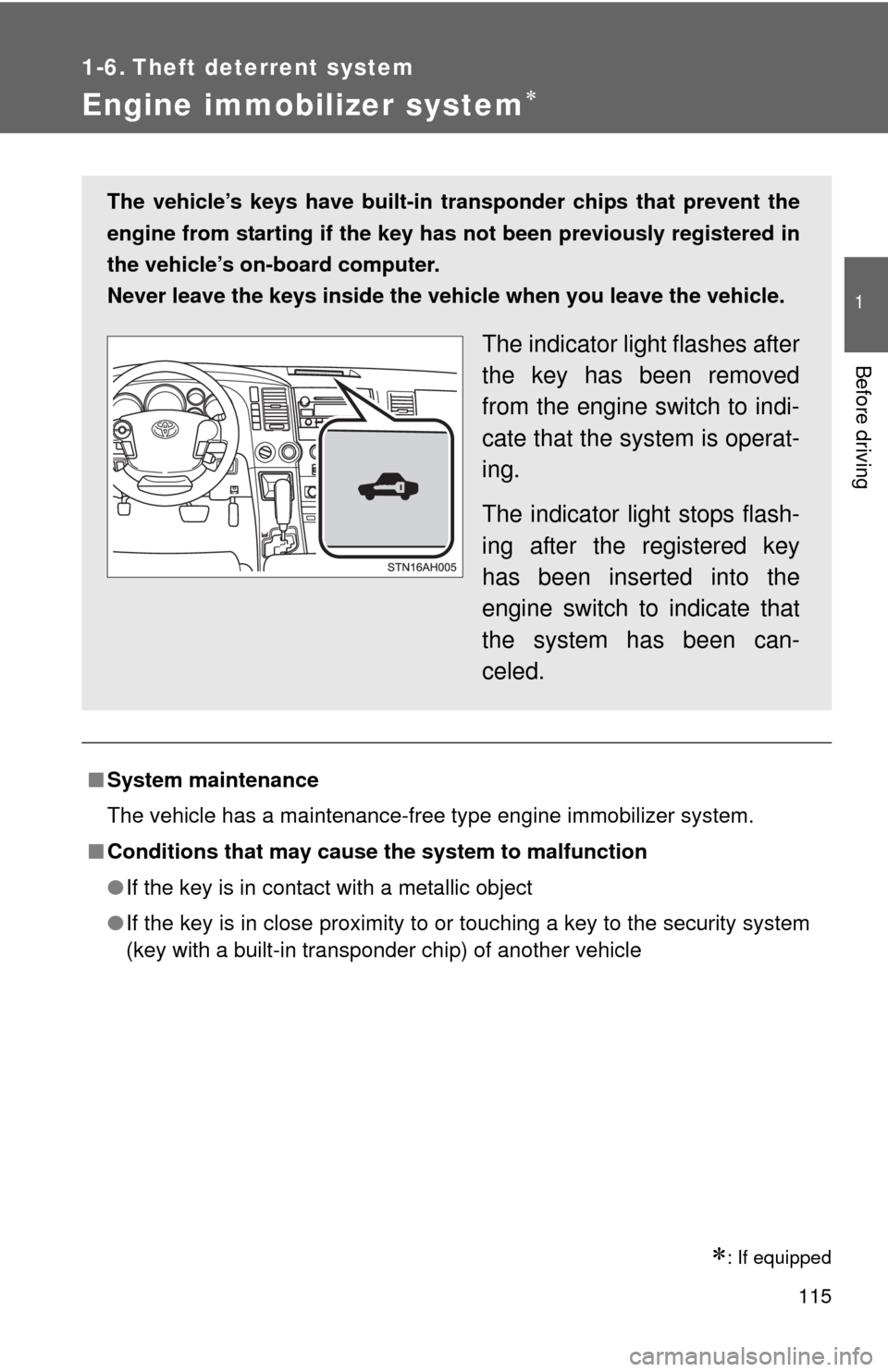
The vehicle’s keys have built-in tr ansponder chips that prevent the
engine from starting if the key has not been previously registered in
the vehicle’s on-board computer.
Never leave the keys inside the vehicle when you leave the vehicle.
The indicator light flashes after
the key has been removed
from the engine switch to indi-
cate that the system is operat-
ing.
The indicator light stops flash-
ing after the registered key
has been inserted into the
engine switch to indicate that
the system has been can-
celed.
Page 132 of 744
132 1-7. Safety information
CAUTION
■SRS airbag precautions
●If the vinyl cover is put on the area where the SRS knee airbag will
deploys, be sure to remove it.
● Do not use seat accessories which cover the parts where the SRS side
airbags inflate as they may interf ere with inflation of the airbags.
● Do not strike or apply significant levels of force to the area of the SRS air-
bag components ( P. 123).
Doing so can cause the SRS airbags to malfunction.
● Do not touch any of the component parts immediately after the SRS air-
bags have deployed (inflated) as they may be hot.
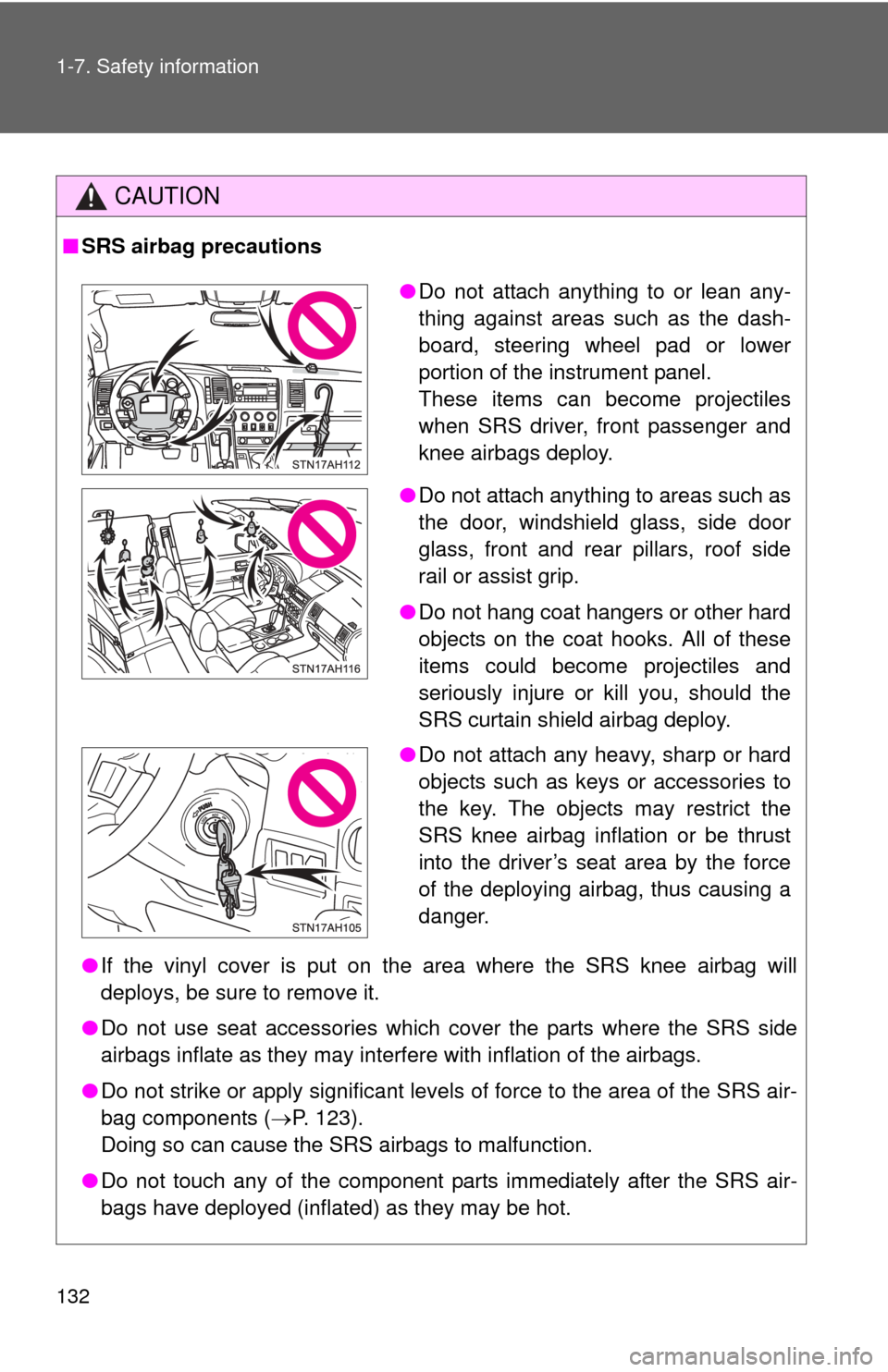
●Do not attach anything to or lean any-
thing against areas such as the dash-
board, steering wheel pad or lower
portion of the instrument panel.
These items can become projectiles
when SRS driver, front passenger and
knee airbags deploy.
● Do not attach anything to areas such as
the door, windshield glass, side door
glass, front and rear pillars, roof side
rail or assist grip.
● Do not hang coat hangers or other hard
objects on the coat hooks. All of these
items could become projectiles and
seriously injure or kill you, should the
SRS curtain shield airbag deploy.
● Do not attach any heavy, sharp or hard
objects such as keys or accessories to
the key. The objects may restrict the
SRS knee airbag inflation or be thrust
into the driver’s seat area by the force
of the deploying airbag, thus causing a
danger.
Page 599 of 744
When trouble arises5
599
5-1. Essential informationEmergency flashers ......... 600
If your vehicle needs to be towed ........................ 601
If you think something is wrong ............................. 607
Fuel pump shut off system ........................... 608
5-2. Steps to take in an emergency
If a warning light turns on or a warning buzzer
sounds... ........................ 609
If a warning message is displayed (vehicles
with multi-information
display) .......................... 619
If you have a flat tire......... 623
If the engine will not start ................................ 641
If the shift lever cannot be shifted from P............ 643
If you lose your keys ........ 646
If the vehicle battery is discharged ..................... 647
If your vehicle overheats ....................... 651
If the vehicle becomes stuck .............................. 654
If your vehicle has to be stopped in
an emergency ................ 655
Page 646 of 744

646
5-2. Steps to take in an emergency
If you lose your keys
■If you lose all your master keys. ( vehicles with engine immobilizer sys-
tem)
You cannot make new keys; the whole engine immobilizer system must be
replaced.
New genuine Toyota keys can be made by your Toyota dealer using
the key number stamped on your key number plate. Vehicles with
engine immobilizer system, the dealer will also need the master key.
( P. 44)