coolant reservoir TOYOTA TUNDRA 2013 2.G Owners Manual
[x] Cancel search | Manufacturer: TOYOTA, Model Year: 2013, Model line: TUNDRA, Model: TOYOTA TUNDRA 2013 2.GPages: 752, PDF Size: 15.87 MB
Page 545 of 752
545
4-3. Do-it-yourself maintenance
4
Maintenance and care
Engine compar tment
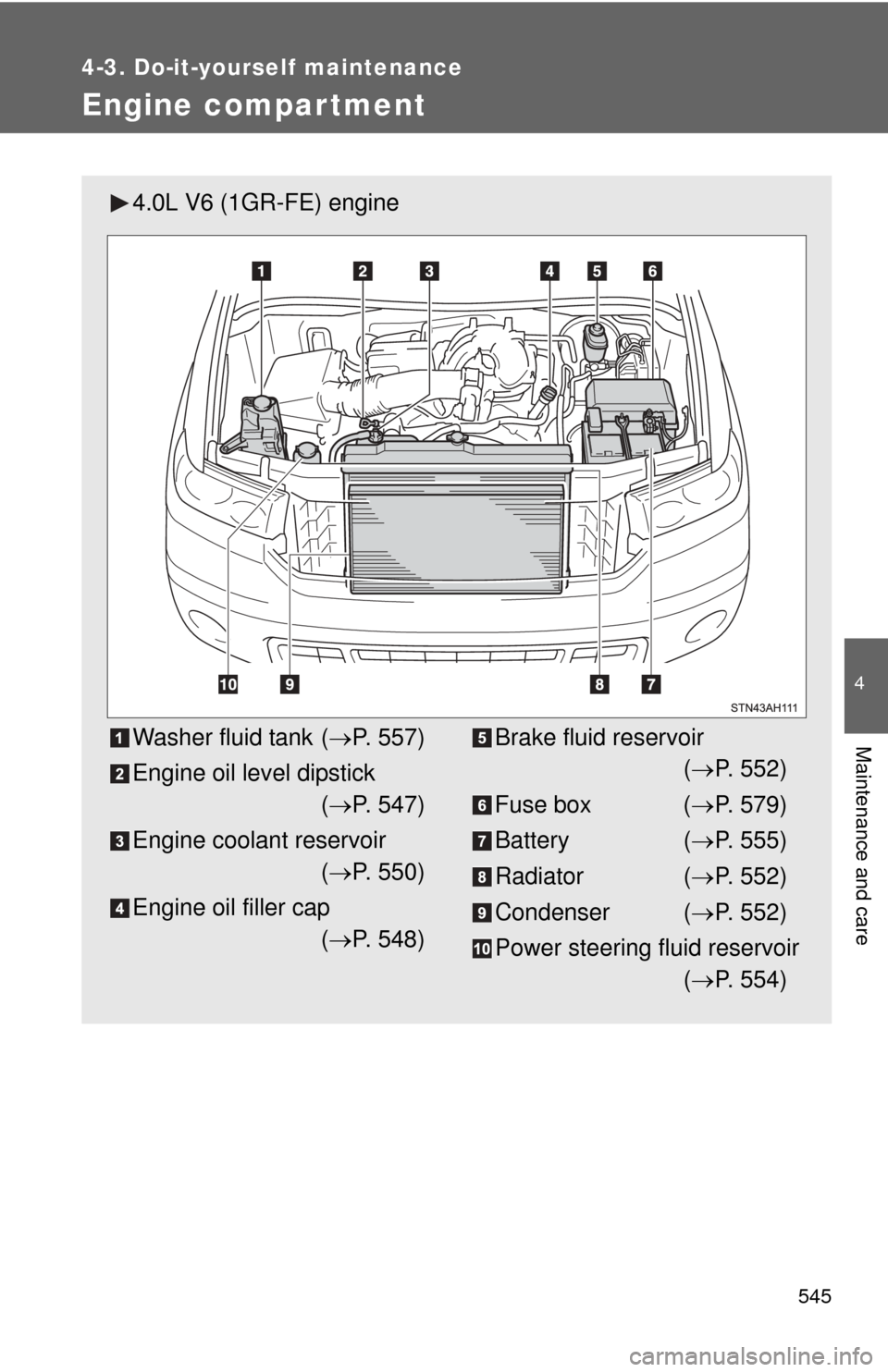
4.0L V6 (1GR-FE) engine
Washer fluid tank (P. 557)
Engine oil level dipstick ( P. 547)
Engine coolant reservoir ( P. 550)
Engine oil filler cap ( P. 548)Brake fluid reservoir
( P. 552)
Fuse box ( P. 579)
Battery ( P. 555)
Radiator ( P. 552)
Condenser ( P. 552)
Power steering fluid reservoir ( P. 554)
Page 546 of 752
546 4-3. Do-it-yourself maintenance
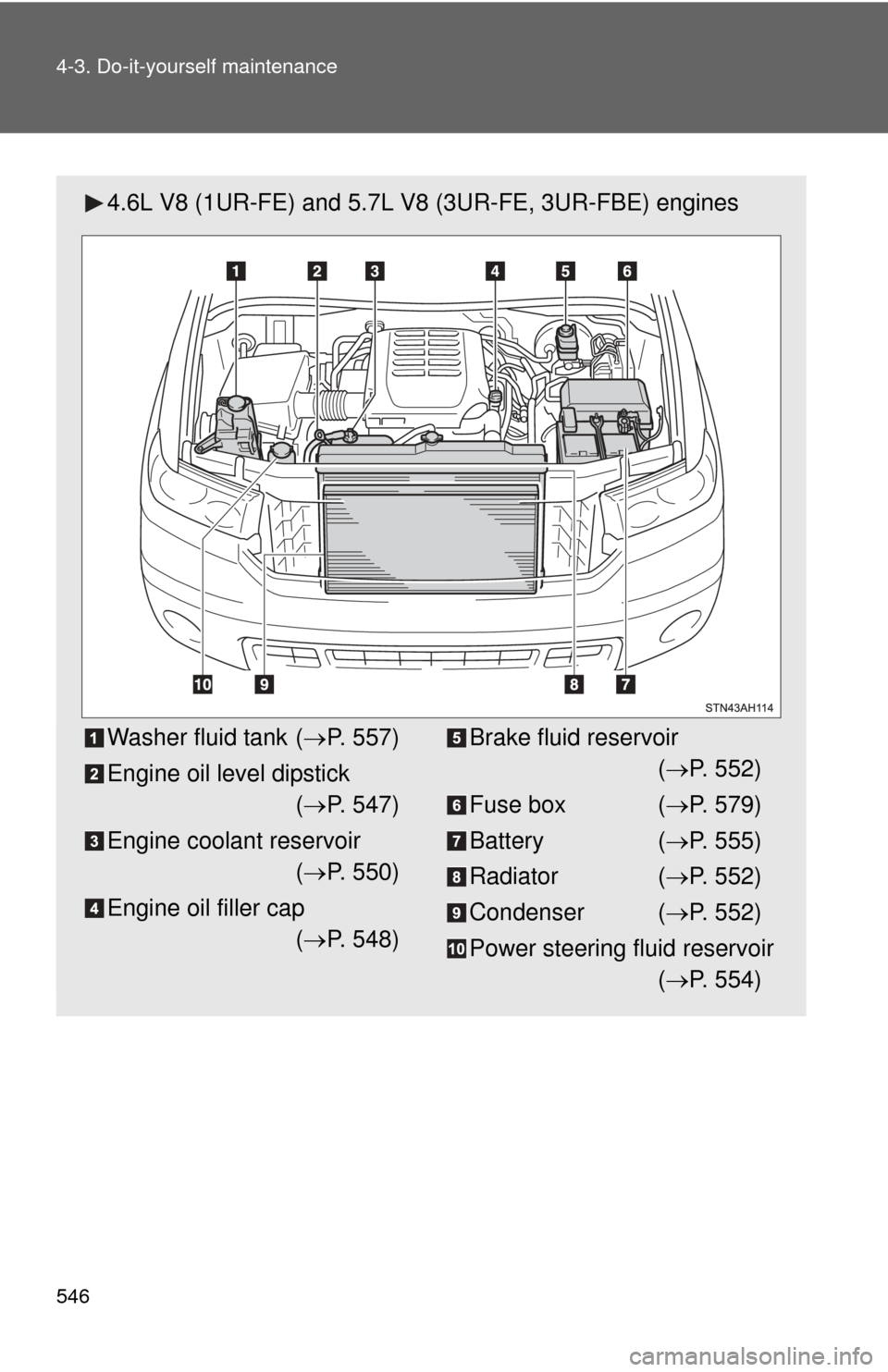
4.6L V8 (1UR-FE) and 5.7L V8 (3UR-FE, 3UR-FBE) engines
Washer fluid tank (P. 557)
Engine oil level dipstick ( P. 547)
Engine coolant reservoir ( P. 550)
Engine oil filler cap ( P. 548)Brake fluid reservoir
( P. 552)
Fuse box ( P. 579)
Battery ( P. 555)
Radiator ( P. 552)
Condenser ( P. 552)
Power steering fluid reservoir ( P. 554)
Page 550 of 752
550 4-3. Do-it-yourself maintenance
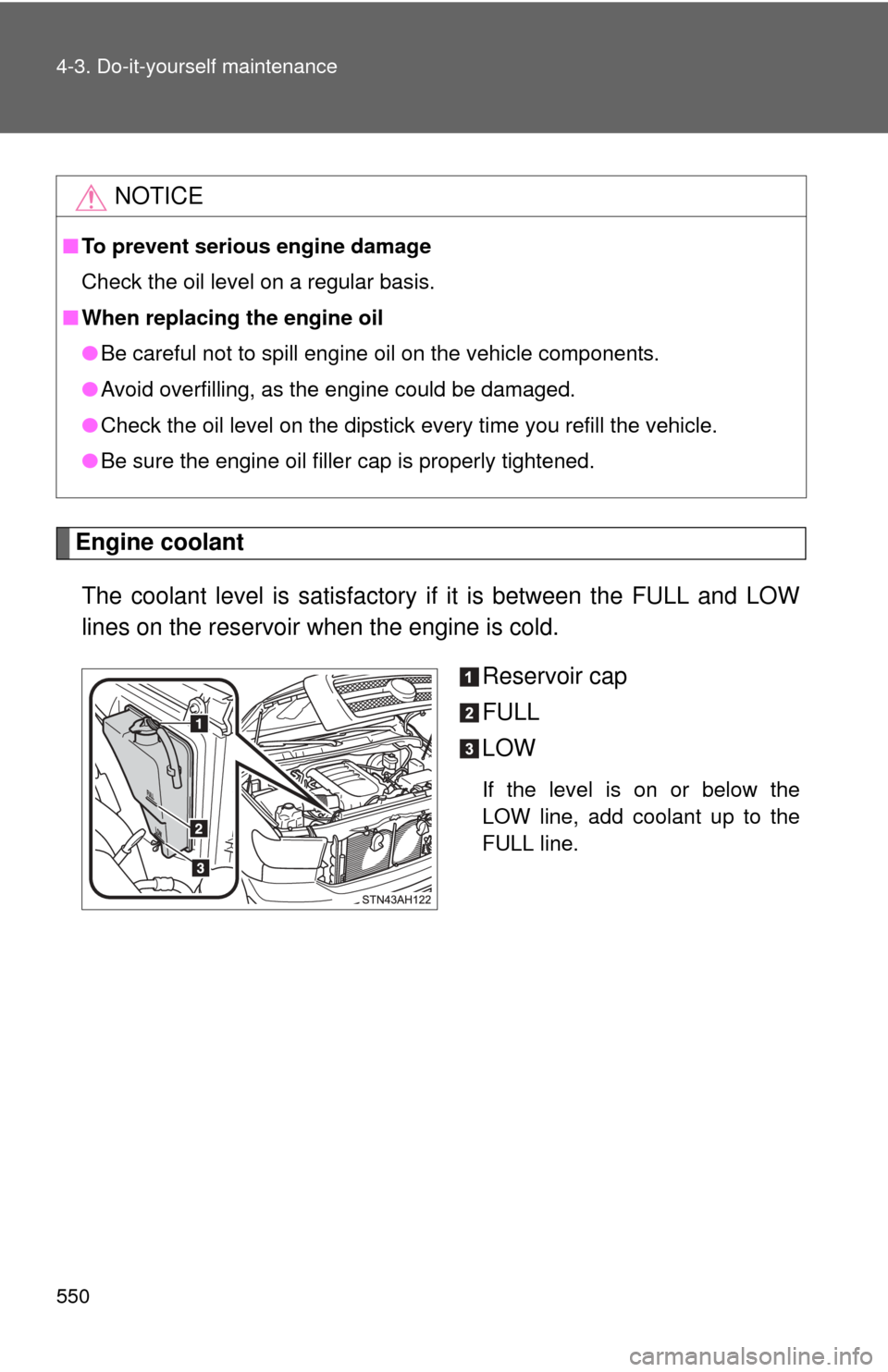
Engine coolantThe coolant level is satisfactory if it is between the FULL and LOW
lines on the reservoir when the engine is cold. Reservoir cap
FULL
LOW
If the level is on or below the
LOW line, add coolant up to the
FULL line.
NOTICE
■To prevent serious engine damage
Check the oil level on a regular basis.
■ When replacing the engine oil
●Be careful not to spill engine oil on the vehicle components.
● Avoid overfilling, as the engine could be damaged.
● Check the oil level on the dipstick every time you refill the vehicle.
● Be sure the engine oil filler cap is properly tightened.
Page 551 of 752
551
4-3. Do-it-yourself maintenance
4
Maintenance and care
■
If the coolant level drops within a short time after replenishing
Visually check the radiator, hoses, reservoir cap, radiator cap, drain cock
and water pump.
If you cannot find a leak, have your Toyota dealer pressure test the cap and
check for leaks in the cooling system.
■ Coolant selection
Only use “Toyota Super Long Life Coolant” or similar high quality ethylene
glycol based non-silicate, non-amine, non-nitrite and non-borate coolant with
long-life hybrid organic acid technology.
U.S.A.: “Toyota Super Long Life Coolant” is a mixture of 50% coolant and 50% deionized water. (Enabled: -31 F [-35 C])
Canada: “Toyota Super Long Life Coolant” is a mixture of 55% coolant and 45% deionized water. (Enabled: -44 F [-42 C])
For more details about engine coolant, contact your Toyota dealer.
CAUTION
■ When the engine is hot
Do not remove the radiator cap.
The cooling system may be under pressure and may spray hot coolant if the
cap is removed, causing serious injuries, such as burns.
NOTICE
■When adding engine coolant
Coolant is neither plain water nor stra ight antifreeze. The correct mixture of
water and antifreeze must be used to provide proper lubrication, corrosion
protection and cooling. Be sure to read the antifreeze or coolant label.
■ If you spill coolant
Be sure to wash it off with water to prevent damage to parts or paint.
Page 655 of 752
5
When trouble arises
655
5-2. Steps to take in an emergency
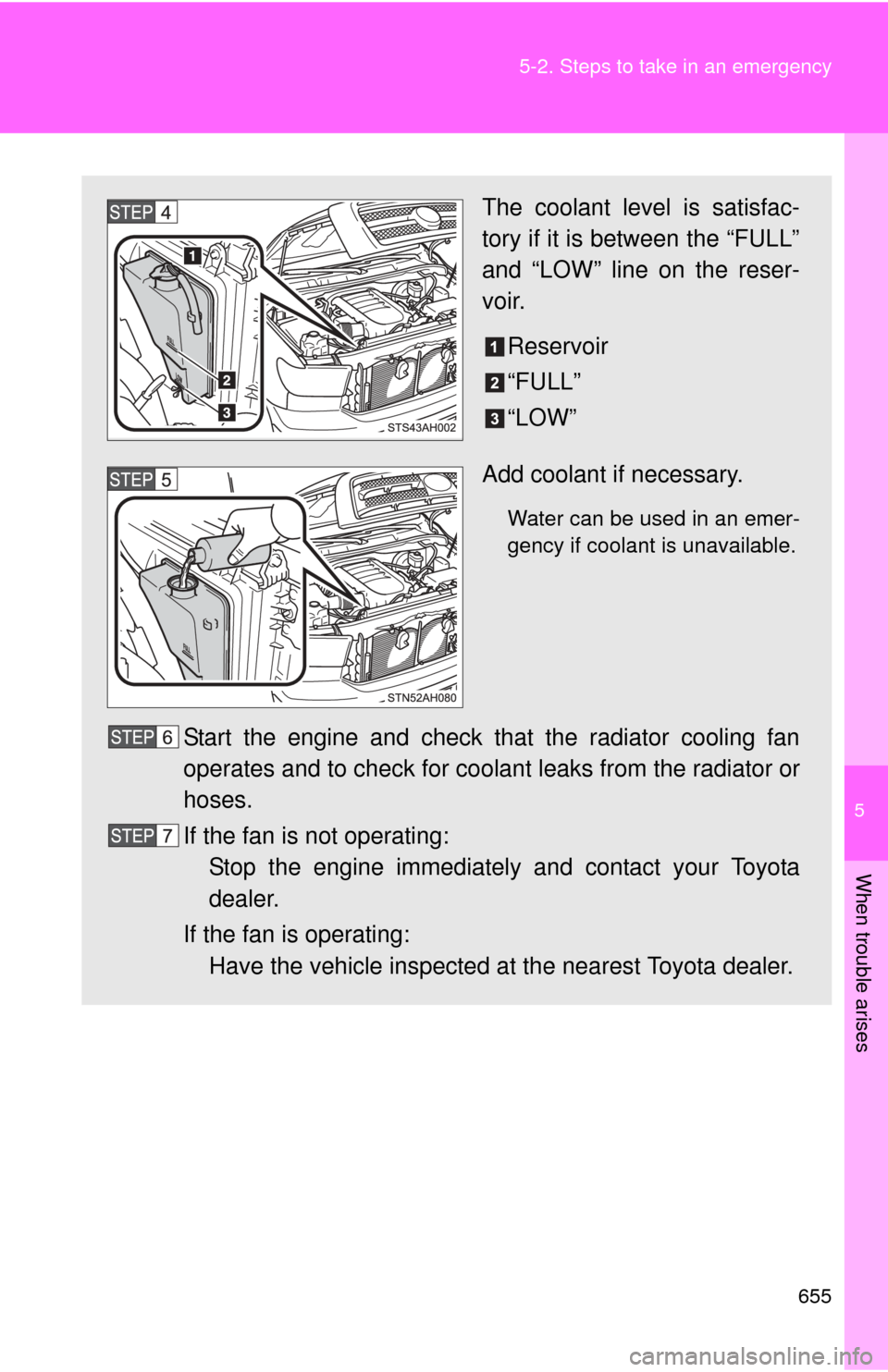
The coolant level is satisfac-
tory if it is between the “FULL”
and “LOW” line on the reser-
voir.
Reservoir
“FULL”
“LOW”
Add coolant if necessary.
Water can be used in an emer-
gency if coolant is unavailable.
Start the engine and check that the radiator cooling fan
operates and to check for coolant leaks from the radiator or
hoses.
If the fan is not operating: Stop the engine immediately and contact your Toyota
dealer.
If the fan is operating: Have the vehicle inspected at the nearest Toyota dealer.
Page 656 of 752
656 5-2. Steps to take in an emergency
CAUTION
■To prevent an accident or injury when inspecting under the hood of
your vehicle
● If steam is seen coming from under the hood, do not open the hood until
the steam has subsided. The engine compartment may be very hot, caus-
ing serious injuries such as burns.
● Keep hands and clothing (especially a tie, a scarf or a muffler) away from
the fan and belts. Failure to do so may cause the hands or clothing to be
caught, resulting in serious injury.
● Do not loosen the radiator cap and the coolant reservoir cap while the
engine and radiator are hot.
Serious injury, such as burns, may result from hot coolant and steam
released under pressure.
NOTICE
■When adding engine coolant
Wait until the engine has cooled down before adding engine coolant.
When adding coolant, do so slowly. Adding cool coolant to a hot engine too
quickly can cause damage to the engine.
■ To prevent damage to the cooling system
Observe the following precautions:
●Avoid contaminating the coolant with foreign matter (such as sand or dust
etc.).
● Do not use commercially available coolant additives.