warning light TOYOTA TUNDRA 2013 2.G Owners Manual
[x] Cancel search | Manufacturer: TOYOTA, Model Year: 2013, Model line: TUNDRA, Model: TOYOTA TUNDRA 2013 2.GPages: 752, PDF Size: 15.87 MB
Page 2 of 752

TABLE OF CONTENTSIndex
2
1-1. Key informationKeys ..................................... 44
1-2. Opening, closing and locking the doors
Wireless remote control ....... 46
Side doors ............................ 49
Tailgate ................................ 54
1-3. Adjustable components (seats, mirrors, steering
wheel)
Front seats ........................... 60
Rear seats (Double Cab and CrewMax models) .............. 65
Driving position memory (driver’s seat) ..................... 70
Head restraints ..................... 73
Seat belts ............................. 77
Steering wheel (manually adjustable type) .................. 85
Steering wheel (power -adjustable type) ................ 87
Anti-glare inside rear view mirror .................................. 88
Outside rear view mirrors ..... 91
1-4. Opening and closing the windows and moon roof
Power windows .................... 96
Back window ...................... 101
Power back window ........... 102
Moon roof ........................... 105 1-5. Refueling
Opening the fuel tank cap... 110
1-6. Theft deterrent system Engine immobilizer system .............................. 115
Alarm .................................. 117
1-7. Safety information Correct driving posture ....... 120
SRS airbags ....................... 122
Front passenger occupant classification system ......... 135
Child restraint systems ....... 140
Installing child restraints ..... 144
2-1. Driving procedures Driving the vehicle .............. 168
Engine (ignition) switch....... 178
Automatic transmission ...... 181
Turn signal lever ................. 186
Parking brake ..................... 187
Horn .................................... 188
2-2. Instrument cluster Gauges and meters ............ 189
Indicators and warning lights ................................. 195
Multi-information display ..... 200
Accessory meter ................. 207
1Before driving
2When driving
Page 5 of 752

1
2
3
4
5
6
7
5
4-1. Maintenance and careCleaning and protecting the vehicle exterior............ 528
Cleaning and protecting the vehicle interior............. 531
4-2. Maintenance Maintenance requirements ..................... 534
General maintenance.......... 536
Emission inspection and maintenance (I/M)
programs........................... 539
4-3. Do-it-yourself maintenance Do-it-yourself service precautions ....................... 540
Hood ................................... 544
Engine compartment ........... 545
Tires .................................... 559
Tire inflation pressure ......... 567
Wheels ................................ 571
Air conditioning filter............ 574
Wireless remote control battery ............................... 577
Checking and replacing fuses ................................. 579
Light bulbs........................... 590 5-1. Essential information
Emergency flashers............ 602
If your vehicle needs to be towed........................... 603
If you think something is wrong ............................... 609
Fuel pump shut off system .............................. 610
5-2. Steps to take in an emergency If a warning light turns on or a warning buzzer
sounds... .......................... 611
If a warning message is displayed (vehicles
with multi-information
display) ............................. 622
If you have a flat tire ........... 626
If the engine will not start .................................. 644
If the shift lever cannot be shifted from P .............. 646
If you lose your keys........... 649
If the vehicle battery is discharged........................ 650
If your vehicle overheats .... 654
If the vehicle becomes stuck ................................. 657
If your vehicle has to be stopped
in an emergency............... 658
4Maintenance and care5When trouble arises
Page 28 of 752
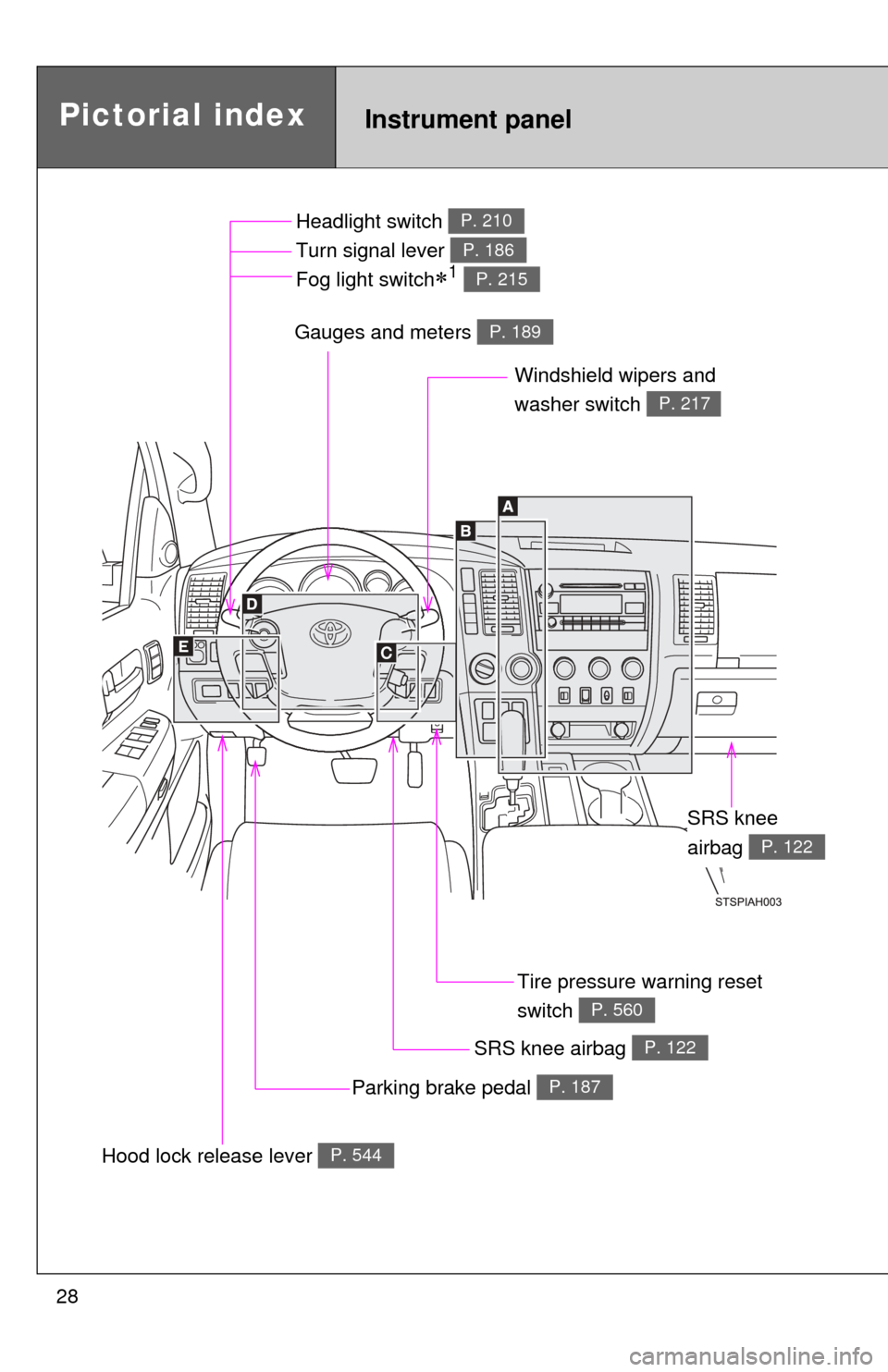
28
Pictorial indexInstrument panel
Headlight switch
Turn signal lever
Fog light switch
1
P. 210
P. 186
P. 215
Windshield wipers and
washer switch
P. 217
Parking brake pedal P. 187
Gauges and meters P. 189
Hood lock release lever P. 544
Tire pressure warning reset
switch
P. 560
SRS knee
airbag
P. 122
SRS knee airbag P. 122
Page 83 of 752

83
1-3. Adjustable components (s
eats, mirrors, steering wheel)
1
Before driving
CAUTION
■Wearing a seat belt
●Do not recline the seat any more than necessary to achieve a proper seat-
ing position. The seat belt is most effective when the occupants are sitting
up straight and well back in the seats.
● Do not wear the shoulder belt under your arm.
● Always wear your seat belt low and snug across your hips.
■ When children are in the vehicle
Do not allow children to play with the seat belt. If the seat belt becomes
twisted around a child’s neck, it may lead to choking or other serious injuries
that could result in death. If this occurs and the buckle cannot be unfas-
tened, scissors should be used to cut the belt.
■ Seat belt pretensioners
●Do not place anything, such as a cushion, on the front passenger’s seat.
Doing so will disperse the passenger’s weight, which prevents the sensor
from detecting the passenger’s weight properly. As a result, the seat belt
pretensioner for the front passenger’s seat may not activate in the event of
a collision.
● If the pretensioner has activated, the SRS warning light will come on. In
that case, the seat belt cannot be used again and must be replaced at
your Toyota dealer.
■ Adjustable shoulder anchor (Double Cab and CrewMax models)
Always make sure the shoulder belt is positioned across the center of your
shoulder. The belt should be kept away from your neck, but not falling off
your shoulder. Failure to do so could reduce the amount of protection in an
accident and cause death or serious injuries in the event of a sudden stop,
sudden swerve or accident. ( P. 79)
■ Seat belt damage and wear
●Do not damage the seat belts by allowing the belt, plate, or buckle to be
jammed in the door.
● Inspect the seat belt system periodically. Check for cuts, fraying, and loose
parts. Do not use a damaged seat belt until it is replaced. Damaged seat
belt cannot protect an occupant from death or serious injury.
Page 124 of 752

124 1-7. Safety information
Your vehicle is equipped with ADVANCED AIRBAGS designed based
on the US motor vehicle safety standards (FMVSS208). The airbag
sensor assembly (ECU) controls ai rbag deployment based on infor-
mation obtained from the sensors etc. shown in the system compo-
nents diagram above. This inform ation includes crash severity and
occupant information. As the air bags deploy, a chemical reaction in
the inflators quickly fills the airbag s with non-toxic gas to help restrain
the motion of the occupants.
Front bench type seat: The SRS airbags are designed to protect the
driver and right front passenger, and they are not designed to protect
an occupant in the front center seating position. Side airbags
AIR BAG ON and AIR BAG
OFF indicator lights
Curtain shield airbags
Front passenger airbag
Knee airbags
Seat belt pretensioner and
force limiters
Side and curtain shield air-
bag sensors
Front airbag sensors
Airbag sensor assembly
Curtain shield airbag sen-
sors (Double Cab and
CrewMax models)
Front passenger’s seat belt
buckle switch
Front passenger occupant
classification system (ECU
and sensors)
SRS warning light and
RSCA OFF indicator light
(4WD models only)
RSCA OFF switch
(4WD models only)
Driver’s seat position sen-
sor
Driver airbag
Driver’s seat belt buckle
switch
Page 125 of 752

125
1-7. Safety information
1
Before driving
■
SRS warning light
This warning light system monitors the airbag sensor assembly, front airbag
sensors, side and curtain shield airbag sensor assemblies, curtain shield air-
bag sensor assemblies, driver’s seat position sensor, driver’s seat belt
buckle switch, front passenger occupant classification system (ECU and
sensors), AIR BAG ON and AIR BAG OFF indicator lights, front passenger’s
seat belt buckle switch, front seat be lt pretensioner assemblies, RSCA OFF
indicator light (4WD models only), airbags, interconnecting wiring and power
sources. ( P. 612)
■ If the SRS airbags deploy (inflate)
●Bruising and slight abrasions may result from contact with a deploying
(inflating) SRS airbag.
● A loud noise and white powder will be emitted.
● Parts of the airbag module (steering wheel hub, airbag cover and inflator)
as well as the front seats, and parts of the front and rear pillars and roof
side rail, may be hot for several minutes. The airbag itself may also be
hot.
● The front windshield may crack.
■ Operating conditions (front airbags)
●The SRS front airbag will deploy in the event of an impact that exceeds
the set threshold level (the level of force corresponding to an approxi-
mately 12-18 mph [20-30 km/h] frontal collision with a fixed wall that does
not move or deform).
However, this threshold velocity will be considerably higher if the vehicle
strikes an object, such as a parked vehicle or sign pole, which can move or
deform on impact, or if the vehicle is involved in an underride collision (e.g.
a collision in which the front of the vehicle “underrides”, or goes under, the
bed of a truck, etc.).
● Depending on the type of collision, it is possible that only the seat belt
pretensioners will activate.
● The SRS front airbags for the front passenger will not activate if there is
no passenger sitting in the right front passenger seat. However, the front
airbags for the front passenger may deploy if luggage is put in the seat,
even if the seat is unoccupied. ( P. 135)
Page 135 of 752
135
1
1-7. Safety information
Before driving
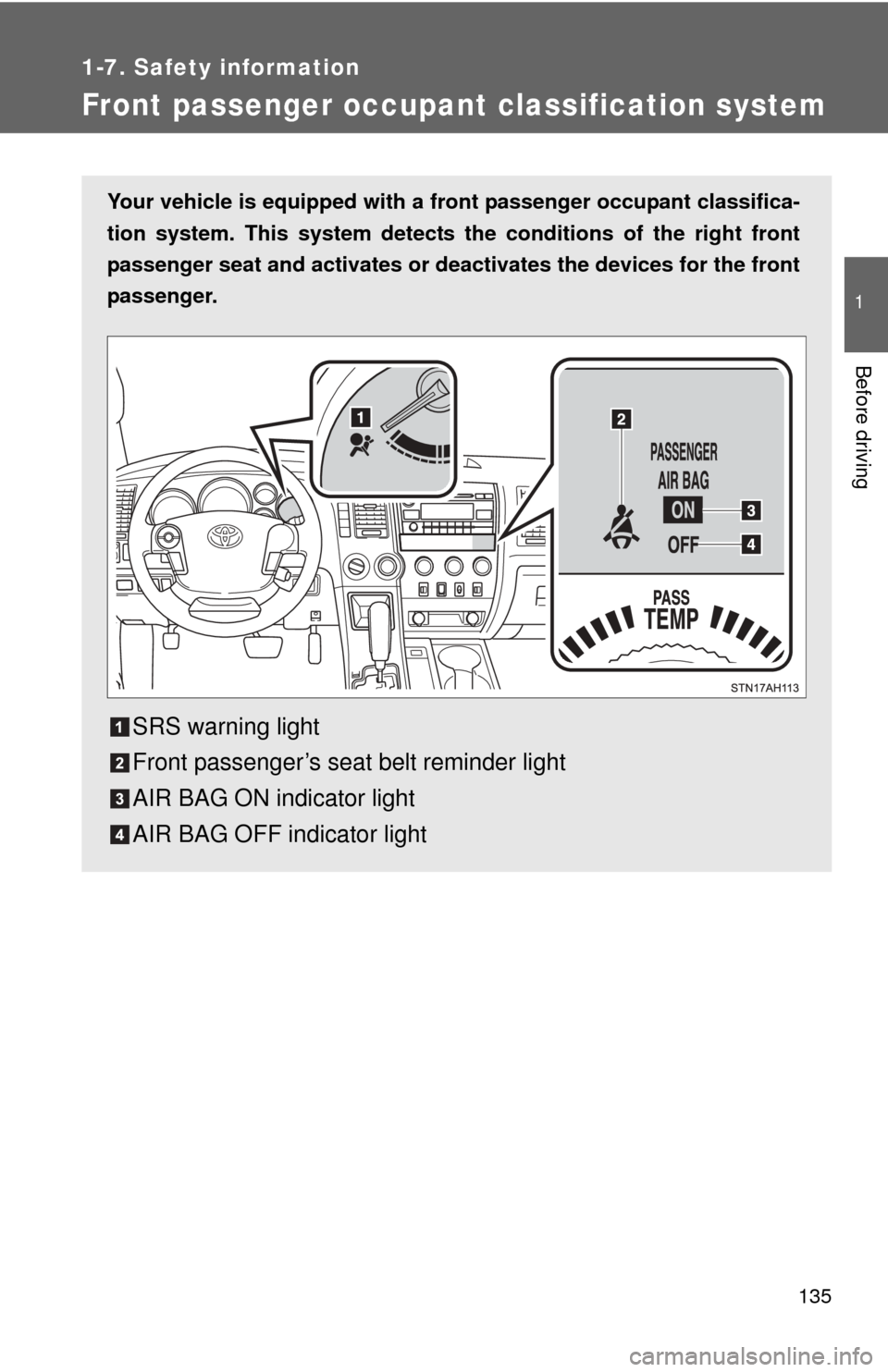
Front passenger occupant classification system
Your vehicle is equipped with a front passenger occupant classifica-
tion system. This system detects the conditions of the right front
passenger seat and activates or deactivates the devices for the front
passenger.
SRS warning light
Front passenger’s seat belt reminder light
AIR BAG ON indicator light
AIR BAG OFF indicator light
Page 136 of 752

136 1-7. Safety information
Conditions and operation of the front passenger occupant
classification system
■ Adult*
1
■Child*3 or child restraint system*4
Indicator/
warning light AIR BAG ON and AIR BAG OFF indica-
tor lights AIR BAG ON
SRS warning light Off
Front passenger’s seat belt reminder light
Flashing*2
Devices Front passenger airbag
Activated
Front passenger knee airbag
Side airbag on the front passenger seat
Curtain shield airbag in the front passen- ger side
Front passenger’s seat belt pretensioner
Indicator/
warning light AIR BAG ON and AIR BAG OFF indica-
tor lights AIR BAG
OFF*
5
SRS warning light Off
Front passenger’s seat belt reminder light Flashing*
2
DevicesFront passenger airbag
Deactivated
Front passenger knee airbag
Side airbag on the front passenger seat
Activated
Curtain shield airbag in the front passen-
ger side
Front passenger’s seat belt pretensioner
Page 137 of 752

137
1-7. Safety information
1
Before driving
■
Unoccupied
■ There is a malfunction in the system
*
1: The system judges a person of adult size as an adult. When a
smaller adult sits in the front passenger seat, the system may rec-
ognize him/her as a child depending on his/her physique and pos-
ture.
*
2: In the event the front passenger does not wear a seat belt.
Indicator/
warning light AIR BAG ON and AIR BAG OFF indica-
tor lights Not illumi-
nated
SRS warning light Off
Front passenger’s seat belt reminder
light
Devices Front passenger airbag
Deactivated
Front passenger knee airbag
Side airbag on the front passenger seat Activated
Curtain shield airbag in the front passen-
ger side
Front passenger’s seat belt pretensioner Deactivated
Indicator/
warning light AIR BAG ON and AIR BAG OFF indica-
tor lights AIR BAG
OFF
SRS warning light On
Front passenger’s seat belt reminder light Off
Devices Front passenger airbag
Deactivated
Front passenger knee airbag
Side airbag on the front passenger seat
Activated
Curtain shield airbag in the front passen-
ger side
Front passenger’s seat belt pretensioner
Page 139 of 752

139
1-7. Safety information
1
Before driving
CAUTION
■
Front passenger occupant cl assification system precautions
● Double Cab and CrewMax models: Do not let a rear passenger lift the
front passenger seat with their feet or press on the seatback with their
legs.
● Do not put objects under the front passenger seat.
● Do not recline the front passenger seatback so far that it touches a rear
seat or a back wall. This may cause the AIR BAG OFF indicator light to be
illuminated, which indicates that the passenger’s airbags will not deploy in
the event of a severe accident. If the seatback touches the rear seat or
back wall, return the seatback to a position where it does not touch the
rear seat or back wall. Keep the front passenger seatback as upright as
possible when the vehicle is moving. Reclining the seatback excessively
may lessen the effectiveness of the seat belt system.
● If an adult sits in the right front passenger seat, the AIR BAG ON indicator
light is illuminated. If the AIR BAG OFF indicator is illuminated, ask the
passenger to sit up straight, well back in the seat, feet on the floor, and
with the seat belt worn correctly. If the AIR BAG OFF indicator still remains
illuminated, either ask the passenger to move to the rear seat, or if that is
not possible, move the right front passenger seat fully rearward.
● When it is unavoidable to install the forward-facing child restraint system
on the front passenger seat, install the child restraint system on the front
passenger seat in the proper order. ( P. 144)
● Do not modify or remove the front seats.
● Do not kick the front passenger seat or subject it to severe impact. Other-
wise, the SRS warning light may come on to indicate a malfunction of the
detection system. In this case, contact your Toyota dealer immediately.
● Double Cab and CrewMax models: Child restraint systems installed on the
rear seat should not contact the front seatbacks.
● Do not use a seat accessory, such as a cushion or seat cover, that covers
the seat cushion surface.
● Do not attach a commercial seatback table or other heavy item to the back
of the front passenger seat.
● Do not modify or replace the upholstery of the front seat.