battery TOYOTA TUNDRA 2014 2.G Service Manual
[x] Cancel search | Manufacturer: TOYOTA, Model Year: 2014, Model line: TUNDRA, Model: TOYOTA TUNDRA 2014 2.GPages: 576, PDF Size: 10.54 MB
Page 490 of 576
4908-2. Steps to take in an emergency
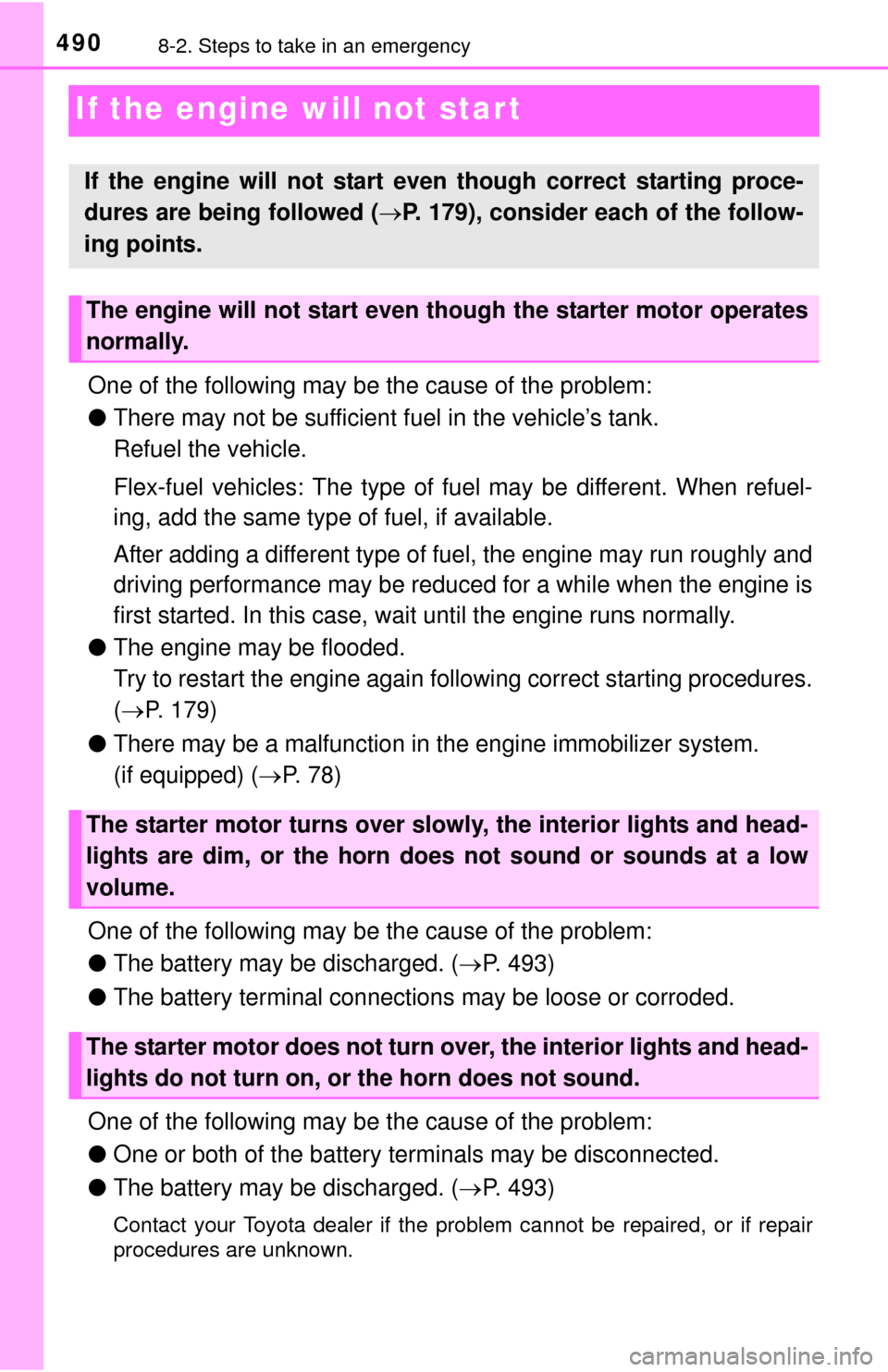
If the engine will not start
One of the following may be the cause of the problem:
●There may not be sufficient fuel in the vehicle’s tank.
Refuel the vehicle.
Flex-fuel vehicles: The type of fu el may be different. When refuel-
ing, add the same type of fuel, if available.
After adding a different type of fuel, the engine may run roughly and
driving performance may be reduced for a while when the engine is
first started. In this case, wait until the engine runs normally.
● The engine may be flooded.
Try to restart the engine again following correct starting procedures.
( P. 179)
● There may be a malfunction in the engine immobilizer system.
(if equipped) ( P. 78)
One of the following may be the cause of the problem:
● The battery may be discharged. ( P. 493)
● The battery terminal connections may be loose or corroded.
One of the following may be the cause of the problem:
● One or both of the battery terminals may be disconnected.
● The battery may be discharged. ( P. 493)
Contact your Toyota dealer if the problem cannot be repaired, or if repair
procedures are unknown.
If the engine will not start even though correct starting proce-
dures are being followed ( P. 179), consider each of the follow-
ing points.
The engine will not start even though the starter motor operates
normally.
The starter motor turns over slowly, the interior lights and head-
lights are dim, or the horn does not sound or sounds at a low
volume.
The starter motor does not turn ov er, the interior lights and head-
lights do not turn on, or the horn does not sound.
Page 493 of 576
493
8
When trouble arises
8-2. Steps to take in an emergency
If the vehicle batter y is discharged
If you have a set of jumper (or booster) cables and a second vehicle
with a 12-volt battery, you can jump start your vehicle by following the
steps below.
Open the hood. ( P. 405)
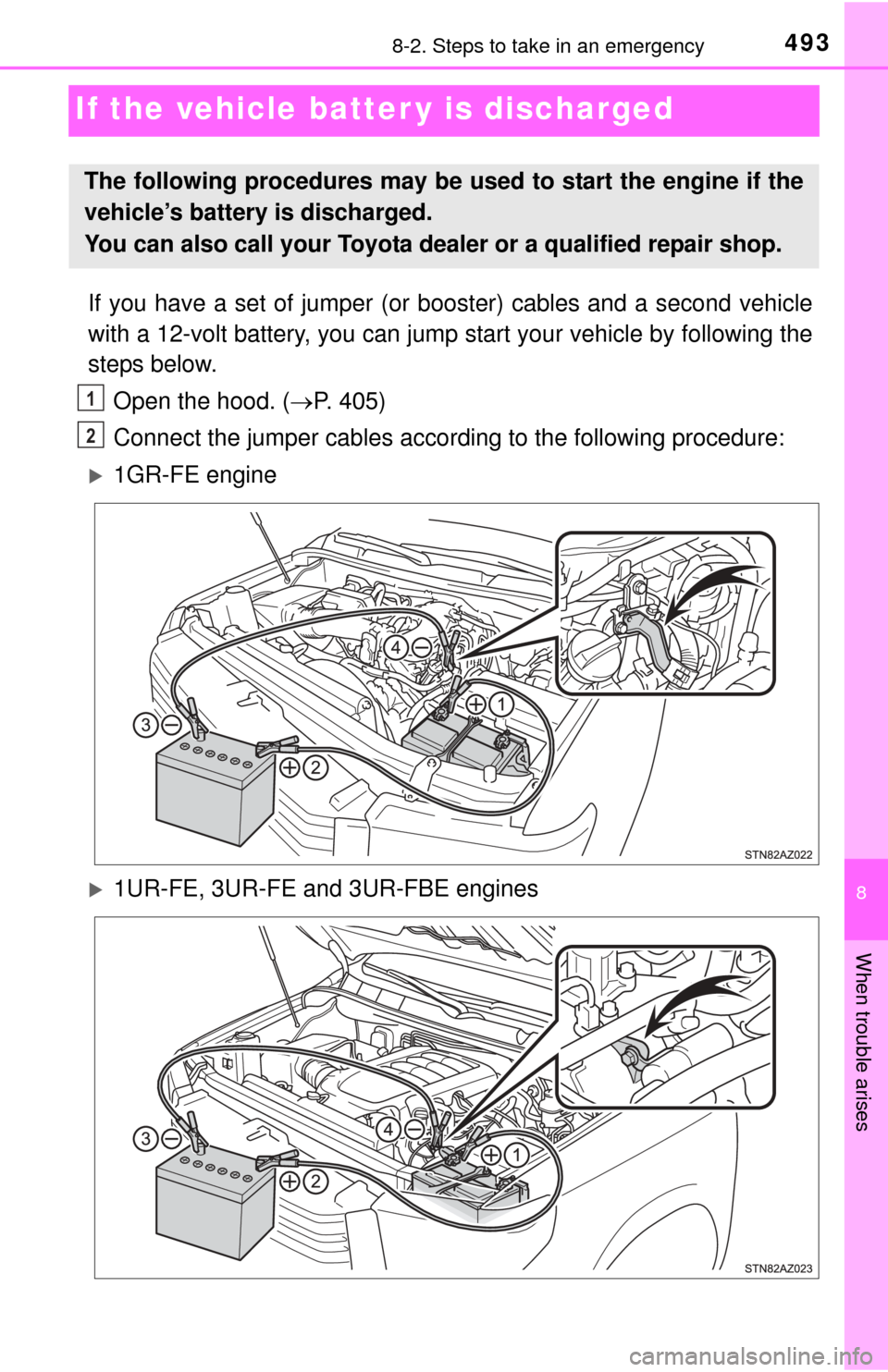
Connect the jumper cables according to the following procedure:
1GR-FE engine
1UR-FE, 3UR-FE and 3UR-FBE engines
The following procedures may be used to start the engine if the
vehicle’s battery is discharged.
You can also call your Toyota de aler or a qualified repair shop.
1
2
Page 494 of 576

4948-2. Steps to take in an emergency
Connect a positive jumper cable clamp to the positive (+) battery
terminal on your vehicle.
Connect the clamp on the other end of the positive cable to the
positive (+) battery terminal on the second vehicle.
Connect a negative cable clamp to the negative (-) battery termi-
nal on the second vehicle.
Connect the clamp at the other end of the negative cable to a
solid, stationary, unpainted metallic point away from the battery
and any moving parts, as shown in the illustration.
Start the engine of the second vehicle. Increase the engine speed
slightly and maintain at that le vel for approximately 5 minutes to
recharge the batter y of your vehicle.
Maintain the engine speed of t he second vehicle and start the
engine of your vehicle.
Once the vehicle’s engine has started, remove the jumper cables in
the exact reverse order from which they were connected.
Once the engine starts, have the vehicle inspected at your Toyota
dealer as soon as possible.
■ Starting the engine when the battery is discharged
The engine cannot be started by push-starting.
■ To prevent battery discharge
●Turn off the headlights and the audio system while the engine is off.
● Turn off any unnecessary electrical components when the vehicle is running
at a low speed for an extended period, such as in heavy traffic.
■ When the battery is removed or discharged
●The moon roof must be initialized. ( P. 144)
● Flex-fuel vehicles: The information recorded in the computer will be cleared,
which may cause the engine to run roughly and reduce driving performance
for a while when the engine is first started. In this case, wait until the engine
runs normally.
If the vehicle is running on E85, the engine may stall.
In this case, restart the engine, repeatedly if necessary.
● Vehicles with alarm: Make sure that the key is not inside the vehicle when
recharging or replacing the battery. The key may be locked in the vehicle if
the alarm is activated. (P. 81)
1
2
3
4
3
4
5
Page 495 of 576
4958-2. Steps to take in an emergency
8
When trouble arises
■Charging the battery
The electricity stored in the battery will discharge gradually even when the
vehicle is not in use, due to natural discharge and the draining effects of cer-
tain electrical appliances. If the vehicle is left for a long time, the battery may
discharge, and the engine may be unable to start. (The battery recharges
automatically during driving.)
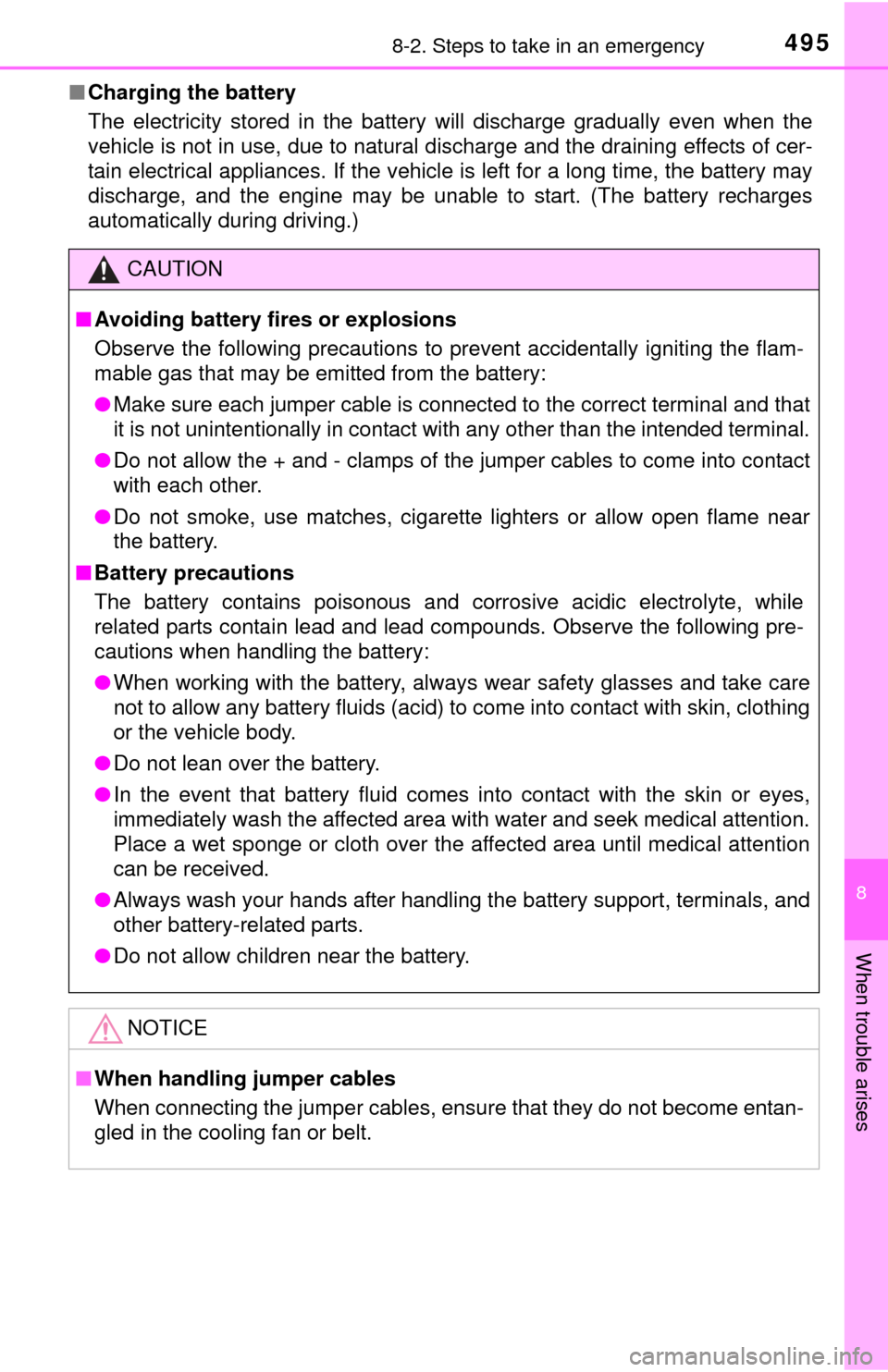
CAUTION
■Avoiding battery fires or explosions
Observe the following precautions to prevent accidentally igniting the flam-
mable gas that may be emitted from the battery:
● Make sure each jumper cable is connected to the correct terminal and that
it is not unintentionally in contact with any other than the intended terminal.
● Do not allow the + and - clamps of the jumper cables to come into contact
with each other.
● Do not smoke, use matches, cigarette lighters or allow open flame near
the battery.
■ Battery precautions
The battery contains poisonous and corrosive acidic electrolyte, while
related parts contain lead and lead compounds. Observe the following pre-
cautions when handling the battery:
● When working with the battery, always wear safety glasses and take care
not to allow any battery fluids (acid) to come into contact with skin, clothing
or the vehicle body.
● Do not lean over the battery.
● In the event that battery fluid comes into contact with the skin or eyes,
immediately wash the affected area with water and seek medical attention.
Place a wet sponge or cloth over the affected area until medical attention
can be received.
● Always wash your hands after handling the battery support, terminals, and
other battery-related parts.
● Do not allow children near the battery.
NOTICE
■When handling jumper cables
When connecting the jumper cables, ensure that they do not become entan-
gled in the cooling fan or belt.
Page 511 of 576

5119-1. Specifications
9
Vehicle specifications
*: Your Toyota vehicle is filled with “Toyota Genuine Differential Gear Oil” atthe factory. Use Toyota approved “Toyota Genuine Differential Gear Oil” or
an equivalent oil of matching quality to satisfy the above specification.
Please contact your Toyota dealer for further details.
Electrical system
Battery
Open voltage at 68 F
(20 C):12.6 12.8 V Fully charged
12.2
12.4 V Half charged
11 . 8
12.0 V Discharged
(Voltage is checked 20 minutes after the engine
and all lights are turned off.)
Charging rates5 A max.
Differential
Oil
capacity
Front (4WD models) 2.2 qt. (2.05 L, 1.8 Imp.qt.)
Rear
1GR-FE and
1UR-FE engines4.9 qt. (4.60 L, 4.0 Imp.qt.)
3UR-FE
and
3UR-FBE
engines
Regular Cab
models3.8 qt. (3.60 L, 3.2 Imp.qt.)
Double Cab
models
With standard bed
3.8 qt. (3.60 L, 3.2 Imp.qt.)
With long bed
4.0 qt. (3.75 L, 3.3 Imp.qt.)
CrewMax
models
2WD models
4.0 qt. (3.75 L, 3.3 Imp.qt.)
4WD models
3.8 qt. (3.60 L, 3.2 Imp.qt.)
Oil type and viscosity*
Toyota Genuine Differential
Gear Oil LT 75W-85 GL-5 or
equivalent
Page 525 of 576
5259-1. Specifications
9
Vehicle specifications
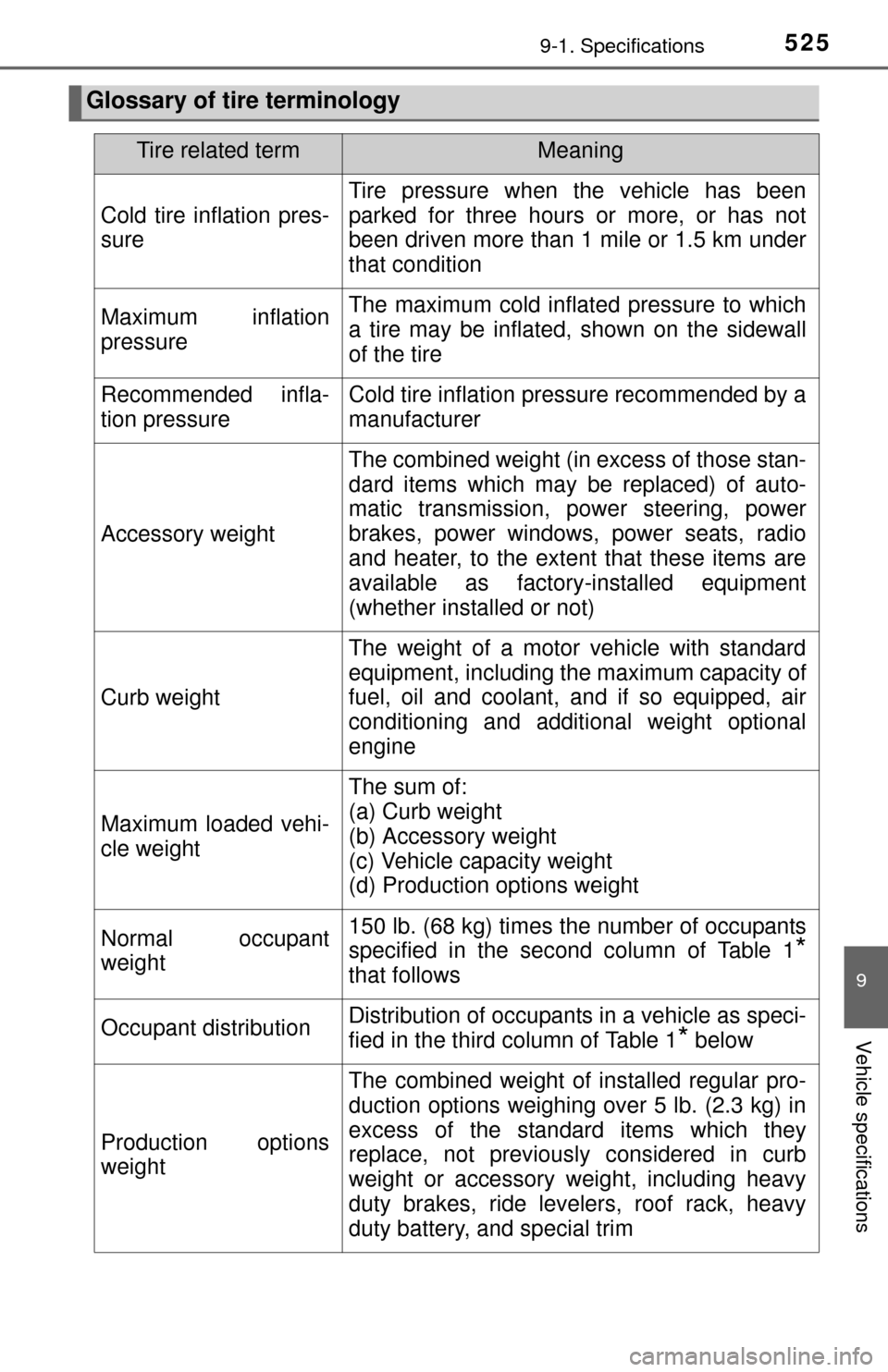
Glossary of tire terminology
Tire related termMeaning
Cold tire inflation pres-
sure
Tire pressure when the vehicle has been
parked for three hours or more, or has not
been driven more than 1 mile or 1.5 km under
that condition
Maximum inflation
pressureThe maximum cold inflated pressure to which
a tire may be inflated, shown on the sidewall
of the tire
Recommended infla-
tion pressureCold tire inflation pressure recommended by a
manufacturer
Accessory weight
The combined weight (in excess of those stan-
dard items which may be replaced) of auto-
matic transmission, power steering, power
brakes, power windows, power seats, radio
and heater, to the extent that these items are
available as factory-installed equipment
(whether installed or not)
Curb weight
The weight of a motor vehicle with standard
equipment, including the maximum capacity of
fuel, oil and coolant, and if so equipped, air
conditioning and additional weight optional
engine
Maximum loaded vehi-
cle weight
The sum of:
(a) Curb weight
(b) Accessory weight
(c) Vehicle capacity weight
(d) Production options weight
Normal occupant
weight150 lb. (68 kg) times the number of occupants
specified in the second column of Table 1
*
that follows
Occupant distributionDistribution of occupants in a vehicle as speci-
fied in the third column of Table 1
* below
Production options
weight
The combined weight of installed regular pro-
duction options weighing over 5 lb. (2.3 kg) in
excess of the standard items which they
replace, not previously considered in curb
weight or accessory weight, including heavy
duty brakes, ride levelers, roof rack, heavy
duty battery, and special trim
Page 534 of 576
5349-2. Customization
■Vehicle customization
●When the speed-detecting automatic door lock function and shift position
linked door locking function (shifting gears to a position other than P locks
all doors) are both on, the door lock operates as follows.
• When shifting the shift lever to any position other than P, all the doors will be locked.
• If the vehicle is started with all the doors locked, the speed-detecting auto- matic door lock function would not operate.
• If the vehicle is started with any the door unlocked, the speed-detecting
automatic door lock function will operate.
● When the doors remain closed after unlocking the doors and the automatic
door lock function (Time elapsed before the automatic door lock function is
activated if a door is not opened after being unlocked) activates, the signals
will be generated in accordance with operation signal (buzzers) and the
operation signal (emergency flashers) settings.
CAUTION
■During customization
As the engine needs to be running during customization, ensure that the
vehicle is parked in a place with adequate ventilation. In a closed area such
as a garage, exhaust gases including harmful carbon monoxide (CO) may
collect and enter the vehicle. This may lead to death or serious health haz-
ard.
NOTICE
■During customization
To prevent battery discharge, ensure that the engine is running while cus-
tomizing features.
Page 535 of 576
5359-3. Items to initialize
9
Vehicle specifications
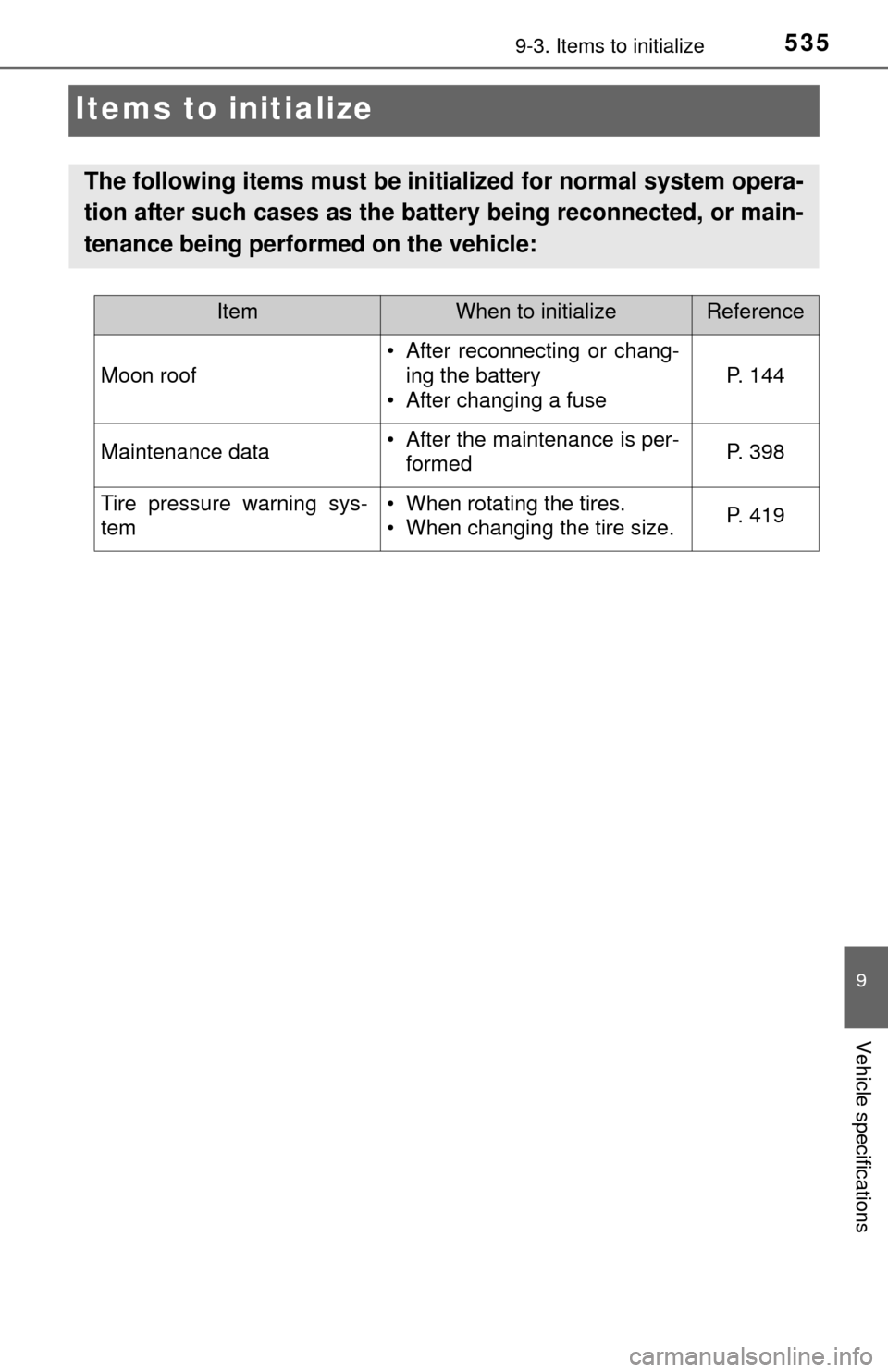
Items to initialize
The following items must be initialized for normal system opera-
tion after such cases as the battery being reconnected, or main-
tenance being performed on the vehicle:
ItemWhen to initializeReference
Moon roof
• After reconnecting or chang- ing the battery
• After changing a fuse
P. 144
Maintenance data• After the maintenance is per- formedP. 398
Tire pressure warning sys-
tem• When rotating the tires.
• When changing the tire size.P. 419
Page 558 of 576
558What to do if... (Troubleshooting)
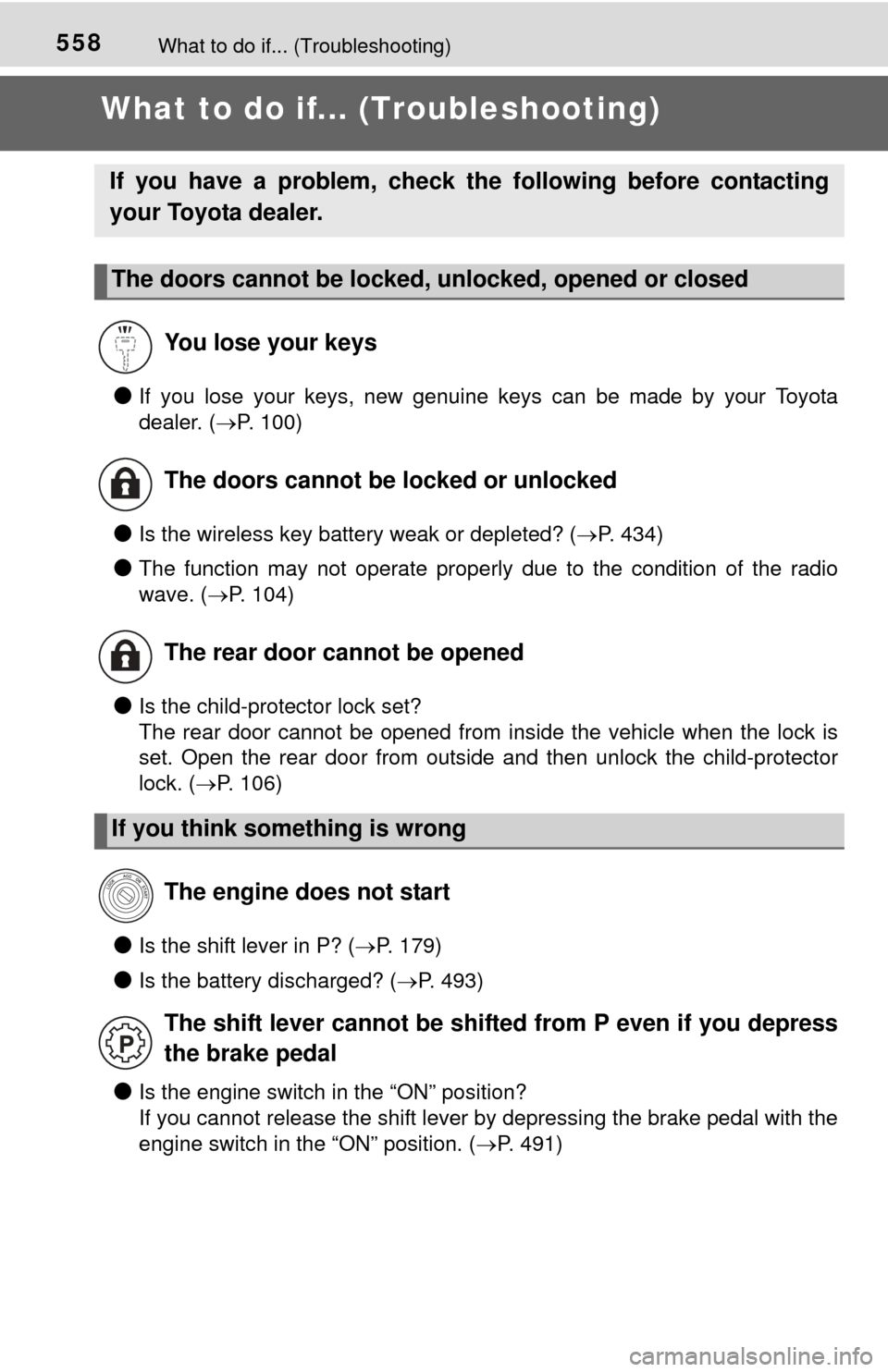
What to do if... (Troubleshooting)
●If you lose your keys, new genuine keys can be made by your Toyota
dealer. (P. 100)
●Is the wireless key battery weak or depleted? ( P. 434)
●The function may not operate properly due to the condition of the radio
wave. (P. 104)
●Is the child-protector lock set?
The rear door cannot be opened from inside the vehicle when the lock is
set. Open the rear door from outside and then unlock the child-protector
lock. (P. 106)
●Is the shift lever in P? ( P. 179)
●Is the battery discharged? ( P. 493)
●Is the engine switch in the “ON” position?
If you cannot release the shift lever by depressing the brake pedal with the
engine switch in the “ON” position. ( P. 491)
If you have a problem, check th e following before contacting
your Toyota dealer.
The doors cannot be locked, unlocked, opened or closed
You lose your keys
The doors cannot be locked or unlocked
The rear door cannot be opened
If you think something is wrong The engine does not start
The shift lever cannot be shifted from P even if you depress
the brake pedal
Page 562 of 576

562Alphabetical index
AUTO LSD system ................... 229
Automatic light control system .................................... 189
Automatic transmission Automatic transmission......... 181
If the shift lever cannot be shifted from P ..................... 491
TOW/HAUL switch ................ 184
AUX port ........................... 255, 282
Auxiliary boxes ........................ 369
Back window Back window ......................... 139
Power back window .............. 140
Back-up lights
Replacing light bulbs............. 450
Wattage ................................ 515
Battery ...................................... 414
If the vehicle battery is discharged .......................... 493
Preparing and checking
before winter....................... 240
Warning light ......................... 464
Blind Spot Monitor (BSM) ....... 218
Bluetooth
®
Audio system ................ 289, 295
Hands-free system
(for cellular phone) ..... 289, 296
Bottle holders .......................... 368
Brake Fluid ...................................... 412
Parking brake........................ 187
Warning buzzer..................... 464
Warning light ......................... 464
Brake assist ............................. 231
Break-in tips ............................. 147 Brightness control
Instrument panel light control .................................. 90
BSM (Blind Spot Monitor) ....... 218 Blind Spot Monitor function............................... 220
Rear Cross Traffic Alert
function............................... 223
Camper information ................ 550
Card holder .............................. 360
Care .................................. 392, 394 Aluminum wheels ................. 392
Exterior ................................. 392
Interior .................................. 394
Seat belts.............................. 395
Cargo capacity......................... 156
Cargo lamp Light switch ........................... 355
Replacing light bulbs ............ 452
Wattage ................................ 515
CD player.................................. 269
Certification label ............ 161, 506
Chains ...................................... 241
Child restraint system............... 56 Booster seats, definition ......... 57
Booster seats, installation....... 67
Convertible seats, definition ... 57
Convertible seats, installation ...................... 65, 66
Front passenger occupant classification syst em ............ 50
Infant seats, definition............. 57
Infant seats, installation .......... 65
Installing CRS with LATCH anchors ............ 63
Installing CRS with seat belts...................................... 65
Installing CRS
with top tether strap.............. 68
B
C