hood open TOYOTA TUNDRA 2014 2.G Owners Manual
[x] Cancel search | Manufacturer: TOYOTA, Model Year: 2014, Model line: TUNDRA, Model: TOYOTA TUNDRA 2014 2.GPages: 576, PDF Size: 10.54 MB
Page 5 of 576

5
1
9 8
7 5 4
3
2
10
6
6-4. Other interior featuresOther interior features ....... 374• Sun visors ..................... 374
• Vanity mirrors................ 374
• Clock ............................. 375
• Outside temperature
display........................... 376
• Power outlets ................ 377
• Armrest ......................... 379
• Assist grips ................... 380
Garage door opener .......... 381
Compass ........................... 387
7-1. Maintenance and care Cleaning and protecting the vehicle exterior .......... 392
Cleaning and protecting the vehicle interior ........... 394
7-2. Maintenance Maintenance requirements ................... 397
General maintenance ........ 399
Emission inspection and maintenance (I/M)
programs ......................... 402
7-3. Do-it-yourself maintenance Do-it-yourself service precautions ..................... 403
Hood.................................. 405
Engine compartment ......... 406
Tires .................................. 417
Tire inflation pressure........ 425
Wheels .............................. 428
Air conditioning filter .......... 431
Wireless remote control battery ............................. 434
Checking and replacing fuses ............................... 436
Light bulbs ......................... 439 8-1. Essential information
Emergency flashers ........... 456
If your vehicle has to be stopped in
an emergency.................. 457
8-2. Steps to take in an emergency
If your vehicle needs to be towed .......................... 458
If you think something is wrong............................... 462
Fuel pump shut off system ............................. 463
If a warning light turns on or a warning buzzer
sounds ............................. 464
If a warning message is displayed (vehicles
with multi-information
display) ............................ 472
If you have a flat tire .......... 475
If the engine will not start ................................. 490
If the shift lever cannot be shifted from P ............. 491
If the vehicle battery is discharged ....................... 493
If your vehicle overheats.... 496
If the vehicle becomes stuck ................................ 498
7Maintenance and care
8When trouble arises
Page 15 of 576
15Pictorial index
Fuel filler door . . . . . . . . . . . . . . . . . . . . . . . . . . . . . . . . . . . . P. 196
Refueling method . . . . . . . . . . . . . . . . . . . . . . . . . . . . . . . . . . . P. 196
Fuel type/fuel tank capacity . . . . . . . . . . . . . . . . . . . . . . . . . . . P. 508
Tires . . . . . . . . . . . . . . . . . . . . . . . . . . . . . . . . . . . . . . . . . . . . P. 417
Tire size/inflation pressure . . . . . . . . . . . . . . . . . . . . . . . . . . . . P. 513
Winter tires/tire chain . . . . . . . . . . . . . . . . . . . . . . . . . . . . . . . . P. 240
Checking/rotation/tire pressure warning system . . . . . . . . . . . P. 417
Coping with flat tires . . . . . . . . . . . . . . . . . . . . . . . . . . . . . . . . P. 475
Hood . . . . . . . . . . . . . . . . . . . . . . . . . . . . . . . . . . . . . . . . . . . . P. 405
Opening . . . . . . . . . . . . . . . . . . . . . . . . . . . . . . . . . . . . . . . . . . P. 405
Engine oil . . . . . . . . . . . . . . . . . . . . . . . . . . . . . . . . . . . . . . . . . P. 508
Coping with overheat . . . . . . . . . . . . . . . . . . . . . . . . . . . . . . . . P. 496
Camera . . . . . . . . . . . . . . . . . . . . . . . . . . . . . . . . . . . . . . . . . . P. 209
Headlights. . . . . . . . . . . . . . . . . . . . . . . . . . . . . . . . . . . . . . . . P. 189
Fog lights
*3 . . . . . . . . . . . . . . . . . . . . . . . . . . . . . . . . . . . . . . P. 192
Front turn signal lights . . . . . . . . . . . . . . . . . . . . . . . . . . . . . P. 186
Parking lights (bulb type)
*3/
daytime running lights (bulb type)
*3. . . . . . . . . . . . . . . . . . P. 189
Parking lights (LED type)
*3/
daytime running lights (LED type)
*3 . . . . . . . . . . . . . . . . . . P. 189
Rear turn signal lights . . . . . . . . . . . . . . . . . . . . . . . . . . . . . . P. 186
Tail lights . . . . . . . . . . . . . . . . . . . . . . . . . . . . . . . . . . . . . . . . P. 189
License plate lights . . . . . . . . . . . . . . . . . . . . . . . . . . . . . . . . P. 189
Back-up lights
Shifting the shift lever to R . . . . . . . . . . . . . . . . . . . . . . . . . . . . P. 181
Side marker lights . . . . . . . . . . . . . . . . . . . . . . . . . . . . . . . . . P. 189
6
7
8
9
Light bulbs of the exterior lights for driving
(Replacing method: P. 439, Watts: P. 515)
*1: Vehicles with multi-information display
*2: If equipped on CrewMax models
*3: If equipped
10
11
12
13
14
15
16
17
18
Page 55 of 576
551-1. For safe use
1
For safety and security
Safety information for children
●Double Cab and CrewMax models: It is recommended that children
sit in the rear seats to avoid acci dental contact with the shift lever,
wiper switch, etc.
● Use the rear door child-protector lock (Double Cab and CrewMax
models) or the window lock switch (if equipped) to avoid children
opening the door while driving or operating the power window acci-
dentally.
● Do not let small children operate equipment which may catch or
pinch body parts, such as the pow er window, hood, tailgate, seats,
etc.
Observe the following precautions when children are in the vehi-
cle.
Use a child restraint system appropriate for the child, until the
child becomes large enough to properly wear the vehicle’s seat
belt.
CAUTION
Never leave children unattended in the vehicle, and never allow children to
have or use the key.
Children may be able to start the vehicle or shift the vehicle into neutral.
There is also a danger that children may injure themselves by playing with
the windows, the moon roof or other features of the vehicle. In addition, heat
build-up or extremely cold temperatures inside the vehicle can be fatal to
children.
Page 80 of 576
801-2. Theft deterrent system
Alar m
The alarm uses light and sound to give an alert when an intrusion is
detected.
The alarm is triggered in the following situations when the alarm is
set:
●A locked door is unlocked or opene d in any way other than using a
key or wireless remote control. (The doors will lock again automati-
cally.)
● The hood is opened.
● Vehicles with the glass breakage sensor: The side windows are
tapped or broken.
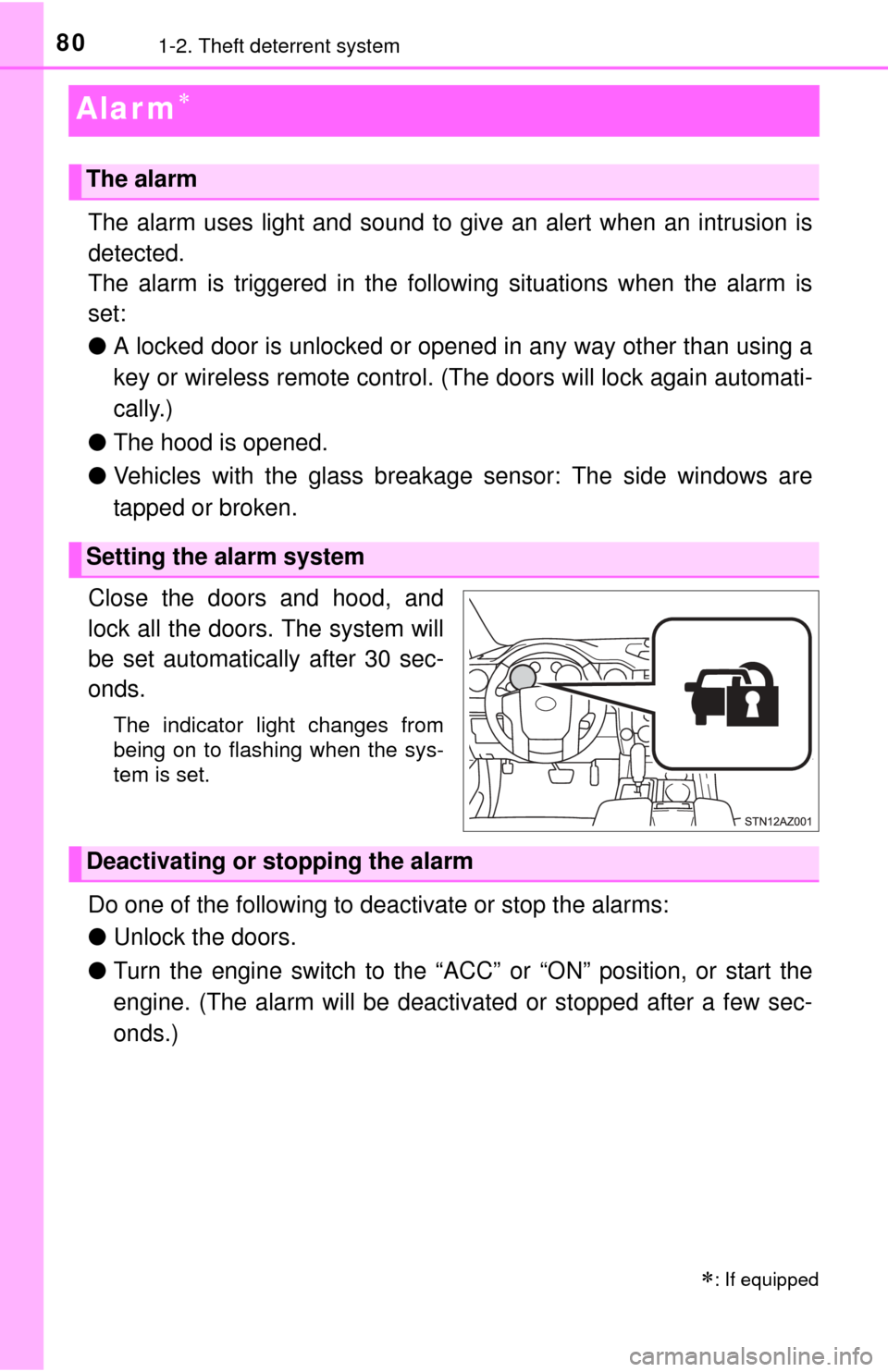
Close the doors and hood, and
lock all the doors. The system will
be set automatically after 30 sec-
onds.
The indicator light changes from
being on to flashing when the sys-
tem is set.
Do one of the following to d eactivate or stop the alarms:
● Unlock the doors.
● Turn the engine switch to the “ACC” or “ON” position, or start the
engine. (The alarm will be deactivated or stopped after a few sec-
onds.)
: If equipped
The alarm
Setting the alarm system
Deactivating or stopping the alarm
Page 81 of 576
811-2. Theft deterrent system
1
For safety and security
■System maintenance
The vehicle has a maintenance-free type alarm system.
■ Items to check before locking the vehicle
To prevent unexpected triggering of the alarm and vehicle theft, make sure of
the following:
●Nobody is in the vehicle.
● The windows and moon roof (if equipped) are closed before the alarm is set.
● No valuables or other personal items are left in the vehicle.
■ Triggering of the alarm
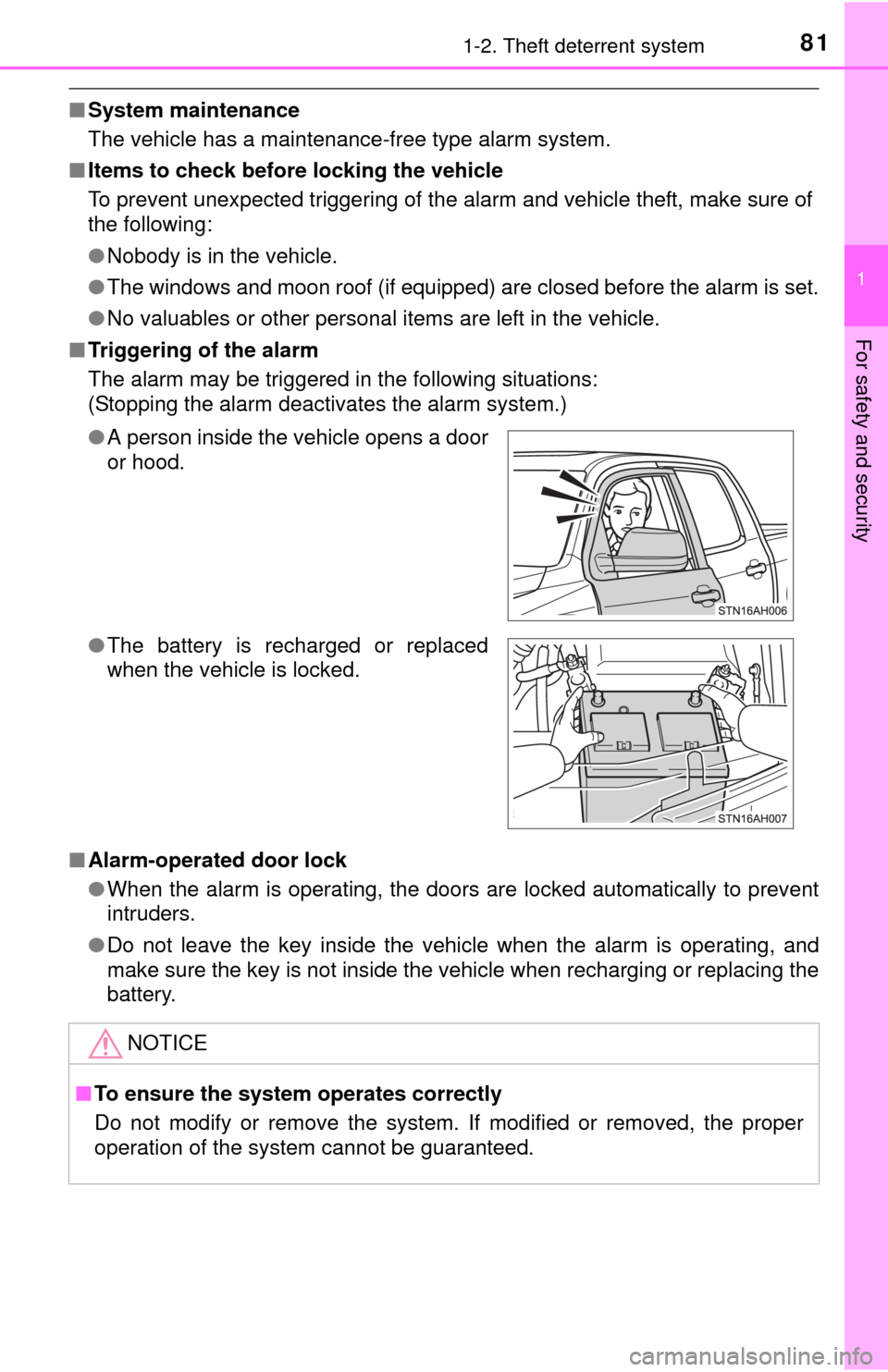
The alarm may be triggered in the following situations:
(Stopping the alarm deactivates the alarm system.)
■ Alarm-operated door lock
●When the alarm is operating, the doors are locked automatically to prevent
intruders.
● Do not leave the key inside the vehicle when the alarm is operating, and
make sure the key is not inside the vehicle when recharging or replacing the
battery.
●
A person inside the vehicle opens a door
or hood.
● The battery is recharged or replaced
when the vehicle is locked.
NOTICE
■To ensure the system operates correctly
Do not modify or remove the system. If modified or removed, the proper
operation of the system cannot be guaranteed.
Page 389 of 576
3896-4. Other interior features
6
Interior features
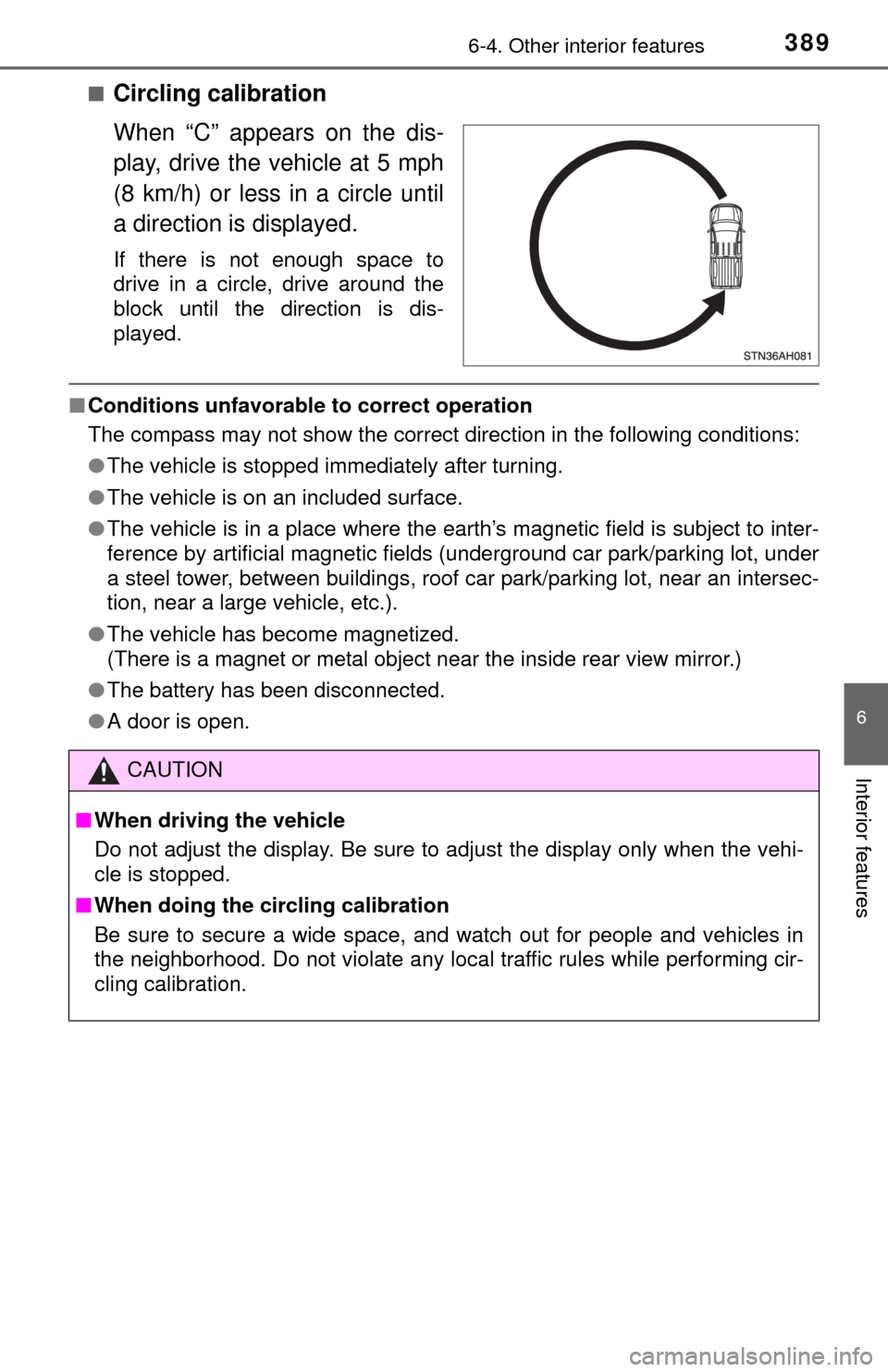
■Circling calibration
When “C” appears on the dis-
play, drive the vehicle at 5 mph
(8 km/h) or less in a circle until
a direction is displayed.
If there is not enough space to
drive in a circle, drive around the
block until the direction is dis-
played.
■Conditions unfavorable to correct operation
The compass may not show the correct direction in the following conditions:
●The vehicle is stopped immediately after turning.
● The vehicle is on an included surface.
● The vehicle is in a place where the earth’s magnetic field is subject to inter-
ference by artificial magnetic fields (underground car park/parking lot, under
a steel tower, between buildings, roof car park/parking lot, near an intersec-
tion, near a large vehicle, etc.).
● The vehicle has become magnetized.
(There is a magnet or metal object near the inside rear view mirror.)
● The battery has been disconnected.
● A door is open.
CAUTION
■When driving the vehicle
Do not adjust the display. Be sure to adjust the display only when the vehi-
cle is stopped.
■ When doing the circling calibration
Be sure to secure a wide space, and watch out for people and vehicles in
the neighborhood. Do not violate any local traffic rules while performing cir-
cling calibration.
Page 405 of 576
4057-3. Do-it-yourself maintenance
7
Maintenance and care
Hood
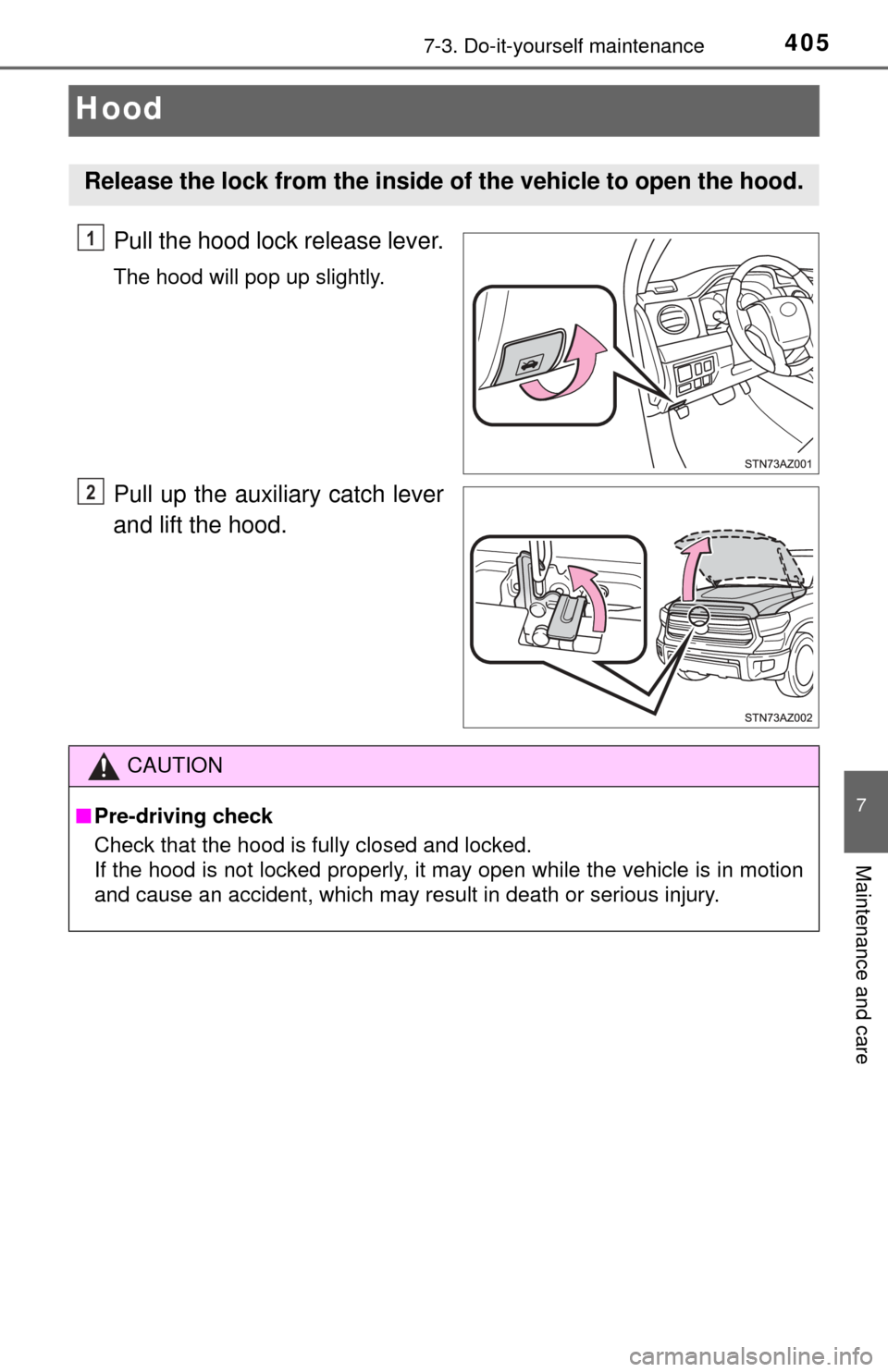
Pull the hood lock release lever.
The hood will pop up slightly.
Pull up the auxiliary catch lever
and lift the hood.
Release the lock from the inside of the vehicle to open the hood.
1
2
CAUTION
■Pre-driving check
Check that the hood is fully closed and locked.
If the hood is not locked properly, it may open while the vehicle is in motion
and cause an accident, which may result in death or serious injury.
Page 493 of 576
493
8
When trouble arises
8-2. Steps to take in an emergency
If the vehicle batter y is discharged
If you have a set of jumper (or booster) cables and a second vehicle
with a 12-volt battery, you can jump start your vehicle by following the
steps below.
Open the hood. ( P. 405)
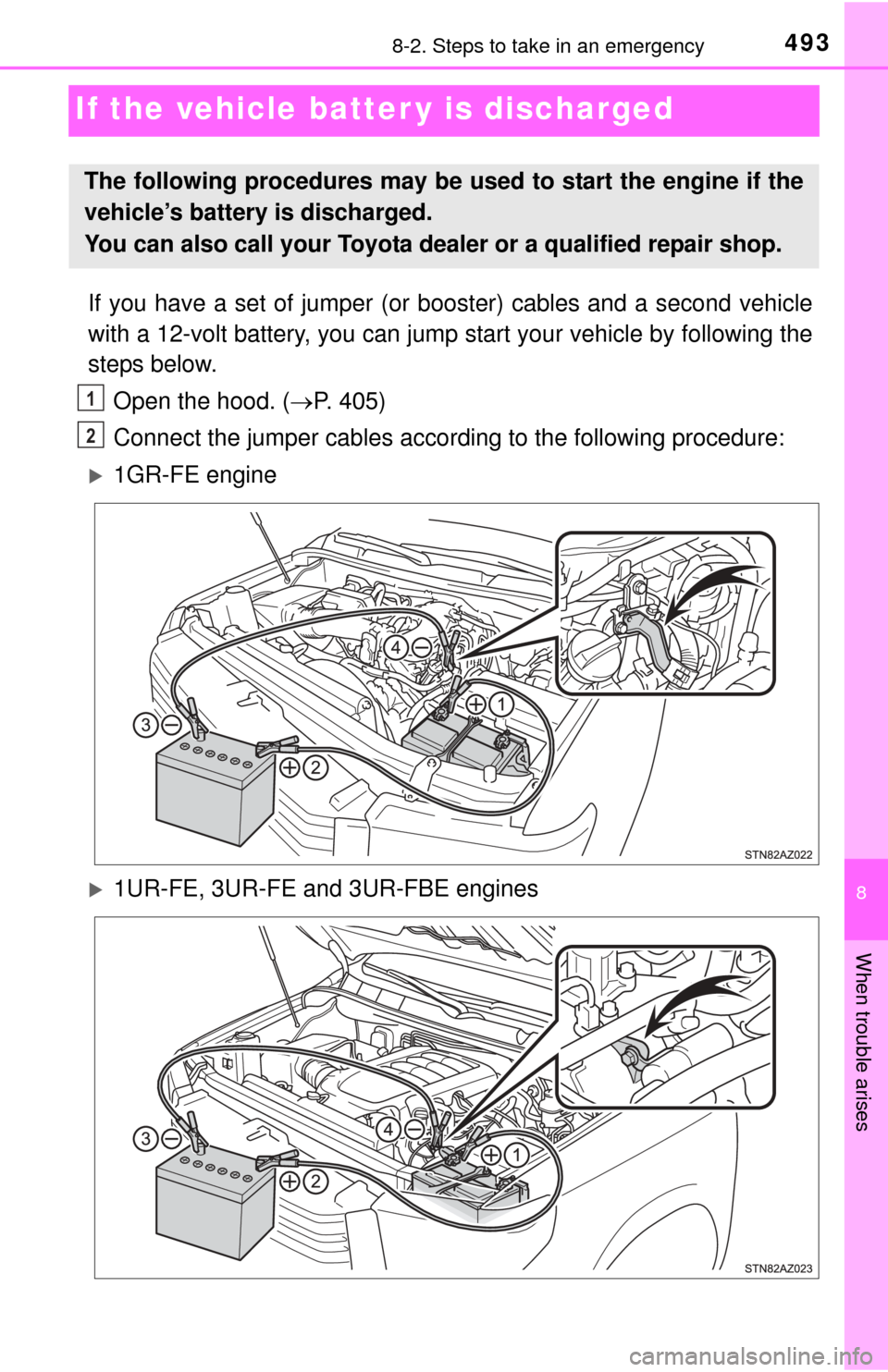
Connect the jumper cables according to the following procedure:
1GR-FE engine
1UR-FE, 3UR-FE and 3UR-FBE engines
The following procedures may be used to start the engine if the
vehicle’s battery is discharged.
You can also call your Toyota de aler or a qualified repair shop.
1
2
Page 497 of 576
4978-2. Steps to take in an emergency
8
When trouble arises
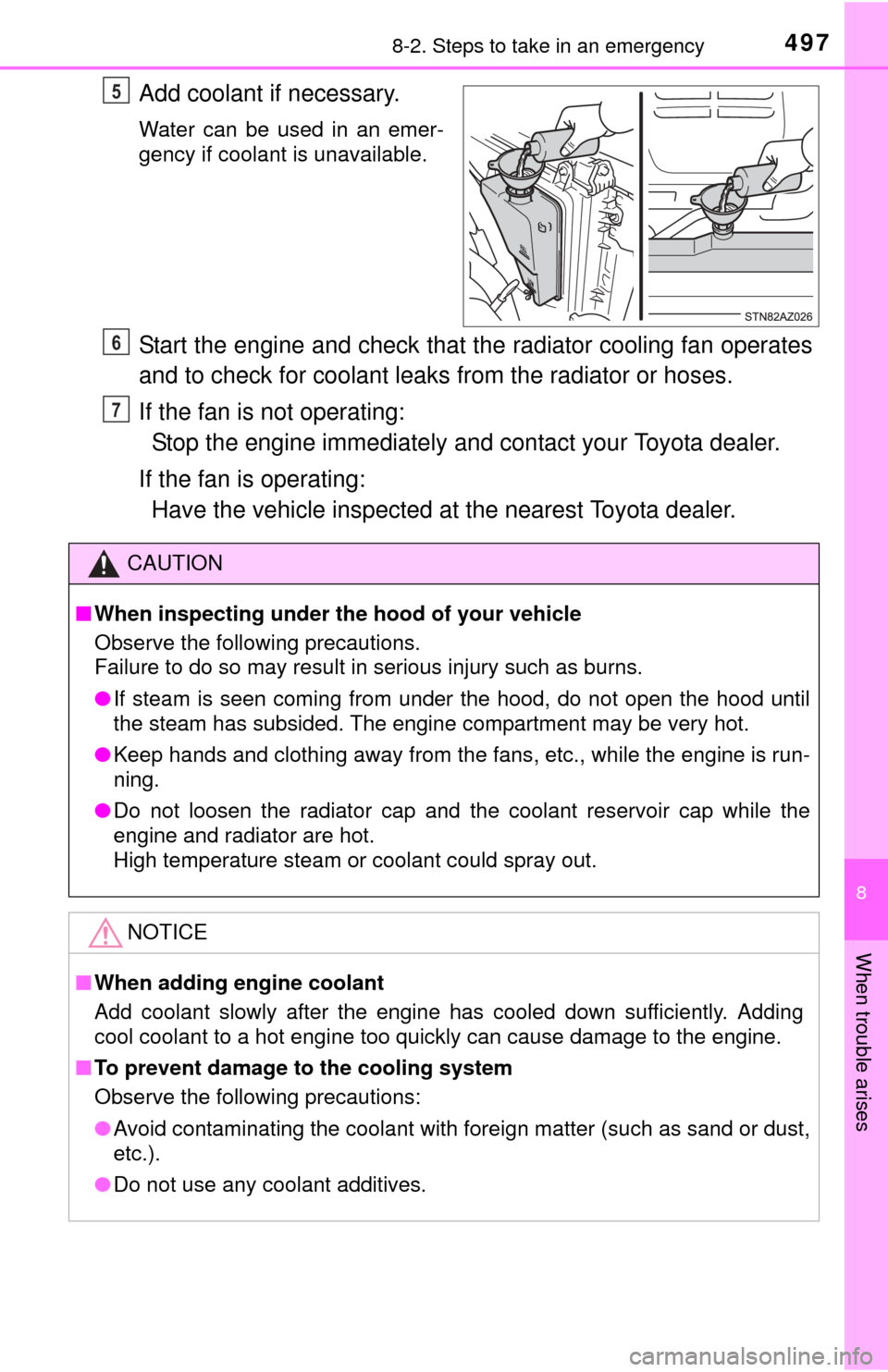
Add coolant if necessary.
Water can be used in an emer-
gency if coolant is unavailable.
Start the engine and check that the radiator cooling fan operates
and to check for coolant leaks from the radiator or hoses.
If the fan is not operating: Stop the engine immediately and contact your Toyota dealer.
If the fan is operating: Have the vehicle inspected at the nearest Toyota dealer.
5
CAUTION
■ When inspecting under the hood of your vehicle
Observe the following precautions.
Failure to do so may result in serious injury such as burns.
● If steam is seen coming from under the hood, do not open the hood until
the steam has subsided. The engine compartment may be very hot.
● Keep hands and clothing away from the fans, etc., while the engine is run-
ning.
● Do not loosen the radiator cap and the coolant reservoir cap while the
engine and radiator are hot.
High temperature steam or coolant could spray out.
NOTICE
■When adding engine coolant
Add coolant slowly after the engine has cooled down sufficiently. Adding
cool coolant to a hot engine too quickly can cause damage to the engine.
■ To prevent damage to the cooling system
Observe the following precautions:
● Avoid contaminating the coolant with foreign matter (such as sand or dust,
etc.).
● Do not use any coolant additives.
6
7
Page 568 of 576

568Alphabetical index
MaintenanceDo-it-yourself maintenance ... 403
General maintenance ........... 399
Maintenance data ................. 500
Maintenance requirements ... 397
Reset the maintenance data .................................... 398
Malfunction indicator lamp ..... 464
Manual headlight leveling dial .......................................... 190
Map holder ............................... 362
Master warning light........ 466, 472
Meter Indicators ................................ 86
Instrument panel light control................................... 90
Meters ..................................... 88
Multi-information display ......... 93
Trip information display........... 91
Warning lights ......................... 85
Mirrors Inside rear view mirror .......... 129
Outside rear view
mirror defoggers ......... 338, 345
Outside rear view mirrors...... 132
Vanity mirrors........................ 374
Moon roof ................................. 142 Door lock linked
moon roof operation ........... 143
Jam protection function......... 142
Operation .............................. 142 MP3 disc ................................... 269
Multi-information display.......... 93
Settings................................... 95
Switching the display .............. 91
Trip information....................... 94
Warning message................. 472
Noise from under vehicle ........... 8
Odometer ............................. 91, 93
Off-road precaution s ............... 244
Oil Engine oil .............................. 508
Differential oil ........................ 511
Transfer oil............................ 512
Opener Hood ..................................... 405
Outer foot lights Location ................................ 353
Replacing light bulbs ............ 452
Wattage ................................ 515
Outside rear view mirrors ....... 132 Adjusting and folding ............ 132
Blind spot monitor ................. 218
Mirror position memory ......... 118
Outside rear view
mirror defoggers ......... 338, 345
Outside temperature display.................................... 376
Overhead console ................... 365
Overheating ............................. 496
M
N
O