airbag off TOYOTA TUNDRA 2015 2.G Owners Manual
[x] Cancel search | Manufacturer: TOYOTA, Model Year: 2015, Model line: TUNDRA, Model: TOYOTA TUNDRA 2015 2.GPages: 576, PDF Size: 9.71 MB
Page 9 of 576

9
The installation of a mobile two-way radio system in your vehicle could affect
electronic systems such as:
●Multiport fuel injection system/sequential multiport fuel injection system
● Cruise control system (if equipped)
● Anti-lock brake system
● SRS airbag system
● Seat belt pretensioner system
Be sure to check with your Toyota dealer for precautionary measures or spe-
cial instructions regarding installation of a mobile two-way radio system.
Your Toyota is equipped with several sophisticated computers that will record
certain data, such as: • Engine speed
• Accelerator status
• Brake status
• Vehicle speed
• Shift position
The recorded data varies according to the vehicle grade level and options
with which it is equipped. Furthermore, these computers do not record con-
versations, sounds or pictures.
●Data usage
Toyota may use the data recorded in these computers to diagnose malfunc-
tions, conduct research and development, and improve quality.
Toyota will not disclose the recorded data to a third party except:
• With the consent of the vehicle owner or with the consent of the lessee if the vehicle is leased
• In response to an official request by the police, a court of law or a govern- ment agency
• For use by Toyota in a lawsuit
• For research purposes where the data is not tied to a specific vehicle or vehicle owner
Installation of a mobile two-way radio system
Vehicle data recordings
Page 41 of 576
411-1. For safe use
1
For safety and security
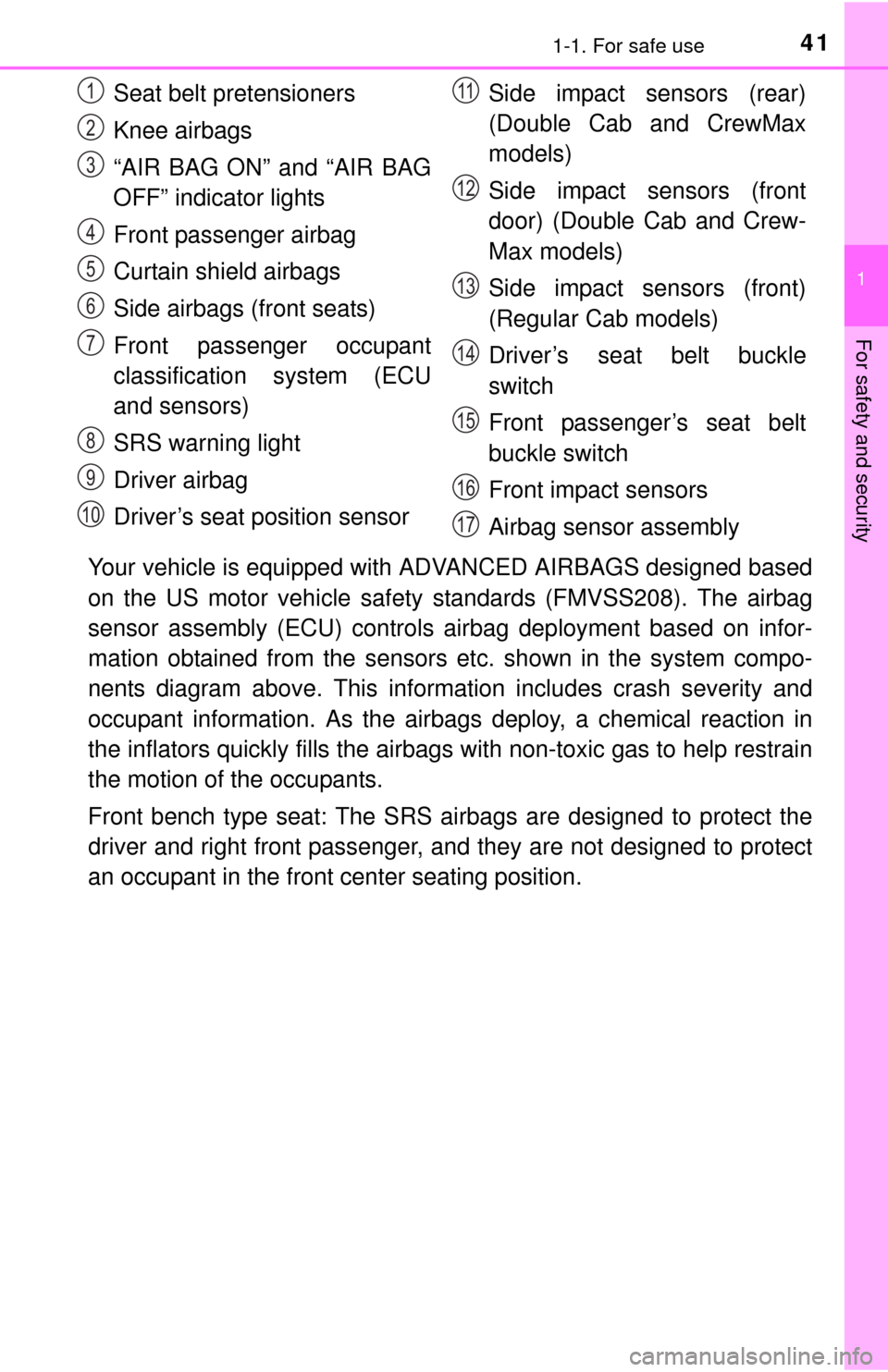
Your vehicle is equipped with ADVANCED AIRBAGS designed based
on the US motor vehicle safety standards (FMVSS208). The airbag
sensor assembly (ECU) controls airbag deployment based on infor-
mation obtained from the sensors et c. shown in the system compo-
nents diagram above. This informat ion includes crash severity and
occupant information. As the airbags deploy, a chemical reaction in
the inflators quickly fills the airbag s with non-toxic gas to help restrain
the motion of the occupants.
Front bench type seat: The SRS airbags are designed to protect the
driver and right front passenger, and they are not designed to protect
an occupant in the front center seating position. Seat belt pretensioners
Knee airbags
“AIR BAG ON” and “AIR BAG
OFF” indicator lights
Front passenger airbag
Curtain shield airbags
Side airbags (front seats)
Front passenger occupant
classification system (ECU
and sensors)
SRS warning light
Driver airbag
Driver’s seat position sensor
Side impact sensors (rear)
(Double Cab and CrewMax
models)
Side impact sensors (front
door) (Double Cab and Crew-
Max models)
Side impact sensors (front)
(Regular Cab models)
Driver’s seat belt buckle
switch
Front passenger’s seat belt
buckle switch
Front impact sensors
Airbag sensor assembly
1
2
3
4
5
6
7
8
9
10
11
12
13
14
15
16
17
Page 45 of 576
451-1. For safe use
1
For safety and security
CAUTION
■SRS airbag precautions
● Do not use seat accessories which cover the parts where the SRS side
airbags inflate as they may interfere with inflation of the airbags. Such
accessories may prevent the side airbags from activating correctly, disable
the system or cause the side airbags to inflate accidentally, resulting in
death or serious injury.
● Do not strike or apply significant levels of force to the area of the SRS air-
bag components.
Doing so can cause the SRS airbags to malfunction.
● Do not touch any of the component parts immediately after the SRS air-
bags have deployed (inflated) as they may be hot.
● If breathing becomes difficult after the SRS airbags have deployed, open a
door or window to allow fresh air in, or leave the vehicle if it is safe to do
so. Wash off any residue as soon as possible to prevent skin irritation.
● If the areas where the SRS airbags are stored, such as the steering wheel
pad and front and rear pillar garnishes, are damaged or cracked, have
them replaced by your Toyota dealer.
● Do not place anything, such as a cushion, on the front passenger’s seat.
Doing so will disperse the passenger’s weight, which prevents the sensor
from detecting the passenger’s weight properly. As a result, the SRS front
airbags for the front passenger may not deploy in the event of a collision.
■ Modification and disposal of SRS airbag system components
Do not dispose of your vehicle or per form any of the following modifications
without consulting your Toyota dealer. The SRS airbags may malfunction or
deploy (inflate) accidentally, causing death or serious injury.
● Installation, removal, disassembly and repair of the SRS airbags
● Repairs, modifications, removal or replacement of the steering wheel,
instrument panel, dashboard, seats or seat upholstery, front, side and rear
pillars or roof side rails
● Repairs or modifications of the front fender, front bumper, or side of the
occupant compartment
● Installation of a grille guard (bull bars, kangaroo bar, etc.), snow plows,
winches or roof luggage carrier
● Modifications to the vehicle’s suspension system
● Installation of electronic devices such as mobile two-way radios and CD
players
● Modifications to your vehicle for a person with a physical disability
Page 51 of 576
511-1. For safe use
1
For safety and security
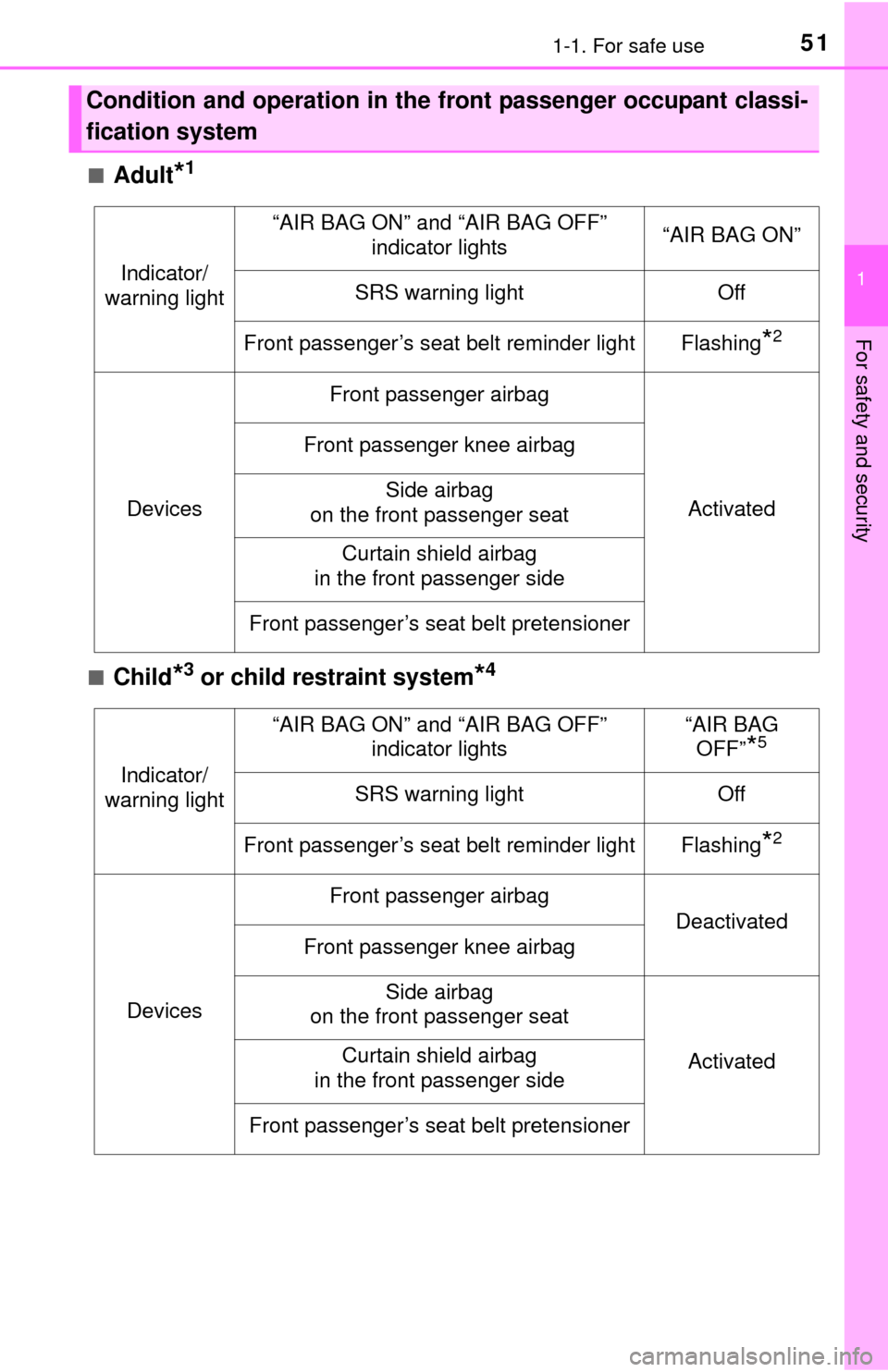
■Adult*1
■Child*3 or child restraint system*4
Condition and operation in the front passenger occupant classi-
fication system
Indicator/
warning light
“AIR BAG ON” and “AIR BAG OFF” indicator lights“AIR BAG ON”
SRS warning lightOff
Front passenger’s seat belt reminder lightFlashing*2
Devices
Front passenger airbag
Activated
Front passenger knee airbag
Side airbag
on the front passenger seat
Curtain shield airbag
in the front passenger side
Front passenger’s seat belt pretensioner
Indicator/
warning light
“AIR BAG ON” and “AIR BAG OFF” indicator lights“AIR BAG OFF”
*5
SRS warning lightOff
Front passenger’s seat belt reminder lightFlashing*2
Devices
Front passenger airbag
Deactivated
Front passenger knee airbag
Side airbag
on the front passenger seat
ActivatedCurtain shield airbag
in the front passenger side
Front passenger’s seat belt pretensioner
Page 52 of 576

521-1. For safe use
■Unoccupied
■There is a malfunction in the system
Indicator/
warning light
“AIR BAG ON” and “AIR BAG OFF”
indicator lightsNot illuminated
SRS warning light
Off
Front passenger’s seat belt reminder light
Devices
Front passenger airbag
Deactivated
Front passenger knee airbag
Side airbag
on the front passenger seat
ActivatedCurtain shield airbag
in the front passenger side
Front passenger’s seat belt pretensioner
Deactivated*6
or
activated
*7
Indicator/
warning light
“AIR BAG ON” and “AIR BAG OFF” indicator lights“AIR BAG OFF”
SRS warning lightOn
Front passenger’s seat belt reminder lightOff
Devices
Front passenger airbag
Deactivated
Front passenger knee airbag
Side airbag
on the front passenger seat
ActivatedCurtain shield airbag
in the front passenger side
Front passenger’s seat belt pretensioner
Page 53 of 576

531-1. For safe use
1
For safety and security
*1: The system judges a person of adult size as an adult. When a smalleradult sits in the front passenger seat, the system may recognize him/her
as a child depending on his/her physique and posture.
*2: In the event the front passenger does not wear a seat belt
*3: When a larger child who has outgrown a child restraint system sits in thefront passenger seat, the system may recognize him/her as an adult
depending on his/her physique or posture.
*4: Never install a rear-facing child restraint system on the front passengerseat. A forward-facing child restraint system should only be installed on
the front passenger seat when it is unavoidable. ( P. 56)
*5: In case the indicator light is not illuminated, consult this manual on how
to install the child restraint system properly. ( P. 60)
*6: In the event of a frontal collision or rollover.
*7: In the event of a side collision.
CAUTION
■Front passenger occupant classification system precautions
Observe the following precautions regarding the front passenger occupant
classification system.
Failure to do so may cause death or serious injury.
● Wear the seat belt properly.
● Make sure the front passenger’s seat belt plate has not been left inserted
into the buckle before someone sits in the front passenger seat.
● Make sure the “AIR BAG OFF” indicator light is not illuminated when using
the seat belt extender for the right front passenger seat. If the “AIR BAG
OFF” indicator light is illuminated, disconnect the extender tongue from
the seat belt buckle, and reconnect the seat belt. Reconnect the seat belt
extender after making sure the “AIR BAG ON” indicator light is illuminated.
If you use the seat belt extender while the “AIR BAG OFF” indicator light is
illuminated, the SRS airbags for the front passenger will not activate,
which could cause death or serious injury in the event of a collision.
● Do not apply a heavy load to the front passenger seat or equipment (e.g.
seatback pockets).
● Double Cab and CrewMax models: Do not put weight on the front passen-
ger seat by putting your hands or feet on the front passenger seat seat-
back from the rear passenger seat.
● Double Cab and CrewMax models: Do not let a rear passenger lift the
front passenger seat with their feet or press on the seatback with their
legs.
● Do not put objects under the front passenger seat.
Page 54 of 576

541-1. For safe use
CAUTION
■Front passenger occupant classification system precautions
● Do not recline the front passenger seatback so far that it touches a rear
seat or a back wall. This may cause the “AIR BAG OFF” indicator light to
be illuminated, which indicates that the SRS airbags for the front passen-
ger will not activate in the event of a severe accident. If the seatback
touches the rear seat or back wall, return the seatback to a position where
it does not touch the rear seat or back wall. Keep the front passenger seat-
back as upright as possible when the vehicle is moving. Reclining the
seatback excessively may lessen the effectiveness of the seat belt sys-
tem.
● If an adult sits in the front passenger seat, the “AIR BAG ON” indicator
light is illuminated. If the “AIR BAG OFF” indicator is illuminated, ask the
passenger to sit up straight, well back in the seat, feet on the floor, and
with the seat belt worn correctly. If the “AIR BAG OFF” indicator still
remains illuminated, either ask the passenger to move to the rear seat, or
if that is not possible, move the front passenger seat fully rearward.
● When it is unavoidable to install a forward-facing child restraint system on
the front passenger seat, install the child restraint system on the front pas-
senger seat in the proper order. ( P. 60)
● Do not modify or remove the front seats.
● Do not kick the front passenger seat or subject it to severe impact. Other-
wise, the SRS warning light may come on to indicate a malfunction of the
front passenger occupant classification system. In this case, contact your
Toyota dealer immediately.
● Double Cab and CrewMax models: Child restraint systems installed on the
rear seat should not contact the front seatbacks.
● Do not use a seat accessory, such as a cushion and seat cover, that cov-
ers the seat cushion surface.
● Do not attach a commercial seatback table or other heavy item to the back
of the front passenger seat.
● Do not modify or replace the upholstery of the front seat.
Page 58 of 576

581-1. For safe use
CAUTION
■Child restraint precautions
● For effective protection in automobile accidents and sudden stops, a child
must be properly restrained, using a seat belt or child restraint system
depending on the age and size of the child. Holding a child in your arms is
not a substitute for a child restraint system. In an accident, the child can be
crushed against the windshield, or between you and the vehicle’s interior.
● Regular Cab models: Toyota strongly urges the use of a proper child
restraint system that conforms to the size of the child.
● Double Cab and CrewMax models: Toyota strongly urges the use of a
proper child restraint system that conforms to the size of the child, installed
on the rear seat. According to accident statistics, the child is safer when
properly restrained in the rear seat than in the front seat.
● Never install a rear-facing child restraint system on the front passenger
seat even if the “AIR BAG OFF” indicator light is illuminated.
In the event of an accident, the force of the rapid inflation of the front pas-
senger airbag can cause death or serious injury to the child if the rear-fac-
ing child restraint system is installed on the front passenger seat.
● Regular Cab models: A forward-facing child restraint system may be
installed on the front passenger seat only when it is unavoidable. Adjust
the seatback as upright as possible and always move the seat as far back
as possible even if the “AIR BAG OFF” indicator light is illuminat\
ed,
because the front passenger airbag could inflate with considerable speed
and force. Otherwise, the child may be killed or seriously injured.
● Double Cab and CrewMax models: A forward-facing child restraint system
may be installed on the front passenger seat only when it is unavoidable.
A child restraint system that requires a top tether strap should not be used
in the front passenger seat since there is no top tether strap anchor for the
front passenger seat. Adjust the seatback as upright as possible and
always move the seat as far back as possible even if the “AIR BAG OFF”
indicator light is illuminated, because the front passenger airbag could
inflate with considerable speed and force. Otherwise, the child may be
killed or seriously injured.
● Regular Cab models: Do not install a child restraint system on the center
seat if it interferes with driving operations such as changing the shift lever
position. In this case, install the child restraint system on the right passen-
ger seat.
Page 75 of 576

751-1. For safe use
1
For safety and security
■Laws and regulations pertaining to anchorages
The LATCH system conforms to FMVSS225 or CMVSS210.2.
Child restraint systems conforming to FMVSS213 or CMVSS213 specifica-
tions can be used.
This vehicle is designed to conform to the SAE J1819.
CAUTION
■When installing a booster seat
To prevent the belt from going into ALR lock mode, do not fully extend the
shoulder belt. ALR mode causes the belt to tighten only. This could cause
injury or discomfort to the child. ( P. 34)
■ When installing a child restraint system
Follow the directions given in the child restraint system installation manual
and fix the child restraint system securely in place.
If the child restraint system is not correctly fixed in place, the child or other
passengers may be seriously injured or even killed in the event of a sudden
braking or an accident.
● Double Cab and CrewMax models: If
the driver’s seat interferes with the child
restraint system and prevents it from
being attached correctly, attach the
child restraint system to the right-hand
rear seat.
● Double Cab and CrewMax models:
Adjust the front passenger seat so that
it does not interfere with the child
restraint system.
● Only put a forward-facing child restraint
system on the front seat when unavoid-
able. When installing a forward-facing
child restraint system on the front pas-
senger seat, move the seat as far back
as possible even if the “AIR BAG OFF”
indicator light is illuminated. Failure to
do so may result in death or serious
injury if the airbags deploy (inflate).
Page 395 of 576

3957-1. Maintenance and care
7
Maintenance and care
■Caring for leather areas
Toyota recommends cleaning the interior of the vehicle at least twice a year to
maintain the quality of the vehicle’s interior.
■ Shampooing the carpets
There are several commercial foaming-type cleaners available. Use a sponge
or brush to apply the foam. Rub in overlapping circles. Do not use water.
Wipe dirty surfaces and let them dry. Excellent results are obtained by keep-
ing the carpet as dry as possible.
■ Seat belts
Clean with mild soap and lukewarm water using a cloth or sponge. Also
check the belts periodically for excessive wear, fraying or cuts.
■ When cleaning the carpeted portio ns of the console box, etc.
If a strong adhesive tape is used, there is a possibility that the surface of the
carpet could be damaged.
CAUTION
■ Water in the vehicle
● Do not splash or spill liquid in the vehicle.
Doing so may cause electrical components, etc., to malfunction or catch
fire.
● Do not get any of the SRS components or wiring in the vehicle interior wet.
(P. 40)
An electrical malfunction may cause the airbags to deploy or not function
properly, resulting in death or serious injury.
■ Cleaning the interior (especially instrument panel)
Do not use polish wax or polish cleaner. The instrument panel may reflect
off the windshield, obstructing the driver’s view and leading to an accident,
resulting in death or serious injury.