transmission TOYOTA TUNDRA 2016 2.G User Guide
[x] Cancel search | Manufacturer: TOYOTA, Model Year: 2016, Model line: TUNDRA, Model: TOYOTA TUNDRA 2016 2.GPages: 588, PDF Size: 13.44 MB
Page 250 of 588
2504-6. Driving tips
NOTICE
■To prevent the water damage
Take all necessary safety measures to ensure that water damage to the
engine or other components does not occur.
● Water entering the engine air intake will cause severe engine damage.
● Water entering the automatic transmission will cause deterioration in shift
quality, locking up of your transmission accompanied by vibration, and ulti-
mately damage.
● Water can wash the grease from wheel bearings, causing rusting and pre-
mature failure, and may also enter the differentials, transmission and
transfer case, reducing the gear oil’s lubricating qualities.
■ When you drive through water
If driving through water, such as when crossing shallow streams, first check
the depth of the water and the bottom of the river bed for firmness. Drive
slowly and avoid deep water.
■ Inspection after off-road driving
● Sand and mud that has accumulated in brake drums and around brake
discs may affect braking efficiency and may damage brake system compo-
nents.
● Always perform a maintenance inspection after each day of off-road driv-
ing that has taken you through rough terrain, sand, mud, or water. For
scheduled maintenance information, refer to the “Scheduled Maintenance
Guide” or “Owner’s Manual Supplement”.
Page 408 of 588
4087-2. Maintenance
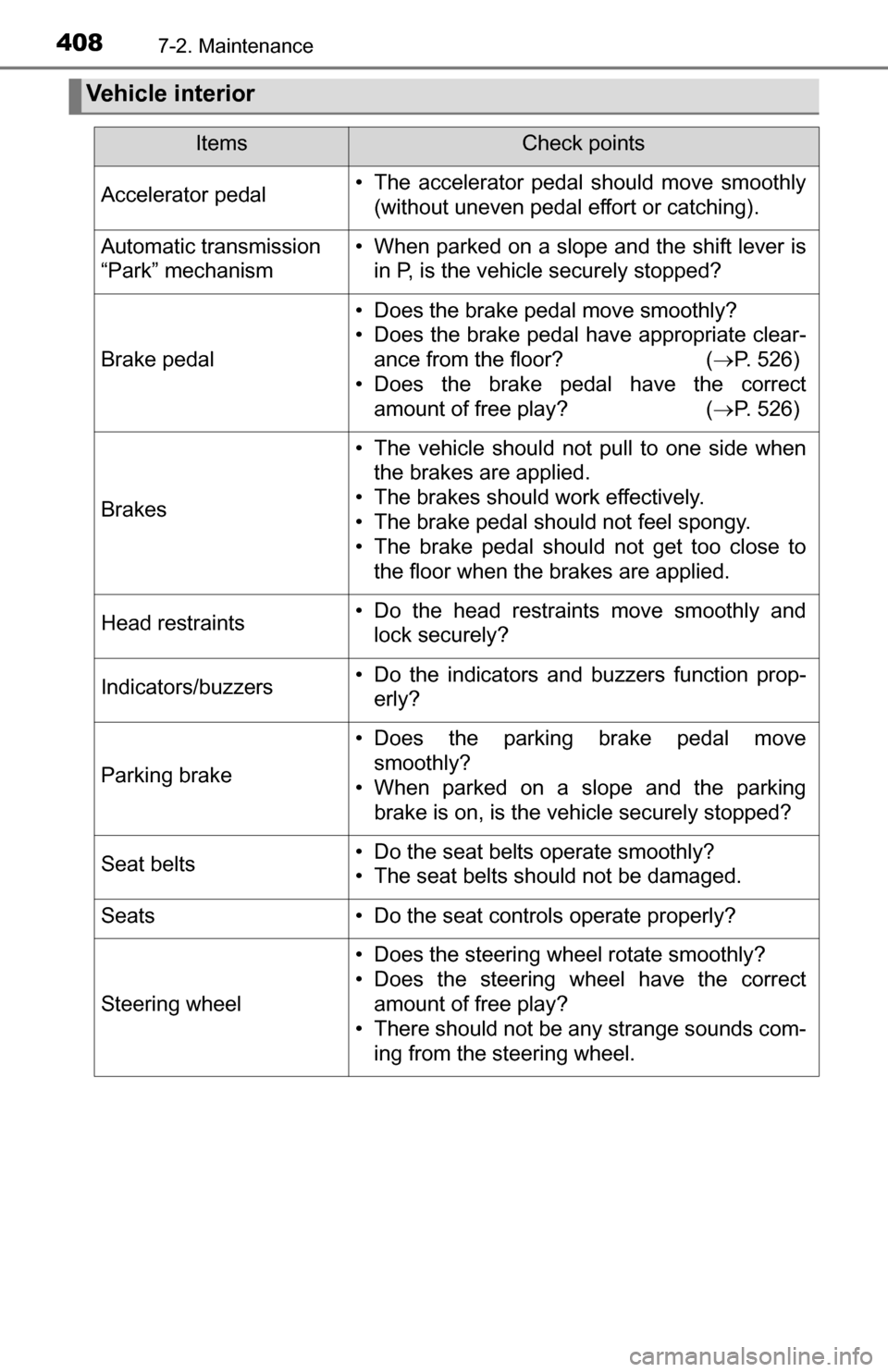
Vehicle interior
ItemsCheck points
Accelerator pedal• The accelerator pedal should move smoothly(without uneven pedal effort or catching).
Automatic transmission
“Park” mechanism• When parked on a slope and the shift lever isin P, is the vehicle securely stopped?
Brake pedal
• Does the brake pedal move smoothly?
• Does the brake pedal have appropriate clear-ance from the floor? ( P. 526)
• Does the brake pedal have the correct amount of free play? ( P. 526)
Brakes
• The vehicle should not pull to one side when
the brakes are applied.
• The brakes should work effectively.
• The brake pedal should not feel spongy.
• The brake pedal should not get too close to the floor when the brakes are applied.
Head restraints• Do the head restraints move smoothly andlock securely?
Indicators/buzzers• Do the indicators and buzzers function prop-erly?
Parking brake
• Does the parking brake pedal movesmoothly?
• When parked on a slope and the parking brake is on, is the vehicle securely stopped?
Seat belts• Do the seat belts operate smoothly?
• The seat belts should not be damaged.
Seats• Do the seat controls operate properly?
Steering wheel
• Does the steering wheel rotate smoothly?
• Does the steering wheel have the correctamount of free play?
• There should not be any strange sounds com-
ing from the steering wheel.
Page 411 of 588
4117-3. Do-it-yourself maintenance
7
Maintenance and care
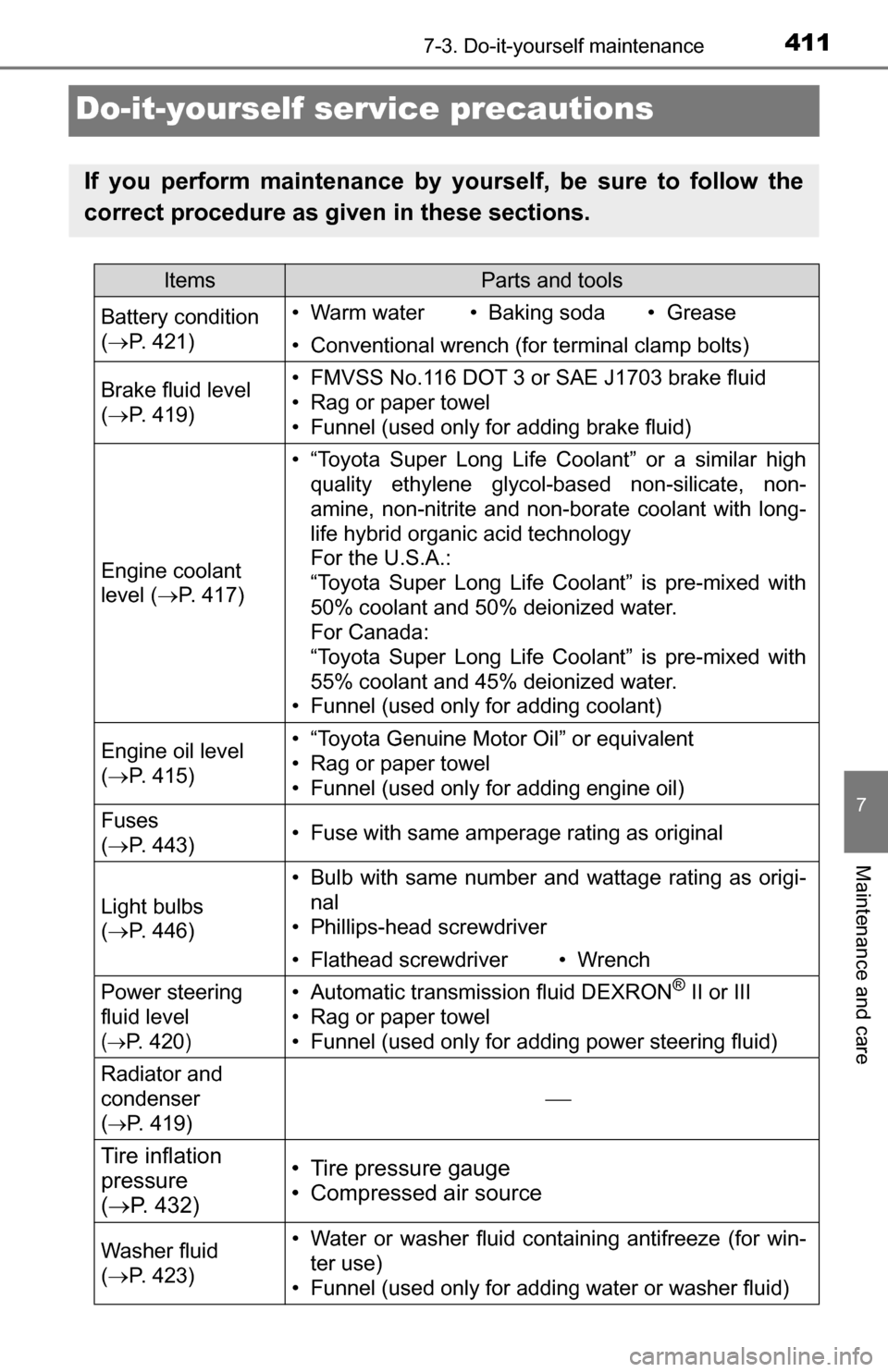
Do-it-yourself service precautions
If you perform maintenance by yourself, be sure to follow the
correct procedure as given in these sections.
ItemsParts and tools
Battery condition
( P. 421)• Warm water• Baking soda• Grease
• Conventional wrench (for terminal clamp bolts)
Brake fluid level
( P. 419)• FMVSS No.116 DOT 3 or SAE J1703 brake fluid
• Rag or paper towel
• Funnel (used only for adding brake fluid)
Engine coolant
level ( P. 417)
• “Toyota Super Long Life Coolant” or a similar high
quality ethylene glycol-based non-silicate, non-
amine, non-nitrite and non-borate coolant with long-
life hybrid organic acid technology
For the U.S.A.:
“Toyota Super Long Life Coolant” is pre-mixed with
50% coolant and 50% deionized water.
For Canada:
“Toyota Super Long Life Coolant” is pre-mixed with
55% coolant and 45% deionized water.
• Funnel (used only for adding coolant)
Engine oil level
( P. 415)• “Toyota Genuine Motor Oil” or equivalent
• Rag or paper towel
• Funnel (used only for adding engine oil)
Fuses
( P. 443)• Fuse with same amperage rating as original
Light bulbs
( P. 446)
• Bulb with same number and wattage rating as origi-
nal
• Phillips-head screwdriver
• Flathead screwdriver• Wrench
Power steering
fluid level
(
P. 420)
• Automatic transmission fluid DEXRON® II or III
• Rag or paper towel
• Funnel (used only for adding power steering fluid)
Radiator and
condenser
(
P. 419)
Tire inflation
pressure
( P. 432)• Tire pressure gauge
• Compressed air source
Washer fluid
( P. 423)• Water or washer fluid containing antifreeze (for win-
ter use)
• Funnel (used only for adding water or washer fluid)
Page 421 of 588
4217-3. Do-it-yourself maintenance
7
Maintenance and care
■Checking the fluid level
Make sure to check the fluid type and prepare the necessary items.Clean all dirt off the reservoir.
Remove the cap by turn ing it counterclockwise.
Wipe the dipstick clean.
Reinstall the cap and remove it again.
Check the fluid level.
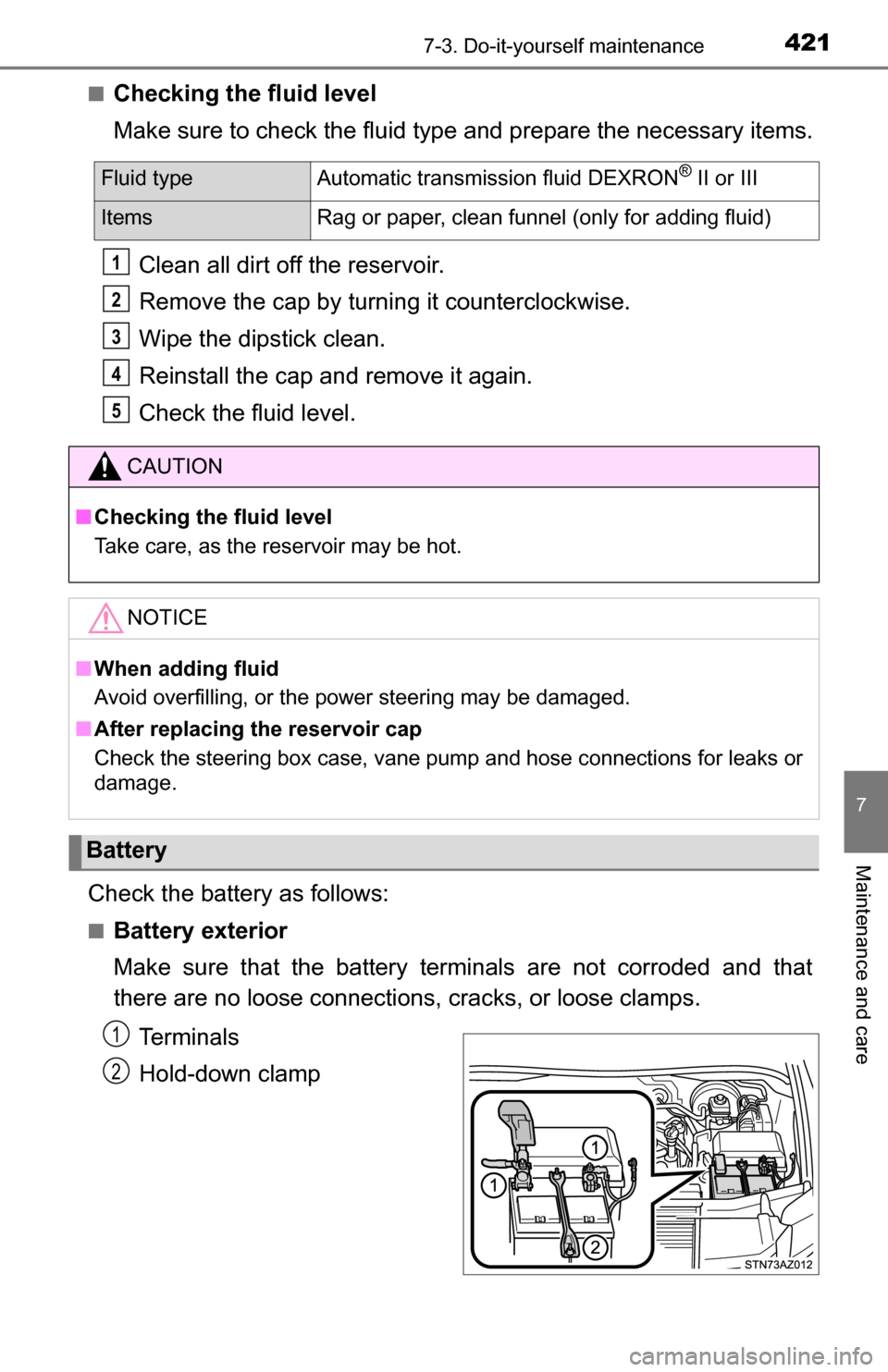
Check the battery as follows:
■Battery exterior
Make sure that the battery terminals are not corroded and that
there are no loose connections, cracks, or loose clamps. Terminals
Hold-down clamp
Fluid type Automatic transmission fluid DEXRON® II or III
Items Rag or paper, clean funnel (only for adding fluid)
CAUTION
■Checking the fluid level
Take care, as the reservoir may be hot.
NOTICE
■When adding fluid
Avoid overfilling, or the power steering may be damaged.
■ After replacing the reservoir cap
Check the steering box case, vane pump and hose connections for leaks or
damage.
Battery
1
2
3
4
5
1
2
Page 466 of 588
4668-2. Steps to take in an emergency
If your vehicle needs to be towed
The following may indicate a problem with your transmission. Contact
your Toyota dealer or commercial towing service before towing.
● The engine is running but the vehicle does not move.
● The vehicle makes an abnormal sound.
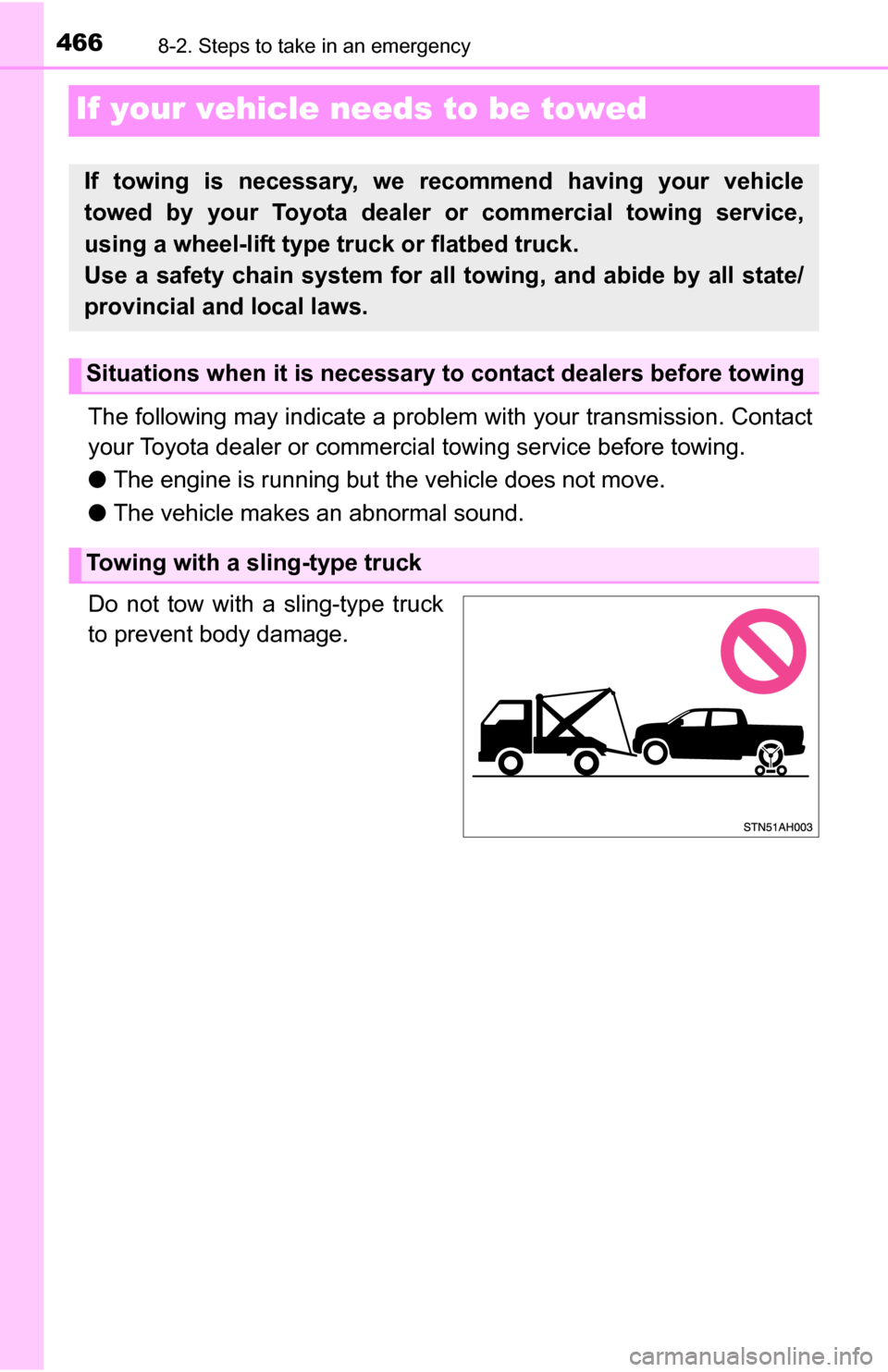
Do not tow with a sling-type truck
to prevent body damage.
If towing is necessary, we re commend having your vehicle
towed by your Toyota dealer or commercial towing service,
using a wheel-lift type truck or flatbed truck.
Use a safety chain system for all towing, and abide by all state/
provincial and local laws.
Situations when it is necessary to contact dealers before towing
Towing with a sling-type truck
Page 471 of 588
471
8
When trouble arises
8-2. Steps to take in an emergency
If you think something is wrong
●Fluid leaks under the vehicle.
(Water dripping from the air co nditioning after use is normal.)
● Flat-looking tires or uneven tire wear
● Engine coolant temperature gauge needle continually points higher
than normal.
● Voltmeter continually points higher or lower than normal
● Engine oil pressure gauge continually points lower than normal
● Automatic transmission fluid temperature warning message is dis-
played
● Changes in exhaust sound
● Excessive tire squeal when cornering
● Strange noises related to the suspension system
● Pinging or other noises related to the engine
● Engine misses, stumbling or running roughly
● Appreciable loss of power
● Vehicle pulls heavily to one side when braking
● Vehicle pulls heavily to one side when driving on a level road
● Loss of brake effectiveness, spon gy feeling, pedal almost touches
the floor
If you notice any of the follow ing symptoms, your vehicle proba-
bly needs adjustment or repair. Contact your Toyota dealer as
soon as possible.
Visible symptoms
Audible symptoms
Operational symptoms
Page 473 of 588
473
8
When trouble arises
8-2. Steps to take in an emergency
If a warning light turns on or a warning
buzzer sounds
Calmly perform the following actions if any of the warning lights
comes on or flashes. If a light comes on or flashes, but then
goes off, this does not necessarily indicate a malfunction in the
system. However, if this continues to occur, have the vehicle
inspected by your Toyota dealer.
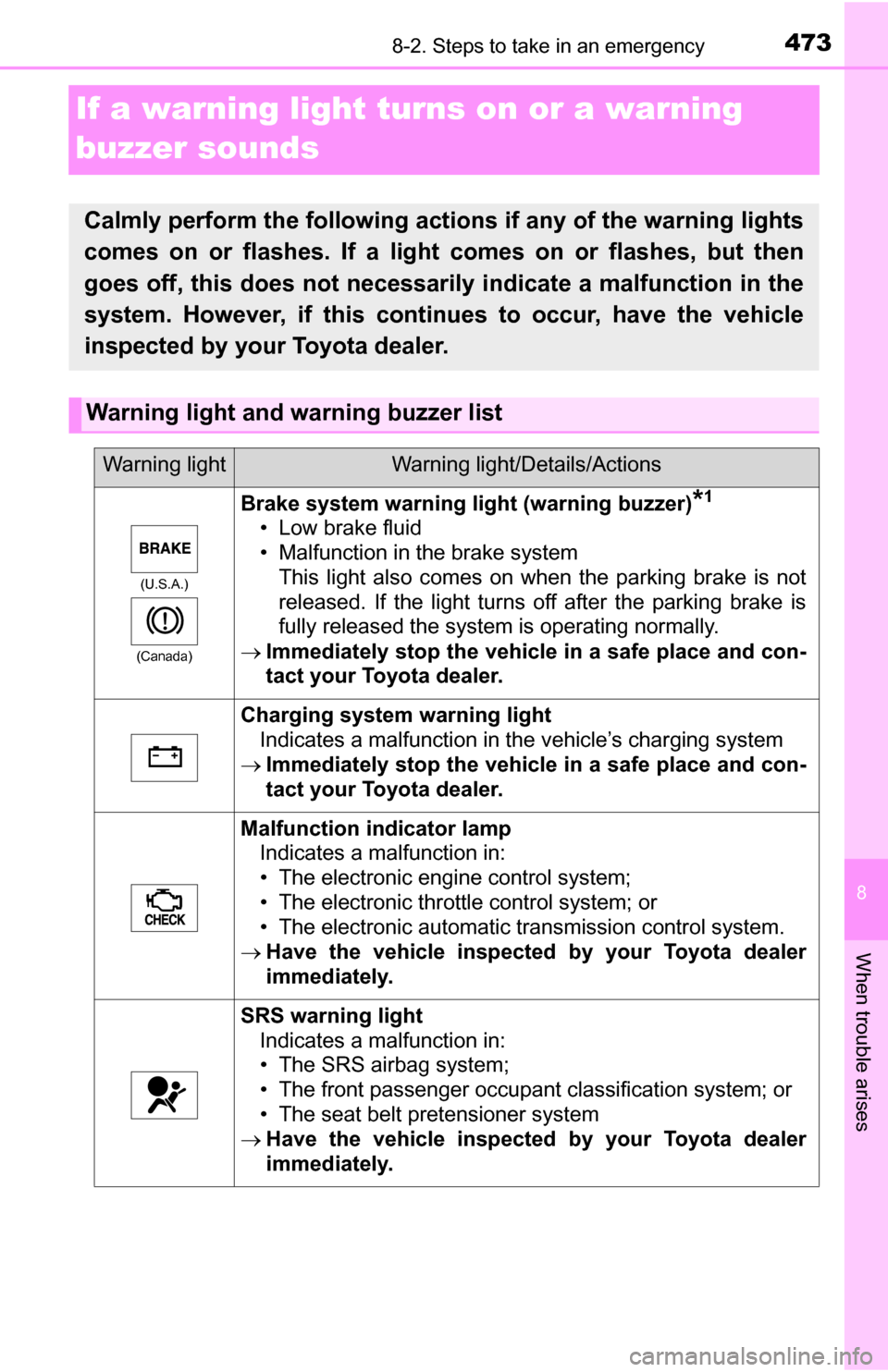
Warning light and warning buzzer list
Warning lightWarning light/Details/Actions
(U.S.A.)
(Canada)
Brake system warning light (warning buzzer)*1
• Low brake fluid
• Malfunction in the brake system This light also comes on when the parking brake is not
released. If the light turns off after the parking brake is
fully released the system is operating normally.
Immediately stop the vehicle in a safe place and con-
tact your Toyota dealer.
Charging system warning light
Indicates a malfunction in the vehicle’s charging system
Immediately stop the vehicle in a safe place and con-
tact your Toyota dealer.
Malfunction indicator lamp
Indicates a malfunction in:
• The electronic engine control system;
• The electronic throttle control system; or
• The electronic automatic transmission control system.
Have the vehicle inspected by your Toyota dealer
immediately.
SRS warning light
Indicates a malfunction in:
• The SRS airbag system;
• The front passenger occupant classification system; or
• The seat belt pretensioner system
Have the vehicle inspected by your Toyota dealer
immediately.
Page 480 of 588
4808-2. Steps to take in an emergency
If a warning message is displayed
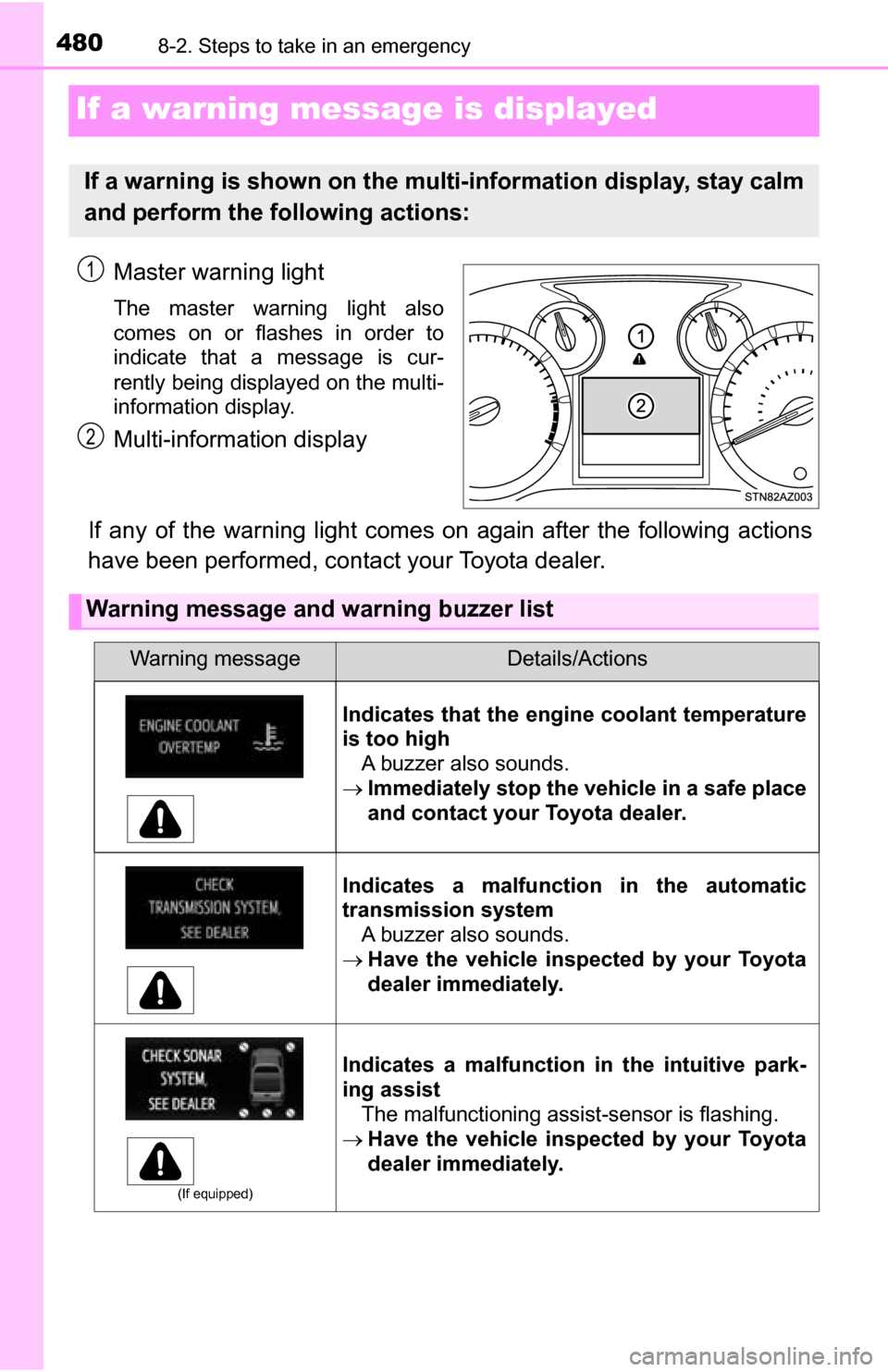
Master warning light
The master warning light also
comes on or flashes in order to
indicate that a message is cur-
rently being displayed on the multi-
information display.
Multi-information display
If any of the warning light comes on again after the following actions
have been performed, contact your Toyota dealer.
If a warning is shown on the mult i-information display, stay calm
and perform the following actions:
1
2
Warning message and warning buzzer list
Warning messageDetails/Actions
Indicates that the engine coolant temperature
is too high A buzzer also sounds.
Immediately stop the vehicle in a safe place
and contact your Toyota dealer.
Indicates a malfunction in the automatic
transmission system
A buzzer also sounds.
Have the vehicle inspect ed by your Toyota
dealer immediately.
(If equipped)
Indicates a malfunction in the intuitive park-
ing assist The malfunctioning assist-sensor is flashing.
Have the vehicle inspect ed by your Toyota
dealer immediately.
Page 481 of 588
4818-2. Steps to take in an emergency
8
When trouble arises
(If equipped)
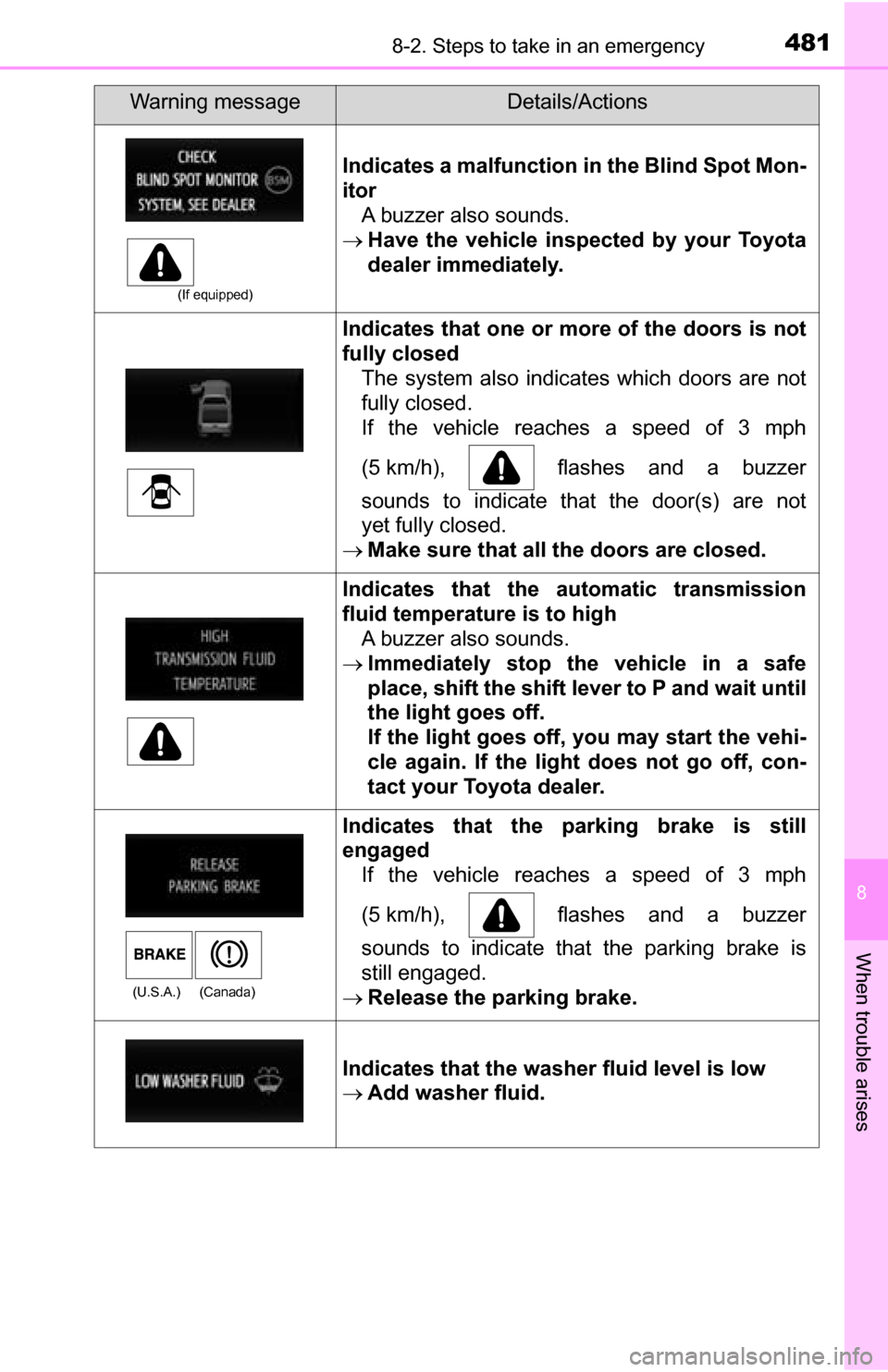
Indicates a malfunction in the Blind Spot Mon-
itorA buzzer also sounds.
Have the vehicle inspect ed by your Toyota
dealer immediately.
Indicates that one or more of the doors is not
fully closed The system also indicates which doors are not
fully closed.
If the vehicle reaches a speed of 3 mph
(5 km/h), flashes and a buzzer
sounds to indicate that the door(s) are not
yet fully closed.
Make sure that all the doors are closed.
Indicates that the automatic transmission
fluid temperature is to high
A buzzer also sounds.
Immediately stop the vehicle in a safe
place, shift the shift lever to P and wait until
the light goes off.
If the light goes off, you may start the vehi-
cle again. If the light does not go off, con-
tact your Toyota dealer.
(U.S.A.) (Canada)
Indicates that the parking brake is still
engaged If the vehicle reaches a speed of 3 mph
(5 km/h), flashes and a buzzer
sounds to indicate that the parking brake is
still engaged.
Release the parking brake.
Indicates that the washer fluid level is low
Add washer fluid.
Warning messageDetails/Actions
Page 508 of 588
5088-2. Steps to take in an emergency
NOTICE
■To avoid damage to the transmission and other components
● Avoid spinning the rear wheels and depressing the accelerator pedal more
than necessary.
● If the vehicle remains stuck even after these procedures are performed,
the vehicle may require towing to be freed.
● When a warning message for the automatic transmission fluid temperature
is displayed while attempting to free a stuck vehicle, immediately remove
your foot from the accelerator pedal and wait until the warning message
disappears. Otherwise, the transmission may become damaged.
(P. 480)