lights TOYOTA TUNDRA 2016 2.G Repair Manual
[x] Cancel search | Manufacturer: TOYOTA, Model Year: 2016, Model line: TUNDRA, Model: TOYOTA TUNDRA 2016 2.GPages: 588, PDF Size: 13.44 MB
Page 461 of 588
4617-3. Do-it-yourself maintenance
7
Maintenance and care
CAUTION
■Replacing light bulbs
● Turn off the lights. Do not attempt to replace the bulb immediately after
turning off the lights.
The bulbs become very hot and may cause burns.
● Do not touch the glass portion of the light bulb with bare hands. When it is
unavoidable to hold the glass portion, use and hold with a clean dry cloth
to avoid getting moisture and oils on the bulb.
Also, if the bulb is scratched or dropped, it may blow out or crack.
● Fully install light bulbs and any parts used to secure them. Failure to do so
may result in heat damage, fire, or water entering the headlight unit. This
may damage the lights or cause condensation to build up on the lens.
● Do not attempt to repair or disassemble the bulb, bulb base, electrical wir-
ing, or subcomponents.
Doing so could result in electric shock and serious injury.
■ To prevent damage or fire
● Make sure bulbs are fully seated and locked.
● Check the wattage of the bulb before installing to prevent heat damage.
Page 464 of 588
4648-1. Essential information
Emergency flashers
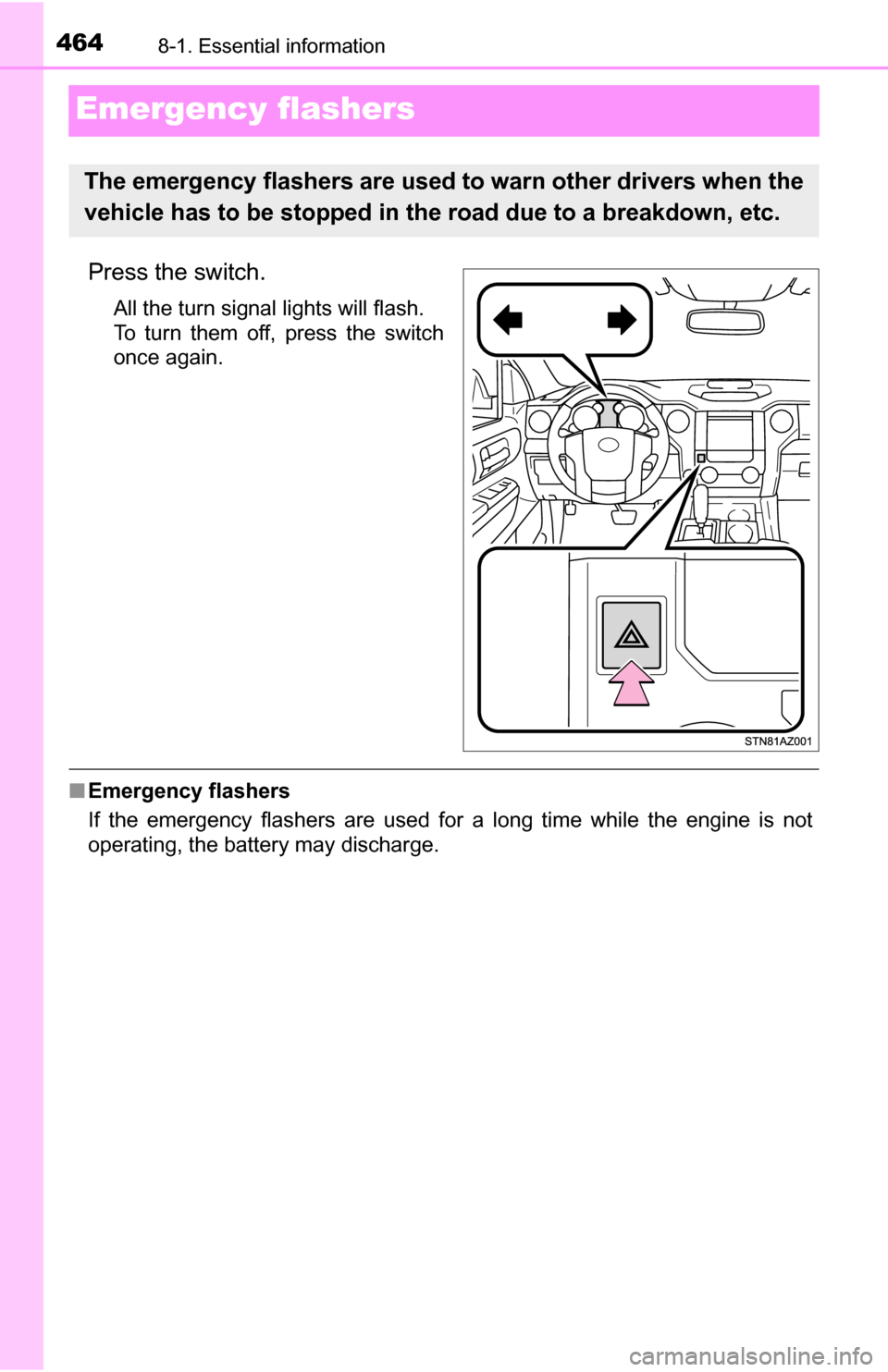
Press the switch.
All the turn signal lights will flash.
To turn them off, press the switch
once again.
■Emergency flashers
If the emergency flashers are used for a long time while the engine is not
operating, the battery may discharge.
The emergency flashers are used to warn other drivers when the
vehicle has to be stopped in th e road due to a breakdown, etc.
Page 473 of 588
473
8
When trouble arises
8-2. Steps to take in an emergency
If a warning light turns on or a warning
buzzer sounds
Calmly perform the following actions if any of the warning lights
comes on or flashes. If a light comes on or flashes, but then
goes off, this does not necessarily indicate a malfunction in the
system. However, if this continues to occur, have the vehicle
inspected by your Toyota dealer.
Warning light and warning buzzer list
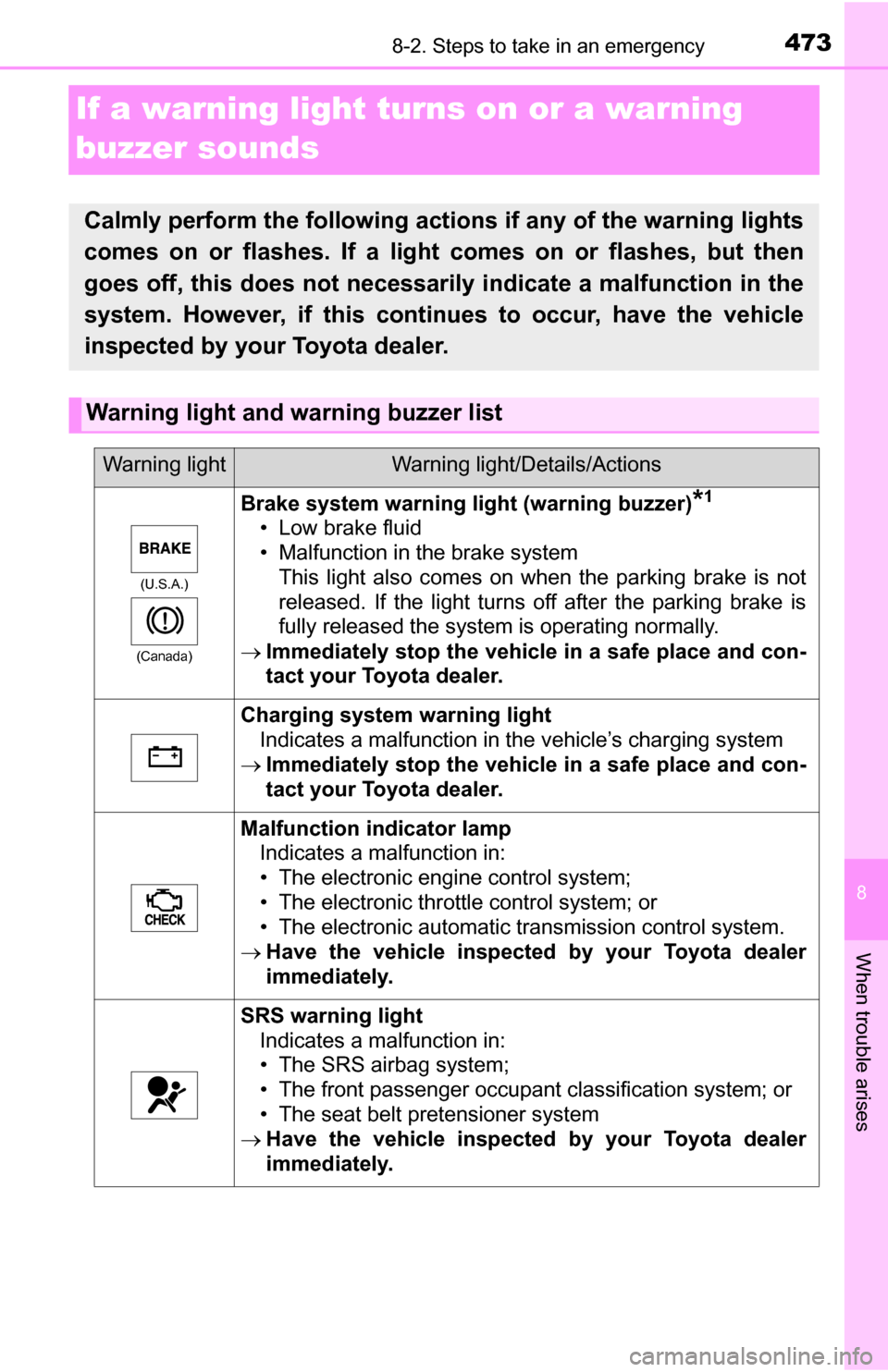
Warning lightWarning light/Details/Actions
(U.S.A.)
(Canada)
Brake system warning light (warning buzzer)*1
• Low brake fluid
• Malfunction in the brake system This light also comes on when the parking brake is not
released. If the light turns off after the parking brake is
fully released the system is operating normally.
Immediately stop the vehicle in a safe place and con-
tact your Toyota dealer.
Charging system warning light
Indicates a malfunction in the vehicle’s charging system
Immediately stop the vehicle in a safe place and con-
tact your Toyota dealer.
Malfunction indicator lamp
Indicates a malfunction in:
• The electronic engine control system;
• The electronic throttle control system; or
• The electronic automatic transmission control system.
Have the vehicle inspected by your Toyota dealer
immediately.
SRS warning light
Indicates a malfunction in:
• The SRS airbag system;
• The front passenger occupant classification system; or
• The seat belt pretensioner system
Have the vehicle inspected by your Toyota dealer
immediately.
Page 478 of 588
4788-2. Steps to take in an emergency
CAUTION
■If both the ABS and the brake system warning lights remain on
Stop your vehicle in a safe place immediately and contact your Toyota
dealer. The vehicle will become extremely unstable during braking, and the
ABS system may fail, which could cause an accident resulting in death or
serious injury.
■ If the tire pressure warning light comes on
Be sure to observe the following precautions. Failure to do so could cause a
loss of vehicle control and result in death or serious injury.
● Stop your vehicle in a safe place as soon as possible. Adjust the tire infla-
tion pressure immediately.
● If the tire pressure warning light comes on even after tire inflation pressure
adjustment, it is probable that you have a flat tire. Check the tires. If a tire
is flat, change it with the spare tire and have the flat tire repaired by the
nearest Toyota dealer.
● Avoid abrupt maneuvering and braking. If the vehicle tires deteriorate, you
could lose control of the steering wheel or the brakes.
■ If a blowout or sudden air leakage should occur
The tire pressure warning system may not activate immediately.
■
Maintenance of the tires
Each tire, including the spare (if provided), should be checked monthly
when cold and inflated to the inflation pressure recommended by the
vehicle manufacturer on the vehicle placard or tire inflation pressure
label (tire and load information label). (If your vehicle has tires of a dif-
ferent size than the size indicated on the vehicle placard or tire inflation
pressure label [tire and load information label], you should determine
the proper tire inflation pressure for those tires.)
As an added safety feature, your vehicle has been equipped with a tire
pressure monitoring system (TPMS-ti re pressure warning system) that
illuminates a low tire pre ssure telltale (tire pressure warning light) when
one or more of your tires is significantly under-inflated. Accordingly,
when the low tire pressure telltale (tire pressure warning light) illumi-
nates, you should stop and check your tires as soon as possible, and
inflate them to the proper pressure. Driving on a significantly under-
inflated tire causes the tire to overheat and can lead to tire failure.
Under-inflation also reduces fuel effi ciency and tire tread life, and may
affect the vehicle’s handling and stopping ability.
Page 499 of 588
499
8
When trouble arises
8-2. Steps to take in an emergency
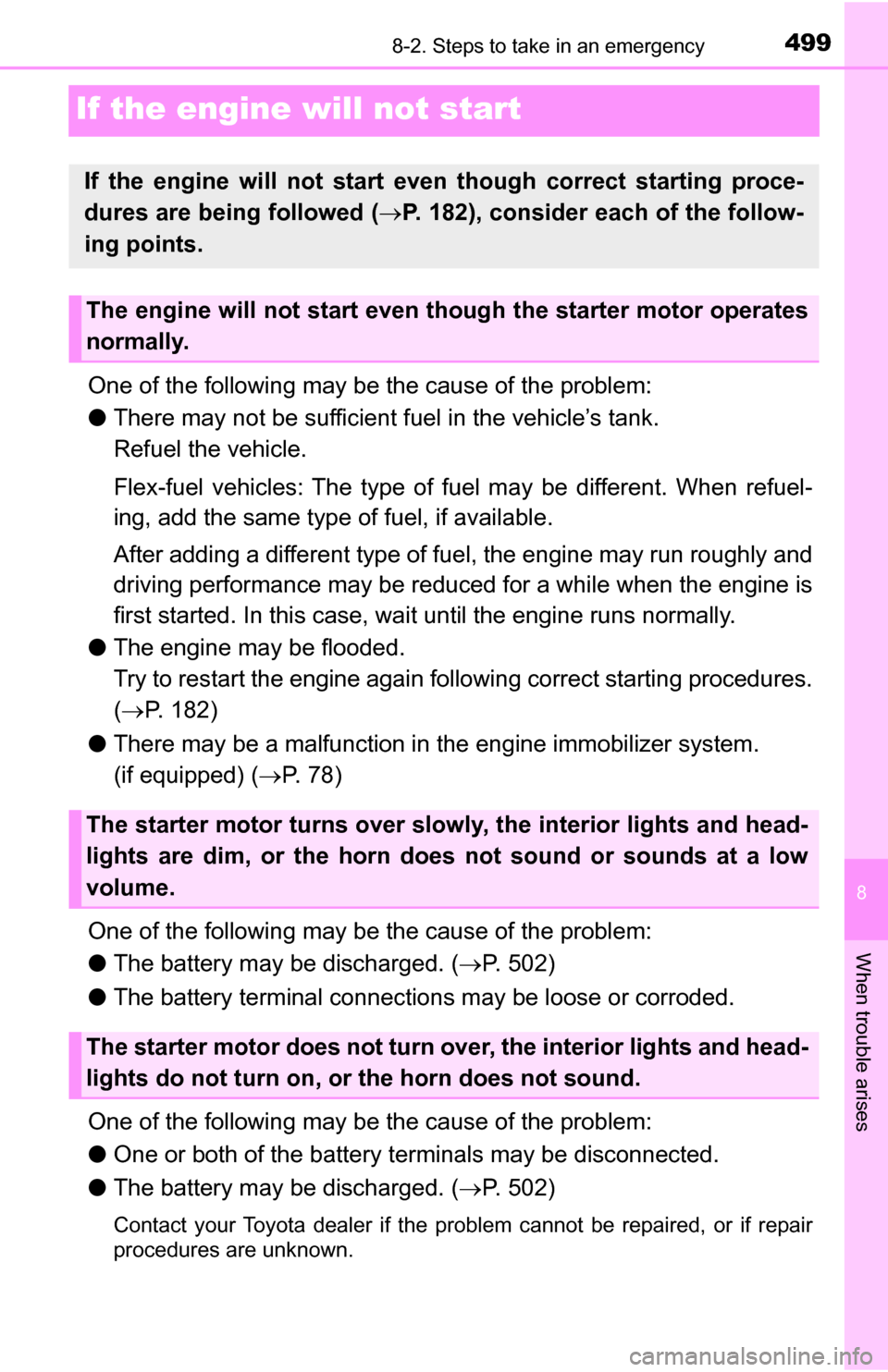
If the engine will not start
One of the following may be the cause of the problem:
●There may not be sufficient fuel in the vehicle’s tank.
Refuel the vehicle.
Flex-fuel vehicles: The type of fuel may be different. When refuel-
ing, add the same type of fuel, if available.
After adding a different type of fuel, the engine may run roughly and
driving performance may be reduced for a while when the engine is
first started. In this case, wait until the engine runs normally.
● The engine may be flooded.
Try to restart the engine again following correct starting procedures.
( P. 182)
● There may be a malfunction in the engine immobilizer system.
(if equipped) ( P. 78)
One of the following may be the cause of the problem:
● The battery may be discharged. ( P. 502)
● The battery terminal connections may be loose or corroded.
One of the following may be the cause of the problem:
● One or both of the battery terminals may be disconnected.
● The battery may be discharged. ( P. 502)
Contact your Toyota dealer if the problem cannot be repaired, or if repair
procedures are unknown.
If the engine will not start eve n though correct starting proce-
dures are being followed ( P. 182), consider each of the follow-
ing points.
The engine will not start even though the starter motor operates
normally.
The starter motor turns over slowly, the interior lights and head-
lights are dim, or the horn does not sound or sounds at a low
volume.
The starter motor does not turn over, the interior lights and head-
lights do not turn on, or the horn does not sound.
Page 503 of 588
5038-2. Steps to take in an emergency
8
When trouble arises
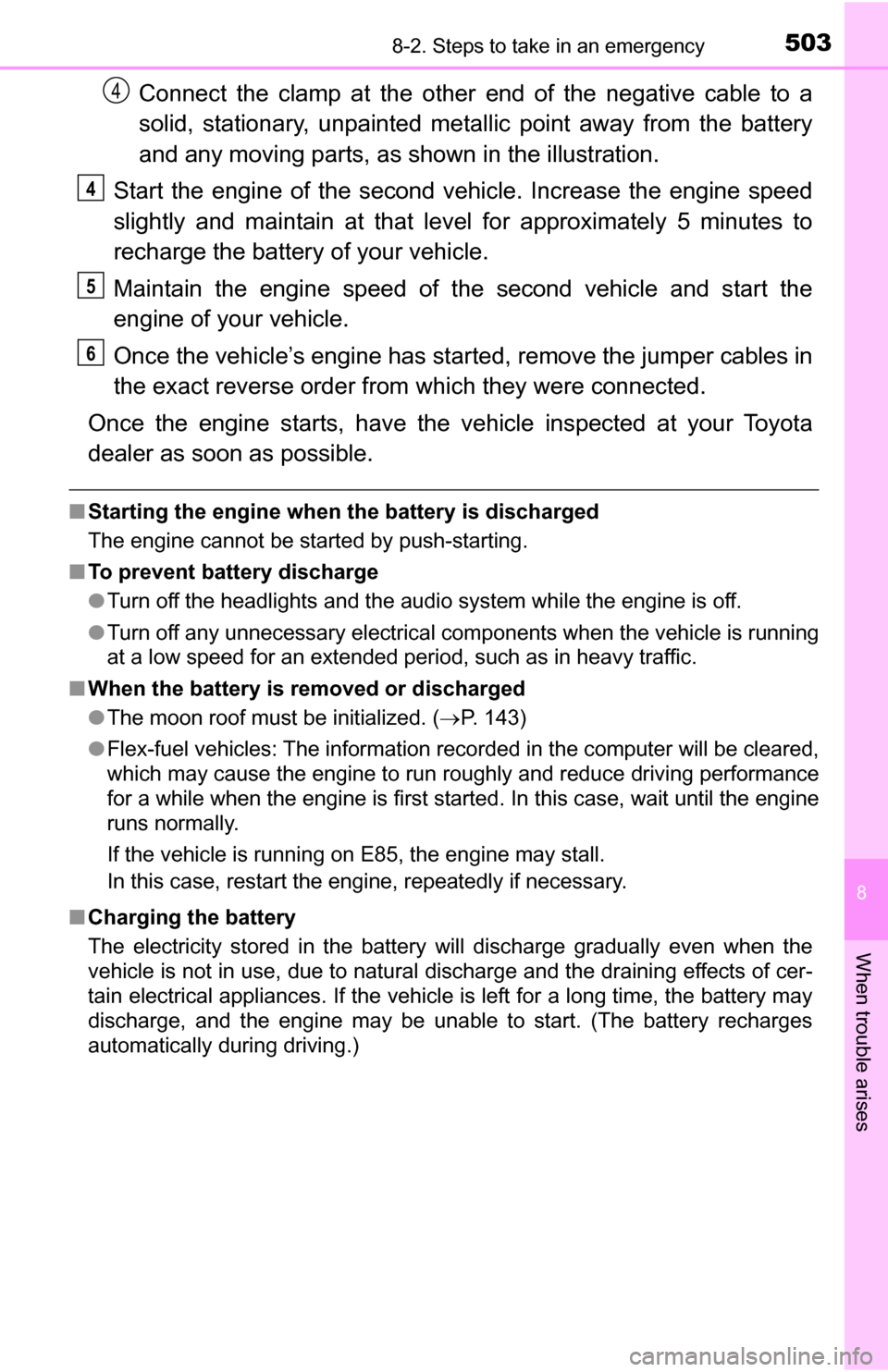
Connect the clamp at the other end of the negative cable to a
solid, stationary, unpainted metallic point away from the battery
and any moving parts, as shown in the illustration.
Start the engine of the second v ehicle. Increase the engine speed
slightly and maintain at that level for approximately 5 minutes to
recharge the batter y of your vehicle.
Maintain the engine speed of t he second vehicle and start the
engine of your vehicle.
Once the vehicle’s engine has star ted, remove the jumper cables in
the exact reverse order from which they were connected.
Once the engine starts, have the v ehicle inspected at your Toyota
dealer as soon as possible.
■ Starting the engine when the battery is discharged
The engine cannot be started by push-starting.
■ To prevent battery discharge
●Turn off the headlights and the audio system while the engine is off.
● Turn off any unnecessary electrical components when the vehicle is running
at a low speed for an extended period, such as in heavy traffic.
■ When the battery is removed or discharged
●The moon roof must be initialized. ( P. 143)
● Flex-fuel vehicles: The information recorded in the computer will be cleared,
which may cause the engine to run roughly and reduce driving performance
for a while when the engine is first started. In this case, wait until the engine
runs normally.
If the vehicle is running on E85, the engine may stall.
In this case, restart the engine, repeatedly if necessary.
■ Charging the battery
The electricity stored in the battery will discharge gradually even when the
vehicle is not in use, due to natural discharge and the draining effects of cer-
tain electrical appliances. If the vehicle is left for a long time, the battery may
discharge, and the engine may be unable to start. (The battery recharges
automatically during driving.)
4
4
5
6
Page 524 of 588
5249-1. Specifications
*: Your Toyota vehicle is filled with “Toyota Genuine Differential Gear Oil” atthe factory. Use Toyota approved “Toyota Genuine Differential Gear Oil” or
an equivalent oil of matching quality to satisfy the above specification.
Please contact your Toyota dealer for further details.
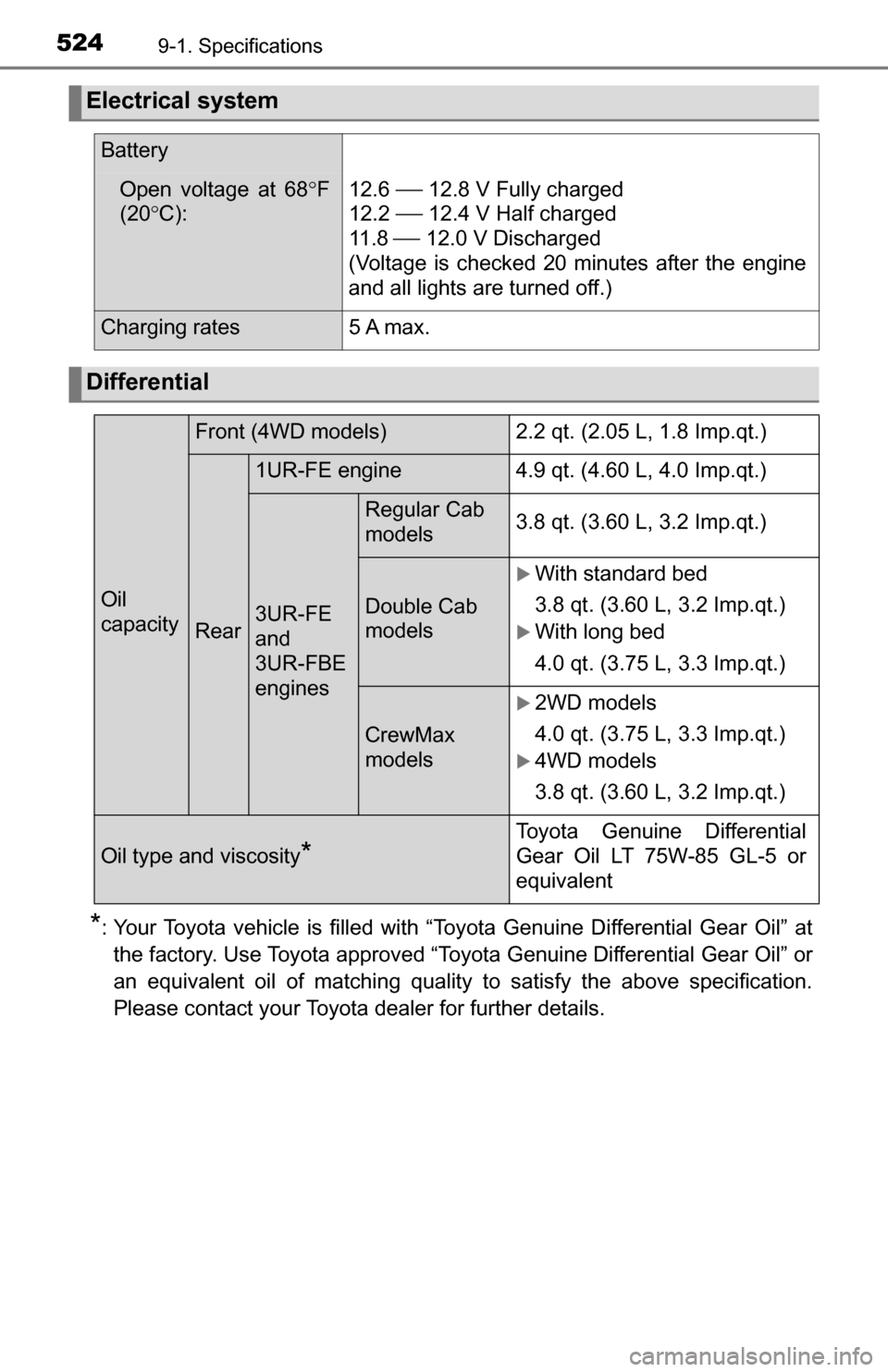
Electrical system
Battery
Open voltage at 68 F
(20 C):12.6 12.8 V Fully charged
12.2
12.4 V Half charged
11 . 8
12.0 V Discharged
(Voltage is checked 20 minutes after the engine
and all lights are turned off.)
Charging rates5 A max.
Differential
Oil
capacity
Front (4WD models) 2.2 qt. (2.05 L, 1.8 Imp.qt.)
Rear
1UR-FE engine4.9 qt. (4.60 L, 4.0 Imp.qt.)
3UR-FE
and
3UR-FBE
engines
Regular Cab
models3.8 qt. (3.60 L, 3.2 Imp.qt.)
Double Cab
models
With standard bed
3.8 qt. (3.60 L, 3.2 Imp.qt.)
With long bed
4.0 qt. (3.75 L, 3.3 Imp.qt.)
CrewMax
models
2WD models
4.0 qt. (3.75 L, 3.3 Imp.qt.)
4WD models
3.8 qt. (3.60 L, 3.2 Imp.qt.)
Oil type and viscosity*
Toyota Genuine Differential
Gear Oil LT 75W-85 GL-5 or
equivalent
Page 528 of 588
5289-1. Specifications
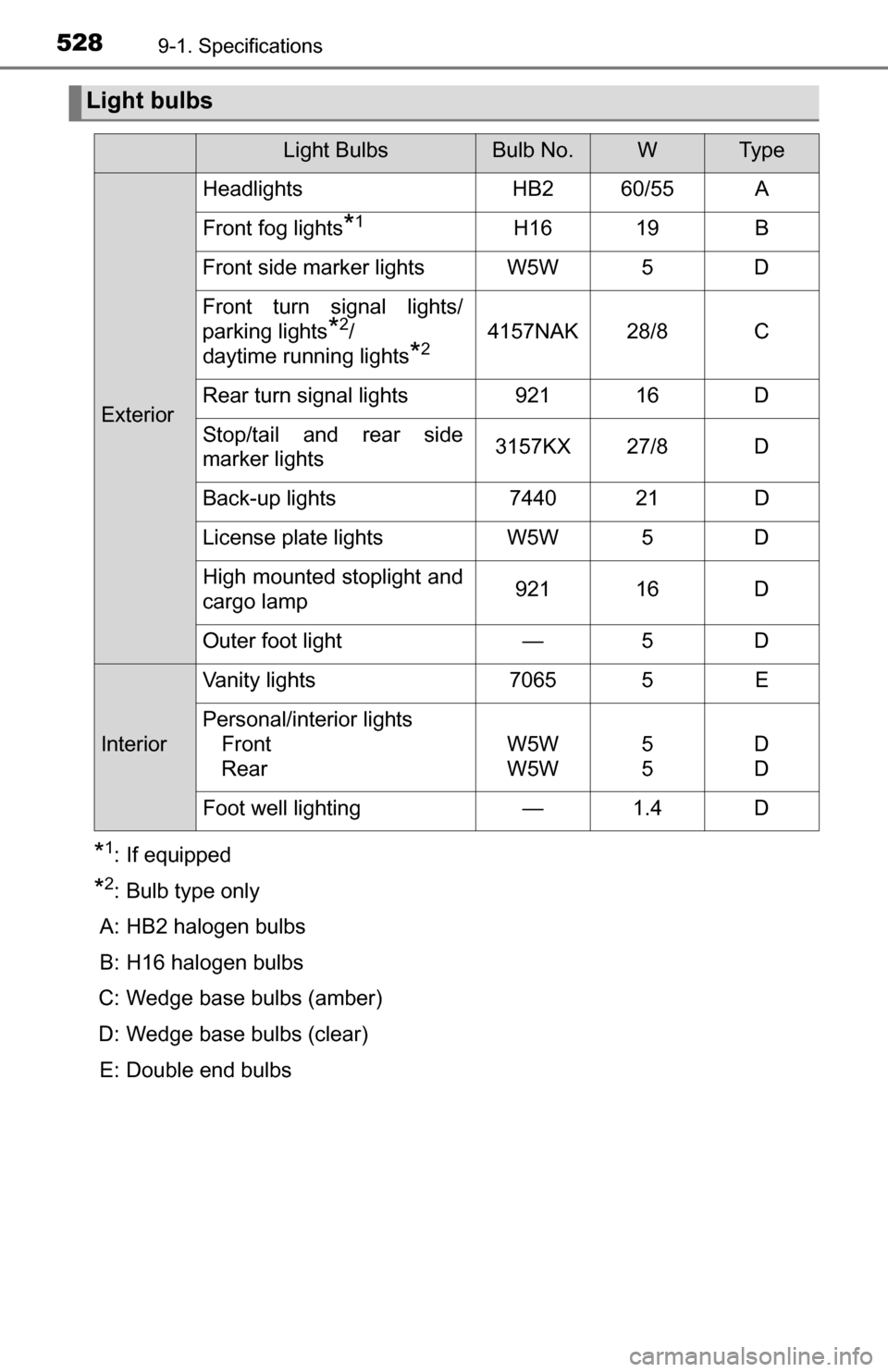
*1: If equipped
*2: Bulb type only
A: HB2 halogen bulbs
B: H16 halogen bulbs
C: Wedge base bulbs (amber)
D: Wedge base bulbs (clear)
E: Double end bulbs
Light bulbs
Light BulbsBulb No.WTy p e
Exterior Headlights HB2 60/55 A
Front fog lights
*1H16 19 B
Front side marker lights W5W 5 D
Front turn signal lights/
parking lights
*2/
daytime running lights
*24157NAK 28/8 C
Rear turn signal lights 921 16 D
Stop/tail and rear side
marker lights 3157KX 27/8 D
Back-up lights 7440 21 D
License plate lights W5W 5 D
High mounted stoplight and
cargo lamp 921 16 D
Outer foot light — 5 D
InteriorVanity lights 7065 5 E
Personal/interior lights
Front
Rear W5W
W5W5
5D
D
Foot well lighting — 1.4 D
Page 546 of 588
5469-2. Customization
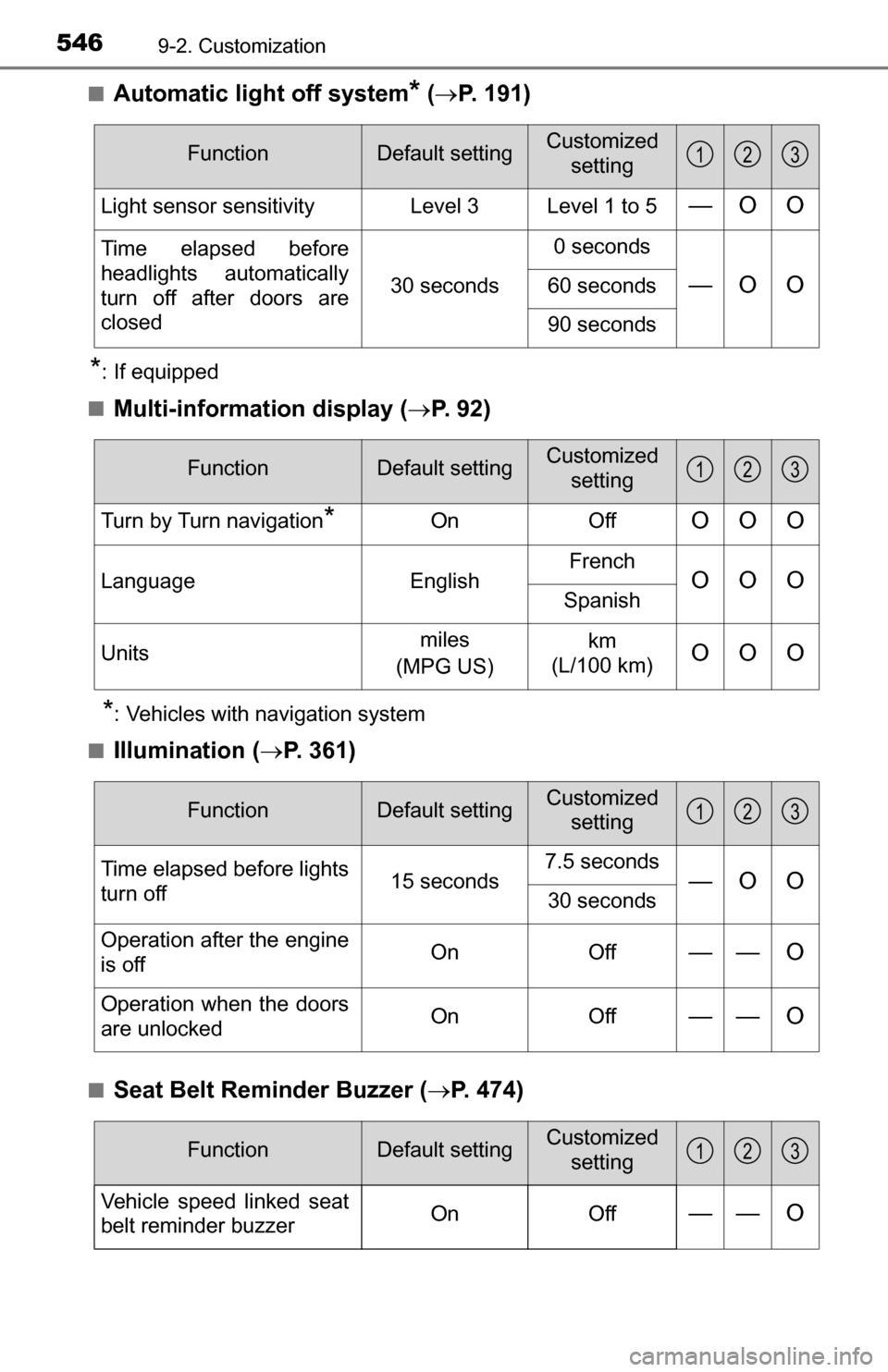
■Automatic light off system* ( P. 191)
*: If equipped
■
Multi-information display ( P. 92)
*: Vehicles with navigation system
■
Illumination ( P. 361)
■Seat Belt Reminder Buzzer ( P. 474)
FunctionDefault settingCustomized
setting
Light sensor sensitivity Level 3 Level 1 to 5—O O
Time elapsed before
headlights automatically
turn off after doors are
closed 30 seconds0 seconds
—O O60 seconds
90 seconds
123
FunctionDefault settingCustomized
setting
Turn by Turn navigation*On OffOOO
Language EnglishFrenchOOOSpanish
Units miles
(MPG US) km
(L/100 km)
OOO
123
FunctionDefault settingCustomized setting
Time elapsed before lights
turn off 15 seconds7.5 seconds—O O30 seconds
Operation after the engine
is off On Off
—— O
Operation when the doors
are unlockedOn Off—— O
123
FunctionDefault settingCustomized
setting
Vehicle speed linked seat
belt reminder buzzerOnOff—— O
123
Page 574 of 588
574Alphabetical index
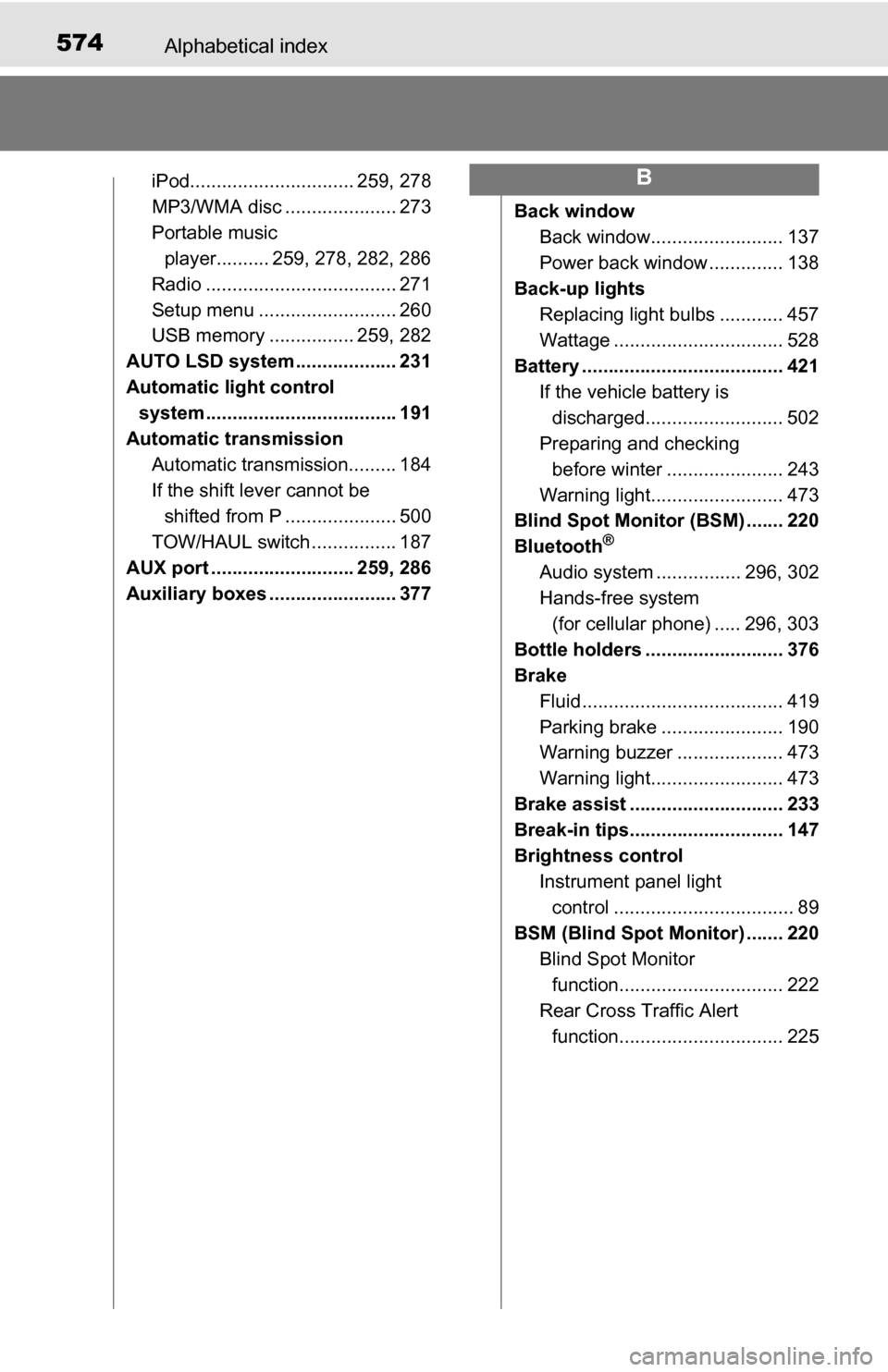
iPod............................... 259, 278
MP3/WMA disc ..................... 273
Portable music player.......... 259, 278, 282, 286
Radio .................................... 271
Setup menu .......................... 260
USB memory ................ 259, 282
AUTO LSD system ................... 231
Automatic light control system .................................... 191
Automatic transmission Automatic transmission......... 184
If the shift lever cannot be shifted from P ..................... 500
TOW/HAUL switch ................ 187
AUX port ........................... 259, 286
Auxiliary boxes ........................ 377 Back window
Back window......................... 137
Power back window .............. 138
Back-up lights
Replacing light bulbs ............ 457
Wattage ................................ 528
Battery ...................................... 421
If the vehicle battery is discharged.......................... 502
Preparing and checking
before winter ...................... 243
Warning light......................... 473
Blind Spot Monitor (BSM) ....... 220
Bluetooth
®
Audio system ................ 296, 302
Hands-free system
(for cellular phone) ..... 296, 303
Bottle holders .......................... 376
Brake Fluid ...................................... 419
Parking brake ....................... 190
Warning buzzer .................... 473
Warning light......................... 473
Brake assist ............................. 233
Break-in tips............................. 147
Brightness control Instrument panel light control .................................. 89
BSM (Blind Spot Monitor) ....... 220 Blind Spot Monitor function............................... 222
Rear Cross Traffic Alert function............................... 225
B