ECU TOYOTA TUNDRA 2017 2.G User Guide
[x] Cancel search | Manufacturer: TOYOTA, Model Year: 2017, Model line: TUNDRA, Model: TOYOTA TUNDRA 2017 2.GPages: 588, PDF Size: 10.76 MB
Page 39 of 588

391-1. For safe use
1
For safety and security
◆SRS front airbags
SRS driver airbag/front passenger airbag
Can help protect the head and chest of the driver and right front
passenger from impact with interior components
SRS knee airbags
Can help provide driver and front passenger protection
◆SRS side and curtain shield airbags
SRS side airbags
Can help protect the torso of the front seat occupants
SRS curtain shield airbags
● Can help protect primarily the he ad of occupants in the outer
seats
● Can prevent the occupants from be ing thrown from the vehicle in
the event of vehicle rollover
1
2
3
4
Page 41 of 588
411-1. For safe use
1
For safety and security
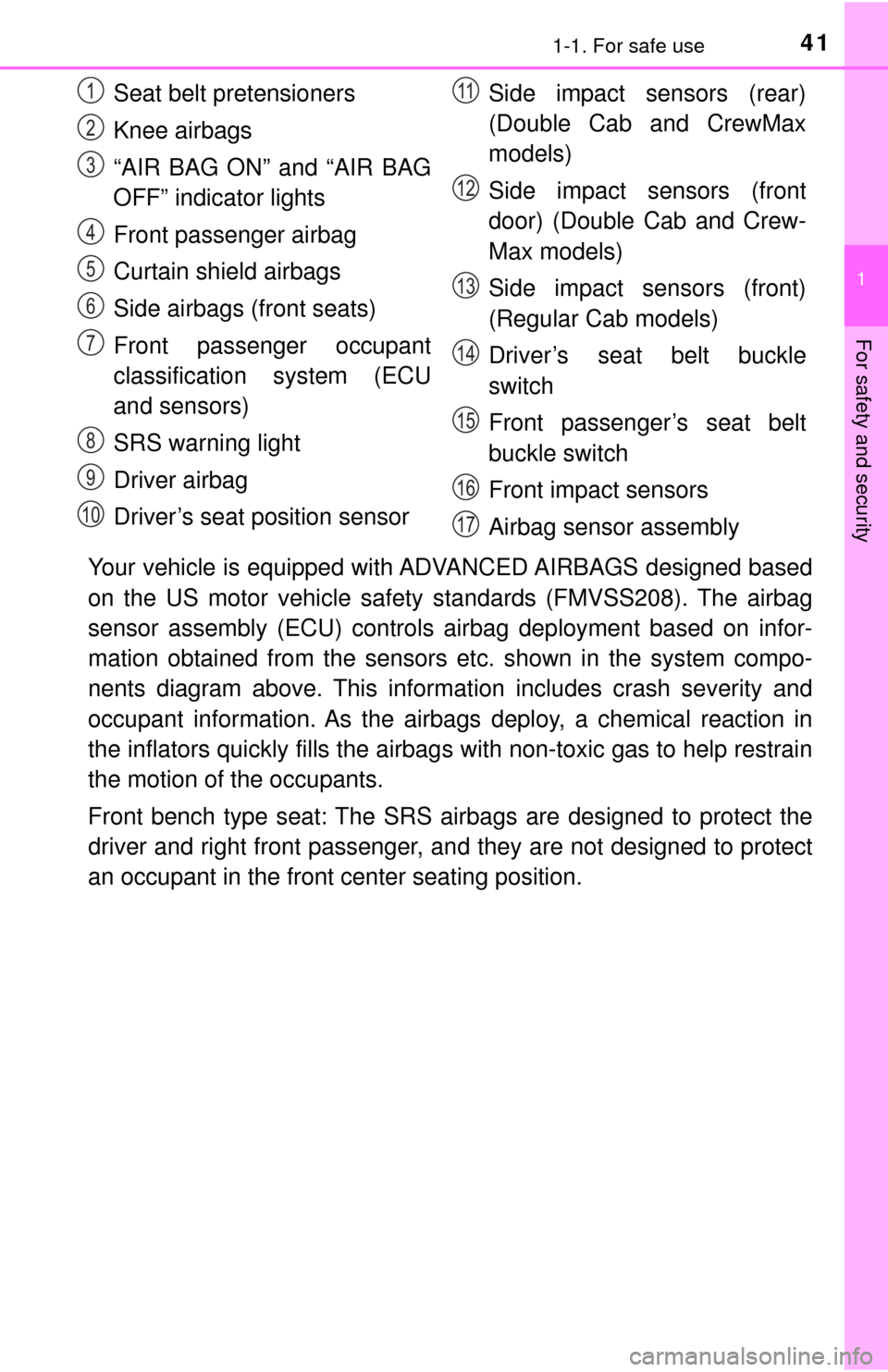
Your vehicle is equipped with ADVANCED AIRBAGS designed based
on the US motor vehicle safety standards (FMVSS208). The airbag
sensor assembly (ECU ) controls airbag deployment based on infor-
mation obtained from the sensors et c. shown in the system compo-
nents diagram above. This informat ion includes crash severity and
occupant information. As the airbags deploy, a chemical reaction in
the inflators quickly fills the airbag s with non-toxic gas to help restrain
the motion of the occupants.
Front bench type seat: The SRS airbags are designed to protect the
driver and right front passenger, an d they are not designed to protect
an occupant in the front center seating position.
Seat belt pretensioners
Knee airbags
“AIR BAG ON” and “AIR BAG
OFF” indicator lights
Front passenger airbag
Curtain shield airbags
Side airbags (front seats)
Front passenger occupant
classification system (ECU
and sensors)
SRS warning light
Driver airbag
Driver’s seat position sensor
Side impact sensors (rear)
(Double Cab and CrewMax
models)
Side impact sensors (front
door) (Double Cab and Crew-
Max models)
Side impact sensors (front)
(Regular Cab models)
Driver’s seat belt buckle
switch
Front passenger’s seat belt
buckle switch
Front impact sensors
Airbag sensor assembly
1
2
3
4
5
6
7
8
9
10
11
12
13
14
15
16
17
Page 43 of 588
431-1. For safe use
1
For safety and security
CAUTION
■SRS airbag precautions
● The SRS front passenger airbag also deploys with considerable force, and
can cause death or serious injury especially if the front passenger is very
close to the airbag. The front passenger seat should be as far from the air-
bag as possible with the seatback adjusted, so the front passenger sits
upright.
● Improperly seated and/or restrained infants and children can be killed or
seriously injured by a deploying airbag. An infant or child who is too small
to use a seat belt should be properly secured using a child restraint sys-
tem. Toyota strongly recommends that all infants and children be placed in
the rear seats of the vehicle and properly restrained. The rear seats are
safer for infants and children than the front passenger seat. ( →P. 56)
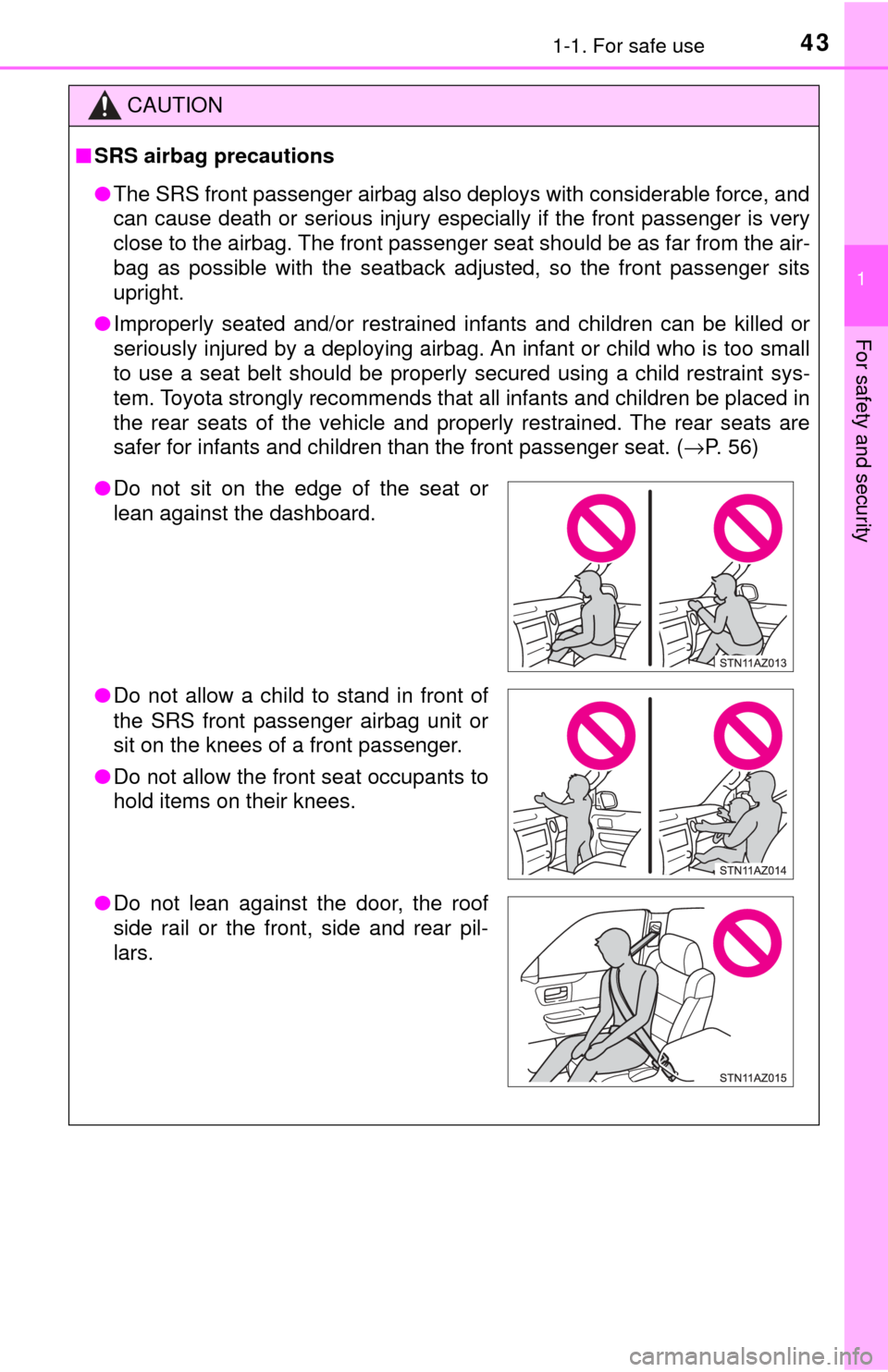
●Do not sit on the edge of the seat or
lean against the dashboard.
● Do not allow a child to stand in front of
the SRS front passenger airbag unit or
sit on the knees of a front passenger.
● Do not allow the front seat occupants to
hold items on their knees.
● Do not lean against the door, the roof
side rail or the front, side and rear pil-
lars.
Page 45 of 588

451-1. For safe use
1
For safety and security
CAUTION
■SRS airbag precautions
● Do not use seat accessories which cover the parts where the SRS side
airbags inflate as they may interfere with inflation of the airbags. Such
accessories may prevent the side airbags from activating correctly, disable
the system or cause the side airbags to inflate accidentally, resulting in
death or serious injury.
● Do not strike or apply significant levels of force to the area of the SRS air-
bag components.
Doing so can cause the SRS airbags to malfunction.
● Do not touch any of the component parts immediately after the SRS air-
bags have deployed (inflated) as they may be hot.
● If breathing becomes difficult after the SRS airbags have deployed, open a
door or window to allow fresh air in, or leave the vehicle if it is safe to do
so. Wash off any residue as soon as possible to prevent skin irritation.
● If the areas where the SRS airbags are stored, such as the steering wheel
pad and front and rear pillar garnishes, are damaged or cracked, have
them replaced by your Toyota dealer.
● Do not place anything, such as a cushion, on the front passenger’s seat.
Doing so will disperse the passenger’s weight, which prevents the sensor
from detecting the passenger’s weight properly. As a result, the SRS front
airbags for the front passenger may not deploy in the event of a collisi\
on.
■ Modification and disposal of SRS airbag system components
Do not dispose of your vehicle or per form any of the following modifications
without consulting your Toyota dealer. The SRS airbags may malfunction or
deploy (inflate) accidentally, causing death or serious injury.
● Installation, removal, disassembly and repair of the SRS airbags
● Repairs, modifications, removal or replacement of the steering wheel,
instrument panel, dashboard, seats or seat upholstery, front, side and rear
pillars or roof side rails
● Repairs or modifications of the front fender, front bumper, or side of the
occupant compartment
● Installation of a grille guard (bull bars, kangaroo bar, etc.), snow plows,
winches or roof luggage carrier
● Modifications to the vehicle’s suspension system
● Installation of electronic devices such as mobile two-way radios and CD
players
● Modifications to your vehicle for a person with a physical disability
Page 47 of 588
471-1. For safe use
1
For safety and security
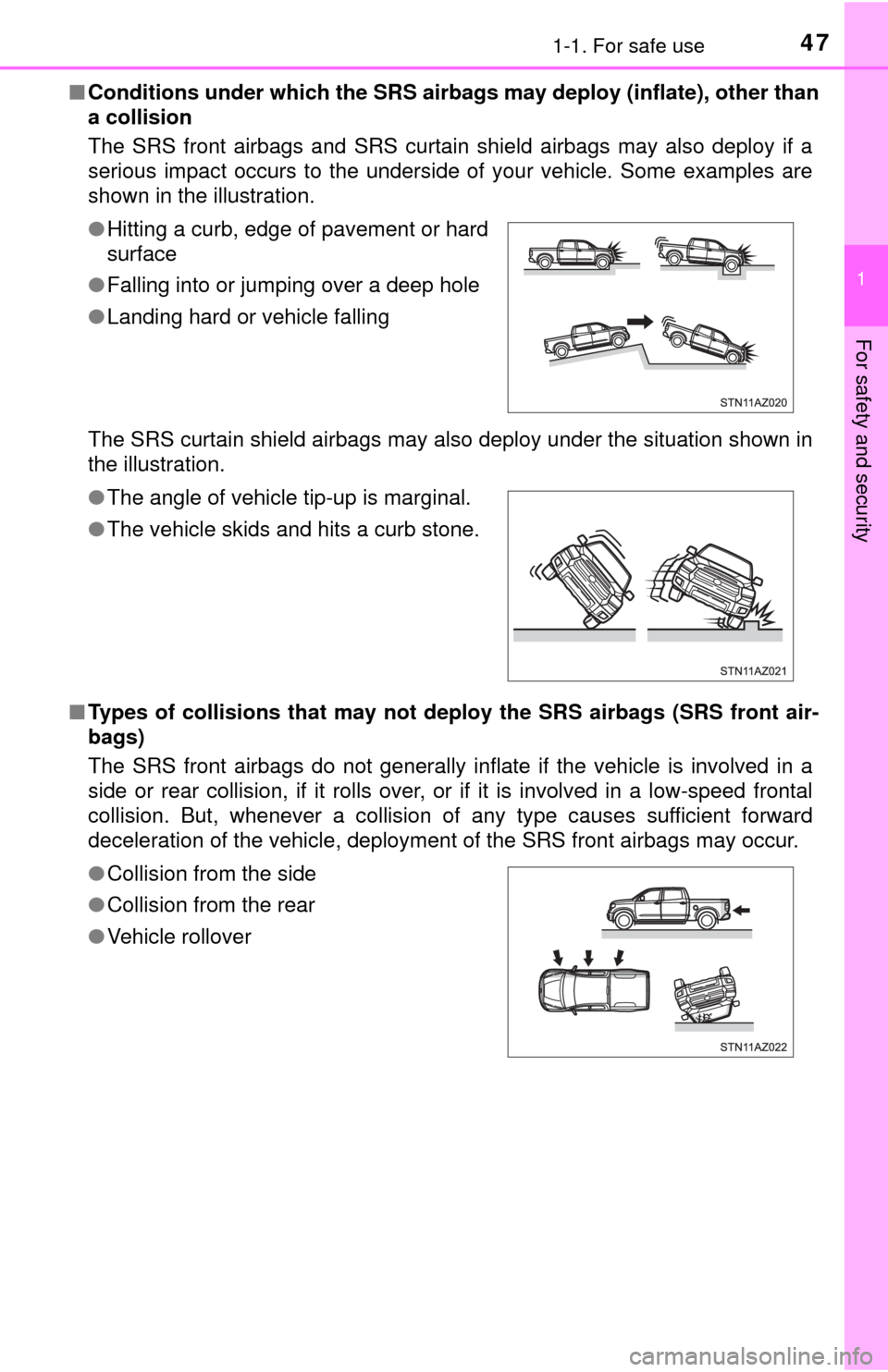
■Conditions under which the SRS airbags may deploy (inflate), other than
a collision
The SRS front airbags and SRS curtain shield airbags may also deploy if a
serious impact occurs to the underside of your vehicle. Some examples are
shown in the illustration.
The SRS curtain shield airbags may also deploy under the situation shown in
the illustration.
■ Types of collisions that may not depl oy the SRS airbags (SRS front air-
bags)
The SRS front airbags do not generally inflate if the vehicle is involved in a
side or rear collision, if it rolls over, or if it is involved in a low-speed frontal
collision. But, whenever a collision of any type causes sufficient forward
deceleration of the vehicle, deployment of the SRS front airbags may occur. ● Hitting a curb, edge of pavement or hard
surface
● Falling into or jumping over a deep hole
● Landing hard or vehicle falling
● The angle of vehicle tip-up is marginal.
● The vehicle skids and hits a curb stone.
● Collision from the side
● Collision from the rear
● Vehicle rollover
Page 49 of 588
491-1. For safe use
1
For safety and security
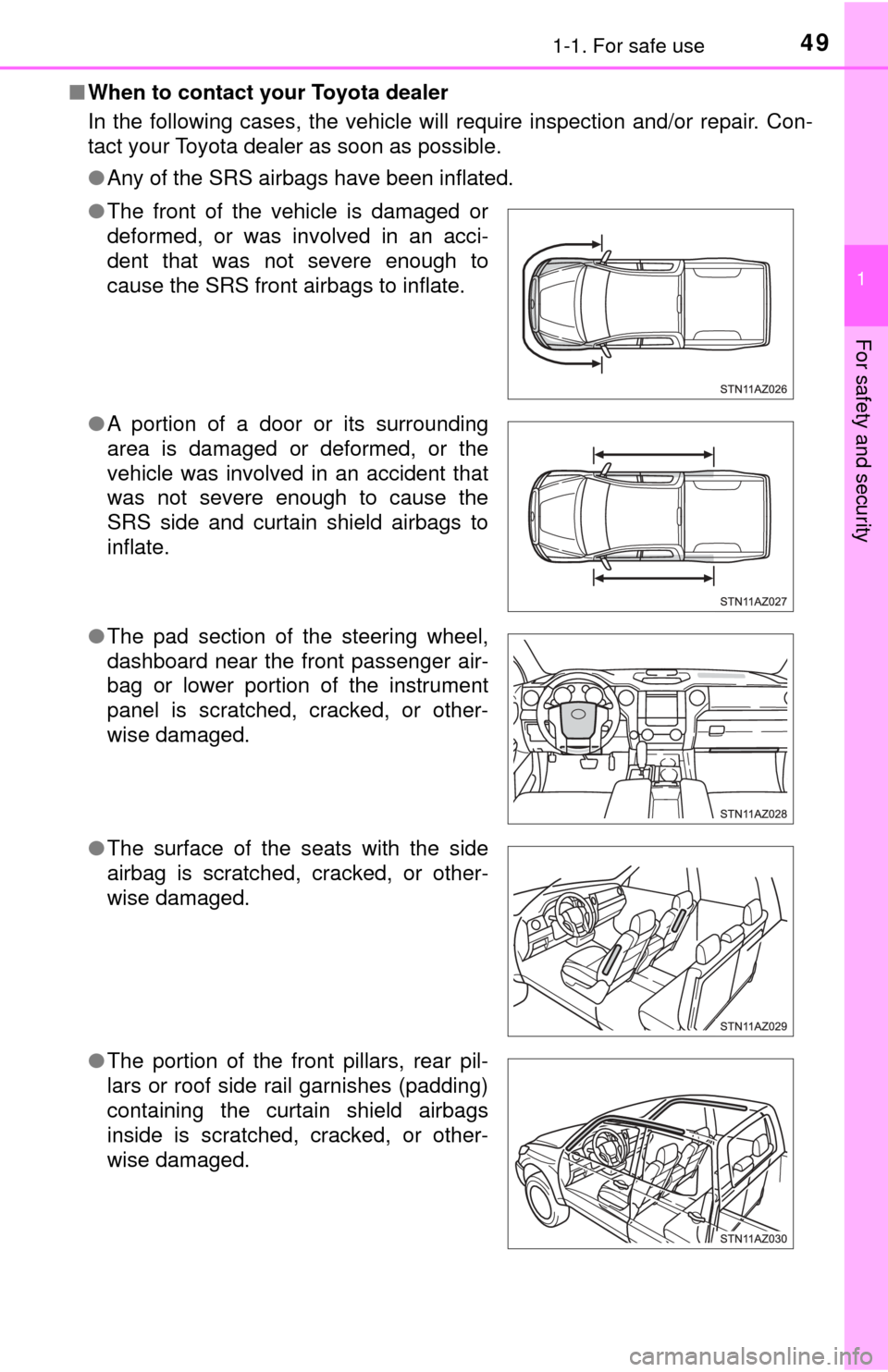
■When to contact your Toyota dealer
In the following cases, the vehicle will require inspection and/or repair. Con-
tact your Toyota dealer as soon as possible.
●Any of the SRS airbags have been inflated.
● The front of the vehicle is damaged or
deformed, or was involved in an acci-
dent that was not severe enough to
cause the SRS front airbags to inflate.
● A portion of a door or its surrounding
area is damaged or deformed, or the
vehicle was involved in an accident that
was not severe enough to cause the
SRS side and curtain shield airbags to
inflate.
● The pad section of the steering wheel,
dashboard near the front passenger air-
bag or lower portion of the instrument
panel is scratched, cracked, or other-
wise damaged.
● The surface of the seats with the side
airbag is scratched, cracked, or other-
wise damaged.
● The portion of the front pillars, rear pil-
lars or roof side rail garnishes (padding)
containing the curtain shield airbags
inside is scratched, cracked, or other-
wise damaged.
Page 51 of 588
511-1. For safe use
1
For safety and security
■Adult*1
■Child*3 or child restraint system*4
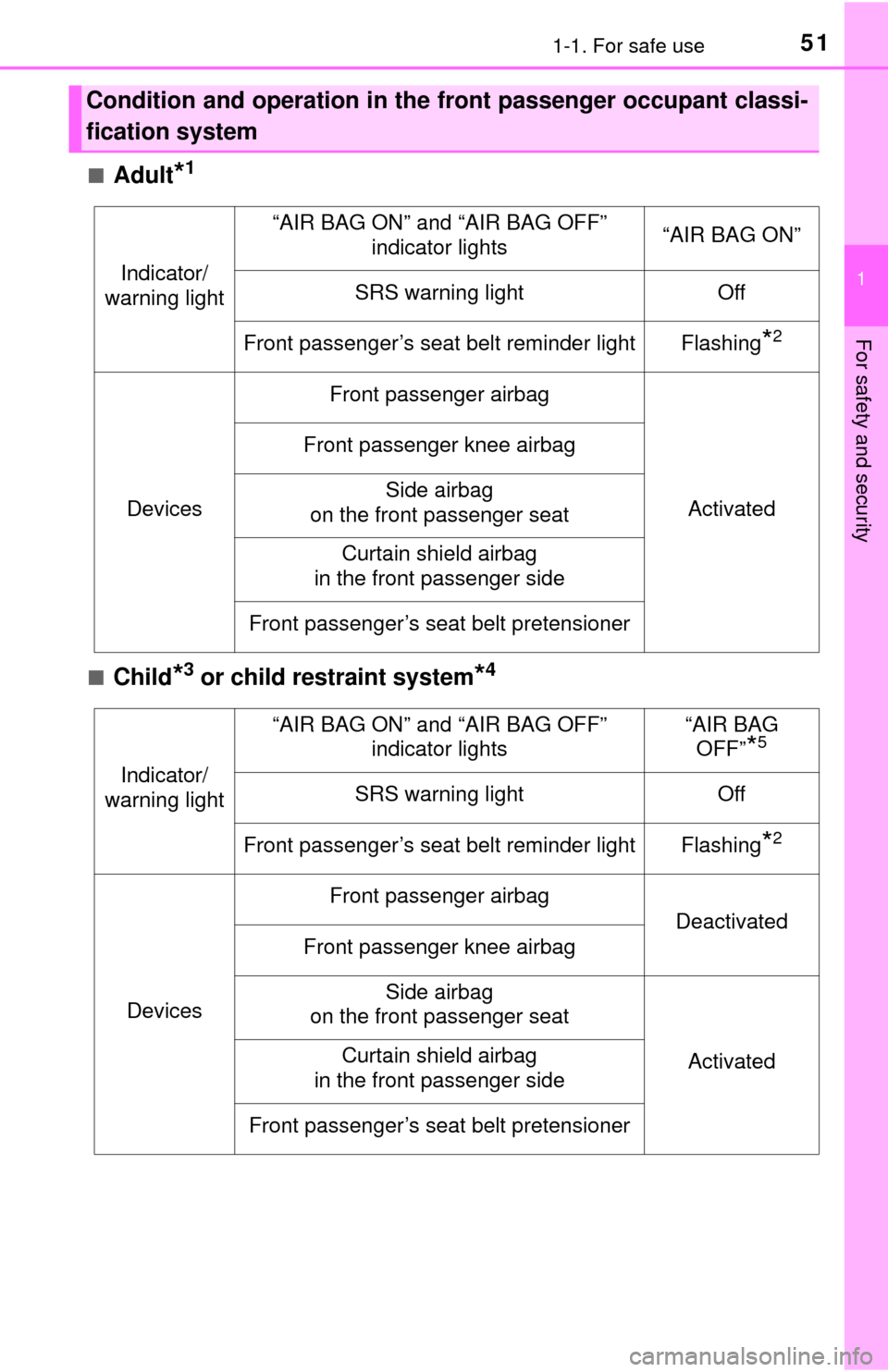
Condition and operation in the front passenger occupant classi-
fication system
Indicator/
warning light
“AIR BAG ON” and “AIR BAG OFF” indicator lights“AIR BAG ON”
SRS warning lightOff
Front passenger’s seat belt reminder lightFlashing*2
Devices
Front passenger airbag
Activated
Front passenger knee airbag
Side airbag
on the front passenger seat
Curtain shield airbag
in the front passenger side
Front passenger’s seat belt pretensioner
Indicator/
warning light
“AIR BAG ON” and “AIR BAG OFF” indicator lights“AIR BAG OFF”
*5
SRS warning lightOff
Front passenger’s seat belt reminder lightFlashing*2
Devices
Front passenger airbag
Deactivated
Front passenger knee airbag
Side airbag
on the front passenger seat
ActivatedCurtain shield airbag
in the front passenger side
Front passenger’s seat belt pretensioner
Page 53 of 588
531-1. For safe use
1
For safety and security
*1: The system judges a person of adult size as an adult. When a smalleradult sits in the front passenger seat, the system may recognize him/her
as a child depending on his/her physique and posture.
*2: In the event the front passenger does not wear a seat belt
*3: When a larger child who has outgrown a child restraint system sits in thefront passenger seat, the system may recognize him/her as an adult
depending on his/her physique or posture.
*4: Never install a rear-facing child restraint system on the front passengerseat. A forward-facing child restraint system should only be installed on
the front passenger seat when it is unavoidable. ( →P. 56)
*5: In case the indicator light is not illuminated, consult this manual on how
to install the child restraint system properly. ( →P. 60)
*6: In the event of a frontal collision or rollover.
*7: In the event of a side collision.
CAUTION
■Front passenger occupant classi fication system precautions
Observe the following precautions regarding the front passenger occupant
classification system.
Failure to do so may cause death or serious injury.
● Wear the seat belt properly.
● Make sure the front passenger’s seat belt plate has not been left inserted
into the buckle before someone sits in the front passenger seat.
● Make sure the “AIR BAG OFF” indicator light is not illuminated when using
the seat belt extender for the right front passenger seat. If the “AIR BAG
OFF” indicator light is illuminated, disconnect the extender tongue from
the seat belt buckle, and reconnect the seat belt. Reconnect the seat belt
extender after making sure the “AIR BAG ON” indicator light is illuminated.
If you use the seat belt extender while the “AIR BAG OFF” indicator light is
illuminated, the SRS airbags for the front passenger will not activate,
which could cause death or serious injury in the event of a collision.
● Do not apply a heavy load to the front passenger seat or equipment (e.g.
seatback pockets).
● Double Cab and CrewMax models: Do not put weight on the front passen-
ger seat by putting your hands or feet on the front passenger seat seat-
back from the rear passenger seat.
● Double Cab and CrewMax models: Do not let a rear passenger lift the
front passenger seat with their feet or press on the seatback with their
legs.
● Do not put objects under the front passenger seat.
Page 55 of 588
551-1. For safe use
1
For safety and security
Safety information for children
●Double Cab and CrewMax models: It is recommended that children
sit in the rear seats to avoid acci dental contact with the shift lever,
wiper switch, etc.
● Use the rear door child-protector lock (Double Cab and CrewMax
models) or the window lock switch (if equipped) to avoid children
opening the door while driving or operating the power window acci-
dentally.
● Do not let small children operate equipment which may catch or
pinch body parts, such as the pow er window, hood, tailgate, seats,
etc.
Observe the following precautions when children are in the vehi-
cle.
Use a child restraint system appropriate for the child, until the
child becomes large enough to pr operly wear the vehicle’s seat
belt.
CAUTION
Never leave children unattended in the vehicle, and never allow children to
have or use the key.
Children may be able to start the vehicle or shift the vehicle into neut\
ral.
There is also a danger that children may injure themselves by playing with
the windows, the moon roof or other features of the vehicle. In addition, heat
build-up or extremely cold temperatures inside the vehicle can be fatal to
children.
Page 57 of 588
571-1. For safe use
1
For safety and security
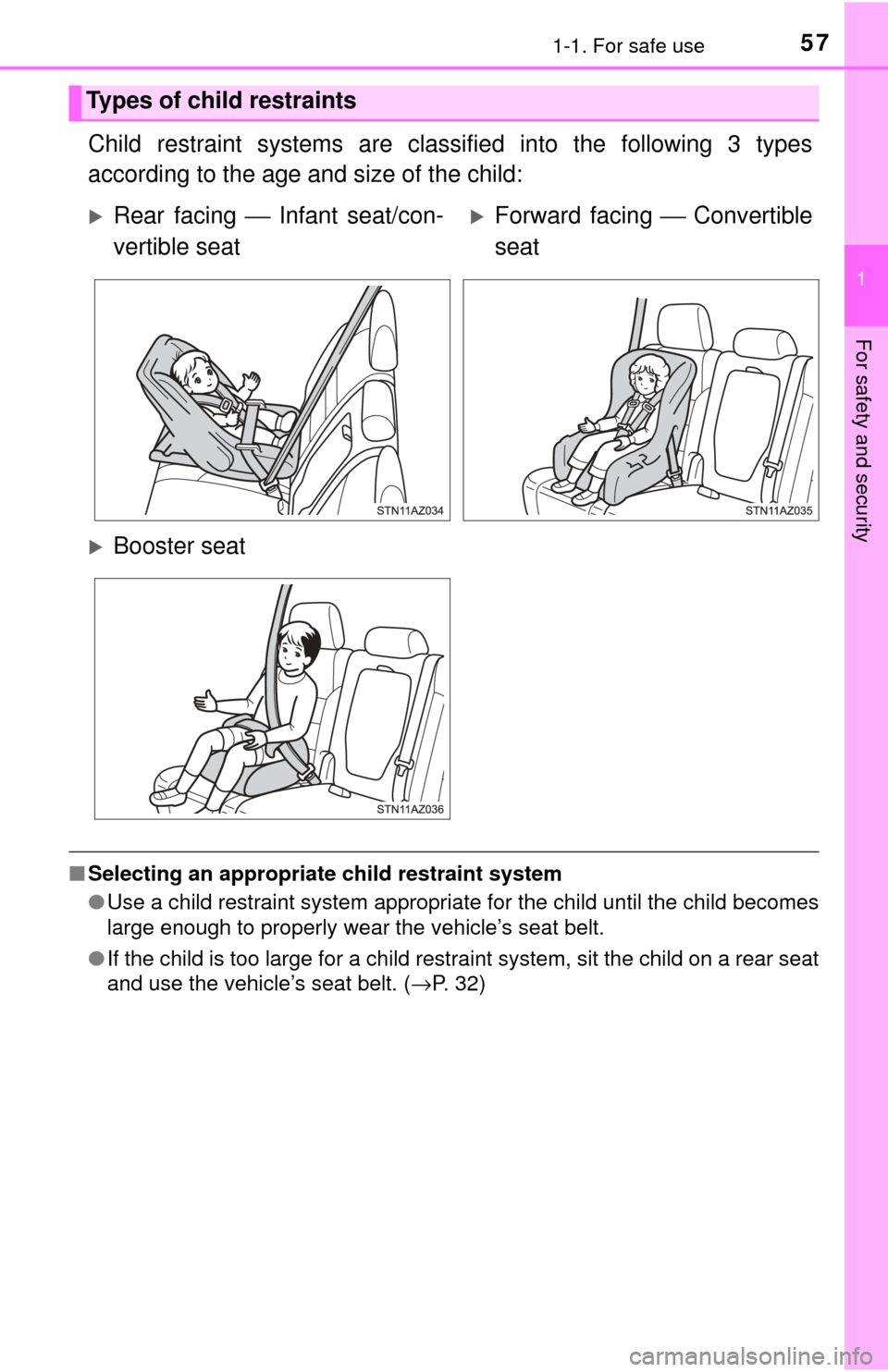
Child restraint systems are classified into the following 3 types
according to the age and size of the child:
■Selecting an appropriate child restraint system
●Use a child restraint system appropriate for the child until the child becomes
large enough to properly wear the vehicle’s seat belt.
● If the child is too large for a child restraint system, sit the child on a rear seat
and use the vehicle’s seat belt. ( →P. 32)
Types of child restraints
Rear facing ⎯ Infant seat/con-
vertible seatForward facing ⎯ Convertible
seat
Booster seat