Interior TOYOTA TUNDRA 2017 2.G Owners Manual
[x] Cancel search | Manufacturer: TOYOTA, Model Year: 2017, Model line: TUNDRA, Model: TOYOTA TUNDRA 2017 2.GPages: 588, PDF Size: 10.76 MB
Page 1 of 588
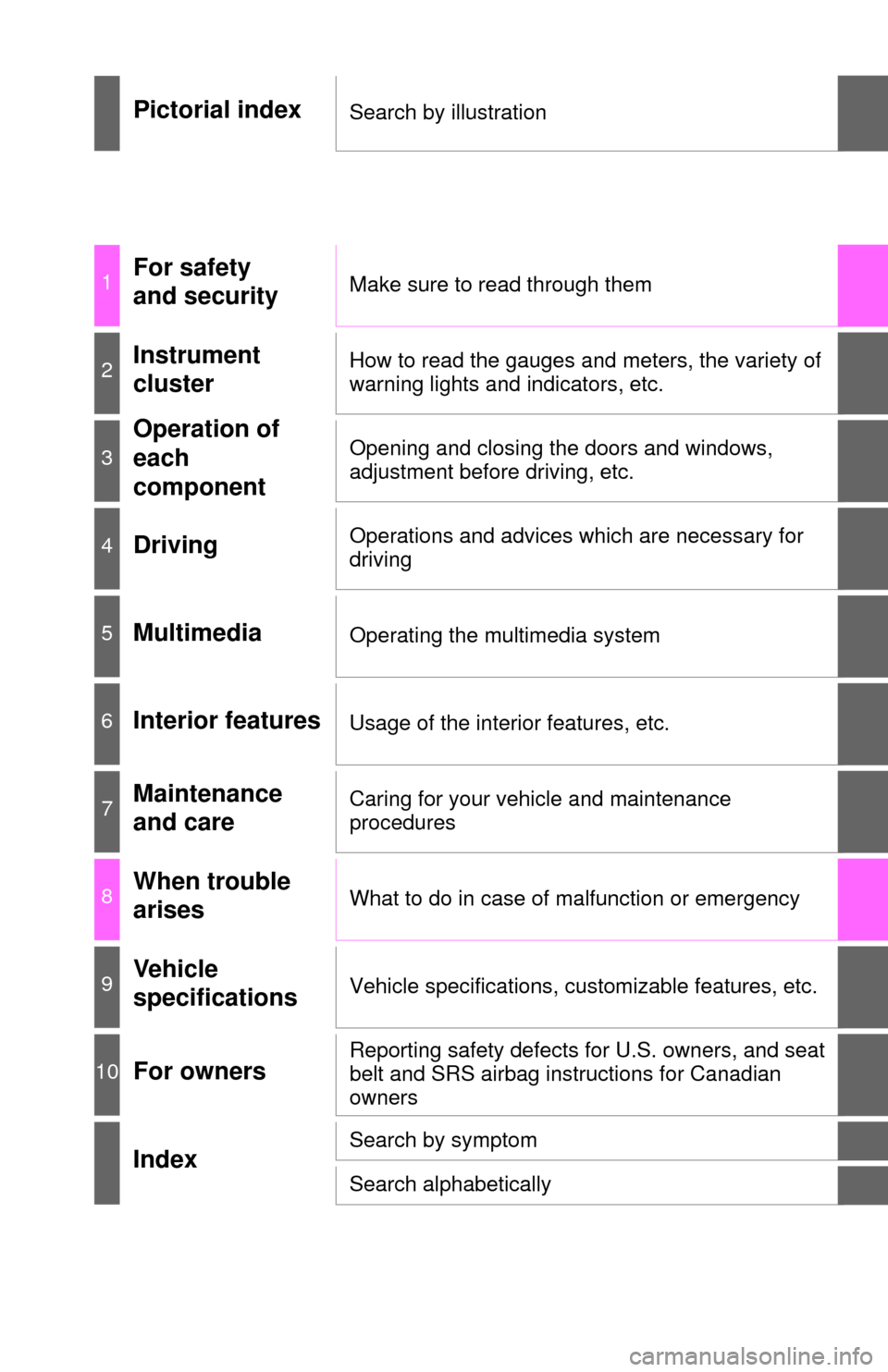
Pictorial indexSearch by illustration
1For safety
and securityMake sure to read through them
2Instrument
clusterHow to read the gauges and meters, the variety of
warning lights and indicators, etc.
3
Operation of
each
componentOpening and closing the doors and windows,
adjustment before driving, etc.
4DrivingOperations and advices which are necessary for
driving
5MultimediaOperating the multimedia system
6Interior featuresUsage of the interior features, etc.
7Maintenance
and careCaring for your vehicle and maintenance
procedures
8When trouble
arisesWhat to do in case of malfunction or emergency
9Vehicle
specificationsVehicle specifications, customizable features, etc.
10For ownersReporting safety defects for U.S. owners, and seat
belt and SRS airbag instructions for Canadian
owners
IndexSearch by symptom
Search alphabetically
Page 4 of 588

TABLE OF CONTENTS4
5-7. Connecting Bluetooth®
Preparations to use wireless
communication ................ 289
Registering a Bluetooth
®
audio player
for the first time ............... 296
Registering a Bluetooth
®
phone for the first time ... 297
Registering a Bluetooth
®
device.............................. 298
Connecting a Bluetooth
®
device.............................. 300
Displaying a Bluetooth
®
device details .................. 302
Detailed Bluetooth
®
system settings ............... 303
5-8. Bluetooth
® audio
Listening to Bluetooth®
audio ............................... 304
5-9. Bluetooth
® phone
Using a Bluetooth®
phone .............................. 305
Making a call ..................... 307
Receiving a call ................. 310
Speaking on the phone ..... 311
Bluetooth
® phone
message function ............ 314
Using the steering wheel switches ................ 318
Bluetooth
® phone
settings............................ 319
Contact/Call History Settings ........................... 321
What to do if... (Troubleshooting) ............ 330
5-10. Using the voice command system
Voice command system .... 334 5-11. Bluetooth
®
Bluetooth®......................... 338
5-12. Antenna Antenna ............................. 343
6-1. Using the air conditioning system
Manual air conditioning system ............................. 346
Automatic air conditioning system ............................. 353
Seat heaters/ seat ventilators ................ 360
6-2. Using the interior lights Interior lights list................. 363• Personal/interior lightsmain switch ................... 364
• Personal/interior lights .............................. 364
• Cargo lamp main
switch ............................ 365
6-3. Using the storage features List of storage features ...... 366• Glove box ...................... 368
• Console box (front separated type seat) ..... 369
• Card holder ................... 370
• Map holder (front bench type seat)............ 372
• Pen holder ..................... 373
• Tissue pocket ................ 374
• Overhead console ......... 375
• Cup holders ................... 376
• Bottle holders ................ 378
• Auxiliary boxes (front bench type seat)............ 379
• Storage box ................... 381
Luggage compartment features ........................... 383
6Interior features
Page 5 of 588
5
1
9 8
7 5 4
3
2
10
6
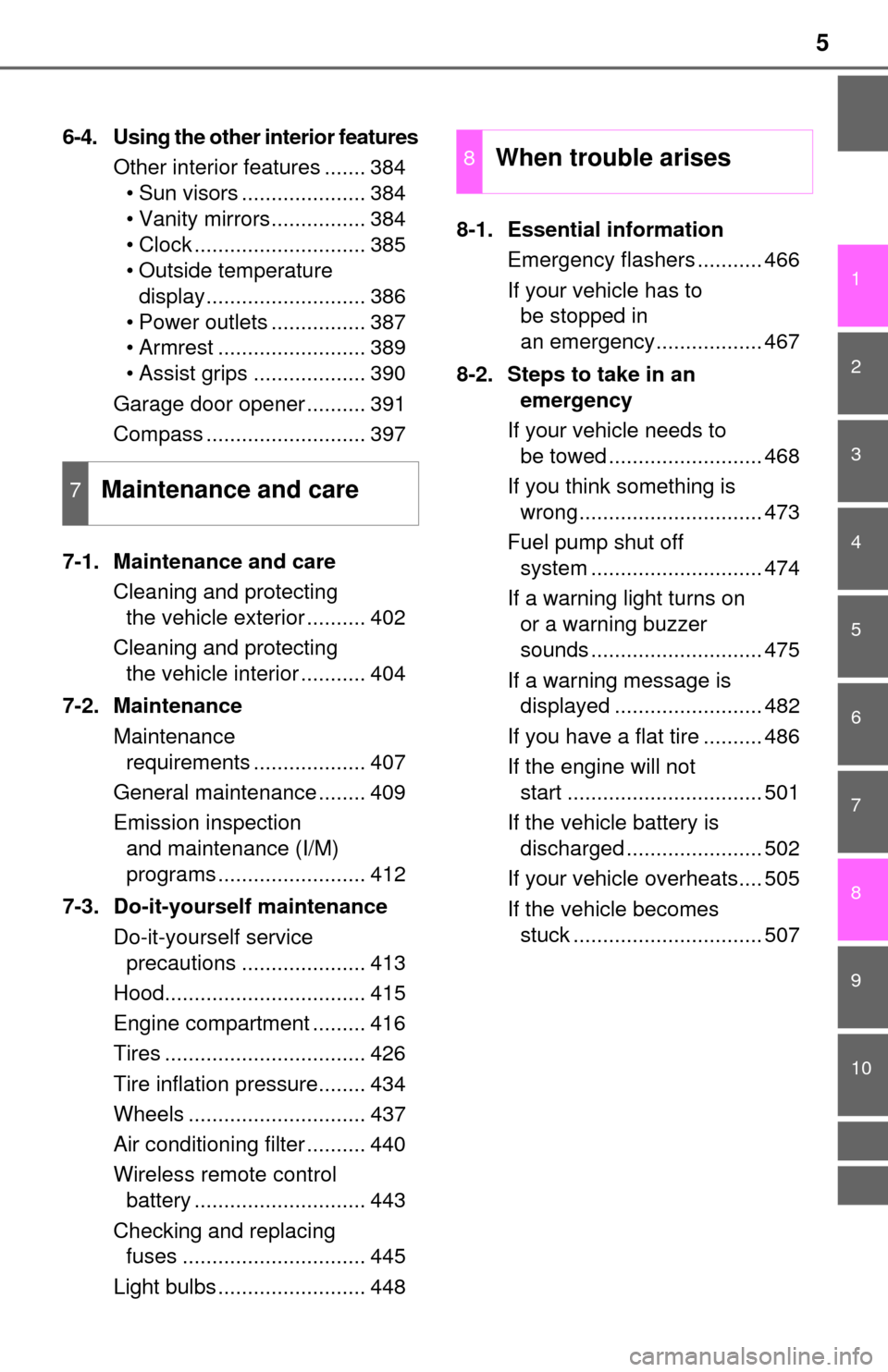
6-4. Using the other interior featuresOther interior features ....... 384• Sun visors ..................... 384
• Vanity mirrors................ 384
• Clock ............................. 385
• Outside temperature
display........................... 386
• Power outlets ................ 387
• Armrest ......................... 389
• Assist grips ................... 390
Garage door opener .......... 391
Compass ........................... 397
7-1. Maintenance and care Cleaning and protecting the vehicle exterior .......... 402
Cleaning and protecting the vehicle interior ........... 404
7-2. Maintenance Maintenance requirements ................... 407
General maintenance ........ 409
Emission inspection and maintenance (I/M)
programs ......................... 412
7-3. Do-it-yourself maintenance Do-it-yourself service precautions ..................... 413
Hood.................................. 415
Engine compartment ......... 416
Tires .................................. 426
Tire inflation pressure........ 434
Wheels .............................. 437
Air conditioning filter .......... 440
Wireless remote control battery ............................. 443
Checking and replacing fuses ............................... 445
Light bulbs ......................... 448 8-1. Essential information
Emergency flashers ........... 466
If your vehicle has to be stopped in
an emergency.................. 467
8-2. Steps to take in an emergency
If your vehicle needs to be towed .......................... 468
If you think something is wrong............................... 473
Fuel pump shut off system ............................. 474
If a warning light turns on or a warning buzzer
sounds ............................. 475
If a warning message is displayed ......................... 482
If you have a flat tire .......... 486
If the engine will not start ................................. 501
If the vehicle battery is discharged ....................... 502
If your vehicle overheats.... 505
If the vehicle becomes stuck ................................ 507
7Maintenance and care
8When trouble arises
Page 20 of 588

20Pictorial index
■Switches
The illustration represents the instrument panel for the front separated\
type
seat.Driving position memory switches
*1. . . . . . . . . . . . . . . . . . P. 116
Power window switches
*1 . . . . . . . . . . . . . . . . . . . . . . . . . . P. 134
Door lock switch
*1. . . . . . . . . . . . . . . . . . . . . . . . . . . . . . . . . P. 103
Window lock switch
*1. . . . . . . . . . . . . . . . . . . . . . . . . . . . . . P. 134
Outside rear view mirror switches
*1 . . . . . . . . . . . . . . . . . . P. 130
Personal/interior lights main switch . . . . . . . . . . . . . . . . . . P. 364
Cargo lamp main switch . . . . . . . . . . . . . . . . . . . . . . . . . . . . P. 365
Manual headlight leveling dial . . . . . . . . . . . . . . . . . . . . . . . P. 194
BSM main switch
*1 . . . . . . . . . . . . . . . . . . . . . . . . . . . . . . . . P. 222
Power back window switch
*2. . . . . . . . . . . . . . . . . . . . . . . . P. 138
Intuitive parking assist switch
*1 . . . . . . . . . . . . . . . . . . . . . P. 207
VSC off switch . . . . . . . . . . . . . . . . . . . . . . . . P. 233, 236, 238, 239
TOW/HAUL switch
*1 . . . . . . . . . . . . . . . . . . . . . . . . . . . . . . . P. 187
Trailer brake controller
*1 . . . . . . . . . . . . . . . . . . . . . . . . . . . P. 242
1
2
3
4
5
6
7
8
9
10
11
12
13
14
Page 23 of 588
23Pictorial index
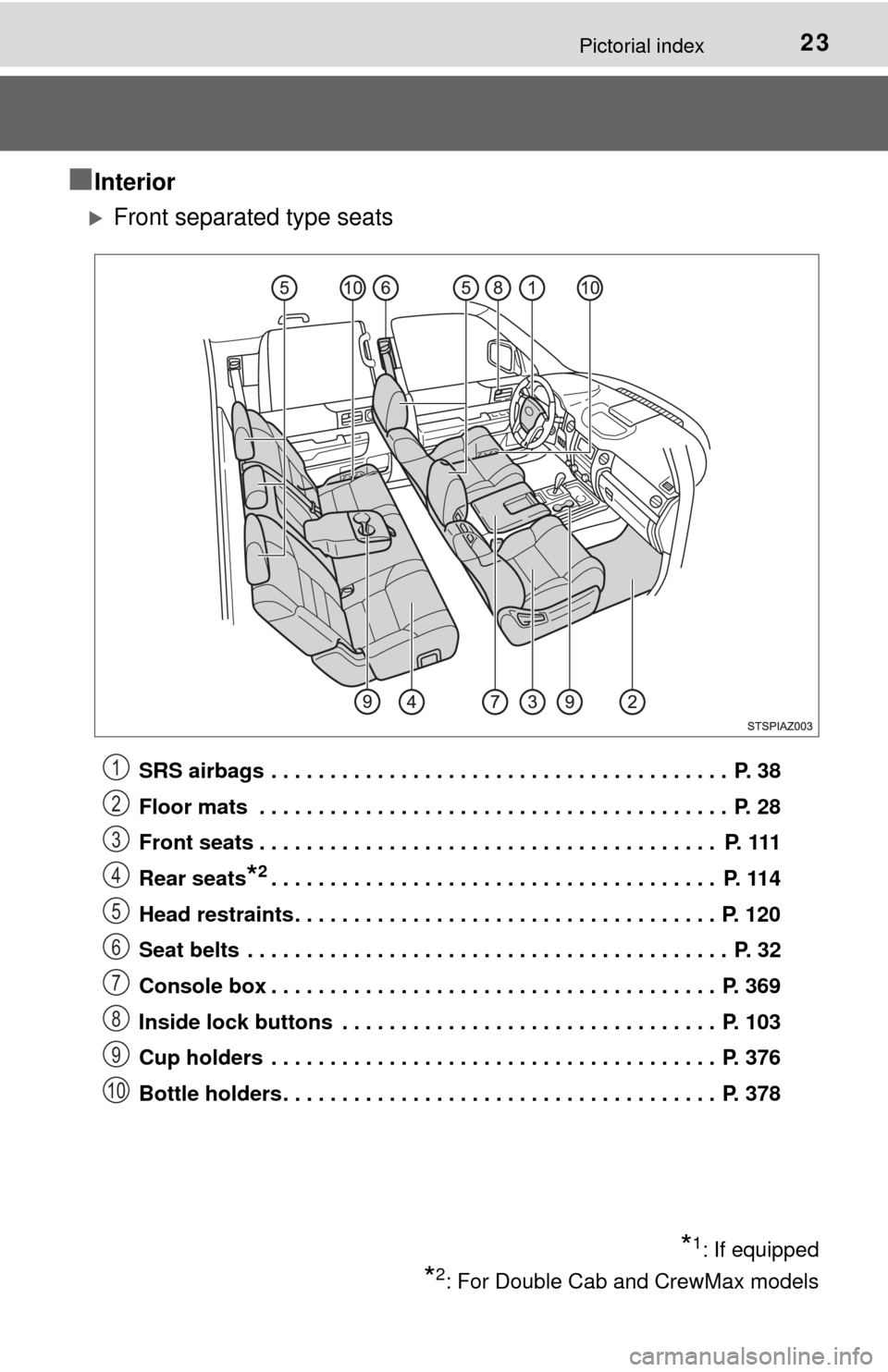
■Interior
Front separated type seats
SRS airbags . . . . . . . . . . . . . . . . . . . . . . . . . . . . . . . . . . . . . . . P. 38
Floor mats . . . . . . . . . . . . . . . . . . . . . . . . . . . . . . . . . . . . . . . . P. 28
Front seats . . . . . . . . . . . . . . . . . . . . . . . . . . . . . . . . . . . . . . . P. 111
Rear seats
*2. . . . . . . . . . . . . . . . . . . . . . . . . . . . . . . . . . . . . . P. 114
Head restraints . . . . . . . . . . . . . . . . . . . . . . . . . . . . . . . . . . . . P. 120
Seat belts . . . . . . . . . . . . . . . . . . . . . . . . . . . . . . . . . . . . . . . . . P. 32
Console box . . . . . . . . . . . . . . . . . . . . . . . . . . . . . . . . . . . . . . P. 369
Inside lock buttons . . . . . . . . . . . . . . . . . . . . . . . . . . . . . . . . P. 103
Cup holders . . . . . . . . . . . . . . . . . . . . . . . . . . . . . . . . . . . . . . P. 376
Bottle holders . . . . . . . . . . . . . . . . . . . . . . . . . . . . . . . . . . . . . P. 378
*1: If equipped
*2: For Double Cab and CrewMax models
1
2
3
4
5
6
7
8
9
10
Page 25 of 588
25Pictorial index
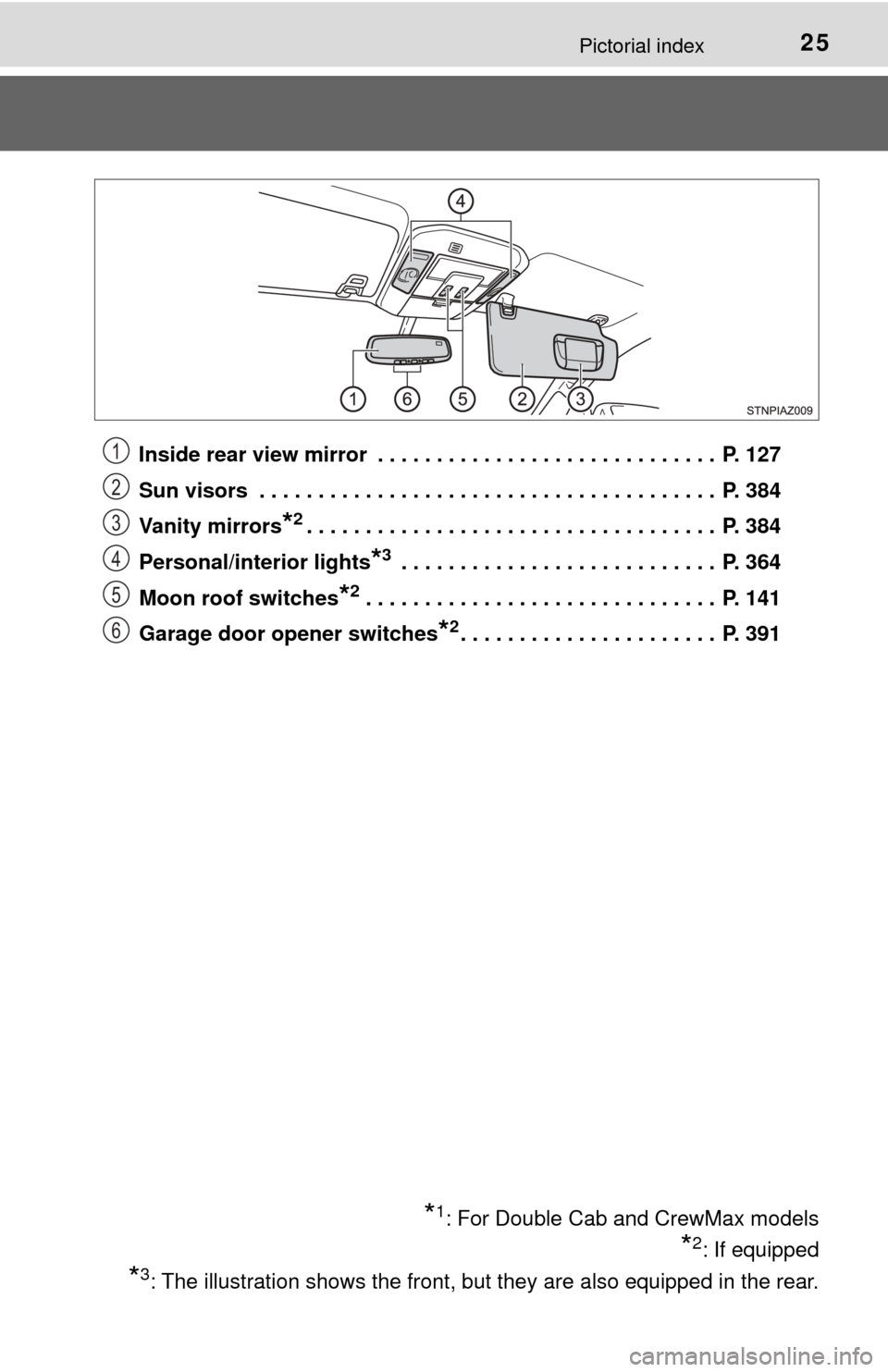
Inside rear view mirror . . . . . . . . . . . . . . . . . . . . . . . . . . . . . P. 127
Sun visors . . . . . . . . . . . . . . . . . . . . . . . . . . . . . . . . . . . . . . . P. 384
Va n i ty m i rr or s
*2. . . . . . . . . . . . . . . . . . . . . . . . . . . . . . . . . . . P. 384
Personal/interior lights
*3 . . . . . . . . . . . . . . . . . . . . . . . . . . . P. 364
Moon roof switches
*2 . . . . . . . . . . . . . . . . . . . . . . . . . . . . . . P. 141
Garage door opener switches
*2. . . . . . . . . . . . . . . . . . . . . . P. 391
*1: For Double Cab and CrewMax models
*2: If equipped
*3: The illustration shows the front, but they are also equipped in the rear.
1
2
3
4
5
6
Page 37 of 588
371-1. For safe use
1
For safety and security
CAUTION
■Before using a front seat belt (Regular Cab models)
Make sure the seat belt hanger is secured in the raised position before you
fasten the seat belt.
■ Using a seat belt extender
● Do not wear the seat belt extender if you can fasten the seat belt witho\
ut
the extender.
● Do not use the seat belt extender when installing a child restraint system
because the belt will not securely hold the child restraint system, increas-
ing the risk of death or serious injury in the event of an accident.
● The personalized extender may not be safe on another vehicle, when
used by another person, or at a different seating position other than the
one originally intended.
NOTICE
■When using a seat belt extender
When releasing the seat belt, press on the buckle release button on the
extender, not on the seat belt.
This helps prevent damage to the vehicle interior and the extender itself.
Page 39 of 588

391-1. For safe use
1
For safety and security
◆SRS front airbags
SRS driver airbag/front passenger airbag
Can help protect the head and chest of the driver and right front
passenger from impact with interior components
SRS knee airbags
Can help provide driver and front passenger protection
◆SRS side and curtain shield airbags
SRS side airbags
Can help protect the torso of the front seat occupants
SRS curtain shield airbags
● Can help protect primarily the he ad of occupants in the outer
seats
● Can prevent the occupants from be ing thrown from the vehicle in
the event of vehicle rollover
1
2
3
4
Page 58 of 588

581-1. For safe use
CAUTION
■Child restraint precautions
● For effective protection in automobile accidents and sudden stops, a child
must be properly restrained, using a seat belt or child restraint system
depending on the age and size of the child. Holding a child in your arms is
not a substitute for a child restraint system. In an accident, the child can be
crushed against the windshield, or between you and the vehicle’s interior.
● Regular Cab models: Toyota strongly urges the use of a proper child
restraint system that conforms to the size of the child.
● Double Cab and CrewMax models: Toyota strongly urges the use of a
proper child restraint system that conforms to the size of the child, installed
on the rear seat. According to accident statistics, the child is safer when
properly restrained in the rear seat than in the front seat.
● Never install a rear-facing child restraint system on the front passenger
seat even if the “AIR BAG OFF” indicator light is illuminated.
In the event of an accident, the force of the rapid inflation of the front pas-
senger airbag can cause death or serious injury to the child if the rear-fac-
ing child restraint system is installed on the front passenger seat.
● Regular Cab models: A forward-facing child restraint system may be
installed on the front passenger seat only when it is unavoidable. Adjust
the seatback as upright as possible and always move the seat as far back
as possible even if the “AIR BAG OFF” indicator light is illuminat\
ed,
because the front passenger airbag could inflate with considerable speed
and force. Otherwise, the child may be killed or seriously injured.
● Double Cab and CrewMax models: A forward-facing child restraint system
may be installed on the front passenger seat only when it is unavoidable.
A child restraint system that requires a top tether strap should not be used
in the front passenger seat since there is no top tether strap anchor for the
front passenger seat. Adjust the seatback as upright as possible and
always move the seat as far back as possible even if the “AIR BAG OFF”
indicator light is illuminated, because the front passenger airbag could
inflate with considerable speed and force. Otherwise, the child may be
killed or seriously injured.
● Regular Cab models: Do not install a child restraint system on the center
seat if it interferes with driving operations such as changing the shift lever
position. In this case, install the child restraint system on the right passen-
ger seat.
Page 77 of 588
771-1. For safe use
1
For safety and security
Exhaust gas precautions
Harmful substance to the human body is included in exhaust
gases if inhale.
CAUTION
Exhaust gases include harmful carbon monoxide (CO), which is colorless and
odorless. Observe the following precautions.
Failure to do so may cause exhaust gases to enter the vehicle and may lead
to an accident caused by light-headedness, or may lead to death or a serious
health hazard.
■Important points while driving
● Double Cab and CrewMax models: Keep the back window closed.
● Double Cab and CrewMax models: If you smell exhaust gases in the vehi-
cle even when the back window is closed, open the windows and have the
vehicle inspected at your Toyota dealer as soon as possible.
● Toyota does not recommend occupying the rear cargo area when it is fitted
with a slide-in camper, camper shell or other type cover while the engine is
running. This caution applies to both driving and stopped or parked situa-
tions with the engine running. Particular care should be taken to prevent
exhaust gases from entering camper bodi es, trailers or other enclosures
on or around your vehicle. If exhaust fumes are detected, open all win-
dows and thoroughly ventilate the area.
■ When parking
● If the vehicle is in a poorly ventilated area or a closed area, such as a
garage, stop the engine.
● Do not leave the vehicle with the engine on for a long time.
If such a situation cannot be avoided, park the vehicle in an open space
and ensure that exhaust fumes do not enter the vehicle interior.
● Do not leave the engine running in an area with snow build-up, or where it
is snowing. If snowbanks build up around the vehicle while the engine is
running, exhaust gases may collect and enter the vehicle.
■ Exhaust pipe
The exhaust system needs to be checked periodically. If there is a hole or
crack caused by corrosion, damage to a joint or abnormal exhaust noise, be
sure to have the vehicle inspected and repaired by your Toyota dealer.