steering wheel TOYOTA TUNDRA 2019 Owners Manual (in English)
[x] Cancel search | Manufacturer: TOYOTA, Model Year: 2019, Model line: TUNDRA, Model: TOYOTA TUNDRA 2019Pages: 56, PDF Size: 3.12 MB
Page 3 of 56
1
OVERVIEW
FEATURES & OPERATIONS
TOYOTA SAFETY SENSE
SAFETY & EMERGENCY FEATURES
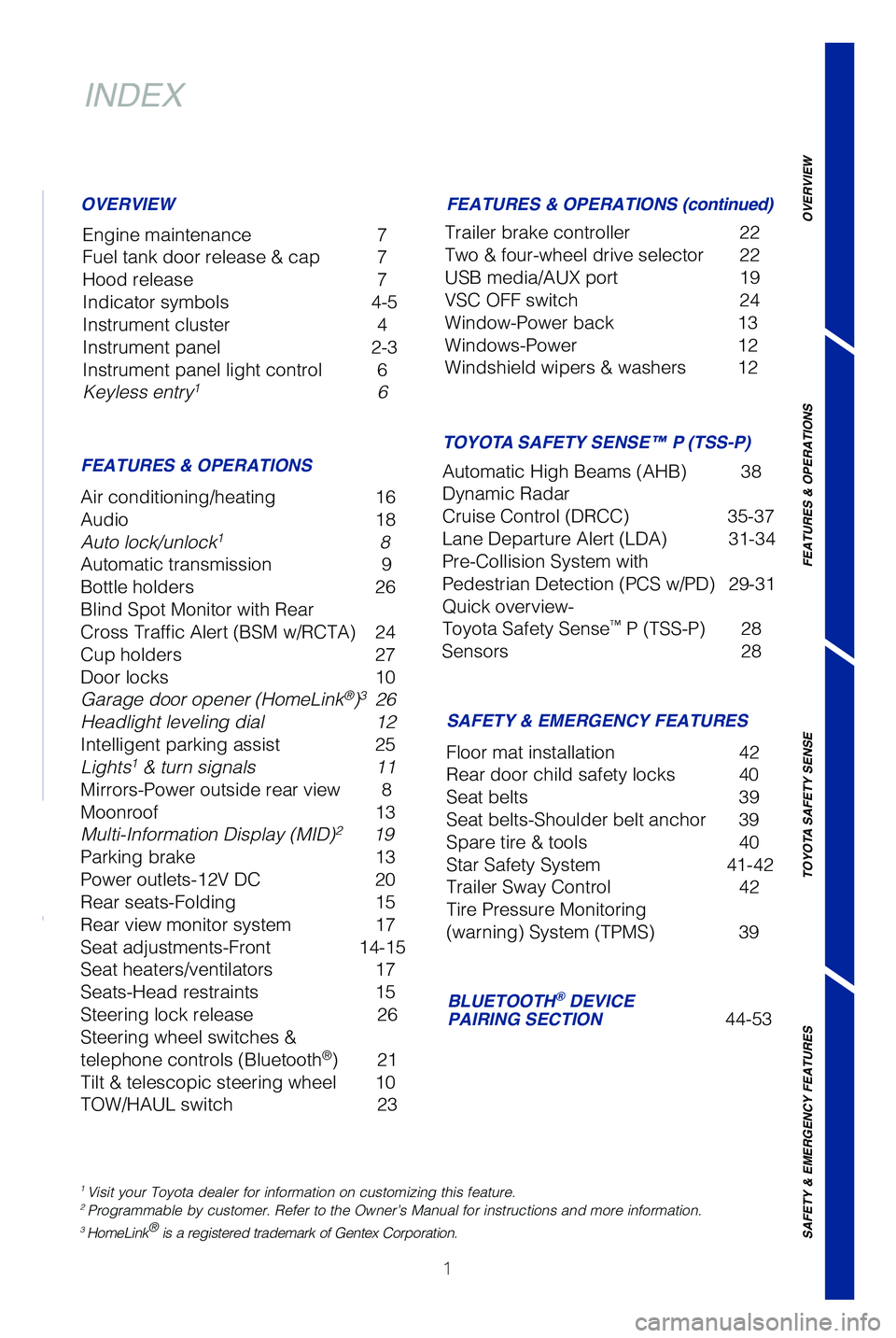
INDEX
Engine maintenance 7
Fuel tank door release & cap 7
Hood release 7
Indicator symbols 4-5
Instrument cluster 4
Instrument panel 2-3
Instrument panel light control 6
Keyless entry
1 6
OVERVIEW
FEATURES & OPERATIONS FEATURES & OPERATIONS (continued)
SAFETY & EMERGENCY FEATURES
Air conditioning/heating
16
Audio 18
Auto lock/unlock
1 8
Automatic transmission 9
Bottle holders 26
Blind Spot Monitor with Rear
Cross Traffic Alert (BSM w/RCTA) 24
Cup holders 27
Door locks 10
Garage door opener (HomeLink
®)3 26
Headlight leveling dial 12
Intelligent parking assist 25
Lights
1 & turn signals 11
Mirrors-Power outside rear view 8
Moonroof 13
Multi-Information Display (MID)
2 19
Parking brake 13
Power outlets-12V DC 20
Rear seats-Folding 15
Rear view monitor system 17
Seat adjustments-Front 14-15
Seat heaters/ventilators 17
Seats-Head restraints 15
Steering lock release 26
Steering wheel switches &
telephone controls (Bluetooth
®) 21
Tilt & telescopic steering wheel 10
TOW/HAUL switch 23Trailer brake controller
22
Two & four-wheel drive selector 22
USB media/AUX port 19
VSC OFF switch 24
Window-Power back 13
Windows-Power 12
Windshield wipers & washers 12
Floor mat installation 42
Rear door child safety locks 40
Seat belts 39
Seat belts-Shoulder belt anchor 39
Spare tire & tools 40
Star Safety System 41-42
Trailer Sway Control 42
Tire Pressure Monitoring
(warning) System (TPMS) 39
BLUETOOTH® DEVICE
PAIRING SECTION 44-53
1 Visit your Toyota dealer for information on customizing this feature.2 Programmable by customer. Refer to the Owner’s Manual for instruction\
s and more information.3 HomeLink® is a registered trademark of Gentex Corporation.
TOYOTA SAFETY SENSE™ P (TSS-P)
Automatic High Beams (AHB) 38
Dynamic Radar
Cruise Control (DRCC) 35-37
Lane Departure Alert (LDA) 31-34
Pre-Collision System with
Pedestrian Detection (PCS w/PD) 29-31
Quick overview-
Toyota Safety Sense
™ P (TSS-P) 28
Sensors 28
49087b_2019_Tundra_QRG_V2_ML_0714.indd 17/17/18 3:18 PM
Page 4 of 56
2
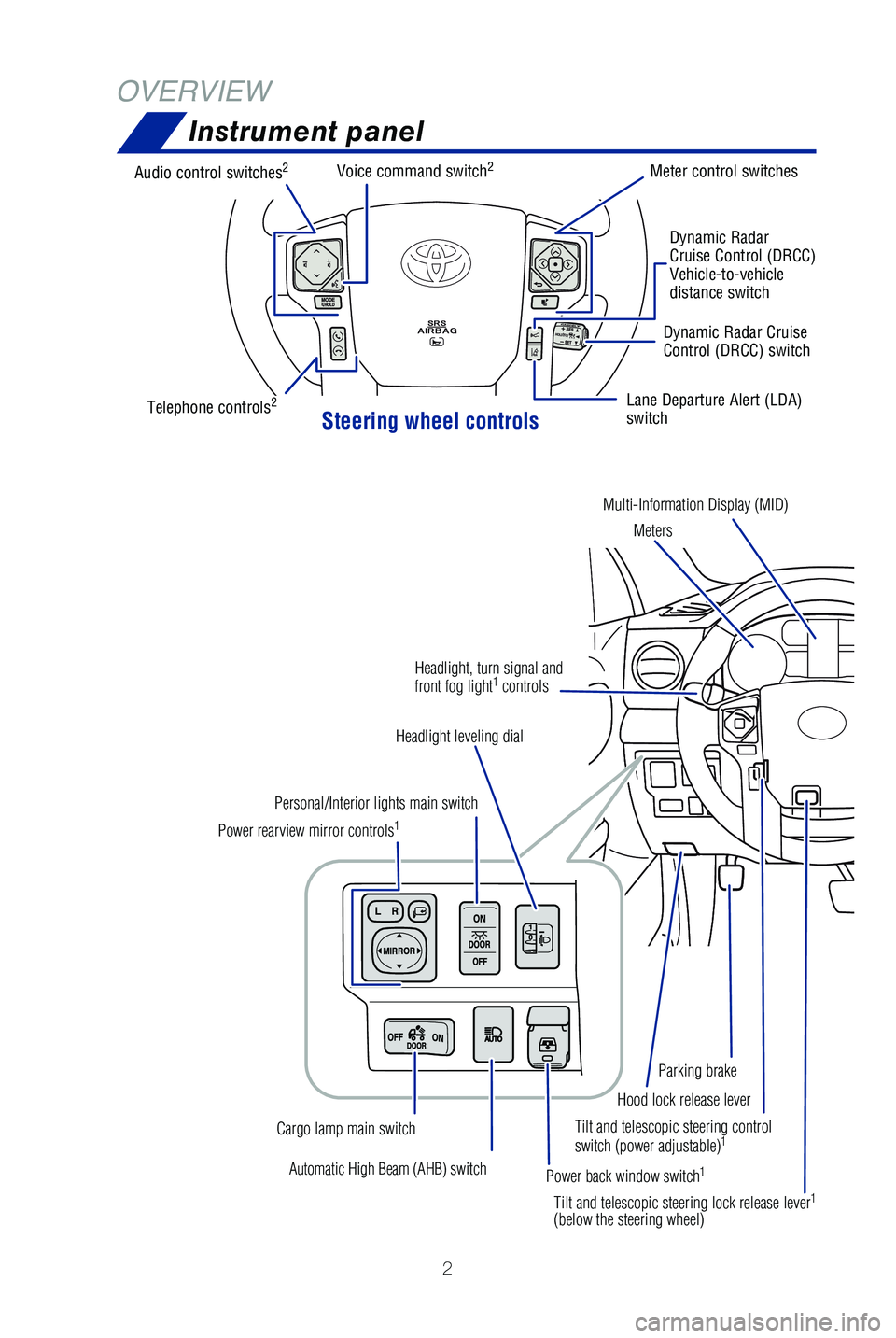
Instrument panel
OVERVIEW
Tilt and telescopic steering control
switch (power adjustable)1
Automatic High Beam (AHB) switch
Power rearview mirror controls
1
Personal/Interior lights main switch
Headlight leveling dial
Power back window switch
1
Cargo lamp main switch Tilt and telescopic steering lock release lever
1
(below the steering wheel)Hood lock release lever
Parking brake
Headlight, turn signal and
front fog light
1
controls
Steering wheel controls
Audio control switches2
Telephone controls2
Voice command switch2Meter control switches
Dynamic Radar
Cruise Control (DRCC)
Vehicle-to-vehicle
distance switch
Lane Departure Alert (LDA)
switch Dynamic Radar Cruise
Control (DRCC) switch
Multi-Information Display (MID) Meters
49087b_2019_Tundra_QRG_V2_ML_0714.indd 27/17/18 3:18 PM
Page 12 of 56
10
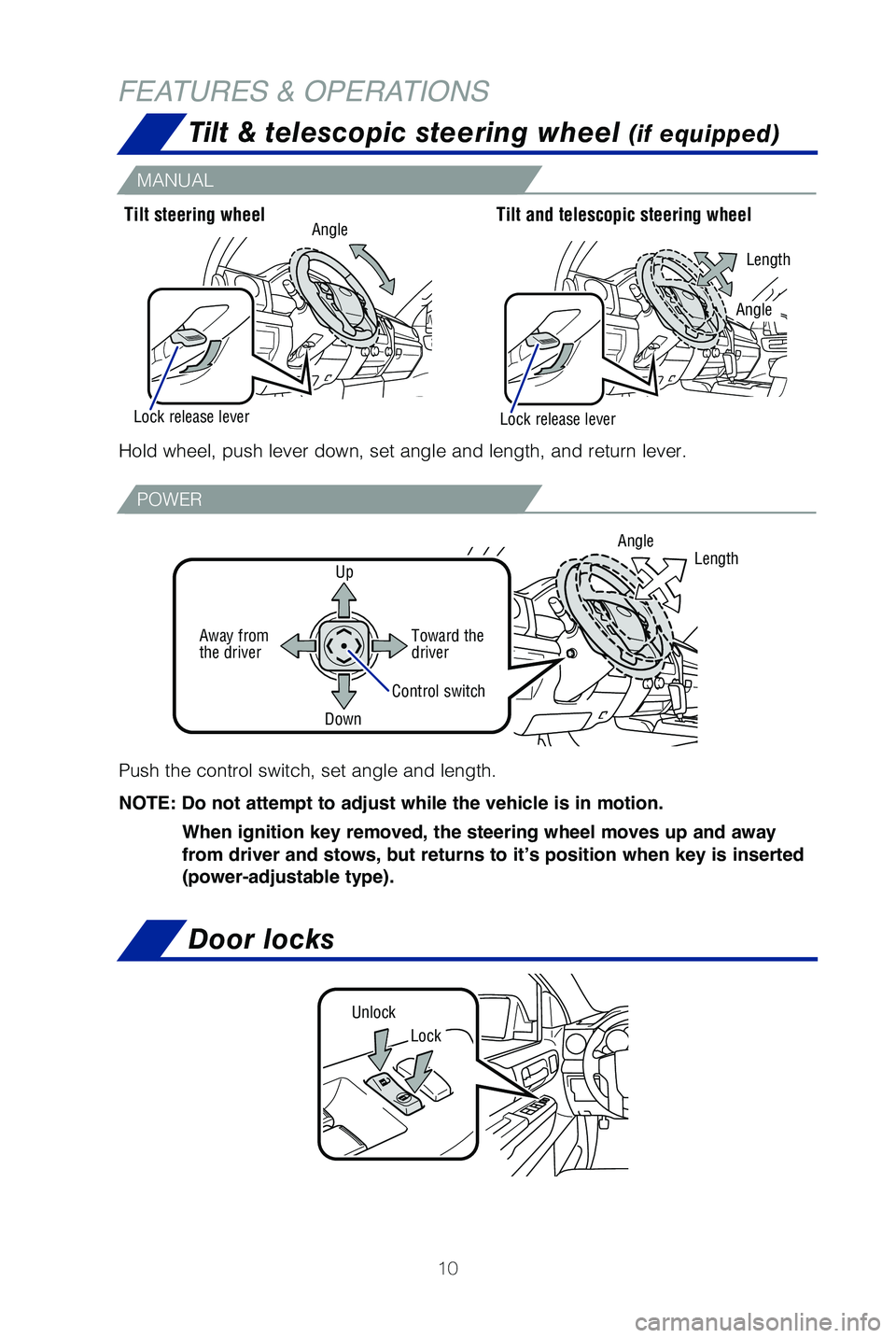
Tilt & telescopic steering wheel (if equipped)
Door locks
Lock
Unlock
Hold wheel, push lever down, set angle and length, and return lever.Tilt steering wheel
Tilt and telescopic steering wheel
Length
Lock release lever
Lock release lever Angle
Push the control switch, set angle and length.
NOTE: Do not attempt to adjust while the vehicle is in motion.
When ignition key removed, the steering wheel moves up and away
from driver and stows, but returns to it’s position when key is inserted
(power-adjustable type).
Angle
Control switchLength
Up
Toward the
driver
Away from
the driver
Down
Angle
FEATURES & OPERATIONS
MANUAL
POWER
49087b_2019_Tundra_QRG_V2_ML_0714.indd 107/17/18 3:18 PM
Page 23 of 56
 21
Bluetooth
® technology allows dialing or receipt of calls without taking hands from\
the steering wheel or using a cable to connect the compatible telephone \
and the
system.
* Push and hold to")
21
Bluetooth
® technology allows dialing or receipt of calls without taking hands from\
the steering wheel or using a cable to connect the compatible telephone \
and the
system.
* Push and hold to access Mobile Assistant. When a compatible smartphone\
is
Bluetooth® connected push and hold the off hook switch 2-3 seconds to access
Siri® Eyes Free.
Refer to the “Bluetooth
® Device Pairing Section” in this guide for more information
about phone connections and compatibility.
Refer to the “Owner’s Manual” and “Navigation and Multimedia\
System Owner’s
Manual” for more details.
Microphone
Steering wheel telephone switches
Steering wheel switches
& telephone controls (Bluetooth®)
NOTE: Concentrating on the road should always be your first priority while
driving. Do not use the Entune system if it will distract you.
OVERVIEW
FEATURES & OPERATIONS
TOYOTA SAFETY SENSE
SAFETY & EMERGENCY FEATURES
“MODE/HOLD”
Push and hold to mute or pause current
operation or change audio source.
“”Use to search within the selected
audio medium (radio, CD, etc.).
Microphone location may vary by vehicle.
• Make a call
• Receive a call
• Display “Phone” screen
• Mobile Assistant access*
• End a call
• Refuse a call
“-, +” Volume control
Voice command switch
49087b_2019_Tundra_QRG_V2_ML_0714.indd 217/17/18 3:18 PM
Page 28 of 56
26
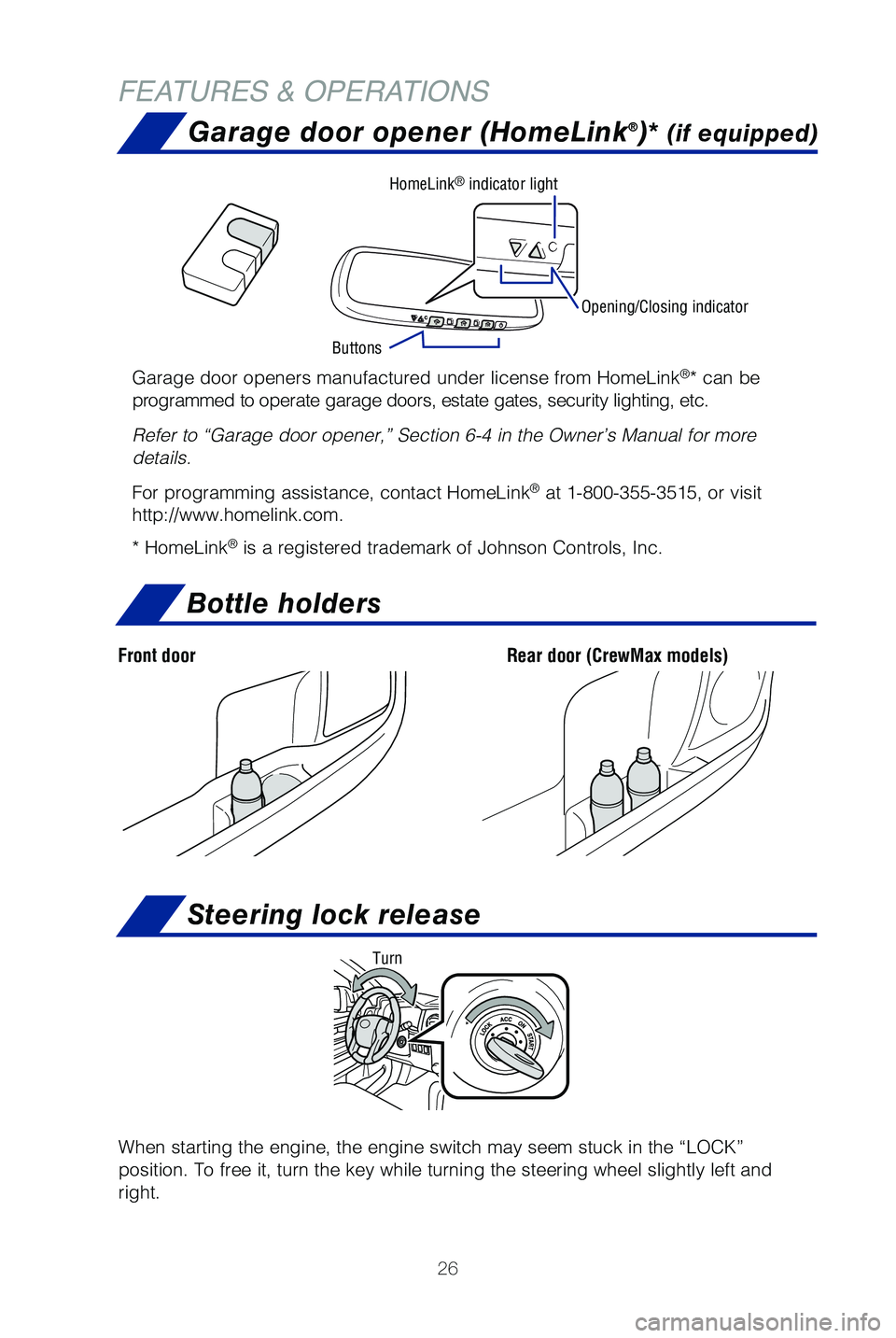
Bottle holders
FEATURES & OPERATIONS
Rear door (CrewMax models)Front door
Garage door opener (HomeLink®)* (if equipped)
Garage door openers manufactured under license from HomeLink®* can be
programmed to operate garage doors, estate gates, security lighting, etc\
.
Refer to “Garage door opener,” Section 6-4 in the Owner’s Manua\
l for more
details.
For programming assistance, contact HomeLink
® at 1-800-355-3515, or visit
http://www.homelink.com.
* HomeLink
® is a registered trademark of Johnson Controls, Inc.
Opening/Closing indicator
Buttons HomeLink
® indicator light
Steering lock release
When starting the engine, the engine switch may seem stuck in the “LO\
CK”
position. To free it, turn the key while turning the steering wheel slig\
htly left and
right.
Turn
49087b_2019_Tundra_QRG_V2_ML_0714.indd 267/17/18 3:18 PM
Page 33 of 56

31
DISABLING PRE-COLLISION SYSTEM (PCS)
(1) Press “” switches and select from the Multi-Information Display (MID).
(2) Press “
” switches and select “PCS” from the MID and then press “”.
(3) Press “
” switches and select “PCS” and then press “” to select the desired
setting ON/OFF.
(4) Press “
” to go back to the menu. Also, use “” to switch menus or display
top screen.
Refer to a Toyota Owner’s Manual for additional information on PCS op\
eration,
settings adjustments, limitations, and precautions before attempting to \
use it.
Lane Departure Alert (LDA)
LDA in TSS-P uses an in-vehicle camera designed to detect visible white \
and yellow
lane markers in front of the vehicle and the vehicle’s position on th\
e road. If the
system determines that the vehicle is starting to unintentionally deviat\
e from its lane,
the system alerts the driver with an audio and visual alert. When the al\
erts occur, the
driver must check the surrounding road situation and carefully operate t\
he steering
wheel to move the vehicle back to the center part of their lane.
LDA is designed to function at speeds of approximately 32 mph (50 km/h) or higher
on relatively straight roadways.
OVERVIEW
FEATURES & OPERATIONS
TOYOTA SAFETY SENSE
SAFETY & EMERGENCY FEATURES
49087b_2019_Tundra_QRG_V2_ML_0714.indd 317/17/18 3:19 PM
Page 36 of 56
 34
TOYOTA SAFETY SENSE™
SWAY WARNING SYSTEM
SWS is a function of LDA and is designed to detect swaying based on the \
vehicle
location in the lane and the driver’s steering wheel operation. To he")
34
TOYOTA SAFETY SENSE™
SWAY WARNING SYSTEM
SWS is a function of LDA and is designed to detect swaying based on the \
vehicle
location in the lane and the driver’s steering wheel operation. To he\
lp prevent
swaying, the system alerts the driver using a buzzer sound and a warning\
displays
in the MID.
Continuous lane deviations from
swaying.
Gentle swaying from driver’s
inattentiveness.
Acute steering wheel operation after the
number of operations decrease due to driver’s
inattentiveness.
DISABLING LDA SWAY WARNING SYSTEM
ADJUSTING SWAY ALERT SENSITIVITY
(1) Press “” switches and select from the Multi-Information Display (MID).
(2) Press “
” switches and select the setting function and then press “.”
(3) Press “
” to go back to the menu. Also, use “” to switch menus or display
top screen.
(1) Press “SETUP” or “APPS” switches on the multimedia system.
If you have Entune AudIo Plus, select “Setup” on the “Apps” \
screen.
(2) Select “Vehicle” on the “Setup” screen.
(3) Select “Vehicle Customization” on the “Vehicle Settings” screen.
(4) Choose a category to display the settings.
(5) Select the setting to be changed.
(6) Select “+” or “-” to choose the desired level, then select “OK.”
Note: Operation of the LDA system and setting adjustments continues in the
same condition regardless of Ignition cycle until changed by the driver or the
system is reset.
49087b_2019_Tundra_QRG_V2_ML_0714.indd 347/17/18 3:19 PM
Page 43 of 56
 41
Star Safety System™
ANTI-LOCK BRAKE SYSTEM (ABS)
Toyota’s ABS sensors detect which wheels are locking up and limits wh\
eel lockup
by “pulsing” each wheel’s brakes independently. Pulsing")
41
Star Safety System™
ANTI-LOCK BRAKE SYSTEM (ABS)
Toyota’s ABS sensors detect which wheels are locking up and limits wh\
eel lockup
by “pulsing” each wheel’s brakes independently. Pulsing release\
s brake pressure
repeatedly for fractions of a second. This helps the tires attain the tr\
action that
current road conditions will allow, helping you to stay in directional c\
ontrol.
BRAKE ASSIST (BA)
Brake Assist is designed to detect sudden or “panic” braking, and \
then add braking
pressure to help decrease the vehicle’s stopping distance. When there\
’s only a split
second to react, Brake Assist can add additional brake pressure more qui\
ckly than
just the driver alone can.
ELECTRONIC BRAKE FORCE DISTRIBUTION (EBD)
Toyota’s ABS technology has Electronic Brake-force Distribution (EBD) to help
maintain control and balance when braking. EBD responds to sudden stops \
by
redistributing brake force to enhance the braking effectiveness of all f\
our wheels.
Your vehicle comes standard with the Star Safety System
TM, which combines
Anti-lock Braking System (ABS), Brake Assist (BA), Electronic Brake-force
Distribution (EBD), Smart Stop Technology (SST), Traction Control (TRAC) and
Vehicle Stability Control (VSC),
Refer to the Owner’s Manual for more details and important information on limitations
to these systems.
SMART STOP TECHNOLOGY (SST)
Smart Stop Technology automatically reduces engine power when the accele\
rator
and brake pedals are pressed simultaneously under certain conditions.
SST engages when the accelerator is depressed first and the brakes are a\
pplied
firmly for longer than one-half second at speeds greater than five miles\
per hour.
SST doesn’t engage if the brake pedal is depressed before the acceler\
ator pedal,
allowing vehicles to start on a steep hill and safely accelerate without\
rolling
backward.
VEHICLE STABILITY CONTROL (VSC)
VSC helps prevent loss of traction during cornering by reducing engine p\
ower and
applying brake force to selected wheels.
Toyota’s VSC monitors steering angle and the direction your vehicle i\
s traveling.
When it senses that the front or rear wheels begin to lose traction, VSC\
reduces
engine power and applies braking to selected wheels. This helps restore \
traction
and vehicle control.
OVERVIEW
FEATURES & OPERATIONS
TOYOTA SAFETY SENSE
SAFETY & EMERGENCY FEATURES
49087b_2019_Tundra_QRG_V2_ML_0714.indd 417/17/18 3:19 PM
Page 44 of 56
 42
Floor mat installation
Trailer Sway Control
There are two types of Toyota floor mats: carpeted and all-weather. Each\
vehicle
has model-specific floor mats. Installation is easy.
To keep your fl")
42
Floor mat installation
Trailer Sway Control
There are two types of Toyota floor mats: carpeted and all-weather. Each\
vehicle
has model-specific floor mats. Installation is easy.
To keep your floor mat properly positioned, follow these steps:
• Only use Toyota floor mats designed for your specific model.
• Use only one floor mat at a time, using the retaining hooks to keep\
the mat in place.
• Install floor mats right side up.
Always align the marks
Trailer sway may occur when towing a trailer due to strong crosswinds, u\
neven and/
or winding road conditions or the driver’s steering input.
Trailer Sway Control uses sensors to detect trailer sway and then simult\
aneously
and automatically helps to suppress the swaying motion of the trailer by\
integrating
brake and engine torque control to reduce speed and to help quickly cont\
rol the
swaying motion of the trailer.
TRACTION CONTROL (TRAC)
VSC helps prevent loss of traction during cornering by reducing engine p\
ower, and
Traction Control helps maintain traction on loose gravel and wet, icy, o\
r uneven
surfaces by applying brake force to the spinning wheel(s).
Toyota’s TRAC sensors are activated when one of the drive wheels star\
ts to slip.
TRAC limits engine output and applies the brakes to the spinning wheel. \
This
transfers power to the wheels that still have traction to help keep you \
on track.
SAFETY & EMERGENCY FEATURES
49087b_2019_Tundra_QRG_V2_ML_0714.indd 427/17/18 3:19 PM