ABS TOYOTA TUNDRA 2019 (in English) User Guide
[x] Cancel search | Manufacturer: TOYOTA, Model Year: 2019, Model line: TUNDRA, Model: TOYOTA TUNDRA 2019Pages: 672, PDF Size: 14.1 MB
Page 306 of 672

3064-5. Using the driving support systems
WARNING
■When the TRAC/VSC/Trailer Sway Control are activated
The slip indicator light flashes. Always drive carefully. Reckless driving may
cause an accident. Exercise particular care when the indicator light flashes.
■ When the TRAC/VSC/Trailer Sway Control systems are turned off
Be especially careful and drive at a speed appropriate to the r oad condi-
tions. As these are the systems to help ensure vehicle stabilit y and driving
force, do not turn the TRAC/VSC/Trailer Sway Control systems of f unless
necessary.
Trailer Sway Control is part of the VSC system and will not operate if VSC is
turned off or experiences a malfunction.
■ Replacing tires
Make sure that all tires are of the specified size, brand, trea d pattern and
total load capacity. In addition, make sure that the tires are inflated to the
recommended tire inflation pressure level.
The ABS, TRAC, VSC and Trailer Sway Control systems will not function
correctly if different tires are installed on the vehicle.
Contact your Toyota dealer for further information when replaci ng tires or
wheels.
■ Handling of tires and the suspension
Using tires with any kind of problem or modifying the suspensio n will affect
the driving assist systems, and may cause a system to malfuncti on.
■ Trailer Sway Control precaution
The Trailer Sway Control system is not able to reduce trailer sway in all situ-
ations. Depending on many factors such as the conditions of the vehicle,
trailer, road surface, and driving environment, the Trailer Swa y Control sys-
tem may not be effective. Refer to your trailer owner’s manual for informa-
tion on how to tow your trailer properly.
■ If trailer sway occurs
Observe the following precautions.
Failure to do so may cause death or serious injury.
● Firmly grip the steering wheel. Steer straight ahead.
Do not try to control trailer swaying by turning the steering w heel.
● Begin releasing the accelerator pedal immediately but very grad ually to
reduce speed.
Do not increase speed. Do not apply vehicle brakes.
If you make no extreme correction with the steering or brakes, your vehicle
and trailer should stabilize. ( P. 190)
Page 310 of 672

3104-5. Using the driving support systems
WARNING
■Trailer brake type setting
It is the responsibility of the driver to make sure the trailer brakes are func-
tioning normally and adjusted appropriately. Failure to check a nd maintain
trailer brakes may result in loss of vehicle control, crash, or serious injury.
Trailer brake control system will work with most electric and e lectric-over-
hydraulic trailer braking systems up to 3 axles (24A output to trailer brakes).
Please be sure to test compatibility with the system at low spe eds and in a
safe area. If a warning message appears in the multi-information display
( P. 563), have the vehicle inspected by your Toyota dealer immed iately.
Some electric-over-hydraulic trailer brakes will take some mini mum output
to activate. Trailer brake control system will not work with tr ailer hydraulic
surge brakes.
■ When driving on slippery road surfaces
When stopping with ABS activated, output to the trailer might b e reduced in
order to reduce the likelihood of trailer wheels to lock. The trailer is not
equipped with ABS. Drive safely on slippery road surfaces.
Page 370 of 672
3705-9. Bluetooth® phone
Using a Bluetooth® phone
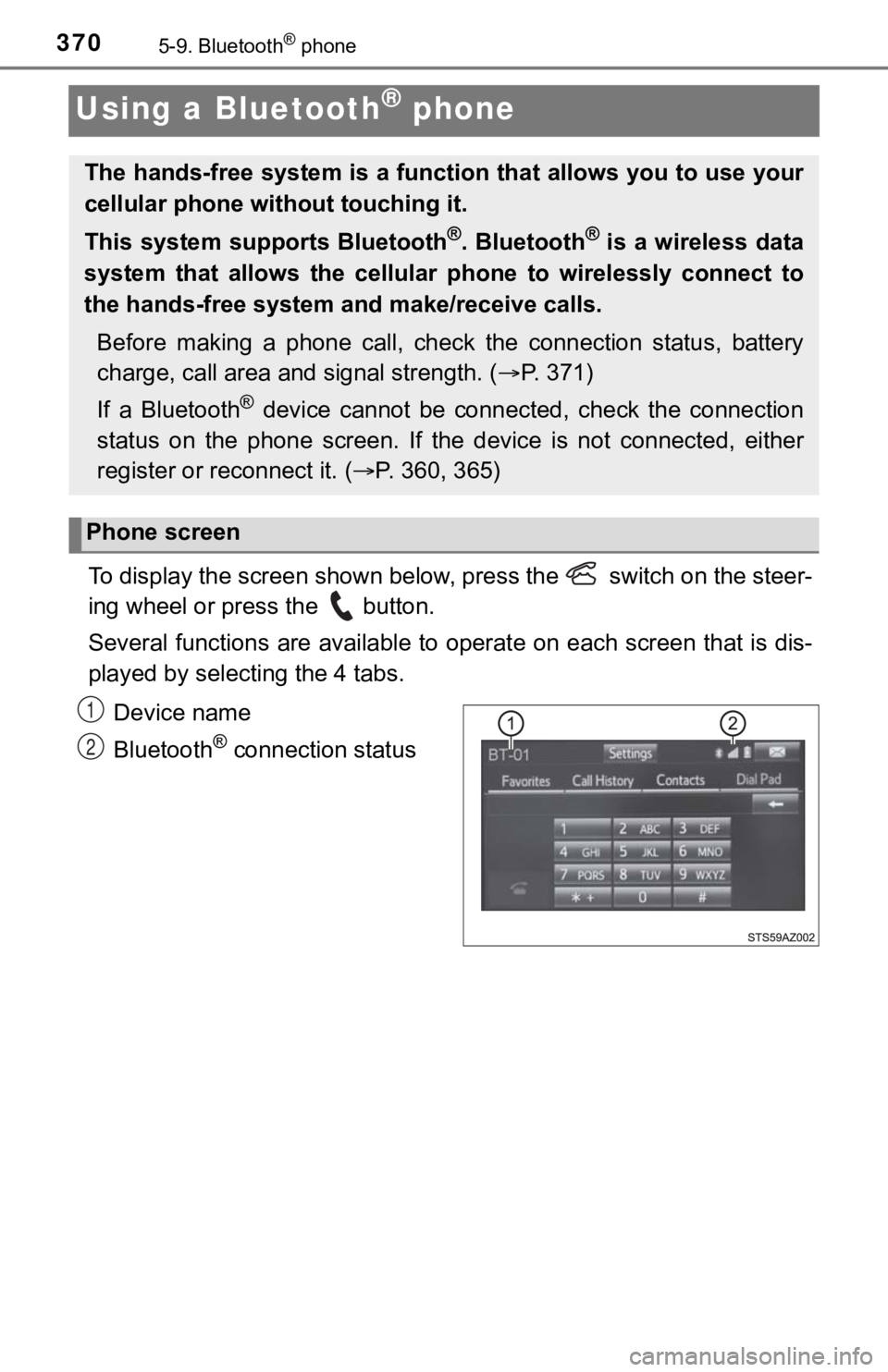
To display the screen shown below, press the switch on the steer-
ing wheel or press the button.
Several functions are available to operate on each screen that is dis-
played by select ing the 4 tabs.
Device name
Bluetooth
® connection status
The hands-free system is a function that allows you to use your
cellular phone without touching it.
This system supports Bluetooth
®. Bluetooth® is a wireless data
system that allows the cellular phone to wirelessly connect to
the hands-free system and make/receive calls.
Before making a phone call, check the connection status, batter y
charge, call area and signal strength. ( P. 3 7 1 )
If a Bluetooth
® device cannot be connected, check the connection
status on the phone screen. If the device is not connected, eit her
register or reconnect it. ( P. 360, 365)
Phone screen
1
2
Page 490 of 672
4907-3. Do-it-yourself maintenance
Check the radiator and condenser and clear away any foreign objects.
If either of the above parts is extremely dirty or you are not sure of
their condition, have your vehic le inspected by your Toyota dea ler.
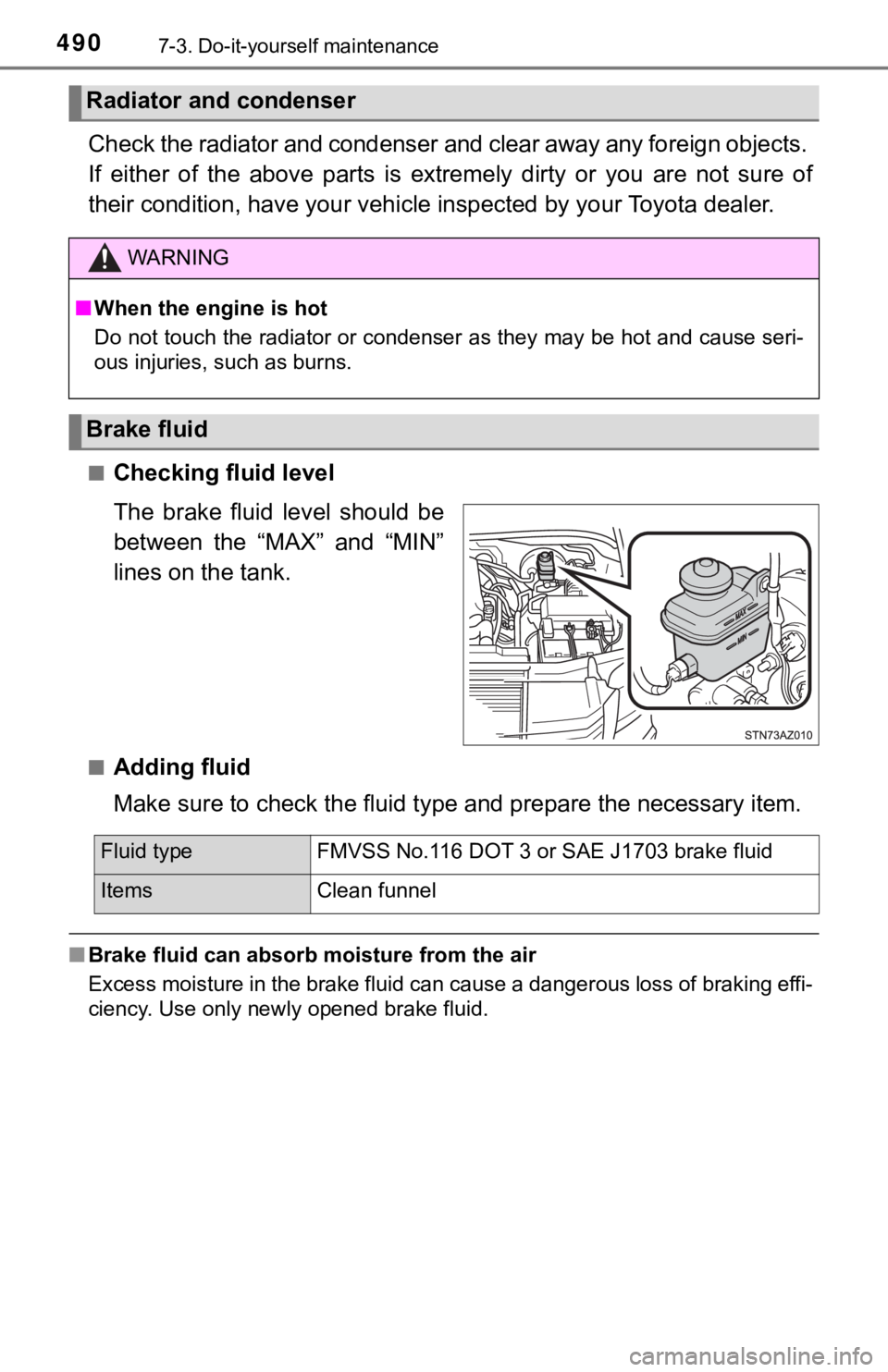
■Checking fluid level
The brake fluid level should be
between the “MAX” and “MIN”
lines on the tank.
■Adding fluid
Make sure to check the fluid type and prepare the necessary ite m.
■Brake fluid can absorb moisture from the air
Excess moisture in the brake fluid can cause a dangerous loss o f braking effi-
ciency. Use only newly opened brake fluid.
Radiator and condenser
WARNING
■ When the engine is hot
Do not touch the radiator or condenser as they may be hot and c ause seri-
ous injuries, such as burns.
Brake fluid
Fluid type FMVSS No.116 DOT 3 or SAE J1703 brake fluid
Items Clean funnel
Page 524 of 672
5247-3. Do-it-yourself maintenance
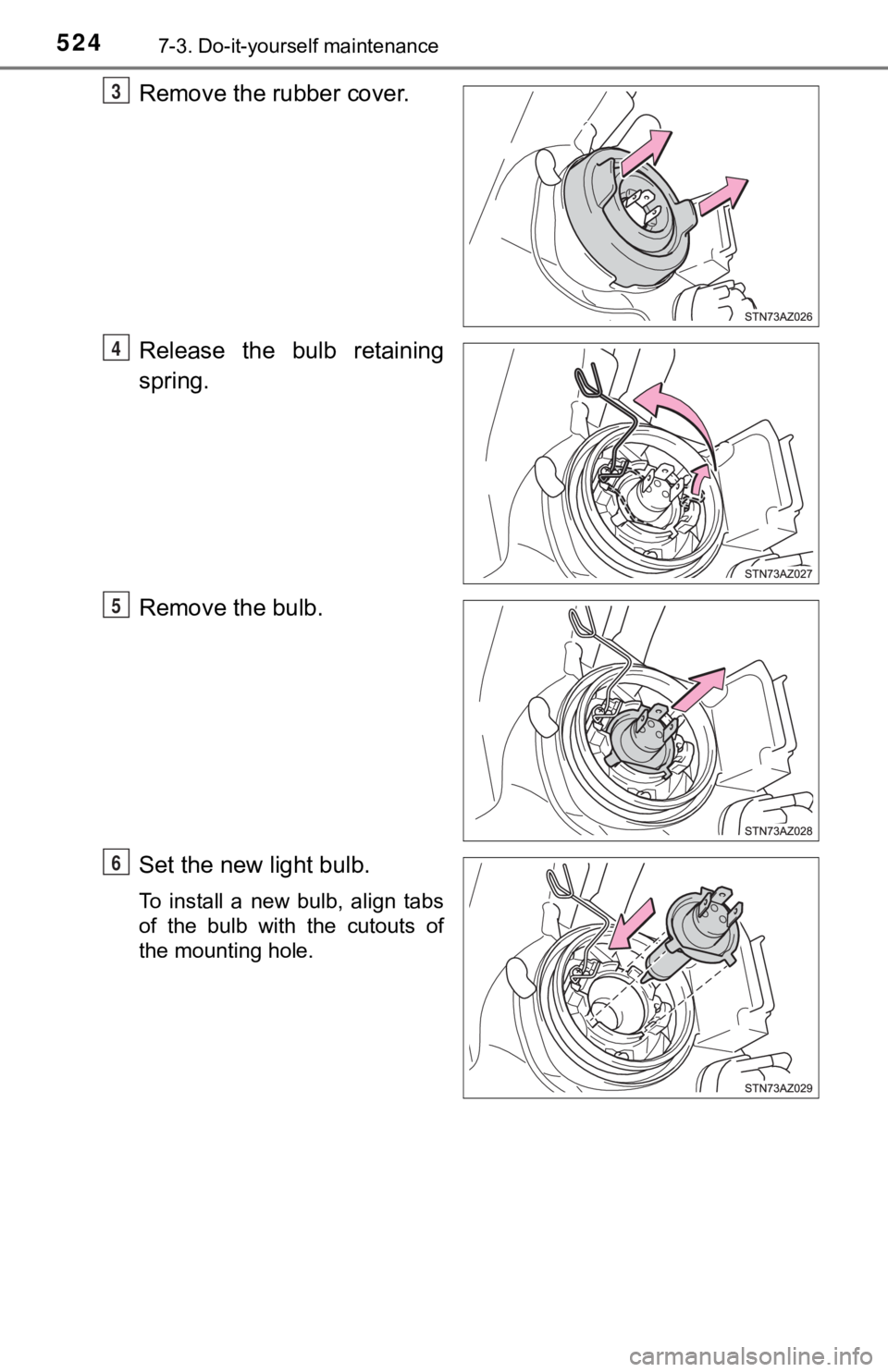
Remove the rubber cover.
Release the bulb retaining
spring.
Remove the bulb.
Set the new light bulb.
To install a new bulb, align tabs
of the bulb with the cutouts of
the mounting hole.
3
4
5
6
Page 531 of 672
5317-3. Do-it-yourself maintenance
7
Maintenance and care
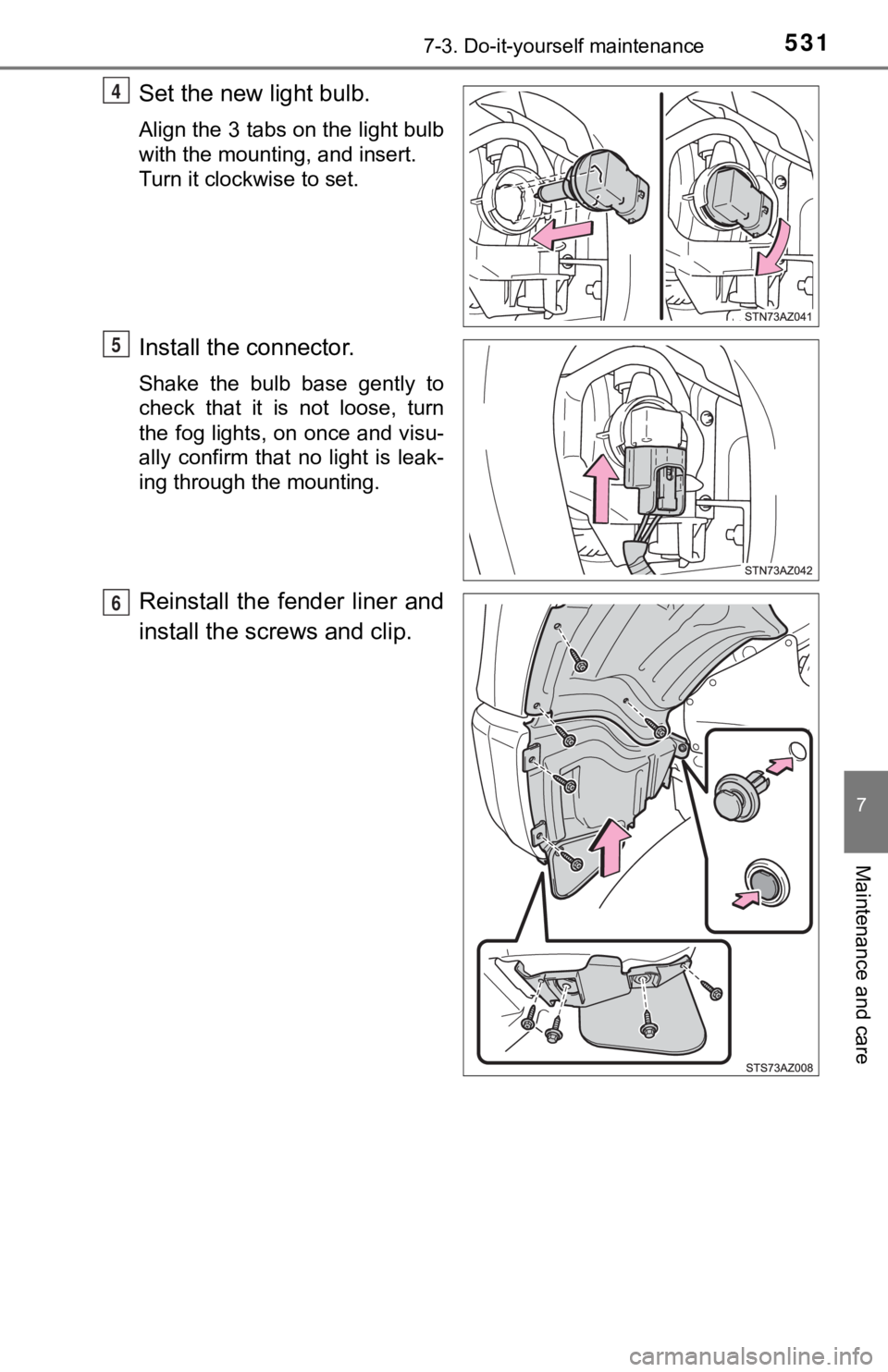
Set the new light bulb.
Align the 3 tabs on the light bulb
with the mounting, and insert.
Turn it clockwise to set.
Install the connector.
Shake the bulb base gently to
check that it is not loose, turn
the fog lights, on once and visu-
ally confirm that no light is leak-
ing through the mounting.
Reinstall the fender liner and
install the screws and clip.
4
5
6
Page 548 of 672
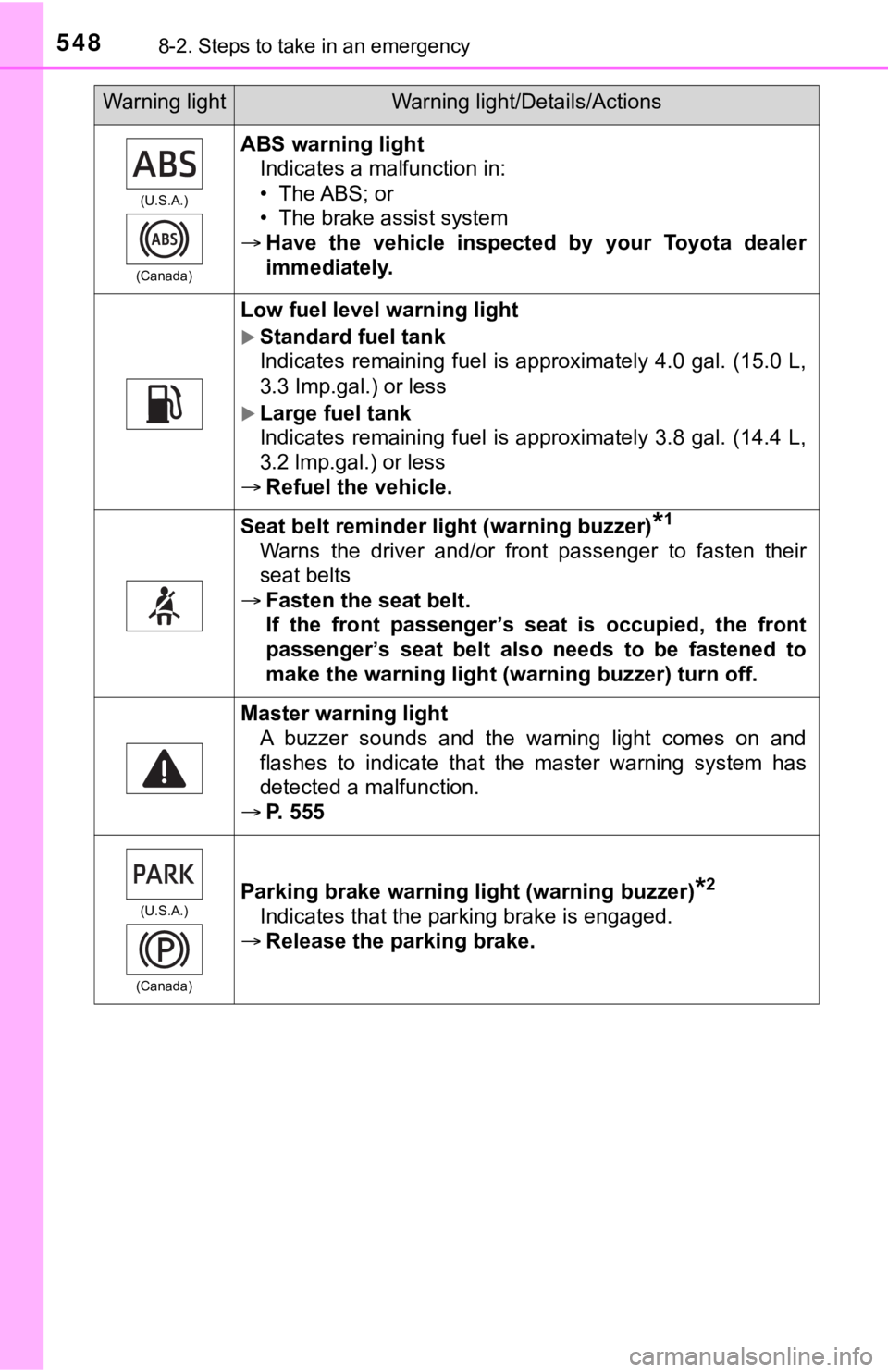
5488-2. Steps to take in an emergency
(U.S.A.)
(Canada)
ABS warning light Indicates a malfunction in:
• The ABS; or
• The brake assist system
Have the vehicle inspected by your Toyota dealer
immediately.
Low fuel level warning light
Standard fuel tank
Indicates remaining fuel is approximately 4.0 gal. (15.0 L,
3.3 Imp.gal.) or less
Large fuel tank
Indicates remaining fuel is approximately 3.8 gal. (14.4 L,
3.2 lmp.gal.) or less
Refuel the vehicle.
Seat belt reminder light (warning buzzer)*1
Warns the driver and/or front passenger to fasten their
seat belts
Fasten the seat belt.
If the front passenger’s seat is occupied, the front
passenger’s seat belt also needs to be fastened to
make the warning light (warning buzzer) turn off.
Master warning light
A buzzer sounds and the warning light comes on and
flashes to indicate that the master warning system has
detected a malfunction.
P. 555
(U.S.A.)
(Canada)Parking brake warning light (warning buzzer)*2
Indicates that the parking brake is engaged.
Release the parking brake.
Warning lightWarning light/Details/Actions
Page 553 of 672

5538-2. Steps to take in an emergency
8
When trouble arises
WARNING
■If both the ABS and the brake s ystem warning lights remain on
Stop your vehicle in a safe place immediately and contact your To y o t a
dealer. The vehicle will become extremely unstable during braki ng, and the
ABS system may fail, which could cause an accident resulting in death or
serious injury.
■ If the tire pressure warning light comes on
Be sure to observe the following precautions. Failure to do so could cause a
loss of vehicle control and result in death or serious injury.
● Stop your vehicle in a safe place as soon as possible. Adjust the tire infla-
tion pressure immediately.
● If the tire pressure warning light comes on even after tire inf lation pressure
adjustment, it is probable that you have a flat tire. Check the tires. If a tire
is flat, change it with the spare tire and have the flat tire repaired by the
nearest Toyota dealer.
● Avoid abrupt maneuvering and braking. If the vehicle tires deteriorate, you
could lose control of the steering wheel or the brakes.
■ If a blowout or sudden air leakage should occur
The tire pressure warning system may not activate immediately.
■
Maintenance of the tires
Each tire, including the spare (if provided), should be checked monthly
when cold and inflated to the inflation pressure recommended by the
vehicle manufacturer on the vehicle placard or tire inflation p ressure
label (tire and load information label). (If your vehicle has t ires of a dif-
ferent size than the size indica ted on the vehicle placard or tire inflation
pressure label [tire and load information label], you should de termine
the proper tire inflation p ressure for those tires.)
As an added safety feature, your vehicle has been equipped with a tire
pressure monitoring system (TPMS -tire pressure warning system) that
illuminates a low tire pressure telltale (tire pressure warning light) when
one or more of your tires is significantly under-inflated. Acco rdingly,
when the low tire pressure telltale (tire pressure warning ligh t) illumi-
nates, you should stop and check your tires as soon as possible , and
inflate them to the proper pressure. Driving on a significantly under-
inflated tire causes the tire to overheat and can lead to tire failure.
Under-inflation also reduces fuel efficiency and tire tread lif e, and may
affect the vehicle’s handl ing and stopping ability.
Page 578 of 672

5788-2. Steps to take in an emergency
WARNING
■When using the temporary spare tire
●Remember that the temporary spare tire provided is specifically
designed for use with your vehicle. Do not use your temporary spare
tire on another vehicle.
●Do not use more than one temporary spare tires simultaneously.
●Replace the temporary spare tire with a standard tire as soon a s possi-
ble.
●Avoid sudden acceleration, abrupt steering, sudden braking and shift-
ing operations that cause sudden engine braking.
■When the spare tire is attached
The vehicle speed may not be co rrectly detected, and the following sys-
tems may not operate correctly:
Also, not only can the following system not be utilized fully, but it may
even negatively affect the drive-train components:
• 4WD system
■Speed limit when using th e temporary spare tire
Do not drive at speeds in excess of 50 mph (80 km/h) when a tem porary
spare tire is installed on the vehicle.
The temporary spare tire is not designed for driving at high sp eeds. Fail-
ure to observe this precaution ma y lead to an accident causing death or
serious injury.
• ABS & Brake assist
• VSC
•TRAC
•AUTO LSD
• Pre-Collision System*
*: If equipped • Automatic High Beam*
• LDA (Lane Departure Alert)*
• Dynamic radar cruise control*
• Cruise control*
• Navigation system*
Page 657 of 672
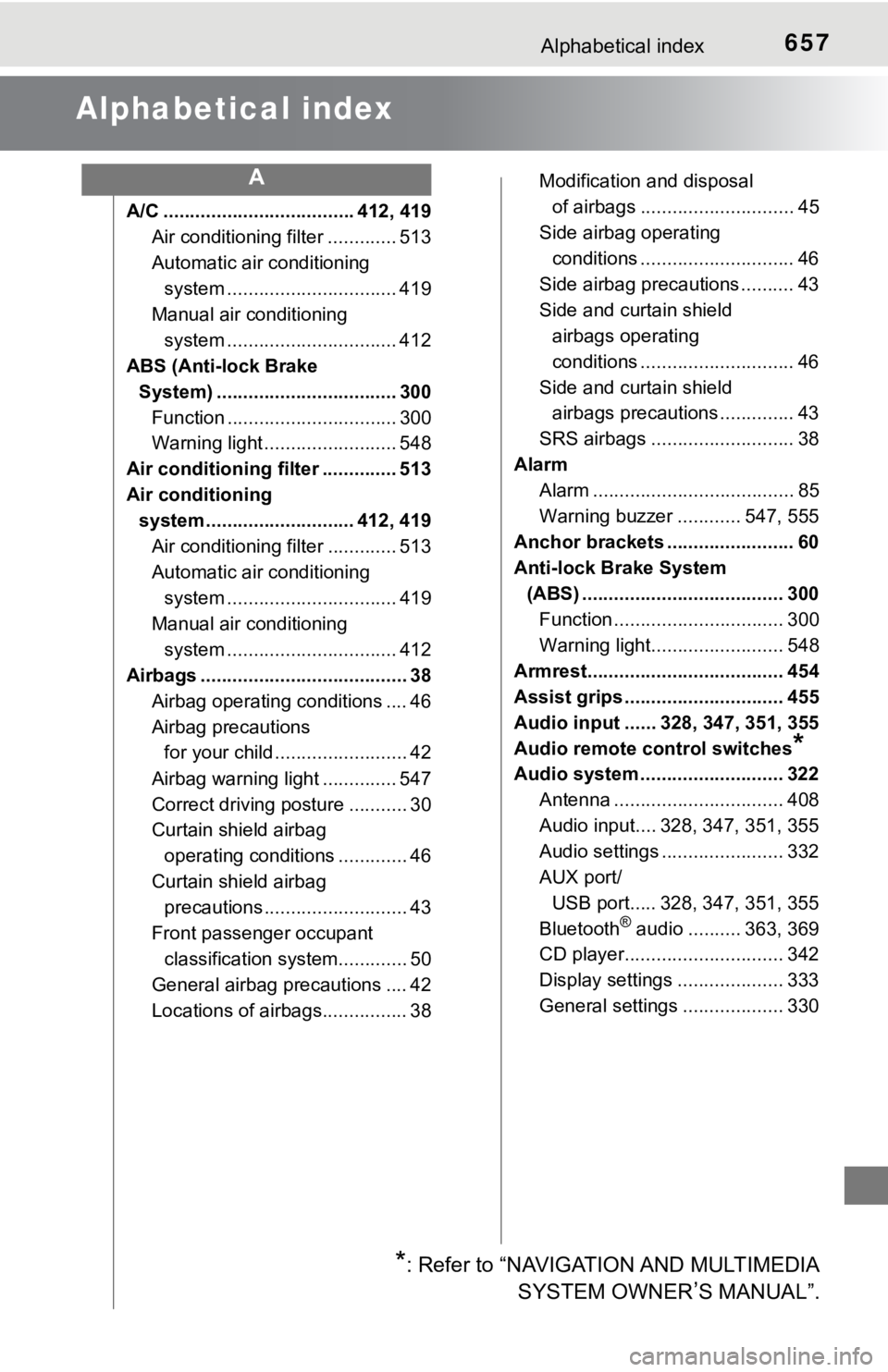
657Alphabetical index
Alphabetical index
A/C .................................... 412, 419Air conditioning filter ............. 513
Automatic air conditioning system ......... ....................... 419
Manual air conditioning system ......... ....................... 412
ABS (Anti-lock Brake
System) .................................. 300 Function ................................ 300
Warning light ......................... 548
Air conditioning filter .............. 513
Air conditioning system ............................ 412, 419
Air conditioning filter ............. 513
Automatic air conditioning system ......... ....................... 419
Manual air conditioning system ......... ....................... 412
Airbags ....................................... 38
Airbag operating conditions .... 46
Airbag precautions for your child ......................... 42
Airbag warning light .............. 547
Correct driving posture ........... 30
Curtain shield airbag operating conditions ............. 46
Curtain shield airbag precautions ........................... 43
Front passenger occupant classification syst em............. 50
General airbag precautions .... 42
Locations of airbags................ 38 Modification and disposal
of airbags ............................. 45
Side airbag operating
conditions ............................. 46
Side airbag precautions .......... 43
Side and curtain shield airbags operating
conditions ............................. 46
Side and curtain shield airbags precautions .............. 43
SRS airbags ........................... 38
Alarm Alarm ...................................... 85
Warning buzzer ............ 547, 555
Anchor brackets ........................ 60
Anti-lock Brake System (ABS) ...................................... 300 Function ................................ 300
Warning light......................... 548
Armrest..................................... 454
Assist grips .............................. 455
Audio input ...... 328, 347, 351, 355
Audio remote control switches
*
Audio system ........................... 322 Antenna ................................ 408
Audio input.... 328, 347, 351, 355
Audio settings ....................... 332
AUX port/
USB port..... 328, 347, 351, 355
Bluetooth
® audio .......... 363, 369
CD player.............................. 342
Display settings .................... 333
General settings ................... 330
A
*: Refer to “NAVIGATION AND MULTIMEDIA SYSTEM OWNER
’S MANUAL”.