brake TOYOTA TUNDRA 2019 (in English) Owner's Manual
[x] Cancel search | Manufacturer: TOYOTA, Model Year: 2019, Model line: TUNDRA, Model: TOYOTA TUNDRA 2019Pages: 672, PDF Size: 14.1 MB
Page 173 of 672
1734-1. Before driving
4
Driving
Trailer towing
Contact your Toyota dealer for further information about additi onal
requirements such as a towing kit, etc.
Your vehicle is designed primarily as a passenger-and-load-car-
rying vehicle. Towing a trailer can have an adverse impact on
handling, performance, braking, durability, and fuel consump-
tion. For your safety and the safety of others, you must not ov er-
load your vehicle or trailer. You must also ensure that you are
using appropriate towing equipm ent, that the towing equipment
has been installed correctly a nd used properly, and that you
employ the requisite driving habits. (P. 191)
Vehicle-trailer stability and braking performance are affected by
trailer stability, brake performance and setting, trailer brake s,
the hitch and hitch systems (if equipped).
To tow a trailer safely, use extreme care and drive the vehicle in
accordance with your trailer’s characteristics and operating
conditions.
Toyota warranties do not apply to damage or malfunction
caused by towing a trailer for commercial purposes.
Page 175 of 672
1754-1. Before driving
4
Driving
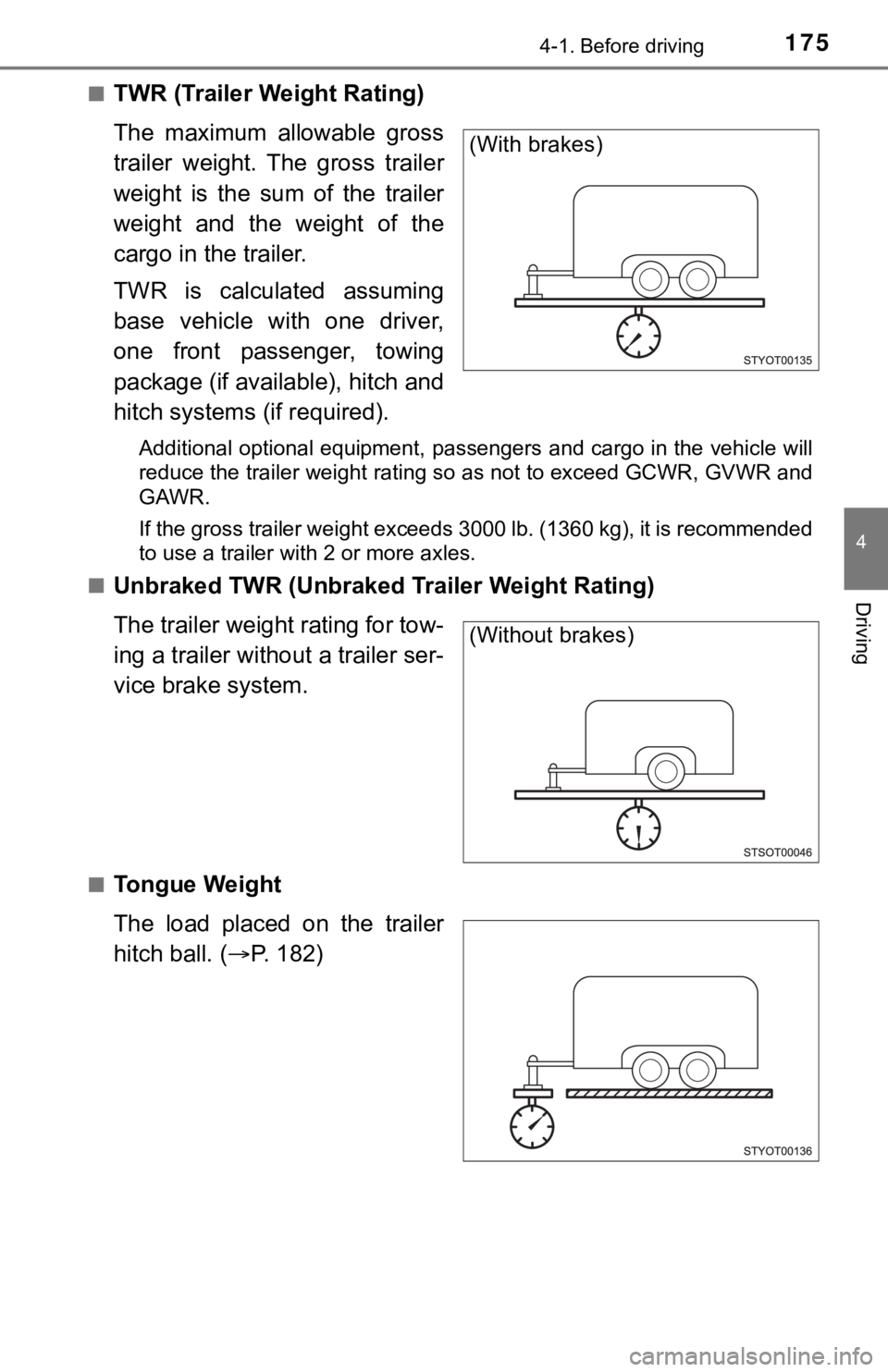
■TWR (Trailer Weight Rating)
The maximum allowable gross
trailer weight. The gross trailer
weight is the sum of the trailer
weight and the weight of the
cargo in the trailer.
TWR is calculated assuming
base vehicle with one driver,
one front passenger, towing
package (if available), hitch and
hitch systems (if required).
Additional optional equipment, passengers and cargo in the vehicle will
reduce the trailer weight rating so as not to exceed GCWR, GVWR and
GAWR.
If the gross trailer weight exceeds 3000 lb. (1360 kg), it is r ecommended
to use a trailer with 2 or more axles.
■
Unbraked TWR (Unbraked Trailer Weight Rating)
The trailer weight rating for tow-
ing a trailer without a trailer ser-
vice brake system.
■Tongue Weight
The load placed on the trailer
hitch ball. ( P. 182)
(With brakes)
(Without brakes)
Page 176 of 672
1764-1. Before driving
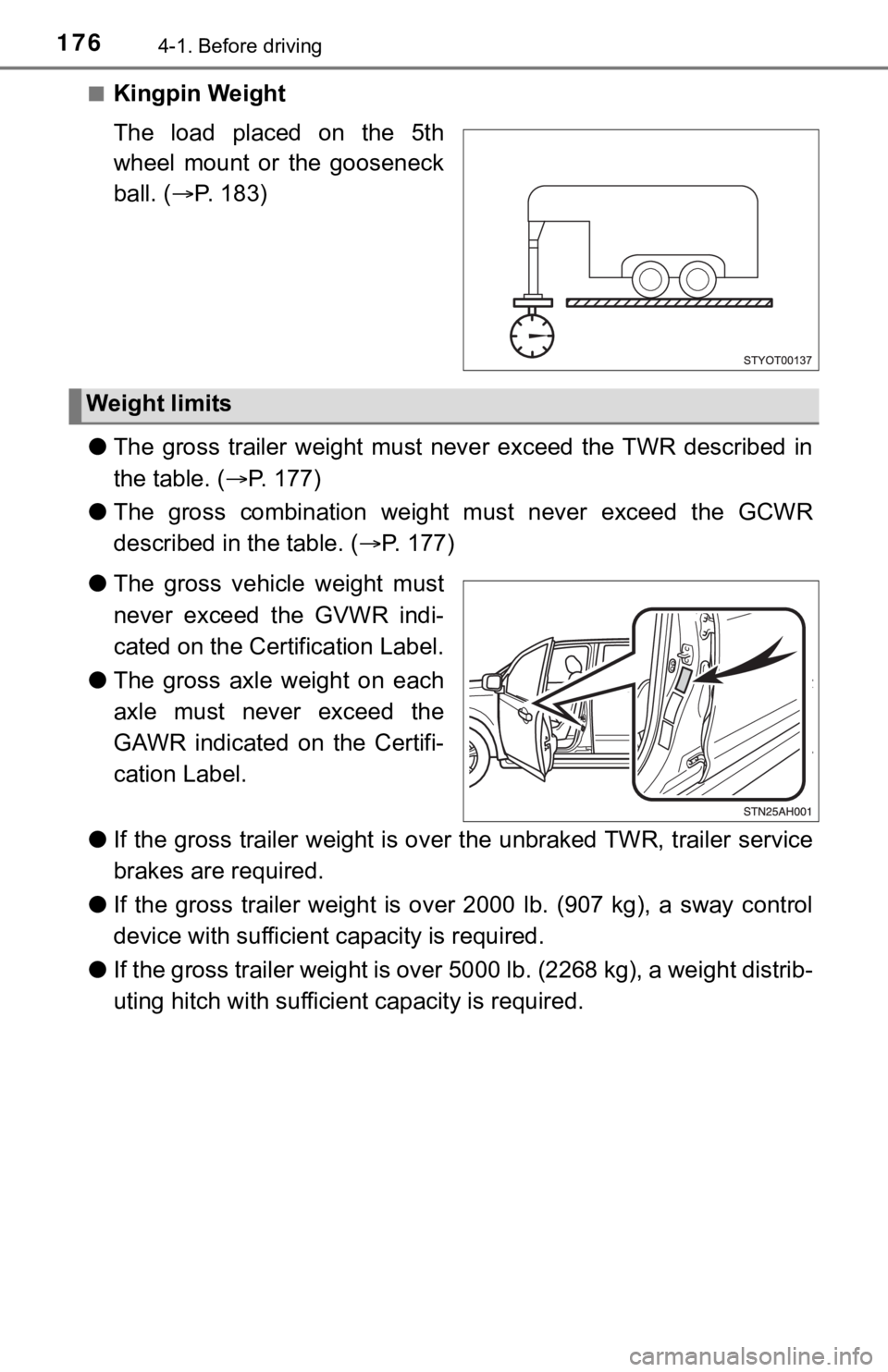
■Kingpin Weight
The load placed on the 5th
wheel mount or the gooseneck
ball. (P. 1 8 3 )
● The gross trailer weight must never exceed the TWR described in
the table. ( P. 1 7 7 )
● The gross combination weight must never exceed the GCWR
described in the table. ( P. 1 7 7 )
● The gross vehicle weight must
never exceed the GVWR indi-
cated on the Certification Label.
● The gross axle weight on each
axle must never exceed the
GAWR indicated on the Certifi-
cation Label.
● If the gross trailer weight is over the unbraked TWR, trailer s ervice
brakes are required.
● If the gross trailer weight is over 2000 lb. (907 kg), a sway c ontrol
device with sufficient capacity is required.
● If the gross trailer weight is over 5000 lb. (2268 kg), a weigh t distrib-
uting hitch with suffici ent capacity is required.
Weight limits
Page 177 of 672
1774-1. Before driving
4
Driving
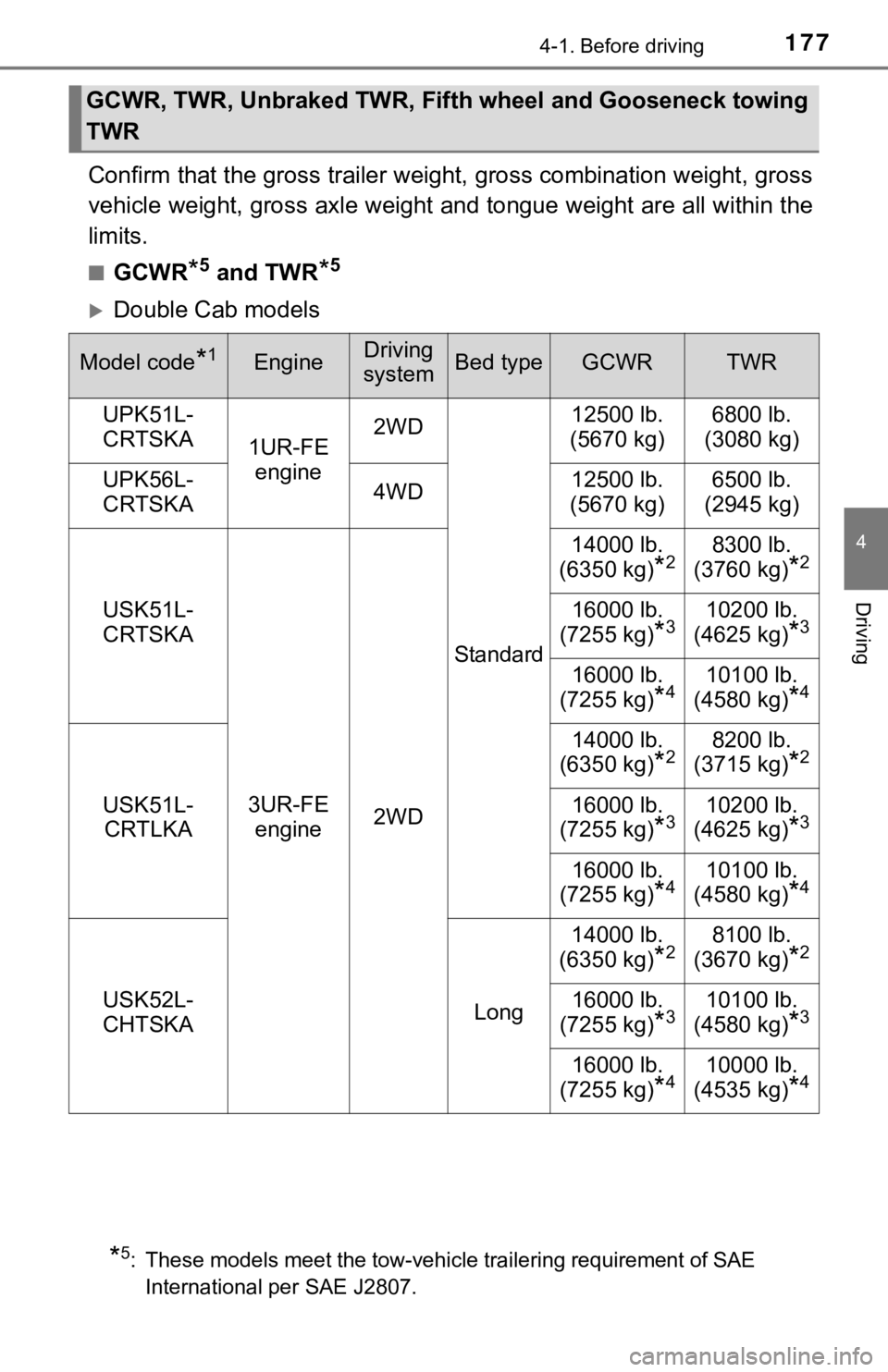
Confirm that the gross trailer weight, gross combination weight, gross
vehicle weight, gross axle weight and tongue weight are all within the
limits.
■GCWR*5 and TWR*5
Double Cab models
GCWR, TWR, Unbraked TWR, Fifth wheel and Gooseneck towing
TWR
*5: These models meet the tow-vehicle trailering requirement of SAE International per SAE J2807.
Model code*1EngineDriving
systemBed typeGCWRTWR
UPK51L- CRTSKA 1UR-FE
engine 2WD
Standard 12500 lb.
(5670 kg) 6800 lb.
(3080 kg)
UPK56L- CRTSKA 4WD12500 lb.
(5670 kg) 6500 lb.
(2945 kg)
USK51L- CRTSKA
3UR-FE engine 2WD 14000 lb.
(6350 kg)
*28300 lb.
(3760 kg)
*2
16000 lb.
(7255 kg)
*310200 lb.
(4625 kg)
*3
16000 lb.
(7255 kg)
*410100 lb.
(4580 kg)
*4
USK51L-
CRTLKA 14000 lb.
(6350 kg)
*28200 lb.
(3715 kg)
*2
16000 lb.
(7255 kg)
*310200 lb.
(4625 kg)
*3
16000 lb.
(7255 kg)
*410100 lb.
(4580 kg)
*4
USK52L-
CHTSKA Long14000 lb.
(6350 kg)
*28100 lb.
(3670 kg)
*2
16000 lb.
(7255 kg)
*310100 lb.
(4580 kg)
*3
16000 lb.
(7255 kg)
*410000 lb.
(4535 kg)
*4
Page 181 of 672
1814-1. Before driving
4
Driving
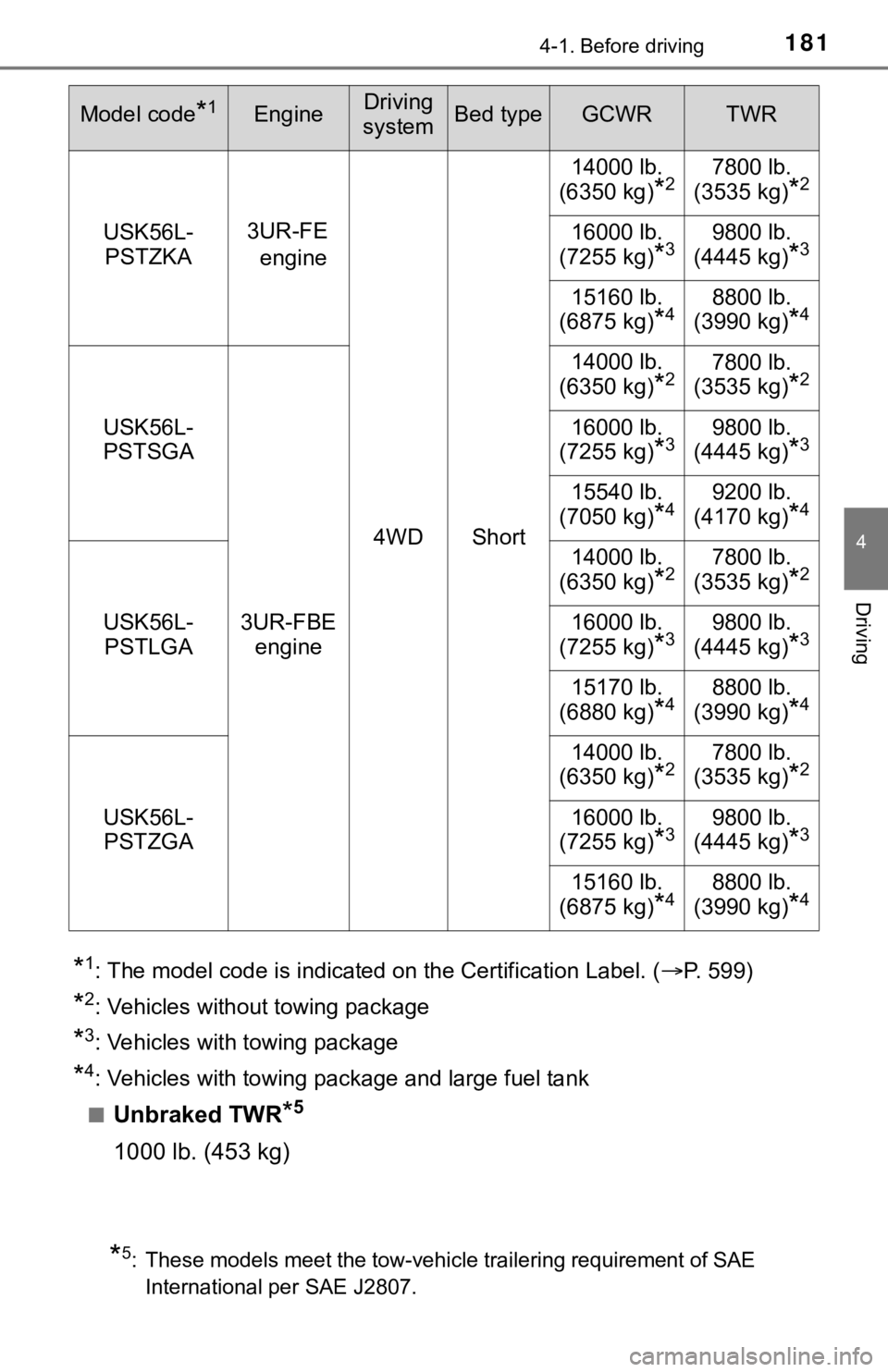
*1: The model code is indicated on the Certification Label. (P. 599)
*2: Vehicles without towing package
*3: Vehicles with towing package
*4: Vehicles with towing package and large fuel tank
■Unbraked TWR*5
1000 lb. (453 kg)
USK56L-
PSTZKA 3UR-FE
engine
4WD Short 14000 lb.
(6350 kg)
*27800 lb.
(3535 kg)
*2
16000 lb.
(7255 kg)
*39800 lb.
(4445 kg)
*3
15160 lb.
(6875 kg)
*48800 lb.
(3990 kg)
*4
USK56L-
PSTSGA
3UR-FBE engine 14000 lb.
(6350 kg)
*27800 lb.
(3535 kg)
*2
16000 lb.
(7255 kg)
*39800 lb.
(4445 kg)
*3
15540 lb.
(7050 kg)
*49200 lb.
(4170 kg)
*4
USK56L- PSTLGA 14000 lb.
(6350 kg)
*27800 lb.
(3535 kg)
*2
16000 lb.
(7255 kg)
*39800 lb.
(4445 kg)
*3
15170 lb.
(6880 kg)
*48800 lb.
(3990 kg)
*4
USK56L- PSTZGA 14000 lb.
(6350 kg)
*27800 lb.
(3535 kg)
*2
16000 lb.
(7255 kg)
*39800 lb.
(4445 kg)
*3
15160 lb.
(6875 kg)
*48800 lb.
(3990 kg)
*4
*5: These models meet the tow-vehicle trailering requirement of SAE
International per SAE J2807.
Model code*1EngineDriving
systemBed typeGCWRTWR
Page 185 of 672
1854-1. Before driving
4
Driving
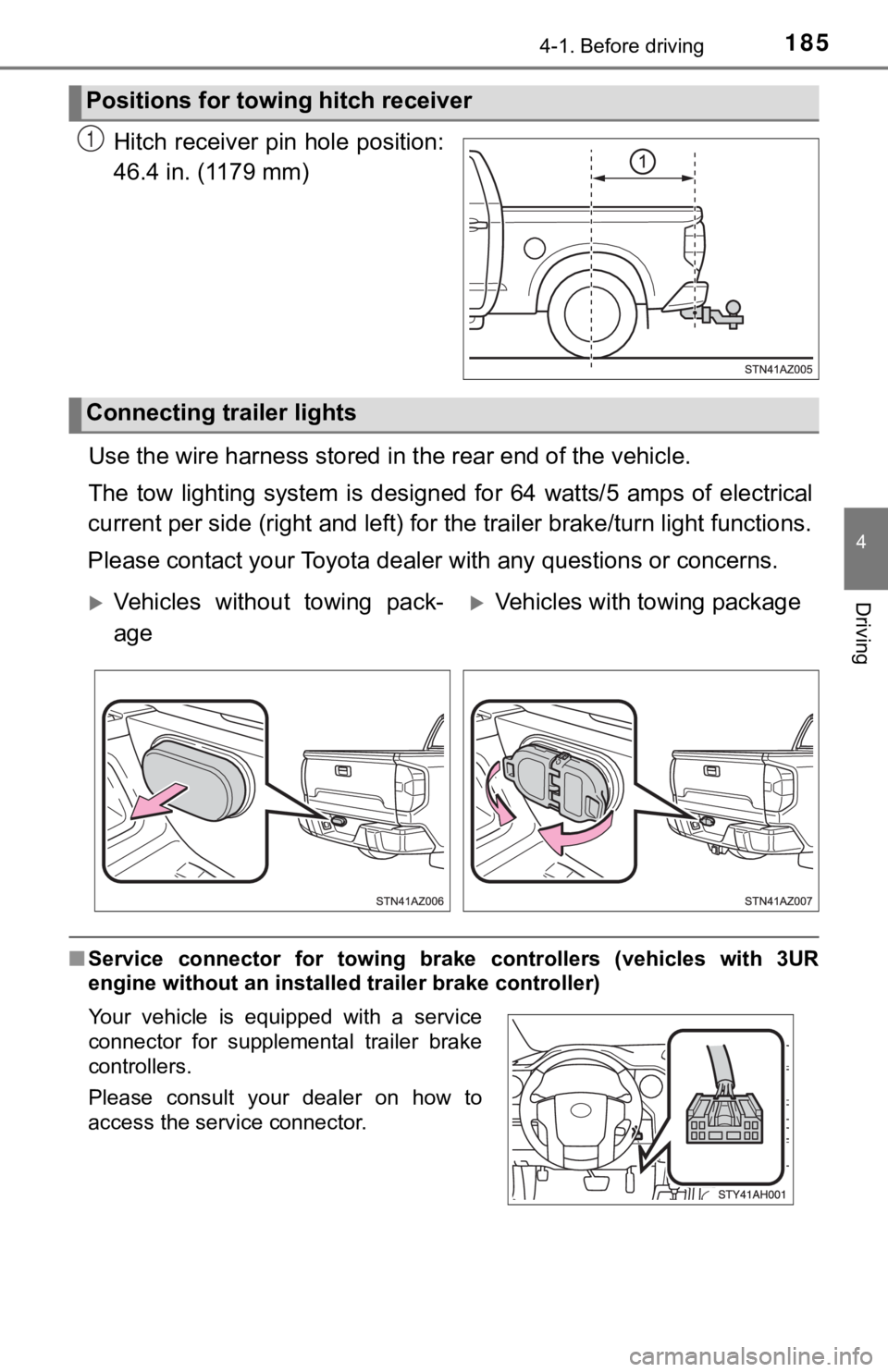
Hitch receiver pin hole position:
46.4 in. (1179 mm)
Use the wire harness stored in the rear end of the vehicle.
The tow lighting system is desi gned for 64 watts/5 amps of elec trical
current per side (right and left) for the trailer brake/turn li ght functions.
Please contact your Toyota dealer with any questions or concerns.
■Service connector for towing br ake controllers (vehicles with 3UR
engine without an installed trailer brake controller)
Positions for towing hitch receiver
1
Connecting trailer lights
Vehicles without towing pack-
ageVehicles with towing package
Your vehicle is equipped with a service
connector for supplemental trailer brake
controllers.
Please consult your dealer on how to
access the service connector.
Page 187 of 672

1874-1. Before driving
4
Driving
●Avoid sudden braking as you may skid, resulting in the trailer jack-
knifing and a loss of vehicle control. This is especially true on wet or
slippery surfaces.
● Avoid jerky starts or sudden acceleration.
● Avoid jerky steering and sharp turns, and slow down before maki ng
a turn.
● Note that when making a turn, the trailer wheels will be closer than
the vehicle wheels to the inside of the turn. Compensate by mak ing
a wider than normal turning radius.
● Slow down before making a turn, in crosswinds, on wet or slippe ry
surfaces, etc.
Increasing vehicle speed can destabilize the trailer.
● Take care when passing other vehicles. Passing requires consider-
able distance. After passing a vehicle, do not forget the lengt h of
your trailer, and be sure you have plenty of room before changi ng
lanes.
● To maintain engine braking efficiency and charging system perfo r-
mance when using engine braking, do not use the transmission in
D.
Transmission shift ra nge position must be in 4 in the S mode.
● Instability happens more frequently when descending steep or lo ng
downhill grades. Before descending, slow down and downshift. Do
not make sudden downshifts while descending steep or long down-
hill grades.
● Avoid holding the brake pedal down too long or applying the bra kes
too frequently. This could cause the brakes to overheat and result in
reduced braking efficiency.
● Due to the added load of the trailer, your vehicle’s engine may over-
heat on hot days (at temperatures over 85°F [30°C]) when drivin g
up a long or steep grade. If the engine coolant temperature gau ge
indicates overheating, immediately turn off the air conditionin g (if in
use), pull your vehicle off the road and stop in a safe spot.
( P. 585)
Page 188 of 672

1884-1. Before driving
●Always place wheel blocks under both the vehicle’s and the trai ler’s
wheels when parking. Apply the parking brake firmly, and put th e
transmission in P. Avoid parking on a slope, but if unavoidable , do
so only after perform ing the following:
Apply the brakes and keep them applied.
Have someone place wheel blocks under both the vehicle’s and
trailer’s wheels.
When the wheel blocks are in pl ace, release the brakes slowly
until the blocks absorb the load.
Apply the parking brake firmly.
Shift into P and turn off the engine.
● When restarting afte r parking on a slope:
With the transmission in P, start the engine. Be sure to keep t he
brake pedal pressed.
Shift into D or R (if reversing).
Release the parking brake and brake pedal, and slowly pull or
back away from the wheel bloc ks. Stop and apply the brakes.
Have someone retrieve the blocks.
1
2
3
4
5
1
2
3
4
Page 189 of 672
1894-1. Before driving
4
Driving
■Trailer brake controller
P. 307
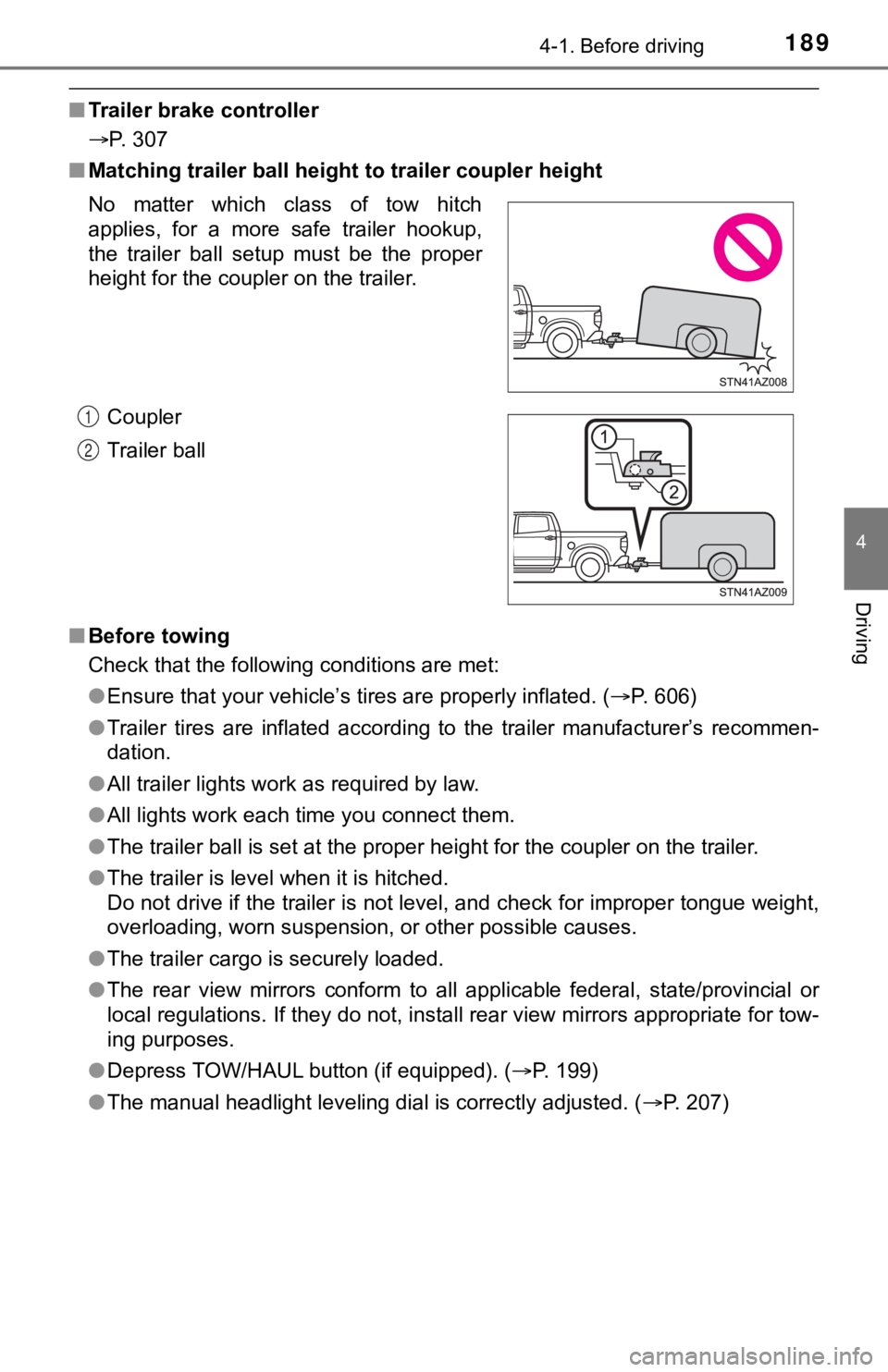
■ Matching trailer ball height to trailer coupler height
■ Before towing
Check that the following conditions are met:
●Ensure that your vehicle’s tires are properly inflated. ( P. 606)
● Trailer tires are inflated according to the trailer manufacture r’s recommen-
dation.
● All trailer lights work as required by law.
● All lights work each time you connect them.
● The trailer ball is set at the proper height for the coupler on the trailer.
● The trailer is level when it is hitched.
Do not drive if the trailer is not level, and check for imprope r tongue weight,
overloading, worn suspension, or other possible causes.
● The trailer cargo is securely loaded.
● The rear view mirrors conform to all applicable federal, state/provincial or
local regulations. If they do not, install rear view mirrors ap propriate for tow-
ing purposes.
● Depress TOW/HAUL button (if equipped). ( P. 199)
● The manual headlight leveling dial is correctly adjusted. ( P. 207)
No matter which class of tow hitch
applies, for a more safe trailer hookup,
the trailer ball setup must be the proper
height for the coupler on the trailer.
Coupler
Trailer ball
1
2
Page 190 of 672

1904-1. Before driving
■Break-in schedule
If your vehicle is new or equipped with any new power train com ponents
(such as an engine, transmission, differential or wheel bearing ), Toyota rec-
ommends that you do not tow a trailer until the vehicle has bee n driven for
over 500 miles (800 km).
After the vehicle has been driven for over 500 miles (800 km), you can start
towing. However, for the next 500 miles (800 km), drive the veh icle at a speed
of less than 50 mph (80 km/h) when towing a trailer, and avoid full throttle
acceleration.
■ Maintenance
●If you tow a trailer, your vehicle will require more frequent m aintenance due
to the additional load. (See “Owner’s Warranty Information Book let” or
“Scheduled Maintenance Guide”/“Owner’s Manual Supplement”.)
● Retighten the fixing bolts of the towing ball and bracket after approximately
600 miles (1000 km) of trailer towing.
■ If trailer sway occurs
One or more factors (crosswinds, passing vehicles, rough roads, etc.) can
adversely affect handling of your vehicle and trailer, causing instability.
● If trailer swaying occurs:
• Firmly grip the steering wheel. Steer straight ahead.
Do not try to control trailer swaying by turning the steering wheel.
• Begin releasing the accelerator pedal immediately but very gra dually to
reduce speed.
Do not increase speed. Do not apply vehicle brakes.
If you make no extreme correction with the steering or brakes, your vehicle
and trailer should stabilize. (if enabled, Trailer Sway Control can also help to
stabilize the vehicle and trailer.)
● After the trailer swaying has stopped:
• Stop in a safe place. Get all occupants out of the vehicle.
• Check the tires of the vehicle and the trailer.
• Check the load in the trailer.
Make sure the load has not shifted.
Make sure the tongue weight is appropriate, if possible.
• Check the load in the vehicle. Make sure the vehicle is not overloaded after occupants get in.
If you cannot find any problems, the speed at which trailer swaying occurred
is beyond the limit of your particular vehicle-trailer combinat ion.
Drive at a lower speed to prevent instability. Remember that sw aying of the
towing vehicle-trailer increases as speed increases.