air condition TOYOTA TUNDRA 2019 Owners Manual (in English)
[x] Cancel search | Manufacturer: TOYOTA, Model Year: 2019, Model line: TUNDRA, Model: TOYOTA TUNDRA 2019Pages: 672, PDF Size: 14.1 MB
Page 5 of 672

5
1
9 8
7 5 4
3
2
10
6
5-9. Bluetooth® phone
Using a Bluetooth®
phone .............................. 370
Making a call ..................... 372
Receiving a call ................. 375
Speaking on the phone ..... 376
Bluetooth
® phone
message function ............ 379
Using the steering wheel switches ................ 383
Bluetooth
® phone
settings............................ 384
Contact/Call History Settings ........................... 386
What to do if... (Troubleshooting) ............ 395
5-10. Using the voice command system
Voice command system .... 399
5-11. Bluetooth
®
Bluetooth®......................... 403
5-12. Antenna Antenna ............................. 408
6-1. Using the air conditioning system
Manual air conditioning system............................. 412
Automatic air conditioning system............................. 419
Seat heaters/ seat ventilators ................ 426 6-2. Using the interior lights
Interior lights list................. 429• Personal/interior lights
main switch ................... 430
• Personal/interior lights .............................. 430
• Cargo lamp main switch ............................ 431
6-3. Using the storage features List of storage features ...... 432• Glove box ...................... 434
• Console box (front separated type seat) ..... 435
• Card holder ................... 436
• Map holder (front bench type seat)............ 438
• Pen holder ..................... 439
• Tissue pocket ................ 440
• Overhead console ......... 441
• Cup holders ................... 442
• Bottle holders ................ 444
• Auxiliary boxes (front bench type seat)............ 445
• Storage box ................... 447
Luggage compartment features ........................... 449
6-4. Using the other interior features Other interior features........ 450• Sun visors ..................... 450
• Vanity mirrors ................ 450
• Clock ............................. 451
• Power outlets ................ 452
• Armrest.......................... 454
• Assist grips .................... 455
Garage door opener .......... 456
Compass ........................... 465
6Interior features
Page 6 of 672

TABLE OF CONTENTS6
7-1. Maintenance and careCleaning and protecting the vehicle exterior .......... 470
Cleaning and protecting the vehicle interior ........... 473
7-2. Maintenance Maintenance requirements ................... 476
General maintenance ........ 478
Emission inspection and maintenance (I/M)
programs ......................... 481
7-3. Do-it-yourself maintenance Do-it-yourself service precautions ..................... 482
Hood.................................. 484
Engine compartment ......... 485
Tires .................................. 495
Tire inflation pressure........ 507
Wheels .............................. 510
Air conditioning filter .......... 513
Wireless remote control battery ............................. 516
Checking and replacing fuses ............................... 518
Light bulbs ......................... 521 8-1. Essential information
Emergency flashers ........... 538
If your vehicle has to be stopped in
an emergency.................. 539
8-2. Steps to take in an emergency
If your vehicle needs to be towed .......................... 540
If you think something is wrong............................... 545
Fuel pump shut off system ............................. 546
If a warning light turns on or a warning buzzer
sounds ............................. 547
If a warning message is displayed ......................... 555
If you have a flat tire .......... 565
If the engine will not start ................................. 580
If the vehicle battery is discharged ....................... 582
If your vehicle overheats.... 585
If the vehicle becomes stuck ................................ 588
7Maintenance and care8When trouble arises
Page 17 of 672

17Pictorial index
Turn signal lever . . . . . . . . . . . . . . . . . . . . . . . . . . . . . . . . . . P. 203
Headlight switch . . . . . . . . . . . . . . . . . . . . . . . . . . . . . . . . . . . . P. 205
Headlights/parking lights/tail lights/
daytime running lights . . . . . . . . . . . . . . . . . . . . . . . . . . . . . . . P. 205
Fog lights
*1 . . . . . . . . . . . . . . . . . . . . . . . . . . . . . . . . . . . . . . . P. 215
Windshield wiper and washer switch . . . . . . . . . . . . . . . . . P. 216
Usage . . . . . . . . . . . . . . . . . . . . . . . . . . . . . . . . . . . . . . . . . . . P. 216
Adding washer fluid . . . . . . . . . . . . . . . . . . . . . . . . . . . . . . . . . P. 494
Warning messages . . . . . . . . . . . . . . . . . . . . . . . . . . . . . . . . . P. 558
Hood lock release lever. . . . . . . . . . . . . . . . . . . . . . . . . . . . . P. 484
Tilt and telescopic steering lock release lever
*2 . . . . . . . . P. 136
Tilt and telescopic steering control switch
*3 . . . . . . . . . . . P. 137
Adjustment . . . . . . . . . . . . . . . . . . . . . . . . . . . . . . . . . . . . . . . . P. 137
Driving position memory . . . . . . . . . . . . . . . . . . . . . . . . . . . . . P. 128
Manual air conditioning system
*1 . . . . . . . . . . . . . . . . . . . . P. 412
Automatic air conditioning system
*1 . . . . . . . . . . . . . . . . . P. 419
Usage . . . . . . . . . . . . . . . . . . . . . . . . . . . . . . . . . . . . . . . P. 412, 419
Back window defogger
*4. . . . . . . . . . . . . . . . . . . . . . . . . P. 414, 421
Windshield wiper de-icer
*1 . . . . . . . . . . . . . . . . . . . . . . . P. 415, 422
Multimedia system. . . . . . . . . . . . . . . . . . . . . . . . . . . . . . . . . P. 322
*1: If equipped
*2: Vehicles without driving position memory
*3: Vehicles with driving position memory
*4: For CrewMax models
6
7
8
9
10
11
12
Page 19 of 672

19Pictorial index
Parking brake pedal. . . . . . . . . . . . . . . . . . . . . . . . . . . . . . . . P. 204
Applying/releasing . . . . . . . . . . . . . . . . . . . . . . . . . . . . . . . . . . P. 204
Precautions against winter season . . . . . . . . . . . . . . . . . . . . . P. 312
Warning buzzer/message . . . . . . . . . . . . . . . . . . . . . . . . P. 548, 557
Turn signal lever . . . . . . . . . . . . . . . . . . . . . . . . . . . . . . . . . . P. 203
Headlight switch . . . . . . . . . . . . . . . . . . . . . . . . . . . . . . . . . . . . P. 205
Headlights/parking lights/tail lights/
daytime running lights . . . . . . . . . . . . . . . . . . . . . . . . . . . . . . . P. 205
Fog lights
*1 . . . . . . . . . . . . . . . . . . . . . . . . . . . . . . . . . . . . . . . P. 215
Windshield wiper and washer switch . . . . . . . . . . . . . . . . . P. 216
Usage . . . . . . . . . . . . . . . . . . . . . . . . . . . . . . . . . . . . . . . . . . . P. 216
Adding washer fluid . . . . . . . . . . . . . . . . . . . . . . . . . . . . . . . . . P. 494
Warning lights/warning messages . . . . . . . . . . . . . . . . . . . . . . P. 558
Hood lock release lever. . . . . . . . . . . . . . . . . . . . . . . . . . . . . P. 484
Tilt steering lock release lever . . . . . . . . . . . . . . . . . . . . . . . P. 136
Manual air conditioning system
*1 . . . . . . . . . . . . . . . . . . . . P. 412
Automatic air conditioning system
*1 . . . . . . . . . . . . . . . . . P. 419
Usage . . . . . . . . . . . . . . . . . . . . . . . . . . . . . . . . . . . . . . . P. 412, 419
Back window defogger
*2. . . . . . . . . . . . . . . . . . . . . . . . . P. 414, 421
Windshield wiper de-icer
*1 . . . . . . . . . . . . . . . . . . . . . . . P. 415, 422
Multimedia system. . . . . . . . . . . . . . . . . . . . . . . . . . . . . . . . . P. 322
*1: If equipped
*2: For CrewMax models
5
6
7
8
9
10
11
Page 46 of 672

461-1. For safe use
■If the SRS airbags deploy (inflate)
●Slight abrasions, burns, bruising etc., may be sustained from S RS airbags,
due to the extremely high speed deployment (inflation) by hot g ases.
● A loud noise and white powder will be emitted.
● Parts of the airbag module (steering wheel hub, airbag cover an d inflator) as
well as the front seats, parts of the front and rear pillars an d roof side rails,
may be hot for several minutes. The airbag itself may also be hot.
● The windshield may crack.
■ SRS airbag deployment condi tions (SRS front airbags)
● The SRS front airbags will deploy in the event of an impact tha t exceeds the
set threshold level (the level of force corresponding to an app roximately
12 - 18 mph [20 - 30 km/h] frontal collision with a fixed wall that does not
move or deform).
However, this threshold velocity will be considerably higher in the following
situations:
• If the vehicle strikes an object, such as a parked vehicle or sign pole, which
can move or deform on impact
• If the vehicle is involved in an underride collision, such as a collision in
which the front of the vehicle “underrides”, or goes under, the bed of a truck
● Depending on the type of collision, it is possible that only th e seat belt pre-
tensioners will activate.
● The SRS front airbags for the front passenger will not activate if there is no
passenger sitting in the right front passenger seat. However, t he SRS front
airbags for the front passenger may deploy if luggage is put in the seat,
even if the seat is unoccupied. ( P. 50)
■ SRS airbag deployment conditions (SRS side and curtain shield airbags)
● The SRS side and curtain shield airbags will deploy in the even t of an
impact that exceeds the set threshold level (the level of force corresponding
to the impact force produced by an approximately 3300 lb. [1500 kg] vehicle
colliding with the vehicle cabin from a direction perpendicular to the vehicle
orientation at an approximate speed of 12 - 18 mph [20 - 30 km/ h]).
● The SRS curtain shield airbags will deploy in the event of vehi cle rollover.
● The SRS curtain shield airbags may also deploy in the event of a severe
frontal collision.
Page 47 of 672
471-1. For safe use
1
For safety and security
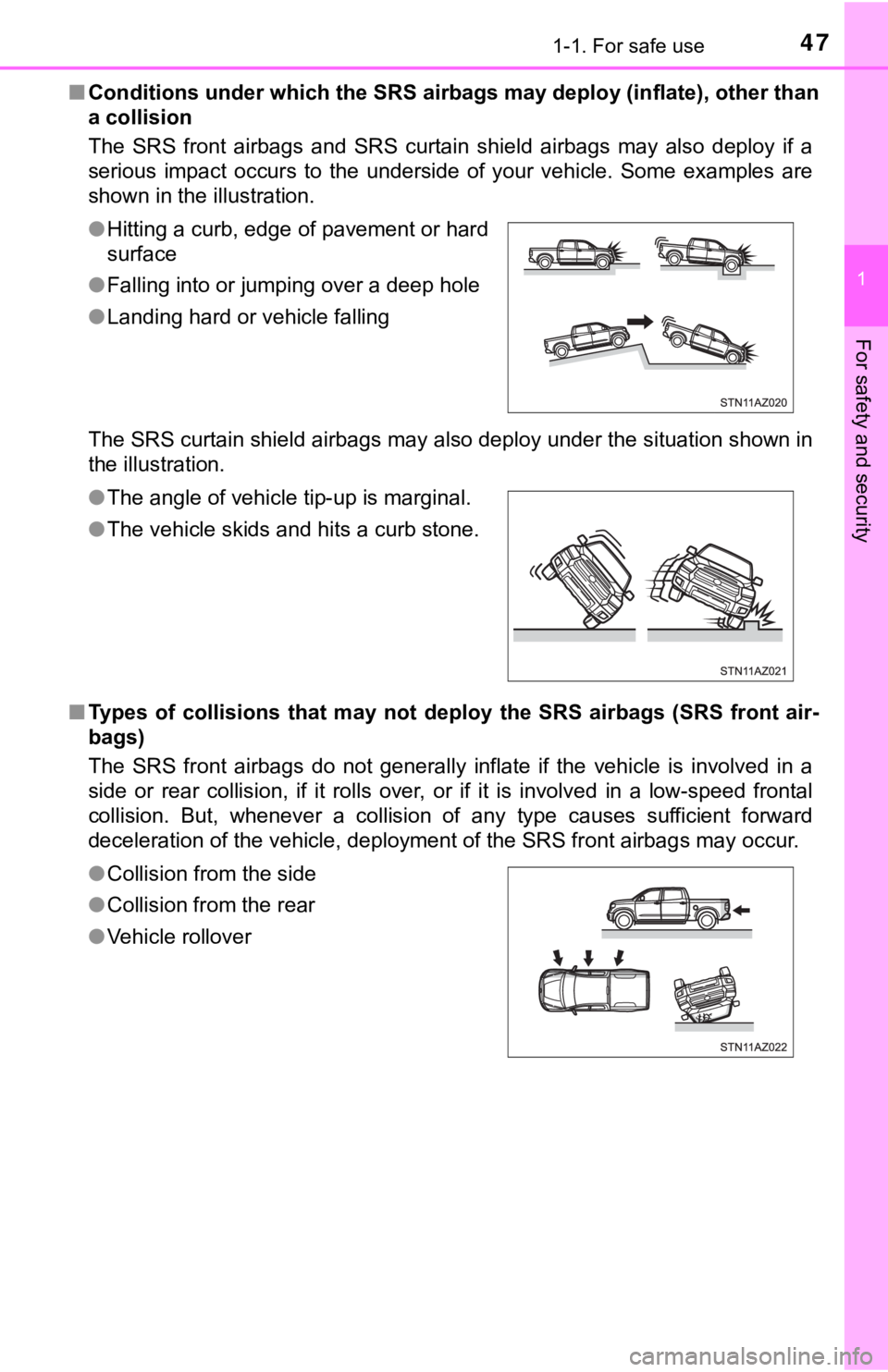
■Conditions under which the SRS ai rbags may deploy (inflate), other than
a collision
The SRS front airbags and SRS curtain shield airbags may also d eploy if a
serious impact occurs to the underside of your vehicle. Some ex amples are
shown in the illustration.
The SRS curtain shield airbags may also deploy under the situation shown in
the illustration.
■ Types of collisions that may not deploy the SRS airbags (SRS fr ont air-
bags)
The SRS front airbags do not generally inflate if the vehicle i s involved in a
side or rear collision, if it rolls over, or if it is involved in a low-speed frontal
collision. But, whenever a collision of any type causes suffici ent forward
deceleration of the vehicle, deployment of the SRS front airbag s may occur.
●
Hitting a curb, edge of pavement or hard
surface
● Falling into or jumping over a deep hole
● Landing hard or vehicle falling
● The angle of vehicle tip-up is marginal.
● The vehicle skids and hits a curb stone.
● Collision from the side
● Collision from the rear
● Vehicle rollover
Page 50 of 672
501-1. For safe use
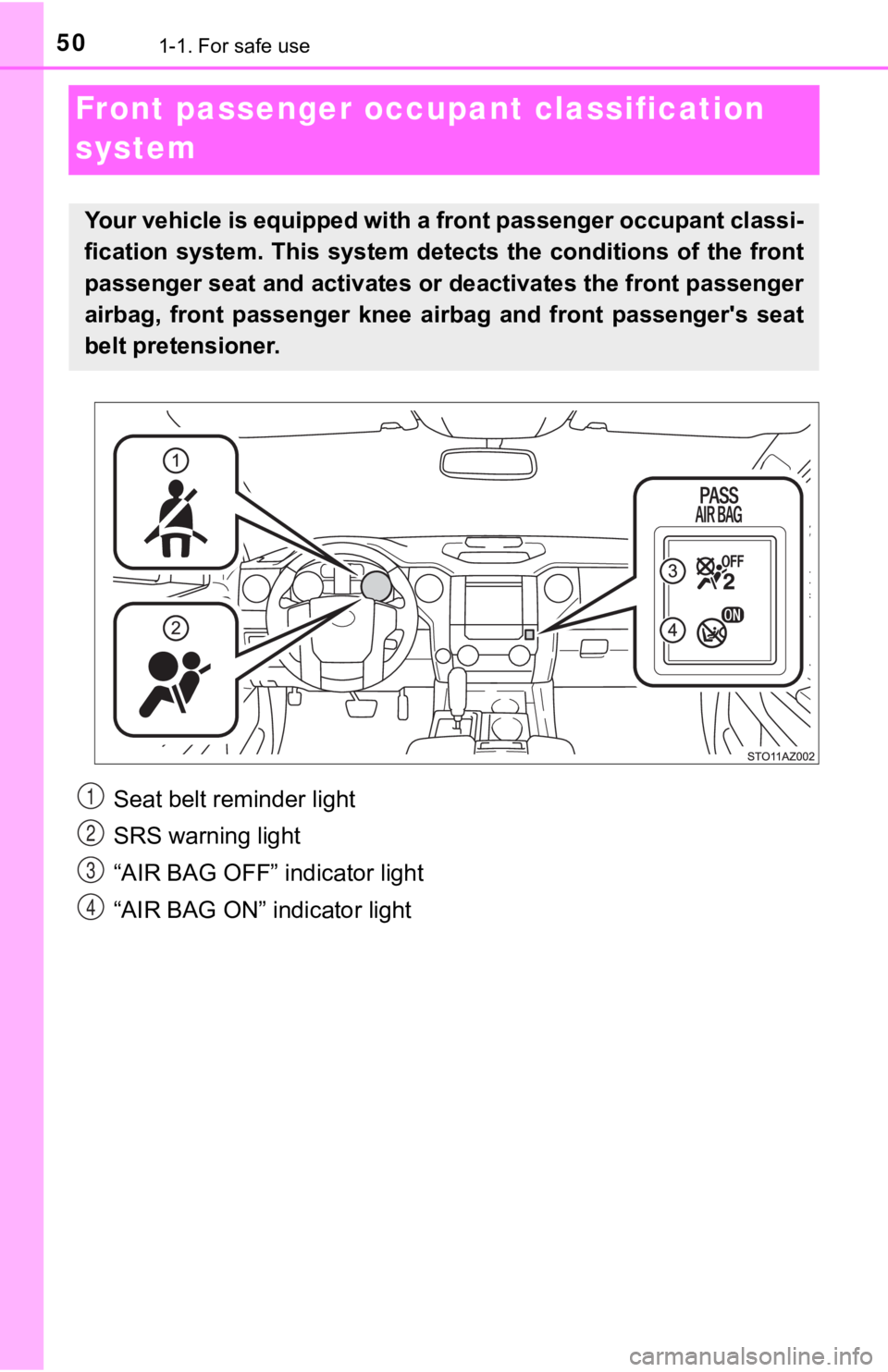
Front passenger occupant classification
system
Your vehicle is equipped with a front passenger occupant classi -
fication system. This system det ects the conditions of the front
passenger seat and activates or deactivates the front passenger
airbag, front passenger knee airbag and front passenger's seat
belt pretensioner.
Seat belt reminder light
SRS warning light
“AIR BAG OFF” indicator light
“AIR BAG ON” indicator light1
2
3
4
Page 51 of 672
511-1. For safe use
1
For safety and security
■Adult*1
■Child*4 or child restraint system*5
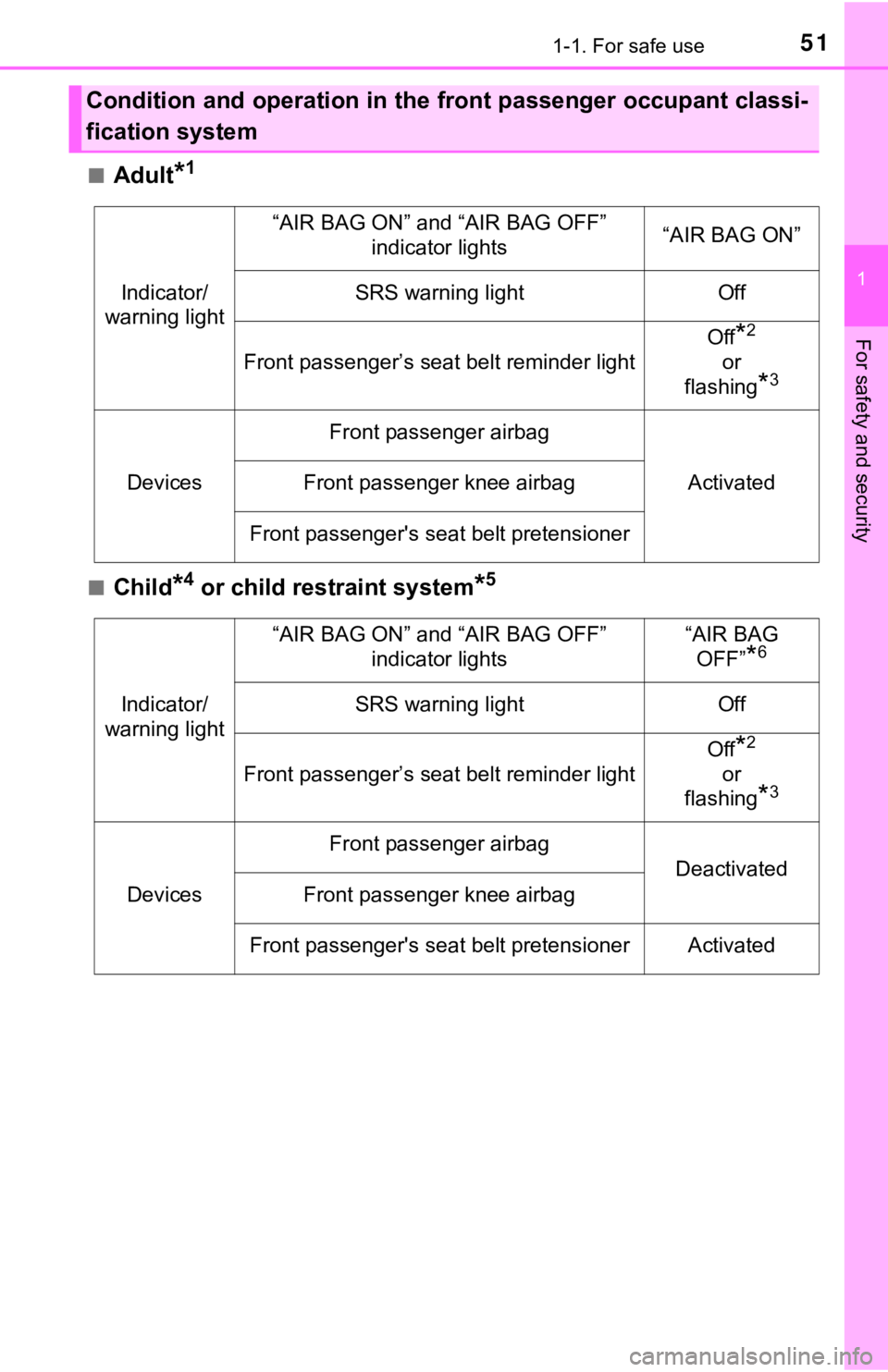
Condition and operation in the front passenger occupant classi-
fication system
Indicator/
warning light
“AIR BAG ON” and “AIR BAG OFF” indicator lights“AIR BAG ON”
SRS warning lightOff
Front passenger’s seat belt reminder light
Off*2
or
flashing
*3
Devices
Front passenger airbag
ActivatedFront passenger knee airbag
Front passenger's seat belt pretensioner
Indicator/
warning light
“AIR BAG ON” and “AIR BAG OFF”
indicator lights“AIR BAG OFF”
*6
SRS warning lightOff
Front passenger’s seat belt reminder light
Off*2
or
flashing
*3
Devices
Front passenger airbag
Deactivated
Front passenger knee airbag
Front passenger's seat belt pretensionerActivated
Page 111 of 672
1113-1. Key information
3
Operation of each component
■If you lose your keys
New genuine key can be made by your Toyota dealer using the other key and
the key number stamped on your key number plate.
Keep the plate in a safe place such as your wallet, not in the vehicle.
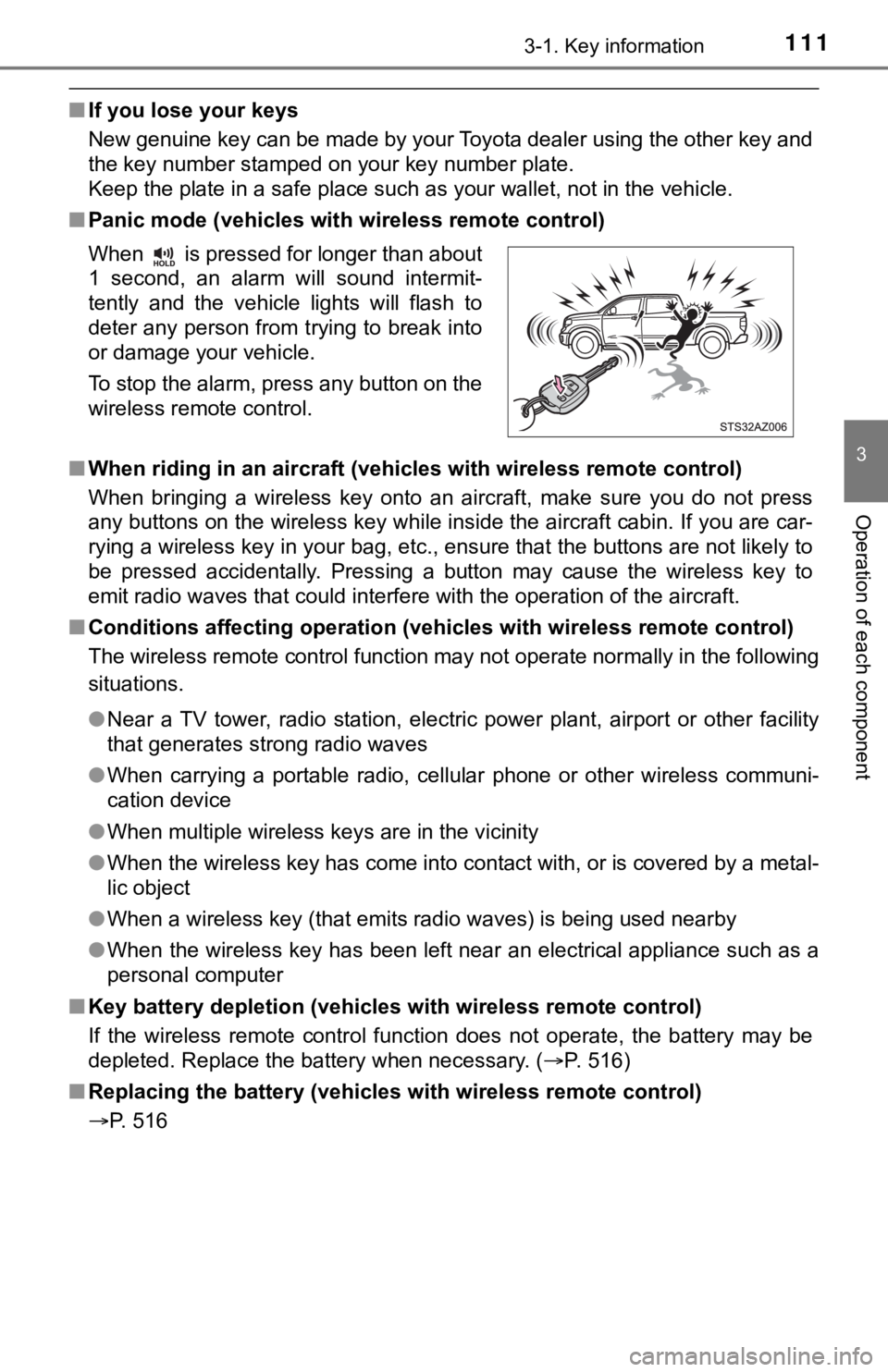
■ Panic mode (vehicles with wireless remote control)
■ When riding in an aircraft (vehic les with wireless remote control)
When bringing a wireless key onto an aircraft, make sure you do not press
any buttons on the wireless key while inside the aircraft cabin . If you are car-
rying a wireless key in your bag, etc., ensure that the buttons are not likely to
be pressed accidentally. Pressing a button may cause the wirele ss key to
emit radio waves that could interfere with the operation of the aircraft.
■ Conditions affecting operation (vehicles with wireless remote c ontrol)
The wireless remote control function may not operate normally i n the following
situations.
● Near a TV tower, radio station, electric power plant, airport o r other facility
that generates strong radio waves
● When carrying a portable radio, cellular phone or other wireles s communi-
cation device
● When multiple wireless keys are in the vicinity
● When the wireless key has come into contact with, or is covered by a metal-
lic object
● When a wireless key (that emits radio waves) is being used near by
● When the wireless key has been left near an electrical applianc e such as a
personal computer
■ Key battery depletion (vehicles with wireless remote control)
If the wireless remote control function does not operate, the b attery may be
depleted. Replace the battery when necessary. ( P. 516)
■ Replacing the battery (vehicles with wireless remote control)
P. 516 When is pressed for longer than about
1 second, an alarm will sound intermit-
tently and the vehicle lights will flash to
deter any person from trying to break into
or damage your vehicle.
To stop the alarm, press any button on the
wireless remote control.
Page 187 of 672

1874-1. Before driving
4
Driving
●Avoid sudden braking as you may skid, resulting in the trailer jack-
knifing and a loss of vehicle control. This is especially true on wet or
slippery surfaces.
● Avoid jerky starts or sudden acceleration.
● Avoid jerky steering and sharp turns, and slow down before maki ng
a turn.
● Note that when making a turn, the trailer wheels will be closer than
the vehicle wheels to the inside of the turn. Compensate by mak ing
a wider than normal turning radius.
● Slow down before making a turn, in crosswinds, on wet or slippe ry
surfaces, etc.
Increasing vehicle speed can destabilize the trailer.
● Take care when passing other vehicles. Passing requires consider-
able distance. After passing a vehicle, do not forget the lengt h of
your trailer, and be sure you have plenty of room before changi ng
lanes.
● To maintain engine braking efficiency and charging system perfo r-
mance when using engine braking, do not use the transmission in
D.
Transmission shift ra nge position must be in 4 in the S mode.
● Instability happens more frequently when descending steep or lo ng
downhill grades. Before descending, slow down and downshift. Do
not make sudden downshifts while descending steep or long down-
hill grades.
● Avoid holding the brake pedal down too long or applying the bra kes
too frequently. This could cause the brakes to overheat and result in
reduced braking efficiency.
● Due to the added load of the trailer, your vehicle’s engine may over-
heat on hot days (at temperatures over 85°F [30°C]) when drivin g
up a long or steep grade. If the engine coolant temperature gau ge
indicates overheating, immediately turn off the air conditionin g (if in
use), pull your vehicle off the road and stop in a safe spot.
( P. 585)