tow TOYOTA TUNDRA 2021 (in English) User Guide
[x] Cancel search | Manufacturer: TOYOTA, Model Year: 2021, Model line: TUNDRA, Model: TOYOTA TUNDRA 2021Pages: 612, PDF Size: 13.7 MB
Page 133 of 612
1333-2. Opening, closing and locking the doors
3
Operation of each component
Tailgate
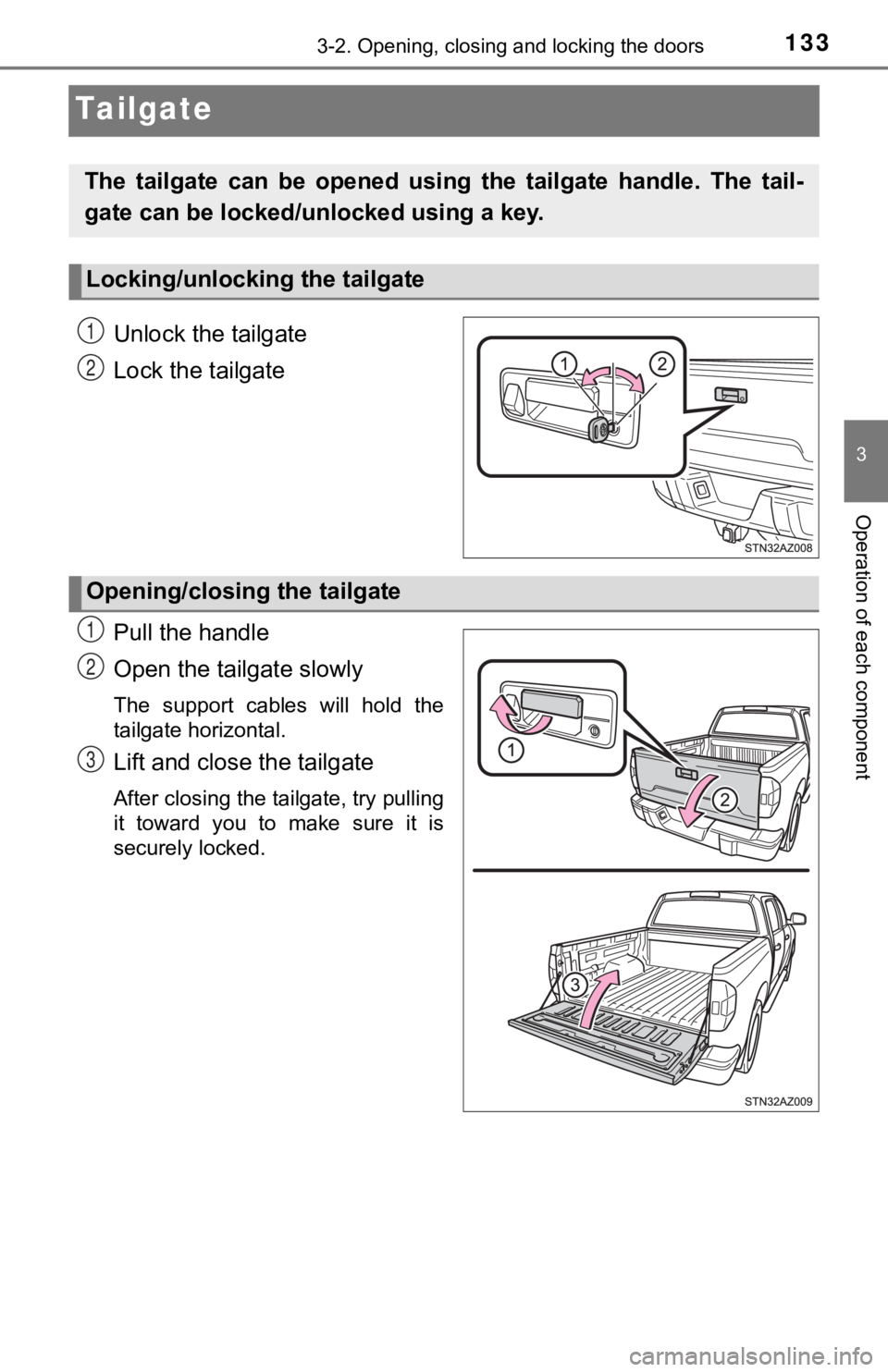
Unlock the tailgate
Lock the tailgate
Pull the handle
Open the tailgate slowly
The support cables will hold the
tailgate horizontal.
Lift and close the tailgate
After closing the tailgate, try pulling
it toward you to make sure it is
securely locked.
The tailgate can be opened using the tailgate handle. The tail-
gate can be locked/ unlocked using a key.
Locking/unlocking the tailgate
1
2
Opening/closing the tailgate
1
2
3
Page 137 of 612
1373-2. Opening, closing and locking the doors
3
Operation of each component
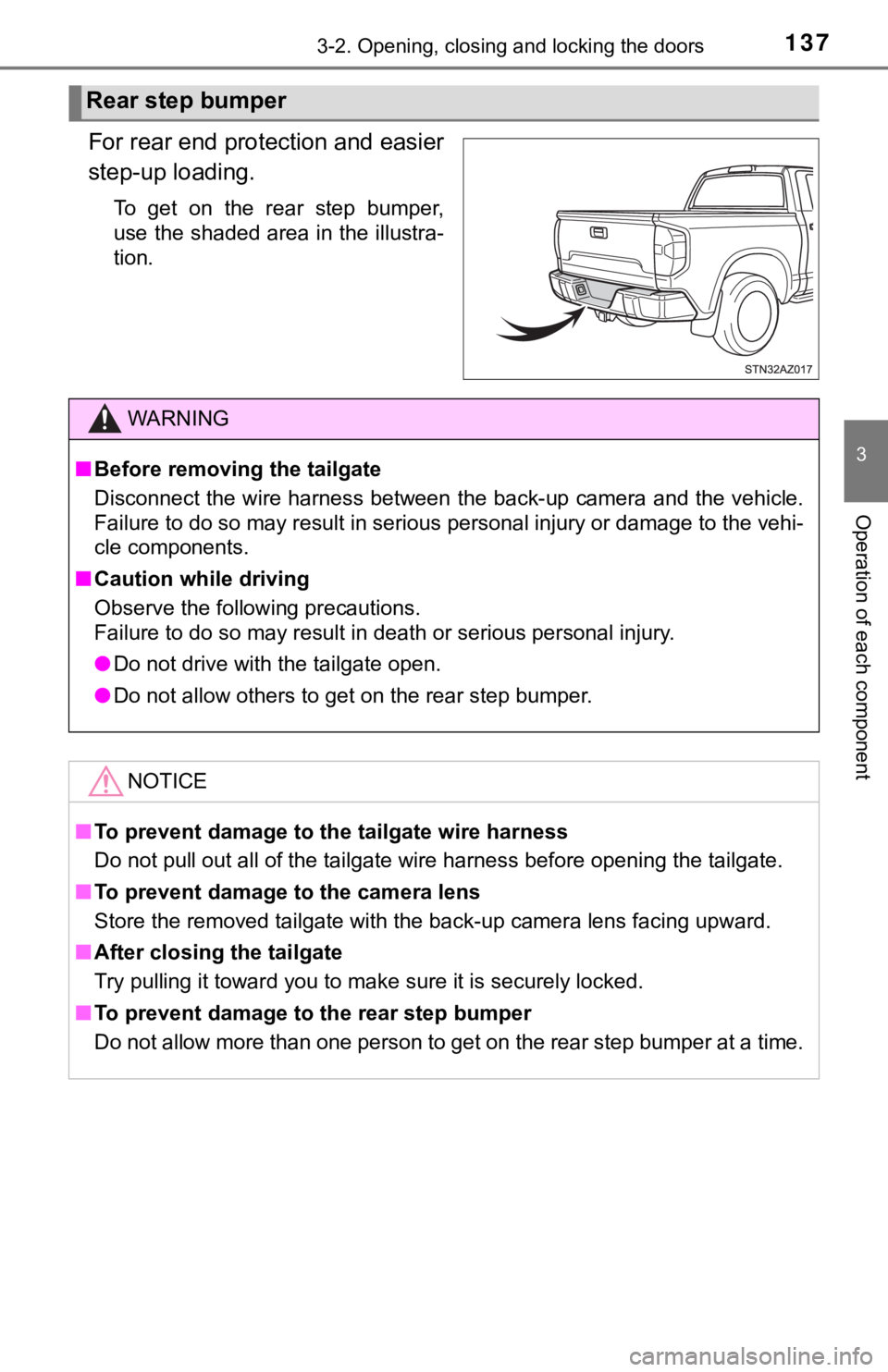
For rear end protection and easier
step-up loading.
To get on the rear step bumper,
use the shaded area in the illustra-
tion.
Rear step bumper
WARNING
■Before removing the tailgate
Disconnect the wire harness between the back-up camera and the vehicle.
Failure to do so may result in serious personal injury or damage to the vehi-
cle components.
■ Caution while driving
Observe the following precautions.
Failure to do so may result in death or serious personal injury .
● Do not drive with the tailgate open.
● Do not allow others to get on the rear step bumper.
NOTICE
■To prevent damage to the tailgate wire harness
Do not pull out all of the tailgate wire harness before opening the tailgate.
■ To prevent damage to the camera lens
Store the removed tailgate with the back-up camera lens facing upward.
■ After closing the tailgate
Try pulling it toward you to make sure it is securely locked.
■ To prevent damage to the rear step bumper
Do not allow more than one person to get on the rear step bumpe r at a time.
Page 142 of 612
1423-2. Opening, closing and locking the doors
■Conditions affecting operation
The smart key system uses weak radio waves. In the following si tuations, the
communication between the electronic key and the vehicle may be affected,
preventing the smart key system, wireless remote control and en gine immobi-
lizer system from operating properly. (Ways of coping: P. 523)
● When the electronic key battery is depleted
● Near a TV tower, electric power plant, gas station, radio stati on, large dis-
play, airport or other facility that generates strong radio wav es or electrical
noise
● When carrying a portable radio, cellular phone, cordless phone or other
wireless communication device
● When the electronic key is in contact with, or is covered by th e following
metallic objects
• Cards to which aluminum foil is attached
• Cigarette boxes that have aluminum foil inside
• Metallic wallets or bags
• Coins
• Hand warmers made of metal
• Media such as CDs and DVDs
● When multiple electronic keys are in the vicinity
● When other wireless keys (that emit radio waves) are being used nearby
● When carrying the electronic key together with the following devices that
emit radio waves
• Another vehicle’s electronic key or a wireless key that emits radio waves
• Personal computers or personal digital assistants (PDAs)
• Digital audio players
• Portable game systems
● If window tint with a metallic content or metallic objects are attached to the
back window
● When the electronic key is placed near a battery charger or ele ctronic
devices
■ Note for the entry function
●Even when the electronic key is within the effective range (detection areas),
the system may not operate properly in the following cases:
• The electronic key is too close to the window or outside door handle, near
the ground, or in a high place when the doors are locked or unl ocked.
• The electronic key is on the instrument panel or floor, or in the console
box or glove box when the engine is started or engine switch mo des are
changed.
Page 151 of 612
1513-3. Adjusting the seats
3
Operation of each component
WARNING
■When raising the bottom cushion
Observe the following precautions.
Failure to do so may result in death or serious injury.
● Do not raise the bottom cushion while driving.
● Stop the vehicle on level ground, set the parking brake and shi ft the shift
lever to P.
■ When bottom cushion is raised
Do not allow passengers to sit on raised bottom cushion or plac e anything
on storage box (Double Cab models) while driving.
■ When returning the seats to their original position
Observe the following precautions.
Failure to do so may result in death or serious injury.
● Be careful not to get your hands or feet pinched in the seat.
● Make sure the bottom cushions are securely locked.
● Check that the seat belts are not twisted or caught in the seat .
● Arrange the seat belts in the proper positions for ready use.
● Make sure that there are no objects under the seat cushion or on the load-
ing floor.
NOTICE
■Before raising the bottom cushion
● Make sure that there are no objects, such as cushions, on the seat cush-
ion.
● The seat belts must be stowed.
Page 160 of 612
1603-3. Adjusting the seats
■Adjusting the front center seat ( bench type seat) and rear center seat
head restraints
Always raise the head restraint one level from the stowed posit ion when
using.
WARNING
■ Head restraint precautions
Observe the following precautions regarding the head restraints .
Failure to do so may result in death or serious injury.
● Use the head restraints designed for each respective seat.
● Adjust the head restraints to the correct position at all times.
● After adjusting the head restraints, push down on them and make sure
they are locked in position.
● Do not drive with the head restraints removed.
Page 162 of 612
1623-4. Adjusting the steering wheel and mirrors
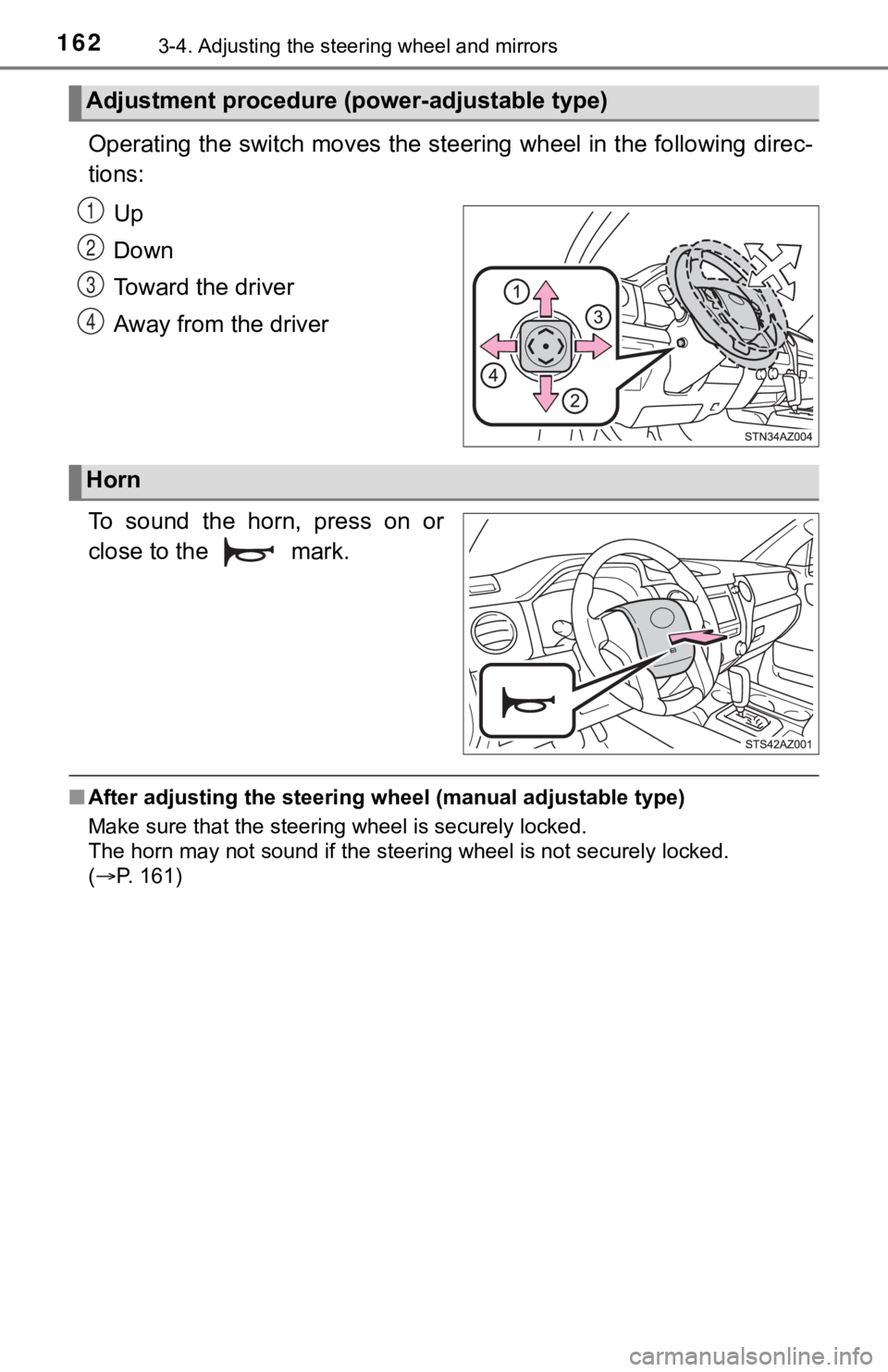
Operating the switch moves the steering wheel in the following direc-
tions:
Up
Down
Toward the driver
Away from the driver
To sound the horn, press on or
close to the mark.
■ After adjusting the steering wheel (manual adjustable type)
Make sure that the steering wheel is securely locked.
The horn may not sound if the steer ing wheel is not securely locked.
( P. 161)
Adjustment procedure (power-adjustable type)
1
2
3
4
Horn
Page 163 of 612
1633-4. Adjusting the steering wheel and mirrors
3
Operation of each component
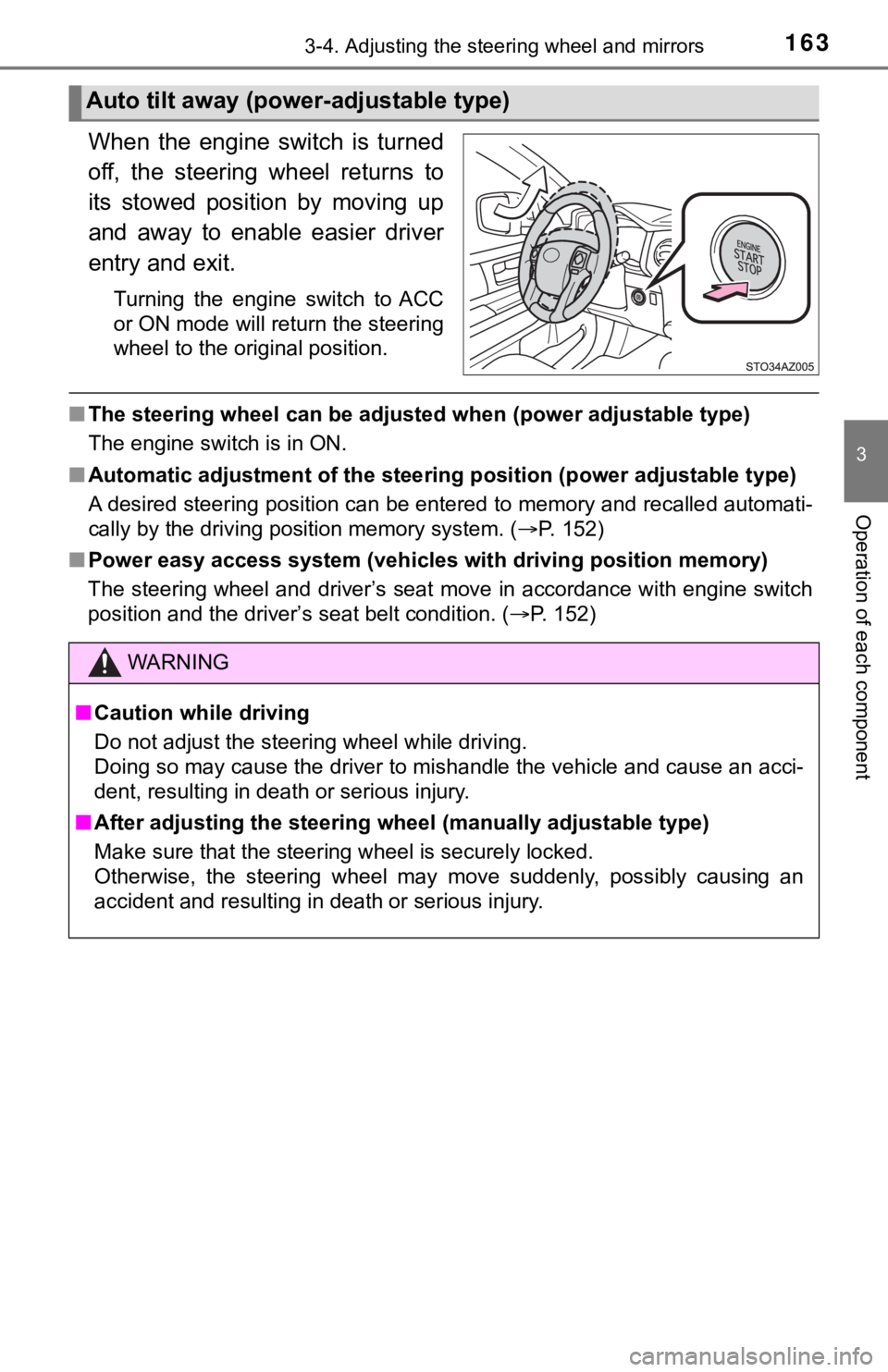
When the engine switch is turned
off, the steering wheel returns to
its stowed position by moving up
and away to enable easier driver
entry and exit.
Turning the engine switch to ACC
or ON mode will return the steering
wheel to the original position.
■The steering wheel can be adjusted when (power adjustable type)
The engine switch is in ON.
■ Automatic adjustment of the stee ring position (power adjustable type)
A desired steering position can be entered to memory and recall ed automati-
cally by the driving position memory system. ( P. 152)
■ Power easy access system (vehicles with driving position memory )
The steering wheel and driver’s seat move in accordance with en gine switch
position and the driver’s seat belt condition. ( P. 152)
Auto tilt away (power-adjustable type)
WARNING
■Caution while driving
Do not adjust the steering wheel while driving.
Doing so may cause the driver to mishandle the vehicle and caus e an acci-
dent, resulting in death or serious injury.
■ After adjusting the steering wheel (manually adjustable type)
Make sure that the steering wheel is securely locked.
Otherwise, the steering wheel may move suddenly, possibly causi ng an
accident and resulting in death or serious injury.
Page 170 of 612
1703-4. Adjusting the steering wheel and mirrors
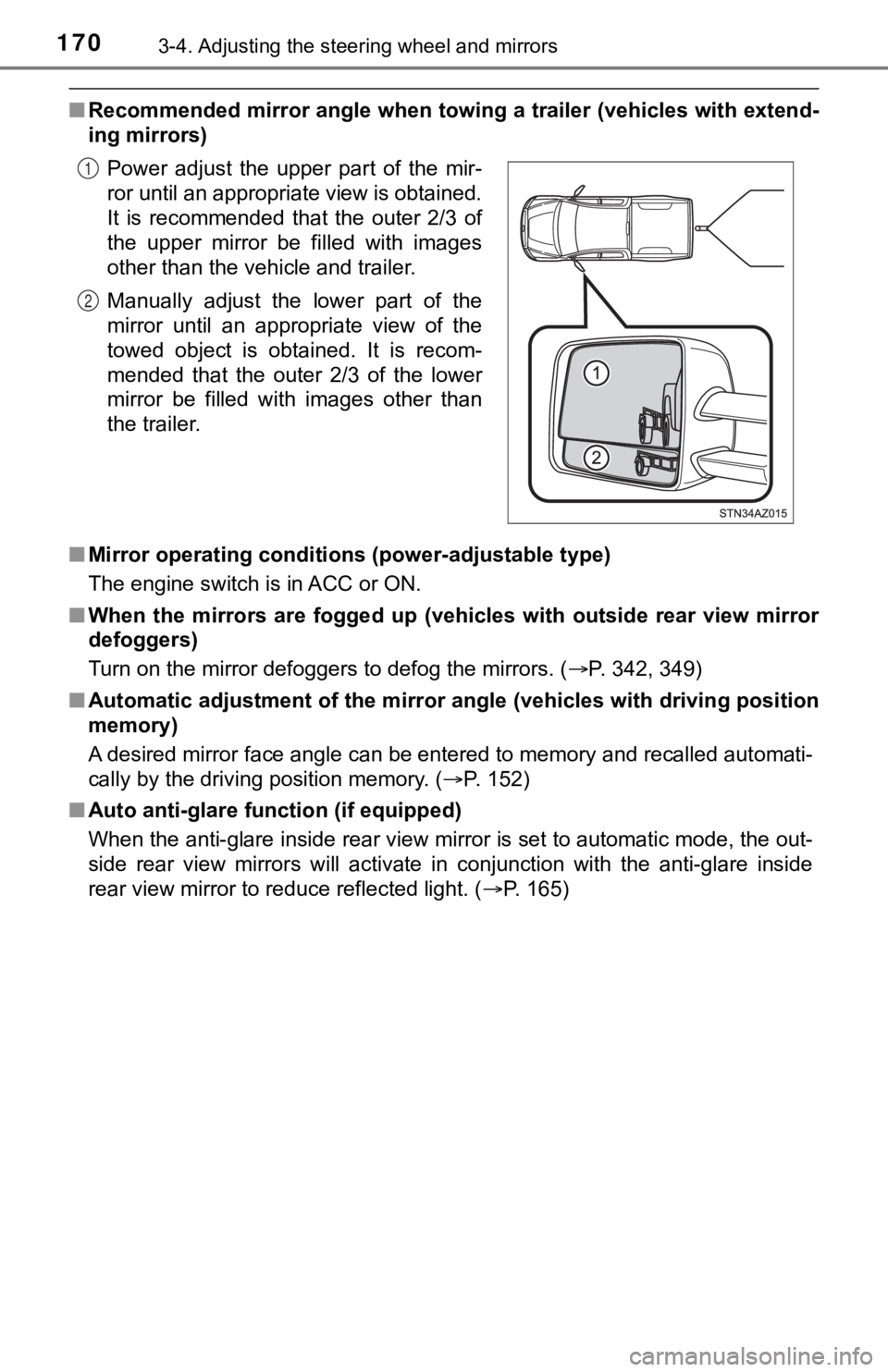
■Recommended mirror angle when to wing a trailer (vehicles with extend-
ing mirrors)
■ Mirror operating conditions (power-adjustable type)
The engine switch is in ACC or ON.
■ When the mirrors are fogged up ( vehicles with outside rear view mirror
defoggers)
Turn on the mirror defoggers to defog the mirrors. ( P. 342, 349)
■ Automatic adjustment of the mirr or angle (vehicles with driving position
memory)
A desired mirror face angle can be entered to memory and recall ed automati-
cally by the driving position memory. ( P. 152)
■ Auto anti-glare function (if equipped)
When the anti-glare inside rear view mirror is set to automatic mode, the out-
side rear view mirrors will activate in conjunction with the an ti-glare inside
rear view mirror to reduce reflected light. ( P. 165)
Power adjust the upper part of the mir-
ror until an appropriate view is obtained.
It is recommended that the outer 2/3 of
the upper mirror be filled with images
other than the vehicle and trailer.
Manually adjust the lower part of the
mirror until an appropriate view of the
towed object is obtained. It is recom-
mended that the outer 2/3 of the lower
mirror be filled with images other than
the trailer.
1
2
Page 181 of 612
1813-5. Opening, closing the windows and moon roof
3
Operation of each component
■Moon roof open reminder function
The buzzer sounds and a message is shown on the multi-informati on display
in the instrument cluster when the engine switch is turned off and the driver’s
door is opened with the moon roof open.
■ When the battery is disconnected
The moon roof must be initialized in order to ensure proper ope ration.
Push and hold the switch toward the “UP” (tilt up) side or “ ▼” (sliding
close) side.
After the moon roof will tilt up and down, release the switch.
To ensure the initialization is complete, make sure automatic opening and
closing functions work properly.
■ Customization that can be configured at Toyota dealer
Settings (e.g. linked door lock operation) can be changed.
(Customizable features: P. 564)
1
2
3
Page 183 of 612
183
4Driving
4-1. Before drivingDriving the vehicle ............. 184
Cargo and luggage ........... 192
Vehicle load limits ............. 195
Trailer towing..................... 197
Dinghy towing ................... 216
4-2. Driving procedures Engine (ignition) switch(vehicles without
a smart key system) ........ 217
Engine (ignition) switch (vehicles with
a smart key system) ........ 219
Automatic transmission ..... 225
Turn signal lever................ 232
Parking brake .................... 233
4-3. Operating the lights and wipers
Headlight switch ................ 234
Automatic High Beam ....... 239
Fog light switch ................. 244
Windshield wipers and washer ............................ 245
4-4. Refueling Opening the fuel tank cap .................................. 248 4-5. Using the driving support
systems
Toyota Safety Sense P ..... 252
PCS (Pre-Collision System)........................... 260
LDA (Lane Departure Alert) ............................... 272
Dynamic radar cruise control ............................. 280
Cruise control .................... 294
Intuitive parking assist....... 298
BSM (Blind Spot Monitor) ........ 305
Four-wheel drive system ... 315
AUTO LSD system............ 318
Driving assist systems ...... 320
Trailer brake controller ...... 327
4-6. Driving tips Winter driving tips ............. 331
Off-road precautions ......... 335