stop start TOYOTA TUNDRA 2021 Owners Manual (in English)
[x] Cancel search | Manufacturer: TOYOTA, Model Year: 2021, Model line: TUNDRA, Model: TOYOTA TUNDRA 2021Pages: 612, PDF Size: 13.7 MB
Page 5 of 612
5
1
9 8
7 5 4
3
2
6
6-1. Maintenance and careCleaning and protecting the vehicle exterior .......... 400
Cleaning and protecting the vehicle interior ........... 403
6-2. Maintenance Maintenance requirements ................... 406
General maintenance ........ 408
Emission inspection and maintenance (I/M)
programs ......................... 411
6-3. Do-it-yourself maintenance Do-it-yourself service precautions ..................... 412
Hood.................................. 414
Engine compartment ......... 415
Tires .................................. 426
Tire inflation pressure........ 442
Wheels .............................. 445
Air conditioning filter .......... 448
Wireless remote control/ electronic key battery ...... 451
Checking and replacing fuses ............................... 454
Light bulbs ......................... 457 7-1. Essential information
Emergency flashers ........... 474
If your vehicle has to be stopped in
an emergency.................. 475
If the vehicle is trapped in rising water .................. 477
7-2. Steps to take in an emergency
If your vehicle needs to be towed .......................... 478
If you think something is wrong............................... 483
Fuel pump shut off system ............................. 484
If a warning light turns on or a warning buzzer
sounds ............................. 485
If a warning message is displayed ......................... 493
If you have a flat tire .......... 506
If the engine will not start ................................. 521
If the electronic key does not operate properly
(vehicles with a smart
key system) .................... 523
If the vehicle battery is discharged ....................... 525
If your vehicle overheats.... 529
If the vehicle becomes stuck ................................ 532
6Maintenance and care7When trouble arises
Page 18 of 612

18Pictorial index
■Instrument panel
Front separated type seats
Engine switch . . . . . . . . . . . . . . . . . . . . . . . . . . . . . . . . . . . . . P. 217
Starting the engine/changing the positions
*1 . . . . . . . . . . . . . P. 217
Starting the engine/changing the modes
*2 . . . . . . . . . . . . . . . P. 220
Emergency stop of the engine . . . . . . . . . . . . . . . . . . . . . . . . . P. 475
When the engine will not start . . . . . . . . . . . . . . . . . . . . . . . . . P. 521
Warning message
*2 . . . . . . . . . . . . . . . . . . . . . . . . . . . . . . . . P. 502
Shift lever . . . . . . . . . . . . . . . . . . . . . . . . . . . . . . . . . . . . . . . . P. 225
Changing the shift position . . . . . . . . . . . . . . . . . . . . . . . . . . . P. 225
Precautions against towing . . . . . . . . . . . . . . . . . . . . . . . . . . . P. 478
When the shift lever does not move . . . . . . . . . . . . . . . . . . . . P. 229
Meters . . . . . . . . . . . . . . . . . . . . . . . . . . . . . . . . . . . . . . . . . . . P. 105
Reading the meters/adjusting the instrument panel light . . . . . P. 105
Warning lights/indicator lights . . . . . . . . . . . . . . . . . . . . . . . . . P. 100
When the warning lights come on . . . . . . . . . . . . . . . . . . . . . . P. 485
Multi-information display . . . . . . . . . . . . . . . . . . . . . . . . . . . P. 110
Display . . . . . . . . . . . . . . . . . . . . . . . . . . . . . . . . . . . . . . . . . . . P. 110
When the warning messages are displayed . . . . . . . . . . . . . . P. 493
1
2
3
4
Page 20 of 612

20Pictorial index
Front bench type seat
Engine switch . . . . . . . . . . . . . . . . . . . . . . . . . . . . . . . . . . . . . P. 217
Starting the engine/changing the positions
*1 . . . . . . . . . . . . . P. 217
Starting the engine/changing the modes
*2 . . . . . . . . . . . . . . . P. 220
Emergency stop of the engine . . . . . . . . . . . . . . . . . . . . . . . . . P. 475
When the engine will not start . . . . . . . . . . . . . . . . . . . . . . . . . P. 521
Warning message
*2 . . . . . . . . . . . . . . . . . . . . . . . . . . . . . . . . P. 502
Shift lever . . . . . . . . . . . . . . . . . . . . . . . . . . . . . . . . . . . . . . . . P. 225
Changing the shift position . . . . . . . . . . . . . . . . . . . . . . . . . . . P. 225
Precautions against towing . . . . . . . . . . . . . . . . . . . . . . . . . . . P. 478
When the shift lever does not move . . . . . . . . . . . . . . . . . . . . P. 229
Meters . . . . . . . . . . . . . . . . . . . . . . . . . . . . . . . . . . . . . . . . . . . P. 105
Reading the meters/adjusting the instrument panel light . . . . . P. 105
Warning lights/indicator lights . . . . . . . . . . . . . . . . . . . . . . . . . P. 100
When the warning lights come on . . . . . . . . . . . . . . . . . . . . . . P. 485
Multi-information display . . . . . . . . . . . . . . . . . . . . . . . . . . . P. 110
Display . . . . . . . . . . . . . . . . . . . . . . . . . . . . . . . . . . . . . . . . . . . P. 110
When the warning messages are displayed . . . . . . . . . . . . . . P. 493
1
2
3
4
Page 33 of 612

331-1. For safe use
1
For safety and security
WARNING
Observe the following precautions.
Failure to do so may result in death or serious injury.
●Do not adjust the position of the driver’s seat while driving.
Doing so could cause the driver to lose control of the vehicle.
● Do not place a cushion between the driver or passenger and the seatback.
A cushion may prevent correct posture from being achieved, and reduce
the effectiveness of the seat belt and head restraint.
● Do not place anything under the front seats.
Objects placed under the front seats may become jammed in the s eat
tracks and stop the seat from locking in place. This may lead t o an acci-
dent and the adjustment mechanism may also be damaged.
● Always observe the legal speed limit when driving on public roads.
● When driving over long distances, take regular breaks before yo u start to
feel tired.
Also, if you feel tired or sleepy while driving, do not force y ourself to con-
tinue driving and take a break immediately.
Page 85 of 612
851-3. Theft deterrent system
1
For safety and security
Engine immobilizer system
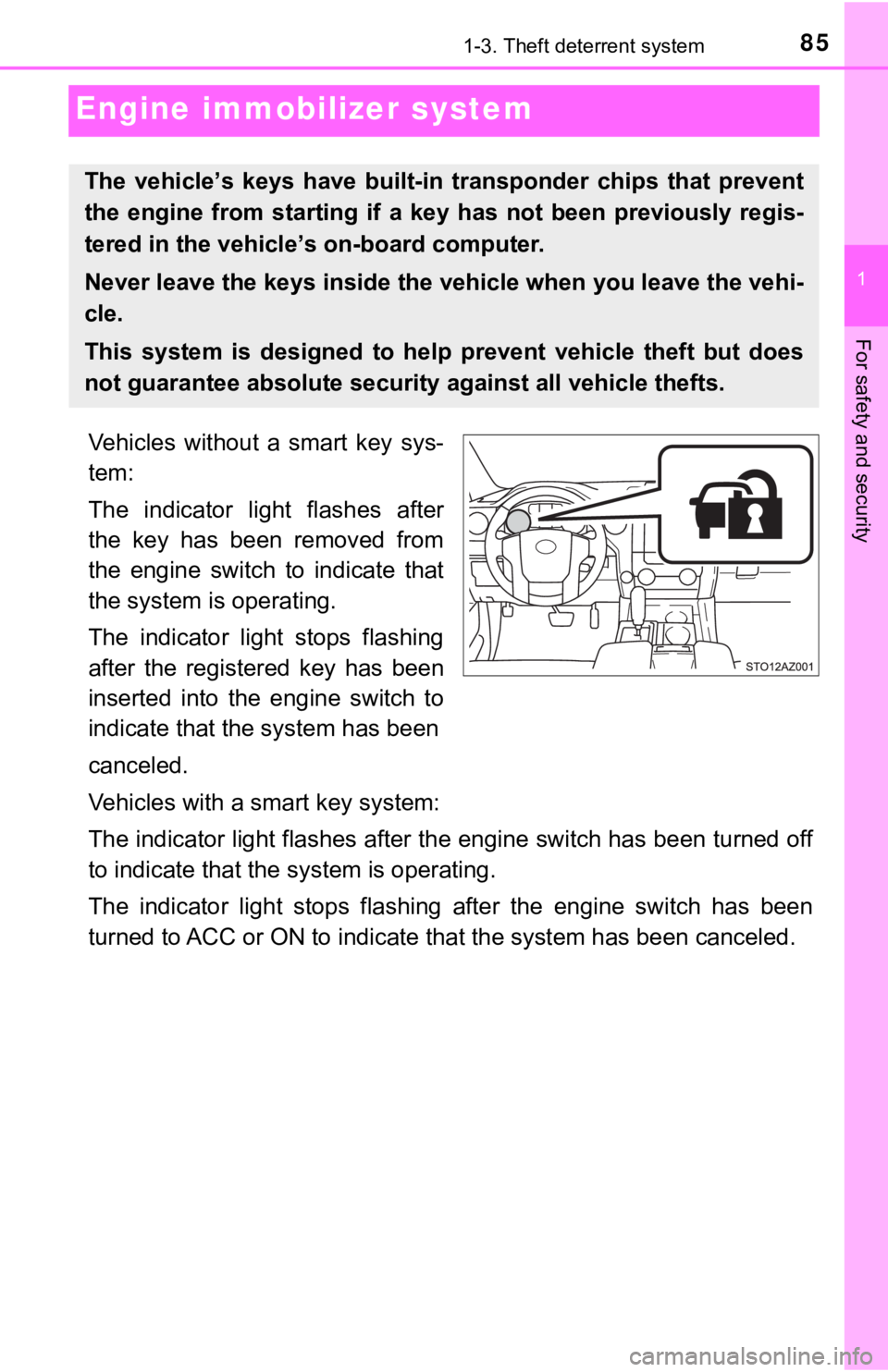
Vehicles without a smart key sys-
tem:
The indicator light flashes after
the key has been removed from
the engine switch to indicate that
the system is operating.
The indicator light stops flashing
after the registered key has been
inserted into the engine switch to
indicate that the system has been
canceled.
Vehicles with a smart key system:
The indicator light flashes aft er the engine switch has been tu rned off
to indicate that the system is operating.
The indicator light stops flashi ng after the engine switch has been
turned to ACC or ON to indicate t hat the system has been canceled.
The vehicle’s keys ha ve built-in transponder chips that prevent
the engine from starting if a key has not been previously regis -
tered in the vehicle’s on-board computer.
Never leave the keys inside the vehicle when you leave the vehi-
cle.
This system is designed to help prevent vehicle theft but does
not guarantee absolute security against all vehicle thefts.
Page 95 of 612
951-3. Theft deterrent system
1
For safety and security
Alar m
The alarm uses light and sound to give an alert when an intrusion is
detected.
The alarm is triggered in the following situations when the ala rm is
set:
● A locked door is unlocked or opened in any way other than using a
key or wireless remote control. (The doors will lock again automati-
cally.)
● The hood is opened.
● Vehicles with the glass breaka ge sensor: The side windows are
tapped or broken.
Close the doors and hood, and
lock all the doors. The system will
be set automatically after 30 sec-
onds.
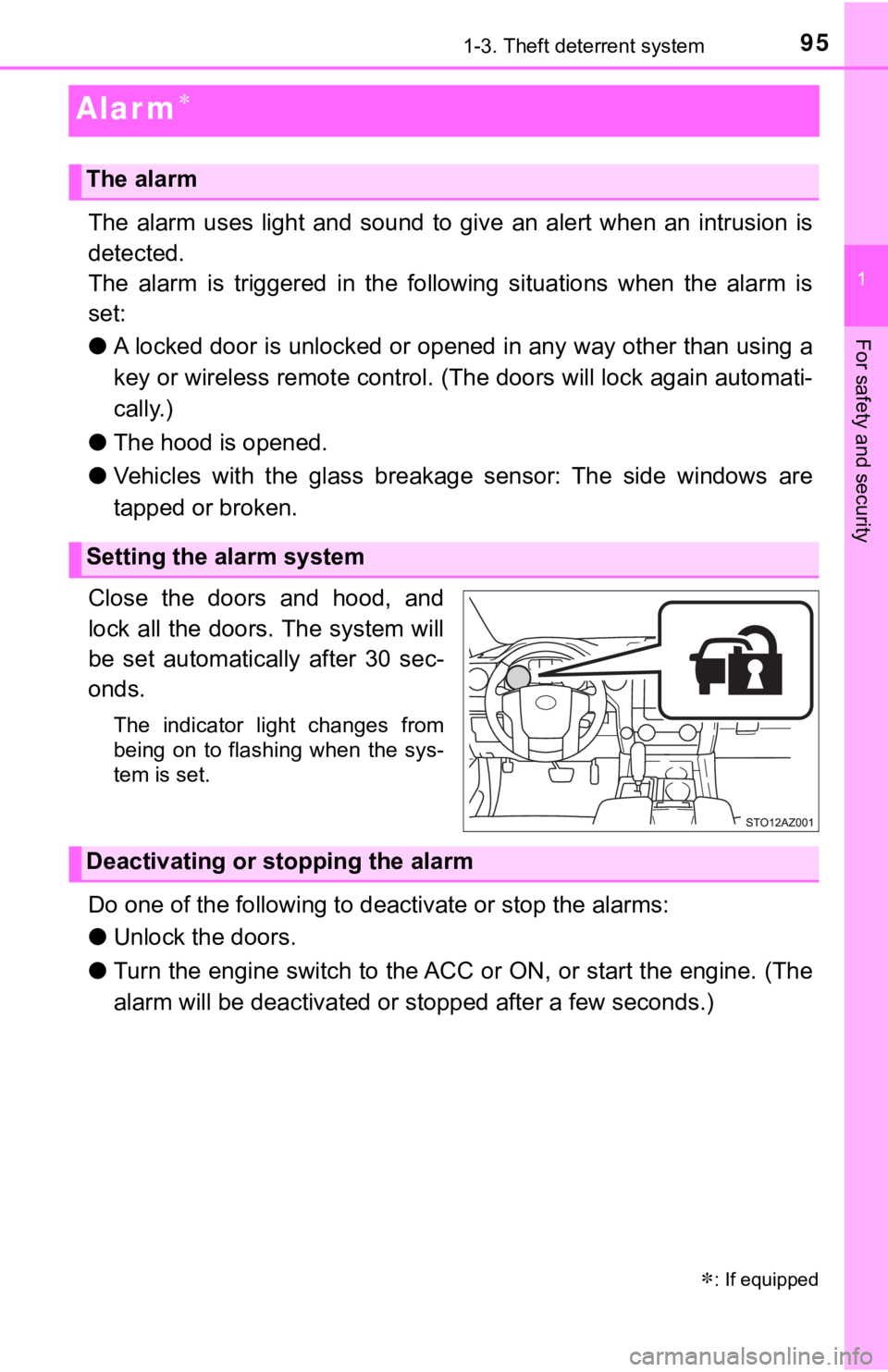
The indicator light changes from
being on to flashing when the sys-
tem is set.
Do one of the following to d eactivate or stop the alarms:
● Unlock the doors.
● Turn the engine switch to the ACC or ON, or start the engine. ( The
alarm will be deactivated or s topped after a few seconds.)
: If equipped
The alarm
Setting the alarm system
Deactivating or stopping the alarm
Page 145 of 612

1453-2. Opening, closing and locking the doors
3
Operation of each component
■Customization
Settings (e. g. smart key system) can be changed.
(Customizable features: P. 564)
■ If the smart key system has been d eactivated in a customized setting
● Locking and unlocking the doors:
Use the wireless remote control or mechanical key. ( P. 128, 523)
● Starting the engine and changing engine switch modes: P. 523
● Stopping the engine: P. 220s
■ Certification for the smart key system
For vehicles sold in U.S.A. and New Caledonia
FCC ID: HYQ23ABL
FCC ID: HYQ14FBA
NOTE:
This device complies with part 15 of the FCC Rules. Operation is subject to
the following two conditions: (1) This device may not cause har mful interfer-
ence, and (2) this device must accept any interference received, including
interference that may cause undesired operation.
FCC WARNING:
Changes or modifications not expressly approved by the party re sponsible for
compliance could void the user’s authority to operate the equip ment.
For vehicles sold in Canada
NOTE:
This device complies with Industry Canada’s licence-exempt RSSs . Opera-
tion is subject to the following two conditions:
(1) This device may not cause interference; and
(2) This device must accept any interference, including interference that may
cause undesired operation of the device.
NOTE:
Le présent appareil est conforme aux CNR d’Industrie Canada app licables
aux appareils radio exempts de licence. L’exploitation est auto risée aux deux
conditions suivantes:
(1) I’appareil ne doit pas produire de brouillage;
(2) l’utilisateur de I’appareil doit accepter tout brouillage radioélectrique subi,
même si le brouillage est susceptible d’en compromettre le fonctionnement.
Page 173 of 612
1733-5. Opening, closing the windows and moon roof
3
Operation of each component
■The power windows can be operated when
The engine switch is in ON.
■ Operating the power windows after turning the engine off
The power windows can be operated for approximately 43 seconds after the
engine switch is turned to ACC or OFF. They cannot, however, be operated
once either front door is opened.
■ Jam protection function (type B only)
If an object becomes caught between the window and the window f rame, win-
dow travel is stopped and the window is opened slightly.
■ When the power window does not close normally (type B only)
If the jam protection function is operating abnormally and a wi ndow cannot be
closed, perform the following operations using the power window switch on
the relevant door.
● After stopping the vehicle, the window can be closed by holding the power
window switch in the one-touch closing position while the engine switch is
turned to ON.
● If the window still cannot be closed even by carrying out the o peration as
explained above, initialize the function by performing the following proce-
dure.
Hold the power window switch in the one-touch closing position. Continue
holding the switch for a further 6 seconds after the window has closed.
Hold the power window switch in the one-touch opening position. Con-
tinue holding the switch for a further 2 seconds after the window has
opened completely.
Hold the power window switch in the one-touch closing position once
again. Continue holding the switch for a further 2 seconds afte r the win-
dow has closed.
If you release the switch while the window is moving, start aga in from the
beginning.
If the window continues to close but then re-open slightly even after perform-
ing the above procedure correctly, have the vehicle inspected b y your Toyota
dealer.
1
2
3
Page 184 of 612

1844-1. Before driving
Driving the vehicle
P. 2 1 7
With the brake pedal depressed, shift the shift lever to D. ( P. 2 2 5 )
Release the parking brake. ( P. 2 3 3 )
Gradually release the brake pedal and gently depress the accele ra-
tor pedal to accelerate the vehicle.
With the shift lever in D , depress the brake pedal.
If necessary, set the parking brake.
If the vehicle is to be stopped for an extended period of time, shift the shift
lever to P or N. ( P. 225)
With the shift lever in D , depress the brake pedal.
Set the parking brake ( P. 233), and shift the shift lever to P
( P. 225).
Turn the engine switch to OFF to stop the engine.
Lock the door, making sure that you have the key on your person.
If parking on a hill, block the wheels as needed.
Make sure that the parking brake is set and shift the shift lev er to D.
Gently depress the accelerator pedal.
Release the parking brake.
The following procedures should be observed to ensure safe
driving:
Starting the engine
Driving
Stopping
Parking the vehicle
Starting off on a steep uphill
1
2
3
1
2
1
2
3
4
1
2
3
Page 187 of 612

1874-1. Before driving
4
Driving
WARNING
Observe the following precautions.
Failure to do so may result in death or serious injury.
■When starting the vehicle
Always keep your foot on the brake pedal while stopped with the engine
running. This prevents the vehicle from creeping.
■ When driving the vehicle
● Do not drive if you are unfamiliar with the location of the brake and accel-
erator pedals to avoid depressing the wrong pedal.
• Accidentally depressing the accelerator pedal instead of the b rake
pedal will result in sudden acceleration that may lead to an accident.
• When backing up, you may twist your body around, leading to di fficulty
in operating the pedals. Make sure to operate the pedals proper ly.
• Make sure to keep a correct driving posture even when moving t he
vehicle only slightly. This allows you to depress the brake and accelera-
tor pedals properly.
• Depress the brake pedal using your right foot. Depressing the brake
pedal using your left foot may delay response in an emergency, result-
ing in an accident.
● Do not drive the vehicle over or stop the vehicle near flammable materials.
The exhaust system and exhaust gases can be extremely hot. Thes e hot
parts may cause a fire if there is any flammable material nearby.
● During normal driving, do not turn off the engine. Turning the engine off
while driving will not cause loss of steering or braking contro l, but the
power assist to these systems will be lost. This will make it m ore difficult to
steer and brake, so you should pull over and stop the vehicle a s soon as it
is safe to do so.
However, in the event of an emergency, such as if it becomes im possible
to stop the vehicle in the normal way: P. 475
● Use engine braking (downshift) to maintain a safe speed when driving
down a steep hill.
Using the brakes continuously may cause the brakes to overheat and lose
effectiveness. ( P. 225)
● Do not adjust the positions of the steering wheel, the seat, or the inside or
outside rear view mirrors while driving.
Doing so may result in a loss of vehicle control.
● Always check that all passengers’ arms, heads or other parts of their body
are not outside the vehicle.