engine TOYOTA TUNDRA 2023 Owners Manual
[x] Cancel search | Manufacturer: TOYOTA, Model Year: 2023, Model line: TUNDRA, Model: TOYOTA TUNDRA 2023Pages: 616, PDF Size: 11.14 MB
Page 528 of 616
5287-2. Steps to take in an emergency
If the electronic key does not operate
properly (vehicles with a smar t key system)
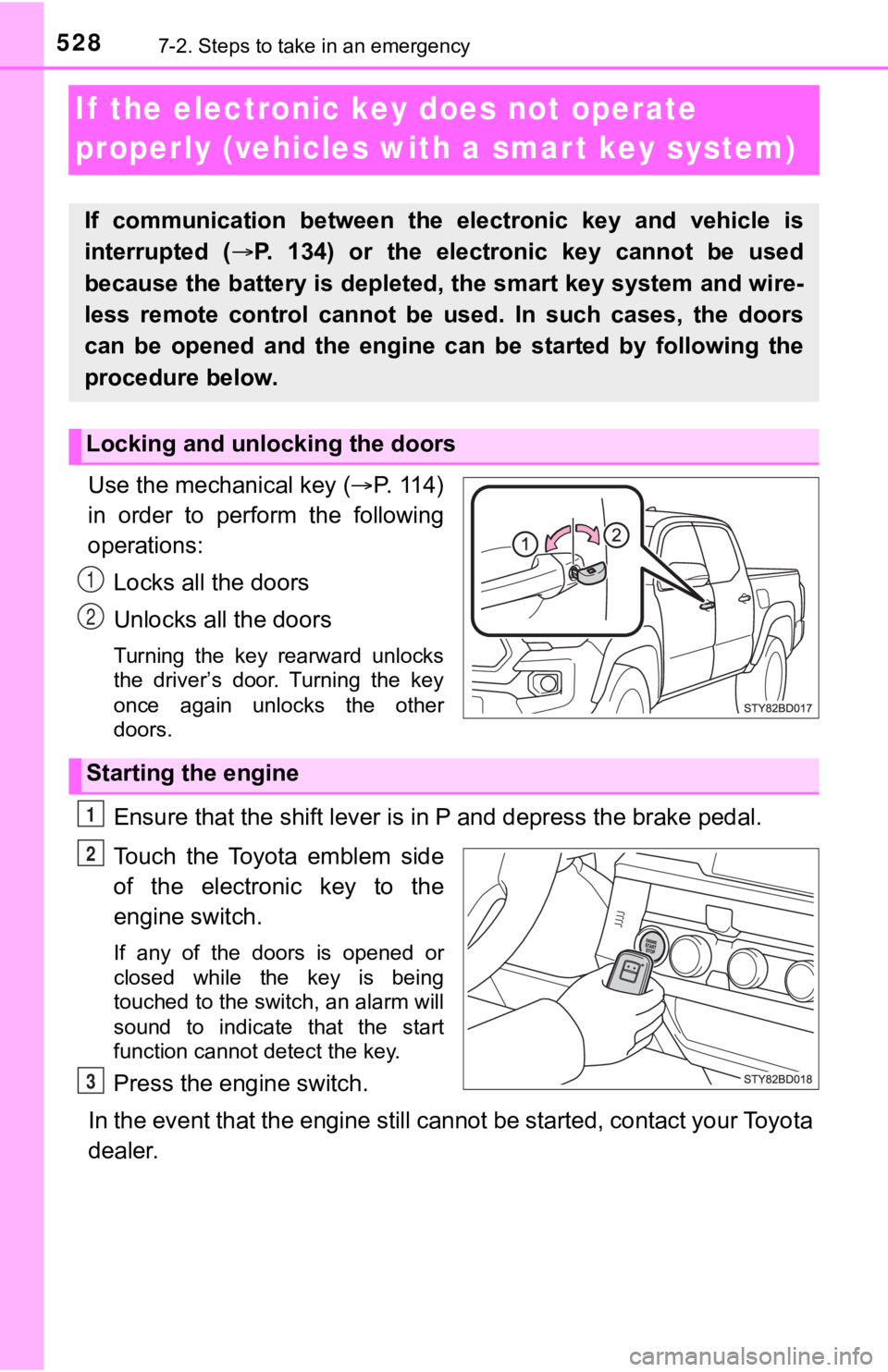
Use the mechanical key (P. 114)
in order to perform the following
operations:
Locks all the doors
Unlocks all the doors
Turning the key rearward unlocks
the driver’s door. Turning the key
once again unlocks the other
doors.
Ensure that the shift lever is in P and depress the brake pedal.
Touch the Toyota emblem side
of the electronic key to the
engine switch.
If any of the doors is opened or
closed while the key is being
touched to the switch, an alarm will
sound to indicate that the start
function cannot detect the key.
Press the engine switch.
In the event that the engine still cannot be started, contact your Toyota
dealer.
If communication between the electronic key and vehicle is
interrupted ( P. 134) or the electronic key cannot be used
because the battery is depleted, the smart key system and wire-
less remote control cannot be used. In such cases, the doors
can be opened and the engine c an be started by following the
procedure below.
Locking and unlocking the doors
1
2
Starting the engine
1
2
3
Page 529 of 616

5297-2. Steps to take in an emergency
7
When trouble arises
■Stopping the engine
Shift the shift lever to P and press the engine switch as you normally do when
stopping the engine.
■ Replacing the key battery
As the above procedure is a temporary measure, it is recommende d that the
electronic key battery be replaced immediately when the battery is depleted.
( P. 451)
■ Changing engine switch modes
Within 10 seconds of the buzzer sounding, release the brake ped al and press
the engine switch.
The engine does not start and modes will be changed each time t he switch is
pressed. ( P. 206)
Page 530 of 616
5307-2. Steps to take in an emergency
If the vehicle batter y is discharged
If you have a set of jumper (or booster) cables and a second ve hicle
with a 12-volt battery, you can jump start your vehicle by foll owing the
steps below.
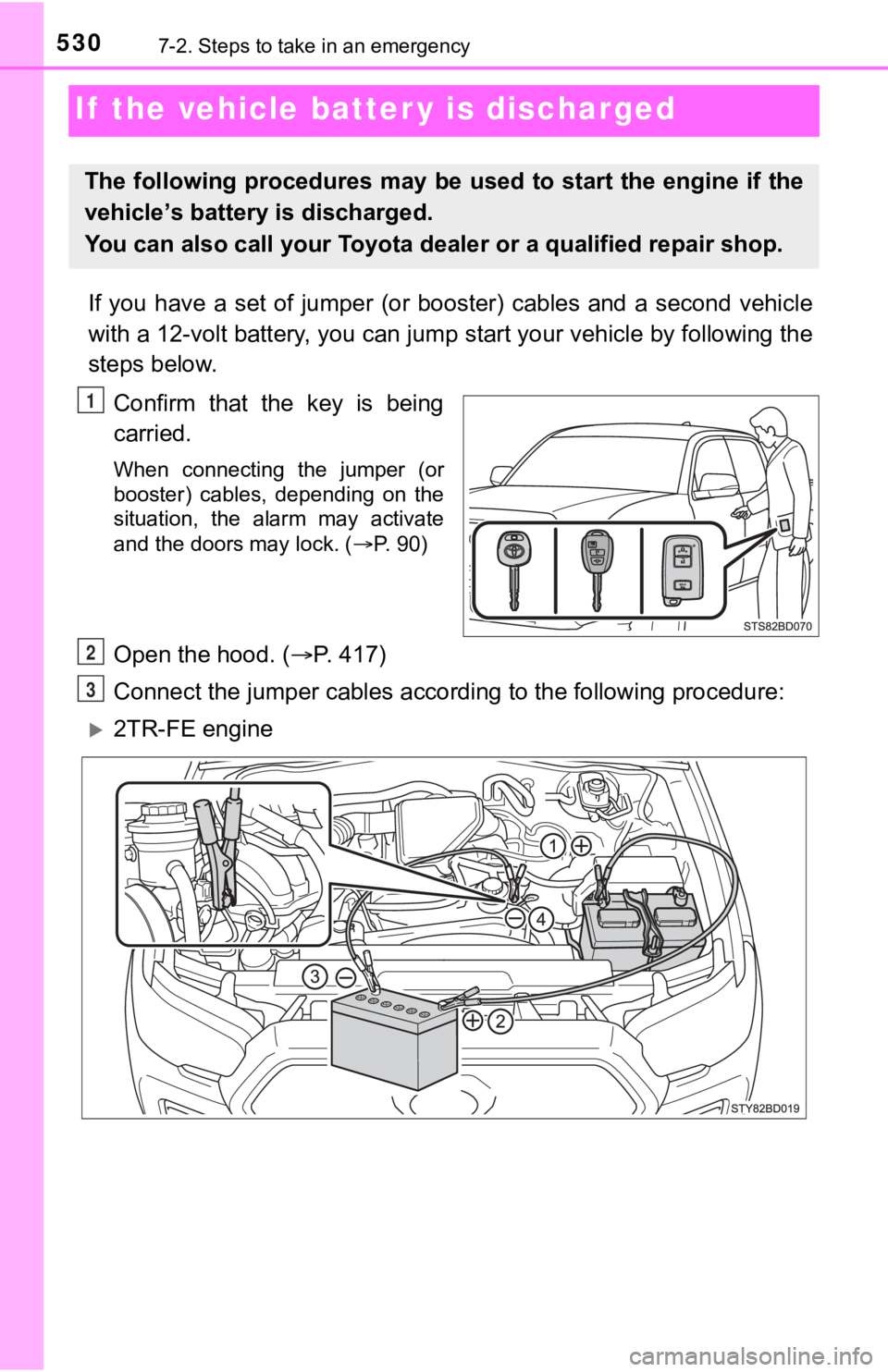
Confirm that the key is being
carried.
When connecting the jumper (or
booster) cables, depending on the
situation, the alarm may activate
and the doors may lock. ( P. 90)
Open the hood. (P. 417)
Connect the jumper cables according to the following procedure:
2TR-FE engine
The following procedures may be used to start the engine if the
vehicle’s battery is discharged.
You can also call your Toyota de aler or a qualified repair shop.
1
2
3
Page 531 of 616
5317-2. Steps to take in an emergency
7
When trouble arises
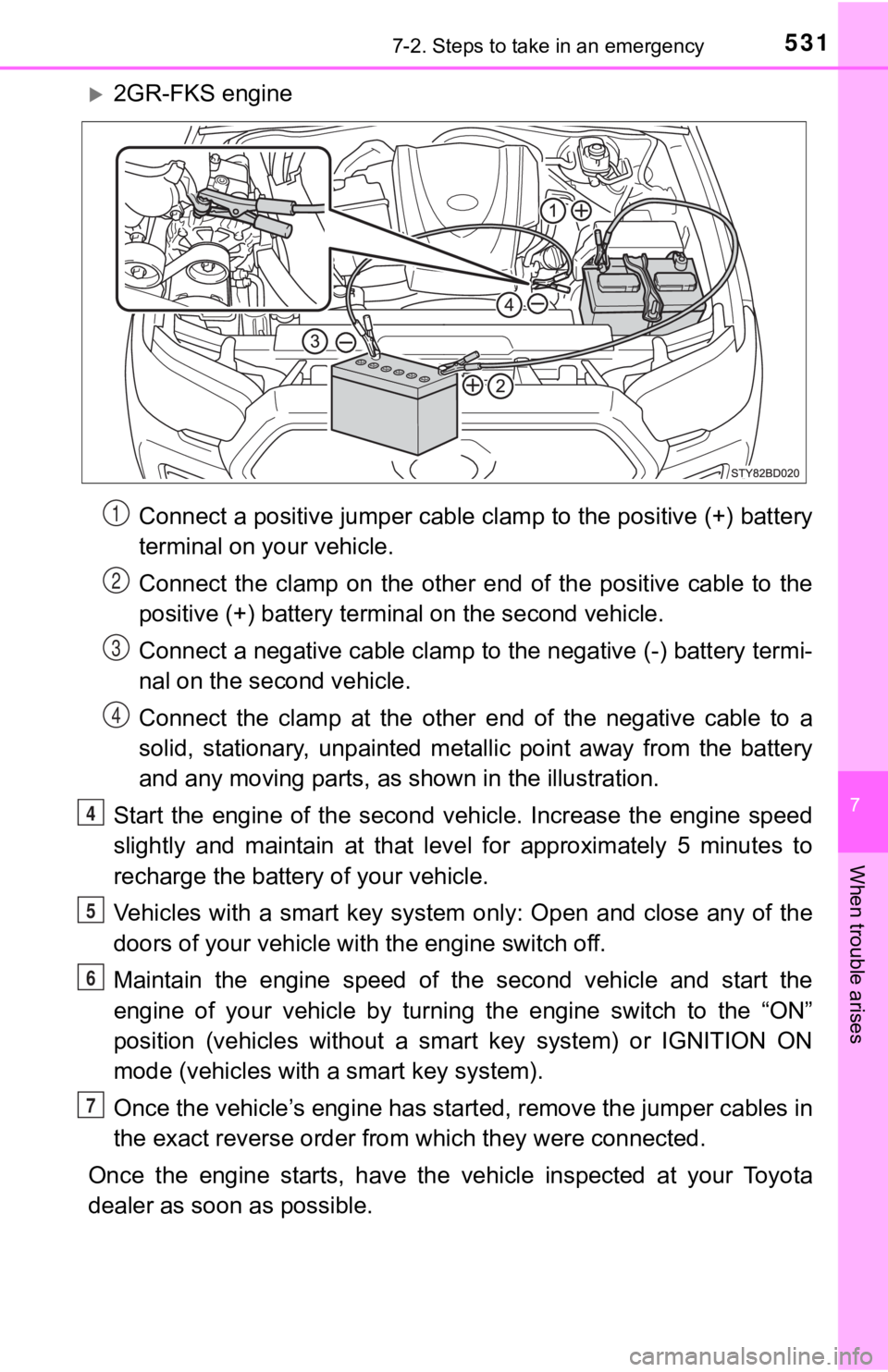
2GR-FKS engineConnect a positive jumper cable clamp to the positive (+) batte ry
terminal on your vehicle.
Connect the clamp on the other end of the positive cable to the
positive (+) battery termi nal on the second vehicle.
Connect a negative cable clamp to the negative (-) battery term i-
nal on the s econd vehicle.
Connect the clamp at the other e nd of the negative cable to a
solid, stationary, unpainted meta llic point away from the battery
and any moving parts, as shown in the illustration.
Start the engine of the second v ehicle. Increase the engine speed
slightly and maintain at that lev el for approximately 5 minutes to
recharge the batter y of your vehicle.
Vehicles with a smart key system only: Open and close any of th e
doors of your vehicle wi th the engine switch off.
Maintain the engine speed of the second vehicle and start the
engine of your vehicle by turning the engine switch to the “ON”
position (vehicles without a sma rt key system) or IGNITION ON
mode (vehicles with a smart key system).
Once the vehicle’s engine has st arted, remove the jumper cables in
the exact reverse order from which they were connected.
Once the engine starts, have the vehicle inspected at your Toyota
dealer as soon as possible.
1
2
3
4
4
5
6
7
Page 532 of 616

5327-2. Steps to take in an emergency
■Starting the engine when the battery is discharged (vehicles wi th an
automatic transmission)
The engine cannot be started by push-starting.
■ To prevent battery discharge
●Turn off the headlights and the audio system while the engine is off.
● Turn off any unnecessary electrical components when the vehicle is running
at a low speed for an extended period, such as in heavy traffic .
■ Charging the battery
The electricity stored in the battery will discharge gradually even when the
vehicle is not in use, due to natural discharge and the draining effects of cer-
tain electrical appliances. If the vehicle is left for a long t ime, the battery may
discharge, and the engine may be unable to start. (The battery recharges
automatically during driving.)
■ When recharging or replacing the battery
●Vehicles with a smart key system: In some cases, it may not be possible to
unlock the doors using the smart key system when the battery is dis-
charged. Use the wireless remote control or the mechanical key to lock or
unlock the doors.
● The engine may not start on the first attempt after the battery has recharged
but will start normally after the second attempt. This is not a malfunction.
● Vehicles with a smart key system: The engine switch mode is mem orized by
the vehicle. When the battery is reconnected, the system will r eturn to the
mode it was in before the battery was discharged. Before discon necting the
battery, turn the engine switch off.
If you are unsure what mode the engine switch was in before the battery dis-
charged, be especially careful when reconnecting the battery.
Page 534 of 616
5347-2. Steps to take in an emergency
If your vehicle overheats
●The needle of the engine coolant temperature gauge ( P. 9 8 )
enters the red zone or a loss of engine power is experienced. ( For
example, the vehicle speed does not increase.)
● “High Engine Coolant Temperature” is shown on the multi-informa-
tion display. (if equipped)
● Steam comes out f rom under the hood.
Stop the vehicle in a safe place and turn off the air condition ing sys-
tem, and then stop the engine.
If you see steam:
Carefully lift the hood after the steam subsides.
If you do not see steam:
Carefully lift the hood.
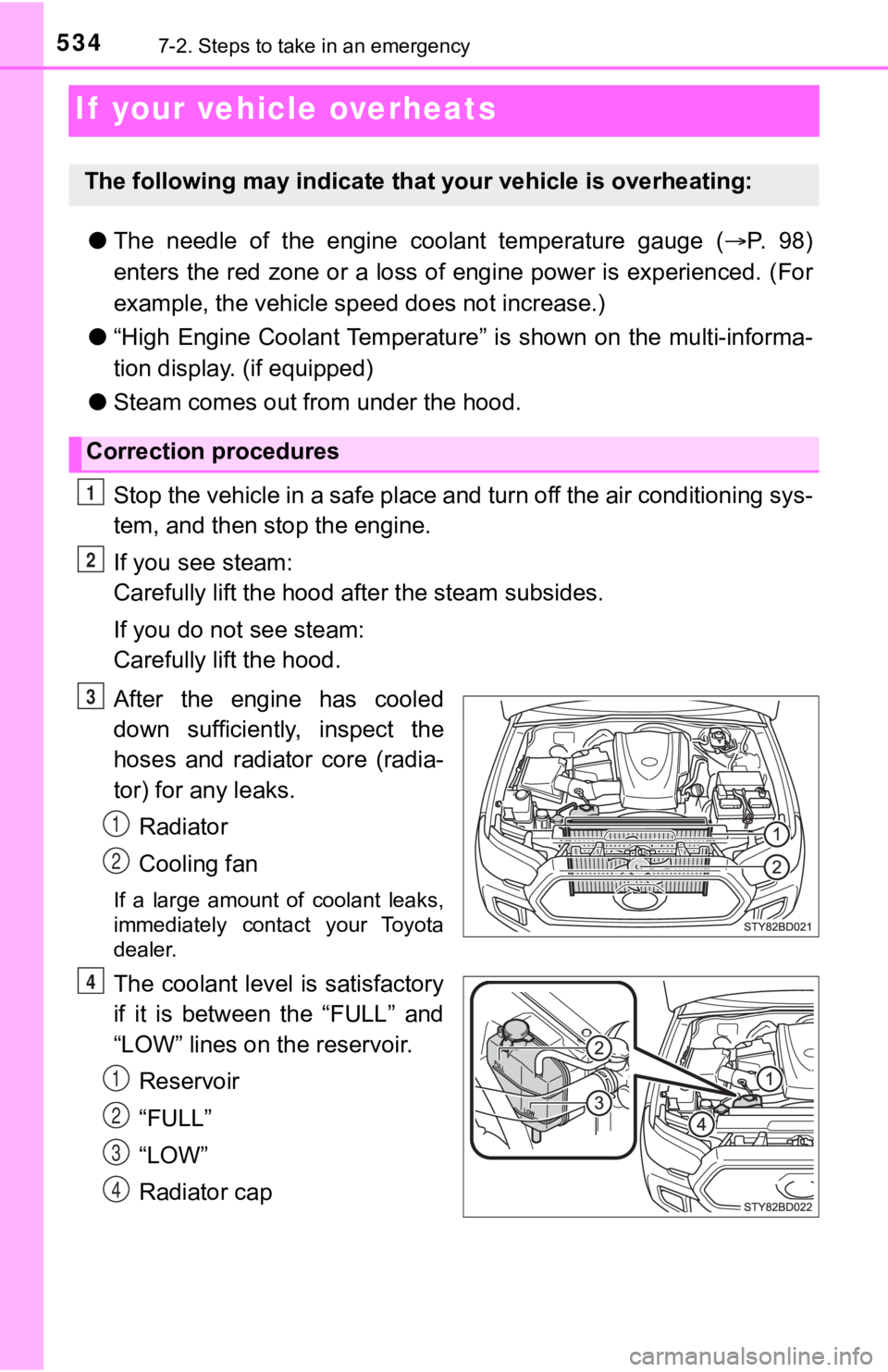
After the engine has cooled
down sufficiently, inspect the
hoses and radiator core (radia-
tor) for any leaks. Radiator
Cooling fan
If a large amount of coolant leaks,
immediately contact your Toyota
dealer.
The coolant level is satisfactory
if it is between the “FULL” and
“LOW” lines on the reservoir.Reservoir
“FULL”
“LOW”
Radiator cap
The following may indicate that your vehicle is overheating:
Correction procedures
1
2
3
1
2
4
1
2
3
4
Page 535 of 616
5357-2. Steps to take in an emergency
7
When trouble arises
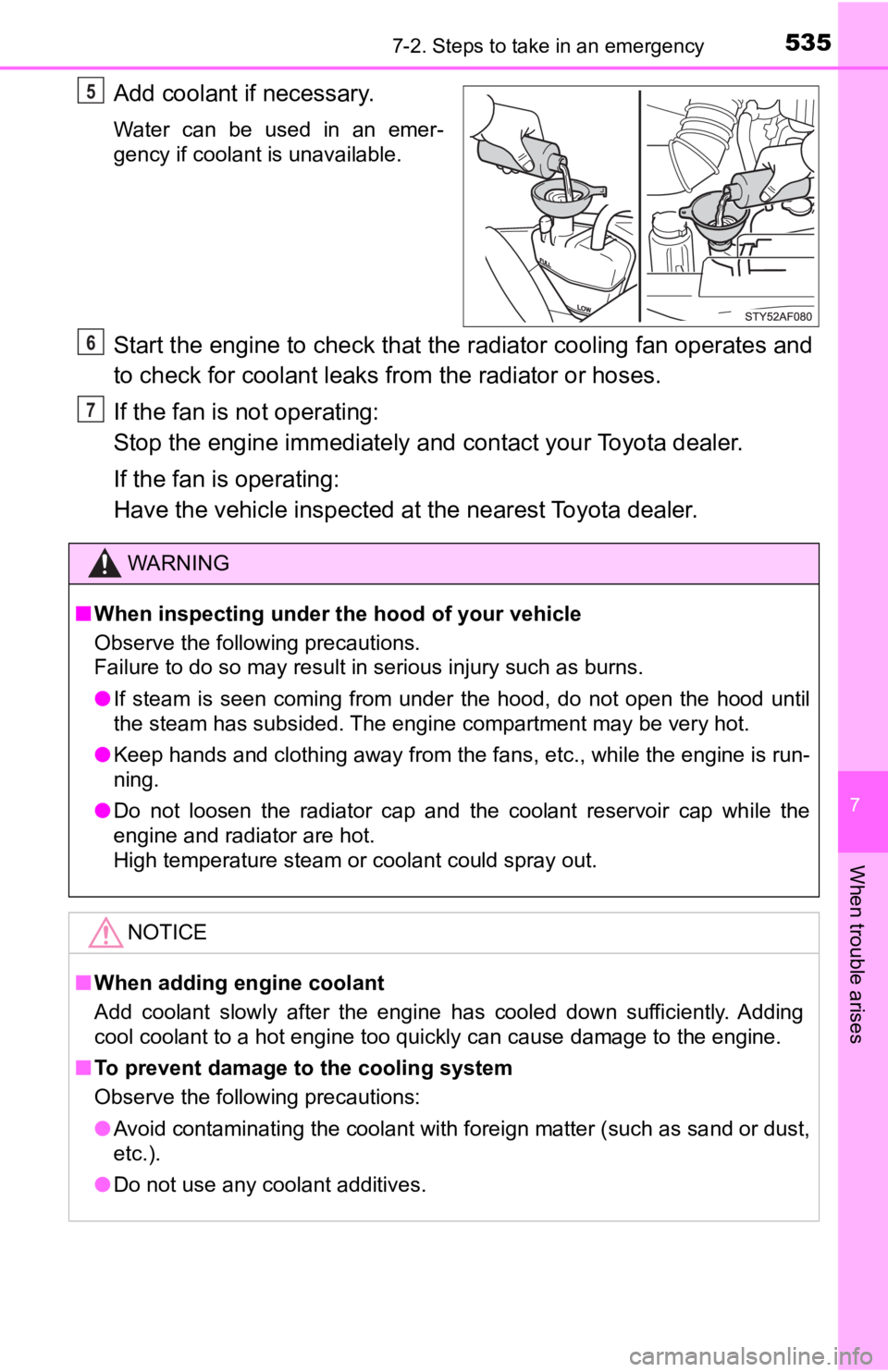
Add coolant if necessary.
Water can be used in an emer-
gency if coolant is unavailable.
Start the engine to check that the radiator cooling fan operates and
to check for coolant leaks from the radiator or hoses.
If the fan is not operating:
Stop the engine immediately and contact your Toyota dealer.
If the fan is operating:
Have the vehicle inspected at the neare st Toyota dealer.
5
WARNING
■When inspecting under the hood of your vehicle
Observe the following precautions.
Failure to do so may result in serious injury such as burns.
● If steam is seen coming from under the hood, do not open the ho od until
the steam has subsided. The engine compartment may be very hot.
● Keep hands and clothing away from the fans, etc., while the engine is run-
ning.
● Do not loosen the radiator cap and the coolant reservoir cap while the
engine and radiator are hot.
High temperature steam or coolant could spray out.
NOTICE
■When adding engine coolant
Add coolant slowly after the engine has cooled down sufficiently. Adding
cool coolant to a hot engine too quickly can cause damage to the engine.
■ To prevent damage to the cooling system
Observe the following precautions:
● Avoid contaminating the coolant with foreign matter (such as sa nd or dust,
etc.).
● Do not use any coolant additives.
6
7
Page 536 of 616
5367-2. Steps to take in an emergency
If the vehicle becomes stuck
Stop the engine. Set the parking brake and shift the shift lever to P
(automatic transmission) or N (manual transmission).
Remove the mud, snow or sand from around the rear wheels.
Place wood, stones or some other material to help provide traction
under the rear wheels.
Restart the engine.
Shift the shift lever to D or R (automatic transmission), or 1 or R
(manual transmission) and release the parking brake. Then, whil e
exercising caution, depress the accelerator pedal.
■ When it is difficult to free the vehicle
Press to turn off TRAC.
Turn off TRAC/active traction control system (if equipped) and/or VSC if these
functions are hampering your attempts to free the vehicle.
(P. 324, 325)
Carry out the following procedures if the tires spin or the vehicle
becomes stuck in mud, dirt or snow:
WARNING
■ When attempting to f ree a stuck vehicle
If you choose to push the vehicle back and forth to free it, make sure the
surrounding area is clear to avoid striking other vehicles, obj ects or people.
The vehicle may also lunge forward or lunge back suddenly as it becomes
free. Use extreme caution.
■ When shifting the shift lever (vehicles with an automatic trans mission)
Be careful not to shift the shift lever with the accelerator pedal depressed.
This may lead to unexpected rapid acceleration of the vehicle t hat may
cause an accident resulting in death or serious injury.
1
2
3
4
5
Page 541 of 616
5418-1. Specifications
8
Vehicle specifications
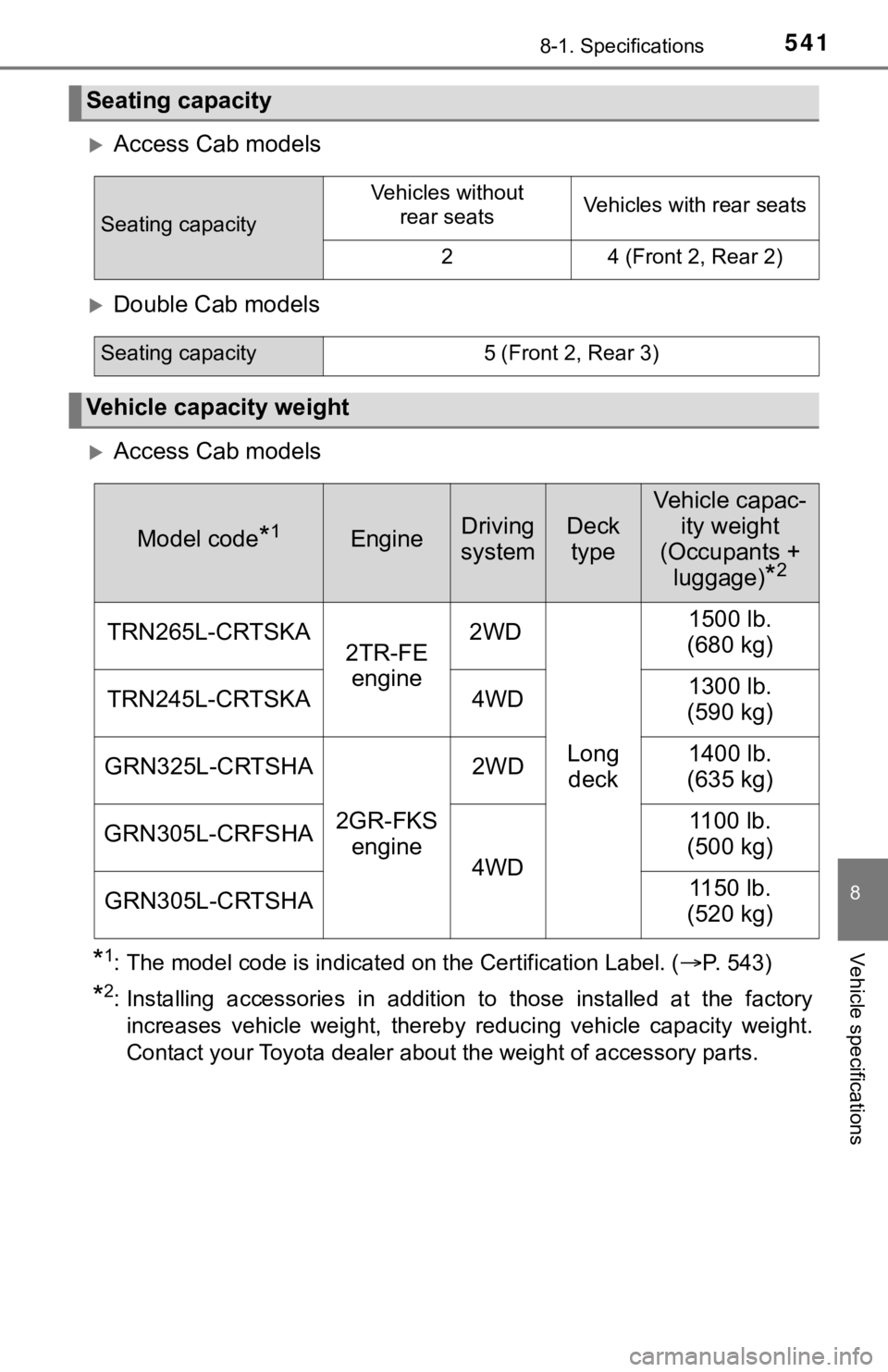
Access Cab models
Double Cab models
Access Cab models
*1: The model code is indicated on the Certification Label. (P. 5 4 3 )
*2: Installing accessories in addition to those installed at the f actory
increases vehicle weight, thereby reducing vehicle capacity wei ght.
Contact your Toyota dealer about the weight of accessory parts.
Seating capacity
Seating capacity
Vehicles without rear seatsVehicles with rear seats
24 (Front 2, Rear 2)
Seating capacity5 (Front 2, Rear 3)
Vehicle capacity weight
Model code*1EngineDriving
systemDeck type
Vehicle capac-
ity weight
(Occupants +
luggage)
*2
TRN265L-CRTSKA 2TR-FE
engine 2WD
Long deck1500 lb.
(680 kg)
TRN245L-CRTSKA 4WD
1300 lb.
(590 kg)
GRN325L-CRTSHA 2GR-FKS engine 2WD
1400 lb.
(635 kg)
GRN305L-CRFSHA 4WD
1100 lb.
(500 kg)
GRN305L-CRTSHA
1150 lb.
(520 kg)
Page 542 of 616
5428-1. Specifications
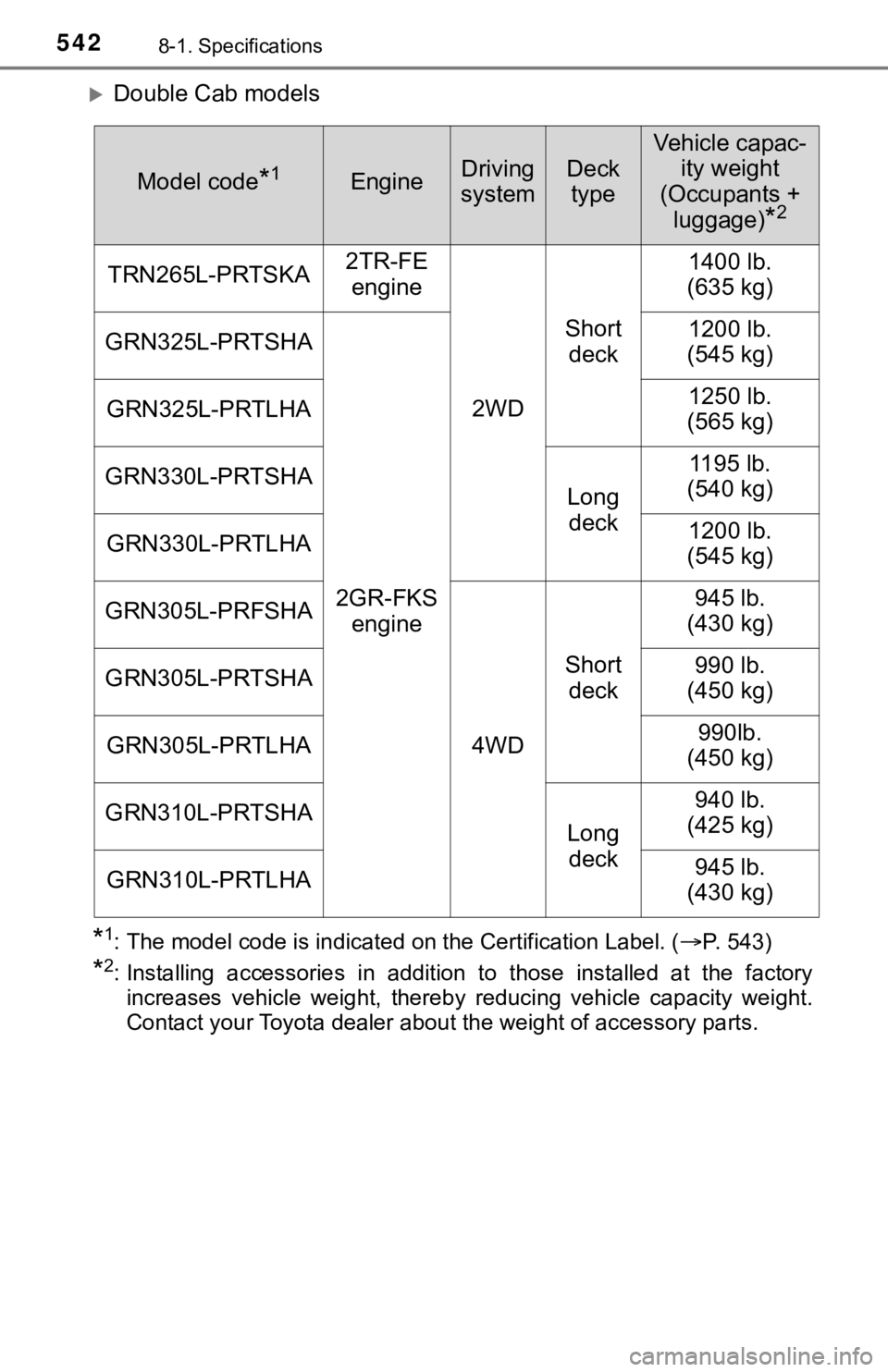
Double Cab models
*1: The model code is indicated on the Certification Label. (P. 5 4 3 )
*2: Installing accessories in addition to those installed at the f actory
increases vehicle weight, thereby reducing vehicle capacity wei ght.
Contact your Toyota dealer about the weight of accessory parts.
Model code*1EngineDriving
systemDeck type
Vehicle capac- ity weight
(Occupants + luggage)
*2
TRN265L-PRTSKA 2TR-FE
engine
2WDShort
deck1400 lb.
(635 kg)
GRN325L-PRTSHA
2GR-FKS engine
1200 lb.
(545 kg)
GRN325L-PRTLHA
1250 lb.
(565 kg)
GRN330L-PRTSHA Long
deck
1195 lb.
(540 kg)
GRN330L-PRTLHA
1200 lb.
(545 kg)
GRN305L-PRFSHA
4WDShort
deck
945 lb.
(430 kg)
GRN305L-PRTSHA
990 lb.
(450 kg)
GRN305L-PRTLHA
990lb.
(450 kg)
GRN310L-PRTSHA Long
deck
940 lb.
(425 kg)
GRN310L-PRTLHA
945 lb.
(430 kg)