check engine TOYOTA URBAN CRUISER 2011 Owner's Manual
[x] Cancel search | Manufacturer: TOYOTA, Model Year: 2011, Model line: URBAN CRUISER, Model: TOYOTA URBAN CRUISER 2011Pages: 532, PDF Size: 27.93 MB
Page 339 of 532
4Maintenance and care
339
URBAN CRUISER_EE (OM52C21E)
4-1. Maintenance and care
Cleaning and protecting
the vehicle exterior ......... 340
Cleaning and protecting
the vehicle interior .......... 344
4-2. Maintenance
Maintenance
requirements................... 347
4-3. Do-it-yourself maintenance
Do-it-yourself service
precautions ..................... 350
Hood ................................. 354
Positioning a floor jack ...... 356
Engine compartment......... 358
Tires .................................. 375
Tire inflation pressure ....... 378
Wheels .............................. 380
Air conditioning filter ......... 382
Key battery........................ 386
Checking and replacing
fuses ............................... 390
Light bulbs ........................ 406
Page 349 of 532
349 4-2. Maintenance
4
Maintenance and care
URBAN CRUISER_EE (OM52C21E)
Does your vehicle need repair?
Be on the alert for changes in performance and sounds, and visual tip-offs
that indicate service is needed. Some important clues are:
Engine missing, stumbling, or pinging
Appreciable loss of power
Strange engine noises
A fluid leak under the vehicle (However, water dripping from the air condi-
tioning after use is normal.)
Change in exhaust sound (This may indicate a dangerous carbon mon-
oxide leak. Drive with the windows open and have the exhaust system
checked immediately.)
Flat-looking tires, excessive tire squeal when cornering, uneven tire wear
Vehicle pulls to one side when driving straight on a level road
Strange noises related to suspension movement
Loss of brake effectiveness, spongy feeling brake pedal, pedal almost
touches the floor, vehicle pulls to one side when braking
Engine coolant temperature continually higher than normal
If you notice any of these clues, take your vehicle to any authorized Toyota
dealer or repairer, or another duly qualified and equipped professional, as
soon as possible. Your vehicle may need adjustment or repair.
CAUTION
If your vehicle is not properly maintained
Improper maintenance could result in serious damage to the vehicle and
possible serious injury or death.
Warning in handling of the battery
Battery posts, terminals and related accessories contain lead and lead com-
pounds which are known to cause brain damage. Wash your hands after
handling. (P. 367)
Page 360 of 532
360 4-3. Do-it-yourself maintenance
URBAN CRUISER_EE (OM52C21E)
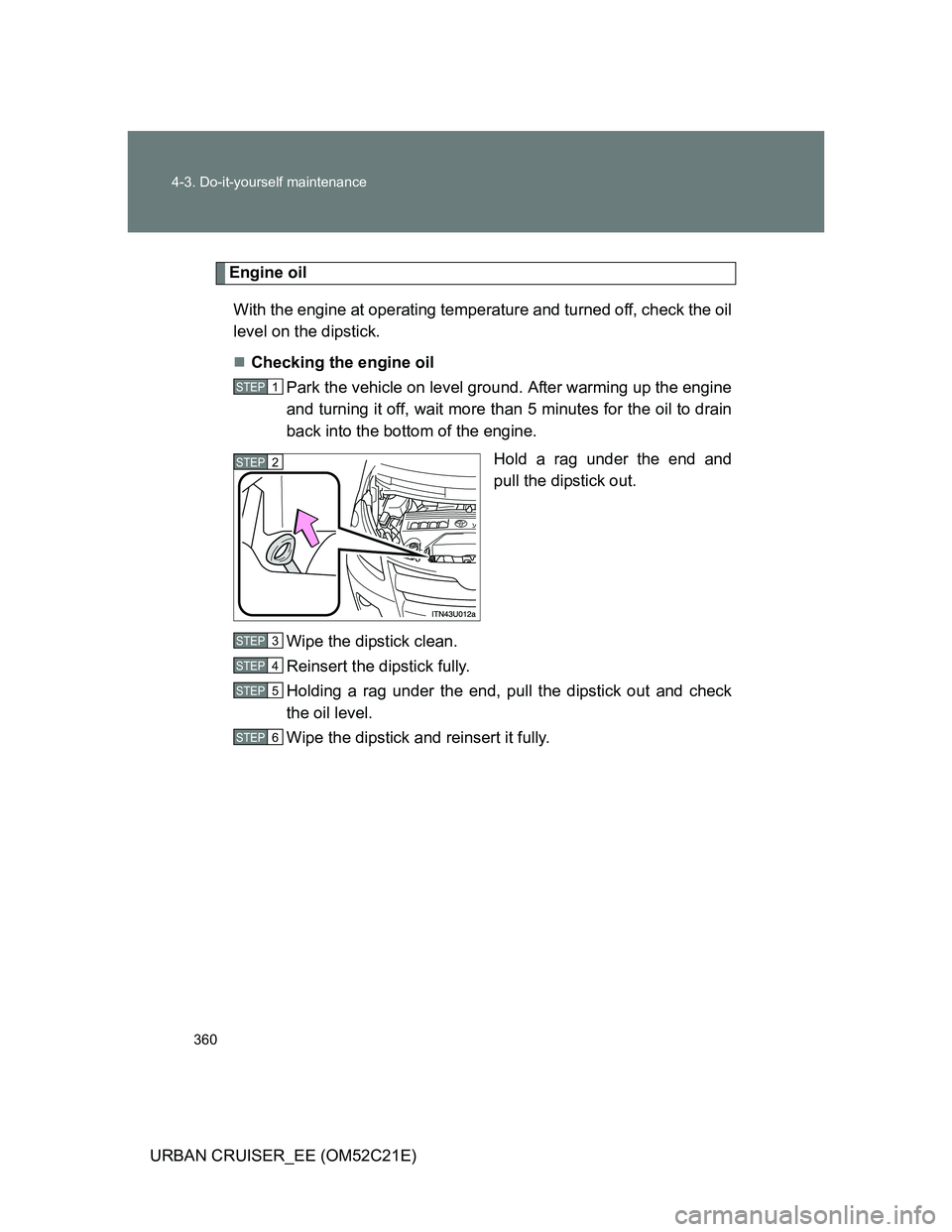
Engine oil
With the engine at operating temperature and turned off, check the oil
level on the dipstick.
Checking the engine oil
Park the vehicle on level ground. After warming up the engine
and turning it off, wait more than 5 minutes for the oil to drain
back into the bottom of the engine.
Hold a rag under the end and
pull the dipstick out.
Wipe the dipstick clean.
Reinsert the dipstick fully.
Holding a rag under the end, pull the dipstick out and check
the oil level.
Wipe the dipstick and reinsert it fully.
STEP1
STEP2
STEP3
STEP4
STEP5
STEP6
Page 362 of 532
362 4-3. Do-it-yourself maintenance
URBAN CRUISER_EE (OM52C21E)Make sure to check the oil type and prepare the items needed before
adding oil.
Remove the oil filler cap.
Add engine oil slowly, checking the dipstick.
Install the filler cap, turning it clockwise.
About 1.5 L (1.6 qt., 1.3 Imp.qt.) is required to raise the oil level from low to
full on the dipstick.
Engine oil selectionP. 499
Items Clean funnel
Engine oil consumption
The amount of engine oil consumed depends on the oil viscosity, the
quality of the oil and the way the vehicle is driven.
More oil is consumed under driving conditions such as high speeds and
frequent acceleration and deceleration.
A new engine consumes more oil.
When judging the amount of oil consumption, keep in mind that the oil
may have become diluted, making it difficult to judge the true level accu-
rately.
Oil consumption: Max. 1.0 L per 1000 km (1.1 qt./600 miles, 0.9 lmp.qt./
600 miles)
If you consume more than 1.0 L (1.1 qt., 0.9 lmp.qt.) every 1000 km (600
miles), contact any authorized Toyota dealer or repairer, or another duly
qualified and equipped professional.
STEP1
STEP2
STEP3
Page 364 of 532
364 4-3. Do-it-yourself maintenance
URBAN CRUISER_EE (OM52C21E)
CAUTION
Used engine oil
Used engine oil contains potentially harmful contaminants which may
cause skin disorders such as inflammation or skin cancer, so care should
be taken to avoid prolonged and repeated contact. To remove used engine
oil from your skin, wash thoroughly with soap and water.
Dispose of used oil and filters only in a safe and acceptable manner. Do
not dispose of used oil and filters in household trash, in sewers or onto the
ground. Call any authorized Toyota dealer or repairer, or another duly
qualified and equipped professional, service station or auto parts store for
information concerning recycling or disposal.
Do not leave used engine oil within the reach of children.
NOTICE
To prevent serious engine damage
Check the oil level on regular basis.
When replacing the engine oil
Be careful not to spill engine oil on the vehicle components.
Avoid overfilling, as the engine could be damaged.
Check the oil level on the dipstick every time you refill the vehicle.
Be sure the engine oil filler cap is properly tightened.
Page 366 of 532
366 4-3. Do-it-yourself maintenance
URBAN CRUISER_EE (OM52C21E)
If the coolant level drops within a short time after replenishing
Visually check the radiator, hoses, reservoir cap, radiator cap, drain cock
and water pump.
If you cannot find a leak, have any authorized Toyota dealer or repairer, or
another duly qualified and equipped professional, test the cap and check for
leaks in the cooling system.
Coolant selection
Only use “Toyota Super Long Life Coolant” or similar high quality ethylene
glycol based non-silicate, non-amine, non-nitrite, and non-borate coolant
with long-life hybrid organic acid technology.
“Toyota Super Long Life Coolant” is a mixture of 50% coolant and 50%
deionized water. (Enabled: -35C [-31F])
For more details about engine coolant, contact any authorized Toyota dealer
or repairer, or another duly qualified and equipped professional.
CAUTION
When the engine is hot
Do not remove the coolant reservoir cap.
The cooling system may be under pressure and may spray hot coolant if the
cap is removed, causing serious injuries, such as burns.
NOTICE
When adding engine coolant
Coolant is neither plain water nor straight antifreeze. The correct mixture of
water and antifreeze must be used to provide proper lubrication, corrosion
protection and cooling. Be sure to read the antifreeze or coolant label.
If you spill coolant
Be sure to wash it off with water to prevent damage to parts or paint.
Page 367 of 532
367 4-3. Do-it-yourself maintenance
4
Maintenance and care
URBAN CRUISER_EE (OM52C21E)
Radiator, condenser and intercooler
Check the radiator, condenser and intercooler (diesel engine only)
and clear any foreign objects.
If any of the above parts are extremely dirty or you are not sure of
their condition, have your vehicle checked by any authorized Toyota
dealer or repairer, or another duly qualified and equipped profes-
sional.
Battery
Check the battery as follows.
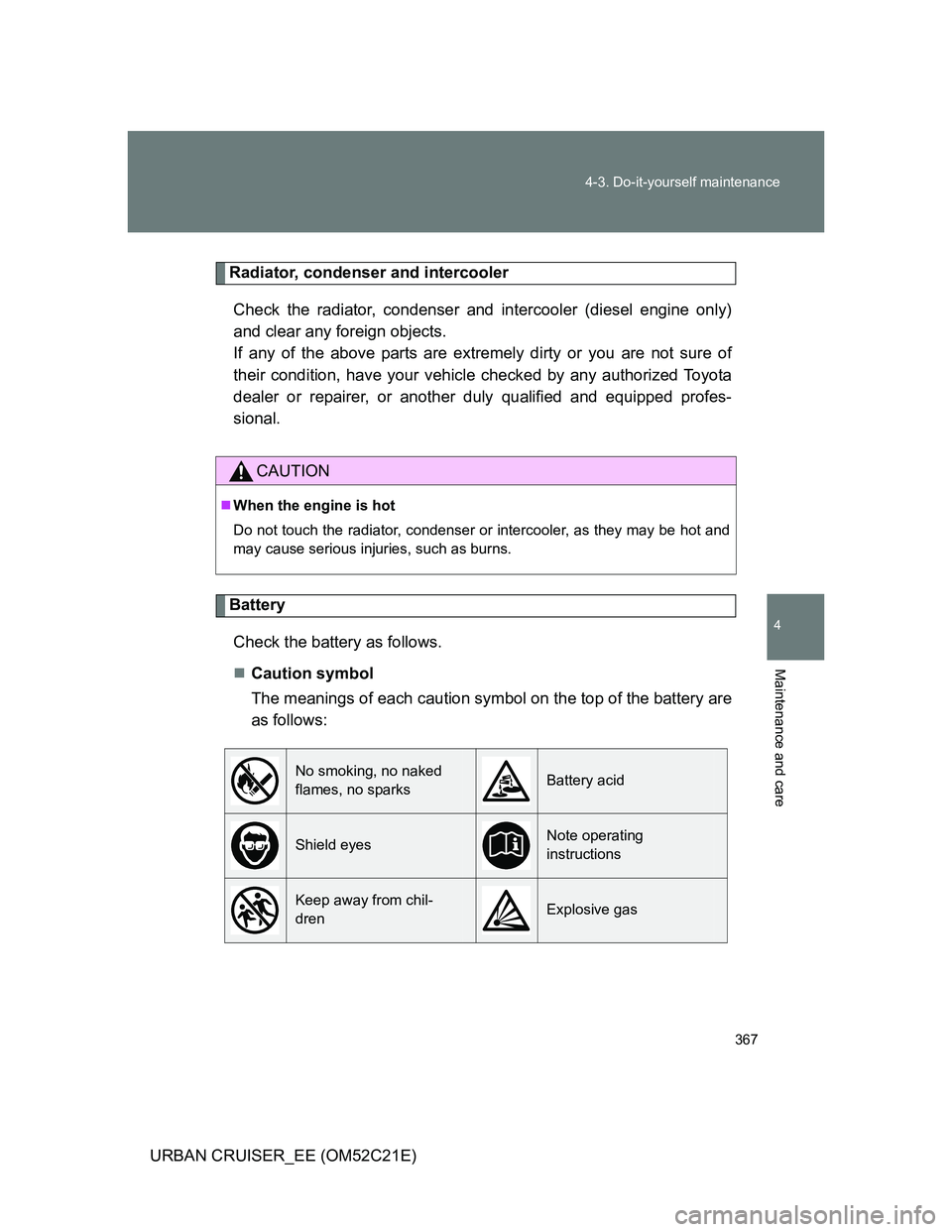
Caution symbol
The meanings of each caution symbol on the top of the battery are
as follows:
CAUTION
When the engine is hot
Do not touch the radiator, condenser or intercooler, as they may be hot and
may cause serious injuries, such as burns.
No smoking, no naked
flames, no sparksBattery acid
Shield eyesNote operating
instructions
Keep away from chil-
drenExplosive gas
Page 390 of 532
390
4-3. Do-it-yourself maintenance
URBAN CRUISER_EE (OM52C21E)
Checking and replacing fuses
If any of the electrical components do not operate, a fuse may have
blown. If this happens, check and replace the fuses as necessary.
Vehicles without smart entry & start system
Turn the engine switch to the “LOCK” position.
Vehicles with smart entry & start system
Turn the “ENGINE START STOP” switch OFF.
The fuses are located in the following places. To check the
fuses, follow the instructions below.
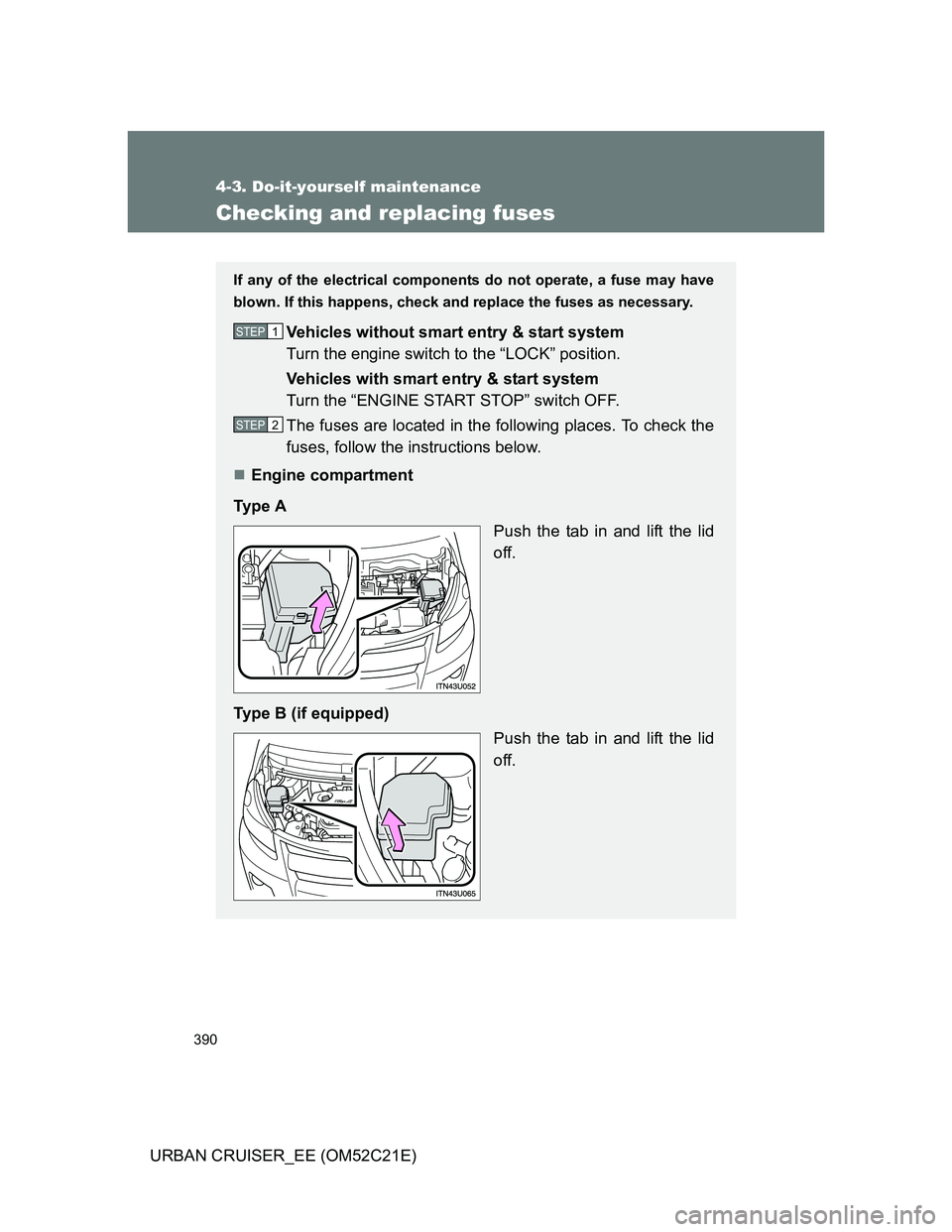
Engine compartment
Ty p e A
Push the tab in and lift the lid
off.
Type B (if equipped)
Push the tab in and lift the lid
off.
STEP1
STEP2
Page 430 of 532
430 5-2. Steps to take in an emergency
URBAN CRUISER_EE (OM52C21E)
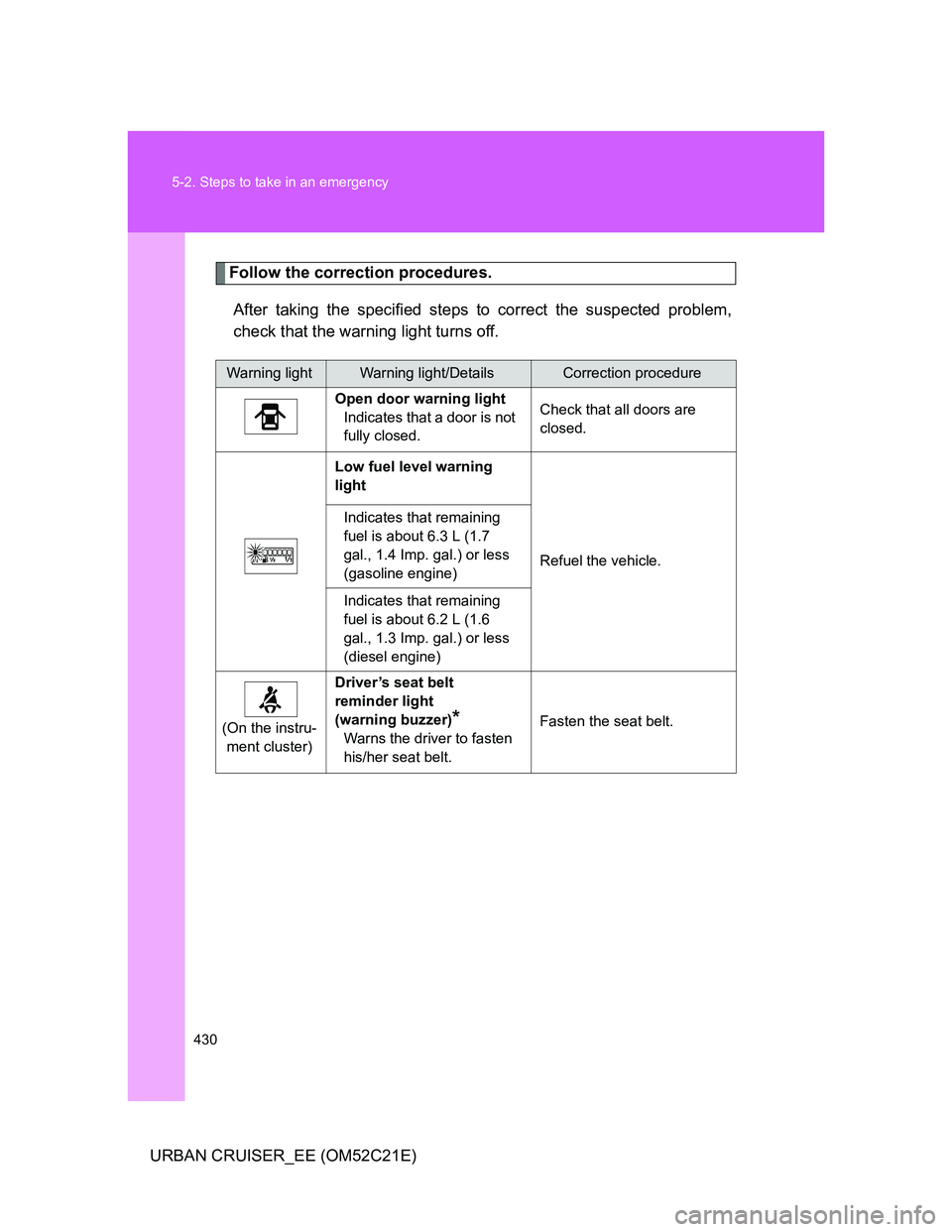
Follow the correction procedures.
After taking the specified steps to correct the suspected problem,
check that the warning light turns off.
Warning lightWarning light/DetailsCorrection procedure
Open door warning light
Indicates that a door is not
fully closed.Check that all doors are
closed.
Low fuel level warning
light
Refuel the vehicle. Indicates that remaining
fuel is about 6.3 L (1.7
gal., 1.4 Imp. gal.) or less
(gasoline engine)
Indicates that remaining
fuel is about 6.2 L (1.6
gal., 1.3 Imp. gal.) or less
(diesel engine)
(On the instru-
ment cluster)Driver’s seat belt
reminder light
(warning buzzer)
*
Warns the driver to fasten
his/her seat belt.Fasten the seat belt.
Page 431 of 532
5
431 5-2. Steps to take in an emergency
When trouble arises
URBAN CRUISER_EE (OM52C21E)
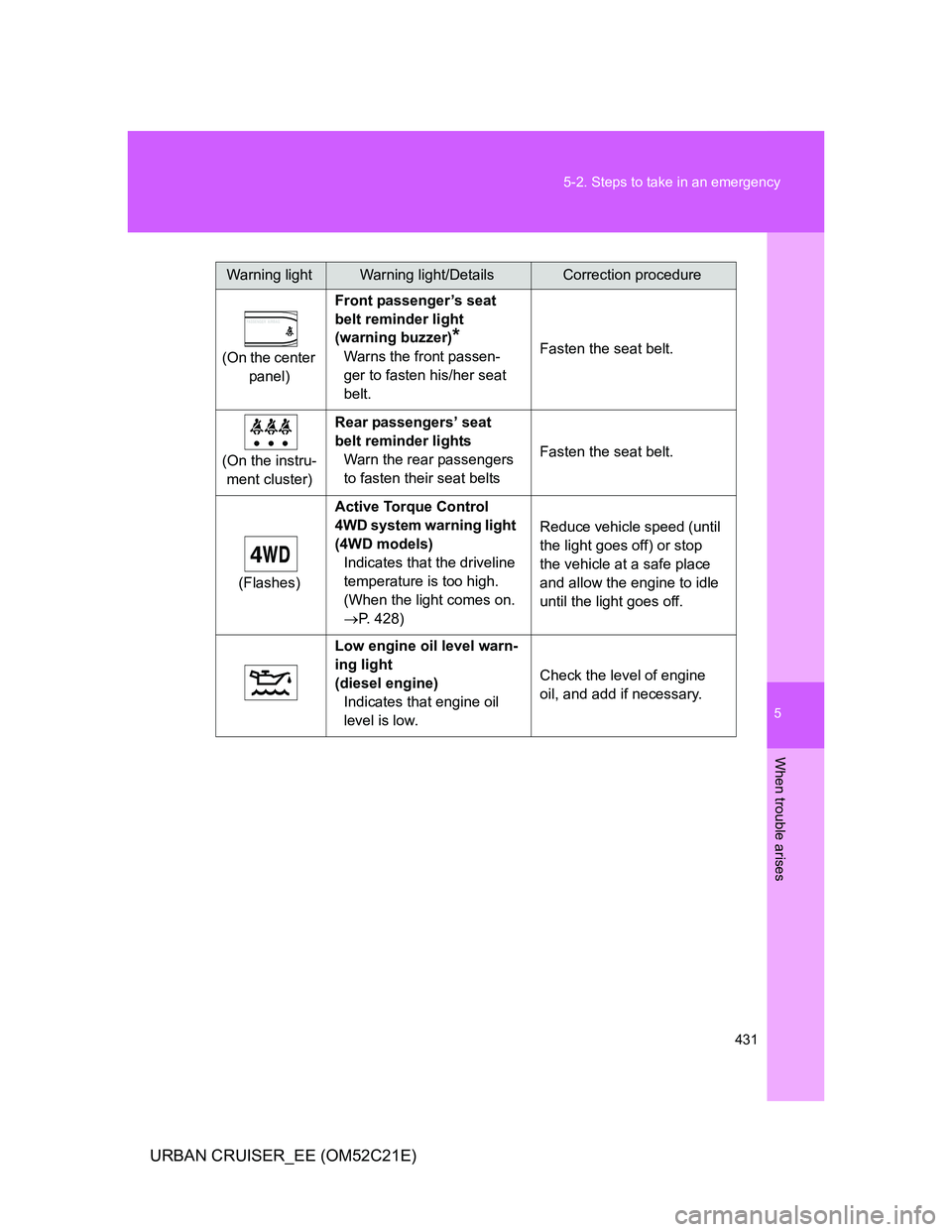
Warning lightWarning light/DetailsCorrection procedure
(On the center
panel)Front passenger’s seat
belt reminder light
(warning buzzer)
*
Warns the front passen-
ger to fasten his/her seat
belt.Fasten the seat belt.
(On the instru-
ment cluster)Rear passengers’ seat
belt reminder lights
Warn the rear passengers
to fasten their seat beltsFasten the seat belt.
(Flashes)Active Torque Control
4WD system warning light
(4WD models)
Indicates that the driveline
temperature is too high.
(When the light comes on.
P. 428)Reduce vehicle speed (until
the light goes off) or stop
the vehicle at a safe place
and allow the engine to idle
until the light goes off.
Low engine oil level warn-
ing light
(diesel engine)
Indicates that engine oil
level is low.Check the level of engine
oil, and add if necessary.