4WD TOYOTA URBAN CRUISER 2012 Owners Manual
[x] Cancel search | Manufacturer: TOYOTA, Model Year: 2012, Model line: URBAN CRUISER, Model: TOYOTA URBAN CRUISER 2012Pages: 532, PDF Size: 27.93 MB
Page 3 of 532
1
2
3
4
5
6
3
URBAN CRUISER_EE (OM52C21E)
2-1. Driving procedures
Driving the vehicle .............. 162
Engine (ignition) switch
(vehicles without smart entry
& start system).................. 175
Engine (ignition) switch
(vehicles with smart entry
& start system).................. 179
Manual transmission ........... 183
Turn signal lever ................. 187
Parking brake...................... 188
Horn .................................... 189
2-2. Instrument cluster
Gauges and meters ............ 190
Indicators and warning
lights ................................. 192
Multi-information display ..... 1962-3. Operating the lights
and wipers
Headlight switch ................. 201
Fog light switch .................. 205
Windshield wipers and
washer ............................. 207
Rear window wiper and
washer ............................. 209
2-4. Using other driving systems
Stop & Start system ........... 211
Driving assist systems........ 217
Four-wheel drive lock
(4WD models) .................. 223
2-5. Driving information
Cargo and luggage............. 224
Winter driving tips............... 227
Trailer towing...................... 231
2When driving
Page 161 of 532
2When driving
161
URBAN CRUISER_EE (OM52C21E)
2-1. Driving procedures
Driving the vehicle ............ 162
Engine (ignition) switch
(vehicles without smart
entry & start system)....... 175
Engine (ignition) switch
(vehicles with smart entry
& start system)................ 179
Manual transmission......... 183
Turn signal lever ............... 187
Parking brake ................... 188
Horn .................................. 1892-2. Instrument cluster
Gauges and meters .......... 190
Indicators and warning
lights ............................... 192
Multi-information
display ............................ 196
2-3. Operating the lights
and wipers
Headlight switch................ 201
Fog light switch ................. 205
Windshield wipers and
washer ............................ 207
Rear window wiper and
washer ............................ 209
2-4. Using other driving systems
Stop & Start system .......... 211
Driving assist systems ...... 217
Four-wheel drive lock
(4WD models)................. 223
2-5. Driving information
Cargo and luggage ........... 224
Winter driving tips ............. 227
Trailer towing .................... 231
Page 167 of 532
167 2-1. Driving procedures
2
When driving
URBAN CRUISER_EE (OM52C21E)
CAUTION
When driving the vehicle
Do not shift the shift lever to “R” while the vehicle is moving forward.
Doing so can damage the transmission and may result in a loss of vehicle
control.
Do not shift the shift lever to “1” while the vehicle is moving backward.
Doing so can damage the transmission and may result in a loss of vehicle
control.
Moving the shift lever to “N” while the vehicle is moving will disengage the
engine from the transmission. Engine braking is not available when “N” is
selected.
During normal driving, do not turn off the engine. Turning the engine off
while driving will not cause loss of steering or braking control, but the
power assist to these systems will be lost. This will make it more difficult to
steer and brake, so you should pull over and stop the vehicle as soon as it
is safe to do so.
However, in the event of an emergency, such as if it becomes impossible
to stop the vehicle in the normal way: P. 490
When stopped on an inclined surface, use the brake pedal and parking
brake to prevent the vehicle from rolling backward or forward and causing
an accident.
Do not adjust the position of the steering wheel, the seat, or the inside or
outside rear view mirrors while driving.
Doing so may result in a loss of vehicle control that can cause accidents
that may result in death or serious injury.
Always check that all passengers’ arms, heads or other parts of their body
are not outside the vehicle, as this may result in death or serious injury.
Do not drive the vehicle off-road.
This is not a 4WD vehicle designed for real off-road driving. Proceed with
all due caution if it becomes unavoidable to drive off-road.
Page 172 of 532
172 2-1. Driving procedures
URBAN CRUISER_EE (OM52C21E)
CAUTION
When braking
When the brakes are wet, drive more cautiously.
Braking distance increases when the brakes are wet, and this may cause
one side of the vehicle to brake differently than the other side. Also the
parking brake may not securely hold the vehicle.
If the power brake assist function does not operate, do not follow other
vehicles closely and avoid hills or sharp turns that require braking.
In this case, braking is still possible, but the brake pedal should be
depressed more firmly than usual. Also, the braking distance will increase.
Do not pump the brake pedal if the engine stalls.
Each push on the brake pedal uses up the reserve for the power-assisted
brakes.
The brake system consists of 2 individual hydraulic systems; if one of the
systems fails, the other will still operate. In this case, the brake pedal
should be depressed more firmly than usual and the braking distance will
increase.
If this happens, do not continue to drive the vehicle. Have your brakes
fixed immediately.
If the vehicle becomes stuck or bogged (4WD models)
Do not spin the wheels recklessly when any of the tires is up in the air, or
stuck in sand or mud etc. This may damage the drive system components or
propel the vehicle forward (or in another direction) and cause an accident.
Page 174 of 532
174 2-1. Driving procedures
URBAN CRUISER_EE (OM52C21E)
NOTICE
If you get a flat tire while driving
A flat or damaged tire may cause the following situations. Hold the steering
wheel firmly and gradually press the brake pedal to slow down the vehicle.
It may be difficult to control your vehicle.
The vehicle will make abnormal sounds or vibrations.
The vehicle will lean abnormally.
Information on what to do in case of a flat tire. (P. 437, 452)
When encountering flooded roads
Do not drive on a road that has flooded after heavy rain etc. Doing so may
cause the following serious damage to the vehicle.
Engine stalling
Short in electrical components
Engine damage caused by water immersion
In the event that you drive on a flooded road and the vehicle is flooded, be
sure to have any authorized Toyota dealer or repairer, or another duly quali-
fied and equipped professional check the following.
Brake function
Changes in quantity and quality of oil and fluid used for the engine, trans-
mission, transfer (4WD models), differential (4WD models), etc.
Lubricant condition for the propeller shaft (4WD models), bearings and
suspension joints (where possible) and the function of all joints, bearings,
etc.
Page 185 of 532
185 2-1. Driving procedures
2
When driving
URBAN CRUISER_EE (OM52C21E)
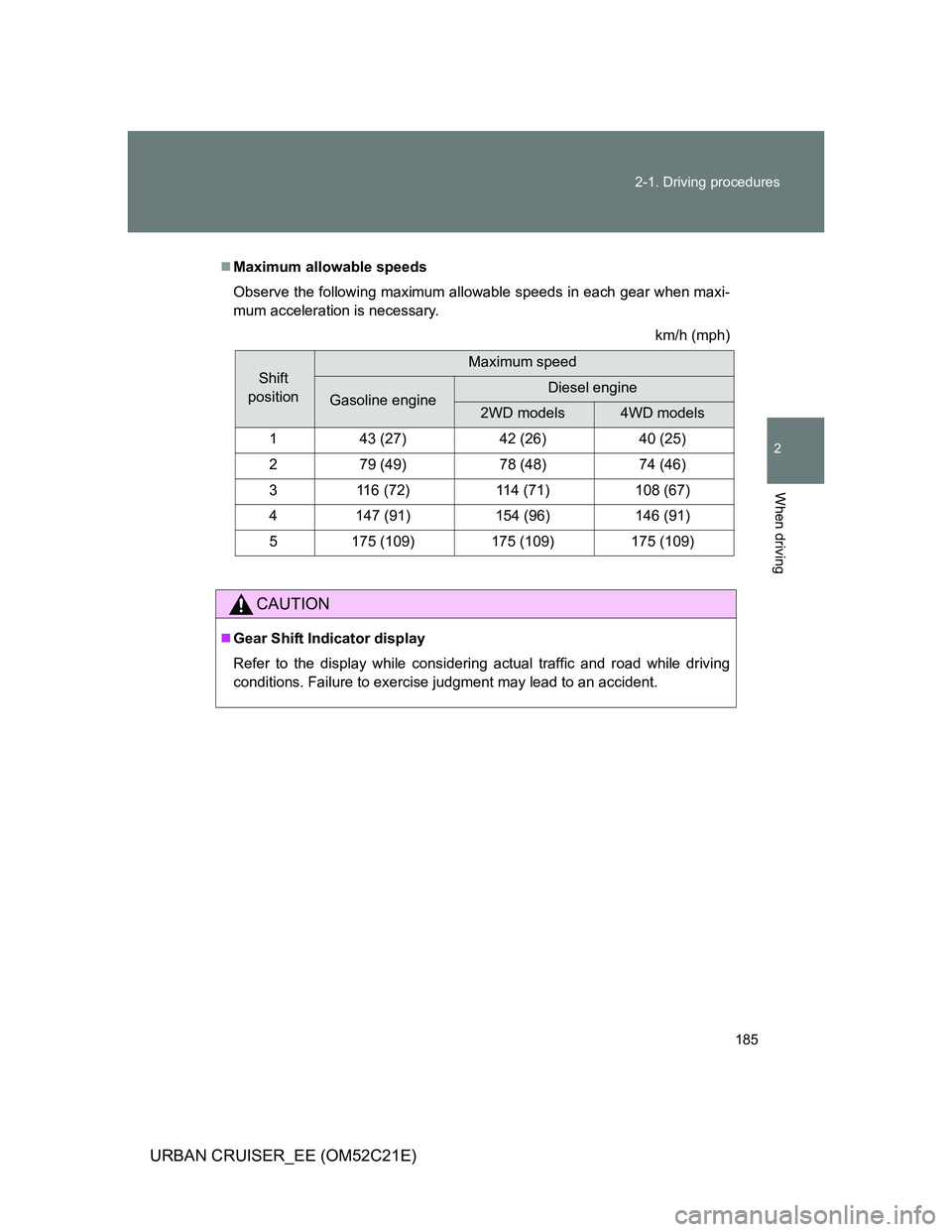
Maximum allowable speeds
Observe the following maximum allowable speeds in each gear when maxi-
mum acceleration is necessary.
km/h (mph)
CAUTION
Gear Shift Indicator display
Refer to the display while considering actual traffic and road while driving
conditions. Failure to exercise judgment may lead to an accident.
Shift
position
Maximum speed
Gasoline engineDiesel engine
2WD models4WD models
143 (27)42 (26)40 (25)
279 (49)78 (48)74 (46)
3116 (72)114 (71)108 (67)
4147 (91)154 (96)146 (91)
5175 (109)175 (109)175 (109)
Page 193 of 532
193 2-2. Instrument cluster
2
When driving
URBAN CRUISER_EE (OM52C21E)
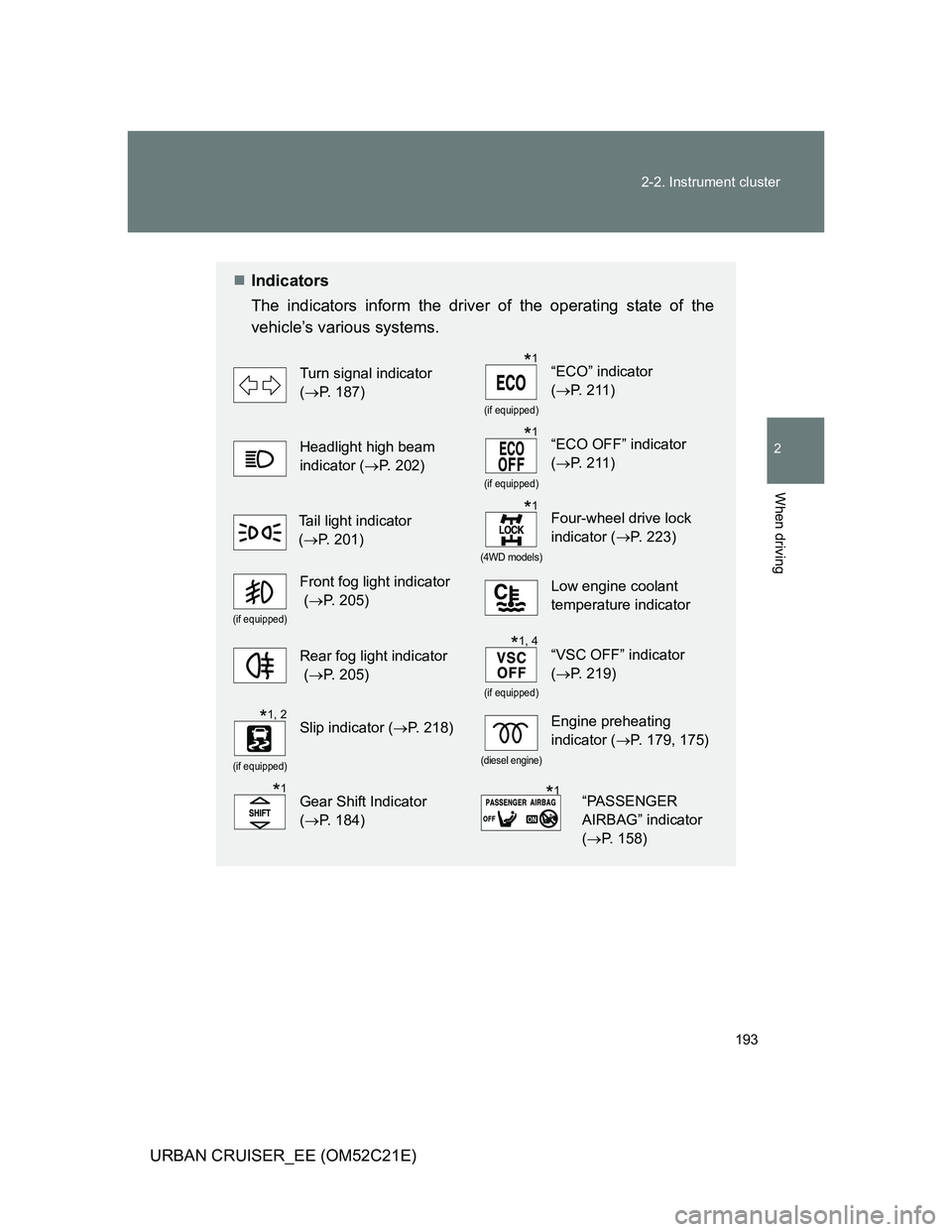
Indicators
The indicators inform the driver of the operating state of the
vehicle’s various systems.
Turn signal indicator
(P. 187)
(if equipped)
“ECO” indicator
(P. 2 1 1 )
Headlight high beam
indicator (P. 202)
(if equipped)
“ECO OFF” indicator
(P. 2 1 1 )
Tail light indicator
(P. 201)
(4WD models)
Four-wheel drive lock
indicator (
P. 223)
(if equipped)
Front fog light indicator
(P. 205)Low engine coolant
temperature indicator
Rear fog light indicator
(P. 205)
(if equipped)
“VSC OFF” indicator
(P. 219)
(if equipped)
Slip indicator (P. 218)
(diesel engine)
Engine preheating
indicator (P. 179, 175)
Gear Shift Indicator
(P. 184)“PASSENGER
AIRBAG” indicator
(P. 158)
*1
*1
*1
*1, 4
*1, 2
*1*1
Page 194 of 532
194 2-2. Instrument cluster
URBAN CRUISER_EE (OM52C21E)
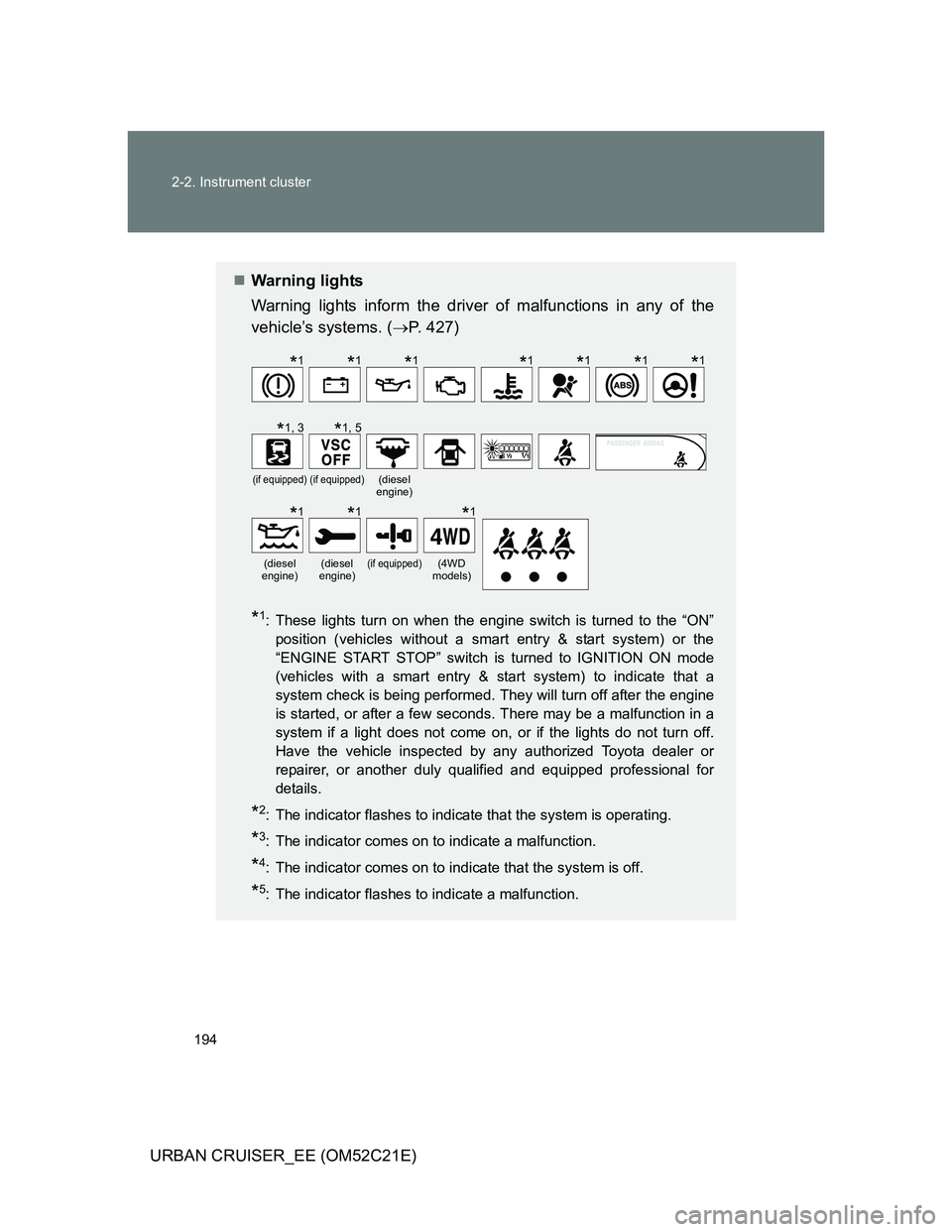
Warning lights
Warning lights inform the driver of malfunctions in any of the
vehicle’s systems. (P. 427)
*1: These lights turn on when the engine switch is turned to the “ON”
position (vehicles without a smart entry & start system) or the
“ENGINE START STOP” switch is turned to IGNITION ON mode
(vehicles with a smart entry & start system) to indicate that a
system check is being performed. They will turn off after the engine
is started, or after a few seconds. There may be a malfunction in a
system if a light does not come on, or if the lights do not turn off.
Have the vehicle inspected by any authorized Toyota dealer or
repairer, or another duly qualified and equipped professional for
details.
*2: The indicator flashes to indicate that the system is operating.
*3: The indicator comes on to indicate a malfunction.
*4: The indicator comes on to indicate that the system is off.
*5: The indicator flashes to indicate a malfunction.
(if equipped)(if equipped)(diesel
engine)
(diesel
engine)(diesel
engine)(if equipped)(4WD
models)
*1*1*1*1*1*1*1
*1, 3*1, 5
*1*1*1
Page 203 of 532
203 2-3. Operating the lights and wipers
2
When driving
URBAN CRUISER_EE (OM52C21E)
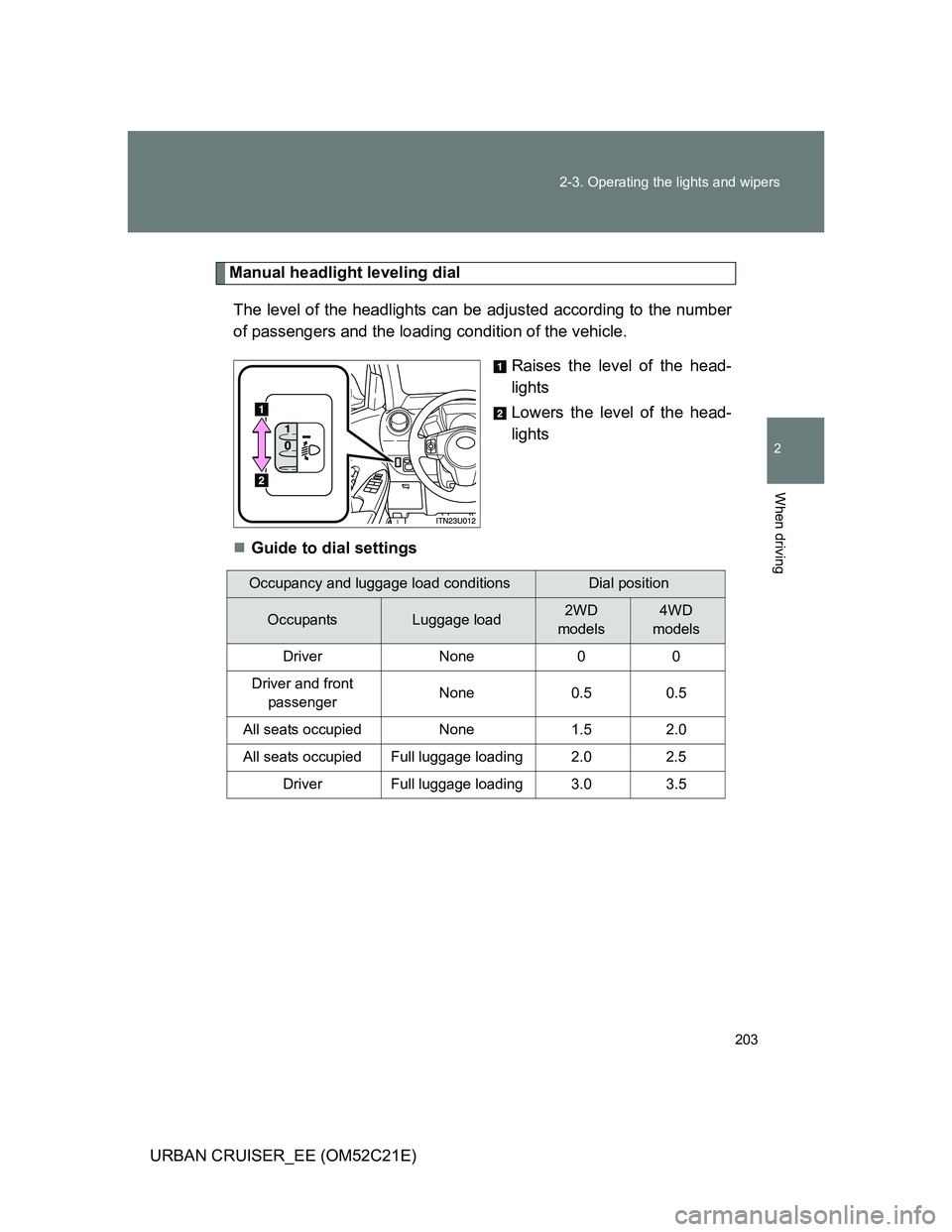
Manual headlight leveling dial
The level of the headlights can be adjusted according to the number
of passengers and the loading condition of the vehicle.
Raises the level of the head-
lights
Lowers the level of the head-
lights
Guide to dial settings
Occupancy and luggage load conditionsDial position
OccupantsLuggage load2WD
models4WD
models
Driver None 0 0
Driver and front
passengerNone 0.5 0.5
All seats occupied None 1.5 2.0
All seats occupied Full luggage loading 2.0 2.5
Driver Full luggage loading 3.0 3.5
Page 217 of 532
217
2-4. Using other driving systems
2
When driving
URBAN CRUISER_EE (OM52C21E)
Driving assist systems
To help enhance driving safety and performance, the following sys-
tems operate automatically in response to various driving situations.
Be aware, however, that these systems are supplementary and
should not be relied upon too heavily when operating the vehicle.
ABS (Anti-lock Brake System)
Helps to prevent wheel lock when the brakes are applied suddenly, or if
the brakes are applied while driving on a slippery road surface.
Brake assist
Generates an increased level of braking force after the brake pedal is
depressed, when the system detects a panic stop situation.
VSC (Vehicle Stability Control) (if equipped)
Helps the driver to control skidding when swerving suddenly or turning
on slippery road surfaces.
TRC (Traction Control) (if equipped)
Helps to maintain drive power and prevent the front wheels from spin-
ning when starting the vehicle or accelerating on slippery roads.
Active Torque Control 4WD system (4WD models)
Automatically switches from front-wheel drive to four-wheel drive
(4WD) according to the driving conditions, helping to ensure reliable
handling and stability. Examples of conditions where the system will
switch to 4WD are when cornering going uphill, starting off or accelerat-
ing, and when the road surface is slippery due to snow, rain, etc.
EPS (Electric Power Steering)
Employs an electric motor to reduce the amount of effort needed to turn
the steering wheel.