weight TOYOTA VENZA 2016 User Guide
[x] Cancel search | Manufacturer: TOYOTA, Model Year: 2016, Model line: VENZA, Model: TOYOTA VENZA 2016Pages: 688, PDF Size: 18.51 MB
Page 285 of 688

2852-5. Driving information
2
When driving
VENZA_OM_OM73030U_(U) ■ TWR (Trailer Weight Rating)
2GR-FE engine (Without towing package) and 1AR-FE engine
The maximum allowable gross
trailer weight. The gross trailer
weight is the sum of the trailer
weight and the weight of the
cargo in the trailer.
TWR is calculated assuming
base vehicle with one driver, one
front passenger, towing package
(if available), hitch and hitch sys-
tems (if required). Additional optional equipment,
passengers and cargo in the vehi-
cle will reduce the trailer weight
rating so as not to exceed
GCWR, GVWR and GAWR.
2GR-FE engine (With towing
package): If the gross trailer
weight exceeds 3000 lb. (1360
kg), it is recommended to use a
trailer with 2 or more axles.
2GR-FE engine (With towing package) (With brakes)
(With brakes)
Page 286 of 688

2862-5. Driving information
VENZA_OM_OM73030U_(U) ■ Unbraked TWR (Unbraked Trailer Weight Rating)
The trailer weight rating for tow-
ing a trailer without a trailer ser-
vice brake system.
■ Tongue Weight
2GR-FE engine (Without towing package) and 1AR-FE engine
The load placed on the trailer
hitch ball. ( P. 289)
2GR-FE engine (With towing package) (Without brakes)
Page 287 of 688
2872-5. Driving information
2
When driving
VENZA_OM_OM73030U_(U) Weight limits
● The gross trailer weight must never exceed TWR described in the
table. ( P. 288)
● The gross combination weight must never exceed the GCWR
described in the table. ( P. 288)
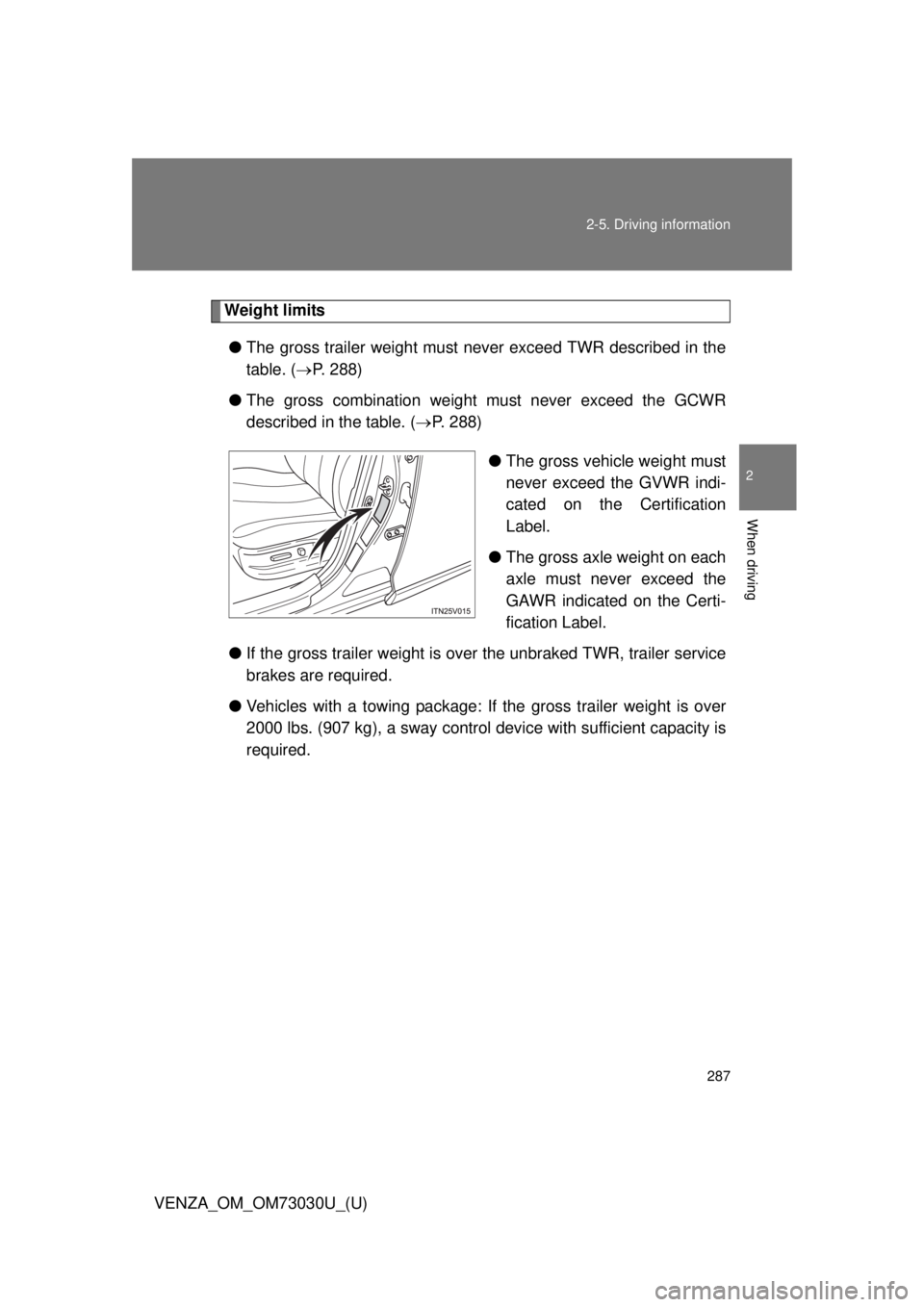
● The gross vehicle weight must
never exceed the GVWR indi-
cated on the Certification
Label.
● The gross axle weight on each
axle must never exceed the
GAWR indicated on the Certi-
fication Label.
● If the gross trailer weight is over the unbraked TWR, trailer service
brakes are required.
● Vehicles with a towing package: If the gross trailer weight is over
2000 lbs. (907 kg), a sway control device with sufficient capacity is
required.
Page 288 of 688
2882-5. Driving information
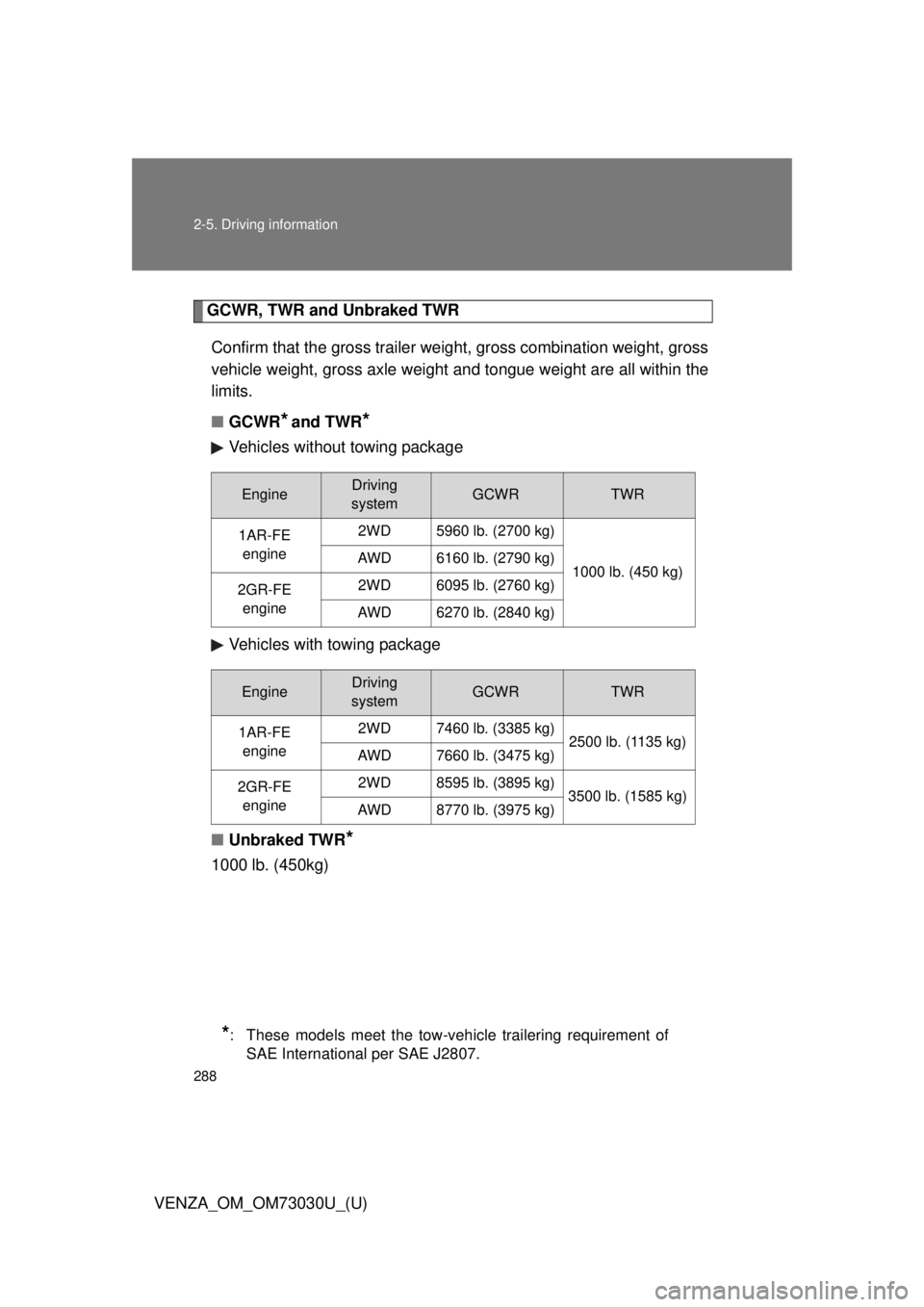
VENZA_OM_OM73030U_(U) GCWR, TWR and Unbraked TWR
Confirm that the gross trailer weight, gross combination weight, gross
vehicle weight, gross axle weight and tongue weight are all within the
limits.
■ GCWR
*
and TWR
*Vehicles without towing package
Vehicles with towing package
■ Unbraked TWR
*1000 lb. (450kg)
* : These models meet the tow-vehicle trailering requirement of
SAE International per SAE J2807. Engine Driving
system GCWR TWR
1AR-FE
engine 2WD 5960 lb. (2700 kg)
1000 lb. (450 kg)AWD 6160 lb. (2790 kg)
2GR-FE
engine 2WD 6095 lb. (2760 kg)
AWD 6270 lb. (2840 kg)
Engine Driving
system GCWR TWR
1AR-FE
engine 2WD 7460 lb. (3385 kg)
2500 lb. (1135 kg)
AWD 7660 lb. (3475 kg)
2GR-FE
engine 2WD 8595 lb. (3895 kg)
3500 lb. (1585 kg)
AWD 8770 lb. (3975 kg)
Page 289 of 688
2892-5. Driving information
2
When driving
VENZA_OM_OM73030U_(U) Trailer Tongue Weight
● A recommended tongue weight varies in accordance with the types
of trailers or towing as described below.
● To ensure the recommended values shown below, the trailer must
be loaded by referring to the following instructions.
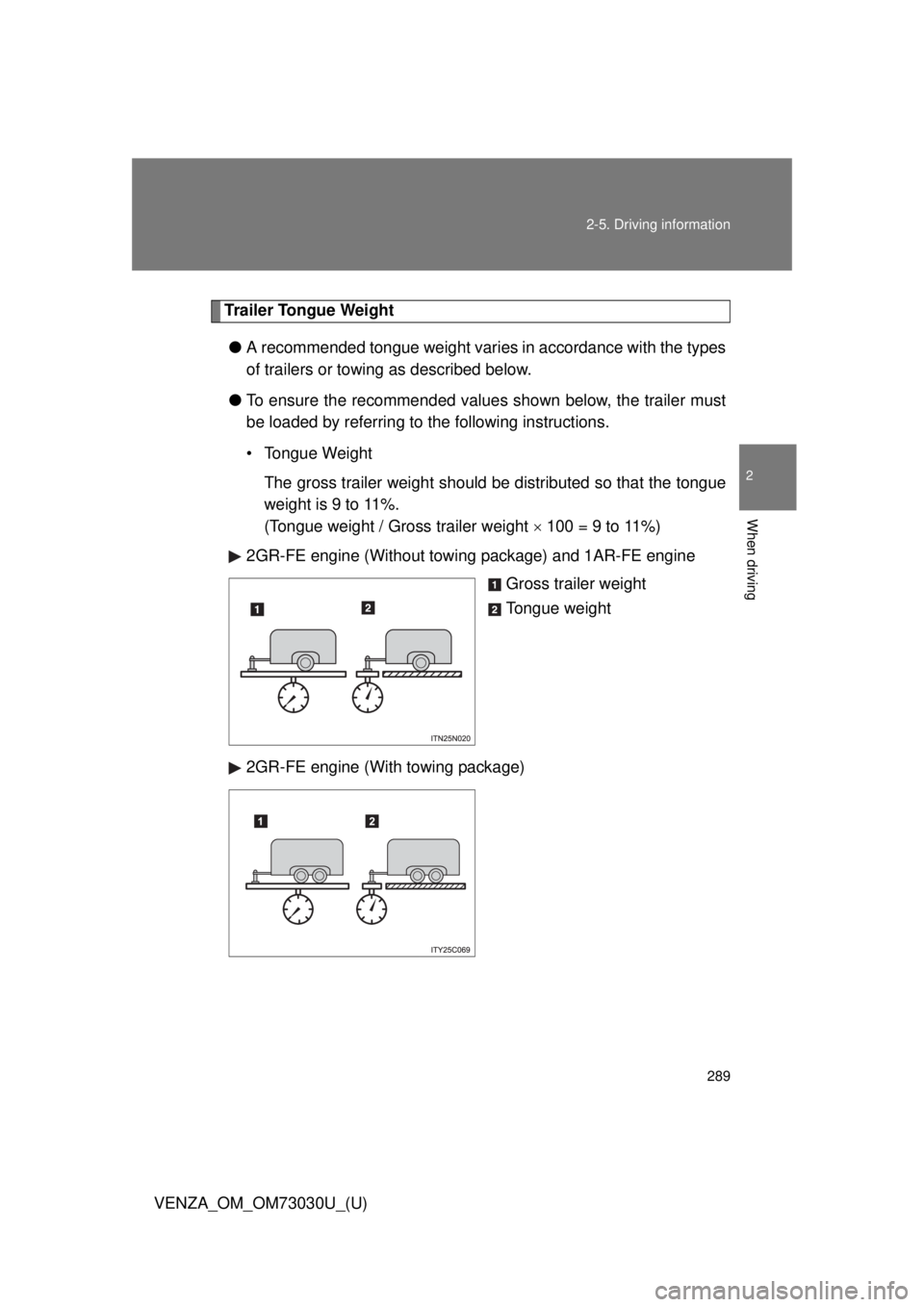
• Tongue Weight
The gross trailer weight should be distributed so that the tongue
weight is 9 to 11%.
(Tongue weight / Gross trailer weight 100 = 9 to 11%)
2GR-FE engine (Without towing package) and 1AR-FE engine
Gross trailer weight
Tongue weight
2GR-FE engine (With towing package)
Page 290 of 688
2902-5. Driving information
VENZA_OM_OM73030U_(U) If using a weight distributing hitch when towing, return the front
axle to the same weight as before the trailer connection.
If front axle weight cannot be measured directly, measure the front
fender height above the front axle before connection. Adjust weight
distributing hitch torque until fr ont fender is returned to the same
height as before connection.
The gross trailer weight, gross axle weight and tongue weight can
be measured with platform scales found at a highway weighing sta-
tion, building supply company, trucking company, junk yard, etc.
Hitch
Trailer hitch assemblies have different weight capacities. Toyota rec-
ommends the use of Toyota hitch/brac ket for your vehicle. For details,
contact your Toyota dealer.
● If you wish to install a trailer hitch, contact your Toyota dealer.
● Use only a hitch that c onforms to the gross trailer weight require-
ment of your vehicle.
● Follow the directions supplied by the hitch manufacturer.
● Lubricate the hitch ball with a light coating of grease.
● Remove the trailer hitch whenever you are not towing a trailer.
After removing the hitch, seal any mounting hole in the vehicle
body to prevent entry of any substances into the vehicle.
Page 291 of 688

2912-5. Driving information
2
When driving
VENZA_OM_OM73030U_(U) Selecting trailer ball
Use the correct trailer ball for your application.
Trailer ball load rating Matches or exceeds the gross
trailer weight rating of the trailer.
Ball diameter Matches the size of the trailer
coupler. Most couplers are
stamped with the required trailer
ball size.
Shank length Protrudes beyond the bottom of
the lock washer and nut at least 2
threads.
Shank diameter Matches the ball mount hole
diameter size.Trailer
class Typical trailer ball
size
IV 2 5/16 in.
II and III 2 in.
I 1 7/8 in.
Page 292 of 688
2922-5. Driving information
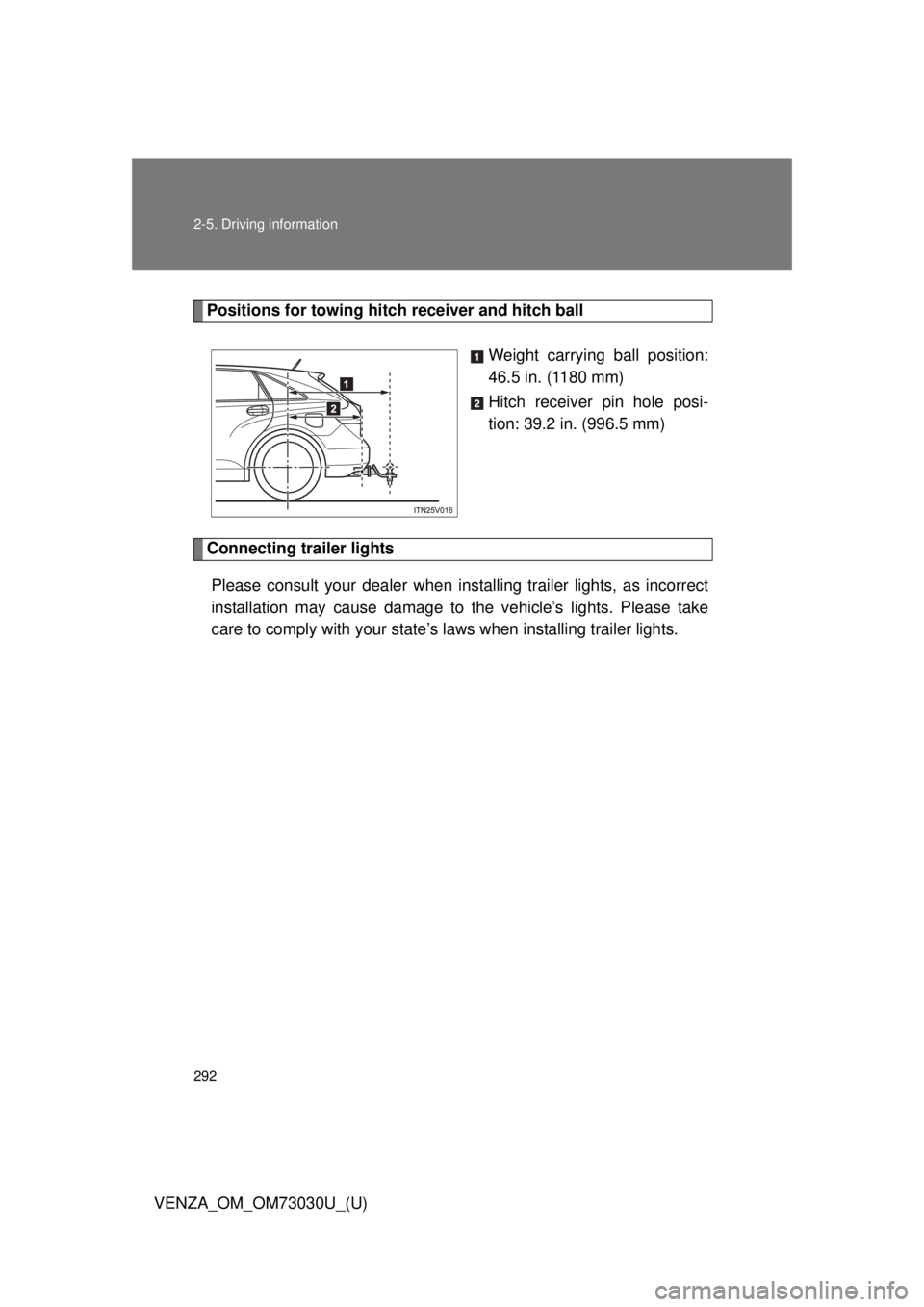
VENZA_OM_OM73030U_(U) Positions for towing hitch receiver and hitch ball
Weight carrying ball position:
46.5 in. (1180 mm)
Hitch receiver pin hole posi-
tion: 39.2 in. (996.5 mm)
Connecting trailer lights
Please consult your dealer when inst alling trailer lights, as incorrect
installation may cause damage to the vehicle’s lights. Please take
care to comply with your state’ s laws when installing trailer lights.
Page 297 of 688
2972-5. Driving information
2
When driving
VENZA_OM_OM73030U_(U) ■ Before towing
Check that the following conditions are met:
● Ensure that your vehicle’s tires are properly inflated. ( P. 622)
● Trailer tires are inflated according to the trailer manufacturer’s recom-
mendation.
● All trailer lights work as required by law.
● All lights work each time you connect them.
● The trailer ball is set at the proper height for the coupler on the trailer.
● The trailer is level when it is hitched.
Do not drive if the trailer is not level, and check for improper tongue
weight, overloading, worn suspension, or other possible causes.
● The trailer cargo is securely loaded.
● The rear view mirrors conform to all applicable federal, state/provincial or
local regulations. If they do not, instal l rear view mirrors appropriate for
towing purposes.
■ Break-in schedule
If your vehicle is new or equipped with any new power train components
(such as an engine, transmission, differential or wheel bearing), Toyota rec-
ommends that you do not tow a trailer until the vehicle has been driven for
over 500 miles (800 km).
After the vehicle has been driven for over 500 miles (800 km), you can start
towing. However, for the next 500 miles (800 km), drive the vehicle at a
speed of less than 50 mph (80 km/h) when towing a trailer, and avoid full
throttle acceleration.
Page 298 of 688
2982-5. Driving information
VENZA_OM_OM73030U_(U) ■ Maintenance
● If you tow a trailer, your vehicle will require more frequent maintenance
due to the additional load. (See “Scheduled Maintenance Guide” or
“Owner’s Manual Supplement”.)
● Retighten the fixing bolts of the towing ball and bracket after approxi-
mately 600 miles (1000 km) of trailer towing.
■ If trailer sway occurs
One or more factors (crosswinds, passing vehicles, rough roads, etc.) can
adversely affect handling of your vehicle and trailer, causing instability.
● If trailer swaying occurs:
• Firmly grip the steering wheel. Steer straight ahead.
Do not try to control trailer swaying by turning the steering wheel.
• Begin releasing the accelerator pedal immediately but very gradually to
reduce speed.
Do not increase speed. Do not apply vehicle brakes.
If you make no extreme correction with the steering or brakes, your vehicle
and trailer should stabilize.
● After the trailer swaying has stopped:
• Stop in a safe place. Get all occupants out of the vehicle.
• Check the tires of the vehicle and the trailer.
• Check the load in the trailer.
Make sure the load has not shifted.
Make sure the tongue weight is appropriate, if possible.
• Check the load in the vehicle.
Make sure the vehicle is not overloaded after occupants get in.
If you cannot find any problems, the speed at which trailer swaying occurred
is beyond the limit of your particul ar vehicle-trailer combination.
Drive at a lower speed to prevent instability. Remember that swaying of the
towing vehicle-trailer increases as speed increases.