DRIVING TOYOTA VERSO 2011 Workshop Manual
[x] Cancel search | Manufacturer: TOYOTA, Model Year: 2011, Model line: VERSO, Model: TOYOTA VERSO 2011Pages: 588, PDF Size: 31.32 MB
Page 123 of 588
123 1-6. Theft deterrent system
1
Before driving
VERSO_WE_OM64524E
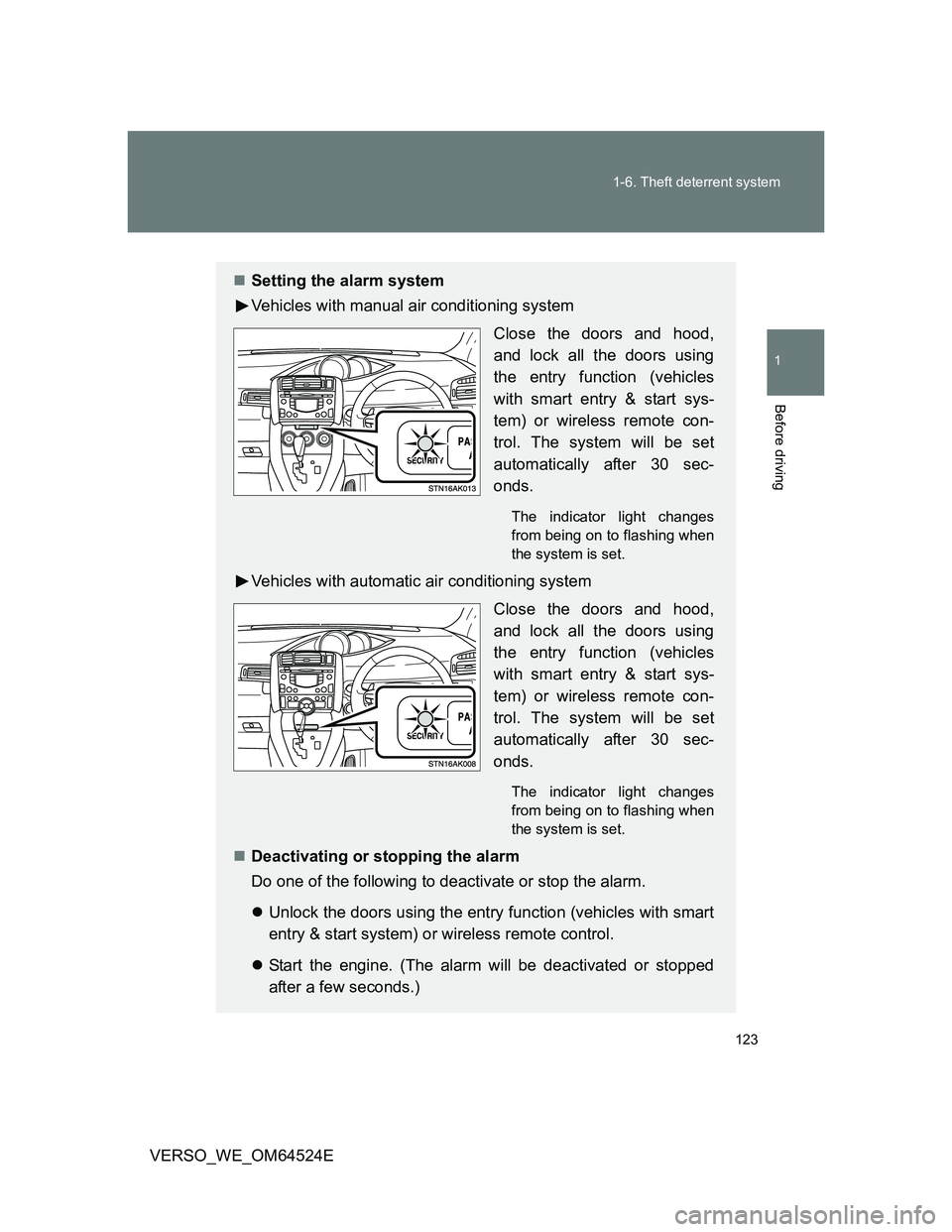
Setting the alarm system
Vehicles with manual air conditioning system
Close the doors and hood,
and lock all the doors using
the entry function (vehicles
with smart entry & start sys-
tem) or wireless remote con-
trol. The system will be set
automatically after 30 sec-
onds.
The indicator light changes
from being on to flashing when
the system is set.
Vehicles with automatic air conditioning system
Close the doors and hood,
and lock all the doors using
the entry function (vehicles
with smart entry & start sys-
tem) or wireless remote con-
trol. The system will be set
automatically after 30 sec-
onds.
The indicator light changes
from being on to flashing when
the system is set.
Deactivating or stopping the alarm
Do one of the following to deactivate or stop the alarm.
Unlock the doors using the entry function (vehicles with smart
entry & start system) or wireless remote control.
Start the engine. (The alarm will be deactivated or stopped
after a few seconds.)
Page 125 of 588
125 1-6. Theft deterrent system
1
Before driving
VERSO_WE_OM64524E
Canceling and automatic re-enabling of the intrusion sensor
The alarm will still be set even when the intrusion sensor is canceled.
Vehicles without smart entry & start system: After the intrusion sensor is
canceled, turn the engine switch to the “ON” position or unlocking the
doors using the wireless remote control will re-enable the intrusion sen-
sor.
Vehicles with smart entry & start system: After the intrusion sensor is can-
celed, pressing the “ENGINE START STOP” switch or unlocking the doors
using the smart entry & start system or wireless remote control will re-
enable the intrusion sensor.
The intrusion sensor will automatically be re-enabled when the alarm
system is deactivated.
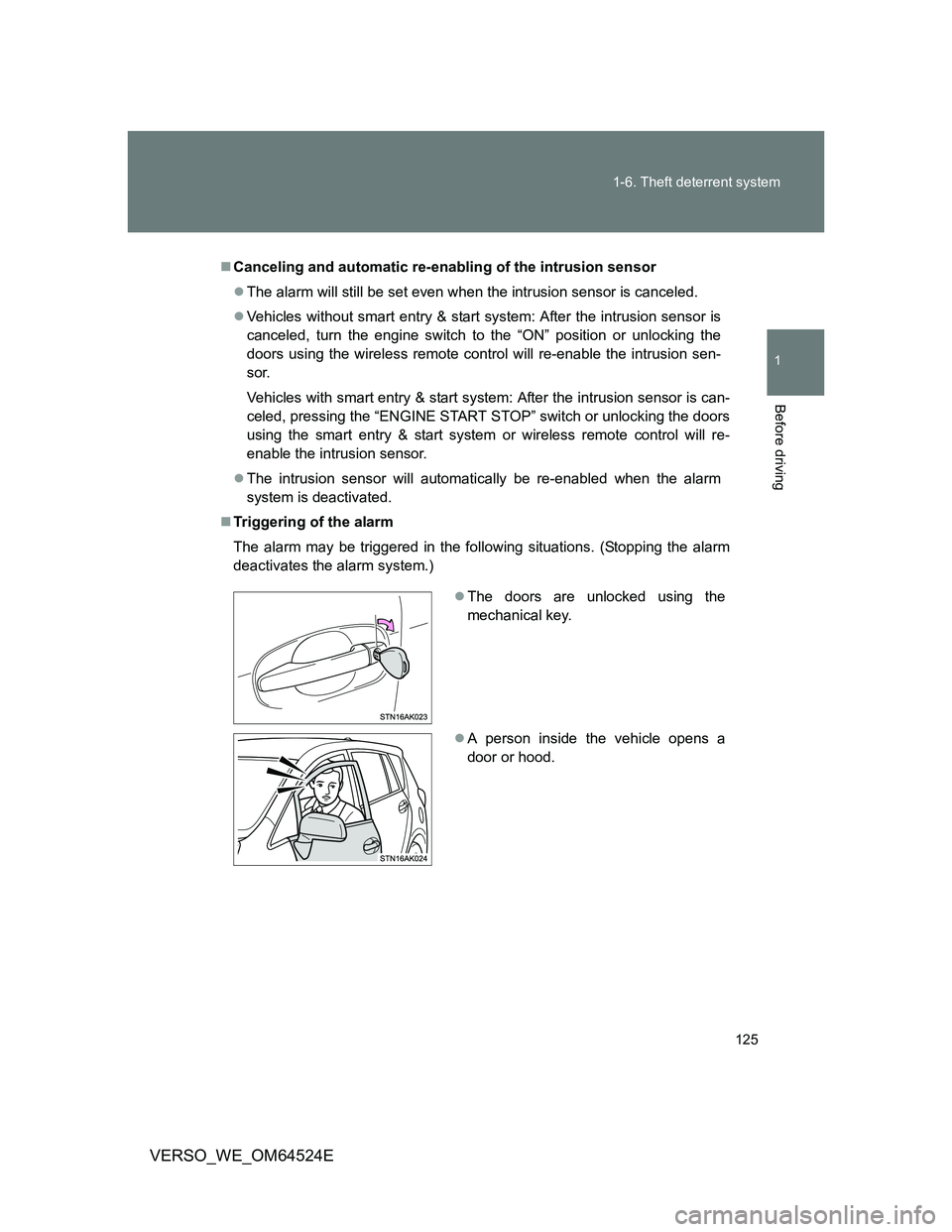
Triggering of the alarm
The alarm may be triggered in the following situations. (Stopping the alarm
deactivates the alarm system.)
The doors are unlocked using the
mechanical key.
A person inside the vehicle opens a
door or hood.
Page 127 of 588
127 1-6. Theft deterrent system
1
Before driving
VERSO_WE_OM64524E
Unstable items, such as dangling accessories or clothes hanging on the
coat hooks, are in the vehicle.
A window is open.
The vehicle is inside an automatic or high-pressure car washer.
The vehicle experiences impacts, such as hail, lightning strikes, or other
kinds of repeated impacts or vibrations.
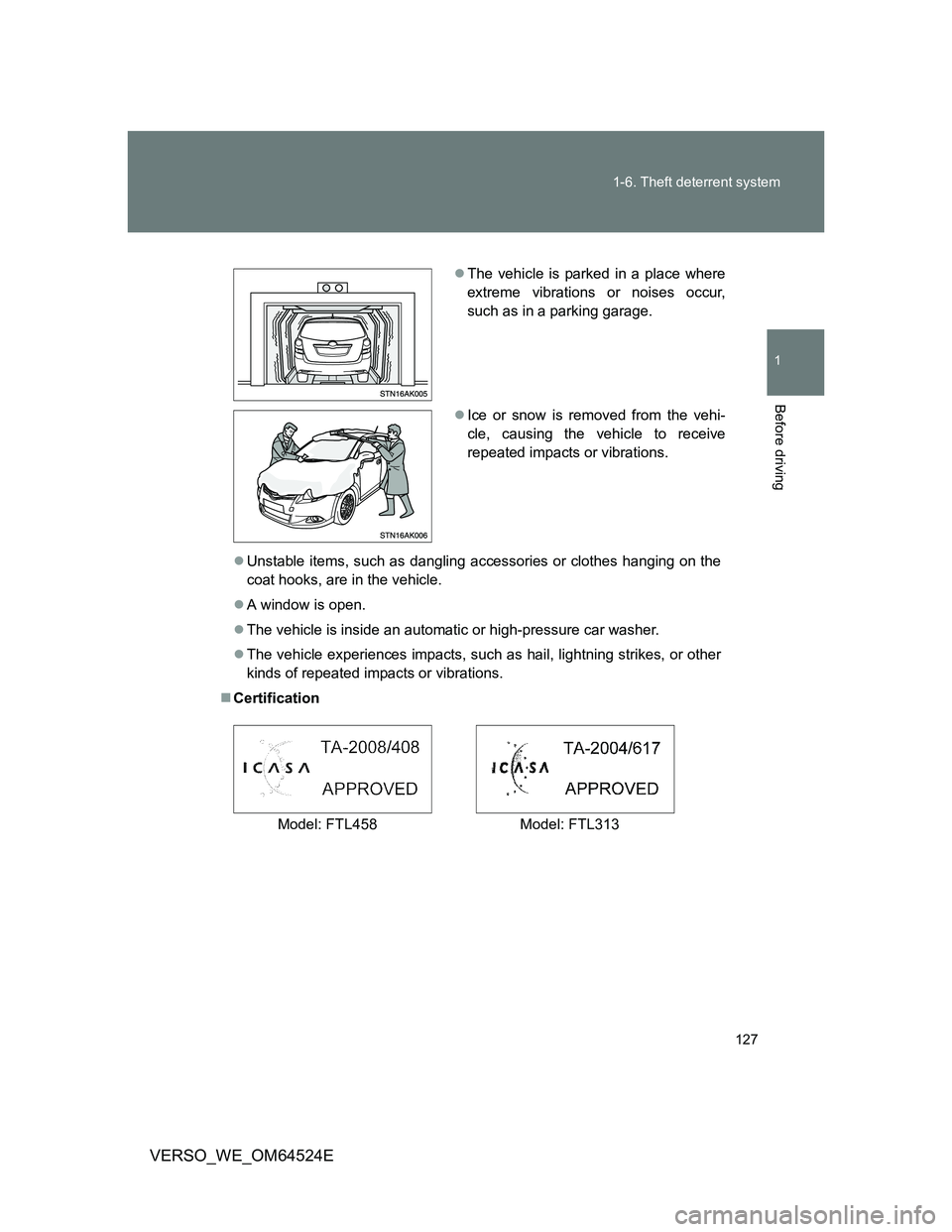
Certification
The vehicle is parked in a place where
extreme vibrations or noises occur,
such as in a parking garage.
Ice or snow is removed from the vehi-
cle, causing the vehicle to receive
repeated impacts or vibrations.
Model: FTL458 Model: FTL313
Page 129 of 588
129 1-6. Theft deterrent system
1
Before driving
VERSO_WE_OM64524E
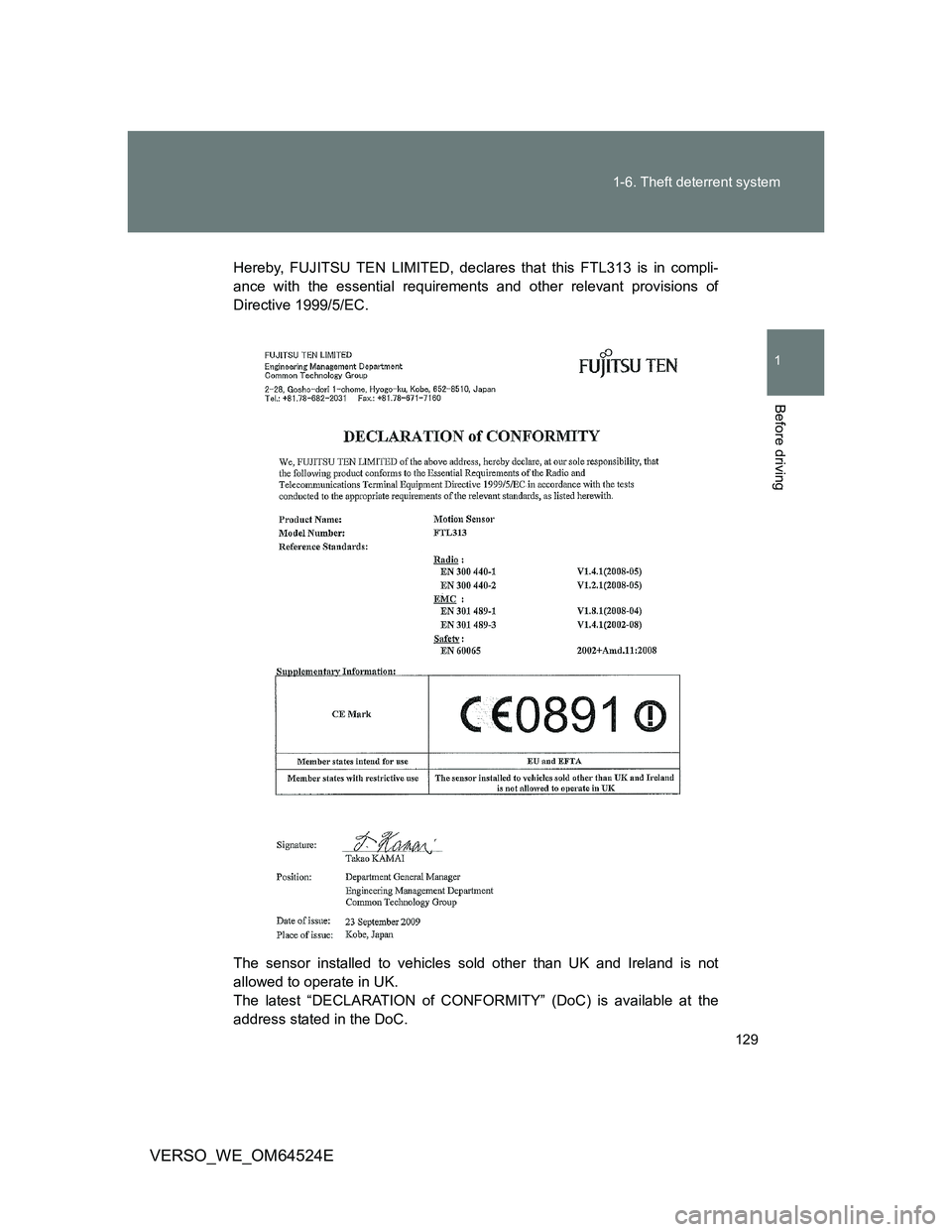
Hereby, FUJITSU TEN LIMITED, declares that this FTL313 is in compli-
ance with the essential requirements and other relevant provisions of
Directive 1999/5/EC.
The sensor installed to vehicles sold other than UK and Ireland is not
allowed to operate in UK.
The latest “DECLARATION of CONFORMITY” (DoC) is available at the
address stated in the DoC.
Page 131 of 588
131
1
Before driving
VERSO_WE_OM64524E
1-7. Safety information
Correct driving posture
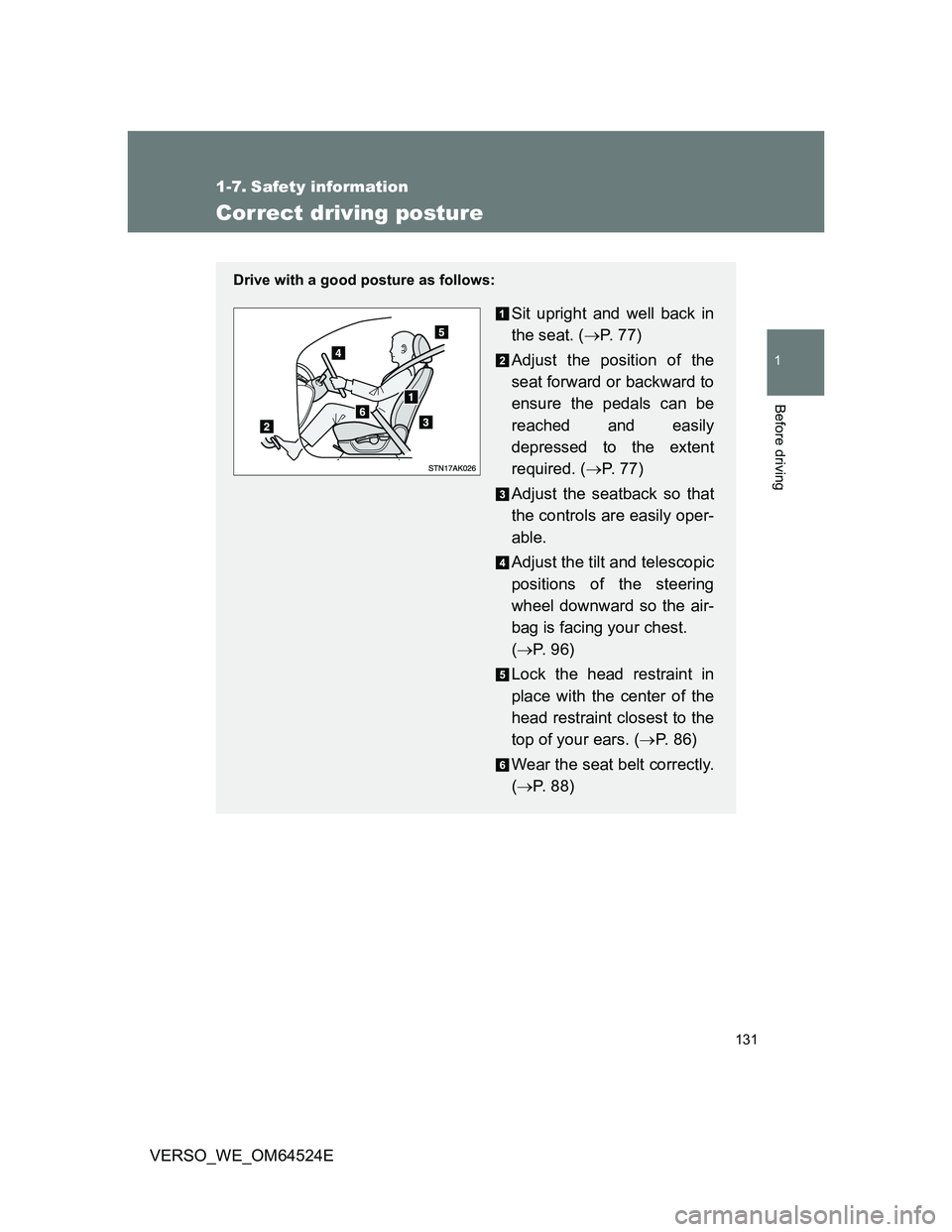
Drive with a good posture as follows:
Sit upright and well back in
the seat. (P. 7 7 )
Adjust the position of the
seat forward or backward to
ensure the pedals can be
reached and easily
depressed to the extent
required. (P. 77)
Adjust the seatback so that
the controls are easily oper-
able.
Adjust the tilt and telescopic
positions of the steering
wheel downward so the air-
bag is facing your chest.
(P. 96)
Lock the head restraint in
place with the center of the
head restraint closest to the
top of your ears. (P. 86)
Wear the seat belt correctly.
(P. 88)
Page 132 of 588
132 1-7. Safety information
VERSO_WE_OM64524E
CAUTION
Caution while driving
Do not adjust the position of the driver’s seat.
Doing so could cause the driver to lose control of the vehicle.
Do not place a cushion between the driver or passenger and the seatback.
A cushion may prevent correct posture from being achieved, and reduce
the effectiveness of the seat belt and head restraint, increasing the risk of
death or serious injury to the driver or passenger.
Do not place anything under the front seats except for putting them in the
auxiliary box.
Objects placed under the front seats may become jammed in the seat
tracks and stop the seat from locking in place. This may lead to an acci-
dent. The adjustment mechanism may also be damaged.
Adjusting the seat position
Do not recline the seat more than necessary when the vehicle is in motion,
to reduce the risk of sliding under the lap belt.
If the seat is too reclined during an accident, the lap belt may slide past the
hips and apply restraint forces directly to the abdomen or your neck may
contact the shoulder belt, increasing the risk of death or serious injury.
Take care when adjusting the seat position to ensure that other passen-
gers are not injured by the moving seat.
Do not put your hands under the seat or near the moving parts to avoid
injury.
Fingers or hands may become jammed in the seat mechanism.
Page 133 of 588
133
1
1-7. Safety information
Before driving
VERSO_WE_OM64524E
SRS airbags
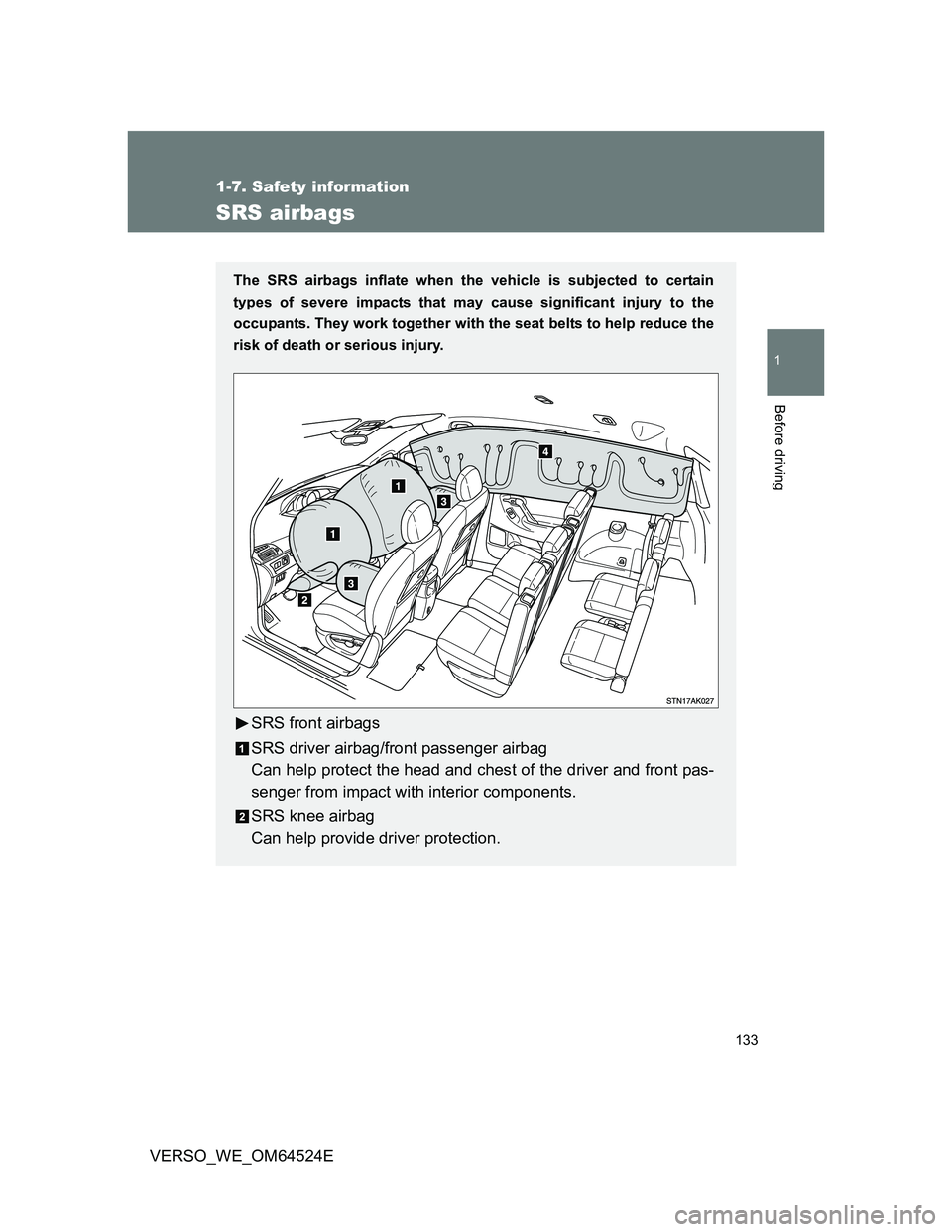
The SRS airbags inflate when the vehicle is subjected to certain
types of severe impacts that may cause significant injury to the
occupants. They work together with the seat belts to help reduce the
risk of death or serious injury.
SRS front airbags
SRS driver airbag/front passenger airbag
Can help protect the head and chest of the driver and front pas-
senger from impact with interior components.
SRS knee airbag
Can help provide driver protection.
Page 135 of 588
135 1-7. Safety information
1
Before driving
VERSO_WE_OM64524EThe main SRS airbag system components are shown. The SRS air-
bag system is controlled by the airbag sensor assembly. The airbag
sensor assembly consists of a safing sensor and an airbag sensor.
In certain types of severe frontal or side impacts, the SRS airbag sys-
tem triggers the airbag inflators. A chemical reaction in the inflators
quickly fills the airbags with non-toxic gas to help restrain the motion
of the occupants.
If the SRS airbags deploy (inflate)
Bruising and slight abrasions may result from contact with a deploying
(inflating) SRS airbag.
A loud noise and white powder will be emitted.
Vehicles without SRS curtain shield airbags: Parts of the airbag module
(steering wheel hub, airbag cover and inflator) as well as the front seats
may be hot for several minutes. The airbag itself may also be hot.
Vehicles with SRS curtain shield airbags: Parts of the airbag module
(steering wheel hub, airbag cover and inflator) as well as the front seats,
parts of the front and rear pillars, and roof side rails, may be hot for sev-
eral minutes. The airbag itself may also be hot.
The windshield may crack.
Page 137 of 588
137 1-7. Safety information
1
Before driving
VERSO_WE_OM64524E
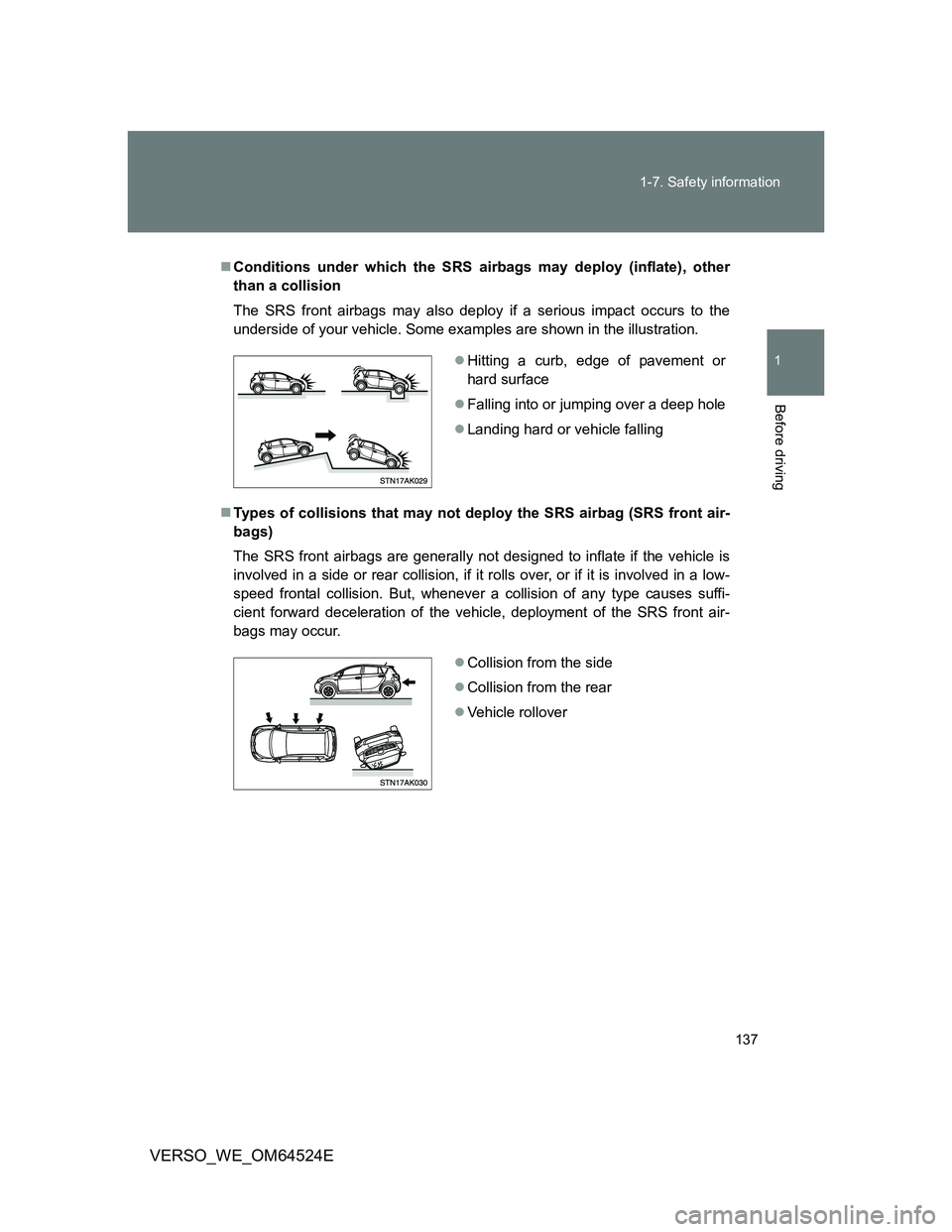
Conditions under which the SRS airbags may deploy (inflate), other
than a collision
The SRS front airbags may also deploy if a serious impact occurs to the
underside of your vehicle. Some examples are shown in the illustration.
Types of collisions that may not deploy the SRS airbag (SRS front air-
bags)
The SRS front airbags are generally not designed to inflate if the vehicle is
involved in a side or rear collision, if it rolls over, or if it is involved in a low-
speed frontal collision. But, whenever a collision of any type causes suffi-
cient forward deceleration of the vehicle, deployment of the SRS front air-
bags may occur.
Hitting a curb, edge of pavement or
hard surface
Falling into or jumping over a deep hole
Landing hard or vehicle falling
Collision from the side
Collision from the rear
Vehicle rollover
Page 139 of 588
139 1-7. Safety information
1
Before driving
VERSO_WE_OM64524E
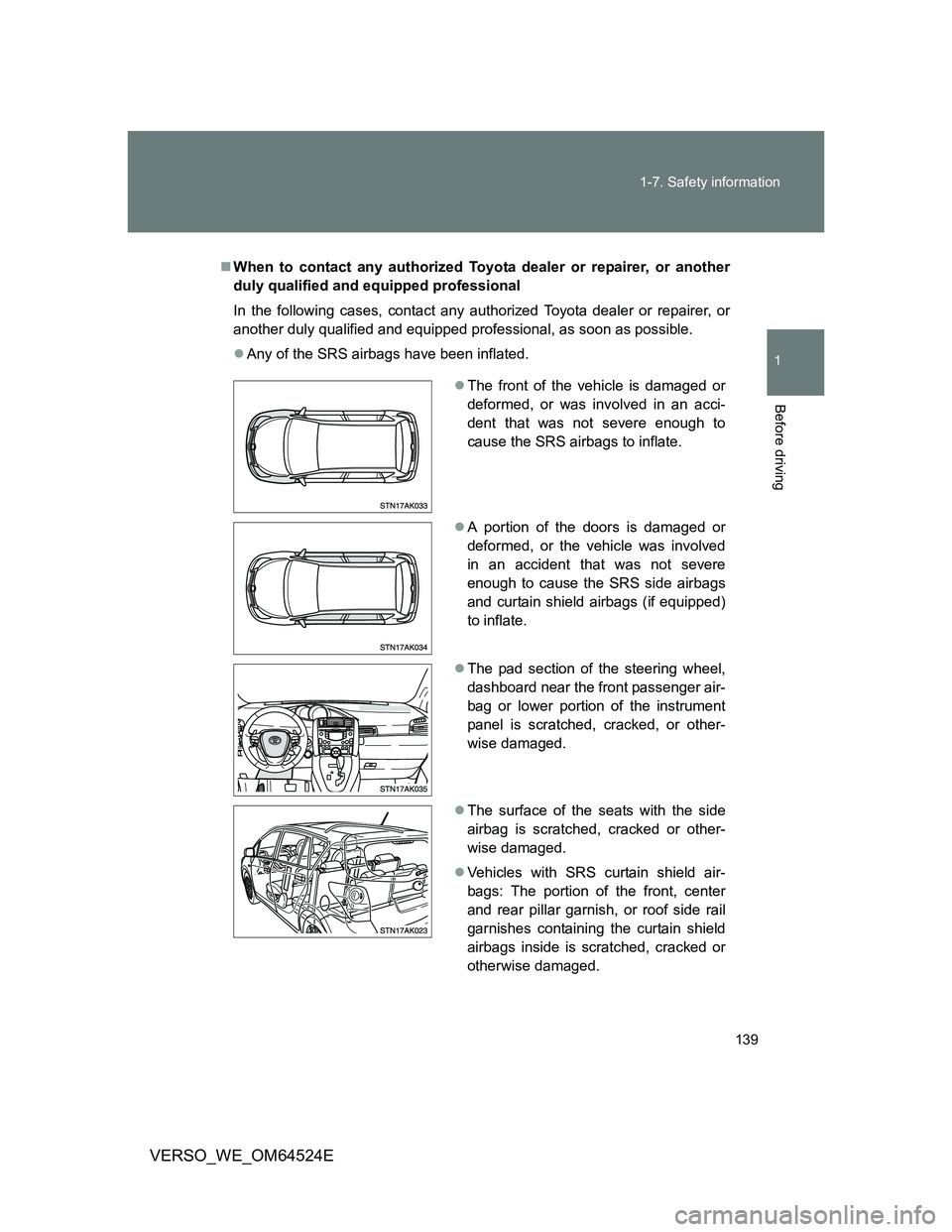
When to contact any authorized Toyota dealer or repairer, or another
duly qualified and equipped professional
In the following cases, contact any authorized Toyota dealer or repairer, or
another duly qualified and equipped professional, as soon as possible.
Any of the SRS airbags have been inflated.
The front of the vehicle is damaged or
deformed, or was involved in an acci-
dent that was not severe enough to
cause the SRS airbags to inflate.
A portion of the doors is damaged or
deformed, or the vehicle was involved
in an accident that was not severe
enough to cause the SRS side airbags
and curtain shield airbags (if equipped)
to inflate.
The pad section of the steering wheel,
dashboard near the front passenger air-
bag or lower portion of the instrument
panel is scratched, cracked, or other-
wise damaged.
The surface of the seats with the side
airbag is scratched, cracked or other-
wise damaged.
Vehicles with SRS curtain shield air-
bags: The portion of the front, center
and rear pillar garnish, or roof side rail
garnishes containing the curtain shield
airbags inside is scratched, cracked or
otherwise damaged.