ECU TOYOTA VERSO 2011 Workshop Manual
[x] Cancel search | Manufacturer: TOYOTA, Model Year: 2011, Model line: VERSO, Model: TOYOTA VERSO 2011Pages: 588, PDF Size: 31.32 MB
Page 461 of 588
461 4-3. Do-it-yourself maintenance
4
Maintenance and care
VERSO_WE_OM64524E
LED light bulbs
The stop lights and high mounted stoplight consist of a number of LEDs. If
any of the LEDs burn out, take your vehicle to any authorized Toyota dealer
or repairer, or another duly qualified and equipped professional to have the
light replaced.
If two or more LEDs in a stop light burn out, your vehicle may not conform to
local laws (ECE).
CAUTION
Replacing light bulbs
Turn off the lights. Do not attempt to replace the bulb immediately after
turning off the lights.
The bulbs become very hot and may cause burns.
Do not touch the glass portion of the light bulb with bare hands. Hold the
bulb by the plastic or metal portion.
If the bulb is scratched or dropped it may blow out or crack.
Fully install light bulbs and any parts used to secure them. Failing to do so
may result in heat damage, fire, or water entering the headlight unit. This
may damage the headlights or cause condensation to build up on the lens.
Discharge headlights (if equipped)
Contact any authorized Toyota dealer or repairer, or another duly qualified
and equipped professional, before replacing the discharge headlights
(including light bulbs).
Do not touch the high-intensity discharge headlight’s high voltage socket
when the headlights are turned on.
An extremely high voltage of 20000V will be discharged and could result in
serious injury or death by electric shock.
Do not attempt to repair or disassemble light bulbs, connectors, electric
circuits or component parts.
Doing so may result in death or serious injury due to electric shock.
To prevent damage or fire
Make sure bulbs are fully seated and locked.
Page 466 of 588
466 5-1. Essential information
VERSO_WE_OM64524E
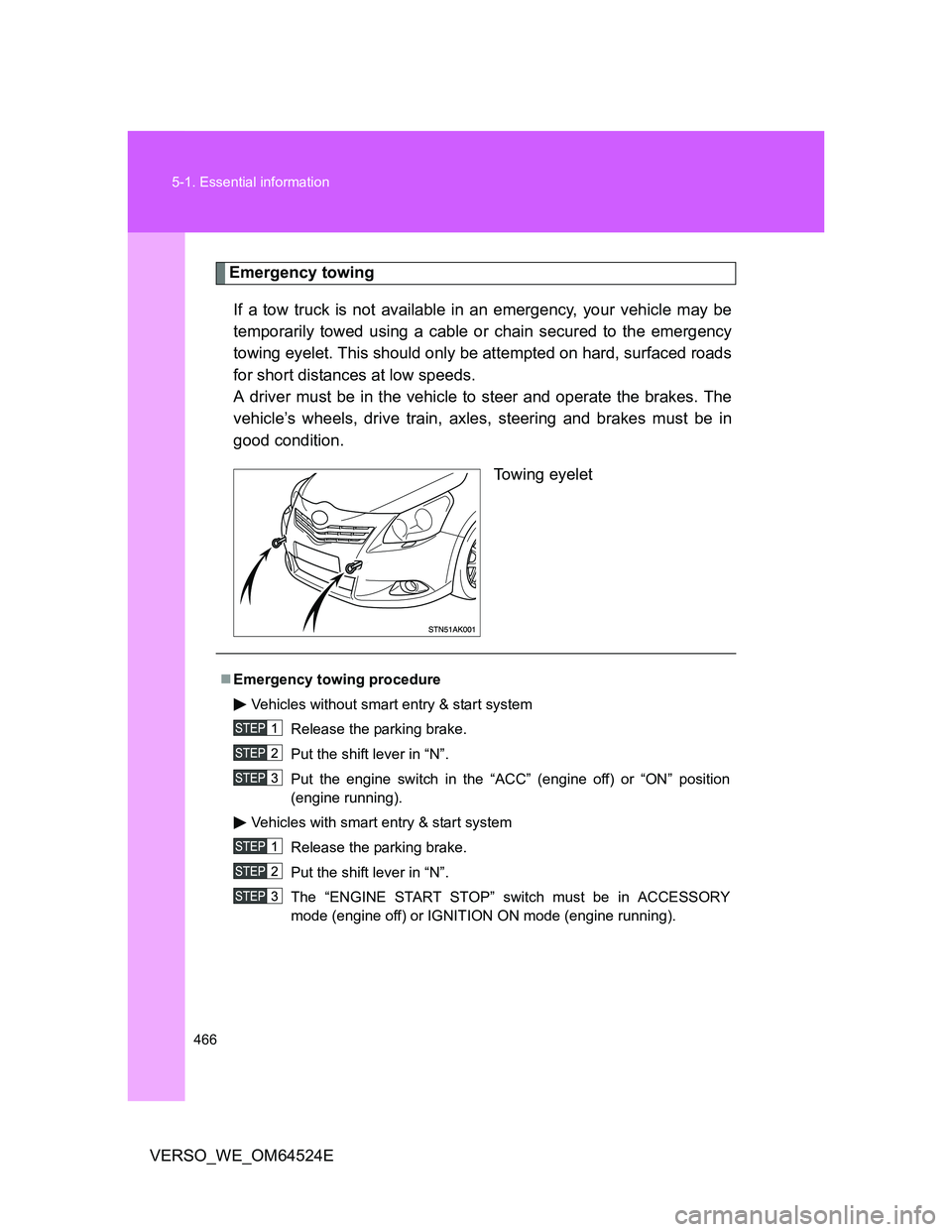
Emergency towing
If a tow truck is not available in an emergency, your vehicle may be
temporarily towed using a cable or chain secured to the emergency
towing eyelet. This should only be attempted on hard, surfaced roads
for short distances at low speeds.
A driver must be in the vehicle to steer and operate the brakes. The
vehicle’s wheels, drive train, axles, steering and brakes must be in
good condition.
Towing eyelet
Emergency towing procedure
Vehicles without smart entry & start system
Release the parking brake.
Put the shift lever in “N”.
Put the engine switch in the “ACC” (engine off) or “ON” position
(engine running).
Vehicles with smart entry & start system
Release the parking brake.
Put the shift lever in “N”.
The “ENGINE START STOP” switch must be in ACCESSORY
mode (engine off) or IGNITION ON mode (engine running).
Page 468 of 588
468 5-1. Essential information
VERSO_WE_OM64524E
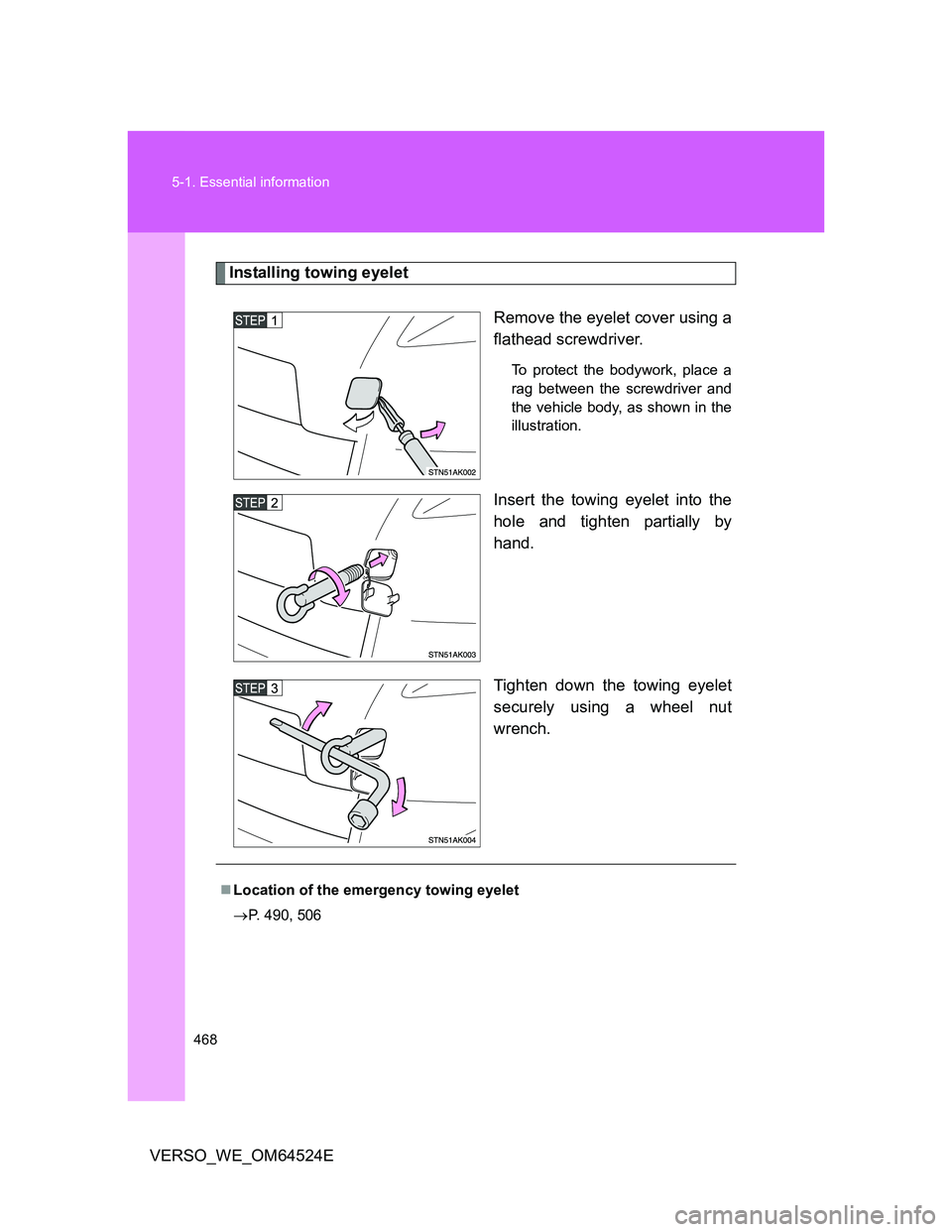
Installing towing eyelet
Remove the eyelet cover using a
flathead screwdriver.
To protect the bodywork, place a
rag between the screwdriver and
the vehicle body, as shown in the
illustration.
Insert the towing eyelet into the
hole and tighten partially by
hand.
Tighten down the towing eyelet
securely using a wheel nut
wrench.
Location of the emergency towing eyelet
P. 490, 506
Page 469 of 588
5
469 5-1. Essential information
When trouble arises
VERSO_WE_OM64524E
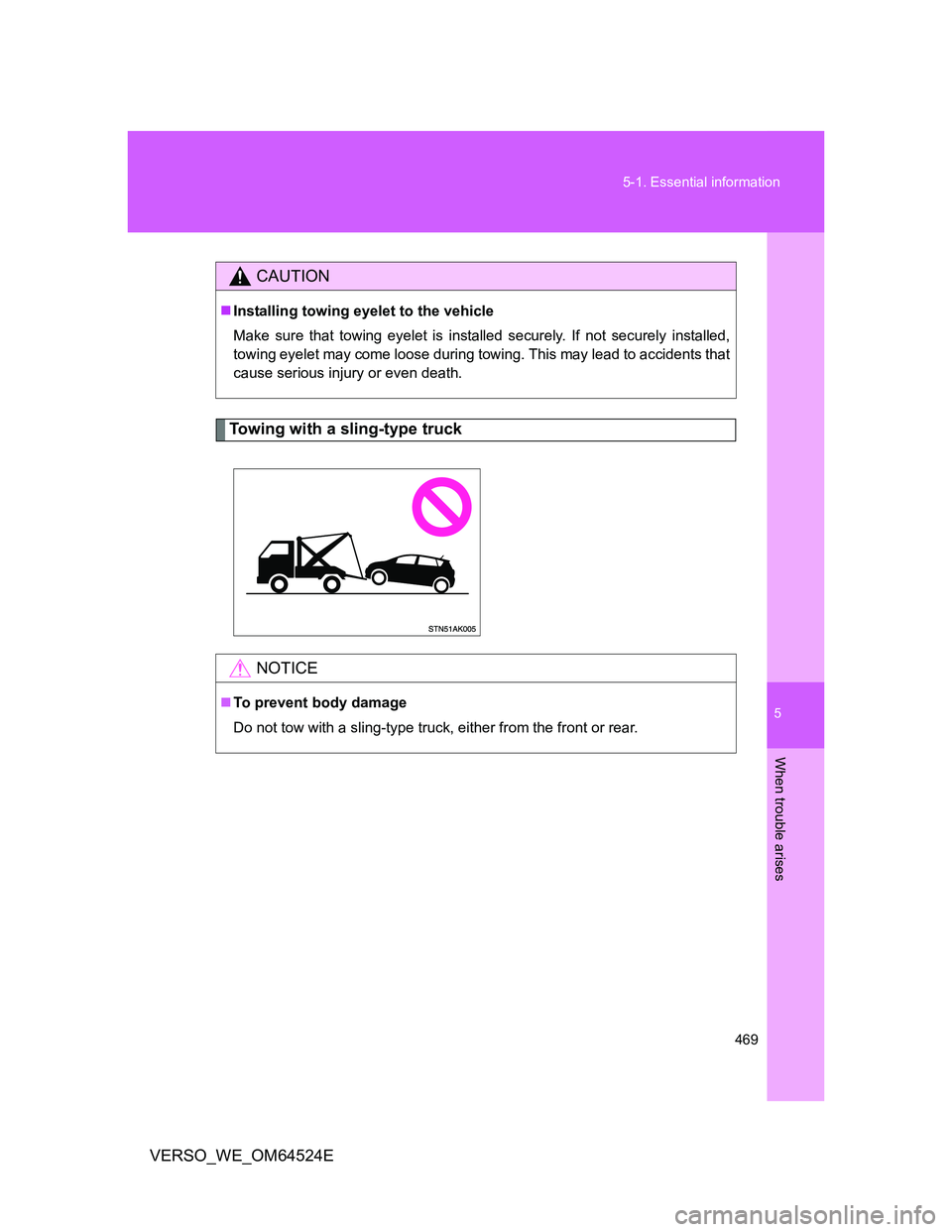
Towing with a sling-type truck
CAUTION
Installing towing eyelet to the vehicle
Make sure that towing eyelet is installed securely. If not securely installed,
towing eyelet may come loose during towing. This may lead to accidents that
cause serious injury or even death.
NOTICE
To prevent body damage
Do not tow with a sling-type truck, either from the front or rear.
Page 472 of 588
472 5-1. Essential information
VERSO_WE_OM64524E
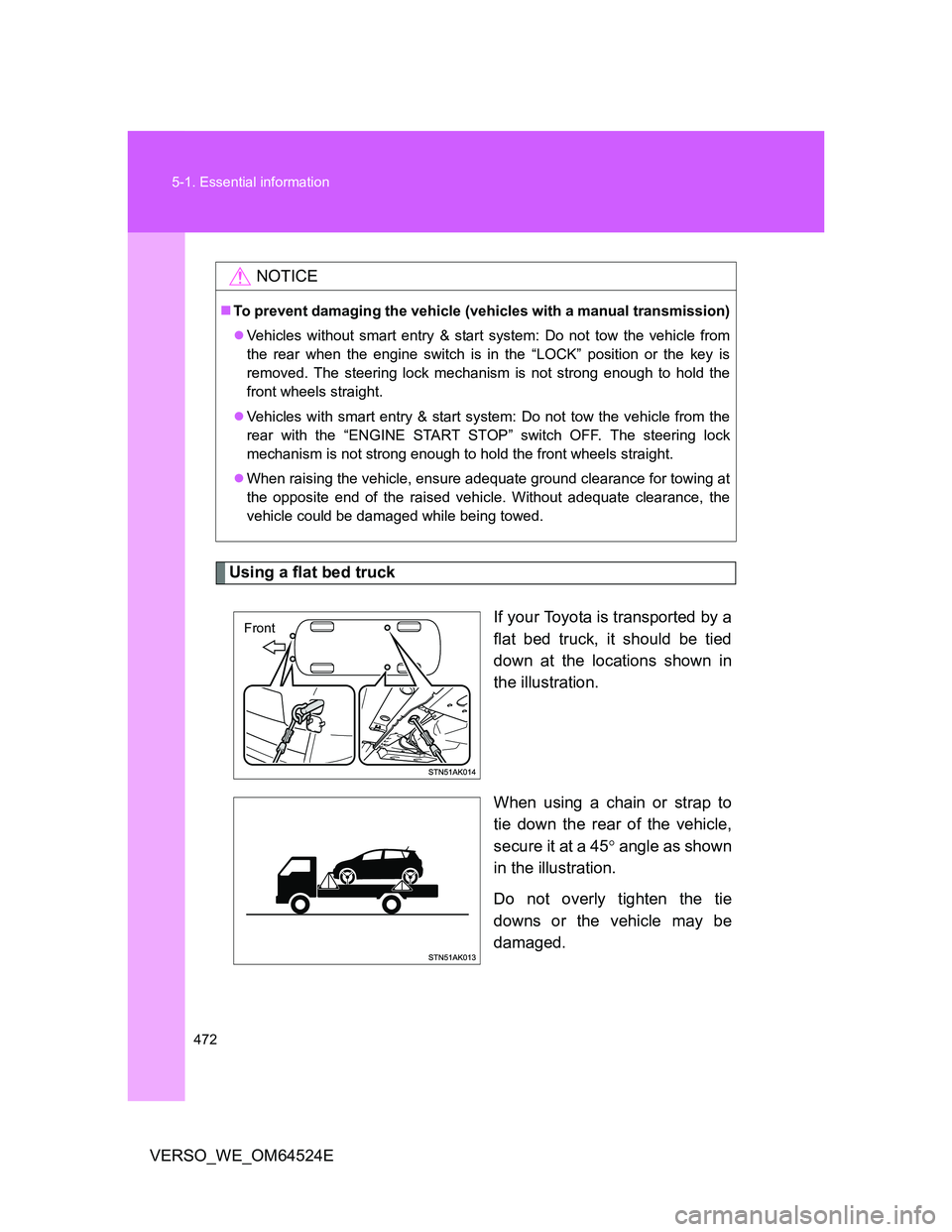
Using a flat bed truck
If your Toyota is transported by a
flat bed truck, it should be tied
down at the locations shown in
the illustration.
When using a chain or strap to
tie down the rear of the vehicle,
secure it at a 45 angle as shown
in the illustration.
Do not overly tighten the tie
downs or the vehicle may be
damaged.
NOTICE
To prevent damaging the vehicle (vehicles with a manual transmission)
Vehicles without smart entry & start system: Do not tow the vehicle from
the rear when the engine switch is in the “LOCK” position or the key is
removed. The steering lock mechanism is not strong enough to hold the
front wheels straight.
Vehicles with smart entry & start system: Do not tow the vehicle from the
rear with the “ENGINE START STOP” switch OFF. The steering lock
mechanism is not strong enough to hold the front wheels straight.
When raising the vehicle, ensure adequate ground clearance for towing at
the opposite end of the raised vehicle. Without adequate clearance, the
vehicle could be damaged while being towed.
Front
Page 493 of 588
5
493 5-2. Steps to take in an emergency
When trouble arises
VERSO_WE_OM64524E
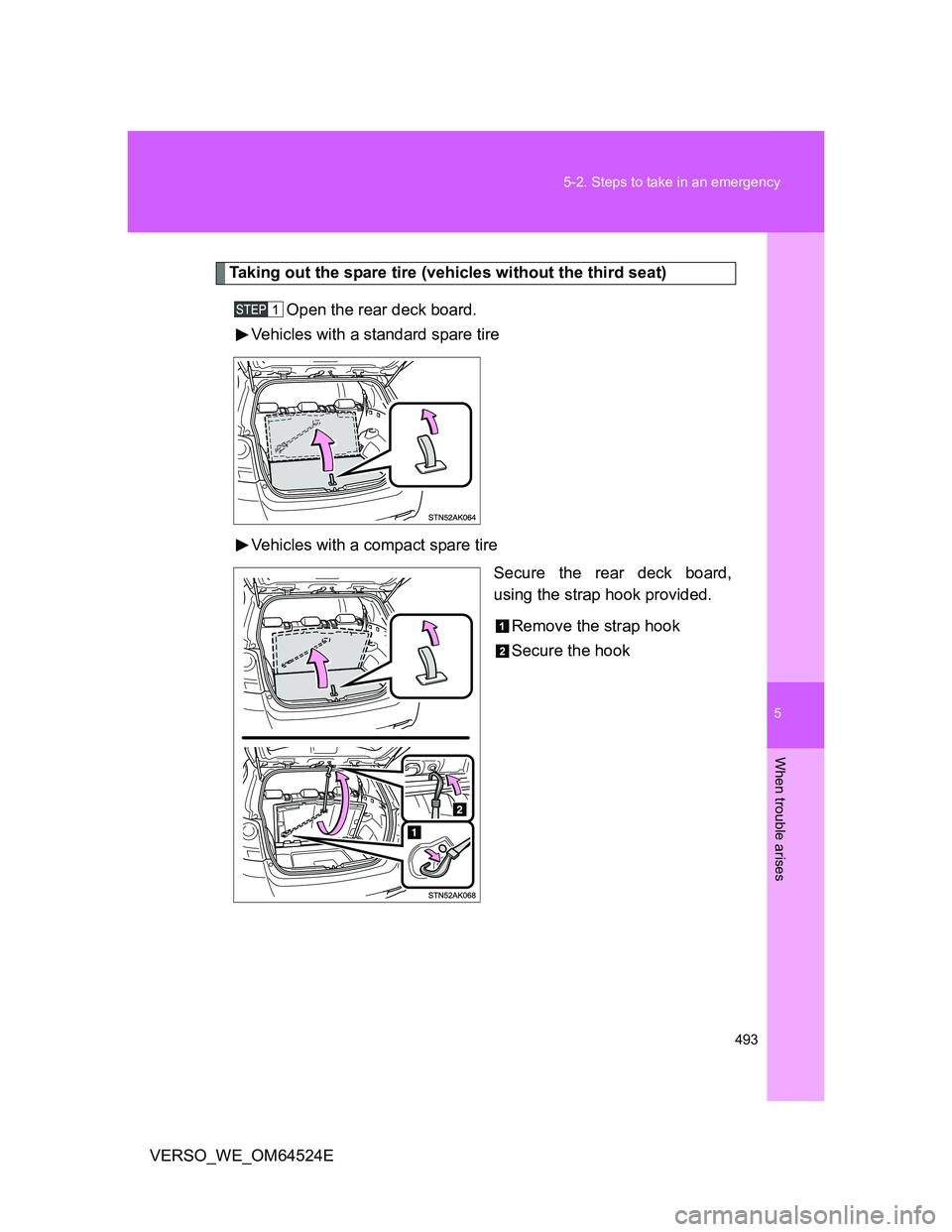
Taking out the spare tire (vehicles without the third seat)
Open the rear deck board.
Vehicles with a standard spare tire
Vehicles with a compact spare tire
Secure the rear deck board,
using the strap hook provided.
Remove the strap hook
Secure the hook
Page 494 of 588
494 5-2. Steps to take in an emergency
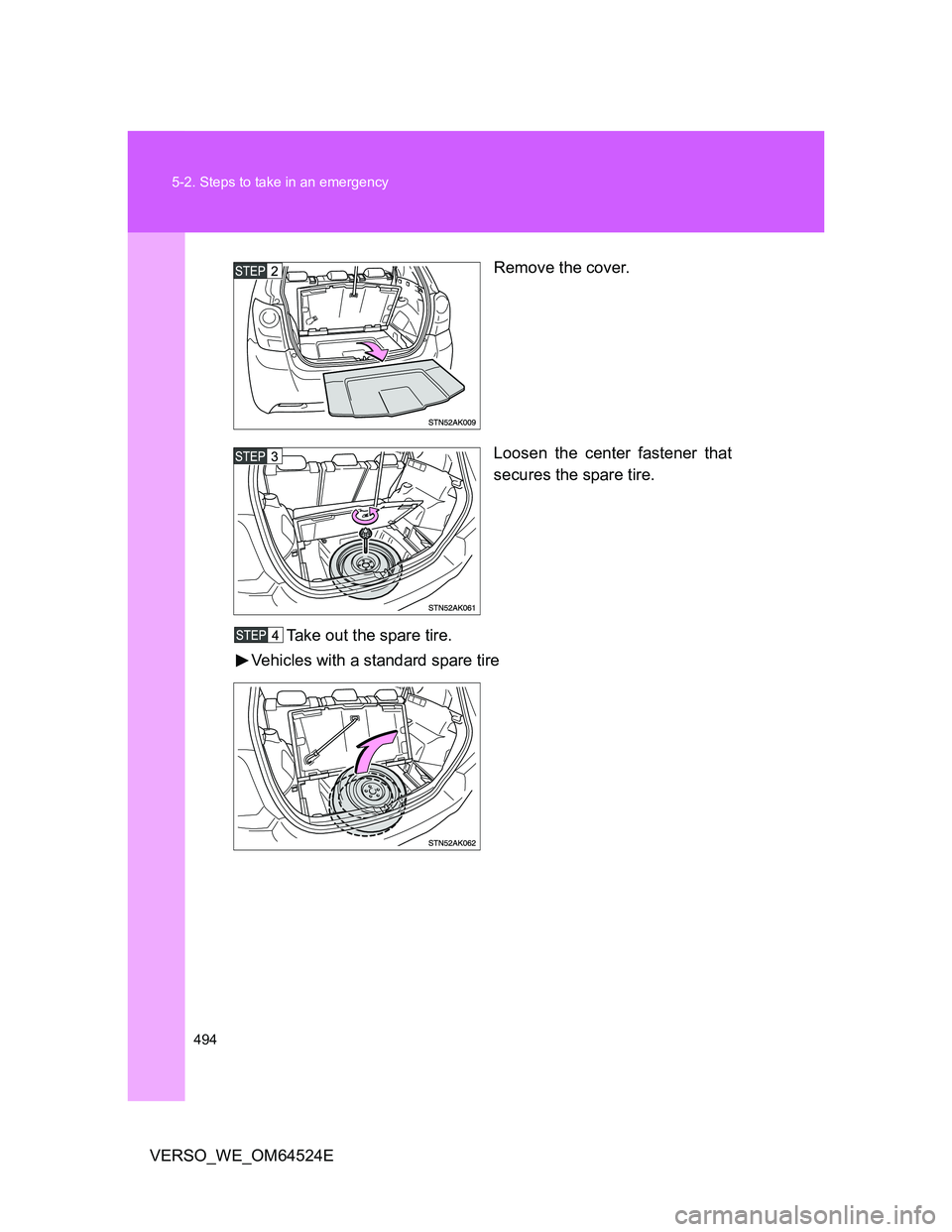
VERSO_WE_OM64524ERemove the cover.
Loosen the center fastener that
secures the spare tire.
Take out the spare tire.
Vehicles with a standard spare tire
Page 495 of 588
5
495 5-2. Steps to take in an emergency
When trouble arises
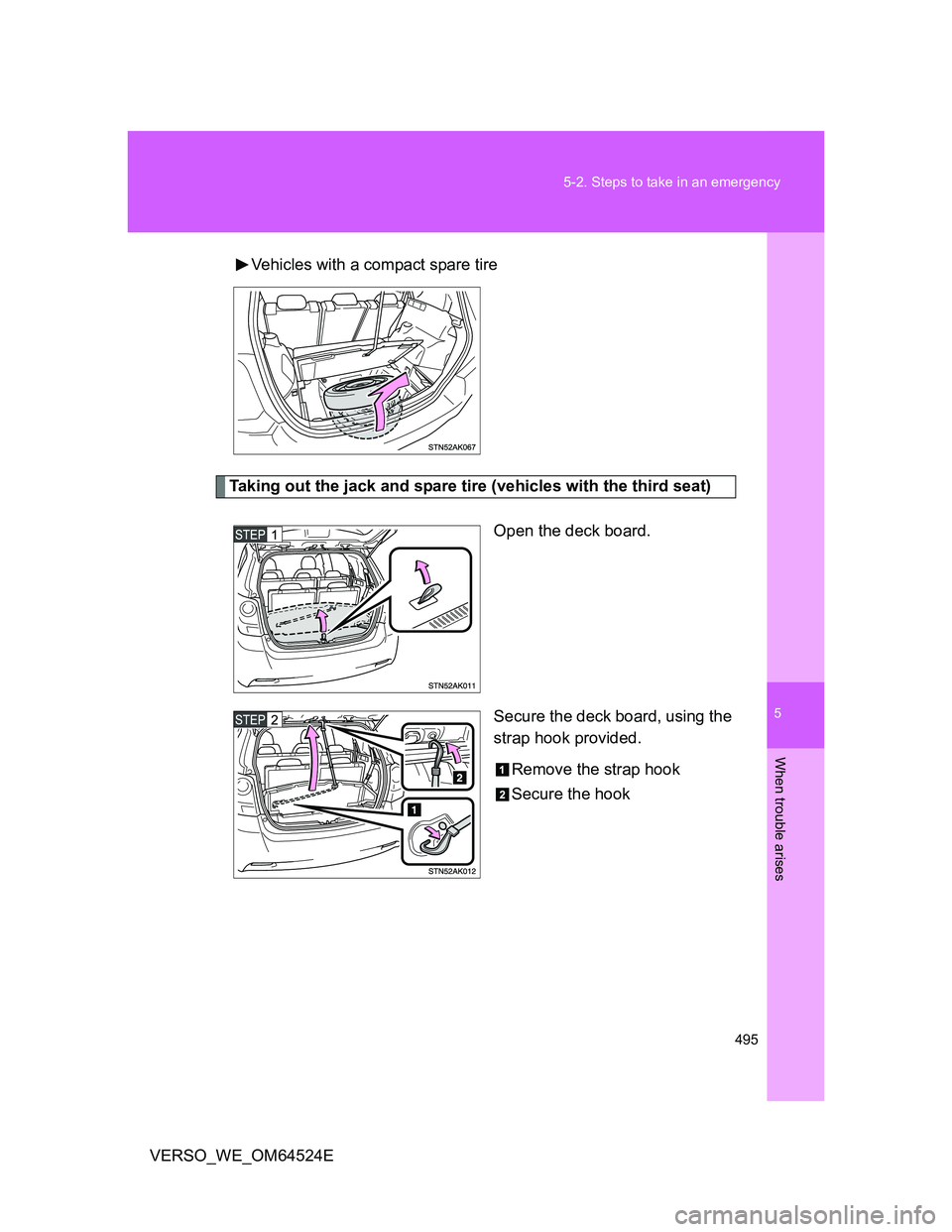
VERSO_WE_OM64524EVehicles with a compact spare tire
Taking out the jack and spare tire (vehicles with the third seat)
Open the deck board.
Secure the deck board, using the
strap hook provided.
Remove the strap hook
Secure the hook
Page 496 of 588
496 5-2. Steps to take in an emergency
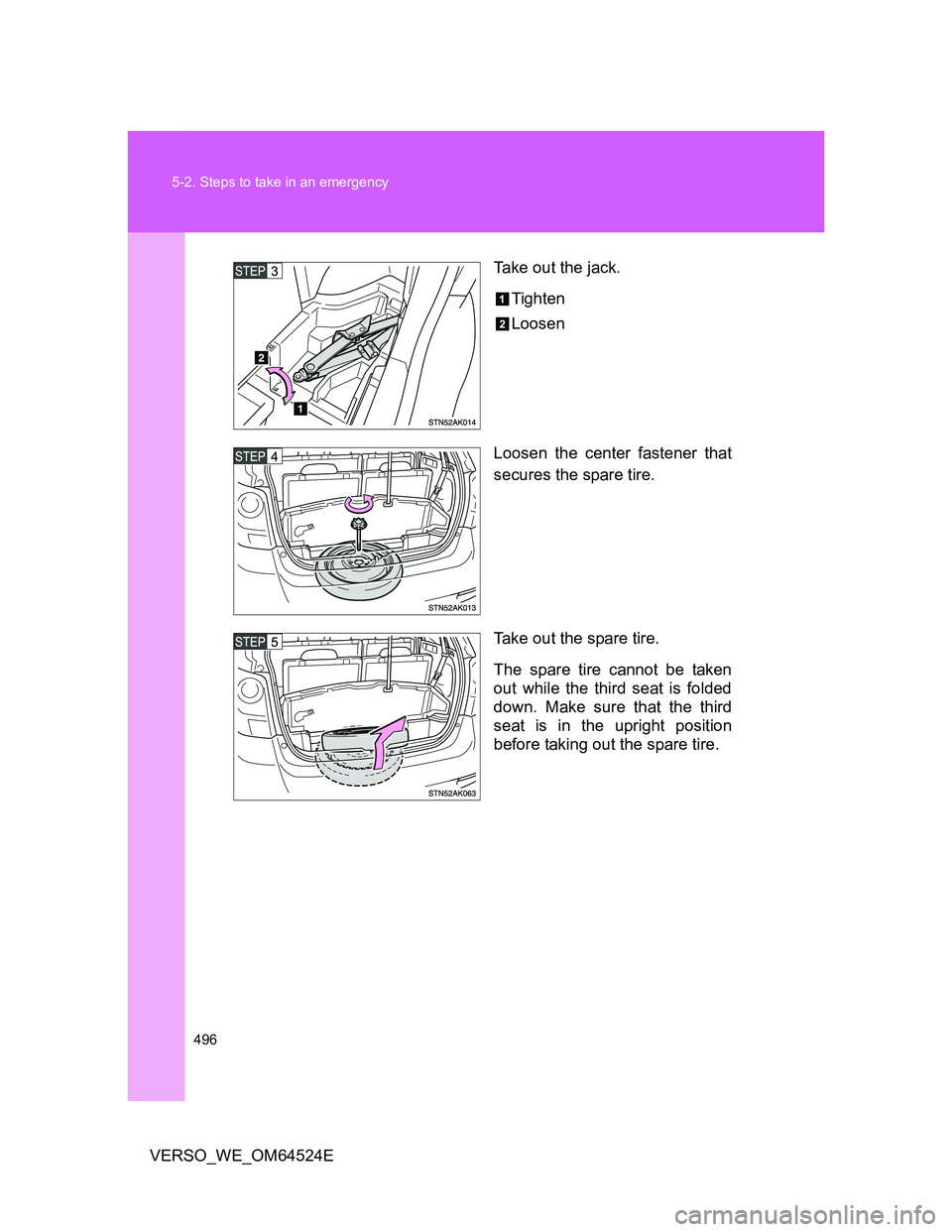
VERSO_WE_OM64524ETake out the jack.
Tighten
Loosen
Loosen the center fastener that
secures the spare tire.
Take out the spare tire.
The spare tire cannot be taken
out while the third seat is folded
down. Make sure that the third
seat is in the upright position
before taking out the spare tire.
Page 503 of 588
5
503 5-2. Steps to take in an emergency
When trouble arises
VERSO_WE_OM64524E
CAUTION
Using the tire jack
Improper use of the tire jack may lead to death or serious injuries due to the
vehicle suddenly falling off the jack.
Do not use the tire jack for any purpose other than replacing tires or install-
ing and removing tire chains.
Only use the tire jack that comes with this vehicle for replacing a flat tire.
Do not use it on other vehicles, and do not use other tire jacks for replac-
ing tires on this vehicle.
Always check that the tire jack is securely set to the jack point.
Do not put any part of your body under the vehicle supported by a jack.
Do not start or run the engine while your vehicle is supported by the jack.
Do not raise the vehicle while someone is in it.
When raising the vehicle, do not put an object on or under the jack.
Do not raise the vehicle to a height greater than that required to replace
the tire.
Use a jack stand if it is necessary to get under the vehicle.
Take particular care when lowering the vehicle to ensure that no one working
on or near the vehicle will be injured.
Replacing a flat tire
Observe the following precautions.
Failure to do so may result in serious injury:
• Do not try to remove the wheel ornament by hand. Take due care in
handling the ornament to avoid unexpected personal injury.
• Do not touch the disc wheels or the area around the brakes immedi-
ately after the vehicle has been driven.
After the vehicle has been driven the disc wheels and the area around
the brakes will be extremely hot. Touching these areas with hands, feet
or other body parts while changing a tire, etc. may result in burns.