brake light TOYOTA VERSO 2012 User Guide
[x] Cancel search | Manufacturer: TOYOTA, Model Year: 2012, Model line: VERSO, Model: TOYOTA VERSO 2012Pages: 588, PDF Size: 31.32 MB
Page 214 of 588
214
2-1. Driving procedures
VERSO_WE_OM64524E
Parking brake
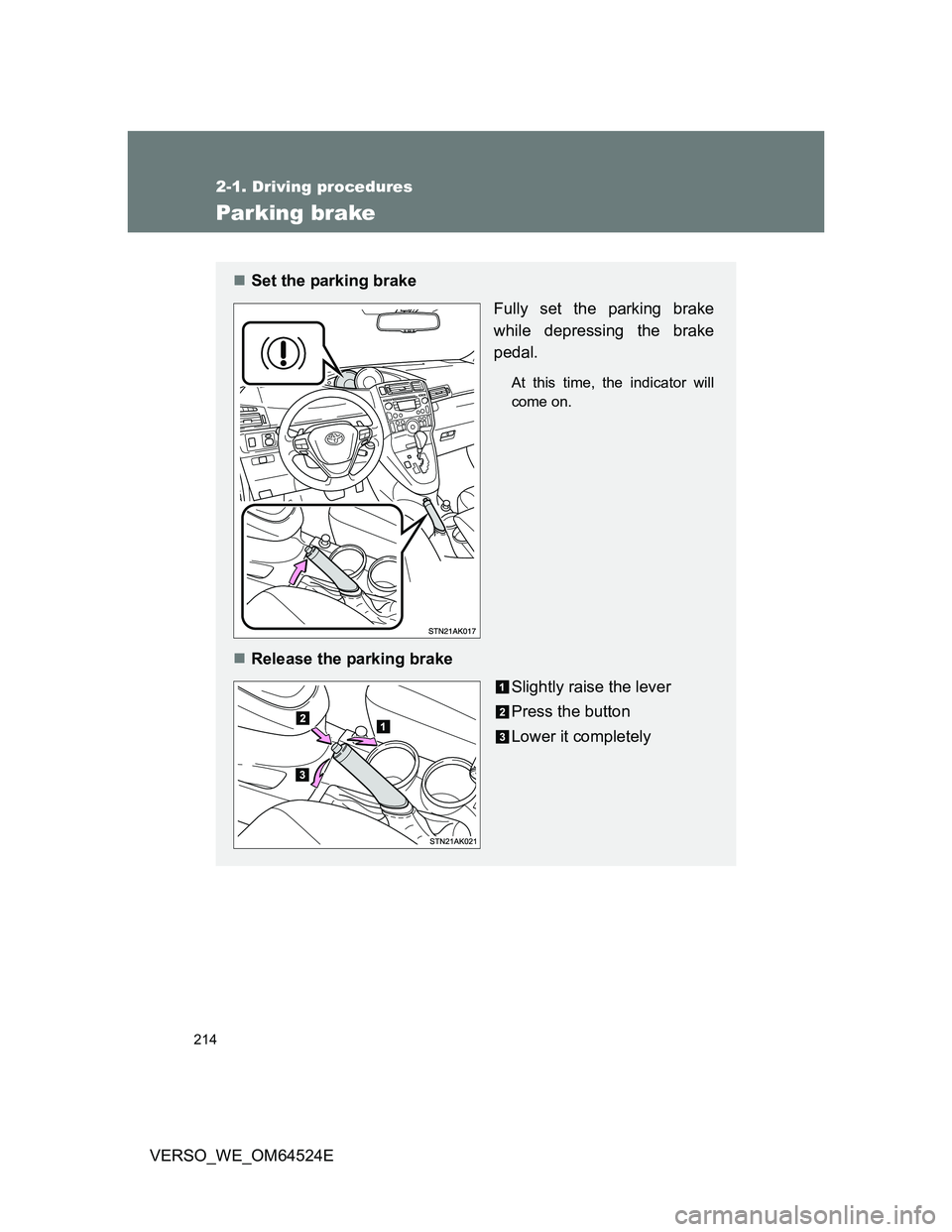
Set the parking brake
Fully set the parking brake
while depressing the brake
pedal.
At this time, the indicator will
come on.
Release the parking brake
Slightly raise the lever
Press the button
Lower it completely
Page 265 of 588
265 2-4. Using other driving systems
2
When driving
VERSO_WE_OM64524E
Sensor detection information
Certain vehicle conditions and the surrounding environment may affect
the ability of a sensor to correctly detect an obstacle. Particular instances
where this may occur are listed below.
• There is dirt, snow or ice on a sensor.
• A sensor is frozen.
• A sensor is covered in any way.
• The vehicle is leaning considerably to one side.
• On an extremely bumpy road, on an incline, on gravel, or on grass.
• The vicinity of the vehicle is noisy due to vehicle horns, motorcycle
engines, air brakes of large vehicles, or other loud noises producing
ultrasonic waves.
• There is another vehicle equipped with parking assist sensors in the
vicinity.
• A sensor is coated with a sheet of spray or heavy rain.
• The vehicle is equipped with a fender pole or radio antenna.
• Towing eyelet is installed.
• A bumper or sensor receives a strong impact.
• The vehicle is approaching a tall or right-angled curb.
• In harsh sunlight or intense cold weather.
• A non-genuine Toyota suspension (lowered suspension etc.) is
installed.
In addition to the examples above, there are instances in which, because of
their shape, signs and other objects may be judged by a sensor to be closer
than they are.
The shape of the obstacle may prevent a sensor from detecting it. Pay
particular attention to the following obstacles:
• Wires, fences, ropes, etc.
• Cotton, snow and other materials that absorb sound waves
• Sharply-angles objects
• Low obstacles
• Tall obstacles with upper sections projecting outwards in the direction
of your vehicle
Page 270 of 588
270 2-4. Using other driving systems
VERSO_WE_OM64524E
Sounds and vibrations caused by the ABS, brake assist, TRC and
VSC+
A sound may be heard from the engine compartment when the engine is
started or just after the vehicle begins to move. This sound does not indi-
cate that a malfunction has occurred in any of these systems.
Any of the following conditions may occur when the above systems are
operating. None of these indicates that a malfunction has occurred.
• Vibrations may be felt through the vehicle body and steering.
• A motor sound may be heard after the vehicle comes to a stop.
• The brake pedal may pulsate slightly after the ABS is activated.
• The brake pedal may move down slightly after the ABS is activated.
EPS operation sound
When the steering wheel operates, a motor sound (whirring sound) may be
heard. This does not indicate a malfunction.
Reduced effectiveness of EPS
The effectiveness of EPS is reduced to prevent the system from overheating
when there is frequent steering input over an extended period of time. The
steering wheel may feel heavy as a result. Should this occur, refrain from
excessive steering input or stop the vehicle and turn the engine off. The sys-
tem should return to normal after about 10 minutes.
Page 273 of 588
273
2-4. Using other driving systems
2
When driving
VERSO_WE_OM64524E
Hill-start assist control
: If equipped
Hill-start assist control operating conditions
The hill-start assist control system operates under the following condi-
tions.
• The shift lever is in a position other than “P”.
• The parking brake is not applied.
• The accelerator pedal is not depressed.
The hill-start assist control system does not operate when “CHECK VSC
SYSTEM” is displayed on the multi-information display.
Hill-start assist control
While hill-start assist control is operating, the brakes remain automati-
cally applied after the driver releases the brake pedal. The stop lights and
the high mounted stoplight turn on.
Hill-start assist control operates for about 2 seconds after the brake pedal
is released.
If the slip indicator does not flash and the buzzer does not sound when
the brake pedal is further depressed, slightly reduce the pressure on the
brake pedal (do not allow the vehicle to roll backward) and then firmly
depress it again. If the system still does not operate, check if the operat-
ing conditions explained above have been met.
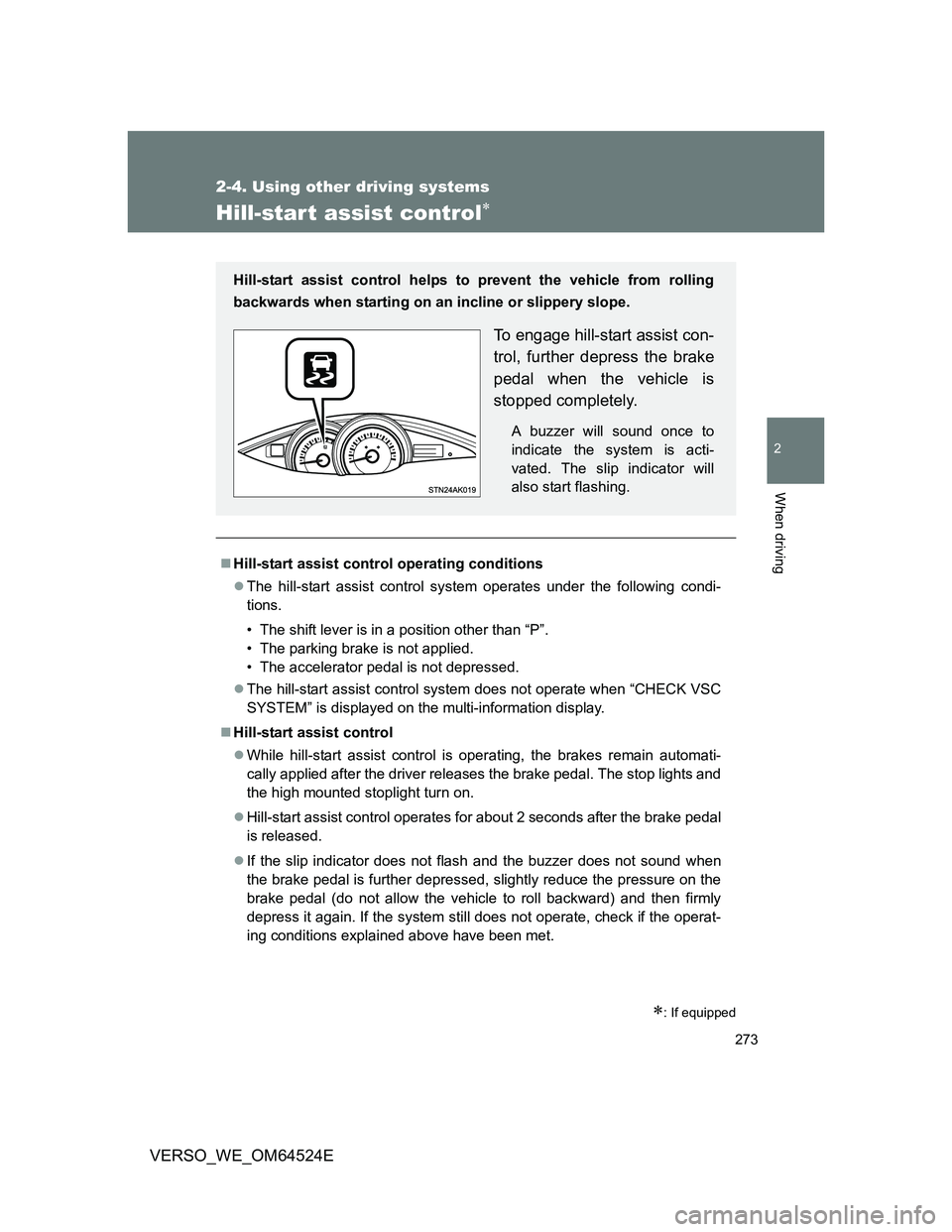
Hill-start assist control helps to prevent the vehicle from rolling
backwards when starting on an incline or slippery slope.
To engage hill-start assist con-
trol, further depress the brake
pedal when the vehicle is
stopped completely.
A buzzer will sound once to
indicate the system is acti-
vated. The slip indicator will
also start flashing.
Page 289 of 588
289 2-5. Driving information
2
When driving
VERSO_WE_OM64524EImportant points regarding turning
The wheels of the trailer will travel closer to the inside of the curve
than the wheels of the vehicle. To make allowance for this, take the
turns wider than you would normally.
Important points regarding stability
Vehicle movement resulting from uneven road surfaces and strong
crosswinds will affect handling. The vehicle may also be rocked by
passing buses or large trucks. Frequently check behind when mov-
ing alongside such vehicles. As soon as such vehicle movement
occurs, immediately start to decelerate smoothly by slowly apply-
ing the brakes. Always steer the vehicle straight ahead while brak-
ing.
Passing other vehicles
Consider the total combined length of your vehicle and trailer, and
ensure that the vehicle-to-vehicle distance is sufficient before exe-
cuting lane changes.
Transmission information
Multidrive or automatic transmission
To maintain engine braking efficiency, when using engine brak-
ing, do not use the transmission in “D”. Transmission shift gear
position must be in “4” in the 7-speed sport sequential shiftmatic
mode (Multidrive) (P. 196) or the “M” mode (automatic trans-
mission) (P. 202).
Manual transmission
To maintain engine braking efficiency, when using engine brak-
ing, do not use the transmission in “5” and “6” gear. (P. 209)
When towing a trailer, check the engine coolant temperature
warning light (Red)
Towing a loaded trailer up a long steep incline in temperatures
exceeding 30C (85F) may result in the engine overheating.
If the engine coolant temperature warning light (Red) flashes or
comes on, turn the air conditioning off immediately and stop the
vehicle in a safe place. (P. 532)
Page 400 of 588
400 4-3. Do-it-yourself maintenance
VERSO_WE_OM64524E
NOTICE
If you remove the air cleaner filter
Driving with the air cleaner filter removed may cause excessive engine wear
due to dirt in the air. Also a backfire could cause a fire in the engine compart-
ment.
If the brake fluid level is low or high
It is normal for the brake fluid level to go down slightly as the brake pads
wear or when the fluid level in the accumulator is high.
If the reservoir needs frequent refilling, it may indicate a serious problem.
Page 441 of 588
441 4-3. Do-it-yourself maintenance
4
Maintenance and care
VERSO_WE_OM64524E
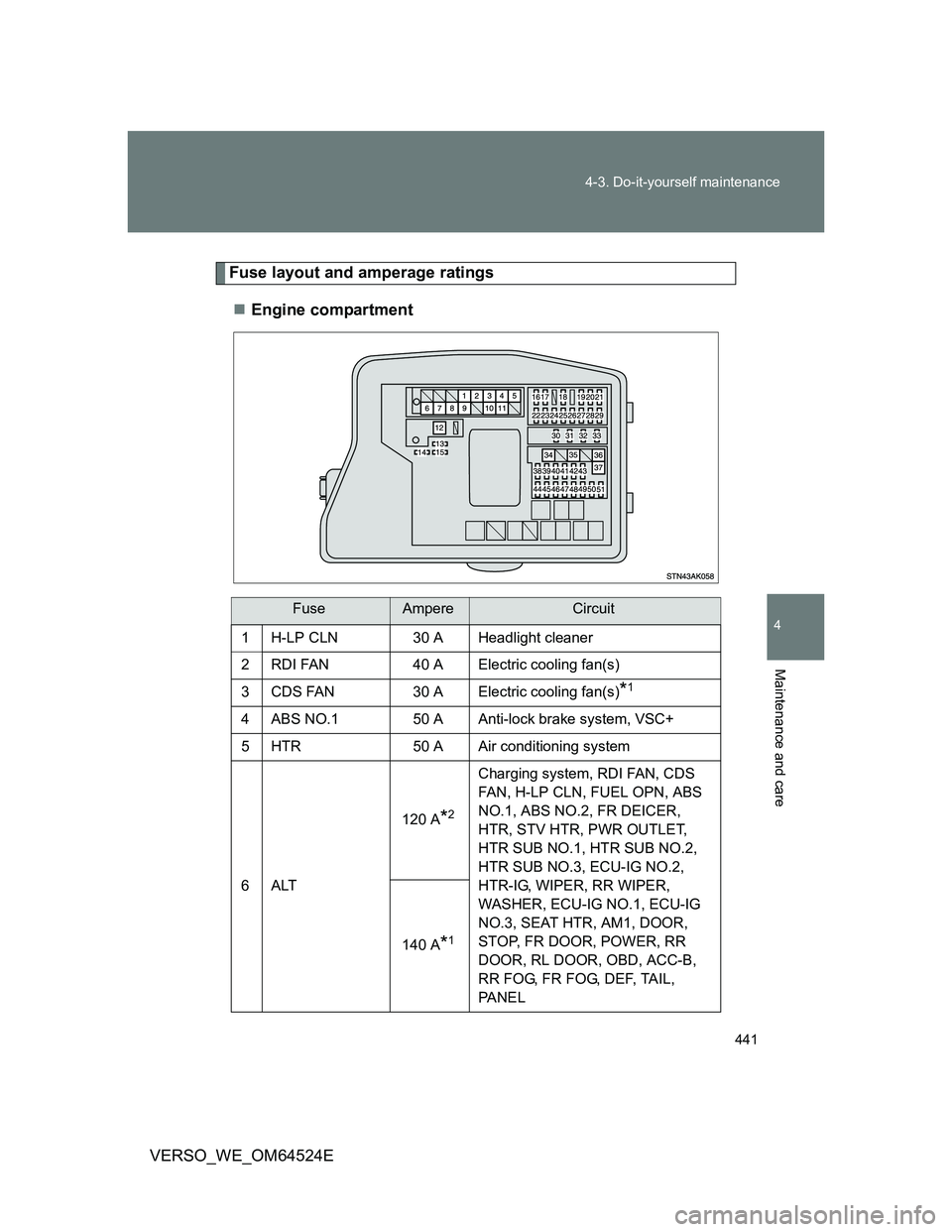
Fuse layout and amperage ratings
Engine compartment
FuseAmpereCircuit
1H-LP CLN30 A Headlight cleaner
2RDI FAN40 A Electric cooling fan(s)
3CDS FAN30 A Electric cooling fan(s)*1
4 ABS NO.1 50 A Anti-lock brake system, VSC+
5 HTR 50 A Air conditioning system
6ALT120 A
*2
Charging system, RDI FAN, CDS
FAN, H-LP CLN, FUEL OPN, ABS
NO.1, ABS NO.2, FR DEICER,
HTR, STV HTR, PWR OUTLET,
HTR SUB NO.1, HTR SUB NO.2,
HTR SUB NO.3, ECU-IG NO.2,
HTR-IG, WIPER, RR WIPER,
WASHER, ECU-IG NO.1, ECU-IG
NO.3, SEAT HTR, AM1, DOOR,
STOP, FR DOOR, POWER, RR
DOOR, RL DOOR, OBD, ACC-B,
RR FOG, FR FOG, DEF, TAIL,
PA N E L 140 A
*1
Page 446 of 588
446 4-3. Do-it-yourself maintenance
VERSO_WE_OM64524E
8ACC 7.5 AShift lock system, audio system,
main body ECU, power outlet
9 MIR HTR 10 A Outside rear view mirror defoggers
10 RR FOG 7.5 A Rear fog light
11 I G N 7 . 5 ASteering lock system, SRS airbag
system, multiport fuel injection sys-
tem/sequential multiport fuel injec-
tion system, automatic
transmission
*1, starting system
12 METER 7.5 A Gauges and meters
13 SEAT HTR
*2 15 A Seat heaters
14 HTR-IG 10 A Air conditioning system
15 WIPER 25 AWindshield wipers, rain-sensing
windshield wipers
16 RR WIPER 15 A Rear window wiper
17 WASHER 15 AWindshield washers, rear window
washer
18 ECU-IG NO.1 10 AMain body ECU, electric cooling
fan(s), shift lock system, anti-lock
brake system, steering sensor,
VSC+, headlight cleaner,
SEQUENTIAL switch, automatic
headlight leveling system, Electric
Power Steering
19 ECU-IG NO.2 10 ABack-up lights, charging system,
emergency flashers, rear window
defogger, front passenger’s seat
belt reminder light, “PASSENGER
AIRBAG” indicator, air conditioning
system, Toyota parking assist-sen-
sor indicator, Toyota parking assist-
sensor switch
20 OBD 7.5 A On-board diagnosis system
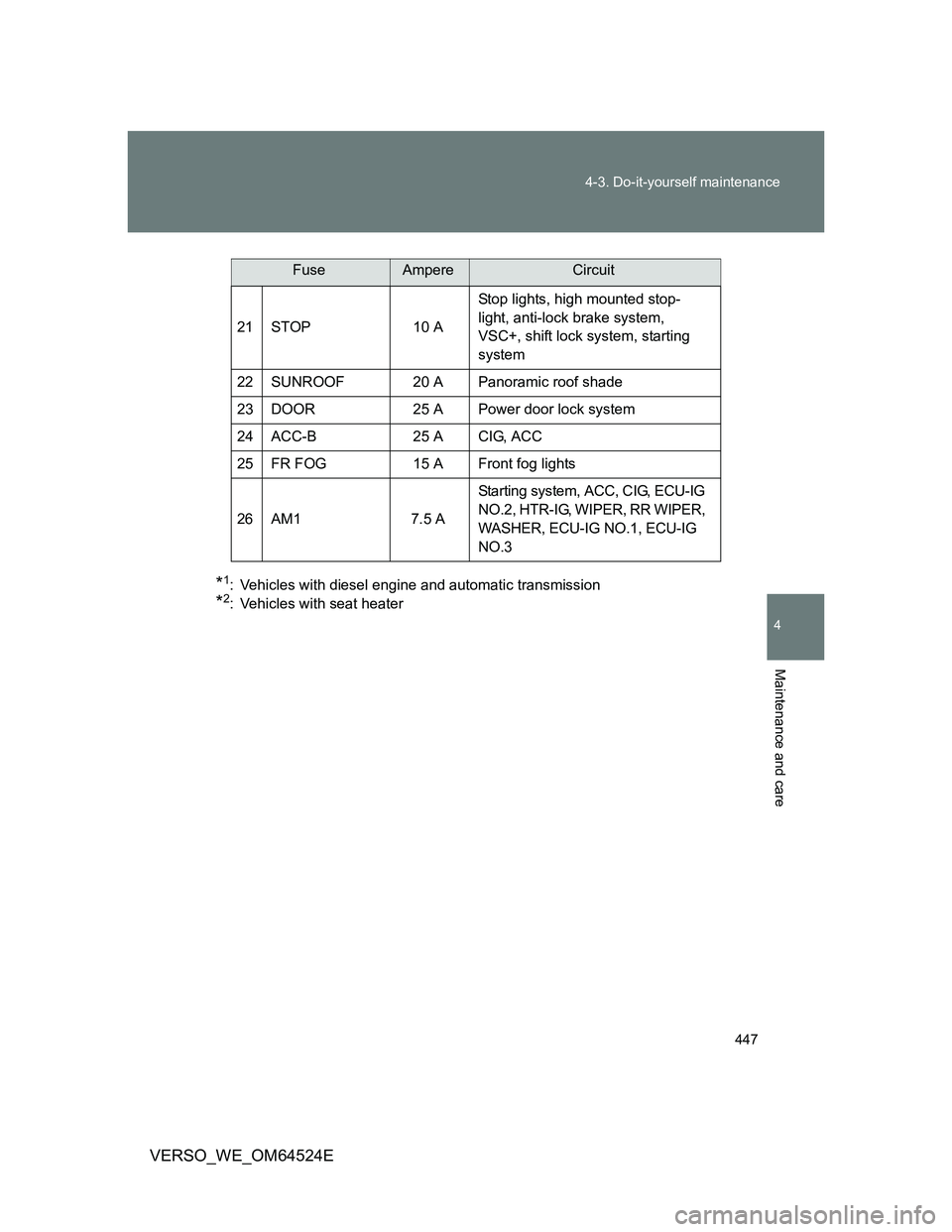
FuseAmpereCircuit
Page 447 of 588
447 4-3. Do-it-yourself maintenance
4
Maintenance and care
VERSO_WE_OM64524E
*1: Vehicles with diesel engine and automatic transmission
*2: Vehicles with seat heater21 STOP 10 AStop lights, high mounted stop-
light, anti-lock brake system,
VSC+, shift lock system, starting
system
22 SUNROOF 20 A Panoramic roof shade
23 DOOR 25 A Power door lock system
24 ACC-B 25 A CIG, ACC
25 FR FOG 15 A Front fog lights
26 AM1 7.5 AStarting system, ACC, CIG, ECU-IG
NO.2, HTR-IG, WIPER, RR WIPER,
WASHER, ECU-IG NO.1, ECU-IG
NO.3
FuseAmpereCircuit
Page 473 of 588
5
473
5-1. Essential information
When trouble arises
VERSO_WE_OM64524E
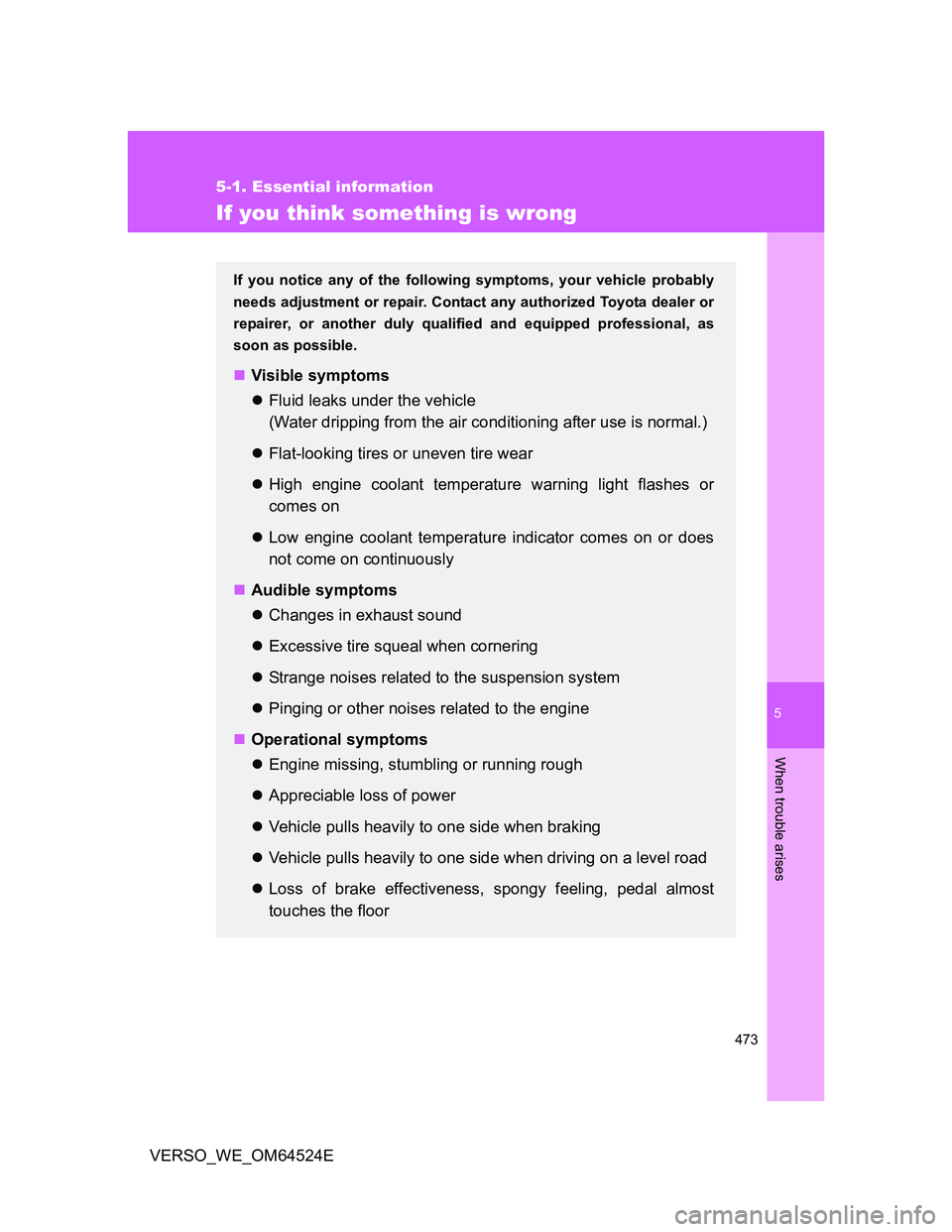
If you think something is wrong
If you notice any of the following symptoms, your vehicle probably
needs adjustment or repair. Contact any authorized Toyota dealer or
repairer, or another duly qualified and equipped professional, as
soon as possible.
Visible symptoms
Fluid leaks under the vehicle
(Water dripping from the air conditioning after use is normal.)
Flat-looking tires or uneven tire wear
High engine coolant temperature warning light flashes or
comes on
Low engine coolant temperature indicator comes on or does
not come on continuously
Audible symptoms
Changes in exhaust sound
Excessive tire squeal when cornering
Strange noises related to the suspension system
Pinging or other noises related to the engine
Operational symptoms
Engine missing, stumbling or running rough
Appreciable loss of power
Vehicle pulls heavily to one side when braking
Vehicle pulls heavily to one side when driving on a level road
Loss of brake effectiveness, spongy feeling, pedal almost
touches the floor