wheel TOYOTA VERSO 2013 Owners Manual
[x] Cancel search | Manufacturer: TOYOTA, Model Year: 2013, Model line: VERSO, Model: TOYOTA VERSO 2013Pages: 616, PDF Size: 39.6 MB
Page 540 of 616
540 5-2. Steps to take in an emergency
VERSO_WE_OM64550E_EURO5
Emergency tire puncture repair kit
The sealant stored in the emergency tire puncture repair kit can be used
only once to temporarily repair a single tire. If the sealant has been used
and needs to be replaced, purchase a new bottle at any authorized Toy-
ota dealer or repairer, or another duly qualified and equipped profes-
sional. The compressor is reusable.
The sealant can be used when the outside temperature is from -30°C
(-22°F) to 60°C (140°F).
The repair kit is exclusively designed for size and type of tires originally
installed on your vehicle. Do not use it for tires that a different size than
the original ones, or for any other purposes.
The sealant has a limited lifespan. The expiry date is marked on the bot-
tle. The bottle of sealant should be replaced with a new bottle before the
expiry date. Contact any authorized Toyota dealer or repairer, or another
duly qualified and equipped professional for replacement.
If the sealant gets on your clothes, it may stain.
If the sealant adheres to a wheel or the surface of the vehicle body, the
stain may not be removable if it is not cleaned at once. Immediately wipe
away the sealant with a wet cloth.
During operation of the repair kit, a loud operation noise is produced.
This does not indicate a malfunction.
Do not use to check or to adjust the tire pressure.
Page 541 of 616
5
541 5-2. Steps to take in an emergency
When trouble arises
VERSO_WE_OM64550E_EURO5
CAUTION
Do not drive the vehicle with a flat tire
Do not continue driving with a flat tire.
Driving even a short distance with a flat tire can damage the tire and the
wheel beyond repair.
Driving with a flat tire may cause a circumferential groove on the side wall. In
such a case, the tire may explode when using a repair kit.
Caution while driving
Store the repair kit in the luggage room.
Injuries may result in the event of an accident or sudden braking.
The repair kit is exclusively only for your vehicle.
Do not use repair kit on other vehicles, which could lead to an accident
causing death or serious injury.
Do not use repair kit for tires that are different size than the original ones,
or for any other purpose. If the tires have not been completely repaired, it
could lead to an accident causing death or serious injury.
Precautions for use of the sealant
Ingesting the sealant is hazardous to your health. If you ingest sealant,
consume as much water as possible, and then immediately consult a doc-
tor.
If sealant gets in eyes or adheres to skin, immediately wash it off with
water. If discomfort persists, consult a doctor.
When fixing the flat tire
Stop your vehicle in a safe and flat area.
Do not touch the wheels or the area around the brakes immediately after
the vehicle has been driven.
After the vehicle has been driven, the wheels and the area around the
brakes may be extremely hot. Touching these areas with hands, feet or
other body parts may result in burns.
To avoid risk of burst or severe leakage, do not drop or damage the bottle.
Visually inspect the bottle before use. Do not use a bottle with shock,
crack, scratch, leakage or any other damage. In such case, immediately
replace.
Page 542 of 616
542 5-2. Steps to take in an emergency
VERSO_WE_OM64550E_EURO5
CAUTION
Connect the valve and hose securely with the tire installed on the vehicle.
If the hose is not properly connected to the valve, air leakage may occur
as sealant may be sprayed out.
If the hose comes off the valve while inflating the tire, there is a risk that
the hose will move abruptly due to air pressure.
After inflation of the tire has completed, the sealant may splatter when the
hose is disconnected or some air is let out of the tire.
Follow the operation procedure to repair the tire. If the procedures not fol-
lowed, the sealant may spray out.
Keep back from the tire while it is being repaired, as there is a chance of it
bursting while the repair operation is being performed. If you notice any
cracks or deformation of the tire, turn off the compressor switch and stop
the repair operation immediately.
The repair kit may overheat if operated for a long period of time. Do not
operate the repair kit continuously for more than 40 minutes.
Parts of the repair kit become hot during operation. Be careful when han-
dling the repair kit during and after operation. Do not touch the metal part
around the connecting area between the bottle and compressor. It will be
extremely hot.
Do not attach the vehicle speed warning sticker to an area other than the
one indicated. If the sticker is attached to an area where an SRS airbag is
located, such as the pad of the steering wheel, it may prevent the SRS air-
bag from operating properly.
Driving to spread the liquid sealant evenly
Observe the following precautions to reduce the risk of accidents.
Failing to do so may result in a loss of vehicle control and cause death or
serious injury.
Drive the vehicle carefully at a low speed. Be especially careful when turn-
ing and cornering.
If the vehicle does not drive straight or you feel a pull through the steering
wheel, stop the vehicle and check the following.
• Tire condition. The tire may have separated from the wheel.
• Tire inflation pressure. If the tire inflation pressure is 130 kPa (1.3
kgf/cm
2 or bar, 19 psi) or less, the tire may be severely damaged.
Page 561 of 616
5
561
5-2. Steps to take in an emergency
When trouble arises
VERSO_WE_OM64550E_EURO5
If the vehicle becomes stuck
When it is difficult to free the vehicle
Emergency hook
Carry out the following procedures if the tires spin or the vehicle
becomes stuck in mud, dirt or snow:
Stop the engine. Set the parking brake and shift the shift
lever in “P” (Multidrive or automatic transmission) or “N”
(manual transmission).
Remove the mud, snow or sand from around the front
wheels.
Place wood, stones or some other material under the front
wheels to help provide traction.
Restart the engine.
Shift the shift lever to the “D” or “R” position (Multidrive or
automatic transmission) or “1” or “R” position (manual
transmission) and release the parking brake. Then, while
exercising caution, depress the accelerator pedal.
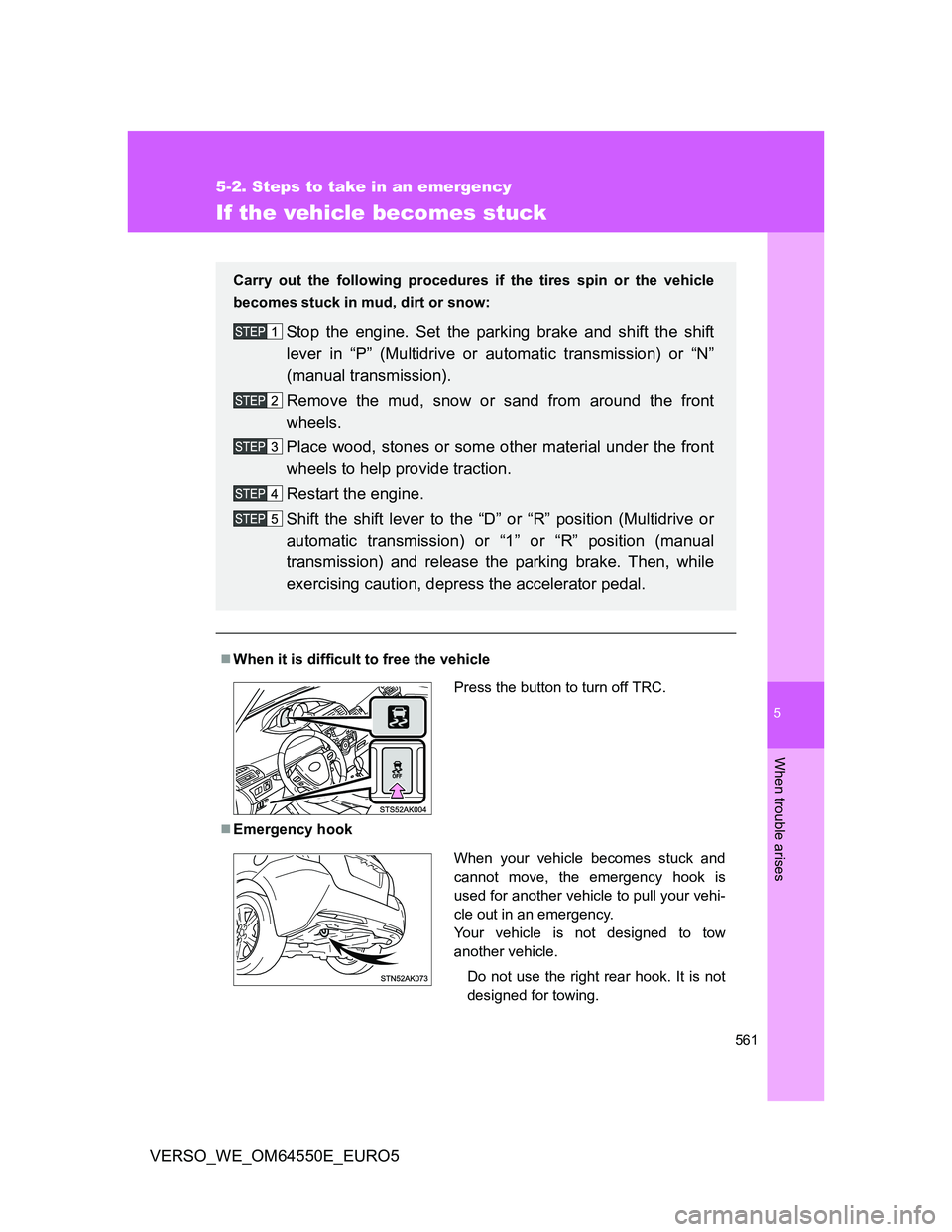
Press the button to turn off TRC.
When your vehicle becomes stuck and
cannot move, the emergency hook is
used for another vehicle to pull your vehi-
cle out in an emergency.
Your vehicle is not designed to tow
another vehicle.
Do not use the right rear hook. It is not
designed for towing.
Page 562 of 616
562 5-2. Steps to take in an emergency
VERSO_WE_OM64550E_EURO5
CAUTION
When attempting to free a stuck vehicle
If you choose to push the vehicle back and forth to free it, make sure the sur-
rounding area is clear to avoid striking other vehicles, objects or people. The
vehicle may also lunge forward or lunge back suddenly as it becomes free.
Use extreme caution.
When shifting the shift lever
Vehicles with a Multidrive or an automatic transmission: Be careful not to
shift the shift lever with the accelerator pedal depressed.
This may lead to unexpected rapid acceleration of the vehicle that may
cause an accident resulting in death or serious injury.
NOTICE
To avoid damage to the transmission and other components
Avoid spinning the front wheels and depressing the accelerator pedal
more than necessary.
If the vehicle remains stuck even after these procedures are performed,
the vehicle may require towing to be freed.
Page 564 of 616
564 5-2. Steps to take in an emergency
VERSO_WE_OM64550E_EURO5
CAUTION
If the engine has to be turned off while driving
Power assist for the brakes and steering wheel will be lost, making the
brake pedal harder to depress and the steering wheel heavier to turn.
Decelerate as much as possible before turning off the engine.
Vehicles without smart entry & start system: Never attempt to remove the
key, as doing so will lock the steering wheel.
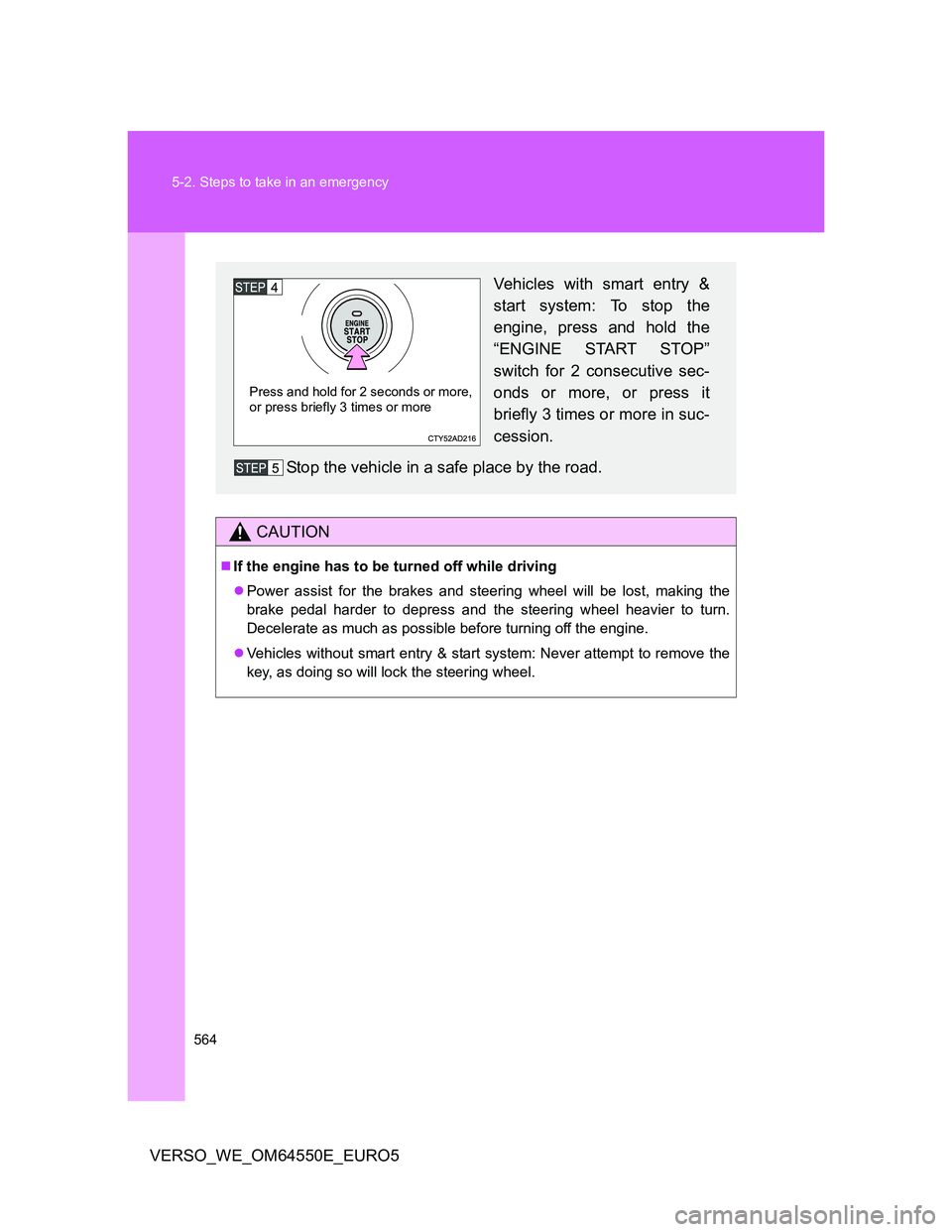
Vehicles with smart entry &
start system: To stop the
engine, press and hold the
“ENGINE START STOP”
switch for 2 consecutive sec-
onds or more, or press it
briefly 3 times or more in suc-
cession.
Stop the vehicle in a safe place by the road.
Press and hold for 2 seconds or more,
or press briefly 3 times or more
Page 566 of 616
566
VERSO_WE_OM64550E_EURO5
6-1. Specifications
Maintenance data (fuel, oil level, etc.)
Dimensions and weights
Overall length 4440 mm (174.8 in.)
Overall width 1790 mm (70.5 in.)
Overall height *1
205/60R16 tiresWithout roof rail
1620 mm (63.8 in.)
1630 mm (64.2 in.)
*2,*3
With roof rail
1660 mm (65.4 in.)
1670 mm (65.7 in.)
*2,*3
215/55R17 tiresWithout roof rail
1630 mm (64.2 in.)
1640 mm (64.6 in.)
*2
With roof rail
1670 mm (65.7 in.)
1680 mm (66.1 in.)
*2
Wheelbase 2780 mm (109.4 in.)
TreadFront 1535 mm (60.4 in.)
Rear 1545 mm (60.8 in.)
Gross vehicle mass1935 kg (4266 lb.)
*3, 4, *3, 5
2125 kg (4686 lb.) *4,*5
2060 kg (4542 lb.) *3, 6
2260 kg (4983 lb.) *6,*7
Maximum
permissible axle
capacityFront1220 kg (2690 lb.)
*4,*5
1260 kg (2778 lb.) *6,*7
Rear1180 kg (2601 lb.) *4,*5,*6
1250 kg (2756 lb.) *7
Page 586 of 616
586 6-1. Specifications
VERSO_WE_OM64550E_EURO5
Tires and wheels
16 inch tires
Tire size205/60R16 92V,
T145/70D17 106M (compact spare)
1ZR-FAE and
2ZR-FAE engines
Tire inflation pressure
(Recommended cold tire
inflation pressure)Vehicle
speedFront wheel
kPa (kgf/cm
2
or bar, psi)Rear wheel
kPa (kgf/cm2
or bar, psi)
160 km/h
(99 mph) or
less240 (2.4, 35) 230 (2.3, 33)
More than
160 km/h
(99 mph)270 (2.7, 40) 260 (2.6, 38)
1AD-FTV engine
Tire inflation pressure
(Recommended cold tire
inflation pressure)Vehicle
speedFront wheel
kPa (kgf/cm
2
or bar, psi)Rear wheel
kPa (kgf/cm2
or bar, psi)
160 km/h
(99 mph) or
less250 (2.5, 36) 230 (2.3, 33)
More than
160 km/h
(99 mph)280 (2.8, 41) 260 (2.6, 38)
Tire inflation pressure
(compact spare)
(Recommended cold tire
inflation pressure)420 kPa (4.2 kgf/cm
2 or bar, 60 psi)
Wheel size16 6 1/2J,
17 4T (compact spare)
Wheel nut torque 103 N·m (10.5 kgf·m, 76 ft·lbf)
Page 587 of 616
587 6-1. Specifications
6
Vehicle specifications
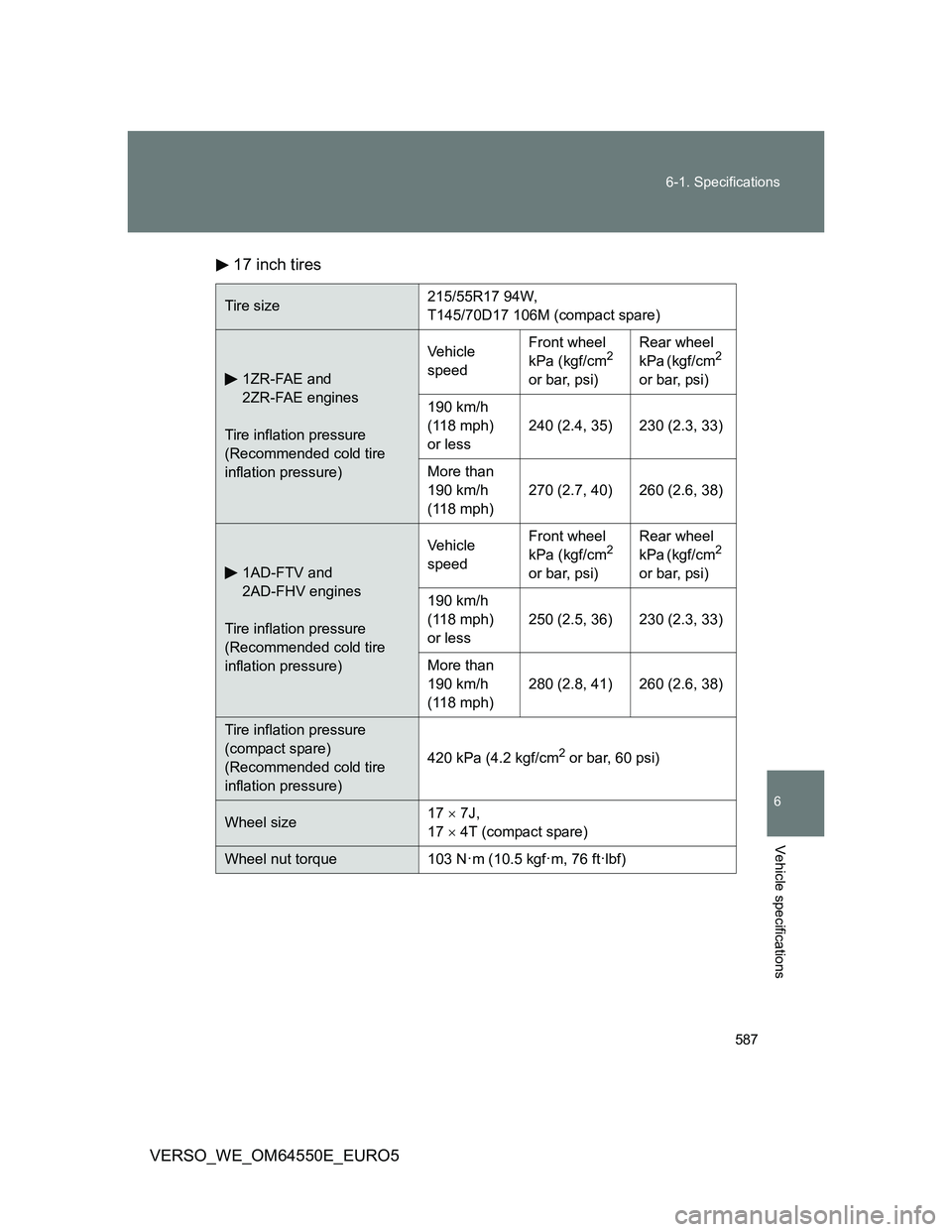
VERSO_WE_OM64550E_EURO517 inch tires
Tire size215/55R17 94W,
T145/70D17 106M (compact spare)
1ZR-FAE and
2ZR-FAE engines
Tire inflation pressure
(Recommended cold tire
inflation pressure)Vehicle
speedFront wheel
kPa (kgf/cm
2
or bar, psi)Rear wheel
kPa (kgf/cm2
or bar, psi)
190 km/h
(118 mph)
or less240 (2.4, 35) 230 (2.3, 33)
More than
190 km/h
(118 mph)270 (2.7, 40) 260 (2.6, 38)
1AD-FTV and
2AD-FHV engines
Tire inflation pressure
(Recommended cold tire
inflation pressure)Vehicle
speedFront wheel
kPa (kgf/cm
2
or bar, psi)Rear wheel
kPa (kgf/cm2
or bar, psi)
190 km/h
(118 mph)
or less250 (2.5, 36) 230 (2.3, 33)
More than
190 km/h
(118 mph)280 (2.8, 41) 260 (2.6, 38)
Tire inflation pressure
(compact spare)
(Recommended cold tire
inflation pressure)420 kPa (4.2 kgf/cm
2 or bar, 60 psi)
Wheel size17 7J,
17 4T (compact spare)
Wheel nut torque 103 N·m (10.5 kgf·m, 76 ft·lbf)
Page 601 of 616
601
VERSO_WE_OM64550E_EURO5
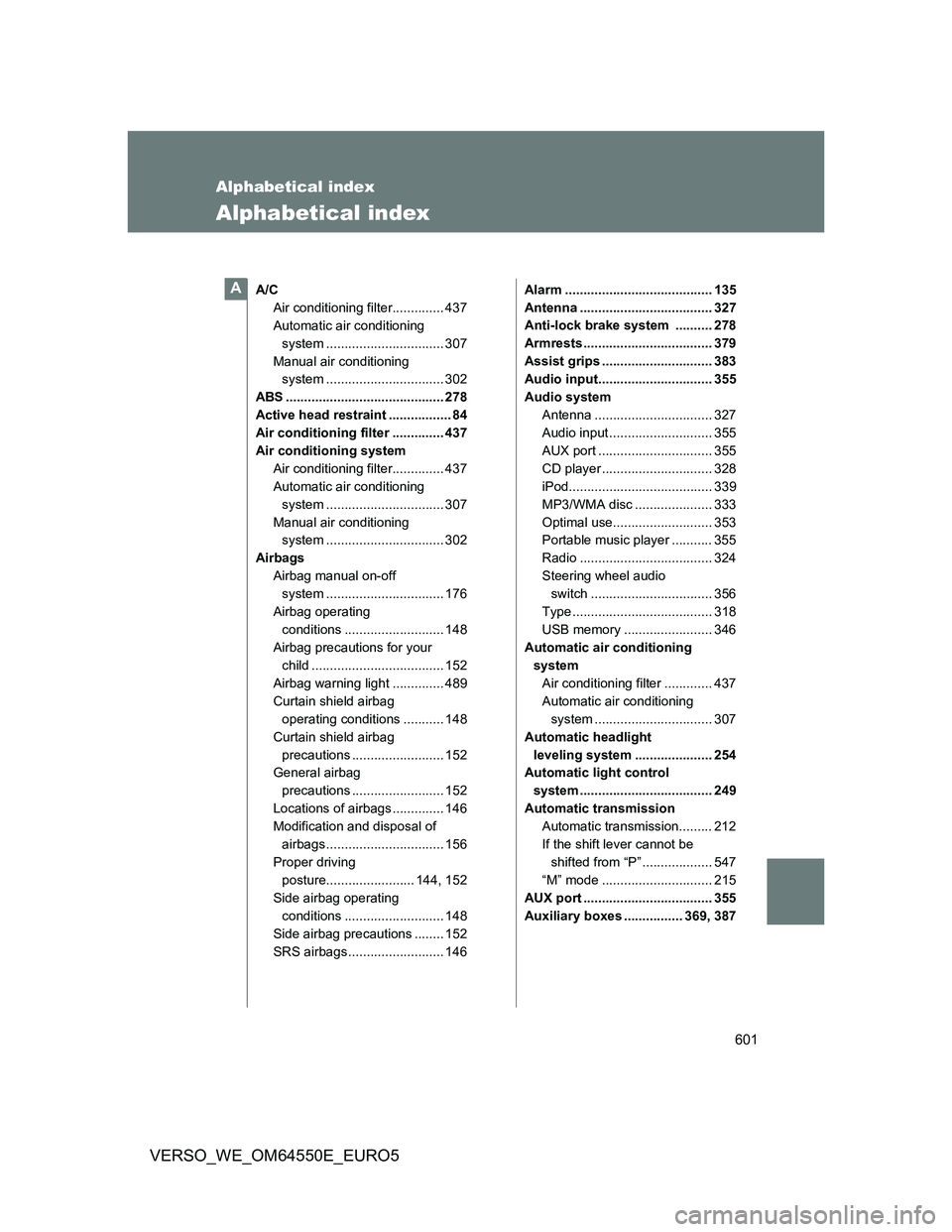
Alphabetical index
Alphabetical index
A/C
Air conditioning filter.............. 437
Automatic air conditioning
system ................................ 307
Manual air conditioning
system ................................ 302
ABS ........................................... 278
Active head restraint ................. 84
Air conditioning filter .............. 437
Air conditioning system
Air conditioning filter.............. 437
Automatic air conditioning
system ................................ 307
Manual air conditioning
system ................................ 302
Airbags
Airbag manual on-off
system ................................ 176
Airbag operating
conditions ........................... 148
Airbag precautions for your
child .................................... 152
Airbag warning light .............. 489
Curtain shield airbag
operating conditions ........... 148
Curtain shield airbag
precautions ......................... 152
General airbag
precautions ......................... 152
Locations of airbags .............. 146
Modification and disposal of
airbags ................................ 156
Proper driving
posture........................ 144, 152
Side airbag operating
conditions ........................... 148
Side airbag precautions ........ 152
SRS airbags .......................... 146Alarm ........................................ 135
Antenna .................................... 327
Anti-lock brake system .......... 278
Armrests ................................... 379
Assist grips .............................. 383
Audio input............................... 355
Audio system
Antenna ................................ 327
Audio input ............................ 355
AUX port ............................... 355
CD player .............................. 328
iPod....................................... 339
MP3/WMA disc ..................... 333
Optimal use........................... 353
Portable music player ........... 355
Radio .................................... 324
Steering wheel audio
switch ................................. 356
Type ...................................... 318
USB memory ........................ 346
Automatic air conditioning
system
Air conditioning filter ............. 437
Automatic air conditioning
system ................................ 307
Automatic headlight
leveling system ..................... 254
Automatic light control
system .................................... 249
Automatic transmission
Automatic transmission......... 212
If the shift lever cannot be
shifted from “P” ................... 547
“M” mode .............................. 215
AUX port ................................... 355
Auxiliary boxes ................ 369, 387A