wheel TOYOTA VERSO S 2011 Owners Manual
[x] Cancel search | Manufacturer: TOYOTA, Model Year: 2011, Model line: VERSO S, Model: TOYOTA VERSO S 2011Pages: 664, PDF Size: 160.56 MB
Page 563 of 664
563
8
8-2. Steps to take in an emergency
When trouble arises
8-2.Ste ps to take in an emerg ency
If your vehicle needs to
be towed
If towing is necessary, we rec-
ommend having your vehicle
towed by any authorized
Toyota retailer or Toyota
authorized repairer, or any reli-
able repairer or commercial
towing service, using a wheel-
lift type truck or flatbed truck.
Use a safety chain system for
all towing, and abide by all
state/provincial and local laws.
If towing your vehicle with a
wheel-lift type truck, use a tow-
ing dolly. ( P.563, 564)
WARNING
Observe the following precautions.
Failure to do so may result in death or serious injury.
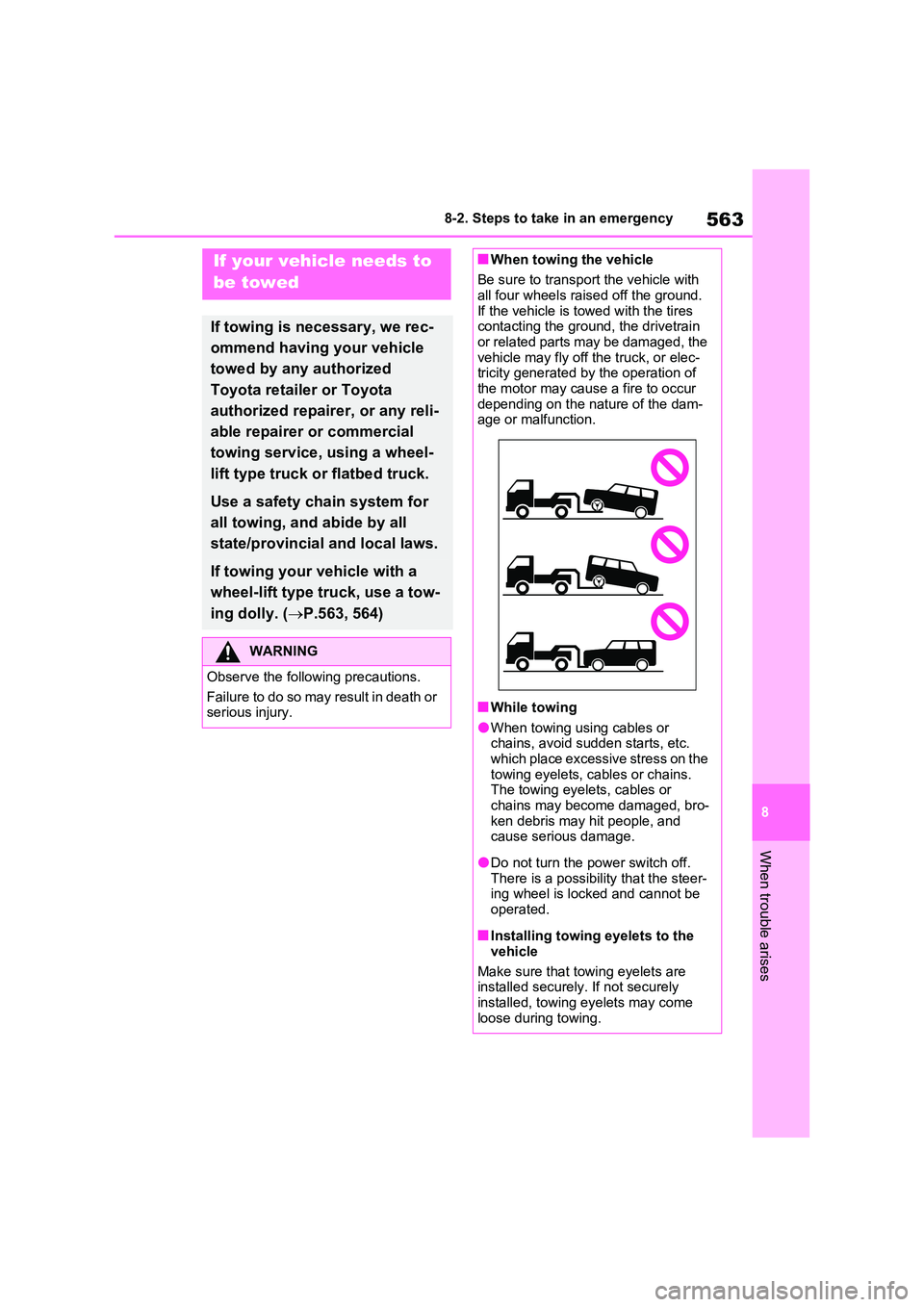
■When towing the vehicle
Be sure to transport the vehicle with all four wheels raised off the ground.
If the vehicle is towed with the tires contacting the ground, the drivetrain or related parts may be damaged, the
vehicle may fly off the truck, or elec- tricity generated by the operation of the motor may cause a fire to occur
depending on the nature of the dam- age or malfunction.
■While towing
●When towing using cables or chains, avoid sudden starts, etc. which place excessive stress on the
towing eyelets, cables or chains. The towing eyelets, cables or chains may become damaged, bro-
ken debris may hit people, and cause serious damage.
●Do not turn the power switch off.There is a possibility that the steer-ing wheel is locked and cannot be
operated.
■Installing towing eyelets to the
vehicle
Make sure that towing eyelets are installed securely. If not securely
installed, towing eyelets may come loose during towing.
Page 564 of 664
5648-2. Steps to take in an emergency
The following may indicate a prob-
lem with your transmission. Contact
any authorized Toyota retailer or
Toyota authorized repairer, or any
reliable repairer or commercial tow-
ing service before towing.
The hybrid system warning mes-
sage is shown on the multi-infor-
mation display and the vehicle
does not move.
The vehicle makes an abnormal
sound.
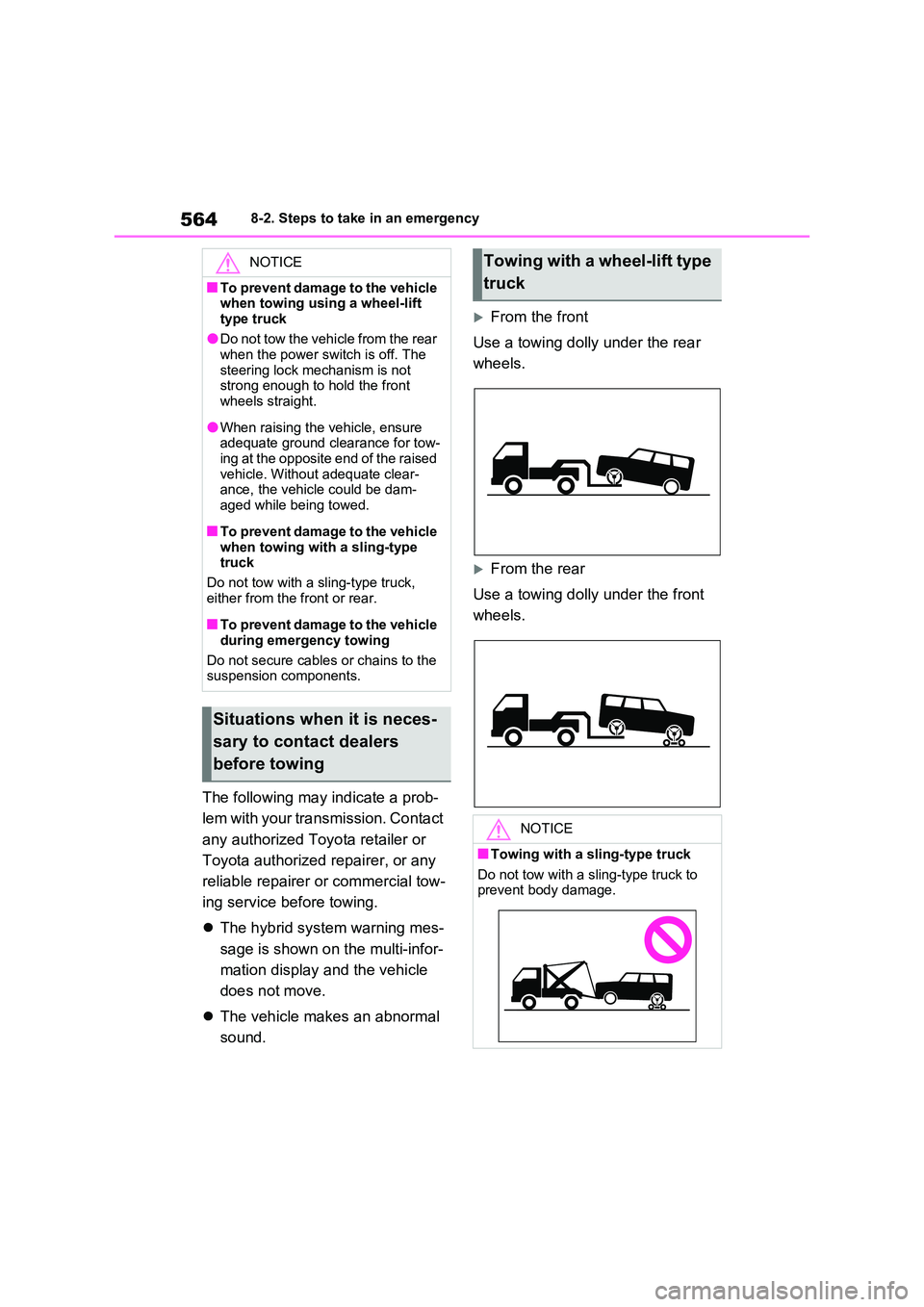
From the front
Use a towing dolly under the rear
wheels.
From the rear
Use a towing dolly under the front
wheels.
NOTICE
■To prevent damage to the vehicle when towing using a wheel-lift
type truck
●Do not tow the vehicle from the rear when the power switch is off. The
steering lock mechanism is not strong enough to hold the front wheels straight.
●When raising the vehicle, ensure adequate ground clearance for tow-
ing at the opposite end of the raised vehicle. Without adequate clear-ance, the vehicle could be dam-
aged while being towed.
■To prevent damage to the vehicle
when towing with a sling-type truck
Do not tow with a sling-type truck,
either from the front or rear.
■To prevent damage to the vehicle
during emergency towing
Do not secure cables or chains to the suspension components.
Situations when it is neces-
sary to contact dealers
before towing
Towing with a wheel-lift type
truck
NOTICE
■Towing with a sling-type truck
Do not tow with a sling-type truck to prevent body damage.
Page 565 of 664
565
8
8-2. Steps to take in an emergency
When trouble arises
When using a flat-bed truck to
transport the vehicle, use tire strap-
ping belts. Refer to the owner’s
manual of the flat-bed truck for the
tire strapping method.
In order to suppress vehicle move-
ment during transportation, set the
parking brake and turn the power
switch off.
If a tow truck is not available in an
emergency, your vehicle may be
temporarily towed using cables or
chains secured to the emergency
towing eyelets. This should only be
attempted on hard surfaced roads
for short distances at under 30
km/h (18 mph).
A driver must be in the vehicle to
steer and operate the brakes. The
vehicle’s wheels, drive train, axles,
steering and brakes must be in
good condition.
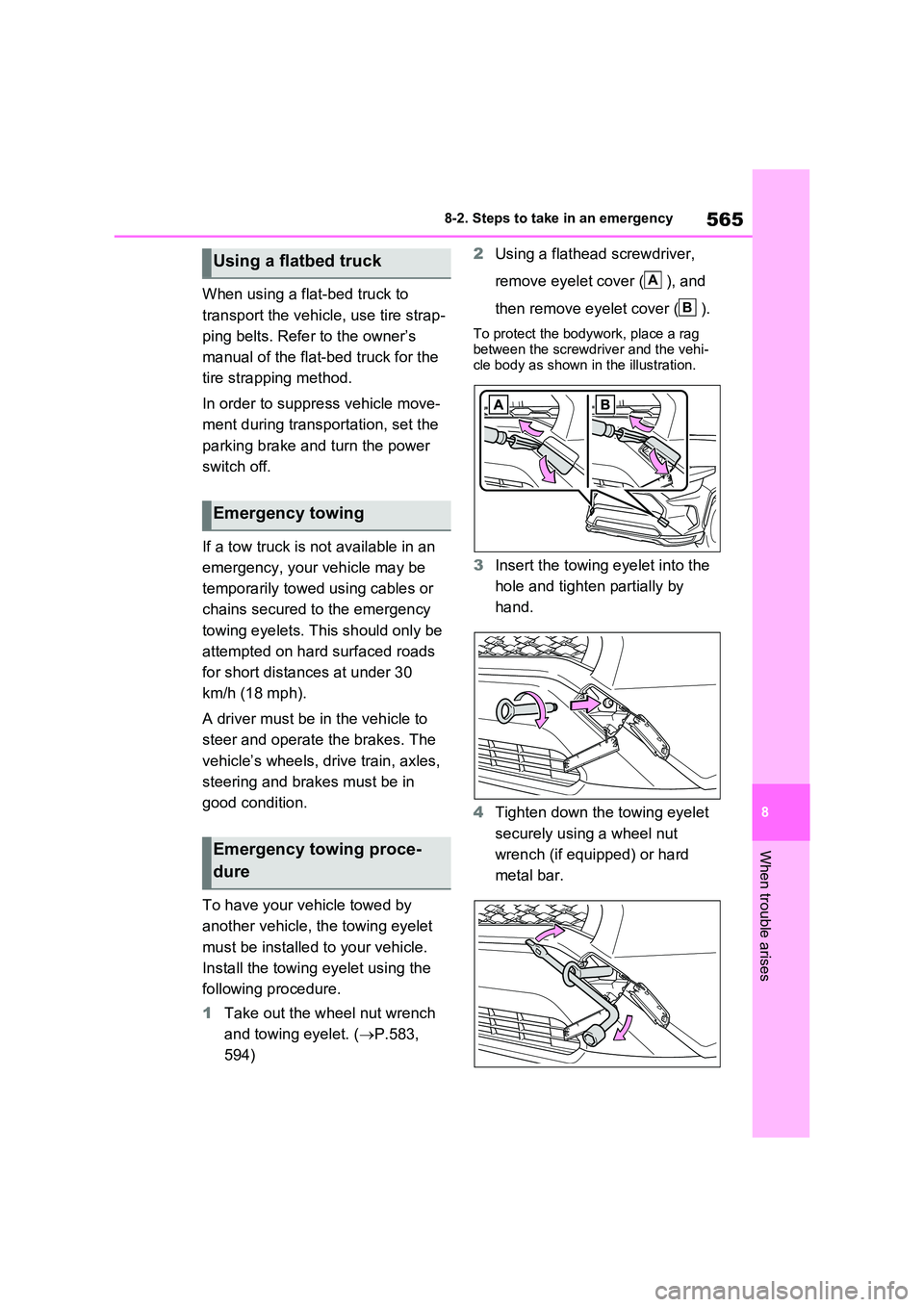
To have your vehicle towed by
another vehicle, the towing eyelet
must be installed to your vehicle.
Install the towing eyelet using the
following procedure.
1 Take out the wheel nut wrench
and towing eyelet. ( P.583,
594)
2 Using a flathead screwdriver,
remove eyelet cover ( ), and
then remove eyelet cover ( ).
To protect the bodywork, place a rag
between the screwdriver and the vehi- cle body as shown in the illustration.
3 Insert the towing eyelet into the
hole and tighten partially by
hand.
4 Tighten down the towing eyelet
securely using a wheel nut
wrench (if equipped) or hard
metal bar.
Using a flatbed truck
Emergency towing
Emergency towing proce-
dure
A
B
Page 566 of 664
5668-2. Steps to take in an emergency
5Securely attach cables or chains
to the towing eyelet.
Take care not to damage the vehicle
body.
6 Enter the vehicle being towed
and start the hybrid system.
Turn off the Parking Support Brake
function. (if equipped): P.420
If the hybrid system does not start, turn the power switch to ON.
7 Shift the shift lever to N and
release the parking brake.
Turn automatic mode off. ( P.327)
When the shift lever cannot be shifted:
P.323
■While towing
If the hybrid system is not running, the power assist for the brakes and steering will not function, making steering and
braking more difficult.
■Wheel nut wrench (if equipped)
Wheel nut wrench is installed in the deck under tray. ( P.583, 594)
Fluid leaks under the vehicle
(Water dripping from the air con-
ditioning after use is normal.)
Flat-looking tires or uneven tire
wear
High coolant temperature warn-
ing light flashes or come on
Changes in exhaust sound
Excessive tire squeal when cor-
nering
Strange noises related to the
suspension system
Pinging or other noises related to
the hybrid system
Engine missing, stumbling or
running roughly
Appreciable loss of power
If you think something is
wrong
If you notice any of the follow-
ing symptoms, your vehicle
probably needs adjustment or
repair. Contact any authorized
Toyota retailer or Toyota
authorized repairer, or any reli-
able repairer as soon as possi-
ble.
Visible symptoms
Audible symptoms
Operational symptoms
Page 577 of 664
577
8
8-2. Steps to take in an emergency
When trouble arises
elapsed, check that the inflation
pressure of each tire is at the speci- fied level and perform initialization. ( P.523)
■The tire pressure warning light may
come on due to natural causes
The tire pressure warning light may come on due to natural causes such as
natural air leaks and tire inflation pres- sure changes caused by temperature. In this case, adjusting the tire inflation
pressure will turn off the warning light (after a few minutes).
■When a tire is replaced with a com-pact spare tire (vehicles with com-
pact spare tire)
The compact spare tire is not equipped with a tire pressure warning valve and
transmitter. If a tire goes flat, the tire pressure warning light will not turn off even though the flat tire has been
replaced with the spare tire. Replace the spare tire with the standard tire and adjust the tire inflation pressure. The tire
pressure warning light will go off after a few minutes.
■Conditions that the tire pressure warning system may not function
properly
P.512
WARNING
■If a warning light comes on or a
warning buzzer sounds when a warning message is shown on
the multi-information display*
Check and follow the message shown on the multi-information display.
Failure to do so may result in death or serious injury.*: Warning lights illuminate in red or
yellow and the warning buzzer
beeps once or sounds continu-
ously.
■When the electric power steer- ing system warning light comes on
When the light comes on yellow, the assist to the power steering is restricted. When the light comes on
red, the assist to the power steering is lost and handling operations of the steering wheel become extremely
heavy. If the steering wheel becomes heavier than usual when operating, hold firmly
and operate using more force than usual.
■If the tire pressure warning light comes on
Be sure to observe the following pre-
cautions. Failure to do so could cause a loss of vehicle control and result in death or serious injury.
●Stop your vehicle in a safe place as soon as possible. Adjust the tire inflation pressure immediately.
●If the tire pressure warning light comes on even after tire inflation
pressure adjustment, it is probable that you have a flat tire. Check the tires. If a tire is flat, change it with
the spare tire and have the flat tire repaired by the nearest authorized Toyota retailer or Toyota authorized
repairer, or any reliable repairer.
●Avoid abrupt maneuvering and
braking. If the vehicle tires deterio- rate, you could lose control of the steering wheel or the brakes.
■If a blowout or sudden air leak-age should occur
The tire pressure warning system may not activate immediately.
Page 582 of 664
5828-2. Steps to take in an emergency
Stop the vehicle in a safe place
on a hard, flat surface.
Set the parking brake.
Shift the shift lever to P.
Turn off the intrusion sensor and
tilt sensor (if equipped) ( P.79)
Stop the hybrid system.
Turn on the emergency flashers.
( P.560)
For vehicles with power back
door: Turn off the power back
door system. ( P.213)
Check the degree of the tire
damage.
A tire should only be repaired with
the emergency tire puncture repair
kit if the damage is caused by a nail
or screw passing through the tire
tread.
• Do not remove the nail or screw
from the tire. Removing the
object may widen the opening
and prevent emergency repair
with the repair kit.
• To avoid sealant leakage, move
the vehicle until the area of the
puncture, if known, is positioned
at the top of the tire.
If you have a flat tire
(vehicles without spare
tire)
Your vehicle is not equipped
with a spare tire, but instead is
equipped with an emergency
tire puncture repair kit.
A puncture caused by a nail or
screw passing through the tire
tread can be repaired tempo-
rarily using the emergency tire
puncture repair kit. (The kit
contains a bottle of sealant.
The sealant can be used only
once to temporarily repair one
tire without removing the nail
or screw from the tire.)
Depending on the damage con-
dition of the flat tire, it may not
be able to repaired with the
emergency tire puncture repair
kit. ( P.583)
After temporarily repairing the
tire with the kit, have the tire
repaired or replaced by any
authorized Toyota retailer or
Toyota authorized repairer, or
any reliable repairer.
WARNING
■If you have a flat tire
Do not continue driving with a flat tire.
Driving even a short distance with a
flat tire can damage the tire and the wheel beyond repair, which could result in an accident.
Driving with a flat tire may cause a cir- cumferential groove on the side wall.
In such a case, the tire may explode when using a repair kit.
Before repairing the vehicle
Page 583 of 664
583
8
8-2. Steps to take in an emergency
When trouble arises
■A flat tire that cannot be repaired with the emergency tire puncture
repair kit
In the following cases, the tire cannot be repaired with the emergency tire punc-
ture repair kit. Contact any authorized Toyota retailer or Toyota authorized
repairer, or any reliable repairer.
●When the tire is damaged due to driv- ing without sufficient air pressure
●When the tire lost air pressure due to a crack or damage in the tire sidewall
●When the tire is visibly separated from the wheel
●When the cut or damage to the tread is 4 mm (0.16 in.) long or more
●When the wheel is damaged
●When two or more tires have been punctured
●When there is more than one hole or cut in the damaged tire
●When the sealant has expired
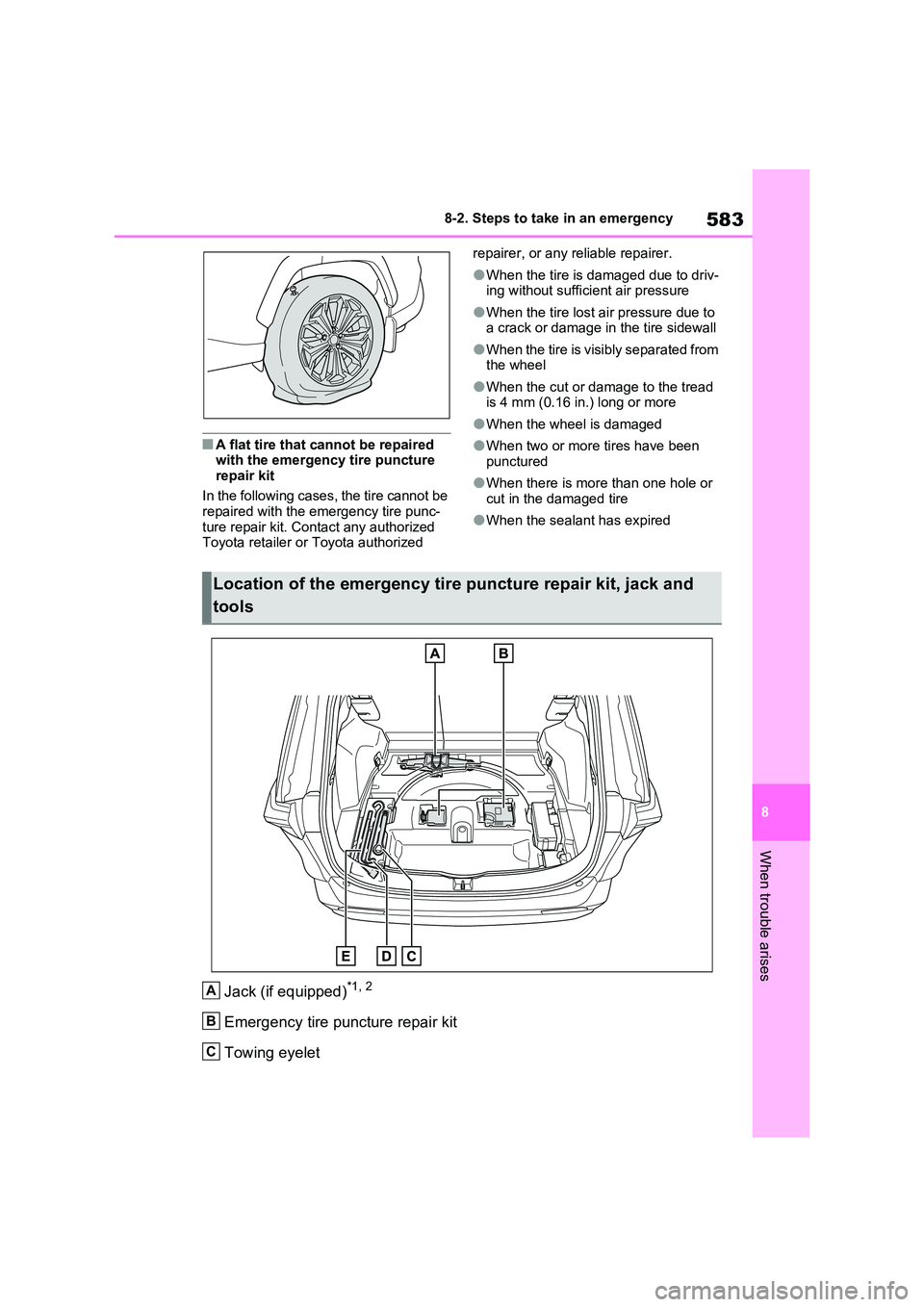
Jack (if equipped)*1, 2
Emergency tire puncture repair kit
Towing eyelet
Location of the emergency tire puncture repair kit, jack and
tools
A
B
C
Page 584 of 664
5848-2. Steps to take in an emergency
Jack handle (if equipped)
Wheel nut wrench (if equipped)
*1: Taking out the jack ( P.590)
*2: Use of the jack (P.596)
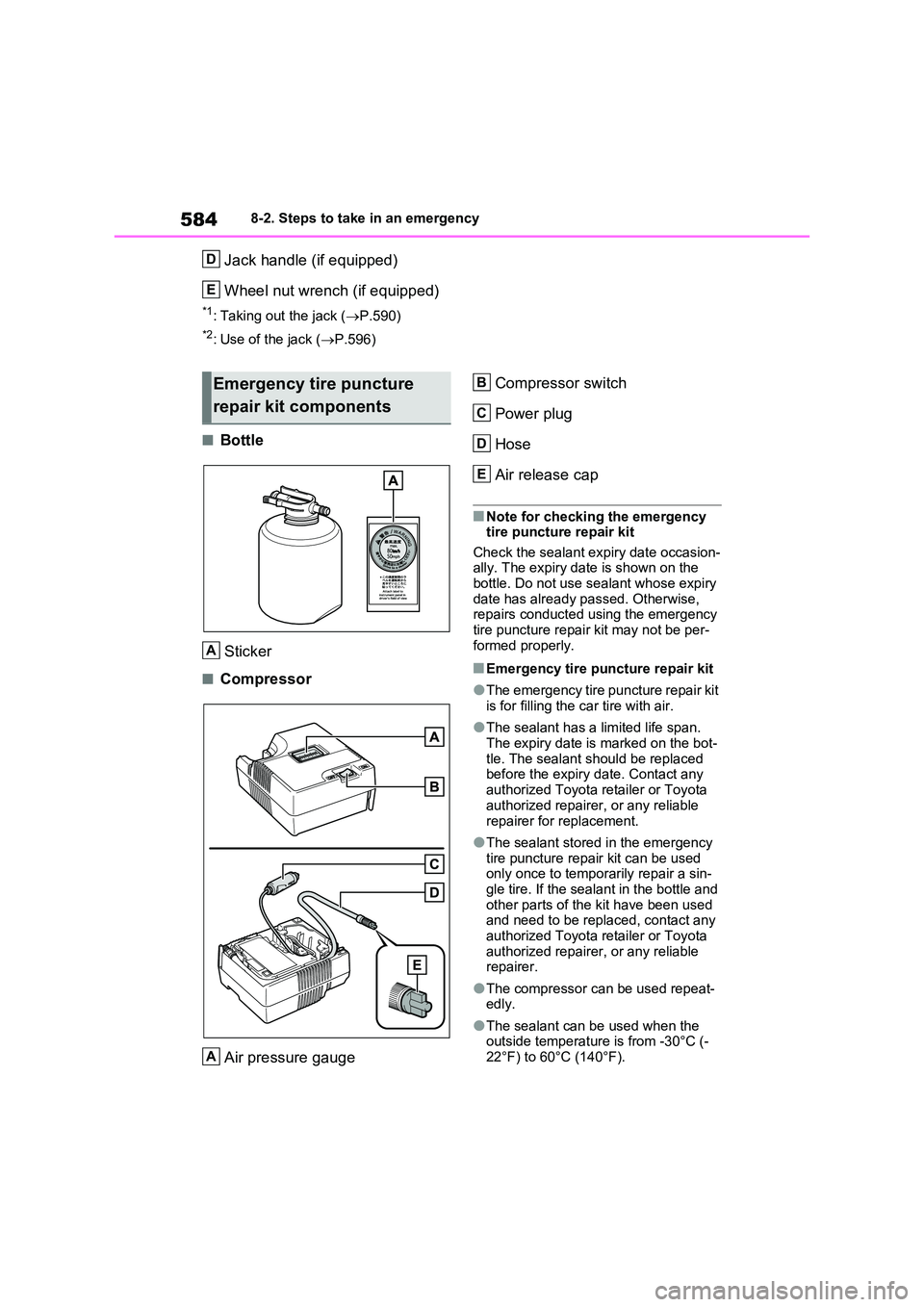
■Bottle
Sticker
■Compressor
Air pressure gauge
Compressor switch
Power plug
Hose
Air release cap
■Note for checking the emergency tire puncture repair kit
Check the sealant expiry date occasion- ally. The expiry date is shown on the bottle. Do not use sealant whose expiry
date has already passed. Otherwise, repairs conducted using the emergency tire puncture repair kit may not be per-
formed properly.
■Emergency tire puncture repair kit
●The emergency tire puncture repair kit
is for filling the car tire with air.
●The sealant has a limited life span.
The expiry date is marked on the bot- tle. The sealant should be replaced before the expiry date. Contact any
authorized Toyota retailer or Toyota authorized repairer, or any reliable
repairer for replacement.
●The sealant stored in the emergency
tire puncture repair kit can be used only once to temporarily repair a sin-gle tire. If the sealant in the bottle and
other parts of the kit have been used and need to be replaced, contact any authorized Toyota retailer or Toyota
authorized repairer, or any reliable repairer.
●The compressor can be used repeat-edly.
●The sealant can be used when the outside temperature is from -30°C (-22°F) to 60°C (140°F).
D
E
Emergency tire puncture
repair kit components
A
A
B
C
D
E
Page 585 of 664
585
8
8-2. Steps to take in an emergency
When trouble arises
●The kit is exclusively designed for size
and type of tires originally installed on your vehicle. Do not use it for tires that a different size than the original ones,
or for any other purposes.
●If the sealant gets on your clothes, it
may stain.
●If the sealant adheres to a wheel or
the surface of the vehicle body, the stain may not be removable if it is not cleaned at once. Immediately wipe
away the sealant with a wet cloth.
●During operation of the repair kit, a
loud operation noise is produced. This does not indicate a malfunction.
●Do not use to check or to adjust the tire pressure.
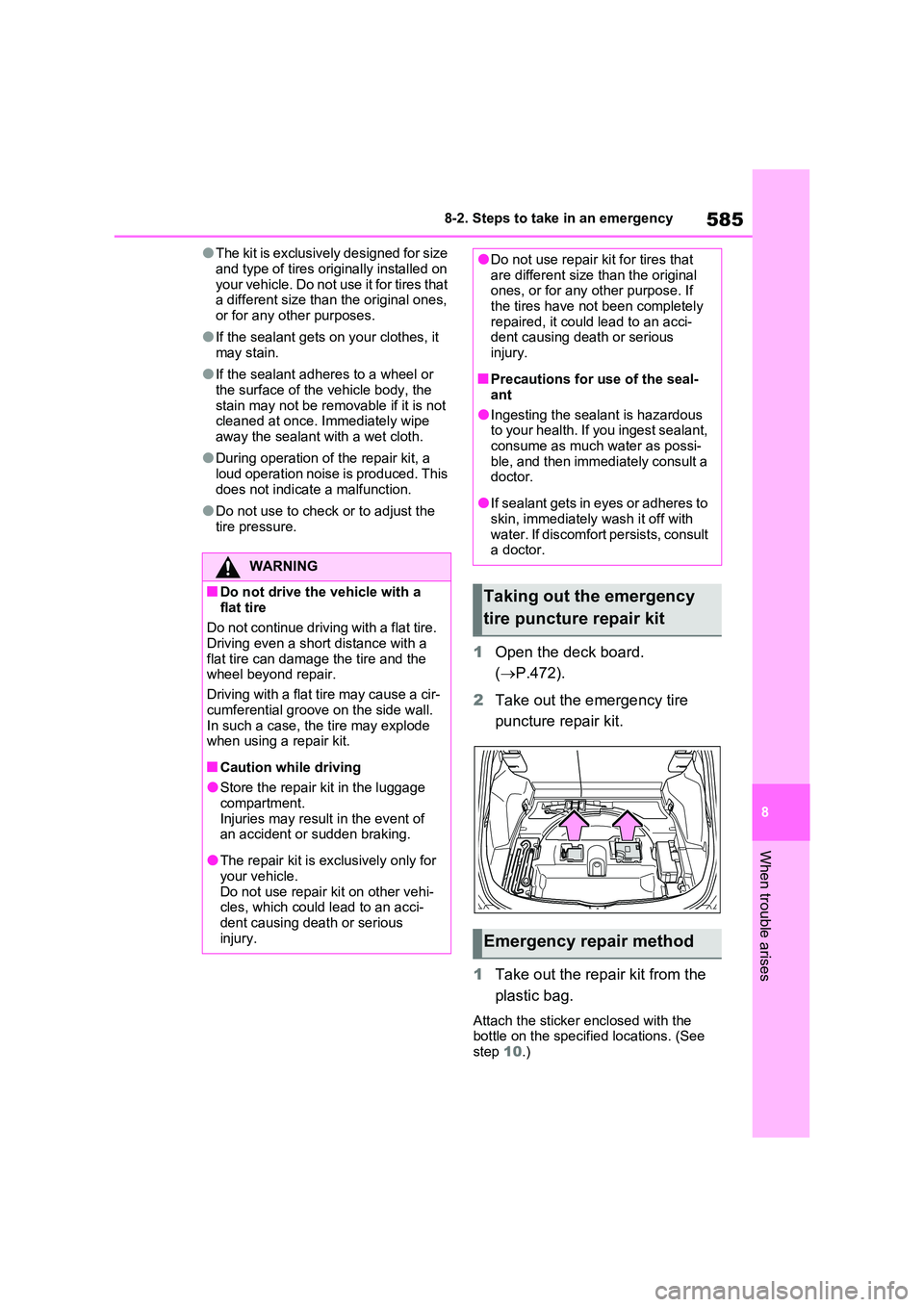
1 Open the deck board.
( P.472).
2 Take out the emergency tire
puncture repair kit.
1 Take out the repair kit from the
plastic bag.
Attach the sticker enclosed with the bottle on the specified locations. (See step 10.)
WARNING
■Do not drive the vehicle with a
flat tire
Do not continue driving with a flat tire. Driving even a short distance with a
flat tire can damage the tire and the wheel beyond repair.
Driving with a flat tire may cause a cir-
cumferential groove on the side wall. In such a case, the tire may explode when using a repair kit.
■Caution while driving
●Store the repair kit in the luggage
compartment. Injuries may result in the event of an accident or sudden braking.
●The repair kit is exclusively only for your vehicle.
Do not use repair kit on other vehi- cles, which could lead to an acci-dent causing death or serious
injury.
●Do not use repair kit for tires that are different size than the original ones, or for any other purpose. If
the tires have not been completely repaired, it could lead to an acci-dent causing death or serious
injury.
■Precautions for use of the seal-
ant
●Ingesting the sealant is hazardous to your health. If you ingest sealant,
consume as much water as possi- ble, and then immediately consult a doctor.
●If sealant gets in eyes or adheres to skin, immediately wash it off with
water. If discomfort persists, consult a doctor.
Taking out the emergency
tire puncture repair kit
Emergency repair method
Page 591 of 664
591
8
8-2. Steps to take in an emergency
When trouble arises
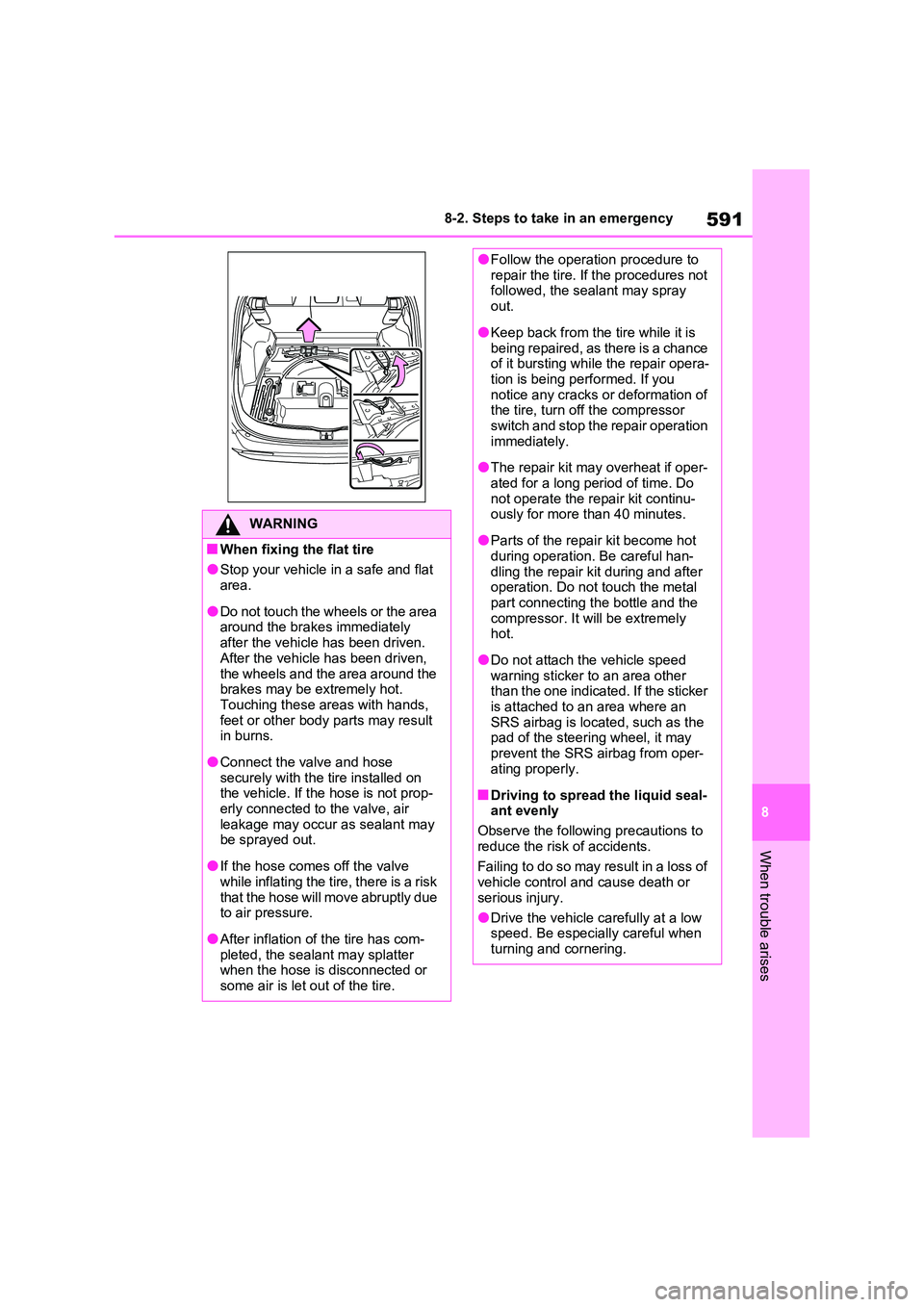
WARNING
■When fixing the flat tire
●Stop your vehicle in a safe and flat area.
●Do not touch the wheels or the area around the brakes immediately
after the vehicle has been driven. After the vehicle has been driven,
the wheels and the area around the brakes may be extremely hot. Touching these areas with hands,
feet or other body parts may result in burns.
●Connect the valve and hose securely with the tire installed on the vehicle. If the hose is not prop-
erly connected to the valve, air leakage may occur as sealant may be sprayed out.
●If the hose comes off the valve while inflating the tire, there is a risk
that the hose will move abruptly due to air pressure.
●After inflation of the tire has com-pleted, the sealant may splatter when the hose is disconnected or
some air is let out of the tire.
●Follow the operation procedure to repair the tire. If the procedures not followed, the sealant may spray
out.
●Keep back from the tire while it is
being repaired, as there is a chance of it bursting while the repair opera-tion is being performed. If you
notice any cracks or deformation of the tire, turn off the compressor switch and stop the repair operation
immediately.
●The repair kit may overheat if oper-
ated for a long period of time. Do not operate the repair kit continu-ously for more than 40 minutes.
●Parts of the repair kit become hot during operation. Be careful han-
dling the repair kit during and after operation. Do not touch the metal part connecting the bottle and the
compressor. It will be extremely hot.
●Do not attach the vehicle speed warning sticker to an area other than the one indicated. If the sticker
is attached to an area where an SRS airbag is located, such as the pad of the steering wheel, it may
prevent the SRS airbag from oper- ating properly.
■Driving to spread the liquid seal-ant evenly
Observe the following precautions to
reduce the risk of accidents.
Failing to do so may result in a loss of vehicle control and cause death or
serious injury.
●Drive the vehicle carefully at a low speed. Be especially careful when
turning and cornering.