service TOYOTA VERSO S 2011 User Guide
[x] Cancel search | Manufacturer: TOYOTA, Model Year: 2011, Model line: VERSO S, Model: TOYOTA VERSO S 2011Pages: 664, PDF Size: 160.56 MB
Page 94 of 664
942-1. Plug-in hybrid system
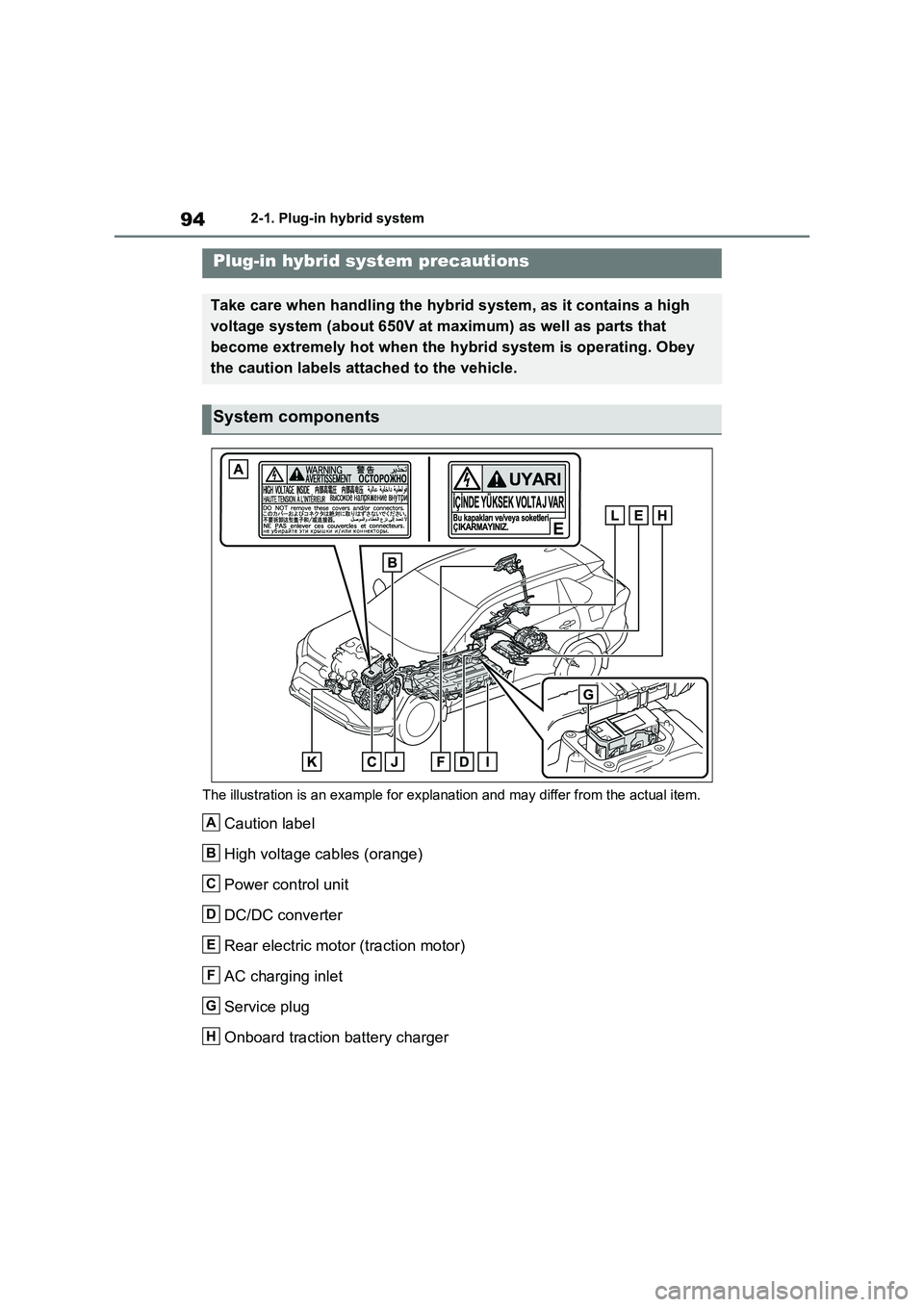
The illustration is an example for explanation and may differ from the actual item.
Caution label
High voltage cables (orange)
Power control unit
DC/DC converter
Rear electric motor (traction motor)
AC charging inlet
Service plug
Onboard traction battery charger
Plug-in hybrid system precautions
Take care when handling the hybrid system, as it contains a high
voltage system (about 650V at maximum) as well as parts that
become extremely hot when the hybrid system is operating. Obey
the caution labels attached to the vehicle.
System components
A
B
C
D
E
F
G
H
Page 95 of 664
95
2
2-1. Plug-in hybrid system
Plug-in hybrid system
Hybrid battery (traction battery)
Front electric motor (traction motor)
Air conditioning compressor
Junction box
■Running out of fuel
When the vehicle has run out of fuel and
the hybrid system cannot be started, refuel the vehicle with at least enough gasoline to make the low fuel level warn-
ing light ( P.575) go off. If there is only a small amount of fuel, the hybrid sys-tem may not be able to start. (The stan-
dard amount of fuel is about 8.8 L [2.3 gal., 1.9 Imp.gal.], when the vehicle is on a level surface. This value may vary
when the vehicle is on a slope. Add extra fuel when the vehicle is inclined.)
■Electromagnetic waves
●High voltage parts and cables on the hybrid vehicles incorporate electro-magnetic shielding, and therefore emit
approximately the same amount of electromagnetic waves as conven-tional gasoline powered vehicles or
home electronic appliances.
●Your vehicle may cause sound inter-
ference in some third party-produced radio parts.
■Effect of magnetic forces
If objects that generate strong magnetic
forces, such as large speakers, are placed inside the luggage compartment or installed nearby, the generated mag-
netic forces may negatively affect the hybrid system.
■Hybrid battery (traction battery) (lithium-ion battery)
The hybrid battery (traction battery) has a limited service life.
The hybrid battery (traction battery)
capacity (the ability to hold a charge) reduces with time and use in the same way as other rechargeable batteries.
The extent at which capacity reduces
changes drastically depending on the environment (ambient temperature, etc.)
and usage conditions, such as how the vehicle is driven and how the hybrid bat-tery (traction battery) is charged. This is
a natural characteristic of lithium-ion batteries, and is not a malfunction. Also, even though the EV driving range
becomes shorter when the hybrid bat- tery (traction battery) capacity reduces, vehicle performance does not signifi-
cantly become worse.
In order to reduce the possibility of the capacity reducing, follow the directions
listed on P.134, “Capacity reduction of the hybrid battery (traction battery)”.
■Starting the hybrid system in an extremely cold environment
When the hybrid battery (traction bat- tery) is extremely cold (below approxi-mately -30°C [-22°F]) under the
influence of the outside temperature, it may not be possible to start the hybrid system. In this case, try to start the
hybrid system again after the tempera- ture of the hybrid battery increases due to the outside temperature increase etc.
■Declaration of conformity
This model conforms to hydrogen emis- sions according to regulation ECE100 (Battery electric vehicle safety).
I
J
K
L
WARNING
■High voltage precautions
The vehicle has high voltage DC and
AC systems as well as a 12-volt sys- tem. DC and AC high voltage is very dangerous and can cause severe
burns and electric shock that may result in death or serious injury.
Page 96 of 664
962-1. Plug-in hybrid system
WARNING
●Never touch, disassemble, remove or replace the high voltage parts,
cables or their connectors.
●The hybrid system will become hot
after starting as the system uses high voltage. Be careful of both the high voltage and the high tempera-
ture, and always obey the caution labels attached to the vehicle.
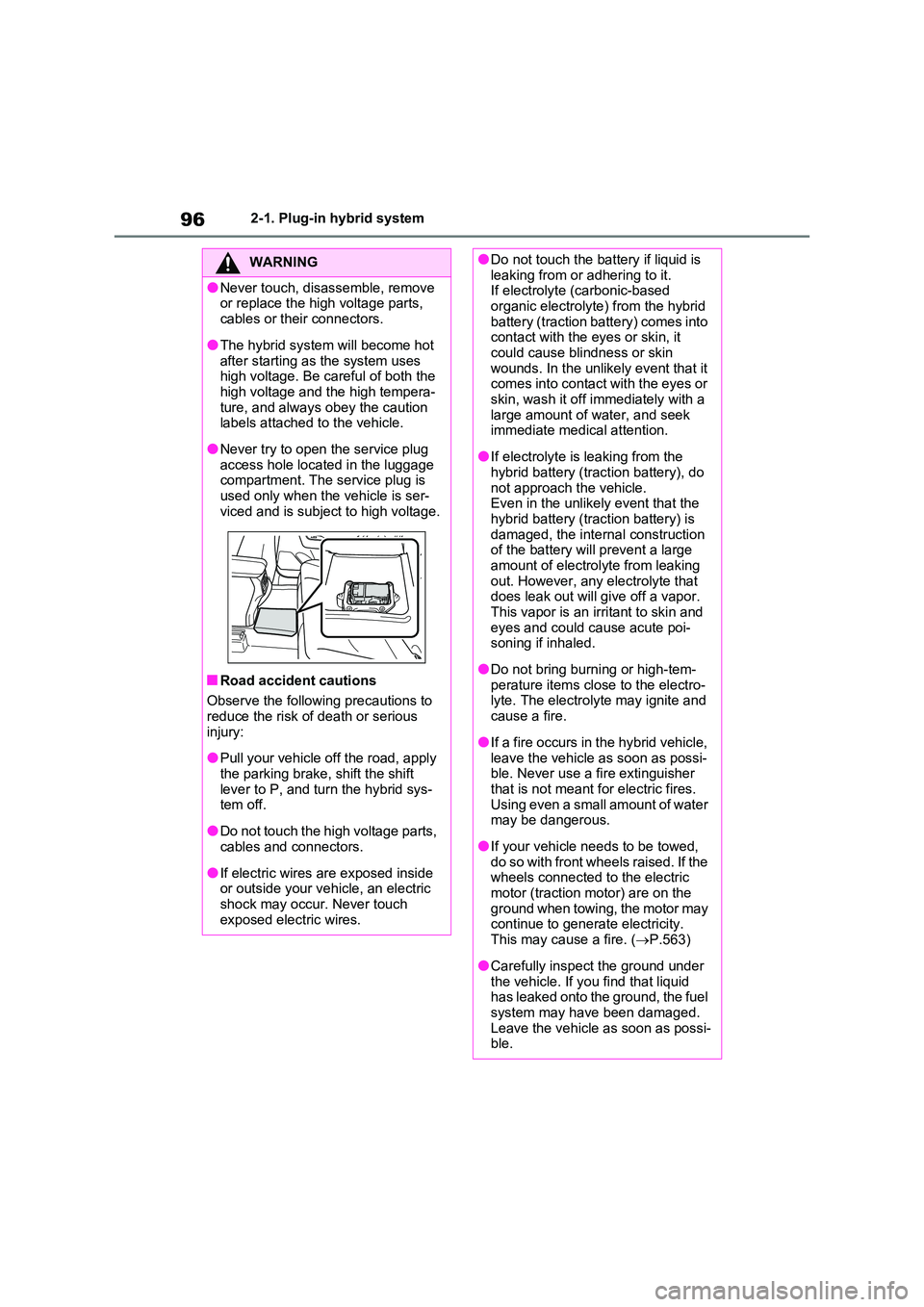
●Never try to open the service plug access hole located in the luggage compartment. The service plug is
used only when the vehicle is ser- viced and is subject to high voltage.
■Road accident cautions
Observe the following precautions to reduce the risk of death or serious
injury:
●Pull your vehicle off the road, apply
the parking brake, shift the shift lever to P, and turn the hybrid sys-tem off.
●Do not touch the high voltage parts, cables and connectors.
●If electric wires are exposed inside or outside your vehicle, an electric
shock may occur. Never touch exposed electric wires.
●Do not touch the battery if liquid is leaking from or adhering to it.If electrolyte (carbonic-based
organic electrolyte) from the hybrid battery (traction battery) comes into contact with the eyes or skin, it
could cause blindness or skin wounds. In the unlikely event that it comes into contact with the eyes or
skin, wash it off immediately with a large amount of water, and seek immediate medical attention.
●If electrolyte is leaking from the hybrid battery (traction battery), do
not approach the vehicle. Even in the unlikely event that the hybrid battery (traction battery) is
damaged, the internal construction of the battery will prevent a large amount of electrolyte from leaking
out. However, any electrolyte that does leak out will give off a vapor. This vapor is an irritant to skin and
eyes and could cause acute poi- soning if inhaled.
●Do not bring burning or high-tem-perature items close to the electro-lyte. The electrolyte may ignite and
cause a fire.
●If a fire occurs in the hybrid vehicle,
leave the vehicle as soon as possi- ble. Never use a fire extinguisher that is not meant for electric fires.
Using even a small amount of water may be dangerous.
●If your vehicle needs to be towed, do so with front wheels raised. If the wheels connected to the electric
motor (traction motor) are on the ground when towing, the motor may continue to generate electricity.
This may cause a fire. ( P.563)
●Carefully inspect the ground under
the vehicle. If you find that liquid has leaked onto the ground, the fuel system may have been damaged.
Leave the vehicle as soon as possi- ble.
Page 112 of 664
1122-2. Charging
This product must be grounded. In
case of malfunction or break down,
grounding provides a path of least
resistance for electric current to
reduce the risk of electric shock.
This product is equipped with a
grounding conductor and a ground-
ing plug. The grounding plug must
be plugged into an appropriate
socket that is properly installed and
grounded in accordance with all
local codes and ordinances.
The CCID (Charging Circuit Inter-
rupting Device) has the following
safety features.
■Electrical leakage detection
function
If an electrical leakage is detected
during charging, the power source
will be automatically interrupted,
thus preventing fires or electrical
shocks caused by electrical leak-
age.
If the power source is interrupted, the
error warning indicator flashes.
If the power source is interrupted:
P.113
■Automatic check function
This is an automatic system check
that is run before charging begins
to check for problems in the opera-
tion of the electrical leakage detec-
tion function.
If a malfunction is found in the electrical
leakage detection function as a result of
the check, the error warning indicator
flashes to inform the user. ( P.113)
■Temperature detection func-
tion
A temperature detection function is
equipped to the plug. While
charging, if heat is generated due
to looseness on the socket side
etc., this function suppresses heat
by controlling the charging current.
■Conditions for supplying cur-
rent to the vehicle
The CCID (Charging Circuit Inter-
rupting Device) is designed to pre-
vent electrical current from being
supplied to the charging connector
when it is not connected to the
vehicle, even if the plug is inserted
into the socket.
Grounding (Mode 2 AC
charging cable)
WARNING
■Grounding precautions
●Improper connection of the ground-
ing conductor increases the risk of electric shock.Check with a qualified electrician or
serviceman if you are in doubt as to whether the product is properly grounded.
●Do not modify the grounding plug provided with the product. If it does
not fit the socket, have a proper socket installed by a qualified elec-trician.
Safety functions (Mode 2 AC
charging cable)
Page 445 of 664
445
5
5-6. Driving tips
Driving
5-6.Driving tips
Use fluids that are appropriate to
the prevailing outside tempera-
tures.
• Engine oil
• Engine coolant
• Power control unit coolant
• Washer fluid
Have a service technician
inspect the condition of the 12-
volt battery.
Have the vehicle fitted with four
snow tires or purchase a set of
tire chains for the front tires.
Ensure that all tires are the same size
and brand, and that chains match the
size of the tires.*
*: Tire chains cannot be mounted on
vehicles with 235/55R19 tires.
Winter driving tips
Carry out the necessary prepa-
rations and inspections before
driving the vehicle in winter.
Always drive the vehicle in a
manner appropriate to the pre-
vailing weather conditions.
Pre-winter preparations
WARNING
■Driving with snow tires
Observe the following precautions to reduce the risk of accidents.
Failure to do so may result in a loss of vehicle control and cause death or serious injury.
●Use tires of the specified size.
●Maintain the recommended level of air pressure.
●Do not drive at speeds in excess of the speed limit or the speed limit specified for the snow tires being
used.
●Use snow tires on all, not just some
wheels.
■Driving with tire chains (except
235/55R19 tires)
Observe the following precautions to reduce the risk of accidents.
Failure to do so may result in the vehi- cle being unable to be driven safely, and may cause death or serious
injury.
●Do not drive in excess of the speed
limit specified for the tire chains being used, or 50 km/h (30 mph), whichever is lower.
●Avoid driving on bumpy road sur-faces or over potholes.
●Avoid sudden acceleration, abrupt steering, sudden braking and shift-
ing operations that cause sudden engine braking.
●Slow down sufficiently before enter-ing a curve to ensure that vehicle control is maintained.
●Do not use LTA (Lane Tracing Assist) system (if equipped).
NOTICE
■Repairing or replacing snow tires
Request repairs or replacement of snow tires from any authorized
Toyota retailer or Toyota authorized repairer, or any reliable repairer or legitimate tire retailers.
This is because the removal and attachment of snow tires affects the operation of the tire pressure warning
valves and transmitters.
Page 487 of 664
7
487
7
Maintenance and care
Maintenance and care
7-1. Maintenance and care
Cleaning and protecting the
vehicle exterior ............... 488
Cleaning and protecting the
vehicle interior ................ 491
7-2. Maintenance
Maintenance requirements 494
7-3. Do-it-yourself maintenance
Do-it-yourself service precau-
tions ................................ 496
Hood ................................. 498
Positioning a floor jack...... 499
Engine compartment ........ 501
12-volt battery ................... 506
Tires.................................. 509
Tire inflation pressure ....... 529
Wheels.............................. 530
Air conditioning filter ......... 532
Cleaning the DC/DC Con-
verter air intake vent and filter
....................................... 536
Wiper insert replacement .. 539
Electronic key battery ....... 543
Checking and replacing fuses
....................................... 545
Light bulbs ........................ 548
Page 494 of 664
4947-2. Maintenance
7-2.Mainte nance
■Where to go for maintenance ser-
vice?
In order to maintain your vehicle in the best possible condition, Toyota recom-
mends that maintenance service opera- tions as well as other inspections and repairs be carried out by authorized
Toyota retailers or Toyota authorized repairers, or any reliable repairers. For repairs and services covered by your
warranty, please visit an authorized Toyota retailer or repairer, who will use genuine Toyota parts in repairing any
difficulties you may encounter. There can also be advantages in utilizing authorized Toyota retailers or repairers
for non-warranty repairs and services, as members of the Toyota network will be able to expertly assist you with any
difficulties you may encounter.
Your Toyota retailer or Toyota autho-
rized repairer, or any reliable repairer will perform all of the scheduled mainte-nance on your vehicle reliably and eco-
nomically due to their experience with Toyota vehicles.
Scheduled maintenance should be
performed at specified intervals
according to the maintenance
schedule.
For full details of your maintenance
schedule, refer to the “Toyota Service
Booklet” or “Toyota Warranty Booklet”.
What about do-it-yourself mainte-
nance?
Many maintenance items are easy to
do yourself if you have a little mechani-
cal ability and a few basic automotive
tools.
Note, however, that some maintenance
tasks require special tools and skills.
These are best performed by qualified
technicians. Even if you’re an experi-
enced do-it-yourself mechanic, we rec-
ommend that repairs and maintenance
be conducted by any authorized Toyota
retailer or Toyota authorized repairer,
or any reliable repairer. Any authorized
Toyota retailer or repairer will keep a
record of maintenance, which could be
useful should you ever require War-
ranty Service. Should you choose to
select a qualified and equipped profes-
sional other than an authorized Toyota
repairer to service or maintain your
vehicle, we recommend that you
Maintenance require-
ments
To ensure safe and economical
driving, day-to-day care and
regular maintenance are
essential. Toyota recom-
mends the maintenance below.
WARNING
■If your vehicle is not properly
maintained
Improper maintenance could result in serious damage to the vehicle and
possible death or serious injury.
■Handling of the 12-volt battery
12-volt battery posts, terminals and related accessories contain lead and
lead compounds which are known to cause brain damage. Wash your hands after handling. ( P.506)
Scheduled maintenance
Do-it-yourself maintenance
Page 495 of 664
495
7 7-2. Maintenance
Maintenance and care
request that a record of maintenance
be kept.
■Does your vehicle need repairs?
Be on the alert for changes in perfor-
mance and sounds, and visual tip-offs
that indicate service is needed. Some
important clues are:
●Engine missing, stumbling or pinging
●Appreciable loss of power
●Strange engine noises
●A fluid leak under the vehicle (How-
ever, water dripping from the air con-
ditioning system after use is normal.)
●Change in exhaust sound (This may
indicate a dangerous carbon monox-
ide leak. Drive with the windows open
and have the exhaust system checked
immediately.)
●Flat-looking tires, excessive tire
squeal when cornering, uneven tire
wear
●Vehicle pulls to one side when driven
straight on a level road
●Strange noises related to suspension
movement
●Loss of brake effectiveness, spongy
feeling brake pedal, pedal almost
touches the floor, vehicle pulls to one
side when braking
●Engine coolant temperature continu-
ally higher than normal (P.174)
If you notice any of these clues, take
your vehicle to any authorized Toyota
retailer or Toyota authorized repairer, or
any reliable repairer as soon as possi-
ble.
Your vehicle may need adjustment or
repair.
Page 496 of 664
4967-3. Do-it-yourself maintenance
7-3.Do-it-y ours elf main ten ance
Do-it-yourself service
precautions
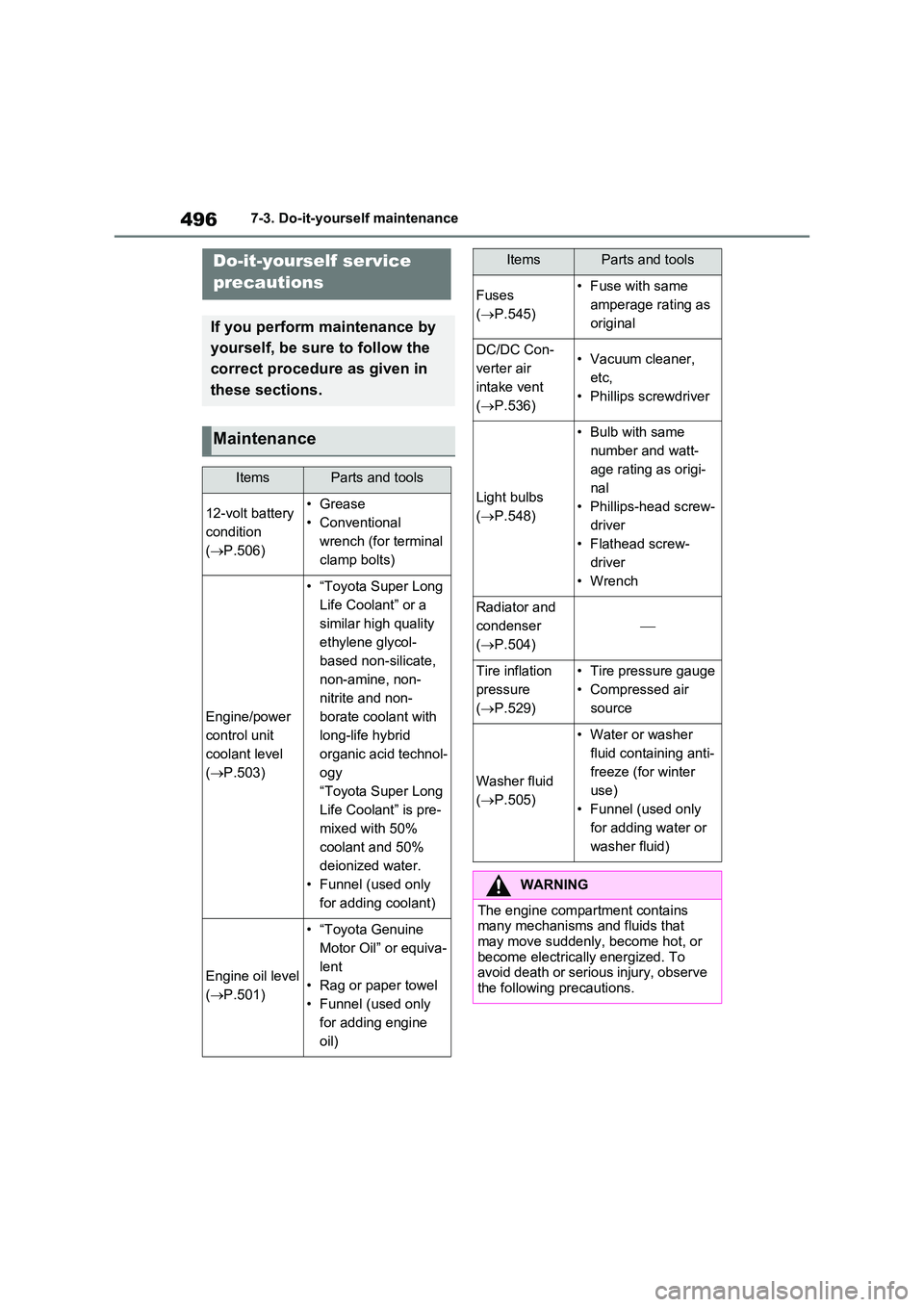
If you perform maintenance by
yourself, be sure to follow the
correct procedure as given in
these sections.
Maintenance
ItemsParts and tools
12-volt battery
condition
( P.506)
•Grease
• Conventional
wrench (for terminal
clamp bolts)
Engine/power
control unit
coolant level
( P.503)
• “Toyota Super Long
Life Coolant” or a
similar high quality
ethylene glycol-
based non-silicate,
non-amine, non-
nitrite and non-
borate coolant with
long-life hybrid
organic acid technol-
ogy
“Toyota Super Long
Life Coolant” is pre-
mixed with 50%
coolant and 50%
deionized water.
• Funnel (used only
for adding coolant)
Engine oil level
( P.501)
• “Toyota Genuine
Motor Oil” or equiva-
lent
• Rag or paper towel
• Funnel (used only
for adding engine
oil)
Fuses
( P.545)
• Fuse with same
amperage rating as
original
DC/DC Con-
verter air
intake vent
( P.536)
• Vacuum cleaner,
etc,
• Phillips screwdriver
Light bulbs
( P.548)
• Bulb with same
number and watt-
age rating as origi-
nal
• Phillips-head screw-
driver
• Flathead screw-
driver
•Wrench
Radiator and
condenser
( P.504)
Tire inflation
pressure
( P.529)
• Tire pressure gauge
• Compressed air
source
Washer fluid
( P.505)
• Water or washer
fluid containing anti-
freeze (for winter
use)
• Funnel (used only
for adding water or
washer fluid)
WARNING
The engine compartment contains many mechanisms and fluids that may move suddenly, become hot, or
become electrically energized. To avoid death or serious injury, observe the following precautions.
ItemsParts and tools
Page 503 of 664
503
7
7-3. Do-it-yourself maintenance
Maintenance and care
■Engine oil consumption
A certain amount of engine oil will be
consumed while driving. In the following situations, oil consumption may increase, and engine oil may need to be
refilled in between oil maintenance inter- vals.
●When the engine is new, for example directly after purchasing the vehicle or after replacing the engine
●If low quality oil or oil of an inappropri-ate viscosity is used
●When driving at high engine speeds or with a heavy load, when towing, or
when driving while accelerating or decelerating frequently
●When leaving the engine idling for a long time, or when driving frequently through heavy traffic
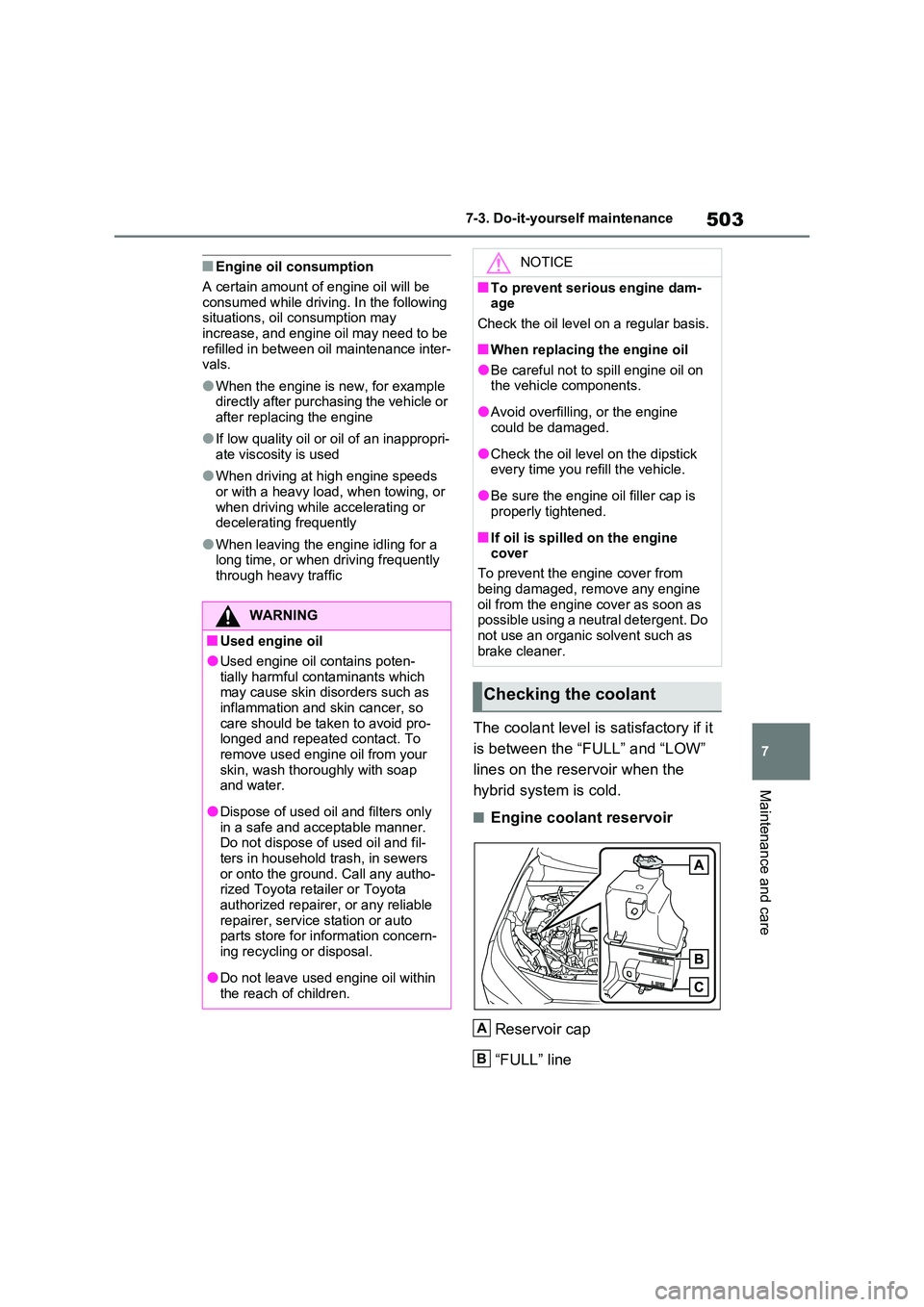
The coolant level is satisfactory if it
is between the “FULL” and “LOW”
lines on the reservoir when the
hybrid system is cold.
■Engine coolant reservoir
Reservoir cap
“FULL” line
WARNING
■Used engine oil
●Used engine oil contains poten-
tially harmful contaminants which may cause skin disorders such as inflammation and skin cancer, so
care should be taken to avoid pro- longed and repeated contact. To remove used engine oil from your
skin, wash thoroughly with soap and water.
●Dispose of used oil and filters only in a safe and acceptable manner. Do not dispose of used oil and fil-
ters in household trash, in sewers or onto the ground. Call any autho-rized Toyota retailer or Toyota
authorized repairer, or any reliable repairer, service station or auto parts store for information concern-
ing recycling or disposal.
●Do not leave used engine oil within
the reach of children.
NOTICE
■To prevent serious engine dam- age
Check the oil level on a regular basis.
■When replacing the engine oil
●Be careful not to spill engine oil on the vehicle components.
●Avoid overfilling, or the engine could be damaged.
●Check the oil level on the dipstick every time you refill the vehicle.
●Be sure the engine oil filler cap is properly tightened.
■If oil is spilled on the engine cover
To prevent the engine cover from
being damaged, remove any engine oil from the engine cover as soon as possible using a neutral detergent. Do
not use an organic solvent such as brake cleaner.
Checking the coolant
A
B