towing TOYOTA VERSO S 2011 Owner's Manual
[x] Cancel search | Manufacturer: TOYOTA, Model Year: 2011, Model line: VERSO S, Model: TOYOTA VERSO S 2011Pages: 664, PDF Size: 160.56 MB
Page 413 of 664
413
5 5-5. Using the driving support systems
Driving
a strong impact to the sensor or its
surrounding area
• When mud, snow, ice, a sticker, etc. is
covering the sensor or surrounding
area on the rear bumper
• When driving on a road surface that is
wet with standing water during bad
weather, such as heavy rain, snow, or
fog
• When multiple vehicles are approach-
ing with only a small gap between
each vehicle
• When a vehicle is approaching at high
speed
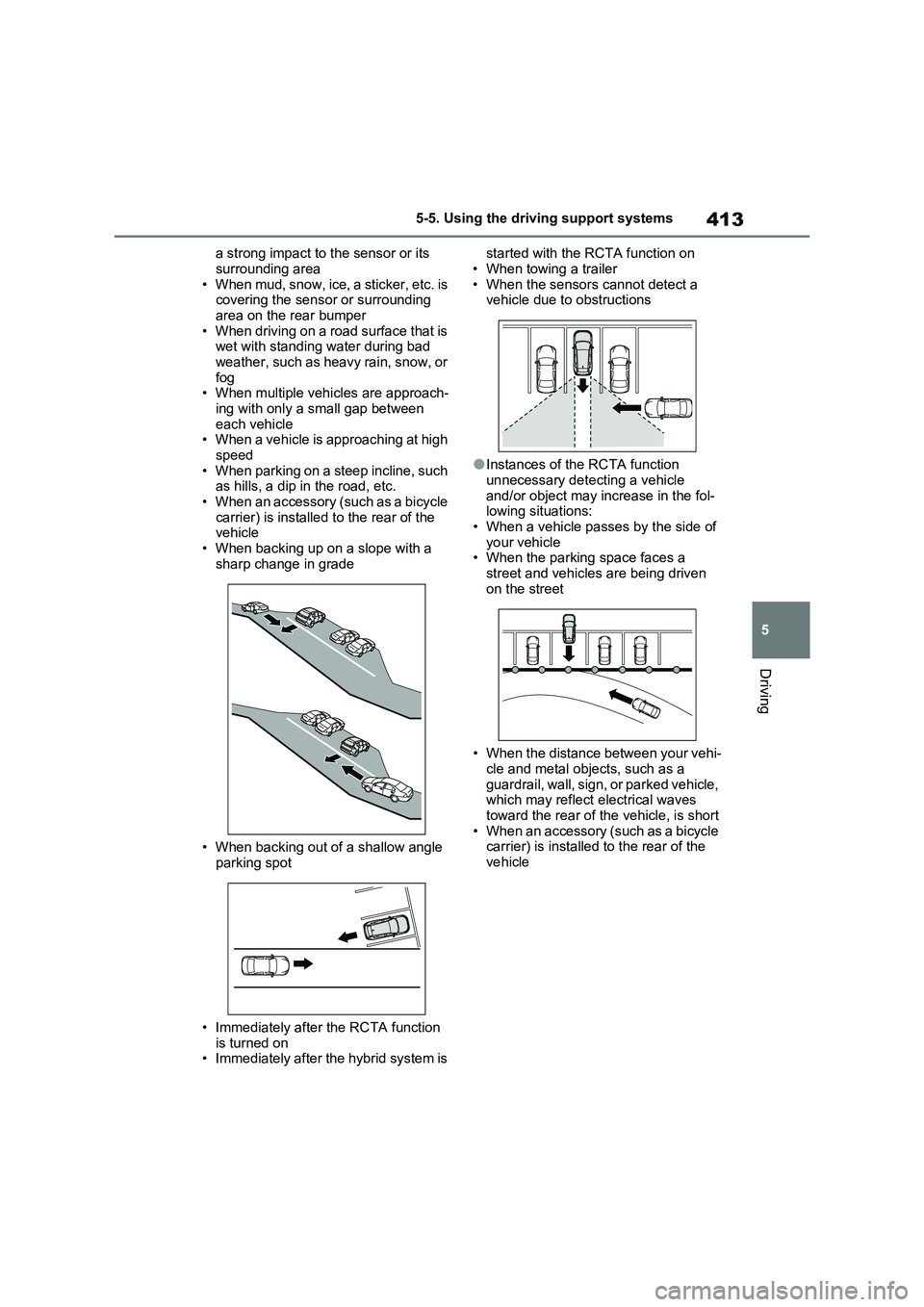
• When parking on a steep incline, such
as hills, a dip in the road, etc.
• When an accessory (such as a bicycle
carrier) is installed to the rear of the
vehicle
• When backing up on a slope with a
sharp change in grade
• When backing out of a shallow angle
parking spot
• Immediately after the RCTA function
is turned on
• Immediately after the hybrid system is started with the RCTA function on
• When towing a trailer
• When the sensors cannot detect a
vehicle due to obstructions
●Instances of the RCTA function
unnecessary detecting a vehicle
and/or object may increase in the fol-
lowing situations:
• When a vehicle passes by the side of
your vehicle
• When the parking space faces a
street and vehicles are being driven
on the street
• When the distance between your vehi-
cle and metal objects, such as a
guardrail, wall, sign, or parked vehicle,
which may reflect electrical waves
toward the rear of the vehicle, is short
• When an accessory (such as a bicycle
carrier) is installed to the rear of the
vehicle
Page 416 of 664
4165-5. Using the driving support systems
■The system can be operated when
●The power switch is in ON.
●Toyota parking assist-sensor function is on.
●The vehicle speed is less than about 10 km/h (6 mph).
●The shift lever is in other than P.
■If “Clean Parking Assist Sensor” is displayed on the multi-information
display
A sensor may be covered with ice,
snow, dirt, etc. Remove the ice, snow, dirt, etc., from the sensor to return the system to normal.
Also, due to ice forming on a sensor at low temperatures, a warning message may be displayed or the sensor may not
be able to detect an object. Once the ice melts, the system will return to normal.
If a warning message is displayed even
if the sensor is clean, there may be a sensor malfunction. Have the vehicle inspected by any authorized Toyota
retailer or Toyota authorized repairer, or any reliable repairer.
WARNING
●The area directly under the bum-pers is not detected.
Thin posts or objects lower than the sensor may not be detected when approached, even if they have been
detected once.
■When to disable the function
In the following situations, disable the function as it may operate even though there is no possibility of a colli-
sion.
●The vehicle is equipped with a com- mercial fender pole, wireless
antenna or fog lights.
●The front or rear bumper or a sen-
sor receives a strong impact.
●A non-genuine Toyota suspension
(lowered suspension, etc.) is installed.
●Towing eyelets are installed.
●A backlit license plate is installed.
●When using an automatic car wash
■When using the Toyota parking assist-sensor
In the following situations, the system
may not function correctly due to a sensor malfunction, etc. Have the vehicle checked by any authorized
Toyota retailer or Toyota authorized repairer, or any reliable repairer.
●The Toyota parking assist-sensor operation display flashes or shows continuously, and a beep sounds
when no objects are detected.
●If the area around a sensor collides
with something, or is subjected to strong impact.
●If the bumper or grille collides with something.
●If the display flashes or is displayed continuously and a buzzer does not sound, except when the mute func-
tion has been turned on.
■Notes when washing the vehicle
Do not apply intensive bursts of water or steam to the sensor area.
Doing so may result in the sensor
malfunctioning.
●When using a high pressure
washer to wash the vehicle, do not spray the sensors directly, as doing so may cause a sensor to malfunc-
tion.
●When using steam to clean the
vehicle, do not direct steam too close to the sensors as doing so may cause a sensor to malfunction.
Page 429 of 664
429
5 5-5. Using the driving support systems
Driving
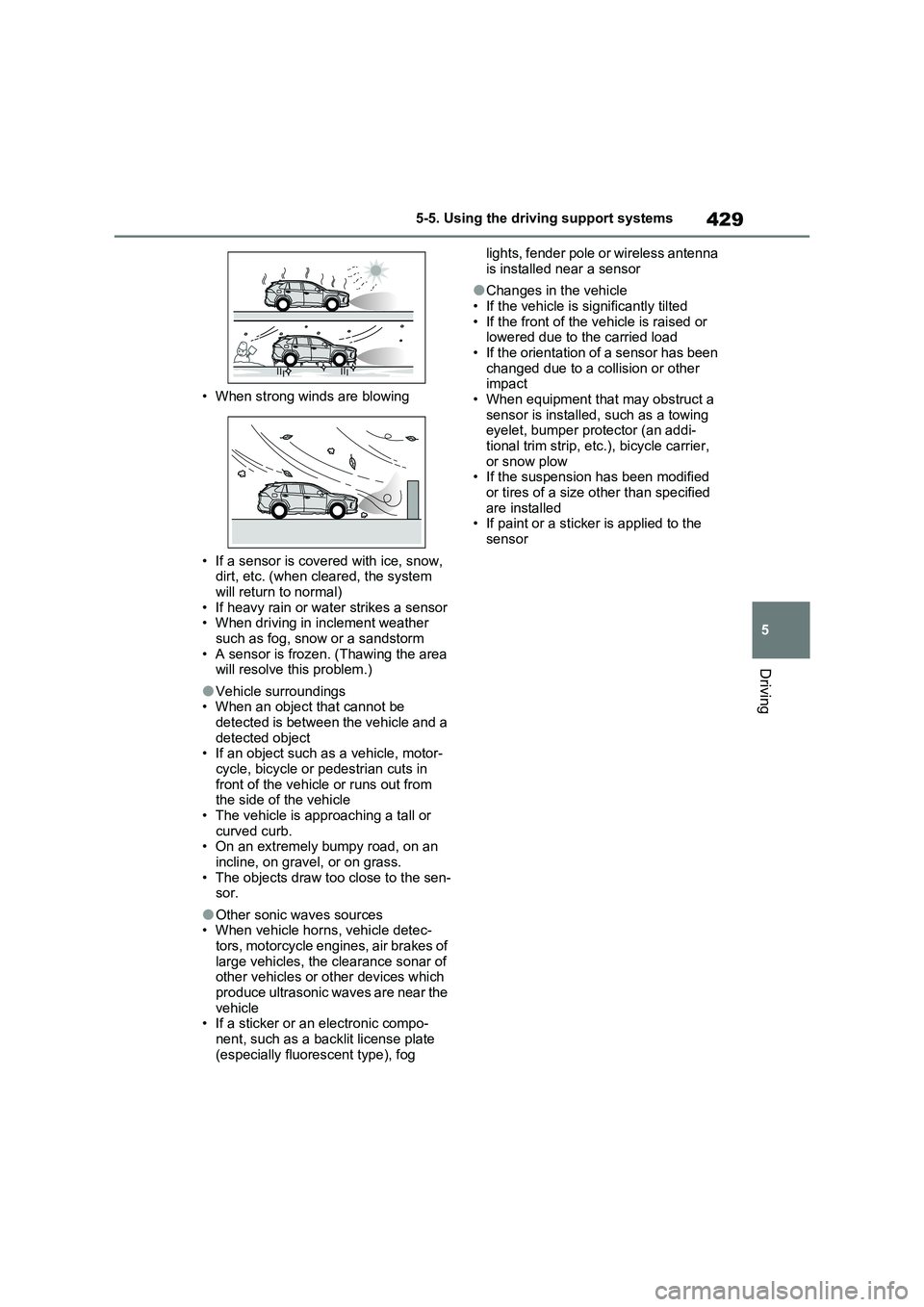
• When strong winds are blowing
• If a sensor is covered with ice, snow,
dirt, etc. (when cleared, the system
will return to normal)
• If heavy rain or water strikes a sensor
• When driving in inclement weather
such as fog, snow or a sandstorm
• A sensor is frozen. (Thawing the area
will resolve this problem.)
●Vehicle surroundings
• When an object that cannot be
detected is between the vehicle and a
detected object
• If an object such as a vehicle, motor-
cycle, bicycle or pedestrian cuts in
front of the vehicle or runs out from
the side of the vehicle
• The vehicle is approaching a tall or
curved curb.
• On an extremely bumpy road, on an
incline, on gravel, or on grass.
• The objects draw too close to the sen-
sor.
●Other sonic waves sources
• When vehicle horns, vehicle detec-
tors, motorcycle engines, air brakes of
large vehicles, the clearance sonar of
other vehicles or other devices which
produce ultrasonic waves are near the
vehicle
• If a sticker or an electronic compo-
nent, such as a backlit license plate
(especially fluorescent type), fog lights, fender pole or wireless antenna
is installed near a sensor
●Changes in the vehicle
• If the vehicle is significantly tilted
• If the front of the vehicle is raised or
lowered due to the carried load
• If the orientation of a sensor has been
changed due to a collision or other
impact
• When equipment that may obstruct a
sensor is installed, such as a towing
eyelet, bumper protector (an addi-
tional trim strip, etc.), bicycle carrier,
or snow plow
• If the suspension has been modified
or tires of a size other than specified
are installed
• If paint or a sticker is applied to the
sensor
Page 432 of 664
4325-5. Using the driving support systems
approximately 24 km/h (15 mph)
*: Depending on the conditions, detec-
tion of a vehicle and/or object may
occur.
■Situations in which the system may
operate even though there is no
possibility of a collision
In some situations such as the following,
the Parking Support Brake function
(rear-crossing vehicles) may operate
even though there is no possibility of a
collision.
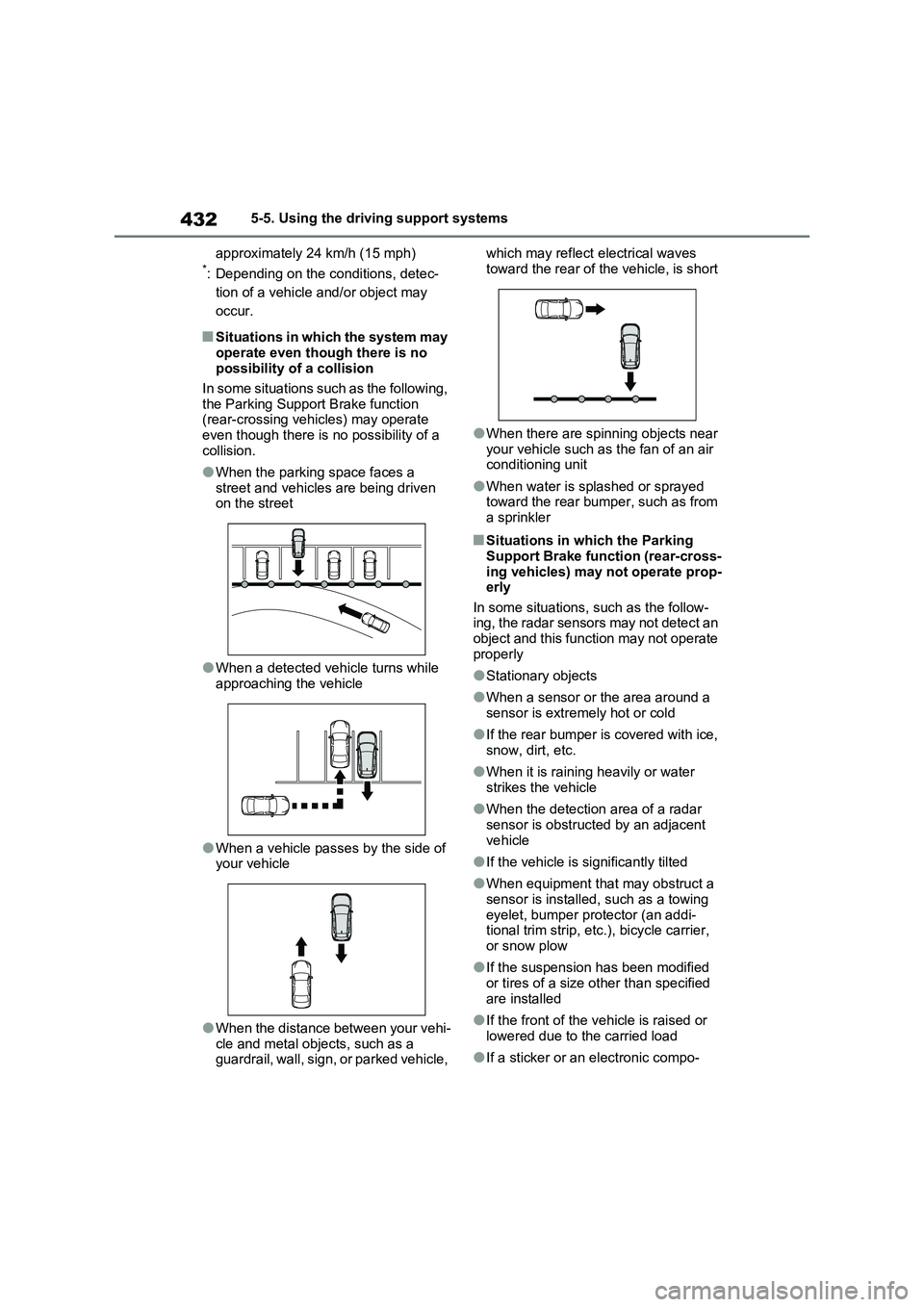
●When the parking space faces a
street and vehicles are being driven
on the street
●When a detected vehicle turns while
approaching the vehicle
●When a vehicle passes by the side of
your vehicle
●When the distance between your vehi-
cle and metal objects, such as a
guardrail, wall, sign, or parked vehicle, which may reflect electrical waves
toward the rear of the vehicle, is short
●When there are spinning objects near
your vehicle such as the fan of an air
conditioning unit
●When water is splashed or sprayed
toward the rear bumper, such as from
a sprinkler
■Situations in which the Parking
Support Brake function (rear-cross-
ing vehicles) may not operate prop-
erly
In some situations, such as the follow-
ing, the radar sensors may not detect an
object and this function may not operate
properly
●Stationary objects
●When a sensor or the area around a
sensor is extremely hot or cold
●If the rear bumper is covered with ice,
snow, dirt, etc.
●When it is raining heavily or water
strikes the vehicle
●When the detection area of a radar
sensor is obstructed by an adjacent
vehicle
●If the vehicle is significantly tilted
●When equipment that may obstruct a
sensor is installed, such as a towing
eyelet, bumper protector (an addi-
tional trim strip, etc.), bicycle carrier,
or snow plow
●If the suspension has been modified
or tires of a size other than specified
are installed
●If the front of the vehicle is raised or
lowered due to the carried load
●If a sticker or an electronic compo-
Page 474 of 664
4746-3. Using the storage features
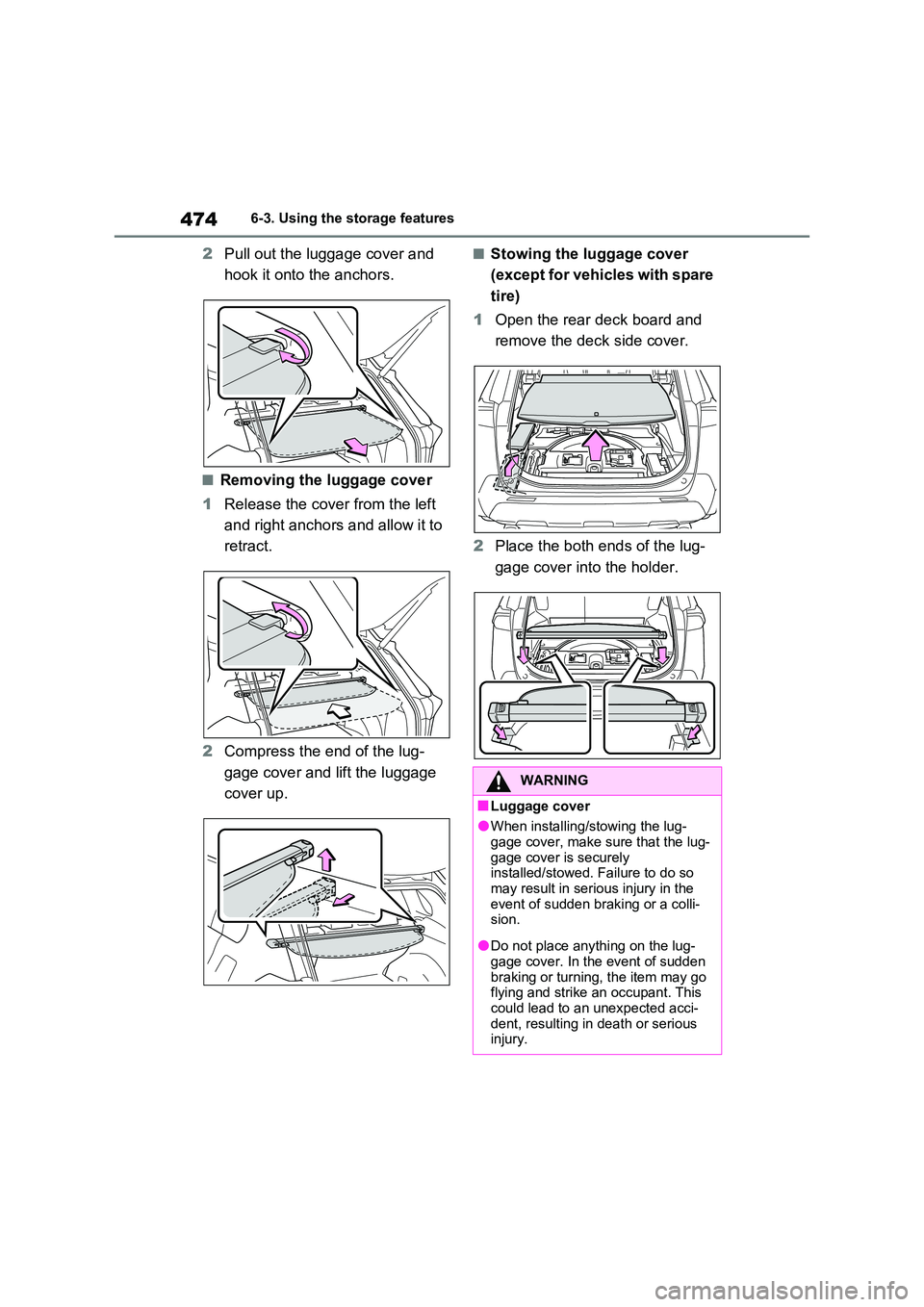
2Pull out the luggage cover and
hook it onto the anchors.
■Removing the luggage cover
1 Release the cover from the left
and right anchors and allow it to
retract.
2 Compress the end of the lug-
gage cover and lift the luggage
cover up.
■Stowing the luggage cover
(except for vehicles with spare
tire)
1 Open the rear deck board and
remove the deck side cover.
2 Place the both ends of the lug-
gage cover into the holder.
WARNING
■Luggage cover
●When installing/stowing the lug-
gage cover, make sure that the lug- gage cover is securely installed/stowed. Failure to do so
may result in serious injury in the event of sudden braking or a colli-sion.
●Do not place anything on the lug-gage cover. In the event of sudden
braking or turning, the item may go flying and strike an occupant. This could lead to an unexpected acci-
dent, resulting in death or serious injury.
Page 503 of 664
503
7
7-3. Do-it-yourself maintenance
Maintenance and care
■Engine oil consumption
A certain amount of engine oil will be
consumed while driving. In the following situations, oil consumption may increase, and engine oil may need to be
refilled in between oil maintenance inter- vals.
●When the engine is new, for example directly after purchasing the vehicle or after replacing the engine
●If low quality oil or oil of an inappropri-ate viscosity is used
●When driving at high engine speeds or with a heavy load, when towing, or
when driving while accelerating or decelerating frequently
●When leaving the engine idling for a long time, or when driving frequently through heavy traffic
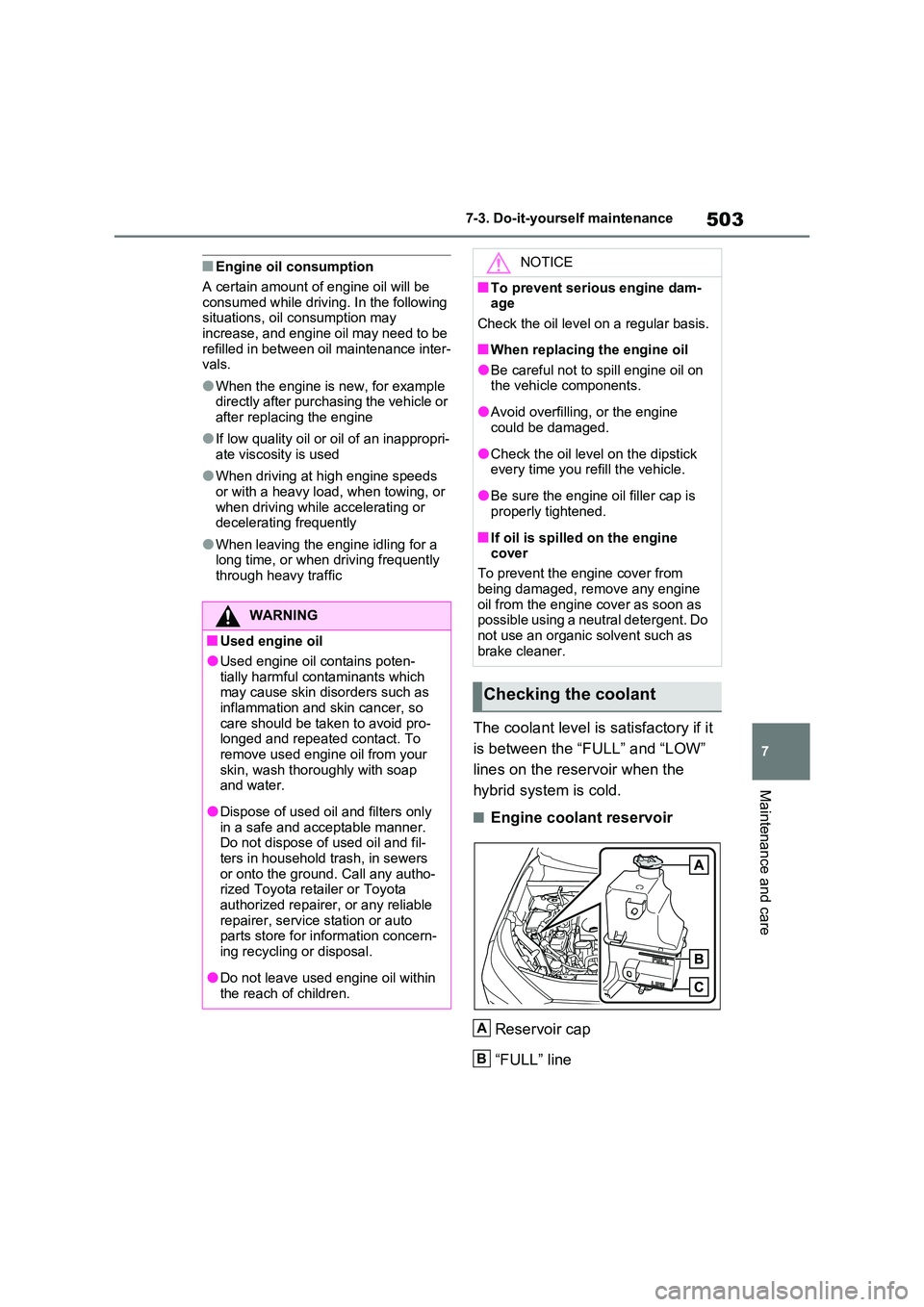
The coolant level is satisfactory if it
is between the “FULL” and “LOW”
lines on the reservoir when the
hybrid system is cold.
■Engine coolant reservoir
Reservoir cap
“FULL” line
WARNING
■Used engine oil
●Used engine oil contains poten-
tially harmful contaminants which may cause skin disorders such as inflammation and skin cancer, so
care should be taken to avoid pro- longed and repeated contact. To remove used engine oil from your
skin, wash thoroughly with soap and water.
●Dispose of used oil and filters only in a safe and acceptable manner. Do not dispose of used oil and fil-
ters in household trash, in sewers or onto the ground. Call any autho-rized Toyota retailer or Toyota
authorized repairer, or any reliable repairer, service station or auto parts store for information concern-
ing recycling or disposal.
●Do not leave used engine oil within
the reach of children.
NOTICE
■To prevent serious engine dam- age
Check the oil level on a regular basis.
■When replacing the engine oil
●Be careful not to spill engine oil on the vehicle components.
●Avoid overfilling, or the engine could be damaged.
●Check the oil level on the dipstick every time you refill the vehicle.
●Be sure the engine oil filler cap is properly tightened.
■If oil is spilled on the engine cover
To prevent the engine cover from
being damaged, remove any engine oil from the engine cover as soon as possible using a neutral detergent. Do
not use an organic solvent such as brake cleaner.
Checking the coolant
A
B
Page 563 of 664
563
8
8-2. Steps to take in an emergency
When trouble arises
8-2.Ste ps to take in an emerg ency
If your vehicle needs to
be towed
If towing is necessary, we rec-
ommend having your vehicle
towed by any authorized
Toyota retailer or Toyota
authorized repairer, or any reli-
able repairer or commercial
towing service, using a wheel-
lift type truck or flatbed truck.
Use a safety chain system for
all towing, and abide by all
state/provincial and local laws.
If towing your vehicle with a
wheel-lift type truck, use a tow-
ing dolly. ( P.563, 564)
WARNING
Observe the following precautions.
Failure to do so may result in death or serious injury.
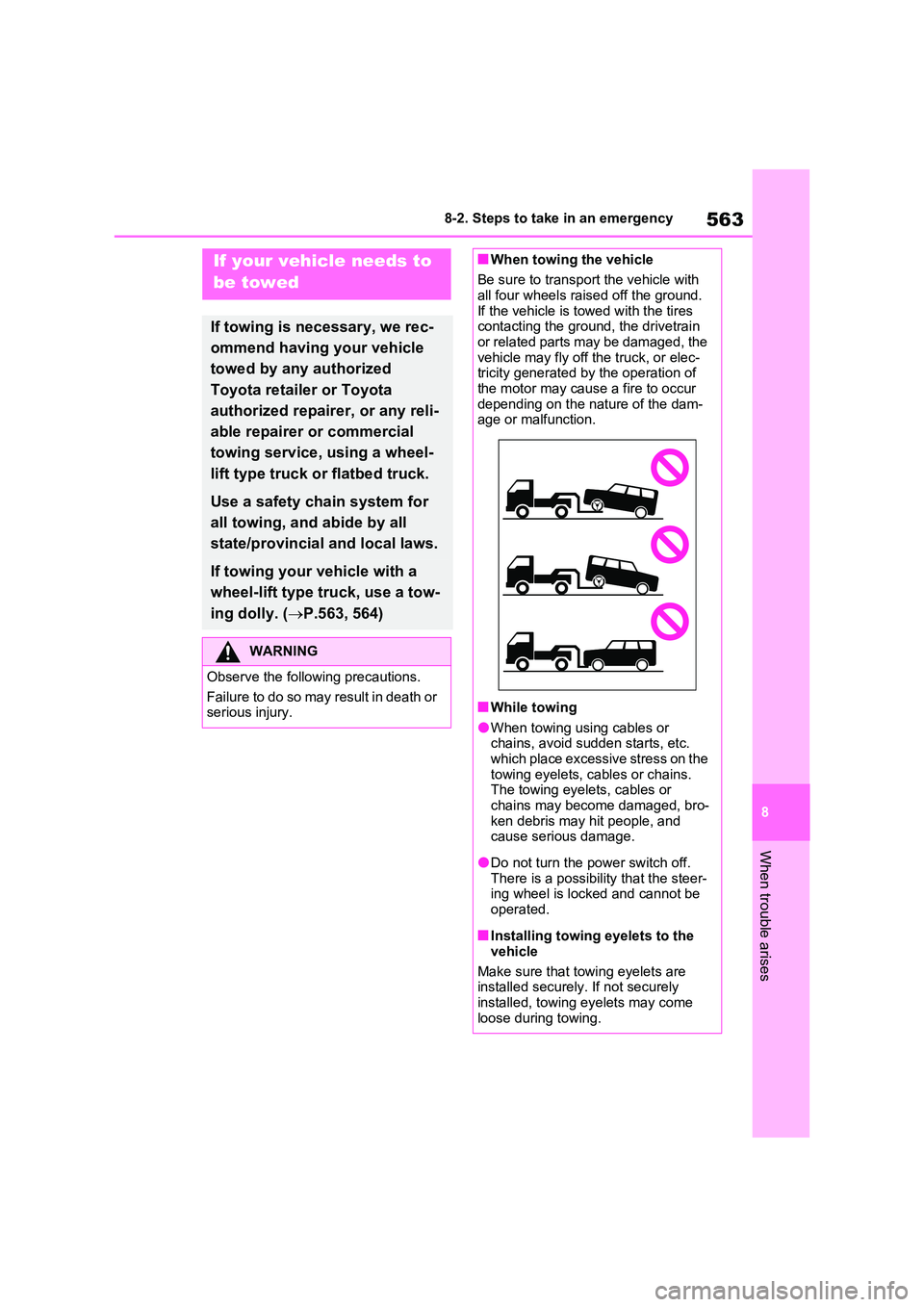
■When towing the vehicle
Be sure to transport the vehicle with all four wheels raised off the ground.
If the vehicle is towed with the tires contacting the ground, the drivetrain or related parts may be damaged, the
vehicle may fly off the truck, or elec- tricity generated by the operation of the motor may cause a fire to occur
depending on the nature of the dam- age or malfunction.
■While towing
●When towing using cables or chains, avoid sudden starts, etc. which place excessive stress on the
towing eyelets, cables or chains. The towing eyelets, cables or chains may become damaged, bro-
ken debris may hit people, and cause serious damage.
●Do not turn the power switch off.There is a possibility that the steer-ing wheel is locked and cannot be
operated.
■Installing towing eyelets to the
vehicle
Make sure that towing eyelets are installed securely. If not securely
installed, towing eyelets may come loose during towing.
Page 564 of 664
5648-2. Steps to take in an emergency
The following may indicate a prob-
lem with your transmission. Contact
any authorized Toyota retailer or
Toyota authorized repairer, or any
reliable repairer or commercial tow-
ing service before towing.
The hybrid system warning mes-
sage is shown on the multi-infor-
mation display and the vehicle
does not move.
The vehicle makes an abnormal
sound.
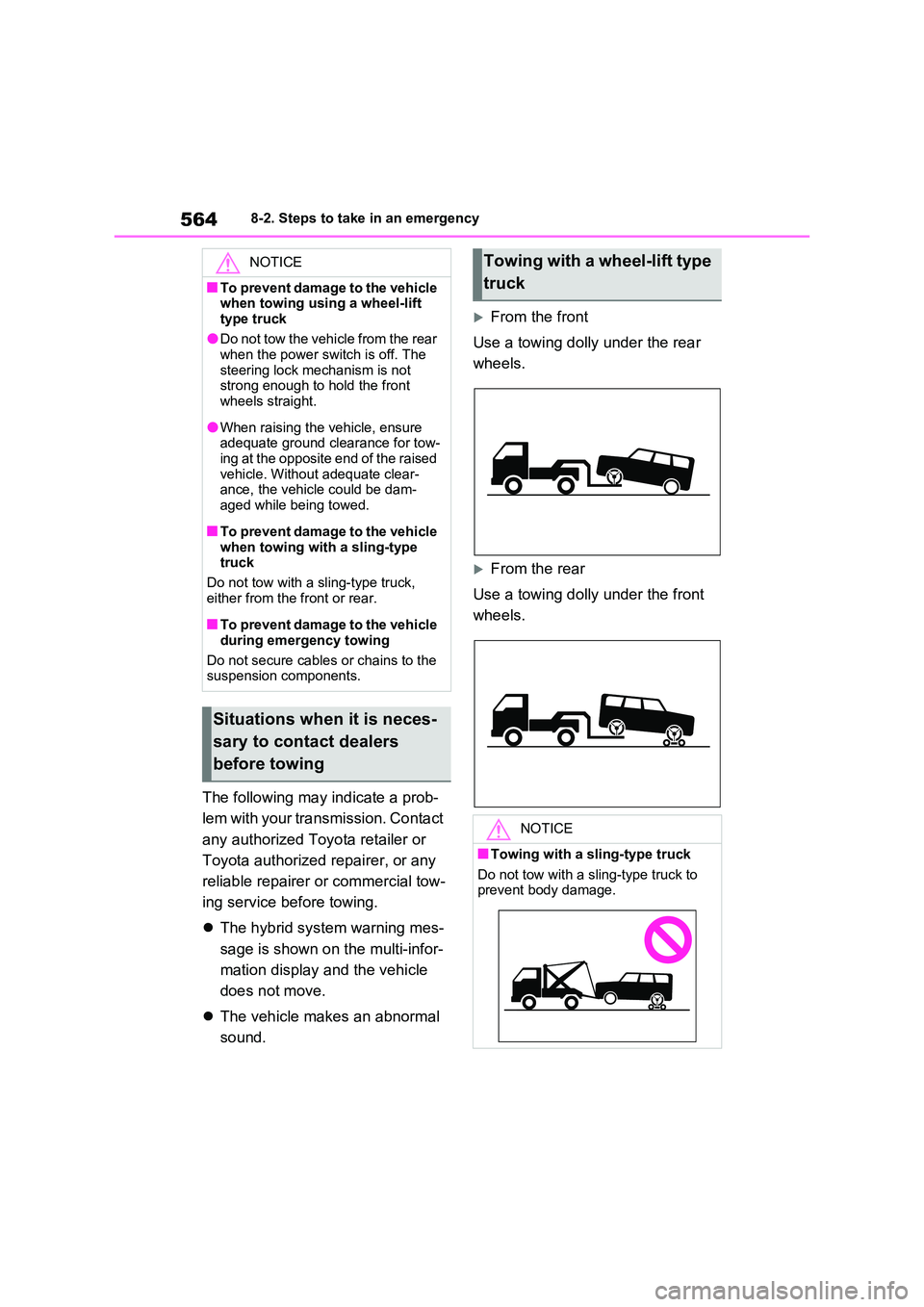
From the front
Use a towing dolly under the rear
wheels.
From the rear
Use a towing dolly under the front
wheels.
NOTICE
■To prevent damage to the vehicle when towing using a wheel-lift
type truck
●Do not tow the vehicle from the rear when the power switch is off. The
steering lock mechanism is not strong enough to hold the front wheels straight.
●When raising the vehicle, ensure adequate ground clearance for tow-
ing at the opposite end of the raised vehicle. Without adequate clear-ance, the vehicle could be dam-
aged while being towed.
■To prevent damage to the vehicle
when towing with a sling-type truck
Do not tow with a sling-type truck,
either from the front or rear.
■To prevent damage to the vehicle
during emergency towing
Do not secure cables or chains to the suspension components.
Situations when it is neces-
sary to contact dealers
before towing
Towing with a wheel-lift type
truck
NOTICE
■Towing with a sling-type truck
Do not tow with a sling-type truck to prevent body damage.
Page 565 of 664
565
8
8-2. Steps to take in an emergency
When trouble arises
When using a flat-bed truck to
transport the vehicle, use tire strap-
ping belts. Refer to the owner’s
manual of the flat-bed truck for the
tire strapping method.
In order to suppress vehicle move-
ment during transportation, set the
parking brake and turn the power
switch off.
If a tow truck is not available in an
emergency, your vehicle may be
temporarily towed using cables or
chains secured to the emergency
towing eyelets. This should only be
attempted on hard surfaced roads
for short distances at under 30
km/h (18 mph).
A driver must be in the vehicle to
steer and operate the brakes. The
vehicle’s wheels, drive train, axles,
steering and brakes must be in
good condition.
To have your vehicle towed by
another vehicle, the towing eyelet
must be installed to your vehicle.
Install the towing eyelet using the
following procedure.
1 Take out the wheel nut wrench
and towing eyelet. ( P.583,
594)
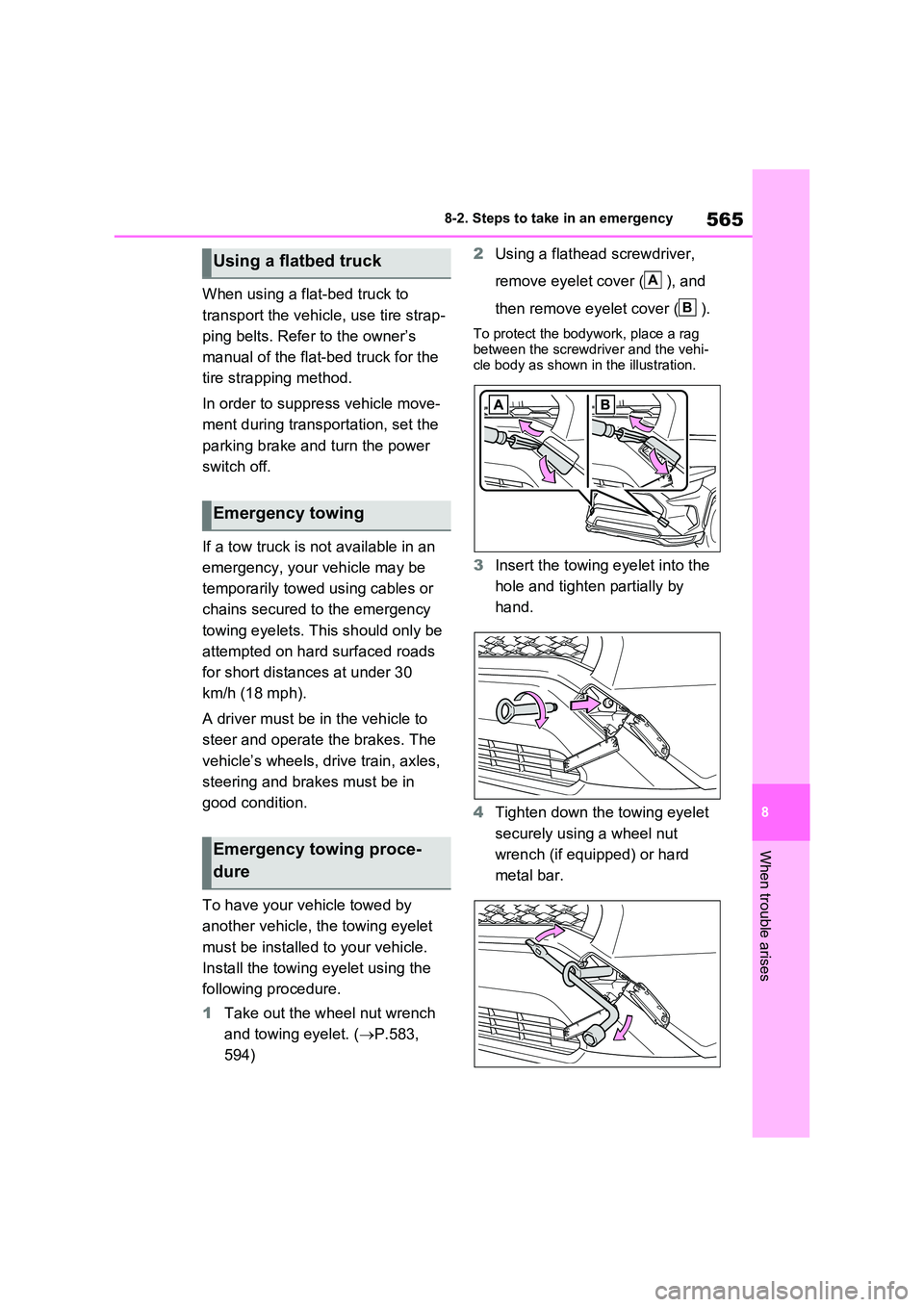
2 Using a flathead screwdriver,
remove eyelet cover ( ), and
then remove eyelet cover ( ).
To protect the bodywork, place a rag
between the screwdriver and the vehi- cle body as shown in the illustration.
3 Insert the towing eyelet into the
hole and tighten partially by
hand.
4 Tighten down the towing eyelet
securely using a wheel nut
wrench (if equipped) or hard
metal bar.
Using a flatbed truck
Emergency towing
Emergency towing proce-
dure
A
B
Page 566 of 664
5668-2. Steps to take in an emergency
5Securely attach cables or chains
to the towing eyelet.
Take care not to damage the vehicle
body.
6 Enter the vehicle being towed
and start the hybrid system.
Turn off the Parking Support Brake
function. (if equipped): P.420
If the hybrid system does not start, turn the power switch to ON.
7 Shift the shift lever to N and
release the parking brake.
Turn automatic mode off. ( P.327)
When the shift lever cannot be shifted:
P.323
■While towing
If the hybrid system is not running, the power assist for the brakes and steering will not function, making steering and
braking more difficult.
■Wheel nut wrench (if equipped)
Wheel nut wrench is installed in the deck under tray. ( P.583, 594)
Fluid leaks under the vehicle
(Water dripping from the air con-
ditioning after use is normal.)
Flat-looking tires or uneven tire
wear
High coolant temperature warn-
ing light flashes or come on
Changes in exhaust sound
Excessive tire squeal when cor-
nering
Strange noises related to the
suspension system
Pinging or other noises related to
the hybrid system
Engine missing, stumbling or
running roughly
Appreciable loss of power
If you think something is
wrong
If you notice any of the follow-
ing symptoms, your vehicle
probably needs adjustment or
repair. Contact any authorized
Toyota retailer or Toyota
authorized repairer, or any reli-
able repairer as soon as possi-
ble.
Visible symptoms
Audible symptoms
Operational symptoms