battery capacity TOYOTA VERSO S 2011 Owners Manual
[x] Cancel search | Manufacturer: TOYOTA, Model Year: 2011, Model line: VERSO S, Model: TOYOTA VERSO S 2011Pages: 664, PDF Size: 160.56 MB
Page 87 of 664
87
2 2-1. Plug-in hybrid system
Plug-in hybrid system
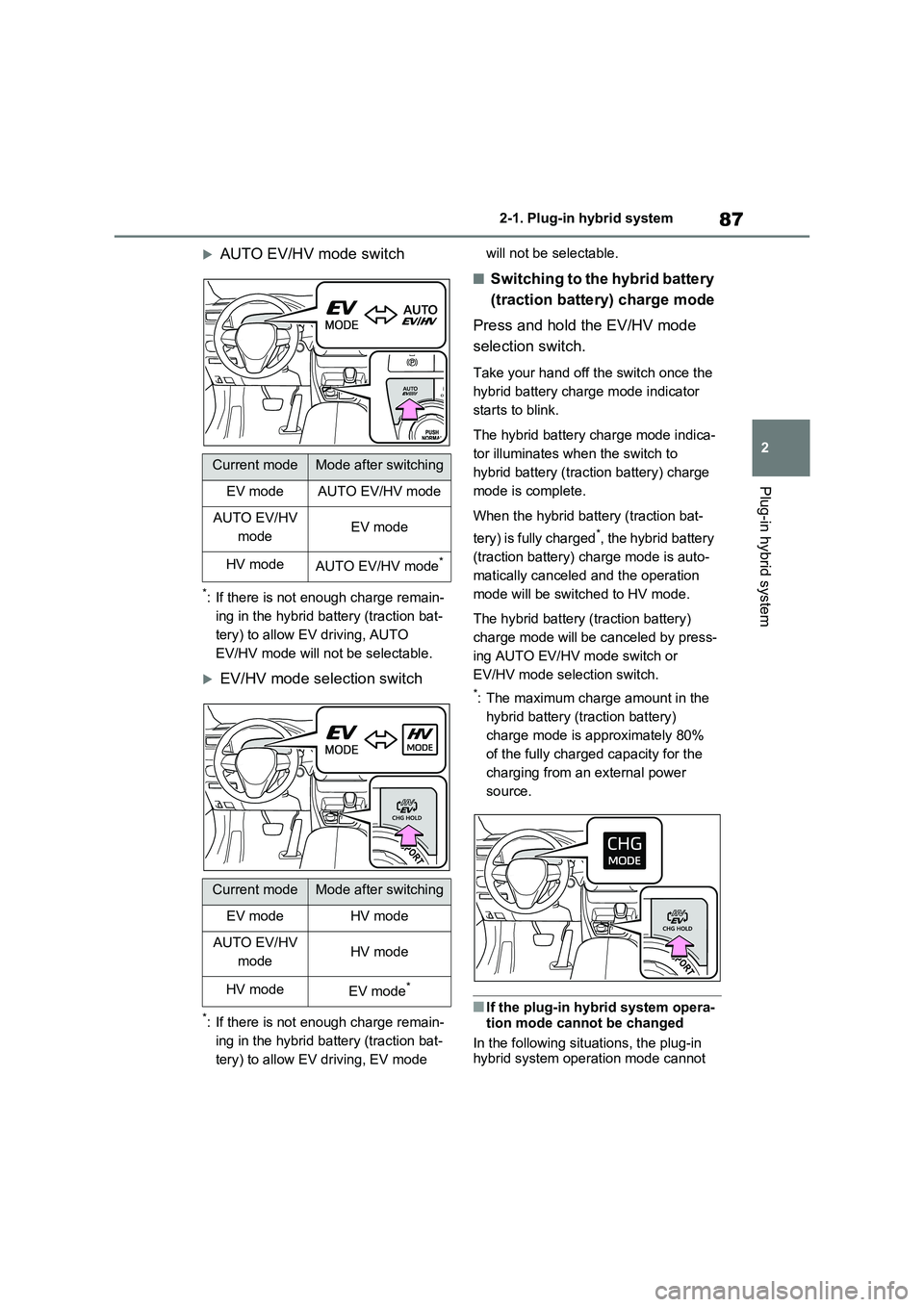
AUTO EV/HV mode switch
*: If there is not enough charge remain-
ing in the hybrid battery (traction bat-
tery) to allow EV driving, AUTO
EV/HV mode will not be selectable.
EV/HV mode selection switch
*: If there is not enough charge remain-
ing in the hybrid battery (traction bat-
tery) to allow EV driving, EV mode will not be selectable.
■Switching to the hybrid battery
(traction battery) charge mode
Press and hold the EV/HV mode
selection switch.
Take your hand off the switch once the
hybrid battery charge mode indicator
starts to blink.
The hybrid battery charge mode indica-
tor illuminates when the switch to
hybrid battery (traction battery) charge
mode is complete.
When the hybrid battery (traction bat-
tery) is fully charged
*, the hybrid battery
(traction battery) charge mode is auto-
matically canceled and the operation
mode will be switched to HV mode.
The hybrid battery (traction battery)
charge mode will be canceled by press-
ing AUTO EV/HV mode switch or
EV/HV mode selection switch.
*: The maximum charge amount in the
hybrid battery (traction battery)
charge mode is approximately 80%
of the fully charged capacity for the
charging from an external power
source.
■If the plug-in hybrid system opera-
tion mode cannot be changed
In the following situations, the plug-in
hybrid system operation mode cannot
Current modeMode after switching
EV modeAUTO EV/HV mode
AUTO EV/HV
modeEV mode
HV modeAUTO EV/HV mode*
Current modeMode after switching
EV modeHV mode
AUTO EV/HV
modeHV mode
HV modeEV mode*
Page 95 of 664
95
2
2-1. Plug-in hybrid system
Plug-in hybrid system
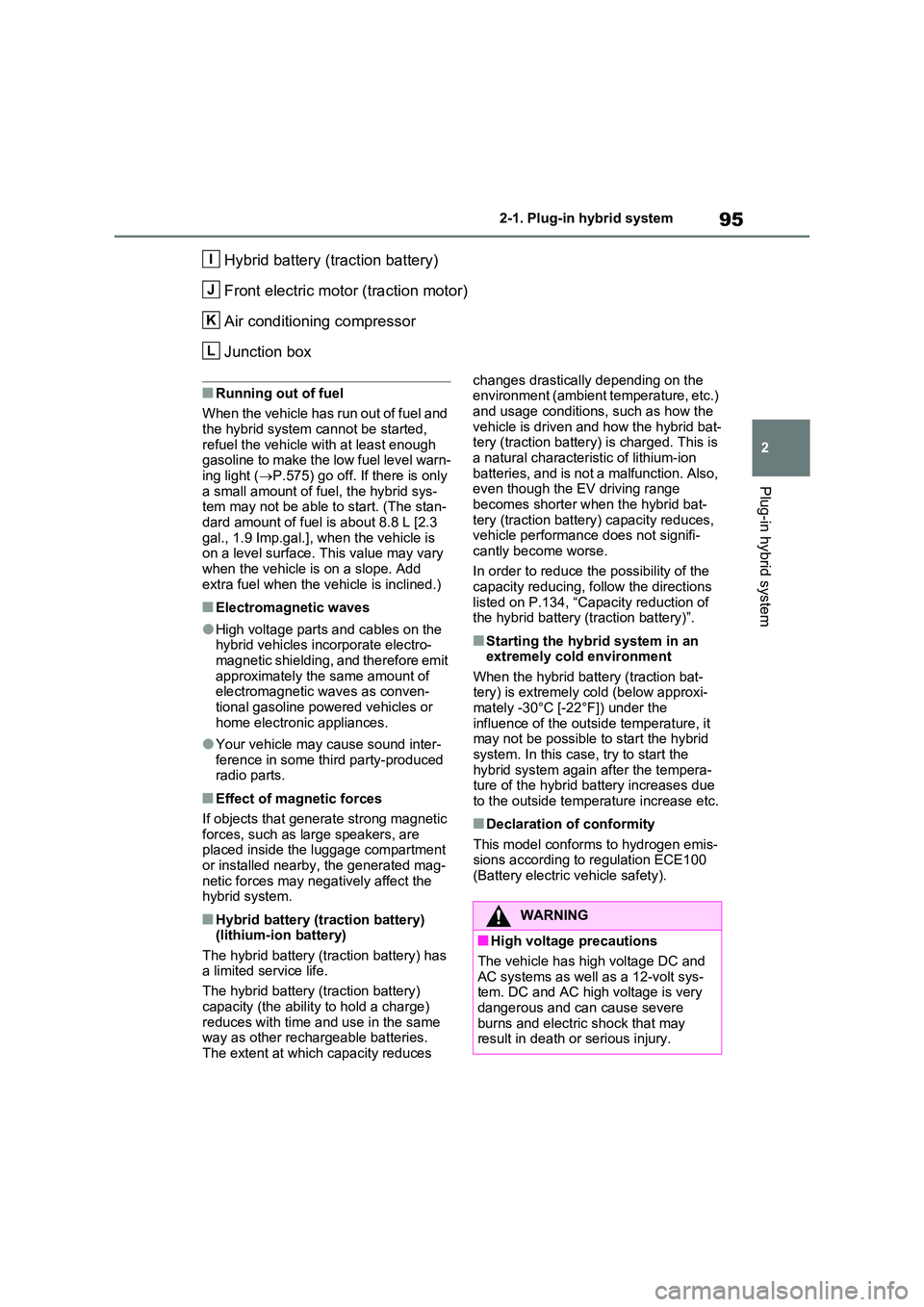
Hybrid battery (traction battery)
Front electric motor (traction motor)
Air conditioning compressor
Junction box
■Running out of fuel
When the vehicle has run out of fuel and
the hybrid system cannot be started, refuel the vehicle with at least enough gasoline to make the low fuel level warn-
ing light ( P.575) go off. If there is only a small amount of fuel, the hybrid sys-tem may not be able to start. (The stan-
dard amount of fuel is about 8.8 L [2.3 gal., 1.9 Imp.gal.], when the vehicle is on a level surface. This value may vary
when the vehicle is on a slope. Add extra fuel when the vehicle is inclined.)
■Electromagnetic waves
●High voltage parts and cables on the hybrid vehicles incorporate electro-magnetic shielding, and therefore emit
approximately the same amount of electromagnetic waves as conven-tional gasoline powered vehicles or
home electronic appliances.
●Your vehicle may cause sound inter-
ference in some third party-produced radio parts.
■Effect of magnetic forces
If objects that generate strong magnetic
forces, such as large speakers, are placed inside the luggage compartment or installed nearby, the generated mag-
netic forces may negatively affect the hybrid system.
■Hybrid battery (traction battery) (lithium-ion battery)
The hybrid battery (traction battery) has a limited service life.
The hybrid battery (traction battery)
capacity (the ability to hold a charge) reduces with time and use in the same way as other rechargeable batteries.
The extent at which capacity reduces
changes drastically depending on the environment (ambient temperature, etc.)
and usage conditions, such as how the vehicle is driven and how the hybrid bat-tery (traction battery) is charged. This is
a natural characteristic of lithium-ion batteries, and is not a malfunction. Also, even though the EV driving range
becomes shorter when the hybrid bat- tery (traction battery) capacity reduces, vehicle performance does not signifi-
cantly become worse.
In order to reduce the possibility of the capacity reducing, follow the directions
listed on P.134, “Capacity reduction of the hybrid battery (traction battery)”.
■Starting the hybrid system in an extremely cold environment
When the hybrid battery (traction bat- tery) is extremely cold (below approxi-mately -30°C [-22°F]) under the
influence of the outside temperature, it may not be possible to start the hybrid system. In this case, try to start the
hybrid system again after the tempera- ture of the hybrid battery increases due to the outside temperature increase etc.
■Declaration of conformity
This model conforms to hydrogen emis- sions according to regulation ECE100 (Battery electric vehicle safety).
I
J
K
L
WARNING
■High voltage precautions
The vehicle has high voltage DC and
AC systems as well as a 12-volt sys- tem. DC and AC high voltage is very dangerous and can cause severe
burns and electric shock that may result in death or serious injury.
Page 127 of 664
127
2 2-2. Charging
Plug-in hybrid system
■Charging from an external
power source (P.135)
This is a charging method used
when charging from an AC socket
(220 V - 240 V) with the AC
charging cable equipped to the
vehicle or charging at a public
charging station.
The charging start time (or departure
time) and day can be set to carry out
charging using the charging schedule
at the desired date and time. (P.144)
■Using the hybrid battery (trac-
tion battery) charge mode
(P.87)
The plug-in hybrid system can be
switched to hybrid battery (traction
battery) charge mode to charge the
hybrid battery (traction battery)
using electricity generated by gaso-
line engine operation.
The maximum charge amount in the
hybrid battery (traction battery) charge
mode is approximately 80% of the fully
charged capacity for the charging from
an external power source.
The time required to charge the
hybrid battery (traction battery) dif-fers according to the charging volt-
age and charging current.
Home power source (except for
France, Finland and Switzerland)
Charging voltage*1: AC 230 V
Charging current
*2: 10A
Estimated charging time
*3, 4: Approxi-
mately 7 hours 30 minutes
Home power source (for France,
Finland and Switzerland)
Charging voltage*1: AC 230 V
Charging current
*2: 8A
Estimated charging time
*3, 4: Approxi-
mately 9 hours
Charging station (3.3 kW
onboard traction battery charger)
Charging voltage*1: AC 230 V
Charging current
*2: 16A
Estimated charging time
*3, 4: Approxi-
mately 5 hours
Charging station (6.6 kW
onboard traction battery char-
ger
*5)
Charging voltage*1: AC 230 V
Charging current
*2: 32A
Estimated charging time
*3, 4: Approxi-
mately 2 hours 30 minutes
*1: The charging voltage may differ
depending on the target region.
*2: This is the maximum value. Further-
more, the upper limit of the charging
current can be changed in “Vehicle
Settings”. (P.125)
*3: The time required to complete
charging depends on conditions
Charging methods
The following methods can be
used to charge the hybrid bat-
tery (traction battery).
Types of charging methods
Estimated charging time
Page 134 of 664
1342-2. Charging
each part of the AC charging cable
is in good condition. (P.117)
■During charging
●The charging starting time may differ
depending on the state of the vehicle,
but this does not indicate a malfunc-
tion.
●Cooling fan sounds may be heard
from near the rear seat. (P.98)
●During charging, sounds may be
heard from near the hybrid battery
(traction battery) in accordance with
the operation of the air conditioning
system or “Battery Cooler” (P.129).
●During and after charging, the rear
seat and its surrounding area in which
the onboard traction battery charger is
installed may get warm.
●The surface of the CCID (Charging
Circuit Interrupting Device) may
become hot, but this does not indicate
a malfunction. (When using Mode 2
AC charging cable.)
●Depending on radio wave conditions,
interference may be heard on the
radio.
●The current charging condition and
the estimated time until charging will
complete can be checked on the
multi-information display.
■Capacity reduction of the hybrid
battery (traction battery)
The capacity of the hybrid battery (trac-
tion battery) will decline gradually when
the hybrid battery (traction battery) is in
use. The rate at which it declines will dif-
fer in accordance with environmental
conditions and the way in which the
vehicle is used. Observing the following
can help suppress battery capacity
decline.
●Avoid parking the vehicle in areas with
a high temperature under direct sun-
light when the hybrid battery (traction
battery) is fully charged.
●Avoid accelerating and decelerating frequently and suddenly when EV
driving.
●Avoid frequent driving near the top
speed for EV driving. (P.90)
●Leave a low level of charge in the
hybrid battery (traction battery) when
leaving the vehicle undriven for a long
period of time.
After confirming that EV mode or
AUTO EV/HV mode has switched to
HV mode, turn the power switch off.
●Use the charging schedule function as
much as possible in order to fully
charge the hybrid battery (traction bat-
tery) immediately before starting off.
(P.144)
Also, if the hybrid battery (traction bat-
tery) capacity reduces, the distance that
can be driven in EV mode or AUTO
EV/HV mode decreases. However, vehi-
cle performance does not significantly
become worse.
■When the remaining charge of the
hybrid battery (traction battery) is
low after charging
In the following situations, the remaining
charge of the hybrid battery (traction
battery) after charging completes may
be less than normal in order to protect
the system (the EV driving range after
the battery is fully charged may be
shorter).
*
●Charging is carried out when the out-
side temperature is low or high.
●Charging is carried out immediately
after high-load driving or in extreme
heat.
When none of the above situations
apply and there is a drastic drop in the
remaining charge of the hybrid battery
(traction battery) after charging com-
pletes, have the vehicle inspected by
any authorized Toyota retailer or Toyota
authorized repairer, or any reliable
repairer.
*: When this occurs, even if the remain-
ing charge display of the hybrid bat-
tery (traction battery) shows that it is
Page 538 of 664
5387-3. Do-it-yourself maintenance
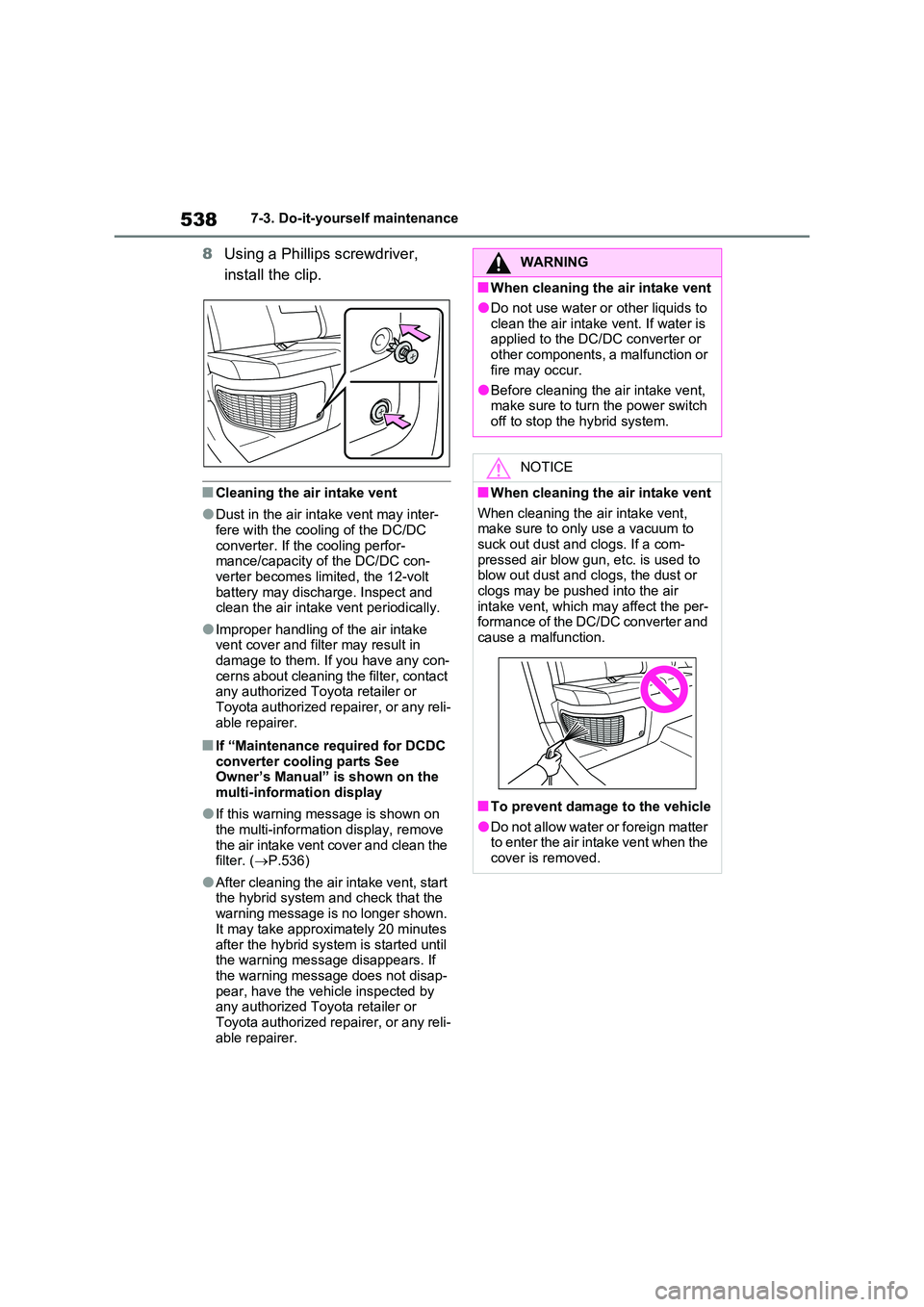
8Using a Phillips screwdriver,
install the clip.
■Cleaning the air intake vent
●Dust in the air intake vent may inter- fere with the cooling of the DC/DC
converter. If the cooling perfor- mance/capacity of the DC/DC con-verter becomes limited, the 12-volt
battery may discharge. Inspect and clean the air intake vent periodically.
●Improper handling of the air intake vent cover and filter may result in damage to them. If you have any con-
cerns about cleaning the filter, contact any authorized Toyota retailer or Toyota authorized repairer, or any reli-
able repairer.
■If “Maintenance required for DCDC converter cooling parts See Owner’s Manual” is shown on the
multi-information display
●If this warning message is shown on
the multi-information display, remove the air intake vent cover and clean the filter. ( P.536)
●After cleaning the air intake vent, start the hybrid system and check that the
warning message is no longer shown. It may take approximately 20 minutes
after the hybrid system is started until the warning message disappears. If the warning message does not disap-
pear, have the vehicle inspected by any authorized Toyota retailer or Toyota authorized repairer, or any reli-
able repairer.
WARNING
■When cleaning the air intake vent
●Do not use water or other liquids to
clean the air intake vent. If water is applied to the DC/DC converter or other components, a malfunction or
fire may occur.
●Before cleaning the air intake vent, make sure to turn the power switch
off to stop the hybrid system.
NOTICE
■When cleaning the air intake vent
When cleaning the air intake vent, make sure to only use a vacuum to suck out dust and clogs. If a com-
pressed air blow gun, etc. is used to blow out dust and clogs, the dust or clogs may be pushed into the air
intake vent, which may affect the per- formance of the DC/DC converter and cause a malfunction.
■To prevent damage to the vehicle
●Do not allow water or foreign matter to enter the air intake vent when the cover is removed.
Page 609 of 664
609
8
8-2. Steps to take in an emergency
When trouble arises
a malfunction, as the hybrid system
will start normally on the second attempt.
●The power switch mode is memorized by the vehicle. When the 12-volt bat-tery is reconnected, the system will
return to the mode it was in before the 12-volt battery was discharged. Before disconnecting the 12-volt bat-
tery, turn the power switch off. If you are unsure what mode the power switch was in before the 12-volt
battery discharged, be especially careful when reconnecting the 12-volt battery.
■When replacing the 12-volt battery
●Use a 12-volt battery that conforms to European regulations.
●Use a 12-volt battery that the case size is same as the previous one
(LN2), 20 hours rate capacity (20HR) is equivalent (55Ah) or greater, and performance rating (CCA) is equiva-
lent (345A) or greater. • If the sizes differ, the 12-volt battery cannot be properly secured.
• If the 20 hour rate capacity is low, even if the time period where the vehi-cle is not used is a short time, the 12-
volt battery may discharge and hybrid system may not be able to start.
●Use a ventilation type calcium battery
●Use a 12-volt battery with a handle. If
a 12-volt battery without a handle is used, removal is more difficult.
●When removing the 12-volt battery: P.508
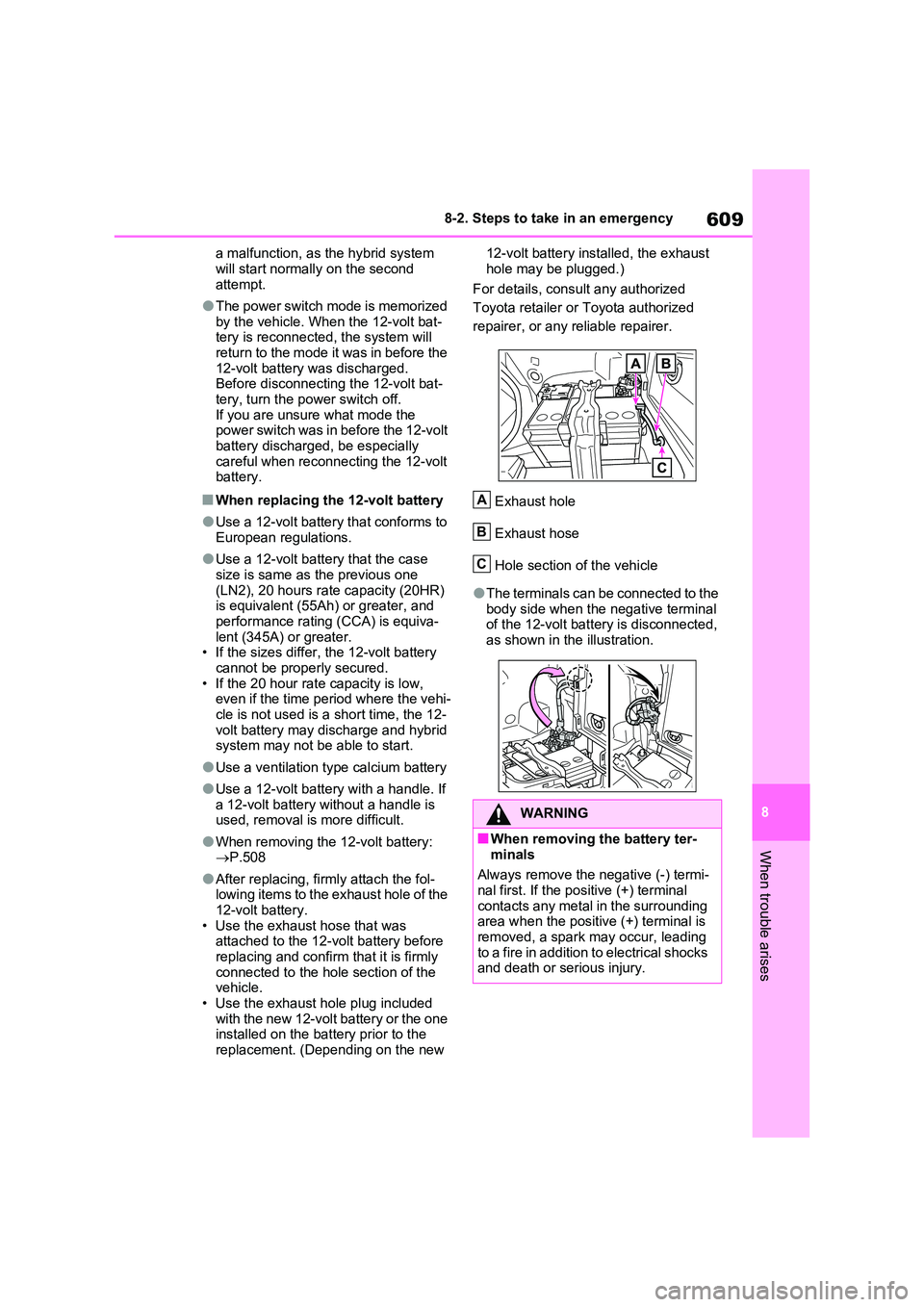
●After replacing, firmly attach the fol- lowing items to the exhaust hole of the 12-volt battery.
• Use the exhaust hose that was attached to the 12-volt battery before replacing and confirm that it is firmly
connected to the hole section of the vehicle.• Use the exhaust hole plug included
with the new 12-volt battery or the one installed on the battery prior to the replacement. (Depending on the new
12-volt battery installed, the exhaust
hole may be plugged.)
For details, consult any authorized
Toyota retailer or Toyota authorized
repairer, or any reliable repairer.
Exhaust hole
Exhaust hose
Hole section of the vehicle
●The terminals can be connected to the body side when the negative terminal of the 12-volt battery is disconnected,
as shown in the illustration.
WARNING
■When removing the battery ter-
minals
Always remove the negative (-) termi- nal first. If the positive (+) terminal
contacts any metal in the surrounding area when the positive (+) terminal is removed, a spark may occur, leading
to a fire in addition to electrical shocks and death or serious injury.
A
B
C
Page 621 of 664
621
9 9-1. Specifications
Vehicle specifications
■Oil capacity (Drain and refill reference*)
*: The engine oil capacity is a reference quantity to be used when changing the
engine oil. Warm up the engine and turning off the hybrid system, wait more than
5 minutes, and check the oil level on the dipstick.
■Engine oil selection
“Toyota Genuine Motor Oil” is used
in your Toyota vehicle. Toyota rec-
ommends the use of approved
“Toyota Genuine Motor Oil”.
Another motor oil of matching qual-
ity can also be used.
Oil grade:
0W-16:
API grade SN “Resource-Conserv-
ing” or SN PLUS “Resource-Con-
serving” multigrade engine oil
0W-20 and 5W-30:
API grade SL “Energy-Conserving”,
SM “Energy-Conserving”, SN
“Resource-Conserving” or SN
PLUS “Resource-Conserving”; or
ILSAC multigrade engine oil
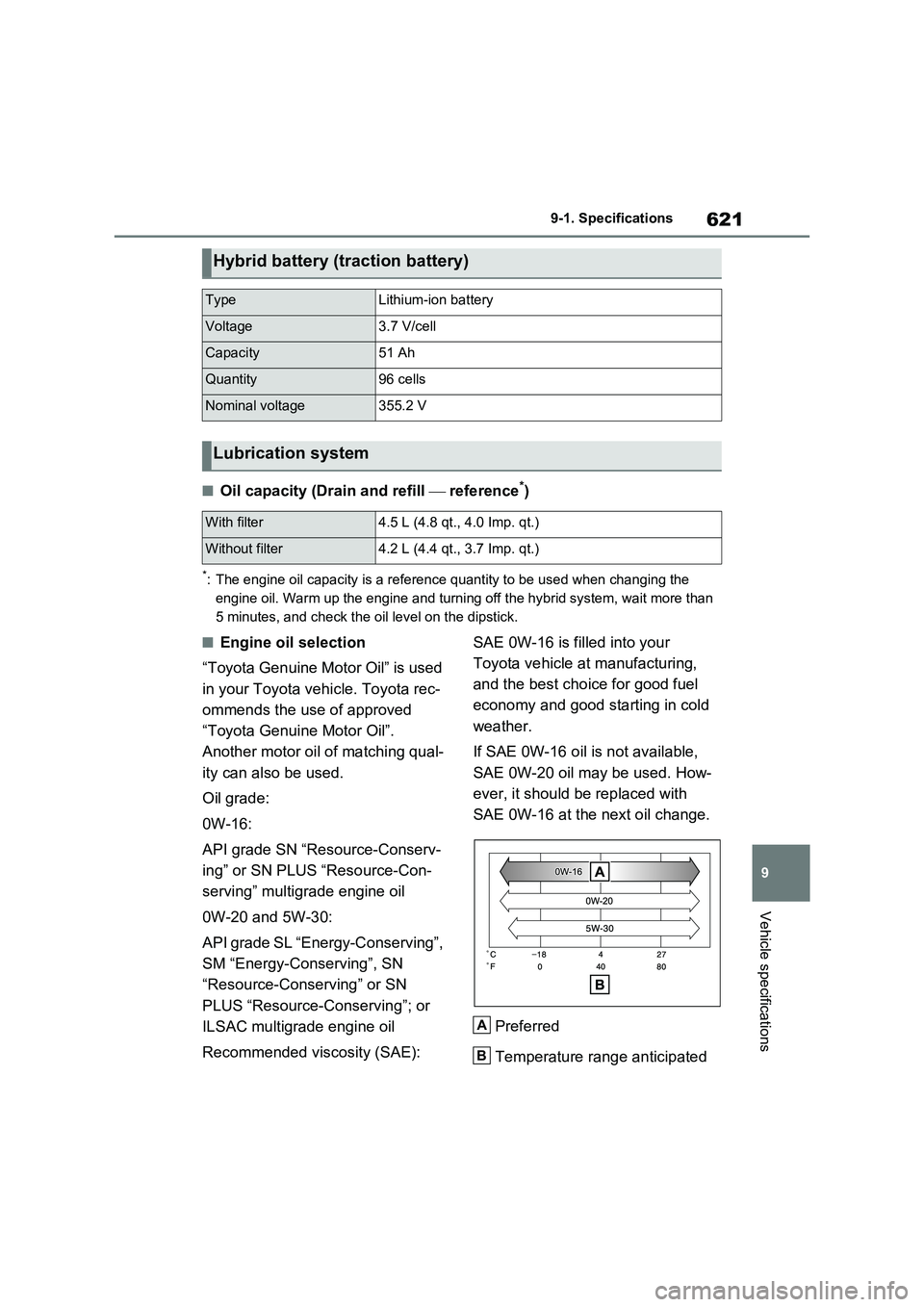
Recommended viscosity (SAE):SAE 0W-16 is filled into your
Toyota vehicle at manufacturing,
and the best choice for good fuel
economy and good starting in cold
weather.
If SAE 0W-16 oil is not available,
SAE 0W-20 oil may be used. How-
ever, it should be replaced with
SAE 0W-16 at the next oil change.
Preferred
Temperature range anticipated
Hybrid battery (traction battery)
TypeLithium-ion battery
Voltage3.7 V/cell
Capacity51 Ah
Quantity96 cells
Nominal voltage355.2 V
Lubrication system
With filter4.5 L (4.8 qt., 4.0 Imp. qt.)
Without filter4.2 L (4.4 qt., 3.7 Imp. qt.)
A
B
Page 623 of 664
623
9
9-1. Specifications
Vehicle specifications
authorized repairer, or any reliable repairer.
*: The fluid capacity is the quantity of reference.
If replacement is necessary, contact any authorized Toyota retailer or Toyota
authorized repairer, or any reliable repairer.
Ignition system (spark plug)
MakeDENSO FC16HR-Q8
Gap0.8 mm (0.031 in.)
NOTICE
■Iridium-tipped spark plugs
Use only iridium-tipped spark plugs. Do not adjust the spark plug gap.
Electrical system (12-volt battery)
Specific voltage reading at 20°C (68°F):
12.0 V or higher
(Turn the power switch to OFF and turn
on the high beam headlights for 30 sec-
onds.)
If the voltage is lower than the standard
value, charge the 12-volt battery.
Charging ratesQuick charge15 A max.
Slow charge5 A max.
Hybrid transmission
Fluid capacity*4.4 L (4.6 qt., 3.9 Imp.qt.)
Fluid typeToyota Genuine ATF WS
NOTICE
■Hybrid transmission fluid type
Using transmission fluid other than the above type may cause abnormal noise or
vibration, or ultimately damage the transmission of your vehicle.
Page 651 of 664
651Alphabetical Index
When charging cannot be carried
out ............................................ 156
Charging port ................................ 105
If the charging port lid does not open
................................................. 121
Locking and unlocking ............... 121
Opening and closing .................. 106
Child-protector.............................. 209
Child restraint system .................... 50
Child restraint system installation
method....................................... 60
Fixed with a seat belt ................... 61
Fixed with an ISOFIX lower anchor-
age ............................................. 62
Points to remember...................... 51
Riding with children ...................... 49
Using a top tether anchorage....... 63
Child safety ..................................... 49
12-volt battery precautions. 507, 610
Airbag precautions ....................... 43
Back door precautions ............... 210
Charging precautions ................. 133
Heated steering wheel and seat
heater precautions ................... 462
How your child should wear the seat
belt ............................................. 36
Panoramic moon roof precautions
................................................. 296
Power window lock switch ......... 293
Power window precautions ........ 292
Rear door child-protectors ......... 209
Seat belt precautions ................... 35
Seat heater precautions ............. 462
Cleaning ................................ 488, 491
Aluminum wheels ....................... 488
DC/DC Converter air intake vent 536
Exterior....................................... 488
Front camera.............................. 345
Interior ........................................ 491
Radar sensor ............................. 345
Seat belts ................................... 491Water-repellent coating .............. 489
Clock ..............................................179
Coat hooks .................................... 484
Condenser ..................................... 504
Console box .................................. 469
Consumption screen .................... 195
Coolant
Capacity ..................................... 622
Checking .................................... 503
Preparing and checking before win-
ter ............................................. 445
Warning light .............................. 569
Cooling system .............................503
Engine overheating .................... 611
Hybrid system overheating......... 613
Cruise control
Cruise control .............................388
Dynamic radar cruise control with
full-speed range .......................376
Cup holders ...................................470
Current fuel consumption ............198
Current fuel economy................... 181
Curtain shield airbags ....................39
Customizable features ................. 629
D
Daytime running light system ..... 332
Replacing light bulbs ..................548
DC/DC converter air intake vent .... 98
Cleaning ..................................... 536
Deck board .................................... 472
Deck under tray.............................473
Defogger
Outside rear view mirrors ........... 454
Rear window .............................. 454
Windshield.................................. 453
Digital Rear-view Mirror ............... 280
Dimensions ...................................618
Display
BSM (Blind Spot Monitor)........... 393
Consumption screen ..................195
Page 653 of 664
653Alphabetical Index
If a warning light turns on ........... 568
If a warning message is displayed
................................................. 578
If the 12-volt battery is discharged
................................................. 606
If the electronic key does not operate
properly.................................... 604
If the fuel filler door cannot be
opened..................................... 603
If the hybrid system will not start 601
If the vehicle is trapped in rising
water ........................................ 561
If you have a flat tire........... 582, 593
If you lose your keys .................. 603
If you think something is wrong.. 566
If your vehicle becomes stuck .... 615
If your vehicle has to be stopped in
an emergency .......................... 560
If your vehicle needs to be towed
................................................. 563
If your vehicle overheats ............ 611
Emergency brake signal .............. 439
Emergency flashers ..................... 560
Emergency tire puncture repair kit
..................................................... 582
Energy monitor ............................. 195
Engine
Compartment ............................. 501
Exhaust gas precautions.............. 47
Hood .......................................... 498
How to start the hybrid system... 317
Identification number.................. 619
If the hybrid system will not start 601
If your vehicle has to be stopped in
an emergency .......................... 560
Overheating ............................... 611
Power switch .............................. 317
Engine coolant
Capacity ..................................... 622
Checking .................................... 503
High coolant temperature warning light .......................................... 569
Preparing and checking before win-
ter ............................................. 445
Warning light .............................. 569
Engine coolant temperature gauge
..................................................... 174
Engine oil
Capacity ..................................... 621
Checking .................................... 501
Preparing and checking before win-
ter ............................................. 445
Warning light .............................. 569
EPS (Electric Power Steering)
Function ..................................... 438
Warning light .............................. 570
EV/HV mode selection switch........ 86
EV driving range ........................... 102
EV mode ..........................................85
Exhaust gas precautions ............... 47
Extended Headlight Lighting system
..................................................... 333
F
Flat tire ................................... 582, 593
Tire pressure warning system .... 511
Floor mats ....................................... 32
Fluid
Brake .......................................... 624
Hybrid transmission.................... 623
Rear differential .......................... 624
Washer ....................................... 505
Fog lights
Replacing light bulbs ..................548
Switch......................................... 337
Wattage ...................................... 625
Footwell lights............................... 465
Front fog lights
Replacing light bulbs ..................548
Switch......................................... 337
Wattage ...................................... 625
Front passenger’s seat belt reminder