ECU TOYOTA VERSO S 2012 User Guide
[x] Cancel search | Manufacturer: TOYOTA, Model Year: 2012, Model line: VERSO S, Model: TOYOTA VERSO S 2012Pages: 540, PDF Size: 17.43 MB
Page 119 of 540
119 1-7. Safety information
1
Before driving
VERSO-S_EE
CAUTION
SRS airbag precautions
The SRS front passenger airbag also deploys with considerable force, and
can cause death or serious injury especially if the front passenger is very
close to the airbag. The front passenger seat should be as far from the air-
bag as possible with the seatback adjusted, so the front passenger sits
upright.
Improperly seated and/or restrained infants and children can be killed or
seriously injured by a deploying airbag. An infant or child who is too small
to use a seat belt should be properly secured using a child restraint sys-
tem. Toyota strongly recommends that all infants and children be placed in
the rear seats of the vehicle and properly restrained. The rear seats are
safer for infants and children than the front passenger seat. (P. 126)
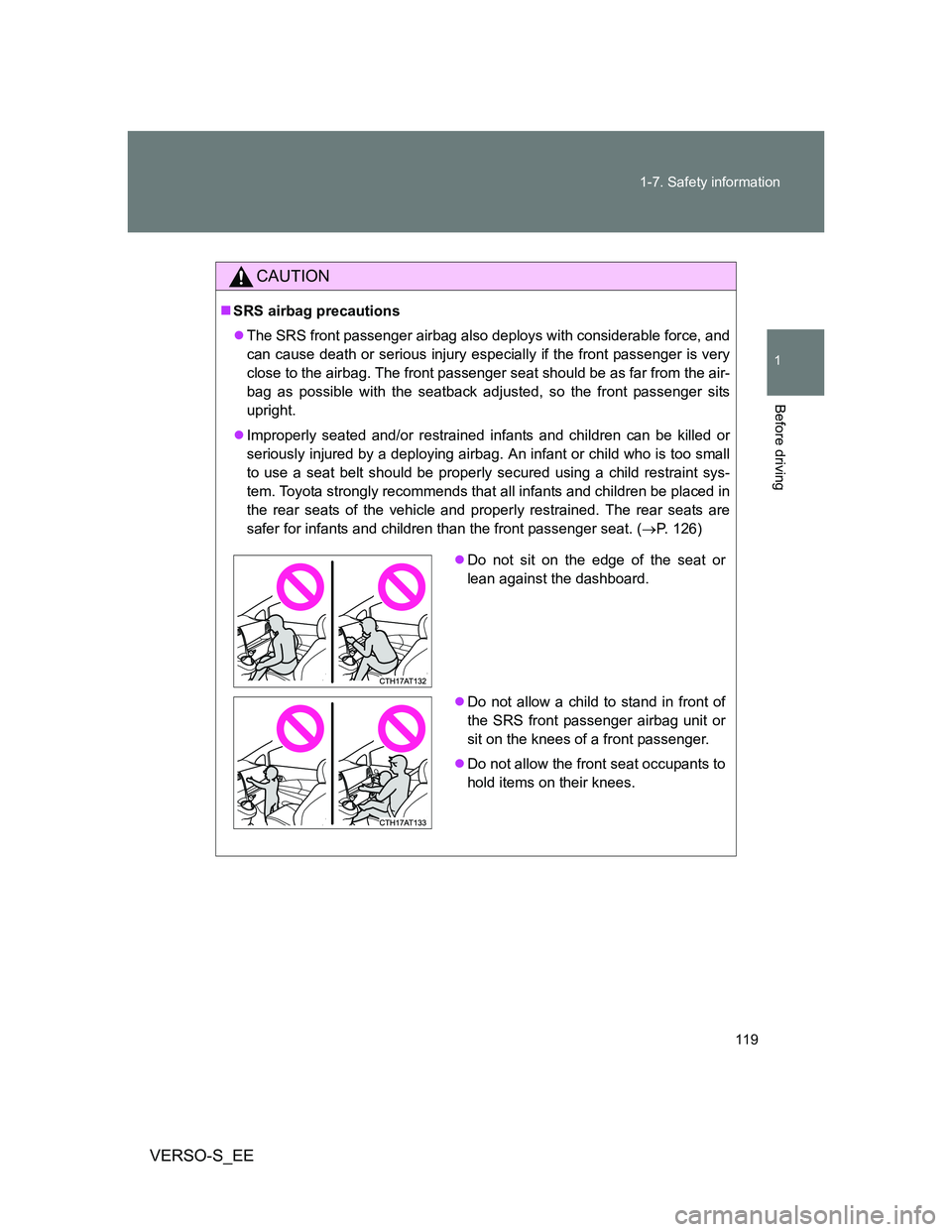
Do not sit on the edge of the seat or
lean against the dashboard.
Do not allow a child to stand in front of
the SRS front passenger airbag unit or
sit on the knees of a front passenger.
Do not allow the front seat occupants to
hold items on their knees.
Page 126 of 540
126
1-7. Safety information
VERSO-S_EE
Child restraint systems
Points to remember
Studies have shown that installing a child restraint on a rear seat is
much safer than installing one on the front passenger seat.
Choose a child restraint system that suits your vehicle and is
appropriate to the age and size of the child.
For installation details, follow the instructions provided with the
child restraint system.
General installation instructions are provided in this manual.
(P. 135)
If child restraint system regulations exist in the country where you
reside, please contact your Toyota dealer for the child restraint sys-
tem installation.
Toyota recommends that you use a child restraint system which
conforms to the regulation ECE No.44.
Types of child restraints
Child restraint systems are classified into the following 5 groups
according to the regulation ECE No.44:
Group 0: Up to 10 kg (22 lb.) (0 - 9 months)
Group 0
+: Up to 13 kg (28 lb.) (0 - 2 years)
Group I: 9 to 18 kg (20 to 39 lb.) (9 months - 4 years)
Group II: 15 to 25 kg (34 to 55 lb.) (4 years - 7 years)
Group III: 22 to 36 kg (49 to 79 lb.) (6 years - 12 years)
In this owner's manual, the following 3 types of popular child restraint
systems that can be secured with the seat belts are explained:
Toyota strongly urges the use of child restraint systems.
Page 132 of 540
132 1-7. Safety information
VERSO-S_EE
Selecting an appropriate child restraint system
Use a child restraint system appropriate for the child until the child
becomes large enough to properly wear the vehicle’s seat belt.
If the child is too large for a child restraint system, sit the child on a rear
seat and use the vehicle's seat belt. (P. 77)
CAUTION
Using a child restraint system
The use of a child restraint system not suitable for the vehicle may not prop-
erly secure the infant or child. It may result in death or serious injury (in the
event of sudden braking or an accident).
Child restraint precautions
For effective protection in automobile accidents and sudden stops, a child
must be properly restrained, using a seat belt or child restraint system
depending on the age and size of the child. Holding a child in your arms is
not a substitute for a child restraint system. In an accident, the child can be
crushed against the windshield, or between you and the vehicle's interior.
Toyota strongly urges the use of a proper child restraint system that con-
forms to the size of the child, installed on the rear seat. According to acci-
dent statistics, the child is safer when properly restrained in the rear seat
than in the front seat.
Page 133 of 540
133 1-7. Safety information
1
Before driving
VERSO-S_EE
CAUTION
Child restraint precautions
Never use a rear-facing child restraint system on the front passenger seat
when the airbag manual on-off switch is on. (P. 123)
In the event of an accident, the force of the rapid inflation of the front pas-
senger airbag can cause death or serious injury to the child.
A forward-facing child restraint system may be installed on the front pas-
senger seat only when it is unavoidable. A child restraint system that
requires a top tether strap should not be used in the front passenger seat
since there is no top tether strap anchor for the front passenger seat.
Adjust the seatback as upright as possible and always move the seat as
far back as possible because the front passenger airbag could inflate with
considerable speed and force. Otherwise, the child may be killed or seri-
ously injured.
Vehicles without SRS curtain shield airbags: Do not allow the child to lean
his/her head or any part of his/her body against the door or the area of the
seat from which the SRS side airbags deploy even if the child is seated in
the child restraint system. It is dangerous if the SRS side airbags inflate,
and the impact could cause death or serious injury to the child.
Vehicles with SRS curtain shield airbags: Do not allow the child to lean his/
her head or any part of his/her body against the door or the area of the
seat, front and rear pillars or roof side rails from which the SRS side air-
bags or SRS curtain shield airbags deploy even if the child is seated in the
child restraint system. It is dangerous if the SRS side airbags and curtain
shield airbags inflate, and the impact could cause death or serious injury to
the child.
Make sure you have complied with all installation instructions provided by
the child restraint manufacturer and that the system is properly secured. If
it is not secured properly, it may cause death or serious injury to the child
in the event of a sudden stop, sudden swerve or an accident.
Page 134 of 540
134 1-7. Safety information
VERSO-S_EE
CAUTION
When children are in the vehicle
Do not allow children to play with the seat belt. If the seat belt becomes
twisted around a child’s neck, choking or other serious injuries may result in
death.
If this occurs and the buckle cannot be unfastened, scissors should be used
to cut the belt.
When the child restraint system is not in use
Keep the child restraint system properly secured on the seat even if it is
not in use. Do not store the child restraint system unsecured in the pas-
senger compartment.
If it is necessary to detach the child restraint system, remove it from the
vehicle or store it securely in the luggage compartment. This will prevent it
from injuring passengers in the event of a sudden stop, sudden swerve or
accident.
Page 135 of 540
135
1
1-7. Safety information
Before driving
VERSO-S_EE
Installing child restraints
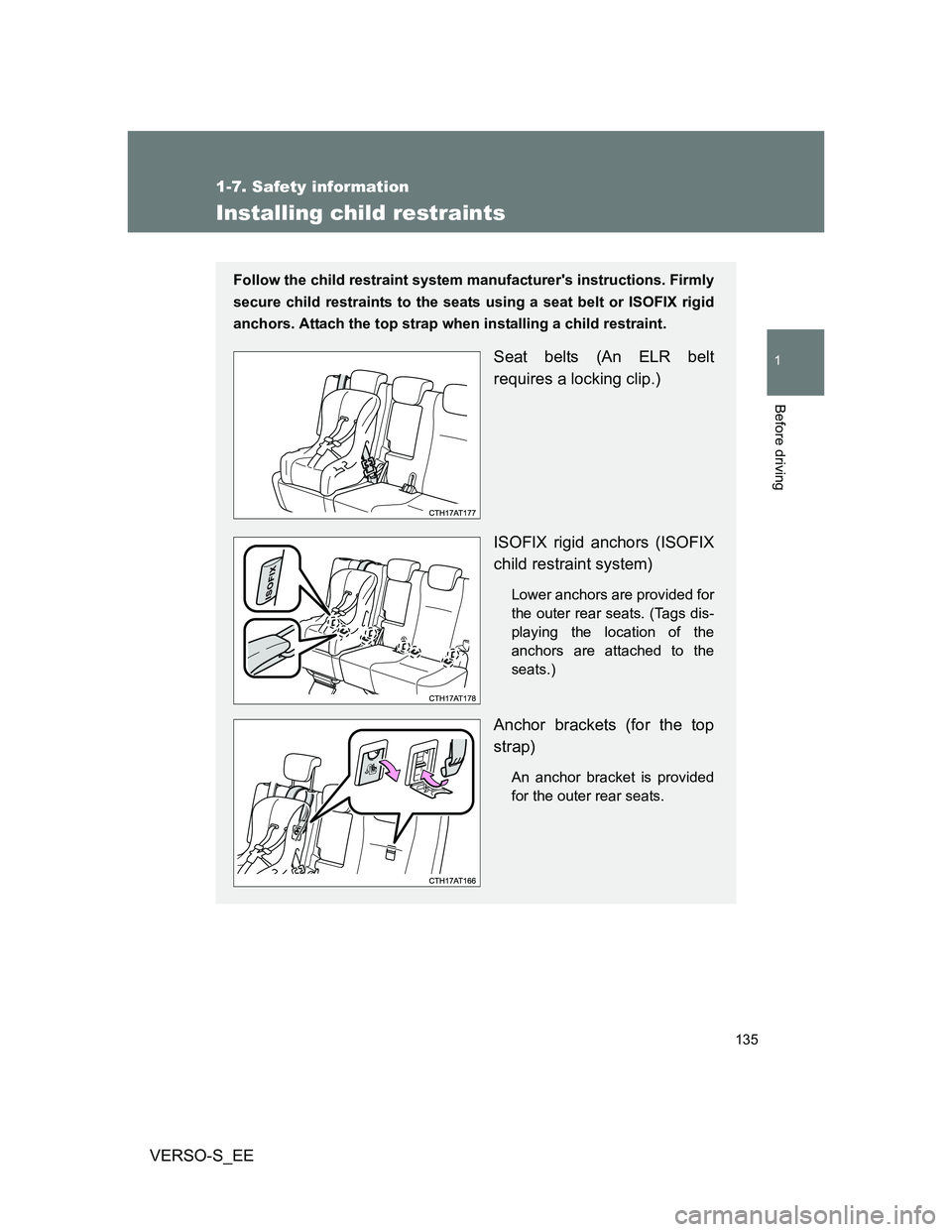
Follow the child restraint system manufacturer's instructions. Firmly
secure child restraints to the seats using a seat belt or ISOFIX rigid
anchors. Attach the top strap when installing a child restraint.
Seat belts (An ELR belt
requires a locking clip.)
ISOFIX rigid anchors (ISOFIX
child restraint system)
Lower anchors are provided for
the outer rear seats. (Tags dis-
playing the location of the
anchors are attached to the
seats.)
Anchor brackets (for the top
strap)
An anchor bracket is provided
for the outer rear seats.
Page 141 of 540
141 1-7. Safety information
1
Before driving
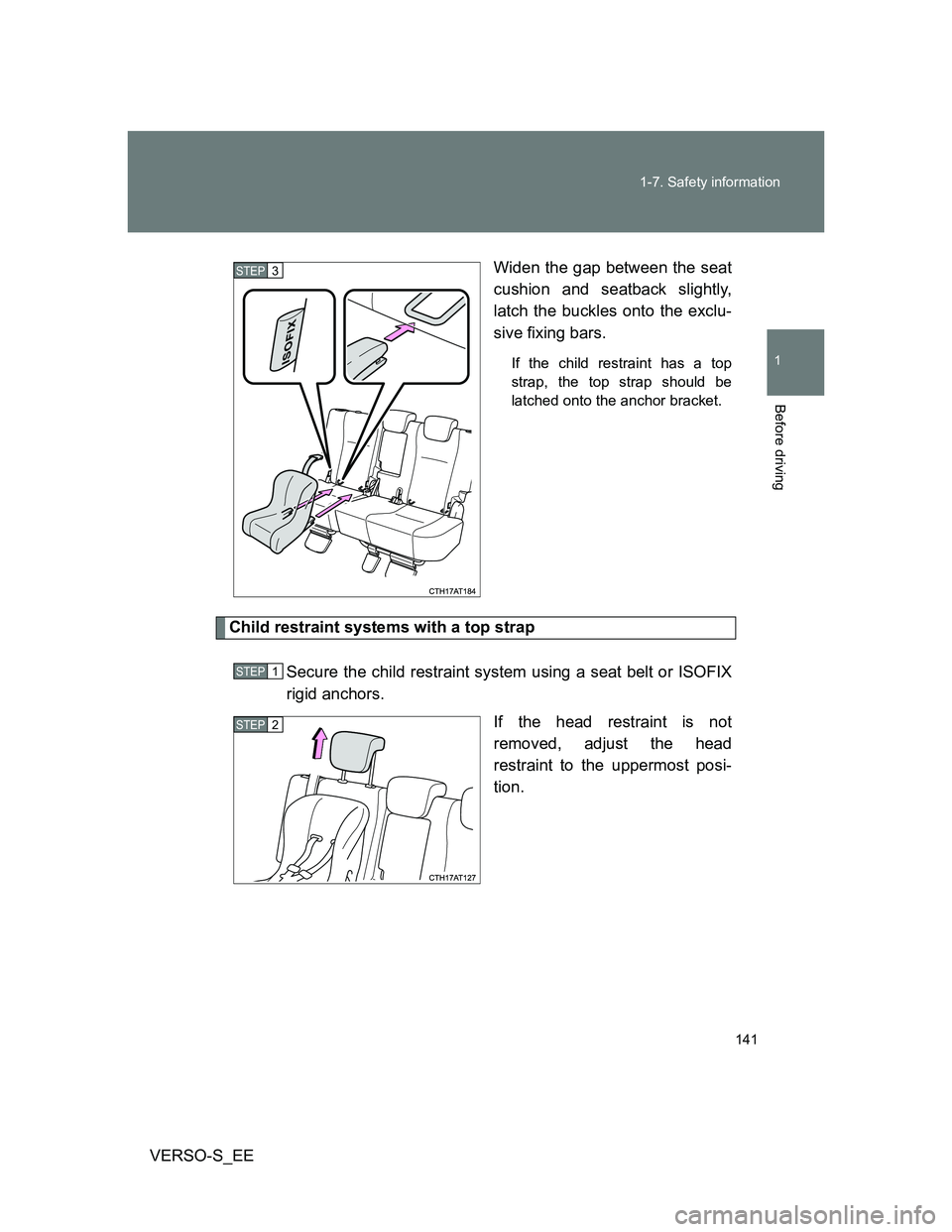
VERSO-S_EEWiden the gap between the seat
cushion and seatback slightly,
latch the buckles onto the exclu-
sive fixing bars.
If the child restraint has a top
strap, the top strap should be
latched onto the anchor bracket.
Child restraint systems with a top strap
Secure the child restraint system using a seat belt or ISOFIX
rigid anchors.
If the head restraint is not
removed, adjust the head
restraint to the uppermost posi-
tion.
STEP3
STEP1
STEP2
Page 142 of 540
142 1-7. Safety information
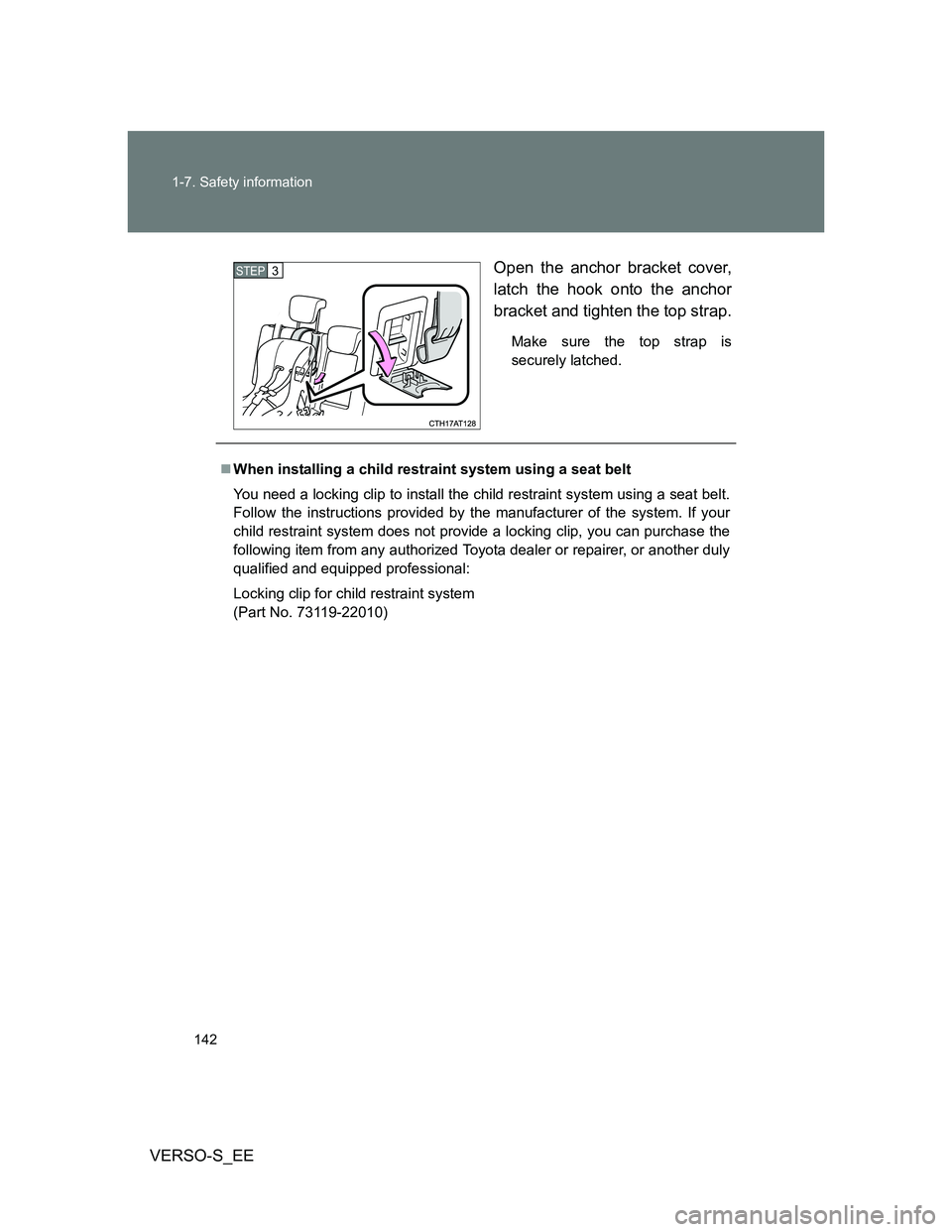
VERSO-S_EEOpen the anchor bracket cover,
latch the hook onto the anchor
bracket and tighten the top strap.
Make sure the top strap is
securely latched.
STEP3
When installing a child restraint system using a seat belt
You need a locking clip to install the child restraint system using a seat belt.
Follow the instructions provided by the manufacturer of the system. If your
child restraint system does not provide a locking clip, you can purchase the
following item from any authorized Toyota dealer or repairer, or another duly
qualified and equipped professional:
Locking clip for child restraint system
(Part No. 73119-22010)
Page 143 of 540
143 1-7. Safety information
1
Before driving
VERSO-S_EE
CAUTION
When installing a child restraint system
Follow the directions given in the child restraint system installation manual
and fix the child restraint system securely in place.
If the child restraint system is not correctly fixed in place, the child or other
passengers may be seriously injured or even killed in the event of sudden
braking, sudden swerving or an accident.
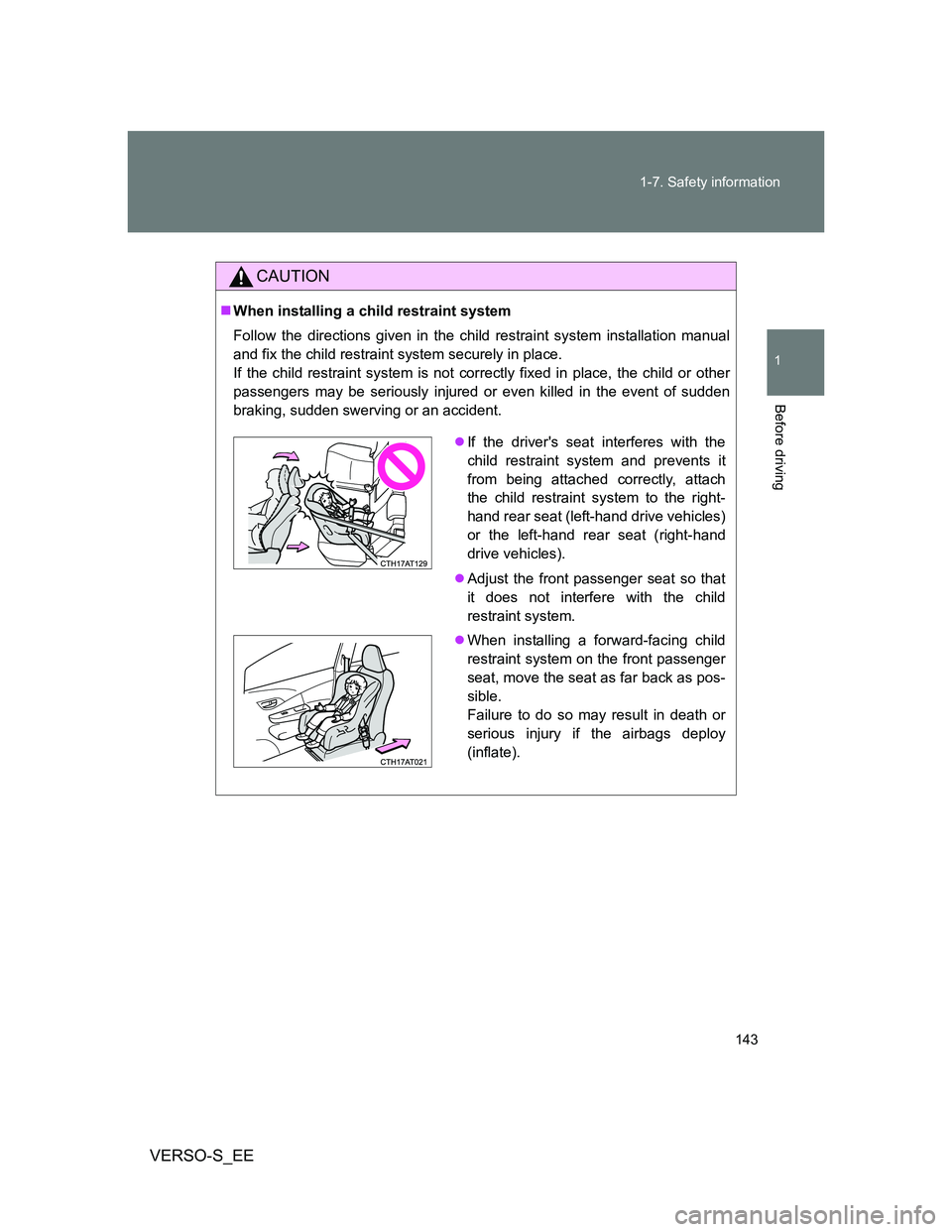
If the driver's seat interferes with the
child restraint system and prevents it
from being attached correctly, attach
the child restraint system to the right-
hand rear seat (left-hand drive vehicles)
or the left-hand rear seat (right-hand
drive vehicles).
Adjust the front passenger seat so that
it does not interfere with the child
restraint system.
When installing a forward-facing child
restraint system on the front passenger
seat, move the seat as far back as pos-
sible.
Failure to do so may result in death or
serious injury if the airbags deploy
(inflate).
Page 147 of 540
147 1-7. Safety information
1
Before driving
VERSO-S_EE
CAUTION
When installing a child restraint system
If child restraint system regulations exist in the country where you reside,
please contact any authorized Toyota dealer or repairer, or another duly
qualified and equipped professional for the child restraint system installa-
tion.
When installing a child restraint system on the rear center seat, adjust both
seatbacks at the same angle. The seatbacks must be adjusted to the
same angle. Otherwise, the child restraint system cannot be securely
restrained and this may cause death or serious injuries in the event of sud-
den braking, sudden swerving or an accident.
When a junior seat is installed, always ensure that the shoulder belt is
positioned across the center of the child's shoulder. The belt should be
kept away from the child's neck, but not so that it could fall off the child's
shoulder. Failure to do so may result in death or serious injury in the event
of sudden braking, sudden swerving or an accident.
Ensure that the belt and plate are securely locked and the seat belt is not
twisted.
Push and pull the child restraint system from side to side and forward to be
sure it is secure.
After securing a child restraint system, never adjust the seat.
Follow all installation instructions provided by the child restraint system
manufacturer.
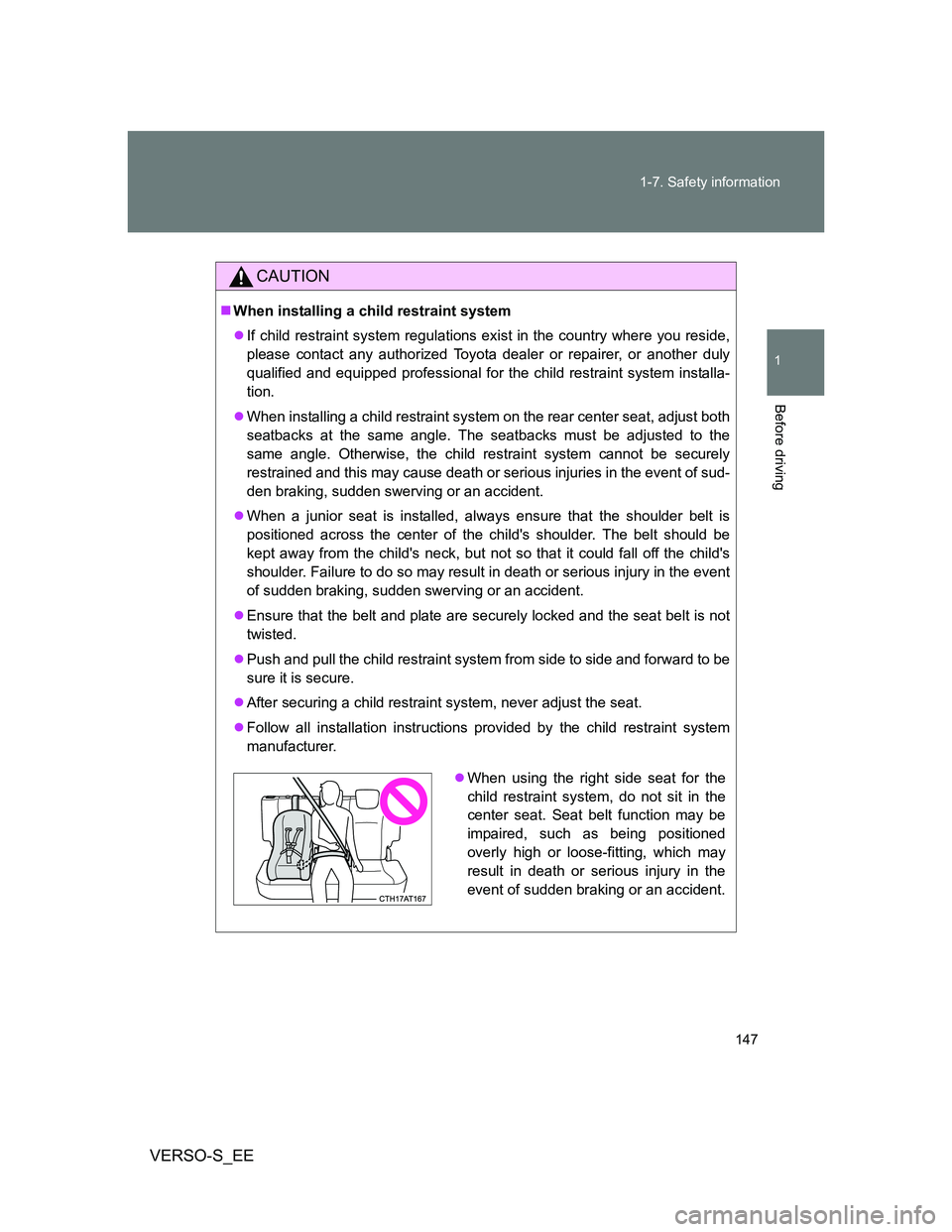
When using the right side seat for the
child restraint system, do not sit in the
center seat. Seat belt function may be
impaired, such as being positioned
overly high or loose-fitting, which may
result in death or serious injury in the
event of sudden braking or an accident.