light TOYOTA VERSO S 2012 Owner's Manual
[x] Cancel search | Manufacturer: TOYOTA, Model Year: 2012, Model line: VERSO S, Model: TOYOTA VERSO S 2012Pages: 540, PDF Size: 17.43 MB
Page 97 of 540
97
1
Before driving
VERSO-S_EE
1-6. Theft deterrent system
Engine immobilizer system
The vehicle's keys have built-in transponder chips that prevent the
engine from starting if a key has not been previously registered in
the vehicle's on-board computer.
Never leave the keys inside the vehicle when you leave the vehicle.
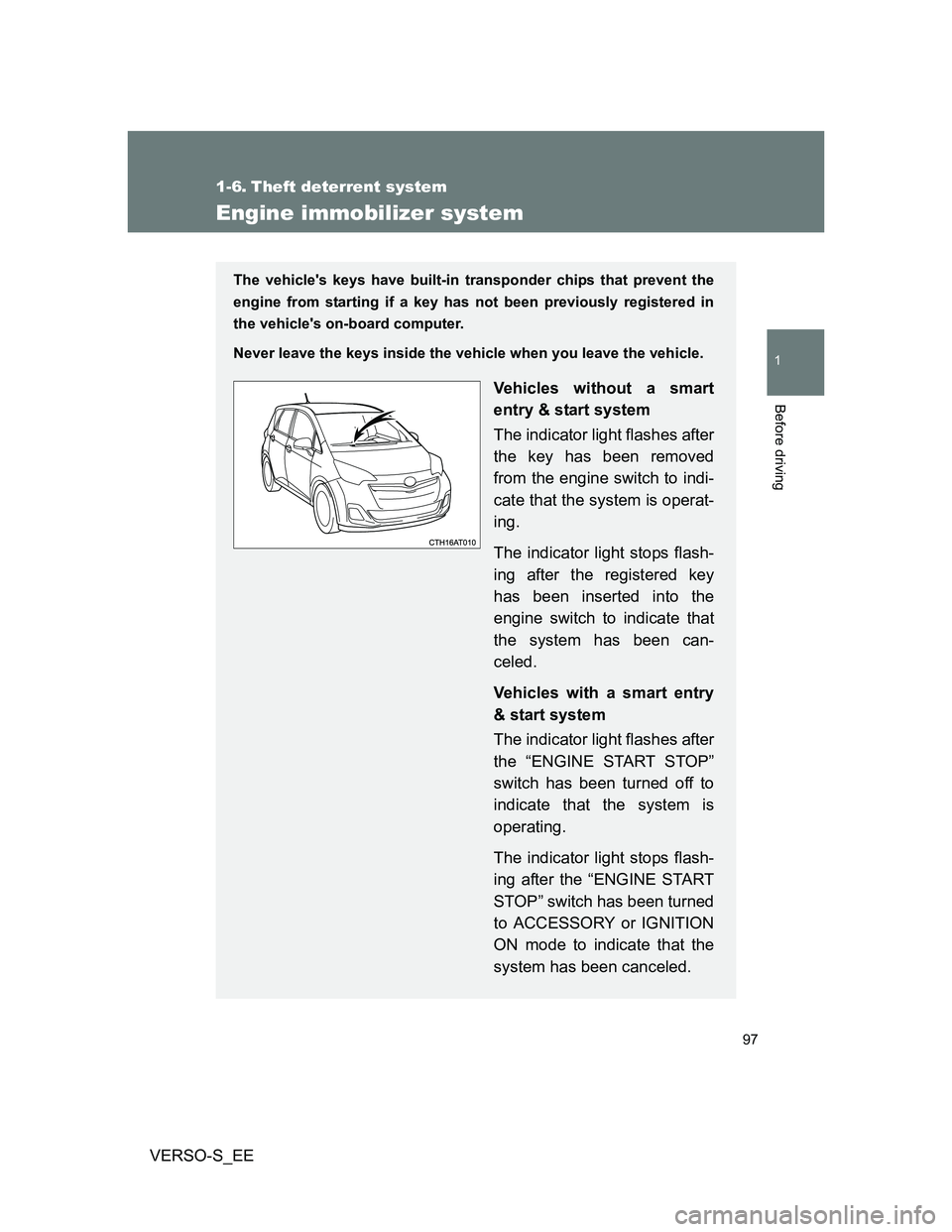
Vehicles without a smart
entry & start system
The indicator light flashes after
the key has been removed
from the engine switch to indi-
cate that the system is operat-
ing.
The indicator light stops flash-
ing after the registered key
has been inserted into the
engine switch to indicate that
the system has been can-
celed.
Vehicles with a smart entry
& start system
The indicator light flashes after
the “ENGINE START STOP”
switch has been turned off to
indicate that the system is
operating.
The indicator light stops flash-
ing after the “ENGINE START
STOP” switch has been turned
to ACCESSORY or IGNITION
ON mode to indicate that the
system has been canceled.
Page 107 of 540
107
1
1-6. Theft deterrent system
Before driving
VERSO-S_EE
Alarm
: If equipped
The system sounds the alarm and flashes the lights when forced
entry is detected.
Triggering of the alarm
The alarm is triggered in the following situations when the alarm
is set:
A locked door is unlocked or opened in any way other than
using the entry function (vehicles with a smart entry & start
system) or wireless remote control. (The doors will lock again
automatically.)
The hood is opened.
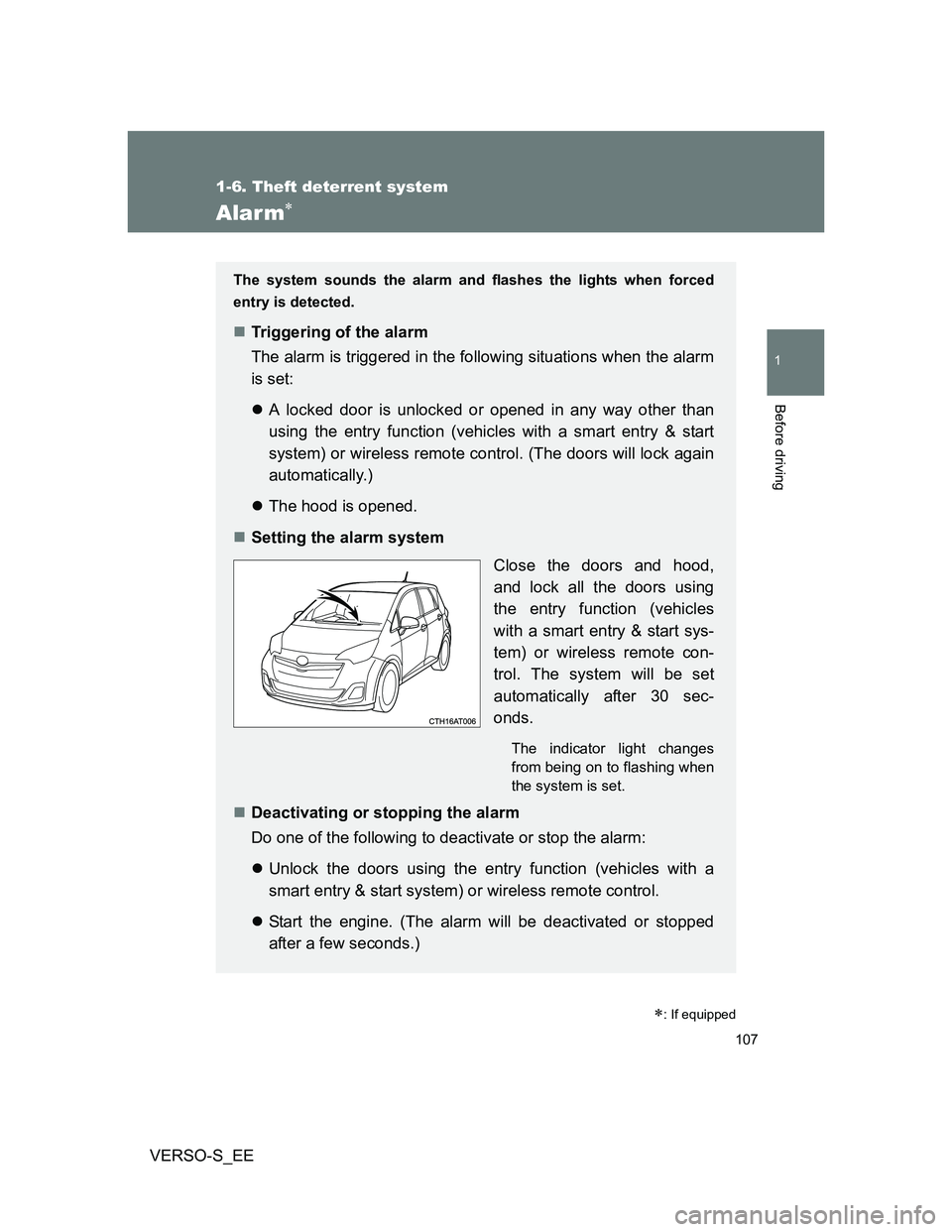
Setting the alarm system
Close the doors and hood,
and lock all the doors using
the entry function (vehicles
with a smart entry & start sys-
tem) or wireless remote con-
trol. The system will be set
automatically after 30 sec-
onds.
The indicator light changes
from being on to flashing when
the system is set.
Deactivating or stopping the alarm
Do one of the following to deactivate or stop the alarm:
Unlock the doors using the entry function (vehicles with a
smart entry & start system) or wireless remote control.
Start the engine. (The alarm will be deactivated or stopped
after a few seconds.)
Page 113 of 540
113 1-7. Safety information
1
Before driving
VERSO-S_EE
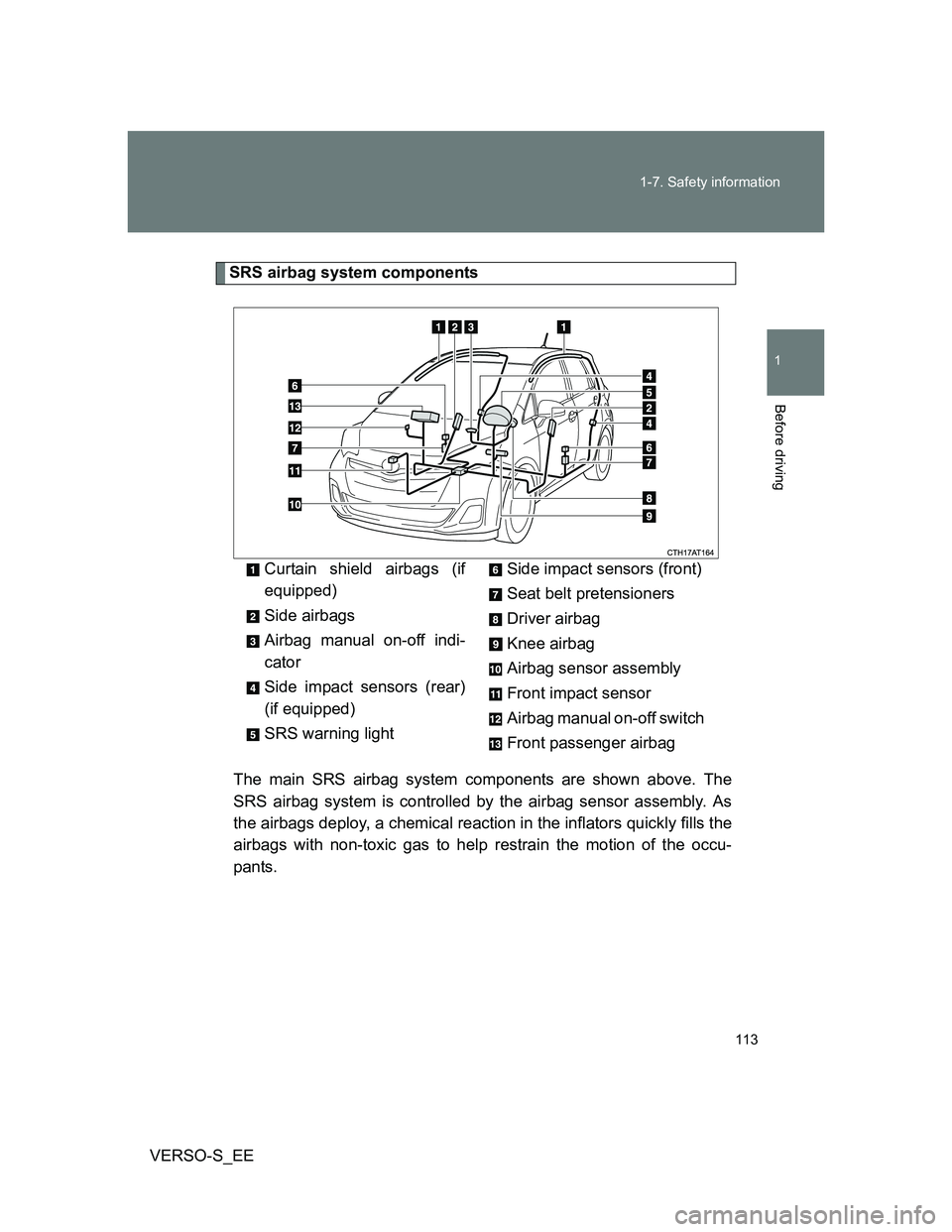
SRS airbag system components
The main SRS airbag system components are shown above. The
SRS airbag system is controlled by the airbag sensor assembly. As
the airbags deploy, a chemical reaction in the inflators quickly fills the
airbags with non-toxic gas to help restrain the motion of the occu-
pants.Curtain shield airbags (if
equipped)
Side airbags
Airbag manual on-off indi-
cator
Side impact sensors (rear)
(if equipped)
SRS warning lightSide impact sensors (front)
Seat belt pretensioners
Driver airbag
Knee airbag
Airbag sensor assembly
Front impact sensor
Airbag manual on-off switch
Front passenger airbag
Page 114 of 540
114 1-7. Safety information
VERSO-S_EE
If the SRS airbags deploy (inflate)
Bruising and slight abrasions may result from contact with a deploying
(inflating) SRS airbag.
A loud noise and white powder will be emitted.
Parts of the airbag module (steering wheel hub, airbag cover and inflator)
as well as the front seats, parts of the front and rear pillars, and roof side
rails, may be hot for several minutes. The airbag itself may also be hot.
The windshield may crack.
SRS airbag deployment conditions (SRS front airbags)
The SRS front airbags will deploy in the event of an impact that exceeds
the set threshold level (the level of force corresponding to an approxi-
mately 20 - 30 km/h [12 - 18 mph] frontal collision with a fixed wall that
does not move or deform).
However, this threshold velocity will be considerably higher if the vehicle
strikes an object, such as a parked vehicle and sign pole, which can move
or deform on impact, or if the vehicle is involved in an underride collision
(e.g. a collision in which the front of the vehicle “underrides”, or goes
under, the bed of a truck etc.).
It is possible that in some collisions where the forward deceleration of the
vehicle is very close to the designed threshold level, the SRS front air-
bags and the seat belt pretensioners may not activate together.
SRS airbag deployment conditions (SRS side and curtain shield air-
bags [if equipped])
The SRS side and curtain shield airbags will deploy in the event of an impact
that exceeds the set threshold level (the level of force corresponding to the
impact force produced by an approximately 1500 kg [3300 lb.] vehicle collid-
ing with the vehicle cabin from a direction perpendicular to the vehicle orien-
tation at an approximate speed of 20 - 30 km/h [12 - 18 mph]).
Page 118 of 540
118 1-7. Safety information
VERSO-S_EE
CAUTION
SRS airbag precautions
Observe the following precautions regarding the SRS airbags.
Failure to do so may cause death or serious injury.
The driver and all passengers in the vehicle must wear their seat belts
properly.
The SRS airbags are supplemental devices to be used with the seat belts.
The SRS driver airbag deploys with considerable force, and can cause
death or serious injury especially if the driver is very close to the airbag.
Since the risk zone for the driver’s airbag is the first 50 - 75 mm (2 - 3 in.)
of inflation, placing yourself 250 mm (10 in.) from your driver airbag pro-
vides you with a clear margin of safety. This distance is measured from the
center of the steering wheel to your breastbone. If you sit less than 250
mm (10 in.) away now, you can change your driving position in several
ways:
• Move your seat to the rear as far as you can while still reaching the
pedals comfortably.
• Slightly recline the back of the seat. Although vehicle designs vary,
many drivers can achieve the 250 mm (10 in.) distance, even with the
driver seat all the way forward, simply by reclining the back of the seat
somewhat. If reclining the back of your seat makes it hard to see the
road, raise yourself by using a firm, non-slippery cushion, or raise the
seat if your vehicle has that feature.
• If your steering wheel is adjustable, tilt it downward. This points the air-
bag toward your chest instead of your head and neck.
The seat should be adjusted as recommended above, while still maintain-
ing control of the foot pedals, steering wheel, and your view of the instru-
ment panel controls.
Page 123 of 540
123
1
1-7. Safety information
Before driving
VERSO-S_EE
Airbag manual on-off system
This system deactivates the front passenger airbag.
Only deactivate the airbags when using a child restraint system on
the front passenger seat.
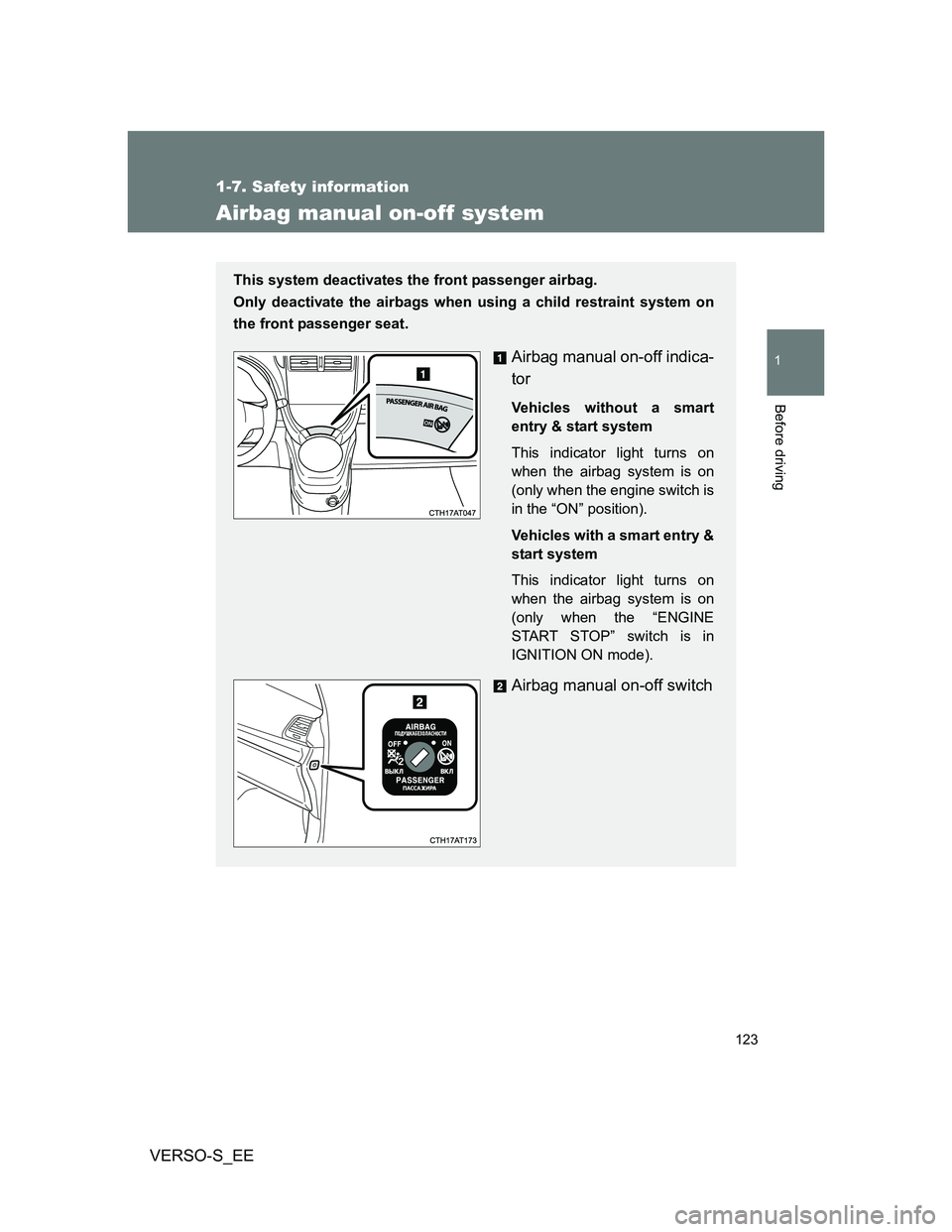
Airbag manual on-off indica-
tor
Vehicles without a smart
entry & start system
This indicator light turns on
when the airbag system is on
(only when the engine switch is
in the “ON” position).
Vehicles with a smart entry &
start system
This indicator light turns on
when the airbag system is on
(only when the “ENGINE
START STOP” switch is in
IGNITION ON mode).
Airbag manual on-off switch
Page 124 of 540
124 1-7. Safety information
VERSO-S_EE
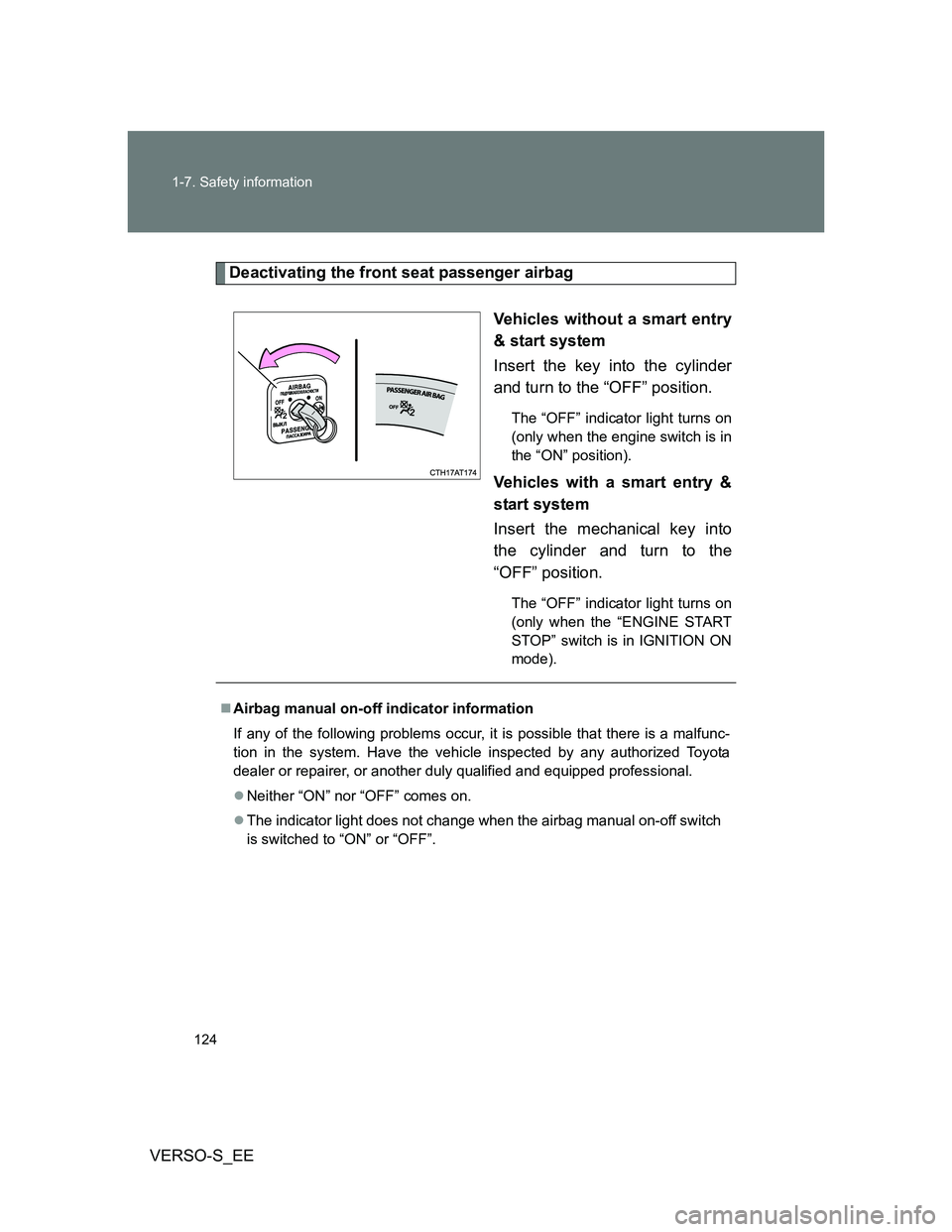
Deactivating the front seat passenger airbag
Vehicles without a smart entry
& start system
Insert the key into the cylinder
and turn to the “OFF” position.
The “OFF” indicator light turns on
(only when the engine switch is in
the “ON” position).
Vehicles with a smart entry &
start system
Insert the mechanical key into
the cylinder and turn to the
“OFF” position.
The “OFF” indicator light turns on
(only when the “ENGINE START
STOP” switch is in IGNITION ON
mode).
Airbag manual on-off indicator information
If any of the following problems occur, it is possible that there is a malfunc-
tion in the system. Have the vehicle inspected by any authorized Toyota
dealer or repairer, or another duly qualified and equipped professional.
Neither “ON” nor “OFF” comes on.
The indicator light does not change when the airbag manual on-off switch
is switched to “ON” or “OFF”.
Page 141 of 540
141 1-7. Safety information
1
Before driving
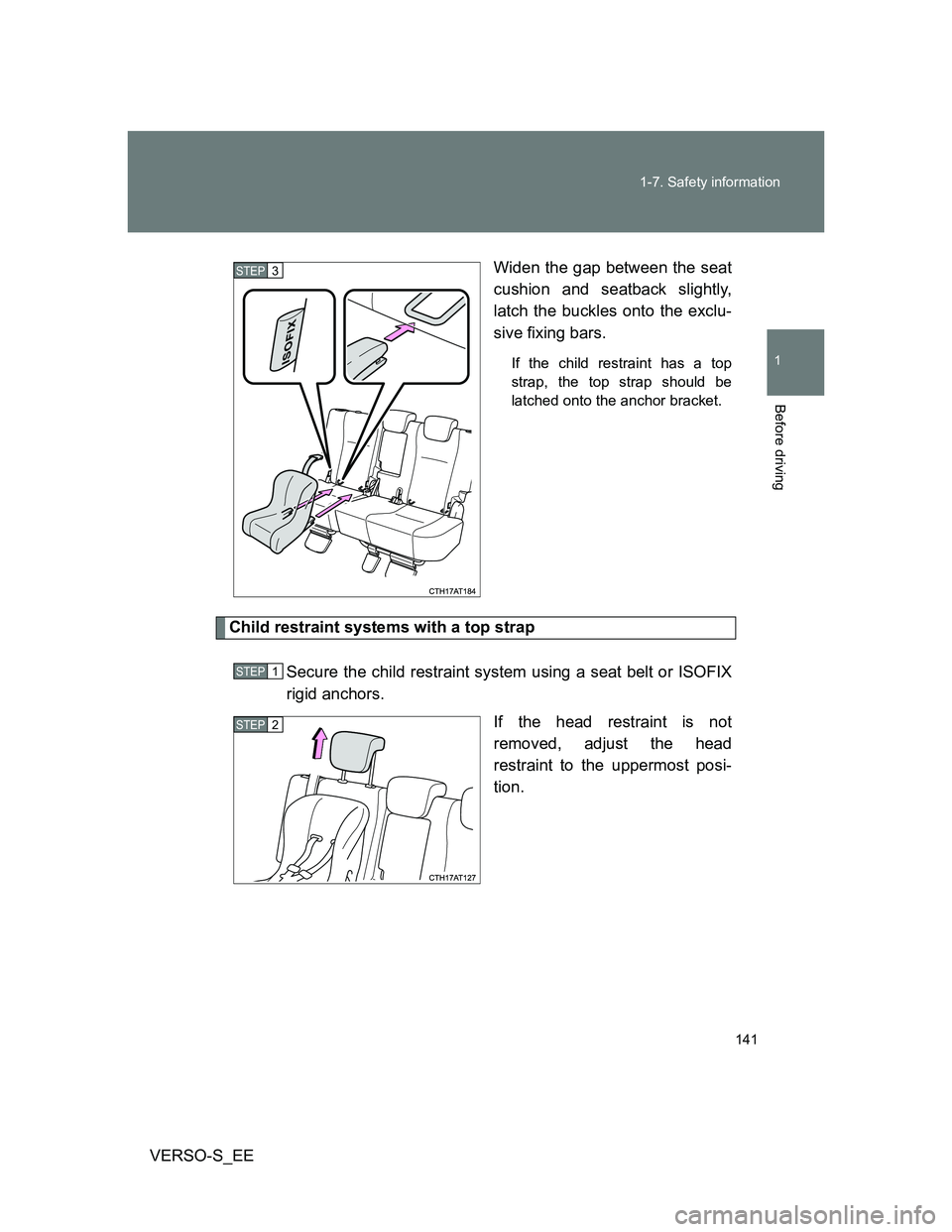
VERSO-S_EEWiden the gap between the seat
cushion and seatback slightly,
latch the buckles onto the exclu-
sive fixing bars.
If the child restraint has a top
strap, the top strap should be
latched onto the anchor bracket.
Child restraint systems with a top strap
Secure the child restraint system using a seat belt or ISOFIX
rigid anchors.
If the head restraint is not
removed, adjust the head
restraint to the uppermost posi-
tion.
STEP3
STEP1
STEP2
Page 149 of 540
2When driving
149
VERSO-S_EE
2-1. Driving procedures
Driving the vehicle ............ 150
Engine (ignition) switch
(vehicles with a smart
entry & start system)....... 166
Engine (ignition) switch
(vehicles without a smart
entry & start system)....... 176
Multidrive .......................... 180
Multi-mode Manual
Transmission .................. 186
Manual Transmission ....... 191
Turn signal lever ............... 194
Parking brake ................... 195
Horn .................................. 196
2-2. Instrument cluster
Gauges and meters .......... 197
Indicators and warning
lights ............................... 201
Multi-information
display ............................ 2072-3. Operating the lights and
wipers
Headlight switch................ 210
Fog light switch ................. 216
Windshield wiper and
washer ............................ 218
Rear window wiper and
washer ............................ 224
2-4. Using other driving
systems
Stop & Start system .......... 226
Driving assist systems ...... 233
Diesel particulate filter
system ............................ 239
2-5. Driving information
Cargo and luggage ........... 241
Winter driving tips ............. 243
Trailer towing .................... 247
Page 154 of 540
154 2-1. Driving procedures
VERSO-S_EE
Starting off on a steep uphill
Vehicles with a Multidrive
Make sure that the parking brake is set and shift the shift lever
to D.
Gently depress the accelerator pedal.
Release the parking brake.
Vehicles with a multi-mode manual transmission
With the brake pedal depressed, firmly set the parking brake
and shift the shift lever to E or M.
Make sure that the display of the gear position indicator shows 1.
Gently depress the accelerator pedal.
Release the parking brake.
Vehicles with a manual transmission
With the parking brake firmly set and the clutch pedal fully
depressed, shift the shift lever to 1.
Lightly depress the accelerator pedal at the same time as
gradually releasing the clutch pedal.
Release the parking brake.
STEP1
STEP2
STEP3
STEP1
STEP2
STEP3
STEP1
STEP2
STEP3