seats TOYOTA VERSO S 2012 Owner's Manual
[x] Cancel search | Manufacturer: TOYOTA, Model Year: 2012, Model line: VERSO S, Model: TOYOTA VERSO S 2012Pages: 540, PDF Size: 17.43 MB
Page 84 of 540
84
1-3. Adjustable components (seats, mirrors, steering wheel)
VERSO-S_EE
Steering wheel
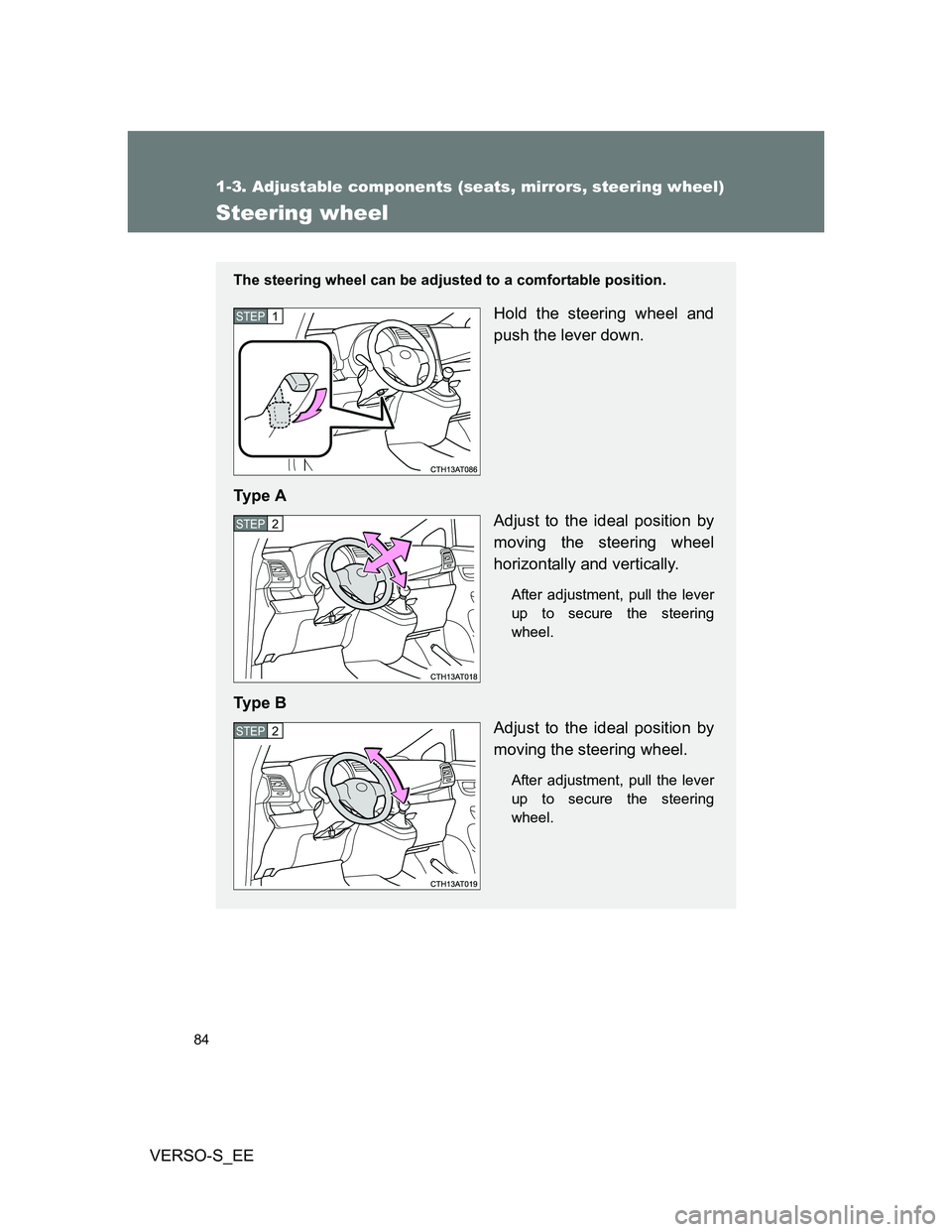
The steering wheel can be adjusted to a comfortable position.
Hold the steering wheel and
push the lever down.
Ty p e A
Adjust to the ideal position by
moving the steering wheel
horizontally and vertically.
After adjustment, pull the lever
up to secure the steering
wheel.
Ty p e B
Adjust to the ideal position by
moving the steering wheel.
After adjustment, pull the lever
up to secure the steering
wheel.
STEP1
STEP2
STEP2
Page 85 of 540
85 1-3. Adjustable components (seats, mirrors, steering wheel)
1
Before driving
VERSO-S_EE
CAUTION
Caution while driving
Do not adjust the steering wheel while driving.
Doing so may cause the driver to mishandle the vehicle and cause an acci-
dent, resulting in death or serious injury.
After adjusting the steering wheel
Make sure that the steering wheel is securely locked.
Otherwise, the steering wheel may move suddenly, possibly causing an
accident, and resulting in death or serious injury.
Page 86 of 540
86
1-3. Adjustable components (seats, mirrors, steering wheel)
VERSO-S_EE
Anti-glare inside rear view mirror
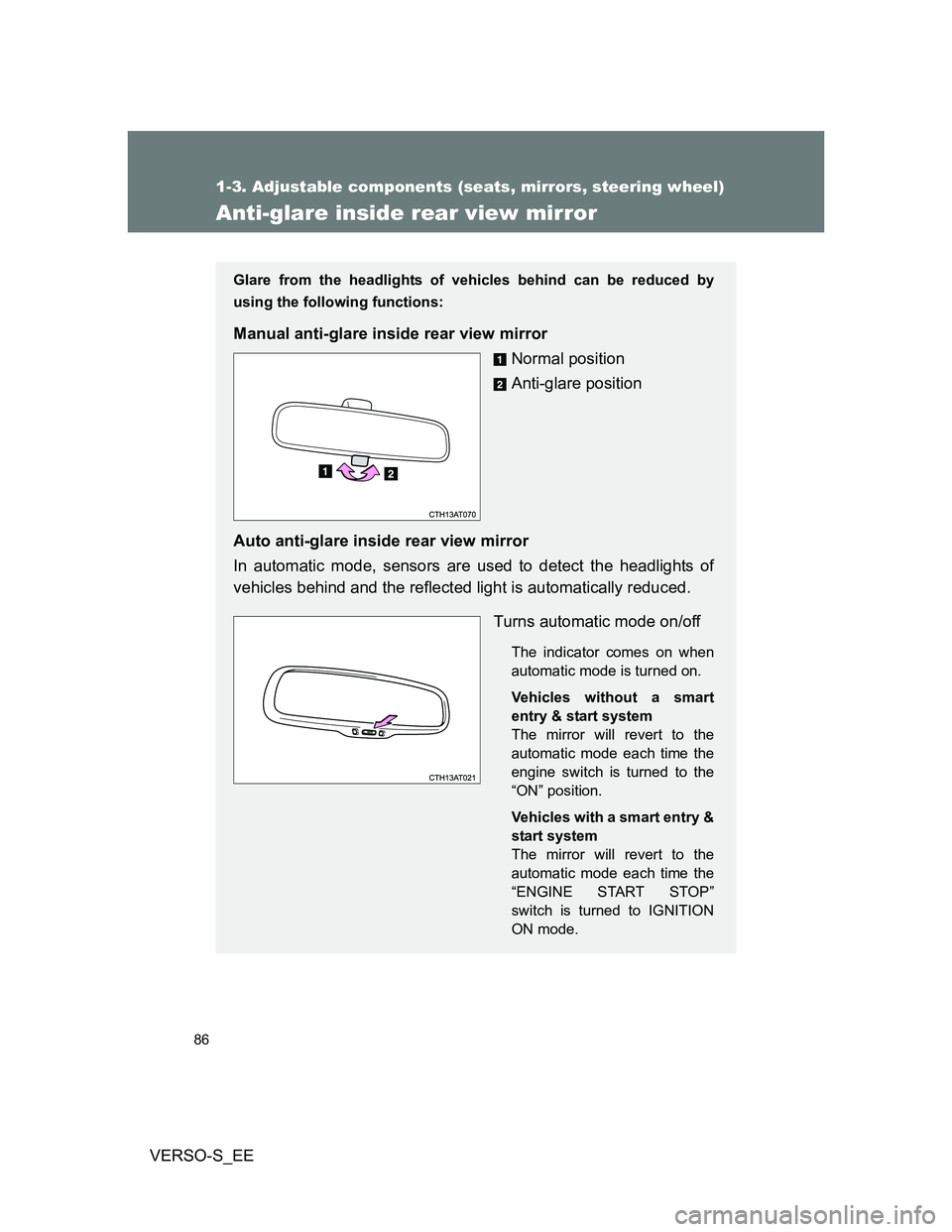
Glare from the headlights of vehicles behind can be reduced by
using the following functions:
Manual anti-glare inside rear view mirror
Normal position
Anti-glare position
Auto anti-glare inside rear view mirror
In automatic mode, sensors are used to detect the headlights of
vehicles behind and the reflected light is automatically reduced.
Turns automatic mode on/off
The indicator comes on when
automatic mode is turned on.
Vehicles without a smart
entry & start system
The mirror will revert to the
automatic mode each time the
engine switch is turned to the
“ON” position.
Vehicles with a smart entry &
start system
The mirror will revert to the
automatic mode each time the
“ENGINE START STOP”
switch is turned to IGNITION
ON mode.
Page 87 of 540
87 1-3. Adjustable components (seats, mirrors, steering wheel)
1
Before driving
VERSO-S_EE
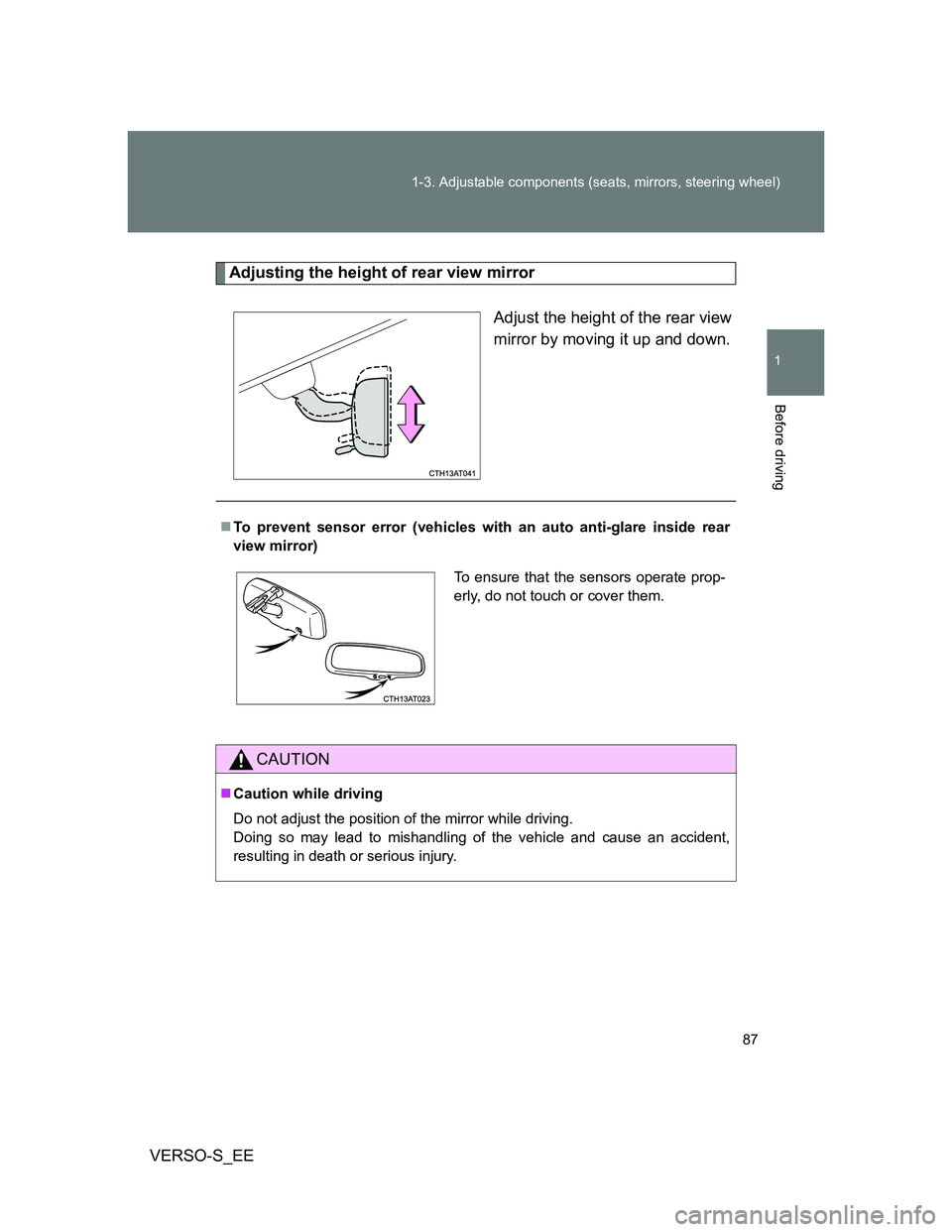
Adjusting the height of rear view mirror
Adjust the height of the rear view
mirror by moving it up and down.
To prevent sensor error (vehicles with an auto anti-glare inside rear
view mirror)
CAUTION
Caution while driving
Do not adjust the position of the mirror while driving.
Doing so may lead to mishandling of the vehicle and cause an accident,
resulting in death or serious injury.
To ensure that the sensors operate prop-
erly, do not touch or cover them.
Page 88 of 540
88
1-3. Adjustable components (seats, mirrors, steering wheel)
VERSO-S_EE
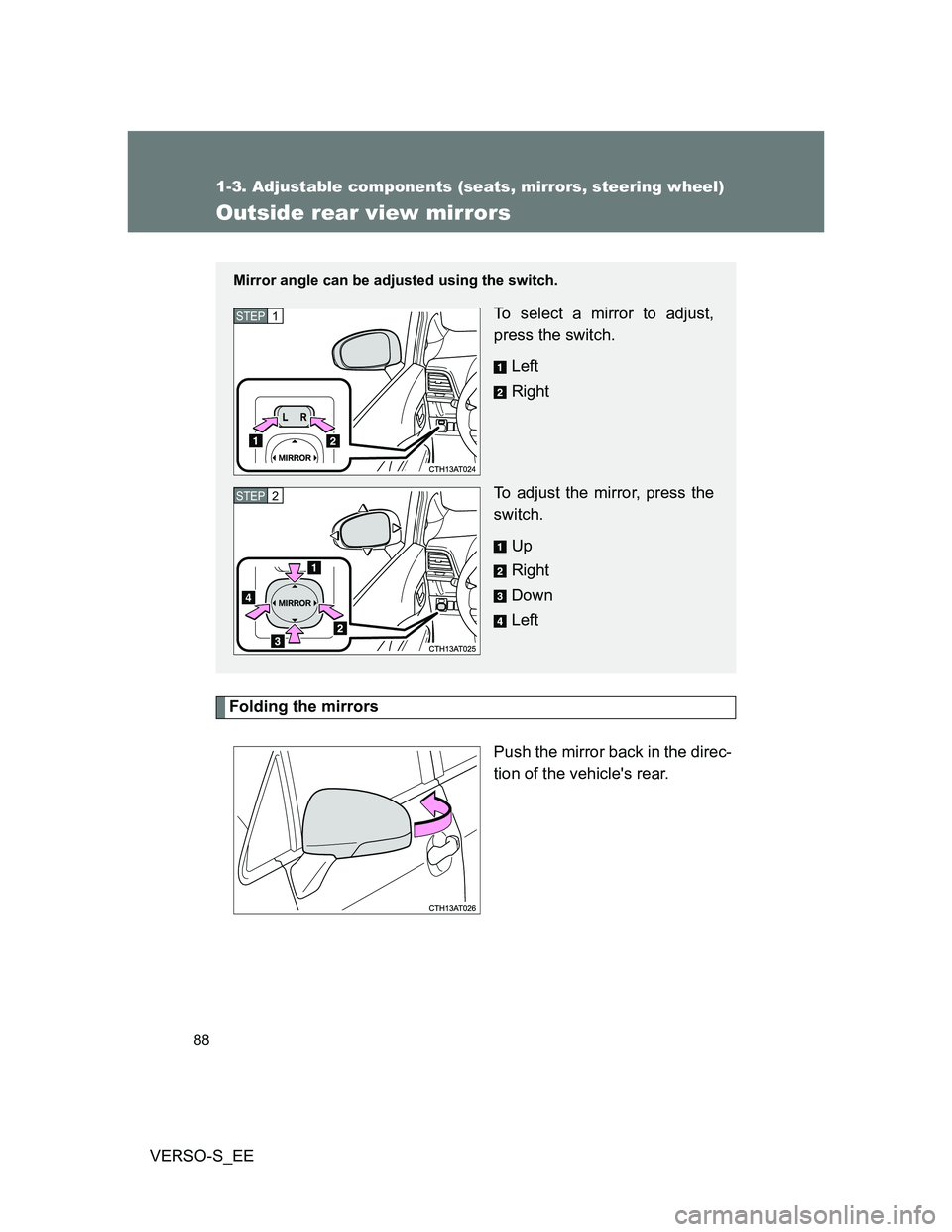
Outside rear view mirrors
Folding the mirrors
Push the mirror back in the direc-
tion of the vehicle's rear.
Mirror angle can be adjusted using the switch.
To select a mirror to adjust,
press the switch.
Left
Right
To adjust the mirror, press the
switch.
Up
Right
Down
LeftSTEP1
STEP2
Page 89 of 540
89 1-3. Adjustable components (seats, mirrors, steering wheel)
1
Before driving
VERSO-S_EE
Mirror angle can be adjusted when
Vehicles without a smart entry & start system
The engine switch is in the “ACC” or “ON” position.
Vehicles with a smart entry & start system
The “ENGINE START STOP” switch is in ACCESSORY or IGNITION ON
mode.
When the mirrors are fogged up (vehicles with outside rear view mirror
defoggers)
Turn on the mirror defoggers to defog the mirrors. (P. 272)
CAUTION
When driving the vehicle
Observe the following precautions while driving.
Failure to do so may result in loss of control of the vehicle and cause an
accident, resulting in death or serious injury.
Do not adjust the mirrors while driving.
Do not drive with the mirrors folded.
Both the driver and passenger side mirrors must be extended and properly
adjusted before driving.
When a mirror is moving
To avoid personal injury and mirror malfunction, be careful not to get your
hand caught by the moving mirror.
When the mirror defoggers are operating (vehicles with outside rear
view mirror defoggers)
Do not touch the rear view mirror surfaces, as they can become very hot and
burn you.
Page 111 of 540
111 1-7. Safety information
1
Before driving
VERSO-S_EE
CAUTION
While driving
Do not adjust the position of the driver's seat.
Doing so could cause the driver to lose control of the vehicle.
Do not place a cushion between the driver or passenger and the seatback.
A cushion may prevent correct posture from being achieved, and reduce
the effectiveness of the seat belt and head restraint, increasing the risk of
death or serious injury to the driver or passenger.
Do not place anything under the front seats except for putting them in the
tray (if equipped).
Objects placed under the front seats may become jammed in the seat
tracks and stop the seat from locking in place. This may lead to an acci-
dent, resulting in death or serious injury. The adjustment mechanism may
also be damaged.
Adjusting the seat position
Take care when adjusting the seat position to ensure that other passen-
gers are not injured by the moving seat.
Do not put your hands under the seat or near the moving parts to avoid
injury.
Fingers or hands may become jammed in the seat mechanism.
Page 112 of 540
112
1-7. Safety information
VERSO-S_EE
SRS airbags
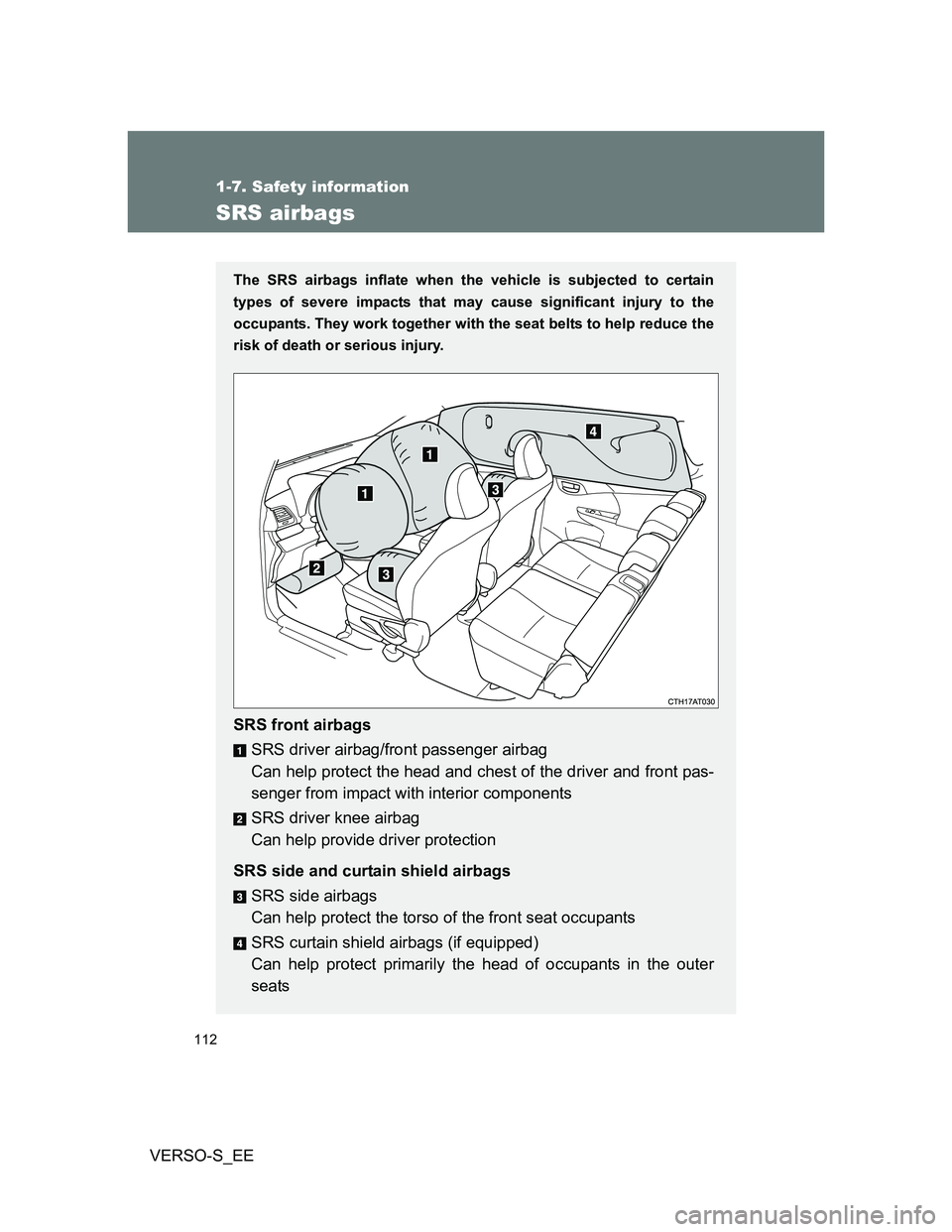
The SRS airbags inflate when the vehicle is subjected to certain
types of severe impacts that may cause significant injury to the
occupants. They work together with the seat belts to help reduce the
risk of death or serious injury.
SRS front airbags
SRS driver airbag/front passenger airbag
Can help protect the head and chest of the driver and front pas-
senger from impact with interior components
SRS driver knee airbag
Can help provide driver protection
SRS side and curtain shield airbags
SRS side airbags
Can help protect the torso of the front seat occupants
SRS curtain shield airbags (if equipped)
Can help protect primarily the head of occupants in the outer
seats
Page 114 of 540
114 1-7. Safety information
VERSO-S_EE
If the SRS airbags deploy (inflate)
Bruising and slight abrasions may result from contact with a deploying
(inflating) SRS airbag.
A loud noise and white powder will be emitted.
Parts of the airbag module (steering wheel hub, airbag cover and inflator)
as well as the front seats, parts of the front and rear pillars, and roof side
rails, may be hot for several minutes. The airbag itself may also be hot.
The windshield may crack.
SRS airbag deployment conditions (SRS front airbags)
The SRS front airbags will deploy in the event of an impact that exceeds
the set threshold level (the level of force corresponding to an approxi-
mately 20 - 30 km/h [12 - 18 mph] frontal collision with a fixed wall that
does not move or deform).
However, this threshold velocity will be considerably higher if the vehicle
strikes an object, such as a parked vehicle and sign pole, which can move
or deform on impact, or if the vehicle is involved in an underride collision
(e.g. a collision in which the front of the vehicle “underrides”, or goes
under, the bed of a truck etc.).
It is possible that in some collisions where the forward deceleration of the
vehicle is very close to the designed threshold level, the SRS front air-
bags and the seat belt pretensioners may not activate together.
SRS airbag deployment conditions (SRS side and curtain shield air-
bags [if equipped])
The SRS side and curtain shield airbags will deploy in the event of an impact
that exceeds the set threshold level (the level of force corresponding to the
impact force produced by an approximately 1500 kg [3300 lb.] vehicle collid-
ing with the vehicle cabin from a direction perpendicular to the vehicle orien-
tation at an approximate speed of 20 - 30 km/h [12 - 18 mph]).
Page 117 of 540
117 1-7. Safety information
1
Before driving
VERSO-S_EE
When to contact any authorized Toyota dealer or repairer, or another
duly qualified and equipped professional
In the following cases, contact any authorized Toyota dealer or repairer, or
another duly qualified and equipped professional as soon as possible.
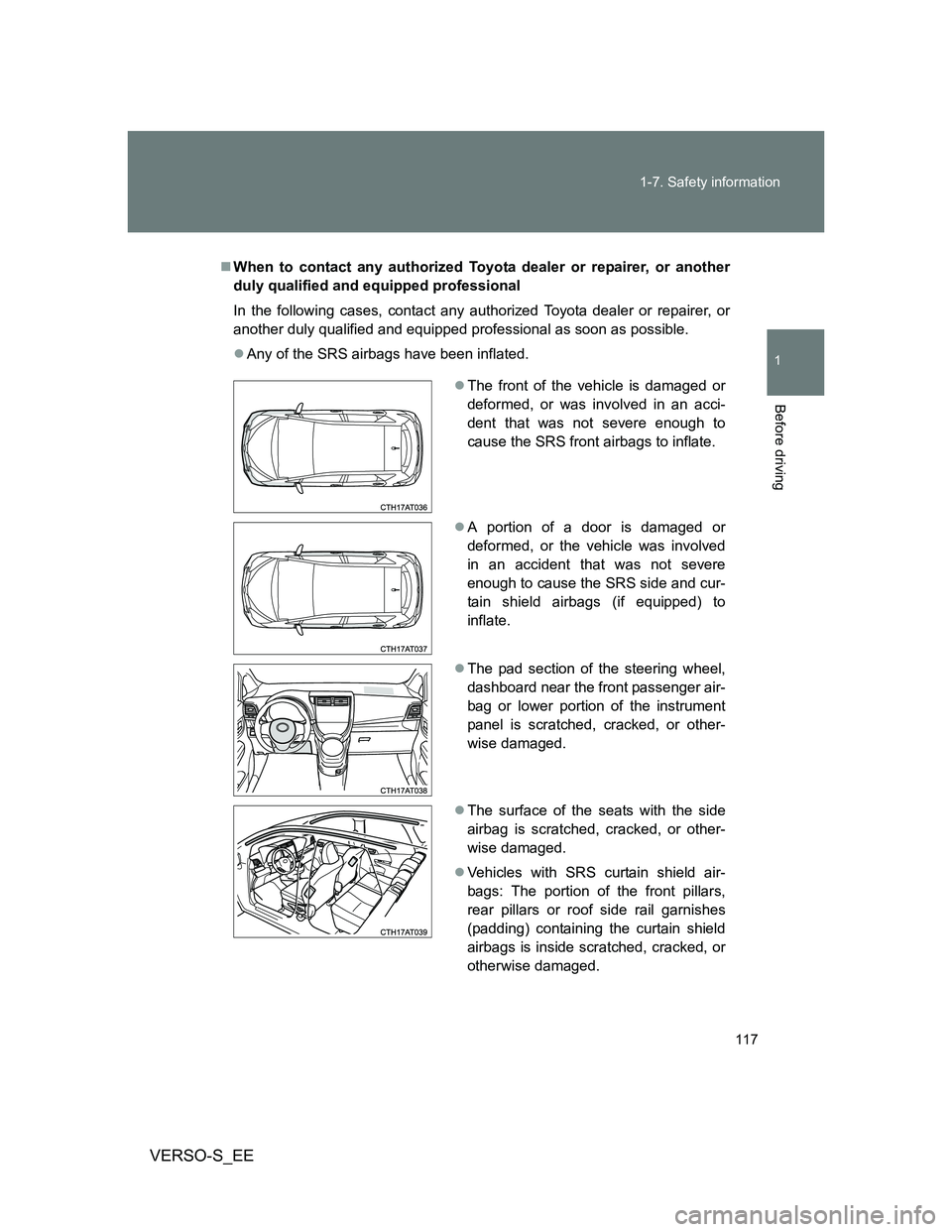
Any of the SRS airbags have been inflated.
The front of the vehicle is damaged or
deformed, or was involved in an acci-
dent that was not severe enough to
cause the SRS front airbags to inflate.
A portion of a door is damaged or
deformed, or the vehicle was involved
in an accident that was not severe
enough to cause the SRS side and cur-
tain shield airbags (if equipped) to
inflate.
The pad section of the steering wheel,
dashboard near the front passenger air-
bag or lower portion of the instrument
panel is scratched, cracked, or other-
wise damaged.
The surface of the seats with the side
airbag is scratched, cracked, or other-
wise damaged.
Vehicles with SRS curtain shield air-
bags: The portion of the front pillars,
rear pillars or roof side rail garnishes
(padding) containing the curtain shield
airbags is inside scratched, cracked, or
otherwise damaged.