stop start TOYOTA VERSO S 2012 Repair Manual
[x] Cancel search | Manufacturer: TOYOTA, Model Year: 2012, Model line: VERSO S, Model: TOYOTA VERSO S 2012Pages: 540, PDF Size: 17.43 MB
Page 226 of 540
226
VERSO-S_EE
2-4. Using other driving systems
Stop & Start system
: If equipped
Vehicles with a Multidrive: The Stop & Start system stops and
restarts the engine according to the brake pedal and shift lever oper-
ation for stopping and starting the vehicle.
Vehicles with a manual transmission: The Stop & Start system stops
and restarts the engine according to the clutch pedal operation for
stopping and starting the vehicle.
Stopping the engine
Vehicles with a Multidrive
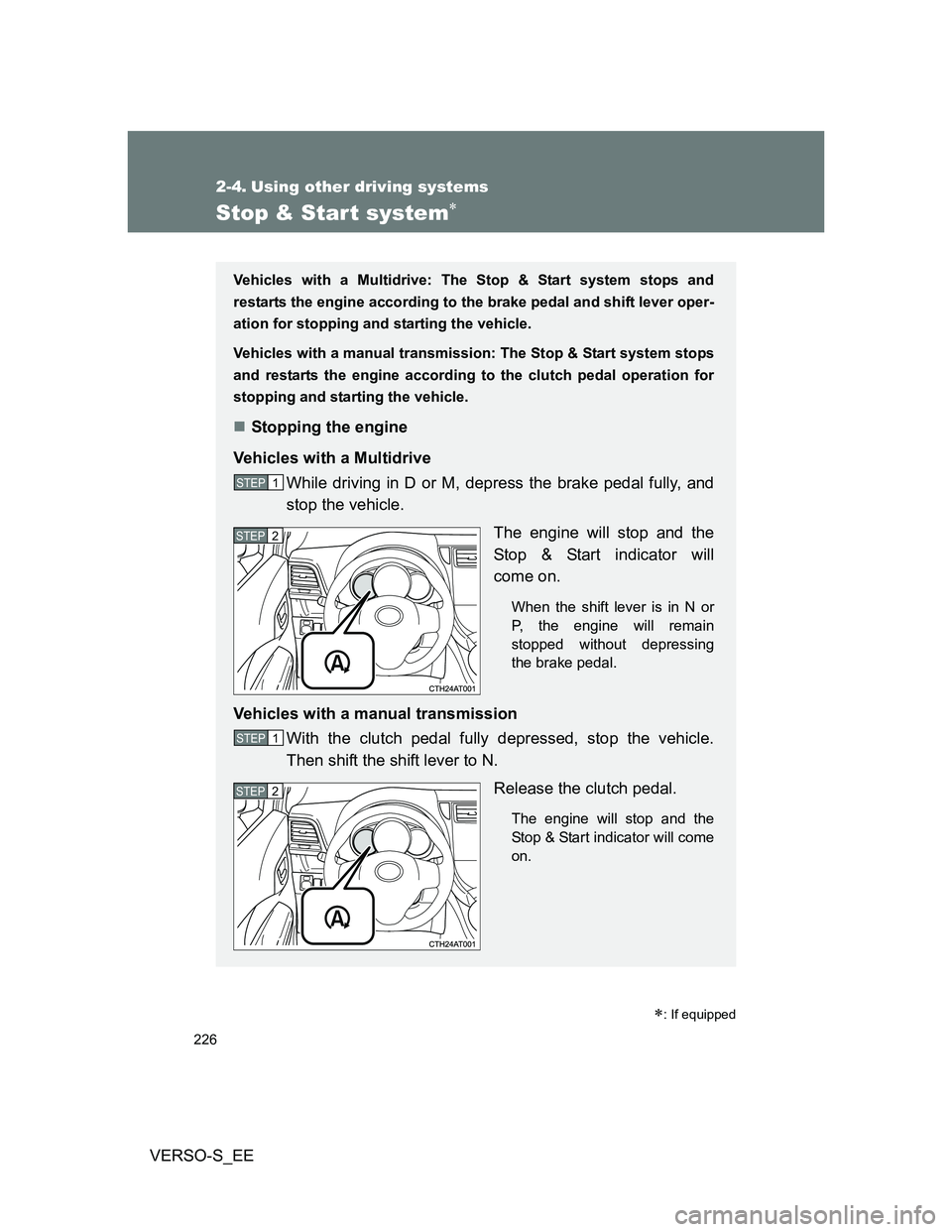
While driving in D or M, depress the brake pedal fully, and
stop the vehicle.
The engine will stop and the
Stop & Start indicator will
come on.
When the shift lever is in N or
P, the engine will remain
stopped without depressing
the brake pedal.
Vehicles with a manual transmission
With the clutch pedal fully depressed, stop the vehicle.
Then shift the shift lever to N.
Release the clutch pedal.
The engine will stop and the
Stop & Start indicator will come
on.
STEP1
STEP2
STEP1
STEP2
Page 227 of 540
227 2-4. Using other driving systems
2
When driving
VERSO-S_EE
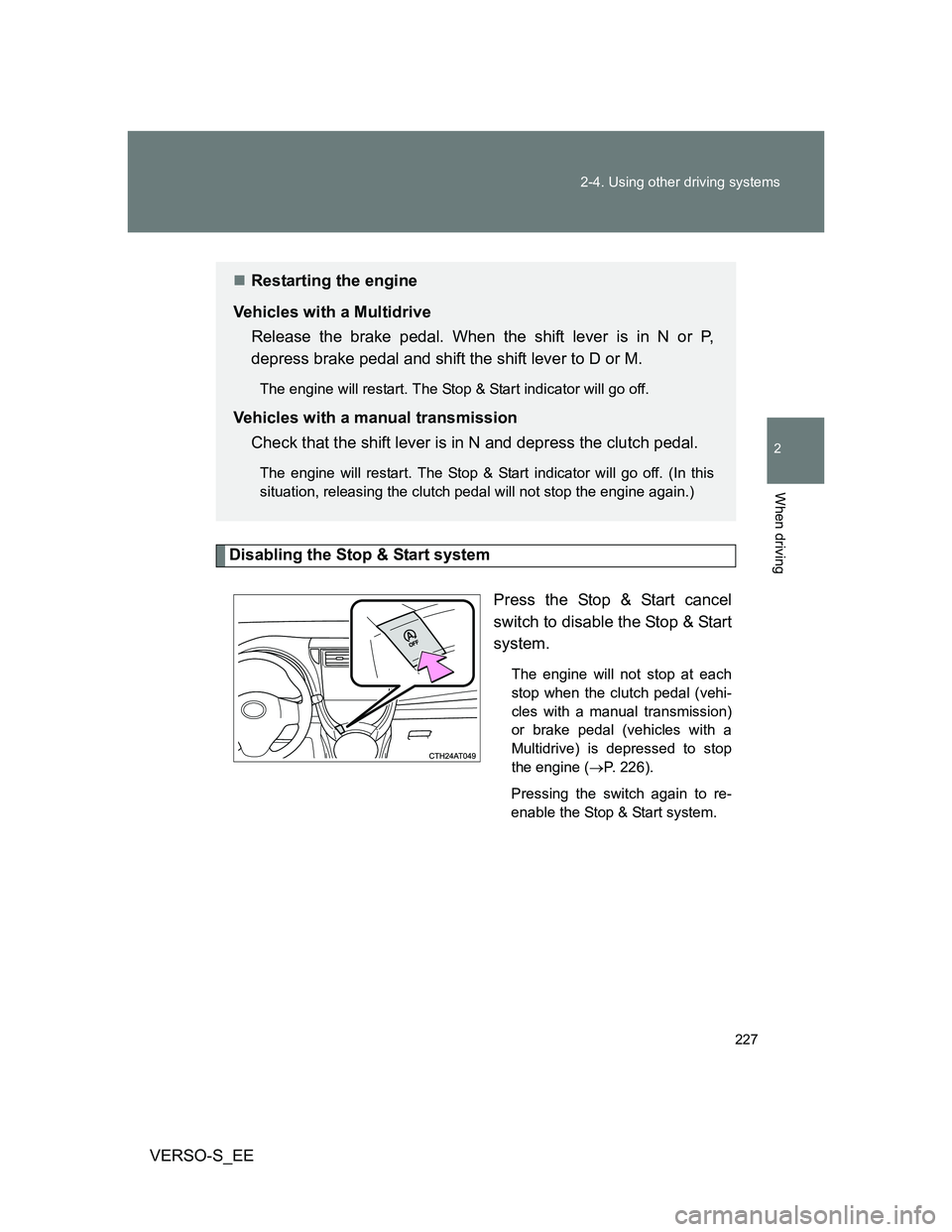
Disabling the Stop & Start system
Press the Stop & Start cancel
switch to disable the Stop & Start
system.
The engine will not stop at each
stop when the clutch pedal (vehi-
cles with a manual transmission)
or brake pedal (vehicles with a
Multidrive) is depressed to stop
the engine (P. 226).
Pressing the switch again to re-
enable the Stop & Start system.
Restarting the engine
Vehicles with a Multidrive
Release the brake pedal. When the shift lever is in N or P,
depress brake pedal and shift the shift lever to D or M.
The engine will restart. The Stop & Start indicator will go off.
Vehicles with a manual transmission
Check that the shift lever is in N and depress the clutch pedal.
The engine will restart. The Stop & Start indicator will go off. (In this
situation, releasing the clutch pedal will not stop the engine again.)
Page 228 of 540
228 2-4. Using other driving systems
VERSO-S_EEIf the Stop & Start cancel switch is pressed while the vehicle is
stopped
When the engine is stopped by the Stop & Start system, press-
ing the Stop & Start cancel switch will restart the engine.
From the next time the vehicle is stopped (after Stop & Start sys-
tem has been turned off), the engine will not be stopped.
With the Stop & Start system disabled, pressing the Stop & Start
cancel switch will re-enable the system but not stop the engine.
From the next time the vehicle is stopped (after Stop & Start sys-
tem has been turned on), the engine will be stopped.
Operating conditions
The Stop & Start system is operational when all of the following condi-
tions are met:
• The engine is adequately warmed up.
• The battery is sufficiently charged.
• The driver's door is closed.
• Vehicles with a Multidrive: The driver’s seat belt is fastened.
• The hood is closed.
In the following circumstances the engine may not be stopped by the
Stop & Start system. This is not a malfunction of the Stop & Start system.
• Engine coolant temperature is extremely high.
• The air conditioning system is being used when the vehicle interior
temperature is extremely high such as after the vehicle was parked
under the hot sun.
• The air conditioning system is being used when the outside tempera-
ture or the engine coolant temperature is low.
• Vehicles with an automatic air conditioning system only: The wind-
shield defogger is being used.
• The battery is not sufficiently charged.
• Due to traffic or other circumstances the vehicle is stopped repeatedly,
resulting in the amount of time the engine is stopped by the Stop &
Start system to become excessively high.
When the above conditions improve, the Stop & Start system will stop and
restart the engine from the next time the vehicle is stopped.
Page 229 of 540
229 2-4. Using other driving systems
2
When driving
VERSO-S_EE
Automatic engine start function
In the following situations, the engine may start even without the clutch pedal
being depressed (vehicles with a manual transmission) or brake pedal being
released (vehicles with a Multidrive).
The brake pedal is pumped or strongly depressed.
The air conditioning system is being used or turned on.
Vehicles with an automatic air conditioning system only: The windshield
defogger is turned on.
The battery is not sufficiently charged.
The vehicle starts to roll on an incline.
Vehicles with a Multidrive: The hood is opened when the shift lever is in N
or P.
Vehicles with a Multidrive: The driver’s door is opened.
Vehicles with a Multidrive: The driver’s seat belt is unfastened.
Automatic reactivation of the Stop & Start system
Vehicles without a smart entry & start system: Even if the Stop & Start sys-
tem is disabled by the Stop & Start cancel switch, it will be automatically re-
enabled once the engine switch is turned to the “LOCK” position then to the
“START” position.
Vehicles with a smart entry & start system: Even if the Stop & Start system is
disabled by the Stop & Start cancel switch, it will be automatically re-enabled
once the “ENGINE START STOP” switch is turned off then the engine is
started.
The Stop & Start system protection feature
Vehicles without a smart entry & start system: When an excessively loud
sound is being projected by the audio system, the audio system may be
automatically cut off in order to maintain power for the Stop & Start system
function.
If this occurs, turning the engine switch to the “LOCK” position then to the
“ACC” or “ON” position re-enables the audio system.
Vehicles with a smart entry & start system: When an excessively loud sound
is being projected by the audio system, the audio system may be automati-
cally cut off in order to maintain power for the Stop & Start system function.
If this occurs, turning the “ENGINE START STOP” switch off then to ACCES-
SORY mode or IGNITION ON mode re-enables the audio system.
Page 230 of 540
230 2-4. Using other driving systems
VERSO-S_EE
Steering wheel operation
When the engine is stopped by the Stop & Start system, the steering wheel
may become heavier than when driving.
Hood
If the hood is opened while the engine is stopped by the Stop & Start system,
the engine cannot be restarted by the Stop & Start system or by the auto-
matic engine start function. Restart the engine with the engine switch opera-
tion. (P. 166176)
Vehicles with a Multidrive: If the hood is opened while the engine is stopped
by the Stop & Start system and the shift lever is in N or P, the engine will
restart.
Stop & Start system warning buzzer
If the engine is stopped by the Stop & Start system and either of the following
actions is performed, a buzzer will sound and the Stop & Start indicator will
flash (vehicles with a Multidrive), or a buzzer will sound (vehicles with a
manual transmission). This indicates that the engine is only stopped by the
Stop & Start system, not that the engine has been turned off completely.
Vehicles with a Multidrive: The driver’s door is opened when the shift
lever is in D or M.
Vehicles with a Multidrive: The shift lever is shifted into a position other
than N or P with the brake pedal released.
Vehicles with a manual transmission: The shift lever is shifted into a posi-
tion other than N with the clutch pedal released.
If the Stop & Start cancel indicator light continues to flash
The Stop & Start system may be malfunctioning. Contact any authorized
Toyota dealer or repairer, or another duly qualified and equipped profes-
sional.
Page 231 of 540
231 2-4. Using other driving systems
2
When driving
VERSO-S_EE
If the windshield is fogged up while the engine is stopped by the Stop
& Start system
Vehicles with an automatic air conditioning system: Turn the windshield
defogger on. (The engine will start due to the automatic engine start func-
tion.) (P. 267)
Vehicles with a manual air conditioning system: Restart the engine by
depressing the clutch pedal (vehicles with a manual transmission) or
releasing brake pedal (vehicles with a Multidrive) (P. 227) or by press-
ing the Stop & Start cancel switch, and then set the air outlet selection
dial to . (P. 259)
If the windshield fogs up frequently, press the Stop & Start cancel switch to
deactivate the system.
The Stop & Start system operation time and Stop & Start system total
operation time display
P. 198
CAUTION
When the Stop & Start system is operating
Keep the shift lever in N and apply the brake pedal or parking brake for
safety while the engine is stopped due to the Stop & Start system (while
the Stop & Start indicator is on).
Unexpected accidents may occur due to the automatic engine start func-
tion.
Do not leave the vehicle while the engine is stopped due to the Stop &
Start system (while the Stop & Start indicator is on).
Unexpected accidents may occur due to the automatic engine start func-
tion.
Ensure that the engine is not stopped by the Stop & Start system while the
vehicle is in a poorly ventilated area. The engine may restart due to the
automatic engine start function, causing exhaust gases to collect and
enter the vehicle and resulting in death or a serious health hazard.
Page 232 of 540
232 2-4. Using other driving systems
VERSO-S_EE
NOTICE
To ensure the system operates correctly
If any one of the following situations occurs, the Stop & Start system may not
operate correctly, thus, please have your vehicle checked by any authorized
Toyota dealer or repairer, or another duly qualified and equipped profes-
sional.
While the driver’s seat belt is fastened, the driver’s and front passenger’s
seat belt reminder light flashes.
Even when the driver’s seat belt is not fastened, the driver’s and front pas-
senger’s seat belt reminder light remains off.
Even when the driver’s door is closed, the open door warning light comes
on, or the interior light comes on when the interior light switch is in the door
position.
Even when the driver’s door is opened, the open door warning light does
not come on, or the interior light does not come on when the interior light
switch is in the door position.
Page 233 of 540
233
2-4. Using other driving systems
2
When driving
VERSO-S_EE
Driving assist systems
To help enhance driving safety and performance, the following sys-
tems operate automatically in response to various driving situations.
Be aware, however, that these systems are supplementary and
should not be relied upon too heavily when operating the vehicle.
ABS (Anti-lock Brake System)
Helps to prevent wheel lock when the brakes are applied suddenly, or if
the brakes are applied while driving on a slippery road surface
Brake assist
Generates an increased level of braking force after the brake pedal is
depressed when the system detects a panic stop situation
VSC (Vehicle Stability Control) (if equipped)
Helps the driver to control skidding when swerving suddenly or turning
on slippery road surfaces
VSC+ (Vehicle Stability Control +) (if equipped)
Provides cooperative control of the ABS, TRC, VSC and EPS.
Helps to maintain stability when swerving on slippery road surfaces by
controlling steering performance.
TRC (Traction Control) (if equipped)
Helps to maintain drive power and prevent the drive wheels from spin-
ning when starting the vehicle or accelerating on slippery roads
Hill-start assist control (with Stop & Start system and Multi-
drive)
Helps to prevent the vehicle from rolling backwards when the brake
pedal is released to restart the engine
EPS (Electric Power Steering)
Employs an electric motor to reduce the amount of effort needed to turn
the steering wheel
Page 236 of 540
236 2-4. Using other driving systems
VERSO-S_EE
Hill-start assist control operation conditions
The shift lever is in D or M.
The brake pedal is not depressed.
Sounds and vibrations caused by the ABS, brake assist, VSC, TRC and
hill-start assist control systems
A sound may be heard from the engine compartment when the engine is
started or just after the vehicle begins to move. This sound does not indi-
cate that a malfunction has occurred in any of these systems.
Any of the following conditions may occur when the above systems are
operating. None of these indicates that a malfunction has occurred.
• Vibrations may be felt through the vehicle body and steering.
• A motor sound may be heard after the vehicle comes to a stop.
• The brake pedal may pulsate slightly after the ABS is activated.
• The brake pedal may move down slightly after the ABS is activated.
EPS operation sound
When the steering wheel is operated, a motor sound (whirring sound) may
be heard. This does not indicate a malfunction.
Reactivation of the TRC/VSC systems after turning off the engine
If the TRC/VSC systems are turned off, re-starting the engine will automati-
cally reactivate them.
Reactivation of the TRC system linked to vehicle speed
When the TRC system is turned off, it will turn on when vehicle speed
increases. However, when the TRC and VSC systems are turned off, the
systems will not turn on even when vehicle speed increases.
Reduced effectiveness of the EPS system
The effectiveness of the EPS system is reduced to prevent the system from
overheating when there is frequent steering input over an extended period of
time. The steering wheel may feel heavy as a result. Should this occur,
refrain from excessive steering input or stop the vehicle and turn the engine
off. The EPS system should return to normal within 10 minutes.
If the slip indicator comes on...
It may indicate a malfunction in the driving assist systems. Contact any
authorized Toyota dealer or repairer, or another duly qualified and equipped
professional.
Page 237 of 540
237 2-4. Using other driving systems
2
When driving
VERSO-S_EE
CAUTION
The ABS does not operate effectively when
Tires with inadequate gripping ability are used (such as excessively worn
tires on a snow covered road).
The vehicle hydroplanes while driving at high speed on wet or slick roads.
Stopping distance when the ABS is operating may exceed that of nor-
mal conditions
The ABS is not designed to shorten the vehicle’s stopping distance. Always
maintain a safe distance from the vehicle in front of you in the following situ-
ations:
When driving on dirt, gravel or snow-covered roads
When driving with tire chains
When driving over bumps in the road
When driving over roads with potholes or roads with uneven surfaces
TRC may not operate effectively when
Directional control and power may not be achievable while driving on slip-
pery road surfaces, even if the TRC system is operating.
Be especially careful and drive the vehicle in conditions where stability and
power may be lost.
Hill-start assist control does not operate effectively when
Do not overly rely on the hill-start assist control. The hill-start assist control
may not operate effectively on steep inclines and roads covered with ice.
When the VSC is activated
The slip indicator light flashes. Always drive carefully. Reckless driving may
cause an accident. Exercise particular care when the indicator light flashes.
When the TRC/VSC systems are turned off
Be especially careful and drive at a speed appropriate to the road condi-
tions. Do not turn the TRC/VSC systems off unless necessary, as these are
the systems to ensure vehicle stability and driving force by automatically
controlling braking and engine outputs.