flat tire TOYOTA VERSO S 2013 User Guide
[x] Cancel search | Manufacturer: TOYOTA, Model Year: 2013, Model line: VERSO S, Model: TOYOTA VERSO S 2013Pages: 552, PDF Size: 15.57 MB
Page 385 of 552
385 4-3. Do-it-yourself maintenance
4
Maintenance and care
VERSO-S_EE
NOTICE
Driving on rough roads
Take particular care when driving on roads with loose surfaces or potholes.
These conditions may cause losses in tire inflation pressure, reducing the
cushioning ability of the tires. In addition, driving on rough roads may cause
damage to the tires themselves, as well as the vehicle’s wheels and body.
If tire inflation pressure of each tire becomes low while driving
Do not continue driving, or your tires and/or wheels may be ruined.
Page 386 of 552
386
4-3. Do-it-yourself maintenance
VERSO-S_EE
Tire inflation pressure
Effects of incorrect tire inflation pressure
Driving with incorrect tire inflation pressure may result in the following:
Reduced fuel efficiency
Reduced driving comfort and tire life
Reduced safety
Damage to the drive train
If a tire needs frequent inflating, have it checked by any authorized Toyota
dealer or repairer, or another duly qualified and equipped professional.
Instructions for checking tire inflation pressure
When checking tire inflation pressure, observe the following:
Check only when the tires are cold.
If your vehicle has been parked for at least 3 hours or has not been
driven for more than 1.5 km or 1 mile, you will get an accurate cold tire
inflation pressure reading.
Always use a tire pressure gauge.
The appearance of the tire can be misleading. In addition, tire inflation
pressure that is even just a few pounds off can affect ride quality and
handling.
Do not reduce tire inflation pressure after driving. It is normal for tire infla-
tion pressure to be higher after driving.
Never exceed the vehicle capacity weight.
Passengers and luggage weight should be placed so that the vehicle is
balanced.
Make sure to maintain proper tire inflation pressure. Tire inflation
pressure should be checked at least once per month. However,
Toyota recommends that tire inflation pressure be checked once
every two weeks. (P. 523)
Page 387 of 552
387 4-3. Do-it-yourself maintenance
4
Maintenance and care
VERSO-S_EE
CAUTION
Proper inflation is critical to save tire performance
Keep your tires properly inflated. Otherwise, the following conditions may
occur and result in an accident causing death or serious injury:
Excessive wear
Uneven wear
Poor handling
Possibility of blowouts resulting from overheated tires
Poor sealing of the tire bead
Wheel deformation and/or tire separation
A greater possibility of tire damage from road hazards
NOTICE
When inspecting and adjusting tire inflation pressure
Be sure to put the tire valve caps back on.
Without the valve caps, dirt or moisture could get into the valve and cause
air leakage, which could result in an accident. If the caps are lost, replace
them as soon as possible.
Page 423 of 552
5When trouble arises
423
VERSO-S_EE
5-1. Essential information
Emergency flashers .......... 424
If your vehicle needs to
be towed ......................... 425
If you think something is
wrong .............................. 433
Fuel pump shut off
system ............................ 4345-2. Steps to take in an
emergency
If a warning light turns
on or a warning buzzer
sounds... ........................ 435
If you have a flat tire
(vehicles with a
spare tire) ....................... 448
If you have a flat tire
(vehicles with an
emergency tire
puncture repair kit).......... 461
If the engine will not
start................................. 478
If the shift lever cannot be
shifted from P ................. 481
If the shift lever cannot be
shifted ............................. 482
If you lose your keys ......... 483
If the electronic key does
not operate properly ....... 484
If the battery is
discharged ...................... 489
If your vehicle
overheats ........................ 497
If you run out of fuel and
the engine stalls.............. 502
If the vehicle becomes
stuck ............................... 504
If your vehicle has to
be stopped in an
emergency ...................... 506
Page 430 of 552
430 5-1. Essential information
VERSO-S_EE
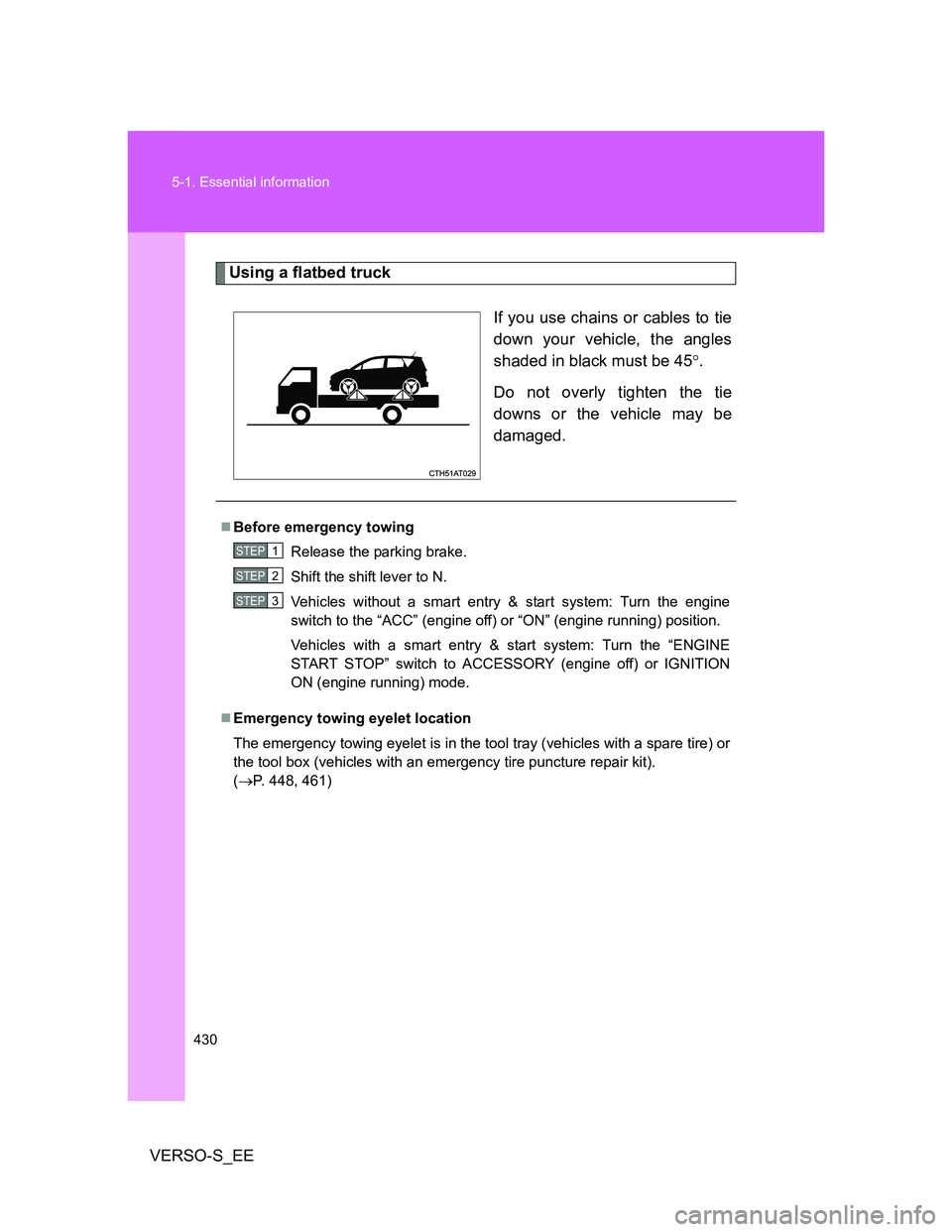
Using a flatbed truck
If you use chains or cables to tie
down your vehicle, the angles
shaded in black must be 45.
Do not overly tighten the tie
downs or the vehicle may be
damaged.
Before emergency towing
Release the parking brake.
Shift the shift lever to N.
Vehicles without a smart entry & start system: Turn the engine
switch to the “ACC” (engine off) or “ON” (engine running) position.
Vehicles with a smart entry & start system: Turn the “ENGINE
START STOP” switch to ACCESSORY (engine off) or IGNITION
ON (engine running) mode.
Emergency towing eyelet location
The emergency towing eyelet is in the tool tray (vehicles with a spare tire) or
the tool box (vehicles with an emergency tire puncture repair kit).
(P. 448, 461)
STEP1
STEP2
STEP3
Page 433 of 552
5
433
5-1. Essential information
When trouble arises
VERSO-S_EE
If you think something is wrong
If you notice any of the following symptoms, your vehicle probably
needs adjustment or repair. Contact any authorized Toyota dealer or
repairer, or another duly qualified and equipped professional as
soon as possible.
Visible symptoms
Fluid leaks under the vehicle
(Water dripping from the air conditioning after use is normal.)
Flat-looking tires or uneven tire wear
High engine coolant temperature warning light flashes or
comes on
Low engine coolant temperature indicator comes on or does
not come on continuously
Audible symptoms
Changes in exhaust sound
Excessive tire squeal when cornering
Strange noises related to the suspension system
Pinging or other noises related to the engine
Operational symptoms
Engine missing, stumbling or running roughly
Appreciable loss of power
Vehicle pulls heavily to one side when braking
Vehicle pulls heavily to one side when driving on a level road
Loss of brake effectiveness, spongy feeling, pedal almost
touches the floor
Page 448 of 552
448
5-2. Steps to take in an emergency
VERSO-S_EE
If you have a flat tire (vehicles with a spare tire)
Remove the flat tire and replace it with the spare tire provided.
Before jacking up the vehicle
Stop the vehicle on a hard, flat surface.
Set the parking brake.
Vehicles with a Multidrive: Shift the shift lever to P.
Vehicles with a multi-mode manual transmission: Shift the
shift lever to M, E or R.
Vehicles with a manual transmission: Shift the shift lever to R.
Stop the engine.
Turn on the emergency flashers.
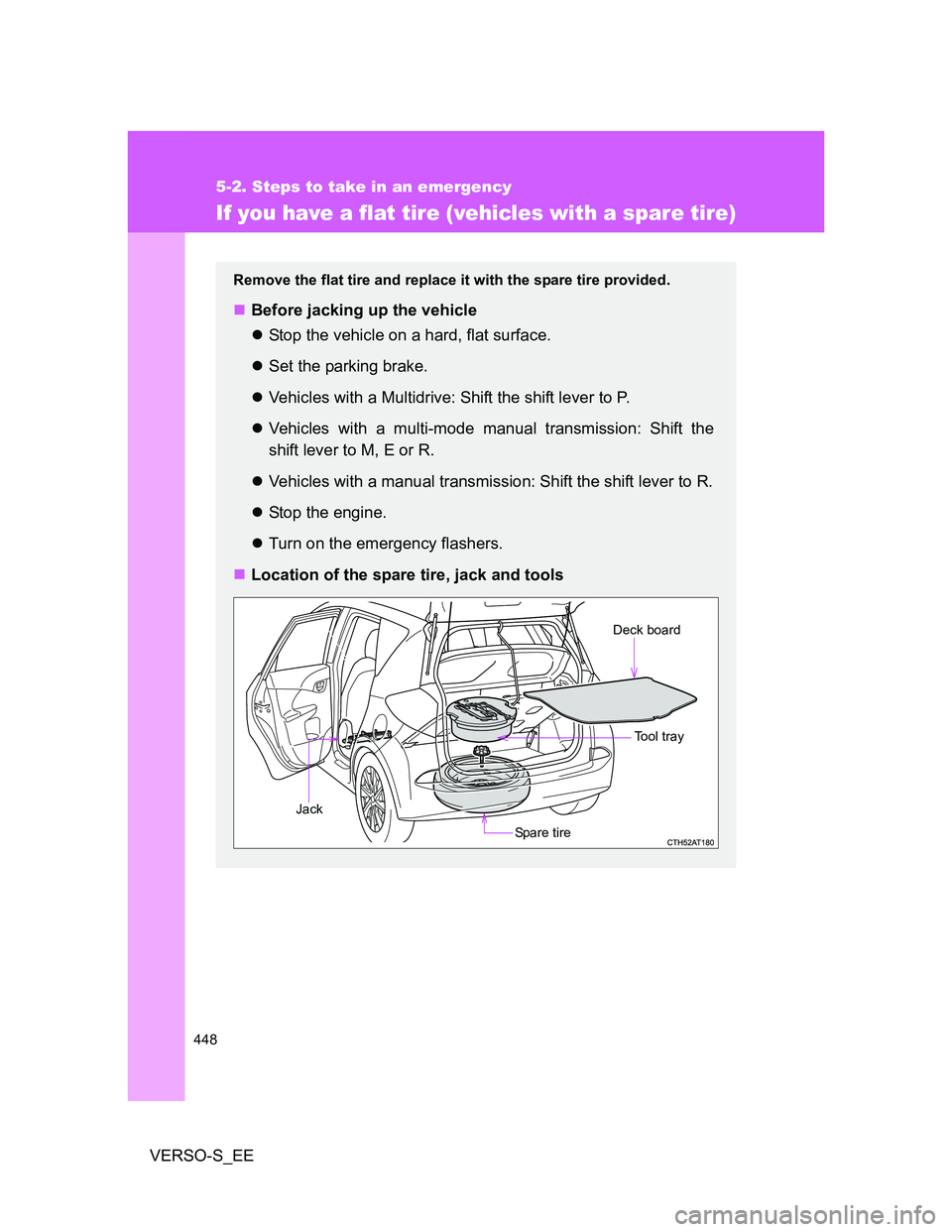
Location of the spare tire, jack and tools
To o l t r a y
Spare tire Jack
Deck board
Page 452 of 552
452 5-2. Steps to take in an emergency
VERSO-S_EE
Replacing a flat tire
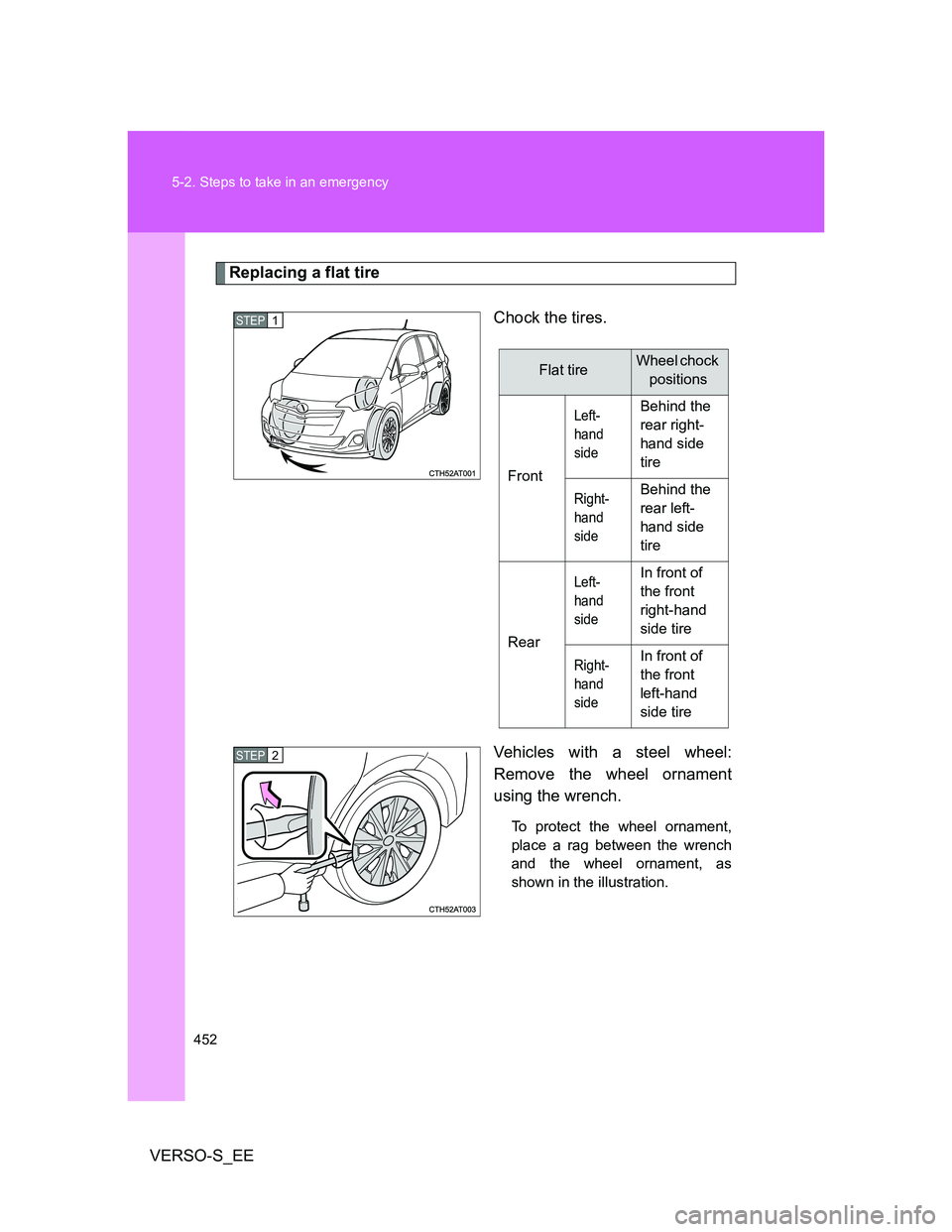
Chock the tires.
Vehicles with a steel wheel:
Remove the wheel ornament
using the wrench.
To protect the wheel ornament,
place a rag between the wrench
and the wheel ornament, as
shown in the illustration.
STEP1STEP1
Flat tireWheel chock
positions
Front
Left-
hand
sideBehind the
rear right-
hand side
tire
Right-
hand
sideBehind the
rear left-
hand side
tire
Rear
Left-
hand
sideIn front of
the front
right-hand
side tire
Right-
hand
sideIn front of
the front
left-hand
side tire
STEP2
Page 455 of 552
5
455 5-2. Steps to take in an emergency
When trouble arises
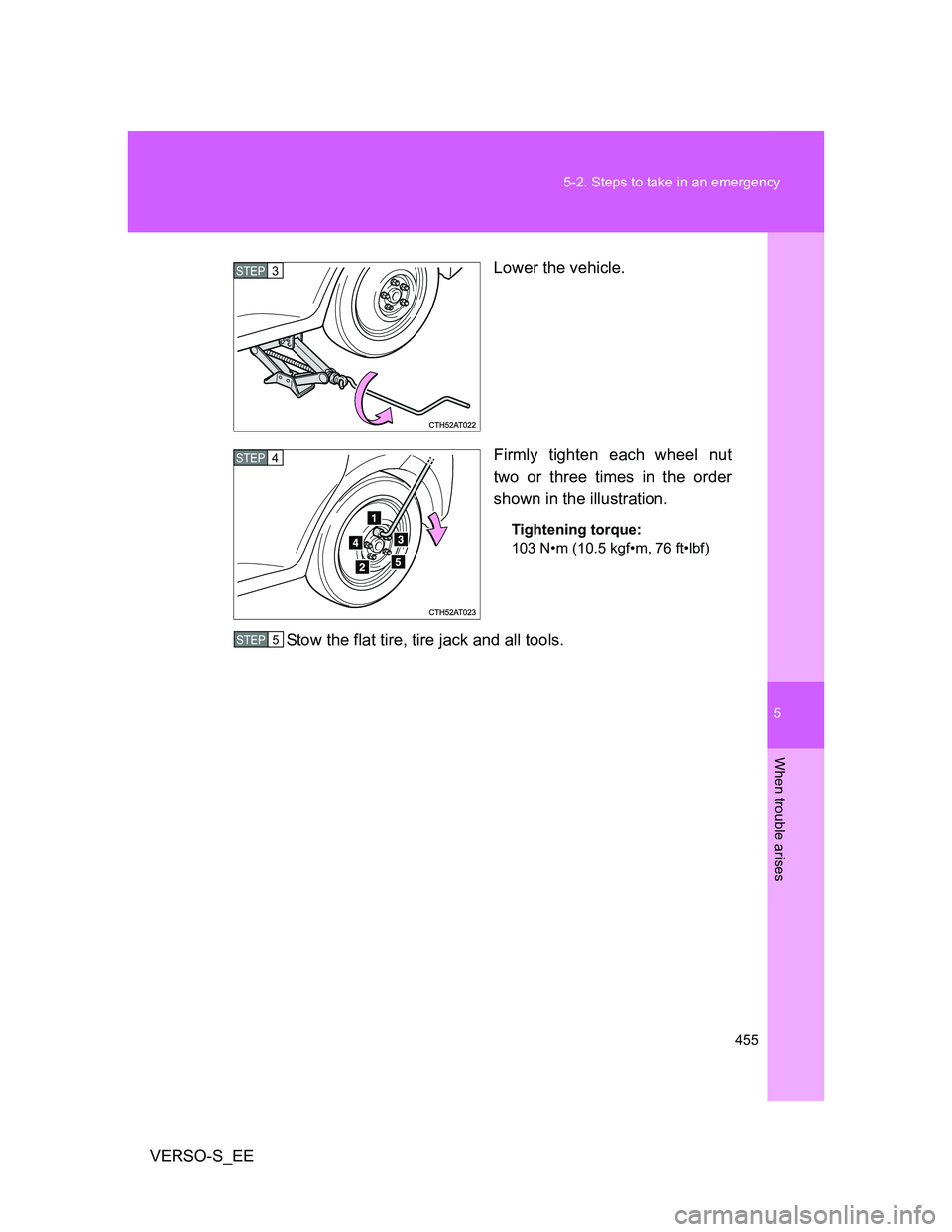
VERSO-S_EELower the vehicle.
Firmly tighten each wheel nut
two or three times in the order
shown in the illustration.
Tightening torque:
103 N•m (10.5 kgf•m, 76 ft•lbf)
Stow the flat tire, tire jack and all tools.
STEP3
STEP4
STEP5
Page 456 of 552
456 5-2. Steps to take in an emergency
VERSO-S_EE
The compact spare tire
The compact spare tire is identified by the label “TEMPORARY USE
ONLY” on the tire sidewall.
Use the compact spare tire temporarily, and only in an emergency.
Make sure to check the tire inflation pressure of the compact spare tire.
(P. 523)
If you have a flat front tire on a road covered with snow or ice
Install the compact spare tire on one of the rear wheels of the vehicle. Per-
form the following steps and fit tire chains to the front tires:
Replace a rear tire with the compact spare tire.
Replace the flat front tire with the tire removed from the rear of the
vehicle.
Fit tire chains to the front tires.
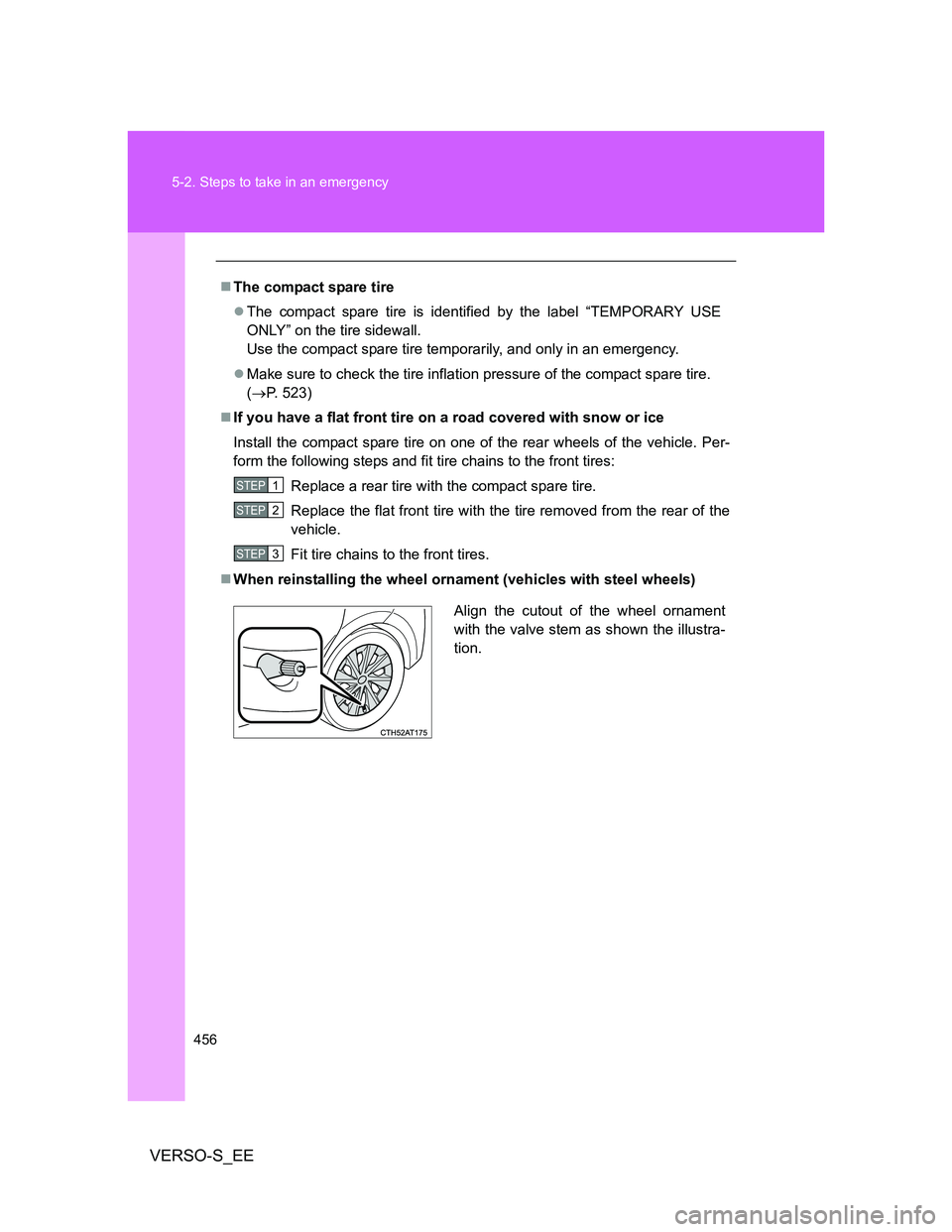
When reinstalling the wheel ornament (vehicles with steel wheels)
STEP1
STEP2
STEP3
Align the cutout of the wheel ornament
with the valve stem as shown the illustra-
tion.